Achievable Rate Region for Iterative Multi-User Detection via Low-cost Gaussian Approximation
Pith reviewed 2026-05-24 15:54 UTC · model grok-4.3
The pith
The achievable rate in IDMA equals the line integral of a conservative K-dimensional MSE vector field between any two points.
A machine-rendered reading of the paper's core claim, the machinery that carries it, and where it could break.
Core claim
We show that the K-dimensional tuples formed by the MSEs of K users constitute a conservative vector field. The achievable rate is a potential function of this conservative field, so it is the integral along any path in the field with value of the integral solely determined by the two path terminals. Optimized codes can be found given the integration paths in the MSE fields by matching EXIT type functions.
What carries the argument
The conservative vector field whose components are the MSE values of the K users.
If this is right
- Low-cost Gaussian-approximation detection can achieve near-capacity performance.
- The sum-rate capacity is reached independently of the chosen integration path through the MSE field.
- The integration path itself supplies an additional degree of freedom for code design.
- EXIT-type functions can be matched to any convenient path to obtain optimized codes.
Where Pith is reading between the lines
- The same conservative-field argument could be tested in other iterative detection schemes that rely on Gaussian approximations.
- Numerical integration routines might be used to automate the search for good paths during code optimization.
- The result suggests that rate-region boundaries for larger user counts remain computable without enumerating every possible iteration trajectory.
Load-bearing premise
The evolution of the MSE vector under Gaussian-approximation multi-user detection has zero curl and is therefore path-independent.
What would settle it
A direct calculation or simulation in which the integrated rate between fixed initial and final MSE points changes when a different integration path is chosen.
Figures


read the original abstract
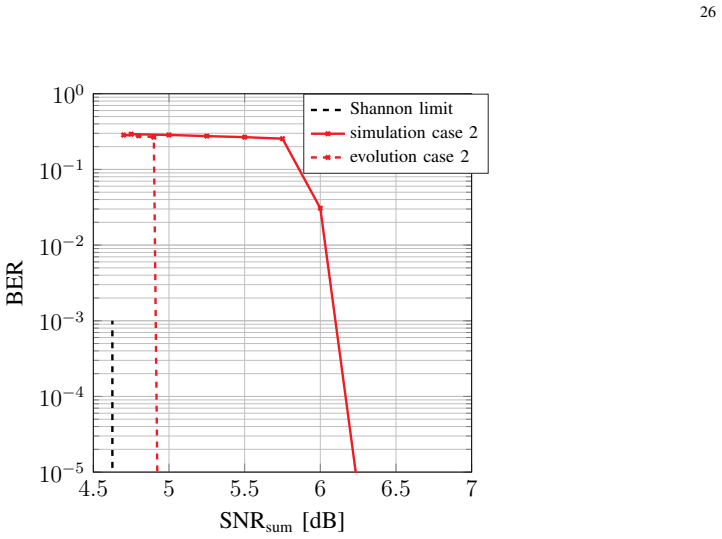
We establish a multiuser extrinsic information transfer (EXIT) chart area theorem for the interleave-division multiple access (IDMA) scheme, a special form of superposition coding, in multiple access channels (MACs). A low-cost multi-user detection (MUD) based on the Gaussian approximation (GA) is assumed. The evolution of mean-square errors (MSE) of the GA-based MUD during iterative processing is studied. We show that the K-dimensional tuples formed by the MSEs of K users constitute a conservative vector field. The achievable rate is a potential function of this conservative field, so it is the integral along any path in the field with value of the integral solely determined by the two path terminals. Optimized codes can be found given the integration paths in the MSE fields by matching EXIT type functions. The above findings imply that i) low-cost GA detection can provide near capacity performance, ii) the sum-rate capacity can be achieved independently of the integration path in the MSE fields; and iii) the integration path can be an extra degree of freedom for code design.
Editorial analysis
A structured set of objections, weighed in public.
Referee Report
Summary. The paper establishes a multiuser EXIT-chart area theorem for IDMA (a superposition-coding MAC) under low-cost Gaussian-approximation multiuser detection. It studies the evolution of the K-dimensional MSE vector during iterative processing and asserts that this vector field is conservative; consequently the achievable rate equals the line integral of the field between any two MSE points and is therefore path-independent. The result is used to argue that GA-MUD can approach capacity, that sum-rate capacity is achievable independently of the integration path, and that the path itself supplies an extra degree of freedom for code optimization via EXIT-function matching.
Significance. If the conservative-field property is established, the work supplies a rigorous information-theoretic justification for the observed near-capacity behavior of low-complexity iterative GA detectors in IDMA and gives a concrete design tool (path selection in MSE space) that is absent from conventional single-user EXIT analysis. The absence of free parameters or post-hoc fitting in the stated derivation would be a notable strength.
major comments (1)
- [Abstract / main theorem] The central claim that the K-dimensional MSE vector under the GA-MUD update rule forms a conservative field (zero curl) is asserted in the abstract and used to conclude path-independence of the rate integral, yet no explicit curl calculation, verification that the mixed partials of the GA interference functions commute, or check of the integrability condition appears. This step is load-bearing for every subsequent statement about area theorems, path-independent sum rates, and code optimization; without it the conclusions do not follow from the MSE evolution equations.
Simulated Author's Rebuttal
We thank the referee for the careful reading and for highlighting the load-bearing role of the conservative-field claim. The comment correctly identifies that an explicit verification is needed to support all subsequent conclusions about path independence and code optimization.
read point-by-point responses
-
Referee: [Abstract / main theorem] The central claim that the K-dimensional MSE vector under the GA-MUD update rule forms a conservative field (zero curl) is asserted in the abstract and used to conclude path-independence of the rate integral, yet no explicit curl calculation, verification that the mixed partials of the GA interference functions commute, or check of the integrability condition appears. This step is load-bearing for every subsequent statement about area theorems, path-independent sum rates, and code optimization; without it the conclusions do not follow from the MSE evolution equations.
Authors: We agree that the manuscript asserts the conservative property of the K-dimensional MSE vector field but does not supply an explicit curl calculation or direct verification that the mixed partial derivatives of the GA interference functions commute. The MSE evolution equations are derived in Section III from the Gaussian approximation update, and the conservative character follows from the symmetry of the resulting Jacobian; however, this symmetry is not demonstrated by an integrability check in the current text. In the revised manuscript we will add an explicit calculation (new subsection in Section III or dedicated appendix) that computes the curl of the MSE vector field and confirms that all mixed partials are equal, thereby establishing the integrability condition and rigorously justifying the path-independent rate integral. revision: yes
Circularity Check
MSE vector field conservativeness derived directly from GA-MUD update equations; rate as potential follows without circular reduction
full rationale
The paper studies the explicit MSE evolution equations under the Gaussian-approximation multiuser detector for IDMA and demonstrates that the resulting K-dimensional vector field has zero curl (mixed partials commute). The achievable rate is then shown to be a scalar potential of that field, making the line integral path-independent by standard vector calculus. This chain is self-contained within the paper's own update functions and does not rely on fitted parameters renamed as predictions, self-citations for the uniqueness of the field property, or any ansatz smuggled from prior work. The central claim therefore reduces to an independent mathematical verification rather than to its own inputs by construction.
Axiom & Free-Parameter Ledger
axioms (2)
- domain assumption The Gaussian approximation for multi-user interference remains accurate throughout the iterative process.
- standard math The MSE update rule defines a continuously differentiable vector field on the K-dimensional error space.
Lean theorems connected to this paper
-
Cost.FunctionalEquationwashburn_uniqueness_aczel matches?
matchesMATCHES: this paper passage directly uses, restates, or depends on the cited Recognition theorem or module.
We show that the K-dimensional tuples formed by the MSEs of K users constitute a conservative vector field. The achievable rate is a potential function of this conservative field, so it is the integral along any path in the field with value of the integral solely determined by the two path terminals.
-
Foundation.BranchSelectioninteractionDefect_RCLCombiner matches?
matchesMATCHES: this paper passage directly uses, restates, or depends on the cited Recognition theorem or module.
g / (g^T v + sigma^2) = nabla_v log(sigma^2 + g^T v) ... R_sum = log(1 + sum P_k |h_k|^2 / sigma^2) which is independent of the path
-
Foundation.ArithmeticFromLogicembed_strictMono_of_one_lt echoes?
echoesECHOES: this paper passage has the same mathematical shape or conceptual pattern as the Recognition theorem, but is not a direct formal dependency.
the integrands constitute a gradient of a scalar field (or potential function)
What do these tags mean?
- matches
- The paper's claim is directly supported by a theorem in the formal canon.
- supports
- The theorem supports part of the paper's argument, but the paper may add assumptions or extra steps.
- extends
- The paper goes beyond the formal theorem; the theorem is a base layer rather than the whole result.
- uses
- The paper appears to rely on the theorem as machinery.
- contradicts
- The paper's claim conflicts with a theorem or certificate in the canon.
- unclear
- Pith found a possible connection, but the passage is too broad, indirect, or ambiguous to say the theorem truly supports the claim.
Reference graph
Works this paper leans on
-
[1]
Achievable rate region for iterative multi-user detection via low-cost Gaussian approximation,
X. Wang, C. Liang, L. Ping, and S. ten Brink, “Achievable rate region for iterative multi-user detection via low-cost Gaussian approximation,” in to appear in Proc. IEEE Int. Symp. Inform. Theory , 2019
work page 2019
-
[2]
T. M. Cover and J. A. Thomas, Elements of Information Theory , 2nd ed. John Wiley & Sons, 2006
work page 2006
-
[3]
A. E. Gamal and Y .-H. Kim, Network Information Theory . Cambridge University Press, 2011
work page 2011
- [4]
-
[5]
Interleave-Division Multiple Access (IDMA),
Y . Hu and L. Ping, “Interleave-Division Multiple Access (IDMA),” in Multiple Access Techniques for 5G Wireless Networks and Beyond, M. Vaezi, Z. Ding, and H. V . Poor, Eds. Springer, 2019, ch. 13, pp. 417–449
work page 2019
-
[6]
T. Richardson and R. Urbanke, Modern Coding Theory , 1st ed. Cambridge University Press, 2008
work page 2008
-
[7]
A novel random wireless packet multiple access method using CDMA,
C. Schlegel, R. Kempter, and P. Kota, “A novel random wireless packet multiple access method using CDMA,” IEEE Trans. Wireless Commun., vol. 5, no. 6, pp. 1362–1370, June 2006
work page 2006
-
[8]
Iterative joint channel estimation and multi-user detection for multiple-antenna aided ofdm systems,
M. Jiang, J. Akhtman, and L. Hanzo, “Iterative joint channel estimation and multi-user detection for multiple-antenna aided ofdm systems,” IEEE Trans. Wireless Commun. , vol. 6, no. 8, pp. 2904–2914, August 2007
work page 2007
-
[9]
Single-antenna co-channel interference cancellation for TDMA cellular radio systems,
P. A. Hoeher, S. Badri-Hoeher, Wen Xu, and C. Krakowski, “Single-antenna co-channel interference cancellation for TDMA cellular radio systems,” IEEE Trans. Wireless Commun. , vol. 12, no. 2, pp. 30–37, April 2005
work page 2005
-
[10]
Iterative turbo channel estimation for OFDM system over rapid dispersive fading channel,
M. Zhao, Z. Shi, and M. C. Reed, “Iterative turbo channel estimation for OFDM system over rapid dispersive fading channel,” IEEE Trans. Wireless Commun. , vol. 7, no. 8, pp. 3174–3184, August 2008
work page 2008
-
[11]
Exploiting the Chain Rule of Mutual Information for the Design of Iterative Deoding Shemes,
S. ten Brink, “Exploiting the Chain Rule of Mutual Information for the Design of Iterative Deoding Shemes,” in Proc. 39th Annual Allerton Conf. on Comm., Control and Computing , 2001
work page 2001
-
[12]
Design of capacity-approaching irregular low-density parity-check codes,
T. J. Richardson, M. A. Shokrollahi, and R. L. Urbanke, “Design of capacity-approaching irregular low-density parity-check codes,” IEEE Trans. Inform. Theory , vol. 47, no. 2, pp. 619–637, Feb 2001
work page 2001
-
[13]
Extrinsic information transfer functions: model and erasure channel properties,
A. Ashikhmin, G. Kramer, and S. ten Brink, “Extrinsic information transfer functions: model and erasure channel properties,” IEEE Trans. Inform. Theory , vol. 50, no. 11, pp. 2657–2673, Nov 2004
work page 2004
-
[14]
An MSE-Based Transfer Chart for Analyzing Iterative Decoding Schemes Using a Gaussian Approximation,
K. Bhattad and K. R. Narayanan, “An MSE-Based Transfer Chart for Analyzing Iterative Decoding Schemes Using a Gaussian Approximation,” IEEE Trans. Inform. Theory , vol. 53, no. 1, pp. 22–38, Jan 2007
work page 2007
-
[15]
Interleave division multiple-access,
L. Ping, L. Liu, K. Wu, and W. K. Leung, “Interleave division multiple-access,” IEEE Trans. Wireless Commun. , vol. 5, no. 4, pp. 938–947, April 2006
work page 2006
-
[16]
Interleave-division multiple access in high rate applications,
Y . Hu, C. Liang, L. Liu, C. Yan, Y . Yuan, and L. Ping, “Interleave-division multiple access in high rate applications,” IEEE Comm. Letters , 2018
work page 2018
-
[17]
EXIT chart analysis of turbo multiuser detection,
K. Li and X. Wang, “EXIT chart analysis of turbo multiuser detection,” IEEE Trans. Wireless Commun., vol. 4, no. 1, pp. 300–311, Jan 2005
work page 2005
-
[18]
Low-complexity coding scheme to approach multiple-access channel capacity,
G. Song and J. Cheng, “Low-complexity coding scheme to approach multiple-access channel capacity,” in Proc. IEEE Int. Symp. on Inform. Theory , June 2015, pp. 2106–2110
work page 2015
-
[19]
Capacity-achieving iterative LMMSE detection for MIMO-NOMA systems,
L. Liu, Y . Chi, C. Yuen, Y . L. Guan, and Y . Li, “Capacity-achieving iterative LMMSE detection for MIMO-NOMA systems,” IEEE Trans. Signal Processing , 2019
work page 2019
-
[20]
Near Gaussian multiple access channel capacity detection and decoding,
X. Wang, S. Cammerer, and S. ten Brink, “Near Gaussian multiple access channel capacity detection and decoding,” in IEEE Int. Symp. on Turbo Codes Iterative Inform. Process. (ISTC) , Dec 2018, pp. 1–5
work page 2018
-
[21]
——, “Near-Capacity Detection and Decoding: Code Design for Dynamic User Loads in Gaussian Multiple Access Channels,” under review in IEEE Trans. Comm. , 2019
work page 2019
-
[22]
Analysis and Optimization of Interleave-Division Multiple-Access Communication Systems,
K. Li, X. Wang, and L. Ping, “Analysis and Optimization of Interleave-Division Multiple-Access Communication Systems,” IEEE Trans. Wireless Commun. , vol. 6, no. 5, pp. 1973–1983, May 2007. 30
work page 1973
-
[23]
IDMA vs. CDMA: Analysis and Comparison of Two Multiple Access Schemes,
K. Kusume, G. Bauch, and W. Utschick, “IDMA vs. CDMA: Analysis and Comparison of Two Multiple Access Schemes,” IEEE Trans. Wireless Commun. , vol. 11, no. 1, pp. 78–87, January 2012
work page 2012
-
[24]
On Construction of Rate-Compatible Raptor-Like QC-LDPC Code for Enhanced IDMA in 5G and Beyond,
J. Song and Y . Shu, “On Construction of Rate-Compatible Raptor-Like QC-LDPC Code for Enhanced IDMA in 5G and Beyond,” in Proc. 10th Internat. Symp. Turbo Codes , 2018
work page 2018
-
[25]
Channel estimation algorithms for OFDM-IDMA: Complexity and performance,
P. Hammarberg, F. Rusek, and O. Edfors, “Channel estimation algorithms for OFDM-IDMA: Complexity and performance,” IEEE Trans. Wireless Commun. , vol. 11, no. 5, pp. 1722–1732, May 2012
work page 2012
-
[26]
Rate optimization for IDMA systems with iterative joint multi-user decoding,
T. Yang, J. Yuan, and Z. Shi, “Rate optimization for IDMA systems with iterative joint multi-user decoding,” IEEE Trans. Wireless Commun., vol. 8, no. 3, pp. 1148–1153, March 2009
work page 2009
-
[27]
Mutual information and minimum mean-square error in Gaussian channels,
D. Guo, S. Shamai, and S. Verdu, “Mutual information and minimum mean-square error in Gaussian channels,” IEEE Trans. Inform. Theory , vol. 51, no. 4, pp. 1261–1282, April 2005
work page 2005
-
[28]
Achievable Rates of MIMO Systems With Linear Precoding and Iterative LMMSE Detection,
X. Yuan, L. Ping, C. Xu, and A. Kavcic, “Achievable Rates of MIMO Systems With Linear Precoding and Iterative LMMSE Detection,” IEEE Trans. Inform. Theory , vol. 60, no. 11, pp. 7073–7089, Nov 2014
work page 2014
-
[29]
Convergence behavior of iteratively decoded parallel concatenated codes,
S. ten Brink, “Convergence behavior of iteratively decoded parallel concatenated codes,” IEEE Trans. Commun. , vol. 49, no. 10, pp. 1727–1737, Oct 2001
work page 2001
-
[30]
Superposition coded modulation and iterative linear MMSE detection,
L. Ping, J. Tong, X. Yuan, and Q. Guo, “Superposition coded modulation and iterative linear MMSE detection,” IEEE J. Sel. Areas Commun. , vol. 27, no. 6, pp. 995–1004, August 2009
work page 2009
-
[31]
Performance of iterative decoding for superposition modulation-based cooperative transmission,
T. Yang and J. Yuan, “Performance of iterative decoding for superposition modulation-based cooperative transmission,” IEEE Trans. Wireless Commun. , vol. 9, no. 1, pp. 51–59, January 2010
work page 2010
-
[32]
Design of low-density parity-check codes for modulation and detection,
S. ten Brink, G. Kramer, and A. Ashikhmin, “Design of low-density parity-check codes for modulation and detection,” IEEE Trans. Commun. , vol. 52, no. 4, pp. 670–678, April 2004
work page 2004
-
[33]
Estimation in Gaussian Noise: Properties of the Minimum Mean-Square Error,
D. Guo, Y . Wu, S. S. Shitz, and S. Verdu, “Estimation in Gaussian Noise: Properties of the Minimum Mean-Square Error,” IEEE Trans. Inform. Theory , vol. 57, no. 4, pp. 2371–2385, April 2011
work page 2011
-
[34]
On the design of low-density parity-check codes within 0.0045 db of the Shannon limit,
Sae-Young Chung, G. D. Forney, T. J. Richardson, and R. Urbanke, “On the design of low-density parity-check codes within 0.0045 db of the Shannon limit,” IEEE Comm. Letters , vol. 5, no. 2, pp. 58–60, Feb 2001
work page 2001
-
[35]
Evolution analysis of low-cost iterative equalization in coded linear systems with cyclic prefixes,
X. Yuan, Q. Guo, X. Wang, and L. Ping, “Evolution analysis of low-cost iterative equalization in coded linear systems with cyclic prefixes,” IEEE J. Sel. Areas Commun. , vol. 26, no. 2, pp. 301–310, February 2008
work page 2008
-
[36]
LDPC Code Design for the Two-User Gaussian Multiple Access Channel,
S. Sharifi, A. K. Tanc, and T. M. Duman, “LDPC Code Design for the Two-User Gaussian Multiple Access Channel,” IEEE Trans. Wireless Commun. , vol. 15, no. 4, pp. 2833–2844, April 2016
work page 2016
-
[37]
Design of LDPC Codes for the Unequal Power Two-User Gaussian Multiple Access Channel,
A. Balatsoukas-Stimming and A. P. Liavas, “Design of LDPC Codes for the Unequal Power Two-User Gaussian Multiple Access Channel,” IEEE Wireless Comm. Letters , pp. 1–1, 2018
work page 2018
-
[38]
Practical MIMO-NOMA: Low Complexity and Capacity- Approaching Solution,
Y . Chi, L. Liu, G. Song, C. Yuen, Y . L. Guan, and Y . Li, “Practical MIMO-NOMA: Low Complexity and Capacity- Approaching Solution,” IEEE Trans. Wireless Commun. , vol. 17, no. 9, pp. 6251–6264, Sep. 2018
work page 2018
-
[39]
Distance enumerator analysis for interleave-division multi-user codes,
G. Song and J. Cheng, “Distance enumerator analysis for interleave-division multi-user codes,” IEEE Trans. Inform. Theory, vol. 62, no. 7, pp. 4039–4053, July 2016
work page 2016
-
[40]
Yuan, Low-complexity iterative detection in coded linear systems , Ph.D
X. Yuan, Low-complexity iterative detection in coded linear systems , Ph.D. dissertation, City University of Hong Kong, Hong Kong, China, 2008
work page 2008
-
[41]
EXIT-chart aided near-capacity irregular bit-interleaved coded modulation design,
R. Y . S. Tee, R. G. Maunder, and L. Hanzo, “EXIT-chart aided near-capacity irregular bit-interleaved coded modulation design,” IEEE Trans. Wireless Commun. , vol. 8, no. 1, pp. 32–37, Jan 2009
work page 2009
-
[42]
Analysis of sum-product decoding of low-density parity-check codes using a Gaussian approximation,
S.-Y . Chung, T. Richardson, and R. Urbanke, “Analysis of sum-product decoding of low-density parity-check codes using a Gaussian approximation,” IEEE Trans. Inform. Theory , vol. 47, no. 2, pp. 657–670, Feb. 2001
work page 2001
-
[43]
J. A. McGowan and R. C. Williamson, “Loop removal from LDPC codes,” in Proc. IEEE Inform. Theory Workshop (ITW’03), Paris, France, 31 Mar. - 4 Apr. 2003, pp. 230–233
work page 2003
discussion (0)
Sign in with ORCID, Apple, or X to comment. Anyone can read and Pith papers without signing in.