REVIEW 3 major objections 4 minor 36 references
An End-to-End Text-independent Speaker Verification Framework with a Keyword Adversarial Network
T0 review · 3 major / 4 minor · reviewed 2026-08-14 · deepseek-v4-flash
Pith's one-line read Keyword-adversarial training makes speaker embeddings ignore the words
desk verdict A clean, well-described combination of triplet loss and a keyword adversary that improves NTK EER on a small closed set, but the text-independence claim outruns the evidence. read the letter →
The pith
A machine-rendered reading of the paper's core claim, the machinery that carries it, and where it could break.
The reading
What carries the argument
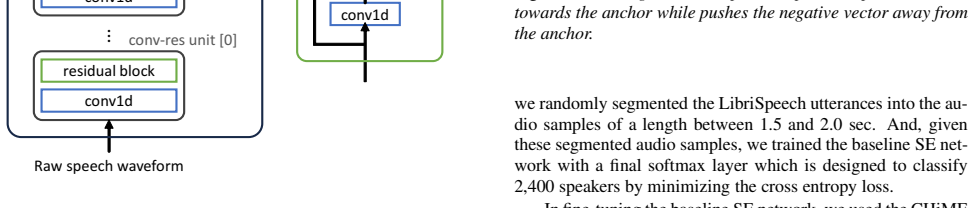
The load-bearing mechanism is the keyword-adversarial training objective $L_{\text{SE}} = L_{\text{triplet}} - \gamma L_{\text{ASR}}$, where $L_{\text{triplet}}$ is the cosine-similarity triplet loss from Eq. (5) and $L_{\text{ASR}}$ is the cross-entropy of a one-layer DNN that classifies the embedding into a small keyword set. The minus sign is the adversarial step: the SE network is trained to maximize the ASR loss, i.e. to produce embeddings the keyword classifier cannot classify, while the triplet term keeps the embeddings speaker-discriminative. The SE network itself maps raw waveform to a 128-dimensional vector through ten conv-res units, five residual blocks, and an attention layer, and verification is done by cosine similarity against the mean enrollment embedding.
What would settle it
Train the N=4 model on four keywords, then evaluate verification on a fifth keyword that was excluded from adversarial training; if the non-target EER rises back to the DeepRes-Base level, the embeddings only learned to ignore the four seen keywords rather than becoming text-independent.
Extended reading notes
Core claim
The paper's central claim is that text-dependency in speaker embeddings is a removable nuisance: a one-layer ASR network trained to classify only N=2, 3, or 4 keywords can supply an adversarial gradient that, when subtracted from the triplet loss ($L_{\text{SE}} = L_{\text{triplet}} - \gamma L_{\text{ASR}}$), drives the embedding to discard word identity while retaining speaker identity. In the reported experiments, DeepRes-TriKwdAdv achieves the lowest equal error rate in every configuration, with the largest gains on non-target keyword trials: at N=2 the NTK EER falls from 9.95% (DeepRes-Base) to 4.76%, and the average EER from 6.34% to 3.36%. The keyword accuracy of the ASR network drops as $\gamma$ grows (e.g. from 98.61% to 50.38% at N=2), which the paper reads as direct evidence that the embeddings have become less phonetically informative.
Load-bearing premise
The method assumes that a one-layer DNN trained on only 2 to 4 isolated keywords supplies a strong enough adversarial signal to strip phonetic content from the 128-dimensional embedding without also stripping speaker information, and that this removal transfers to words the adversary never saw.
Editorial extensions
If this is right
- A voice assistant that enrolls a user on one command phrase could verify that user on other command phrases without re-enrolling, since NTK EER drops by roughly half relative to the triplet-only baseline.
- Text-independence can be induced with a very small vocabulary: the adversarial classifier needs only two to four keywords to produce the effect, not a full ASR system.
- The ASR network's keyword accuracy acts as a built-in diagnostic: lower accuracy under adversarial training indicates less word information in the embedding, and higher $\gamma$ trades a small TK EER increase for a large NTK EER decrease.
- Because the method is a fine-tuning stage over a pretrained speaker classifier, it can be applied on top of existing embedding architectures without changing the enrollment or scoring procedure.
Reading between the lines
- A natural testable extension is to replace the isolated-keyword DNN with a phoneme- or character-level recognizer and evaluate on continuous speech; if the same adversarial mechanism works, text-independence would scale beyond fixed command sets.
- The same 'subtract an attribute classifier' construction could suppress other nuisance factors in speaker embeddings, such as channel, language, or emotion, by swapping the ASR head for the corresponding classifier.
- A cautious interpretation not stated in the paper is that part of the NTK improvement could come from making embeddings less reliant on shallow lexical acoustic cues; measuring performance on unseen keywords would tell whether the effect is true text-independence or memorized suppression of the N seen keywords.
Signed reviews
Editorial analysis
A structured set of objections, weighed in public.
Referee Report
Summary. The paper proposes DeepRes-TriKwdAdv, an end-to-end text-independent speaker verification framework in which a deep residual-convolutional speaker embedding (SE) network is trained jointly with a keyword-classification ASR network. The SE network is trained with a triplet loss and an adversarial gradient from the ASR network (Eq. 7), with the aim of making the embedding vector less informative about phonetic content while preserving speaker identity. Experiments on CHiME 2013 short-keyword data compare the proposed model with GMM-UBM, DeepRes-Base, and DeepRes-GE2E across N=2, 3, and 4 keyword classes, reporting equal error rates (EER) for target-keyword (TK) and non-target-keyword (NTK) trials. The paper reports consistently lower NTK EER for the proposed method, with the largest gains at N=2 (NTK EER dropping from 9.95% for DeepRes-Base to 4.76%).
Significance. If the results hold, the paper offers a simple and practical way to reduce text dependency of speaker embeddings: a lightweight adversarial keyword classifier can be attached to an SE network and trained with a standard cross-entropy objective. The architecture is clearly specified, the losses are standard, and the comparison against a GE2E baseline is appropriate. The use of NTK EER as an operational measure of text dependency is sensible within a fixed vocabulary. Importantly, there is no circularity: the adversarial loss is trained to maximize ASR classification loss, while text independence is measured by a different metric (NTK EER), and the evaluation metric does not directly set the adversarial loss parameters. The strongest limitation is that the evaluation uses only the same small set of keywords on which the adversary was trained, so the external validity of the 'text-independent' claim is not established.
major comments (3)
- [§4.1, §4.2, Eq. (7)] The core text-independence claim is supported only for the closed keyword set used to train the adversary. In §4.1, the ASR network is trained to classify N=2, 3, or 4 keywords selected from the 16 CHiME keywords. In §4.2, the NTK evaluation enrolls each speaker on one keyword and tests on a different keyword, but that different keyword is always one of the same N keywords the adversary was trained on. The adversarial gradient in Eq. (7) therefore optimizes invariance only across these N classes. Table 2 shows the expected internal effect: as gamma increases, Kwd Acc. drops (e.g., from 98.61% to 50.38% at N=2) and in-set NTK EER drops. However, this only demonstrates that the embedding no longer separates the N trained keywords; it does not show that phonetic content outside this closed set is removed. Because all evaluation keywords are present in the adversary's training set, the experiment cannot distinguish true text-independence from keyword-set-specific invariance. The conclusion explicitly defers 'a general speech recognizer' to future work, yet the abstract and title claim 'text-independent.' The central claim is therefore supported only for a closed keyword set, not for the general text-independent setting implied by the framing. Please add a held-out keyword condition (e.g., train the adversary on a subset of keywords and test on disjoint keywords) or temper all claims accordingly.
- [§4.2, Tables 1–2] No uncertainty quantification is provided for any EER value. The evaluation set consists of 10 speakers, and the paper reports point estimates only. Some differences between methods are small; for example, at N=3 the TK EER of DeepRes-TriKwdAdv is 2.16% versus 2.23% for DeepRes-GE2E, and at N=4 the TK EER of DeepRes-TriKwdAdv (2.19%) is actually worse than DeepRes-GE2E (1.90%). Without confidence intervals, bootstrap estimates, or significance tests, the claim of 'considerable improvements' over baselines is not fully established, particularly because the margins in several conditions are within the range that could arise from evaluation noise on a 10-speaker set.
- [§4.1, Table 2] The manuscript reports that 'the best performance was obtained when γ = 0.4' for all N, but it does not state whether this value was selected on a held-out development set or on the same evaluation set used to produce the final EER numbers in Tables 1 and 2. If the evaluation table was used to choose γ, the reported EERs are potentially optimistically biased. Please specify the validation protocol for the adversarial factor γ, including whether the 24-speaker training-validation split was used for model selection, and provide the corresponding development-set results.
minor comments (4)
- [Table 1] The header of Table 1 reads 'GMM-BUM'; this should be 'GMM-UBM'.
- [§4.1] The sentence 'we chose only one keyword data for a speaker, and the other keywords' data were used for the validation' is ambiguous. Please clarify how the training and validation sets are constructed per speaker and per keyword, and whether each speaker contributes exactly one keyword to the ASR training set.
- [Eq. (5)] The text says only violating triplets are selected, but Eq. (5) includes a min operation that evaluates all triplets with saturation. Please state explicitly whether hard triplet mining is used and how the min formulation relates to the selected-triplet description.
- [Figure 3] The caption and text describe '10 conv-res units, 5 residual blocks, and one attention layer,' but the relationship between conv-res units and residual blocks in the diagram is not immediately clear. Please make the architecture diagram unambiguous, for example by labeling the blocks and indicating the order of operations.
Circularity Check
No significant circularity: the adversarial objective and NTK evaluation share the same keyword set, but NTK is not used to fit any parameter and the derivation is otherwise self-contained.
full rationale
The proposed training objective is L_SE = L_triplet - gamma * L_ASR (Eq. 7), where L_ASR is the cross-entropy of an N-keyword classifier. The text-independence evaluation in Section 4.2 enrolls each speaker on one keyword and tests on 'different keywords' (NTK), and those different keywords are drawn from the same N-keyword set used to train the ASR adversary. This overlap makes the evaluation closed-set and limits how far the 'text-independent' claim can be generalized; the conclusion itself states that scaling to a general speech recognizer is future work. However, this is a scope limitation, not circularity. The NTK error rate is not used to define the loss, to select gamma, or to fit any parameter; gamma is swept as a hyperparameter and reported for all values. The drop in Kwd Acc when gamma increases is an independent behavioral check that the adversarial gradient actually changes the representation. There are no load-bearing self-citations: the baselines (GMM-UBM, GE2E) and network components are cited from external work, and no uniqueness theorem is imported from the authors' prior publications. The central derivation is therefore self-contained; the closed-set evaluation is a correctness/scope concern rather than a reduction of the result to its inputs.
Assumptions & free parameters
free parameters (2)
- gamma (adversarial factor) =
0.4 (best of 0.0, 0.2, 0.4)
- triplet margin delta =
not reported
assumptions (3)
- domain assumption The ASR network trained on the speaker embedding provides a gradient that removes phonetic content while preserving speaker identity.
- domain assumption The CHiME keyword set (16 keywords, N=2 to 4) is a representative proxy for text-independent speaker verification.
- standard math Standard neural network training with SGD and backpropagation works as expected.
Cite this review
Pith. "Pith review of An End-to-End Text-independent Speaker Verification Framework with a Keyword Adversarial Network." pith.science (2026). https://pith.science/paper/CFPBMMHJ
@misc{pith2026190802612,
  author       = {Pith},
  title        = {Pith review of: An End-to-End Text-independent Speaker Verification Framework with a Keyword Adversarial Network},
  year         = {2026},
  howpublished = {\url{https://pith.science/paper/CFPBMMHJ}},
  note         = {Machine review of arXiv:1908.02612}
}
read the original abstract
This paper presents an end-to-end text-independent speaker verification framework by jointly considering the speaker embedding (SE) network and automatic speech recognition (ASR) network. The SE network learns to output an embedding vector which distinguishes the speaker characteristics of the input utterance, while the ASR network learns to recognize the phonetic context of the input. In training our speaker verification framework, we consider both the triplet loss minimization and adversarial gradient of the ASR network to obtain more discriminative and text-independent speaker embedding vectors. With the triplet loss, the distances between the embedding vectors of the same speaker are minimized while those of different speakers are maximized. Also, with the adversarial gradient of the ASR network, the text-dependency of the speaker embedding vector can be reduced. In the experiments, we evaluated our speaker verification framework using the LibriSpeech and CHiME 2013 dataset, and the evaluation results show that our speaker verification framework shows lower equal error rate and better text-independency compared to the other approaches.
Figures


Figures from the paper (1 more)

Reference graph
Works this paper leans on
-
[1]
Introduction With the increasing number of researches, developments, an d improvements on automatic speech recognition (ASR) [1–4], speaker verification (SV) [5–10], and spoken dialog system [11, 12], the voice interface has been widely adopted in vari ous artificial intelligent (AI) applications such as mobile pho nes, smart home IoT devices, and automotiv...
work page 2013
-
[2]
Speaker V erification Speaker verification is a decision process of accepting or re ject- ing an input utterance x based on the speaker characteristics, and it can be accomplished by comparing x with the reference speaker model Xref as: f (Xref , x) accept ≷ reject τ (1) where f (·, ·) measures the similarity score between Xref and x. If the score is greate...
-
[3]
Proposed SV Framework As illustrated in Fig 1, the proposed SV framework consists o f two components: the SE network and the ASR network. The SE network takes the raw speech waveform as the input and outputs an embedding vector, and the ASR network takes the embedding vector as the input and outputs the recognized pho - netic context. In training the SE n...
-
[4]
Experiments 4.1. Dataset and Training The proposed SV framework is trained by two stages: train- ing the baseline SE network and fine-tuning the SE network using the triplet loss combined with the ASR-adversarial lo ss. In training the baseline SE network, we used the LibriSpeech dataset [23] which contains 1,000 hours of 2,400 speakers’ recordings based o...
work page 2013
-
[5]
Conclusion and Future Work In this paper, we presented an end-to-end text-independent speaker verification framework by considering the SE networ k and ASR network jointly. The SE network takes the raw wave- form and outputs the embedding vector which distinguishes t he speaker characteristics of the input utterance. In this res earch, we used a number of ...
-
[6]
Direct acoustics-to-word models for english conve rsa- tional speech recognition,
K. Audhkhasi, B. Ramabhadran, G. Saon, M. Picheny, and D. Na- hamoo, “Direct acoustics-to-word models for english conve rsa- tional speech recognition,” CoRR, vol. abs/1703.07754, 2017
arXiv 2017
-
[7]
Acoustic modeling for Google home,
B. Li, T. Sainath, A. Narayanan, J. Caroselli, M. Bacchia ni, A. Misra, I. Shafran, H. Sak, G. Pundak, K. Chin et al., “Acoustic modeling for Google home,” Proceedings of the INTERSPEECH, pp. 399–403, 2017
work page 2017
-
[8]
A comparison of sequence-to-sequence models fo r speech recognition,
R. Prabhavalkar, K. Rao, T. N. Sainath, B. Li, L. Johnson, and N. Jaitly, “A comparison of sequence-to-sequence models fo r speech recognition,” in Proceedings of the INTERSPEECH, 2017, pp. 939–943
work page 2017
Show all 36 references
-
[9]
Domain and speaker adaptation for cortana speech recognition,
Y . Zhao, J. Li, S. Zhang, L. Chen, and Y . Gong, “Domain and speaker adaptation for cortana speech recognition,” in Proceed- ings of the IEEE International Conference on Acoustics, Spe ech and Signal Processing (ICASSP) . IEEE, 2018, pp. 5984–5988
2018
-
[10]
End-to -end text-dependent speaker verification,
G. Heigold, I. Moreno, S. Bengio, and N. Shazeer, “End-to -end text-dependent speaker verification,” in Proceedings of the IEEE International Conference on Acoustics, Speech and Signal P ro- cessing (ICASSP). IEEE, 2016, pp. 5115–5119
2016
-
[11]
N oise invariant frame selection: a simple method to address the ba ck- ground noise problem for text-independent speaker verifica tion,
S. Song, S. Zhang, B. Schuller, L. Shen, and M. V alstar, “N oise invariant frame selection: a simple method to address the ba ck- ground noise problem for text-independent speaker verifica tion,” CoRR, vol. abs/1805.01259, 2018
2018 arXiv
-
[12]
Deep neural network embeddings for text-independent spea ker verification,
D. Snyder, D. Garcia-Romero, D. Povey, and S. Khudanpur, “Deep neural network embeddings for text-independent spea ker verification,” in Proceedings of the INTERSPEECH , 2017, pp. 999–1003
2017
-
[13]
Generalized e nd- to-end loss for speaker verification,
L. Wan, Q. Wang, A. Papir, and I. L. Moreno, “Generalized e nd- to-end loss for speaker verification,” in Proceedings of the IEEE International Conference on Acoustics, Speech and Signal P ro- cessing (ICASSP). IEEE, 2018, pp. 4879–4883
2018
-
[14]
End-to-end text-independent speaker verification with flexibility in utterance duration,
C. Zhang and K. Koishida, “End-to-end text-independent speaker verification with flexibility in utterance duration,” in Proceedings of IEEE Automatic Speech Recognition and Understanding W ork- shop (ASRU), 2017, pp. 584–590
2017
-
[15]
DNN i-vector spea ker verification with short, text-constrained test utterances ,
J. Zhong, W. Hu, F. Soong, and H. Meng, “DNN i-vector spea ker verification with short, text-constrained test utterances ,” Proceed- ings of the INTERSPEECH , pp. 1507–1511, 2017
2017
-
[16]
Iterative policy learning in end-to -end trainable task-oriented neural dialog models,
B. Liu and I. Lane, “Iterative policy learning in end-to -end trainable task-oriented neural dialog models,” in Proceedings of IEEE Automatic Speech Recognition and Understanding W ork- shop (ASRU). IEEE, 2017, pp. 482–489
2017
-
[17]
Inte- gration of a Kaldi speech recognizer into a speech dialog sys tem for automotive infotainment applications,
T. Ranzenberger, C. Hacker, F. Gallwitz, and N. Germany , “Inte- gration of a Kaldi speech recognizer into a speech dialog sys tem for automotive infotainment applications,” in Conference on Elec- tronic Speech Signal Processing (ESSV), Ulm , 2018
2018
-
[18]
Alexa vs. Sir i vs. Cortana vs. Google assistant: a comparison of speech-based nat- ural user interfaces,
G. L ´ opez, L. Quesada, and L. A. Guerrero, “Alexa vs. Sir i vs. Cortana vs. Google assistant: a comparison of speech-based nat- ural user interfaces,” in Proceedings of International Conference on Applied Human Factors and Ergonomics. Springer, 2017, pp. 241–250
2017
-
[19]
Alexa is my new BFF: social roles, user satisfactio n, and personification of the amazon echo,
A. Purington, J. G. Taft, S. Sannon, N. N. Bazarova, and S . H. Taylor, “Alexa is my new BFF: social roles, user satisfactio n, and personification of the amazon echo,” in Proceedings of the 2017 CHI Conference Extended Abstracts on Human Factors in Com- puting Systems. ACM, 20...
2017
-
[20]
X-vectors: Robust DNN embeddings for speaker recogni - tion,
D. Snyder, D. Garcia-Romero, G. Sell, D. Povey, and S. Kh udan- pur, “X-vectors: Robust DNN embeddings for speaker recogni - tion,” in Proceedings of the IEEE International Conference on Acoustics, Speech and Signal Processing (ICASSP) , 2018, pp. 5329–5333
2018
-
[21]
Deep speaker embeddings with c on- volutional neural network on supervector for text-indepen dent speaker recognition,
D. Cai, Z. Cai, and M. Li, “Deep speaker embeddings with c on- volutional neural network on supervector for text-indepen dent speaker recognition,” in Proceedings of Asia-Pacific Signal and Information Processing Association Annual Summit and Conf er- ence, 2018, pp. 1478–1482
2018
-
[22]
Deep residual learni ng for image recognition,
K. He, X. Zhang, S. Ren, and J. Sun, “Deep residual learni ng for image recognition,” in Proceedings of IEEE Conference on Com- puter Vision and Pattern Recognition (CVPR), 2016, pp. 770–778
2016
-
[23]
Identity mappings in deep residual networks,
——, “Identity mappings in deep residual networks,” in Proceed- ings of European Conference on Computer Vision, 2016, pp. 630– 645
2016
-
[24]
Domain- adversarial training of neural networks,
Y . Ganin, E. Ustinova, H. Ajakan, P . Germain, H. Laroche lle, F. Laviolette, M. Marchand, and V . Lempitsky, “Domain- adversarial training of neural networks,” Journal of Machine Learning Research , vol. 17, no. 59, pp. 1–35, 2016. [Online]. Available: http://jmlr.org/papers...
2016
-
[25]
Generative a dver- sarial nets,
I. Goodfellow, J. Pouget-Abadie, M. Mirza, B. Xu, D. War de- Farley, S. Ozair, A. Courville, and Y . Bengio, “Generative a dver- sarial nets,” in Advances in Neural Information Processing Sys- tems, 2014, pp. 2672–2680
2014
-
[26]
SEGAN: Speech enhancement generative adversarial network,
S. Pascual, A. Bonafonte, and J. Serra, “SEGAN: Speech enhancement generative adversarial network,” CoRR, vol. abs/1703.09452, 2017
2017 arXiv
-
[27]
Unsupervised rep resenta- tion learning with deep convolutional generative adversar ial net- works,
A. Radford, L. Metz, and S. Chintala, “Unsupervised rep resenta- tion learning with deep convolutional generative adversar ial net- works,” CoRR, vol. abs/1511.06434, 2015
2015 arXiv
-
[28]
Lib- rispeech: an ASR corpus based on public domain audio books,
V . Panayotov, G. Chen, D. Povey, and S. Khudanpur, “Lib- rispeech: an ASR corpus based on public domain audio books,” in Proceedings of the IEEE International Conference on Acoust ics, Speech and Signal Processing (ICASSP) , 2015, pp. 5206–5210
2015
-
[29]
The second CHiME speech separation and recog - nition challenge: Datasets, tasks and baselines,
E. Vincent, J. Barker, S. Watanabe, J. Le Roux, F. Nesta, and M. Matassoni, “The second CHiME speech separation and recog - nition challenge: Datasets, tasks and baselines,” in Proceedings of the IEEE International Conference on Acoustics, Speech a nd Signal Processing (ICASSP...
2013
-
[30]
Speaker diarization: A review of rece nt research,
X. Anguera, S. Bozonnet, N. Evans, C. Fredouille, G. Fri ed- land, and O. Vinyals, “Speaker diarization: A review of rece nt research,” IEEE Transactions on Audio, Speech, and Language Processing, vol. 20, no. 2, pp. 356–370, 2012
2012
-
[31]
Unsuperv ised methods for speaker diarization: An integrated and iterati ve ap- proach,
S. H. Shum, N. Dehak, R. Dehak, and J. R. Glass, “Unsuperv ised methods for speaker diarization: An integrated and iterati ve ap- proach,” IEEE Transactions on Audio, Speech and Language Pro- cessing, vol. 21, pp. 2015–2028, 2013
2015
-
[32]
Front-end factor analysis for speaker verification,
N. Dehak, P . J. Kenny, R. Dehak, P . Dumouchel, and P . Ouel let, “Front-end factor analysis for speaker verification,” IEEE Trans- actions on Audio, Speech and Language Processing, vol. 19, no. 4, pp. 788–798, 2011
2011
-
[33]
Speaker diarization wit h PLDA i-vector scoring and unsupervised calibration,
G. Sell and D. Garcia-Romero, “Speaker diarization wit h PLDA i-vector scoring and unsupervised calibration,” in Proceedings of IEEE Spoken Language Technology W orkshop (SLT) , 2014, pp. 413–417
2014
-
[34]
Improving i-vect or and PLDA based speaker clustering with long-term features,
A. Woubie, J. Luque, and J. Hernando, “Improving i-vect or and PLDA based speaker clustering with long-term features,” in Pro- ceedings of the INTERSPEECH , 2016, pp. 372–376
2016
-
[35]
Batch normalization: Acceler ating deep network training by reducing internal covariate shift,
S. Ioffe and C. Szegedy, “Batch normalization: Acceler ating deep network training by reducing internal covariate shift,” in Proceed- ings of the International Conference on Machine Learning , 2015, pp. 448–456
2015
-
[36]
http://www.gutenberg.org
Reviewed August 14, 2026 · model on record in the stance chip above.
Discussion (0). Continue with ORCID to comment.