REVIEW 3 major objections 5 minor 56 references
Near-unity light absorption in a monolayer WS2 van der Waals heterostructure cavity
T0 review · 3 major / 5 minor · reviewed 2026-08-14 · deepseek-v4-flash
Pith's one-line read A single atomic layer of WS2 inside a van der Waals cavity absorbs about 92% of resonant light.
desk verdict Strong experimental advance in TMD absorption, but the differential-reflectance normalization and the over-claimed 'universal law' need scrutiny before the record numbers are taken at face value. read the letter →
The pith
A machine-rendered reading of the paper's core claim, the machinery that carries it, and where it could break.
The reading
What carries the argument
The central mechanism is the van der Waals heterostructure cavity: a monolayer WS2 encapsulated in hexagonal boron nitride on a gold back reflector, with hBN thicknesses chosen so that the monolayer sits at an antinode of the cavity field. The theoretical machinery is a quantum transfer matrix method combined with the semiconductor Bloch equations, in which the electromagnetic fields are operators, so pure dephasing enters through quantum coherence. This yields the maximum-absorption formula $A_{\max}=\xi_1 (\gamma_{r,0}/\gamma_T)[1-\xi_2(1+2\gamma_d/\gamma_T)\gamma_{r,0}/\gamma_T]$ with $\gamma_T=\gamma_{nr}+2\gamma_d+\zeta\gamma_{r,0}$, where $\zeta$ is the Purcell factor. The key identity is Eq. (3), which converts this into a linear relation between $A_{\max}\gamma_T/\xi_1$ and $1/\gamma_T$ when $\gamma_d\ll\gamma_T$; the slope and intercept of that line encode the vacuum radiative rate of the exciton, and the Purcell factor shifts the matching condition to larger, experimentally accessible linewidths.
What would settle it
Measure the actual absorbed power at the same temperatures with a photothermal or photocurrent technique; if the absorbed fraction at the neutral exciton is substantially below the reported 85–92%, the reflection-based extraction has a systematic error. Alternatively, plot $A_{\max}\gamma_T/\xi_1$ against $1/\gamma_T$ for a fresh device; a clear deviation from the straight line predicted by Eq. (3) would disprove the universal law.
Extended reading notes
Core claim
The paper's central claim is that the subtle balance of radiative, non-radiative, and pure-dephasing decay rates determines whether a monolayer in a cavity absorbs almost all resonant light. At the neutral exciton, the measured absorption reaches about 85% at 4 K and about 92% at 110 K, while the singlet/triplet trions reach about 41% and the doubly charged trion about 28%. The absorption is extracted as $A=1-R/R_0$ from reflection measurements. The theoretical analysis identifies a matching condition, $\gamma_{nr}\approx \zeta\gamma_{r,0}$ in the low-dephasing limit, at which absorption can approach 100%, with pure dephasing $\gamma_d$ setting the achievable ceiling. The paper also states a universal law, $A_{\max}\gamma_T/\xi_1 = \gamma_{r,0}[1-\xi_2(1+2\gamma_d/\gamma_T)\gamma_{r,0}/\gamma_T]$, which the data from several samples follow as a straight line in $1/\gamma_T$.
Load-bearing premise
The central claim rests on measuring absorption as the difference between two reflections, assuming the gold mirror, the hBN layers, and every interface are identical and loss-free in both measurements, so that any change in reflected light is due entirely to the WS2 monolayer.
Editorial extensions
If this is right
- A single TMD monolayer can be made a near-perfect resonant absorber, with room-temperature absorption already about 55% and cryogenic values near 90%.
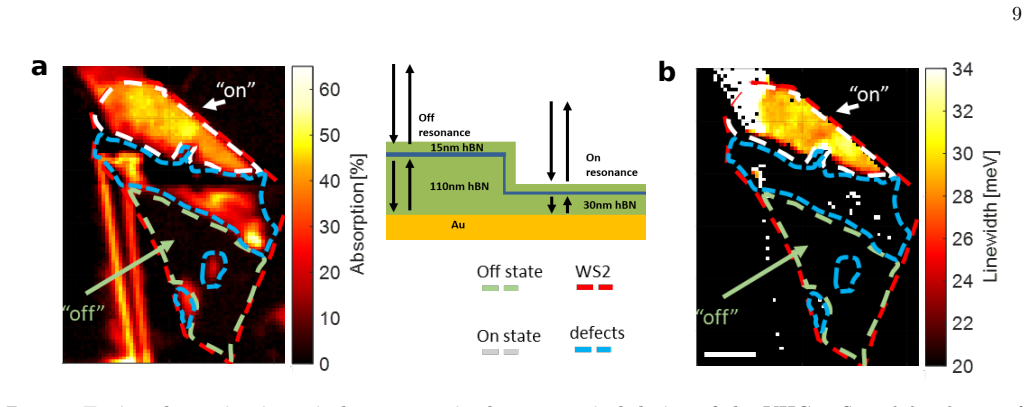
- Absorption is tunable by gate voltage and by cavity geometry: the same device can be switched between 'on' (strong interaction) and 'off' (almost no interaction) states.
- The universal law provides a simple experimental route to extract the vacuum radiative decay rate of any 2D excitonic system from reflection measurements alone.
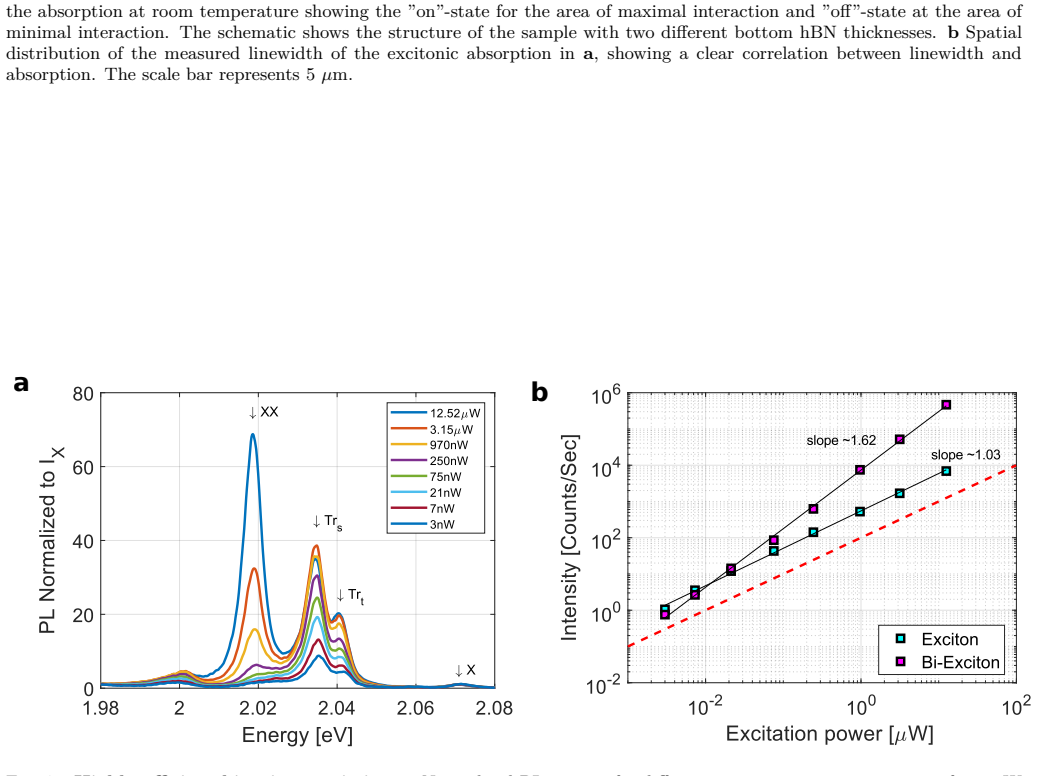
- High absorbed exciton densities at low continuous-wave power make biexciton emission observable at only a few nanowatts, three orders of magnitude lower than previous reports.
- Electrically controlled near-unity absorption opens a path to efficient monolayer photodetectors, modulators, and optically pumped emitters.
Reading between the lines
- The universal law should be testable across material families: if it is truly universal, MoSe2, MoS2, WSe2, and other 2D excitonic semiconductors should each show the same linear collapse, with their own intercepts.
- Because the absolute percentages rest on $A=1-R/R_0$, an independent absorption measurement that does not rely on an identical loss-free reference would strengthen or correct the record values.
- The theory predicts 100% absorption only in the limit of zero pure dephasing; pushing to cleaner, more homogeneous samples at the matching temperature could raise the peak above 92%.
- The on/off cavity could be developed into a spatial light modulator or an electrically switchable absorber pixel, since the interaction strength is controlled locally by the hBN spacer thickness.
Signed reviews
Editorial analysis
A structured set of objections, weighed in public.
Referee Report
Summary. The paper reports a van der Waals heterostructure cavity consisting of monolayer WS2 encapsulated in hBN on a gold back reflector, and claims near-unity excitonic absorption: ~92% at 110 K, ~85% at 4 K, ~41% trion absorption, and ~28% for the X-- state, together with biexciton photoluminescence at excitation powers down to a few nW. A theoretical framework based on semiconductor Bloch equations and a quantum transfer matrix method yields Eq. (1) for the maximum absorption, from which the authors derive a 'universal absorption law' (Eq. (3)). The experimental temperature and gate dependence are presented as evidence, and the paper demonstrates spatial on/off control of the light-matter interaction by varying bottom hBN thickness.
Significance. If the absolute absorption values are correct, this is a substantial advance in 2D-exciton light-matter interaction, with clear implications for excitonic optoelectronic devices and for studying nonlinear exciton physics at low power. The paper's strengths are the direct reflection-based measurement, the temperature and gate dependence, and the comparison of two samples. However, the central quantitative claims depend on the definition of absorption and on the theoretical derivation in the SI, both of which need scrutiny. The claimed 'universal absorption law' is, as shown below, a rearrangement of the authors' own peak-absorption formula rather than an independently established relation.
major comments (3)
- [Main text, 'The VHC is composed of...' (page 2) and Fig. 1] The absorption is defined operationally as A = 1 - R/R0, with R and R0 the reflected intensities from the structure with and without the WS2 monolayer. This quantity is not the absolute absorptance of the monolayer. Energy conservation gives R0 = 1 - A_bg and R = 1 - A_bg - A_TMD only if the gold mirror and hBN layers are loss-free; with finite background absorption A_bg, the reported quantity equals A_TMD/R0, so every quoted value (92%, 85%, 41%, 28%) is inflated by a factor 1/R0 > 1. Since the gold/hBN stack has R0 < 1 in the visible, the record absorption claims are likely overestimated by an amount that is not quantified anywhere in the manuscript. No R0 spectrum, no absolute reflectivity calibration, and no error bars are provided. This normalization directly affects the headline numbers, the temperature-dependence curve in Fig. 1d, and the fit to Eq. (3) in Fig. 2c, and therefore must be corrected or justified.
- [Eq. (3) and Fig. 2c] Eq. (3) is obtained by multiplying Eq. (1) by gamma_T/xi_1; it is an algebraic rearrangement of the authors' own model, not an independent 'universal absorption law'. The agreement shown in Fig. 2c is further weakened by the fact that gamma_r,0 and gamma_d in Eq. (3) are extracted from the same absorption measurements used to build the plot (Fig. 2d and text below Eq. (3)). The linear dependence on 1/gamma_T is therefore partly a consistency check of the model. To substantiate the universality claim, the authors should state which predictions of Eq. (3) are independent of the fitted parameters, and ideally test them on at least one sample or spectral feature not used in the parameter extraction.
- [Main text, 'In order to understand...' (page 2) and Eq. (1)] The central theoretical result, Eq. (1), is derived exclusively in the Supplementary Information, which is not included in the manuscript under review. The coefficients xi_1, xi_2, and zeta are left as unspecified 'geometry-dependent parameters', and the conditions under which Eq. (1) is a valid approximation are not stated. Since the paper's claim of 'full agreement' with the quantum theory rests on this equation, the main text should either present the derivation compactly or provide the explicit functional forms of xi_1, xi_2, and zeta so that the result can be checked.
minor comments (5)
- [Throughout] No error bars or statistical uncertainties are reported for any reflection or absorption measurement, despite the quantitative nature of the claims; at minimum a representative uncertainty for the extraction A = 1 - R/R0 should be given.
- [Introduction, 'Here, we demonstrate ultra-atrong...'] Typo: 'ultra-atrong' should be 'ultra-strong'.
- [Abstract] Grammar: 'the achieved strength have been far below unity' should be 'the achieved strengths have been'.
- [Fig. 3] The 'on' and 'off' regions are described as two different cavities, but the text says they are fabricated on the same device; this wording is confusing and should be clarified, e.g., 'two cavity regions on the same device'.
- [Main text, 'The above discussed decay rates...'] The sentence 'the model makes a striking prediction and inescapable universal feature' is overclaimed; the subsequent derivation shows Eq. (3) is a rearrangement of Eq. (1), so the language should be tempered.
Circularity Check
The universal absorption law (Eq. 3) is a rearrangement of the paper's own model (Eq. 1) and is 'confirmed' by the same data used to extract its parameters.
-
self definitional
[Main text (p.3), around Eqs. (1)-(3) and Fig. 2c; abstract also claims 'unveil a universal absorption law'.]
"Yet, via a simple representation of Eq. 1 as function of γ−1 T , the model makes a striking prediction and inescapable universal feature of this class of devices: ... Indeed, the universal law is confirmed by the experimental data from different samples and locations presented in Fig. 2c."
Equation (3) is obtained from Eq. (1) by multiplying both sides by γT/ξ1; the paper itself says it is a 'simple representation of Eq. 1'. Therefore the 'universal absorption law' is an algebraic identity with the authors' own approximate model, not an independently derived law. The claimed confirmation in Fig. 2c uses the same measured absorption and linewidth data from which the model's parameters (γr,0, γnr, γd) are extracted, making the straight-line fit a self-consistency check of the fitted model rather than an out-of-sample prediction. The core experimental observation of near-unity absorption is independent of this step, but the universal-law claim reduces by construction to the model that produced it.
full rationale
The central experimental result—near-unity excitonic absorption of 85% to 92%—is a measured reflectance contrast and does not derive from the theoretical model, so that part is not circular. The self-citations (e.g., Ref. 52 for the equation-of-motion approach and Ref. 53 for the 50% thin-layer limit) are not load-bearing: they cite general published formalisms or external results whose assumptions do not include the cavity-specific claim. A separate measurement caveat, which I do not count as circularity, is that the quoted 'absorption' is computed as 1 − R/R0, so the absolute monolayer absorptance is R0(1 − R/R0); because R0 is not reported, the headline values could be overestimated if R0 < 1. That is a calibration concern, not a circular derivation. The one genuine circular step is the presentation of Eq. 3 as a 'striking prediction' and its 'confirmation' using the same data from which the model parameters are extracted; Eq. 3 is just Eq. 1 rewritten. Score 6 reflects one prediction reducing by construction while the main experimental finding retains independent content. A score of 8 would require the central result itself to be forced by definition, which is not the case here.
Assumptions & free parameters
free parameters (3)
- gamma_r,0 (radiative decay rate) per sample =
Not explicitly quoted (extracted from y-intercept in Fig. 2c)
- gamma_nr(T) and gamma_d(T) =
Temperature-dependent functions, extracted from model plus data
- Phenomenological fit coefficients for gamma_nr(T) and gamma_d(T) =
Not specified in main text
assumptions (5)
- standard math The exciton polarization follows standard semiconductor Bloch equations
- domain assumption The exciton optical response is fully characterized by radiative (gamma_r), nonradiative (gamma_nr), and pure dephasing (gamma_d) rates
- domain assumption The measured total linewidth gamma_T equals the homogeneous linewidth used in the model
- domain assumption The cavity geometry coefficients xi_1, xi_2, zeta are exactly determined by the known geometry and dielectric functions
- domain assumption The reflectance reference R0 (without TMD) perfectly isolates the TMD contribution with no scattering or mirror loss differences
Cite this review
Pith. "Pith review of Near-unity light absorption in a monolayer WS2 van der Waals heterostructure cavity." pith.science (2026). https://pith.science/paper/IECMV444
@misc{pith2026190807598,
  author       = {Pith},
  title        = {Pith review of: Near-unity light absorption in a monolayer WS2 van der Waals heterostructure cavity},
  year         = {2026},
  howpublished = {\url{https://pith.science/paper/IECMV444}},
  note         = {Machine review of arXiv:1908.07598}
}
read the original abstract
Excitons in monolayer transition-metal-dichalcogenides (TMDs) dominate their optical response and exhibit strong light-matter interactions with lifetime-limited emission. While various approaches have been applied to enhance light-exciton interactions in TMDs, the achieved strength have been far below unity, and a complete picture of its underlying physical mechanisms and fundamental limits has not been provided. Here, we introduce a TMD-based van der Waals heterostructure cavity that provides near-unity excitonic absorption, and emission of excitonic complexes that are observed at ultra-low excitation powers. Our results are in full agreement with a quantum theoretical framework introduced to describe the light-exciton-cavity interaction. We find that the subtle interplay between the radiative, non-radiative and dephasing decay rates plays a crucial role, and unveil a universal absorption law for excitons in 2D systems. This enhanced light-exciton interaction provides a platform for studying excitonic phase-transitions and quantum nonlinearities and enables new possibilities for 2D semiconductor-based optoelectronic devices.
Figures


Figures from the paper (1 more)
Reference graph
Works this paper leans on
-
[1]
author Xu, X. , author Yao, W. , author Xiao, D. & author Heinz, T. F. title Spin and pseudospins in layered transition metal dichalcogenides . journal Nature Physics volume 10 , pages 343--350 ( year 2014 )
work page 2014
-
[2]
author Mueller, T. & author Malic, E. title Exciton physics and device application of two-dimensional transition metal dichalcogenide semiconductors . journal npj 2D Materials and Applications volume 2 , pages 29 ( year 2018 )
work page 2018
-
[3]
author Mak, K. F. et al. title Tightly bound trions in monolayer MoS _2 . journal Nature Materials volume 12 , pages 207--211 ( year 2013 )
work page 2013
-
[4]
author Ross, J. S. et al. title Electrical control of neutral and charged excitons in a monolayer semiconductor . journal Nature Communications volume 4 , pages 1474 ( year 2013 )
work page 2013
-
[5]
author You, Y. et al. title Observation of biexcitons in monolayer WSe _2 . journal Nature Physics volume 11 , pages 477--481 ( year 2015 )
work page 2015
-
[6]
author Plechinger, G. et al. title Identification of excitons, trions and biexcitons in single-layer WS _2 . journal physica status solidi (RRL) - Rapid Research Letters volume 9 , pages 457--461 ( year 2015 )
work page 2015
-
[7]
author Xiao, D. , author Liu, G.-B. , author Feng, W. , author Xu, X. & author Yao, W. title Coupled Spin and Valley Physics in Monolayers of MoS _2 and Other Group-VI Dichalcogenides . journal Physical Review Letters volume 108 , pages 196802 ( year 2012 )
work page 2012
-
[8]
author Zeng, H. , author Dai, J. , author Yao, W. , author Xiao, D. & author Cui, X. title Valley polarization in MoS _2 monolayers by optical pumping . journal Nature Nanotechnology volume 7 , pages 490--493 ( year 2012 )
work page 2012
Show all 56 references
-
[9]
author Mak, K. F. , author He, K. , author Shan, J. & author Heinz, T. F. title Control of valley polarization in monolayer MoS _2 by optical helicity . journal Nature Nanotechnology volume 7 , pages 494--498 ( year 2012 )
2012
-
[10]
author Cao, T. et al. title Valley-selective circular dichroism of monolayer molybdenum disulphide . journal Nature Communications volume 3 , pages 887 ( year 2012 )
2012
-
[11]
author Tonndorf, P. et al. title Single-photon emission from localized excitons in an atomically thin semiconductor . journal Optica volume 2 , pages 347 ( year 2015 )
2015
-
[12]
, author Kinnischtzke, L
author Chakraborty, C. , author Kinnischtzke, L. , author Goodfellow, K. M. , author Beams, R. & author Vamivakas, A. N. title Voltage-controlled quantum light from an atomically thin semiconductor . journal Nature Nanotechnology volume 10 , pages 507--511 ( year 2015 )
2015
-
[13]
author Koperski, M. et al. title Single photon emitters in exfoliated WSe _2 structures . journal Nature Nanotechnology volume 10 , pages 503--506 ( year 2015 )
2015
-
[14]
author He, Y.-M. et al. title Single quantum emitters in monolayer semiconductors . journal Nature Nanotechnology volume 10 , pages 497--502 ( year 2015 )
2015
-
[15]
author Srivastava, A. et al. title Optically active quantum dots in monolayer WSe _2 . journal Nature Nanotechnology volume 10 , pages 491--496 ( year 2015 )
2015
-
[16]
, author Radenovic, A
author Radisavljevic, B. , author Radenovic, A. , author Brivio, J. , author Giacometti, V. & author Kis, A. title Single-layer MoS _2 transistors . journal Nature Nanotechnology volume 6 , pages 147--150 ( year 2011 )
2011
-
[17]
author Yin, Z. et al. title Single-Layer MoS _2 Phototransistors . journal ACS Nano volume 6 , pages 74--80 ( year 2012 )
2012
-
[18]
, author Lembke, D
author Lopez-Sanchez, O. , author Lembke, D. , author Kayci, M. , author Radenovic, A. & author Kis, A. title Ultrasensitive photodetectors based on monolayer MoS _2 . journal Nature Nanotechnology volume 8 , pages 497--501 ( year 2013 )
2013
-
[19]
author Baugher, B. W. H. , author Churchill, H. O. H. , author Yang, Y. & author Jarillo-Herrero, P. title Optoelectronic devices based on electrically tunable p–n diodes in a monolayer dichalcogenide . journal Nature Nanotechnology volume 9 , pages 262--267 ( year 2014 )
2014
-
[20]
author Ross, J. S. et al. title Electrically tunable excitonic light-emitting diodes based on monolayer WSe _2 p–n junctions . journal Nature Nanotechnology volume 9 , pages 268--272 ( year 2014 )
2014
-
[21]
author Mak, K. F. & author Shan, J. title Photonics and optoelectronics of 2D semiconductor transition metal dichalcogenides . journal Nature Photonics volume 10 , pages 216--226 ( year 2016 )
2016
-
[22]
author Wang, G. et al. title Colloquium : Excitons in atomically thin transition metal dichalcogenides . journal Reviews of Modern Physics volume 90 , pages 021001 ( year 2018 )
2018
-
[23]
, author Miller, B
author Wurstbauer, U. , author Miller, B. , author Parzinger, E. & author Holleitner, A. W. title Light–matter interaction in transition metal dichalcogenides and their heterostructures . journal Journal of Physics D: Applied Physics volume 50 , pages 173001 ( year 2017 )
2017
-
[24]
author Britnell, L. et al. title Strong Light-Matter Interactions in Heterostructures of Atomically Thin Films . journal Science volume 340 , pages 1311 LP -- 1314 ( year 2013 )
2013
-
[25]
author Liu, X. et al. title Strong light–matter coupling in two-dimensional atomic crystals . journal Nature Photonics volume 9 , pages 30--34 ( year 2015 )
2015
-
[26]
, author Glazov, M
author Schneider, C. , author Glazov, M. M. , author Korn, T. , author H \" o fling, S. & author Urbaszek, B. title Two-dimensional semiconductors in the regime of strong light-matter coupling . journal Nature Communications volume 9 , pages 2695 ( year 2018 )
2018
-
[27]
author Chernikov, A. et al. title Exciton Binding Energy and Nonhydrogenic Rydberg Series in Monolayer WS _2 . journal Physical Review Letters volume 113 , pages 076802 ( year 2014 )
2014
-
[28]
author Ugeda, M. M. et al. title Giant bandgap renormalization and excitonic effects in a monolayer transition metal dichalcogenide semiconductor . journal Nature Materials volume 13 , pages 1091--1095 ( year 2014 )
2014
-
[29]
author Poellmann, C. et al. title Resonant internal quantum transitions and femtosecond radiative decay of excitons in monolayer WSe _2 . journal Nature Materials volume 14 , pages 889--893 ( year 2015 )
2015
-
[30]
author Robert, C. et al. title Exciton radiative lifetime in transition metal dichalcogenide monolayers . journal Physical Review B volume 93 , pages 205423 ( year 2016 )
2016
-
[31]
author Okada, M. et al. title Observation of biexcitonic emission at extremely low power density in tungsten disulfide atomic layers grown on hexagonal boron nitride . journal Scientific Reports volume 7 , pages 322 ( year 2017 )
2017
-
[32]
author Li, Y. et al. title Measurement of the optical dielectric function of monolayer transition-metal dichalcogenides: MoS _2 , MoSe _2 , WS _2 , and WSe _2 . journal Physical Review B volume 90 , pages 205422 ( year 2014 )
2014
-
[33]
author Bahauddin, S. M. , author Robatjazi, H. & author Thomann, I. title Broadband Absorption Engineering to Enhance Light Absorption in Monolayer MoS _2 . journal ACS Photonics volume 3 , pages 853--862 ( year 2016 )
2016
-
[34]
, author Wang, T.-B
author Liu, J.-T. , author Wang, T.-B. , author Li, X.-J. & author Liu, N.-H. title Enhanced absorption of monolayer MoS _2 with resonant back reflector . journal Journal of Applied Physics volume 115 , pages 193511 ( year 2014 )
2014
-
[35]
author Wang, Q. et al. title Fabry–Perot Cavity-Enhanced Optical Absorption in Ultrasensitive Tunable Photodiodes Based on Hybrid 2D Materials . journal Nano Letters volume 17 , pages 7593--7598 ( year 2017 )
2017
-
[36]
, author Wang, H
author Zhang, C. , author Wang, H. , author Chan, W. , author Manolatou, C. & author Rana, F. title Absorption of light by excitons and trions in monolayers of metal dichalcogenide MoS _2 : Experiments and theory . journal Physical Review B volume 89 , pages 205436 ( year 2014 )
2014
-
[37]
author Jariwala, D. et al. title Near-Unity Absorption in van der Waals Semiconductors for Ultrathin Optoelectronics . journal Nano Letters volume 16 , pages 5482--5487 ( year 2016 )
2016
-
[38]
author Cadiz, F. et al. title Excitonic Linewidth Approaching the Homogeneous Limit in MoS2 -Based van der Waals Heterostructures . journal Physical Review X volume 7 , pages 021026 ( year 2017 )
2017
-
[39]
author Ajayi, O. A. et al. title Approaching the intrinsic photoluminescence linewidth in transition metal dichalcogenide monolayers . journal 2D Materials volume 4 , pages 031011 ( year 2017 )
2017
-
[40]
author Ye, Z. et al. title Efficient generation of neutral and charged biexcitons in encapsulated wse _2 monolayers . journal Nature Communications volume 9 , pages 3718 ( year 2018 )
2018
-
[41]
author Barbone, M. et al. title Charge-tuneable biexciton complexes in monolayer WSe _2 . journal Nature Communications volume 9 , pages 3721 ( year 2018 )
2018
-
[42]
author Scuri, G. et al. title Large Excitonic Reflectivity of Monolayer MoSe _2 Encapsulated in Hexagonal Boron Nitride . journal Physical Review Letters volume 120 , pages 037402 ( year 2018 )
2018
-
[43]
, author Zeytinoglu, S
author Back, P. , author Zeytinoglu, S. , author Ijaz, A. , author Kroner, M. & author Imamoğlu, A. title Realization of an Electrically Tunable Narrow-Bandwidth Atomically Thin Mirror Using Monolayer MoSe _2 . journal Physical Review Letters volume 120 , pages 037401 ( year 2018 )
2018
-
[44]
, author Roth, C
author Zeytinoǧlu, S. , author Roth, C. , author Huber, S. & author İmamoğlu, A. title Atomically thin semiconductors as nonlinear mirrors . journal Physical Review A volume 96 , pages 031801 ( year 2017 )
2017
-
[45]
author Podbiel, D. et al. title Spatiotemporal Analysis of an Efficient Fresnel Grating Coupler for Focusing Surface Plasmon Polaritons . journal ACS Photonics volume 6 , pages 600--604 ( year 2019 )
2019
-
[46]
author Plechinger, G. et al. title Trion fine structure and coupled spin–valley dynamics in monolayer tungsten disulfide . journal Nature Communications volume 7 , pages 12715 ( year 2016 )
2016
-
[47]
author Paur, M. et al. title Electroluminescence from multi-particle exciton complexes in transition metal dichalcogenide semiconductors . journal Nature Communications volume 10 , pages 1709 ( year 2019 )
2019
-
[48]
, author Reinecke, T
author Rudin, S. , author Reinecke, T. L. & author Segall, B. title Temperature-dependent exciton linewidths in semiconductors . journal Physical Review B volume 42 , pages 11218--11231 ( year 1990 )
1990
-
[49]
author Selig, M. et al. title Excitonic linewidth and coherence lifetime in monolayer transition metal dichalcogenides . journal Nature Communications volume 7 , pages 13279 ( year 2016 )
2016
-
[50]
, author Betbeder-Matibet, O
author Combescot, M. , author Betbeder-Matibet, O. & author Leuenberger, M. N. title Analytical approach to semiconductor Bloch equations . journal EPL (Europhysics Letters) volume 88 , pages 57007 ( year 2009 )
2009
-
[51]
author Chaves, A. J. , author Ribeiro, R. M. , author Frederico, T. & author Peres, N. M. R. title Excitonic effects in the optical properties of 2D materials:an equation of motion approach . journal 2D Materials volume 4 , pages 025086 ( year 2017 )
2017
-
[52]
, author Koppens, F
author Thongrattanasiri, S. , author Koppens, F. H. L. & author Garc \' i a de Abajo , F. J. title Complete Optical Absorption in Periodically Patterned Graphene . journal Physical Review Letters volume 108 , pages 047401 ( year 2012 )
2012
-
[53]
author Fang, H. et al. title Control of the Exciton Radiative Lifetime in van der Waals Heterostructures . journal Physical Review Letters volume 123 , pages 067401 ( year 2019 )
2019
-
[54]
, author Hanbicki, A
author Currie, M. , author Hanbicki, A. T. , author Kioseoglou, G. & author Jonker, B. T. title Optical control of charged exciton states in tungsten disulfide . journal Applied Physics Letters volume 106 , pages 201907 ( year 2015 )
2015
-
[55]
author Cadiz, F. et al. title Ultra-low power threshold for laser induced changes in optical properties of 2D molybdenum dichalcogenides . journal 2D Materials volume 3 , pages 045008 ( year 2016 )
2016
-
[56]
author Arp, T. B. , author Pleskot, D. , author Aji, V. & author Gabor, N. M. title Electron–hole liquid in a van der Waals heterostructure photocell at room temperature . journal Nature Photonics volume 13 , pages 245--250 ( year 2019 )
2019
Reviewed August 14, 2026 · model on record in the stance chip above.
Discussion (0). Continue with ORCID to comment.