REVIEW 3 major objections 3 minor 41 references
Fingerprint Presentation Attack Detection Based on Local Features Encoding for Unknown Attacks
T0 review · 3 major / 3 minor · reviewed 2026-08-14 · deepseek-v4-flash
Pith's one-line read Fake-fingerprint detectors can catch unknown attack materials and sensors by encoding local image features into a shared visual vocabulary, cutting reported errors by up to 50% on standard benchmarks.
desk verdict The fusion claim is overblown, but the FV baseline and LivDet 2019 result are real; needs a training-only evaluation protocol before acceptance. read the letter →
The pith
A machine-rendered reading of the paper's core claim, the machinery that carries it, and where it could break.
The reading
What carries the argument
The load-bearing mechanism is the visual vocabulary learned from dense-SIFT descriptors: a codebook of K centroids obtained by k-means for bag-of-words and VLAD, and a Gaussian mixture model with diagonal covariances for the Fisher Vector, together with a spatial pyramid histogram for the bag-of-words branch. This vocabulary is the common feature space claimed to transfer across unknown sensors and attack materials; the encoded vectors are then scored by linear SVMs and fused with weighting parameters alpha and beta. The vocabulary size K controls the trade-off between information loss during quantization, overfitting, and computational cost, with K = 1024 chosen as a robust default.
What would settle it
An experiment that would settle the claim: train the pipeline on one 2011 benchmark sensor and test it on a sensor with a substantially different optical principle, such as an ultrasonic or multispectral capture device; if the APCER at a fixed BPCER of 1% rises far above the roughly 26.8% cross-sensor figure reported for the Biometrika-to-Italdata pair, the common-feature-space assumption fails.
Extended reading notes
Core claim
The central claim is that the generalization problem in fingerprint presentation attack detection is not a feature-learning problem but a representation problem: if local descriptors are quantized through a visual vocabulary learned once, bona fide and attack presentations separate in that space even when the attack material or sensor is new. The paper shows this with dense-SIFT descriptors computed on a regular grid at four scales, decorrelated by PCA, encoded as bag-of-words, Fisher Vector, and VLAD against vocabularies of size up to 2048, classified by linear SVMs, and combined by weighted score fusion. In the most challenging protocols, the best individual encoder reaches an average ACER of 7.83% in the unknown-sensor setting and 9.15% in the cross-database setting, against 14.59% and 17.91% for the best prior method; the fused system with tuned weights improves these further. The authors interpret the results as evidence that the visual vocabulary defines a common feature space that transfers across sensors and attack species, with the best fusion configuration going on to win the 2019 competition.
Load-bearing premise
The method assumes that the visual vocabulary learned from training images spans the descriptors of any future sensor or attack material, so that encoding never discards the cues that distinguish a fake fingerprint from a live one.
Editorial extensions
If this is right
- A deployment could train once on known materials and sensors and still flag attacks made from new materials, because the classifier input is the visual vocabulary rather than the raw image.
- At a high-security operating point with APCER fixed at 1%, the fused detector keeps BPCER at 0.25%, 0.38%, and 7.11% on the 2011, 2013, and 2015 benchmark editions, so strong security does not force large numbers of genuine users to be rejected.
- The single Fisher Vector encoding already beats the prior minutiae-patch CNN baseline in the unknown-sensor and cross-database protocols, so even without fusion the approach improves generalization.
- Runtime measurements (bag-of-words under 0.4 seconds, VLAD about 1.6 seconds, Fisher Vector about 2.1 seconds per image in the 2015 dataset) indicate the method can run in near-real time on conventional hardware.
- The 2019 competition result of 96.17% accuracy shows the tuned pipeline carries over to a fresh competition setting without re-engineering.
Reading between the lines
- Inference: the same encoding pipeline should transfer to other biometric modalities, such as iris or face presentation attack detection, since the visual-vocabulary step is modality-agnostic; the paper only evaluates fingerprints.
- Inference: the assumption that one static vocabulary transfers could be tested by updating the vocabulary with a handful of unlabeled target-sensor images, and the paper's fixed-threshold weaknesses suggest such adaptation would help.
- Inference: the reported error rates depend on choosing the fusion weights and vocabulary size; without tuning, fixed thresholds sometimes underperform the Fisher Vector alone, so a practical system would need a calibration procedure for each deployment.
- Inference: because the paper evaluates only optical fingerprint sensors, the vocabulary claim may not hold for very different capture principles such as multispectral or ultrasonic imaging, where descriptor distributions could lie outside the learned codebook.
Signed reviews
Editorial analysis
A structured set of objections, weighed in public.
Referee Report
Summary. The paper proposes a fingerprint presentation attack detection (PAD) method based on dense-SIFT local descriptors encoded with Bag-of-Words (BoW), Fisher Vector (FV), and Vector of Locally Aggregated Descriptors (VLAD), followed by linear SVMs whose scores are combined by a weighted sum (Eq. 7). The authors argue that the visual vocabulary learned from training data defines a 'common feature space' that transfers to unknown attack materials, unknown sensors, and cross-database scenarios. Experiments on LivDet 2011, 2013, and 2015 report error rates that they claim outperform state-of-the-art results by up to 50% in the most challenging scenarios, and the best configuration won LivDet 2019 with 96.17% accuracy.
Significance. If the generalization claims held under a training-only hyperparameter protocol, the work would be a significant practical contribution to fingerprint PAD, a field where unknown-material and unknown-sensor generalization is a recognized open problem. The paper has notable strengths: it uses the ISO/IEC 30107 evaluation framework, reports APCER/BPCER and DET curves, benchmarks on three public LivDet competitions, and provides a detailed appendix analysis of the vocabulary-size parameter K. The LivDet 2019 out-of-sample result is strong independent evidence that the feature-encoding pipeline, particularly the FV component, is competitive in a truly unseen setting. However, as detailed in the major comments, the claimed advantage of the proposed fusion over standalone FV under unknown-sensor and cross-database conditions is not supported by the experiments as reported, because the headline generalization numbers use test-scenario-specific choices of K and fusion weights.
major comments (3)
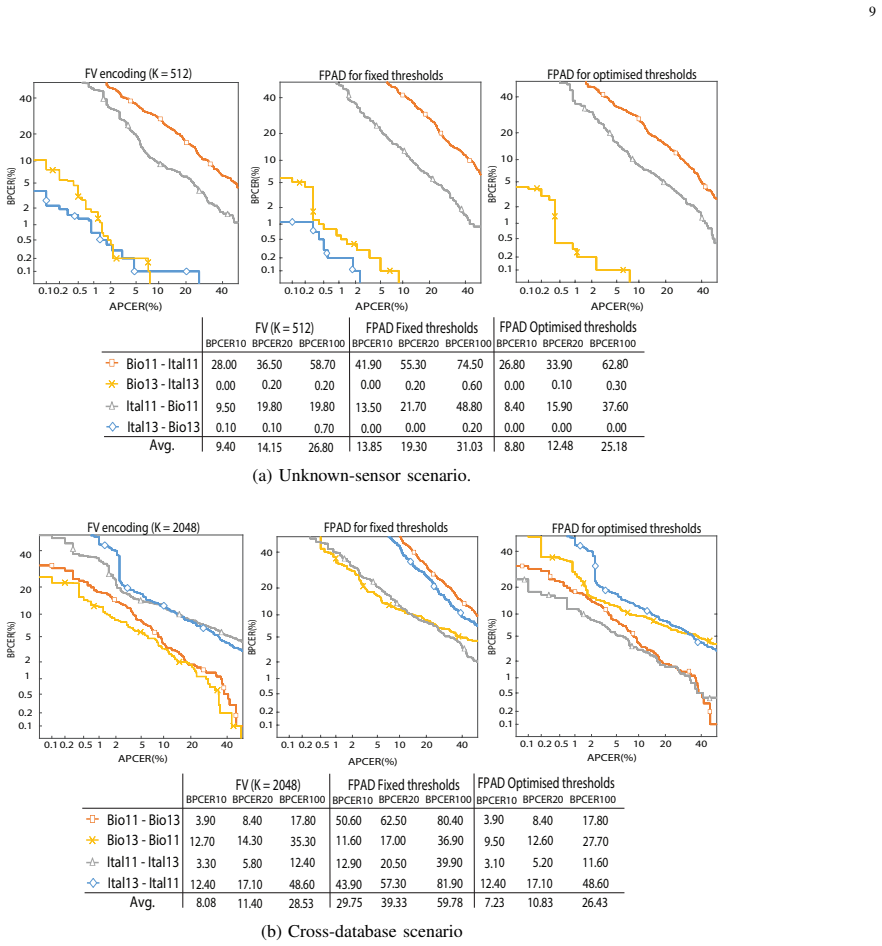
- [§IV.B.3, Table V, and Appendix §C] The headline generalization improvements are not obtained under a training-only hyperparameter protocol. In the unknown-sensor and cross-database experiments, the vocabulary size K is selected per test scenario (K=512 in Fig. 6a, K=2048 in Fig. 6b, K=256 for the unknown-material protocol in Fig. 5b), and the 'optimised thresholds' FPAD rows tune the weights α and β of Eq. (7) on the same test protocols. Under the authors' own fixed thresholds, the fusion is not the workhorse: in Table Va, fixed-threshold FPAD ACER is 9.05% vs. standalone FV 7.83%; in Table Vb, fixed-threshold FPAD ACER is 17.75% vs. FV 9.15%, barely below the FSB baseline of 17.91%. The abstract's 'up to 50%' improvement therefore comes from either FV alone or from fusion weights selected on test labels, not from the proposed FPAD fusion evaluated with training-only hyperparameters. This undercuts the central claim that the fusion's 'common feature space' generalizes. Please rerun the unknown-material, unknown-sensor, and cross-database protocols with a fixed K (e.g., K=1024) and with α, β selected on a training/validation split, and report both the fixed and the properly validated configurations.
- [§III.B and Conclusions] The manuscript itself concedes in the Conclusions that 'the fixed thresholds configurations do not always outperform the FV encoding as a standalone algorithm.' With BoW achieving ACER of 26.04% and 43.99% in the two generalization protocols of Table V, the proposed fusion can degrade performance when weights are not adapted to the target scenario. The 'common feature space' argument in §III.B is therefore not supported by the evidence as presented: no analysis shows that the vocabulary-based quantization improves transfer, and the poor BoW results suggest the opposite. The paper should either provide a training-only protocol in which fusion consistently helps, or restrict the generalization claim to the FV encoder and re-frame the fusion contribution accordingly.
- [§IV.B.2, Table IV] In the unknown-material protocol, the optimised-threshold FPAD row (ACER=1.01%) is the only configuration that clearly beats standalone FV (3.08%), but no evidence is given that these weights can be selected without access to the test set. If α and β are tuned on the same protocol for which performance is reported, the comparison against FSB [13] and other state-of-the-art methods is not an apples-to-apples evaluation. Please state explicitly how α and β are chosen in each scenario, and, if they are chosen on test data, provide a validation-based protocol and report the resulting numbers, since that is the only protocol that reflects deployment conditions.
minor comments (3)
- [Eq. (3)] In Eq. (3), the notation $v_x = \sum_{j=1}^d \left( \sum_{x: NN(x)=c_i} x_j - c_{i,j} \right)$ is confusing: the sum over $j$ appears to define a vector of $d$ components, but the expression as written suggests a scalar. Please make the vector structure explicit.
- [Throughout] There are several typos and inconsistent cross-references that should be corrected: 'afforementioned' in Section I, 'unkown' in the captions of Figs. 5 and 7, 'peformance' in the Appendix, and references to 'Table VIa' in Section IV.B.1 that appear to point to Table III rather than the appendix table.
- [§IV.A.2] The definition of ACER as 'the average of the APCER and the BPCER for a fixed detection threshold δ' is standard, but the symbol δ is also used for the low-contrast threshold in §III.A. Please use distinct symbols to avoid ambiguity.
Circularity Check
Reported generalization gains in unknown-sensor and cross-database scenarios depend on test-selected K and fusion weights; fixed-threshold FPAD does not beat standalone FV, so the fusion's claimed advantage is partly fitted on the test set.
-
fitted input called prediction
[Section IV.B.3 and Appendix C (Tables V, VIc, VId)]
"Table VIc shows the ACER for different values of K. As it can be observed, the FV encoding achieves its better results at different values of K, depending on the sensor used for training: whereas for Italdata 2011 and 2013, the lowest ACER is achieved for K = 512 (9.60% and 0.90%), for Biometrika it is obtained for K = 2048 (18.50% and 1.20%). ... average ACER = 7.83% for FV vs 14.59% for FSB [13], which implies a relative improvement of 48%."
The headline 48% unknown-sensor improvement is reported after choosing K from the test ACER values: Appendix C selects K per training/test pair (512 or 2048) based on the same test protocols whose errors are then reported, and the main text presents the resulting average (7.83%) as the method's generalization result. The same test labels are thus used both to select K and to measure the reported error, so the stated improvement is partly the result of test-set model selection rather than a training-only prediction. The paper does not report a fixed-K, training-only ablation for these scenarios; the known-scenario K=1024 is not the K used in Figs. 6a/6b.
-
fitted input called prediction
[Section IV.B.2, Eq. (7), Tables IV-V, and Conclusion]
"we also evaluate its performance on the best α,β threshold combination (hereafter referred to as 'optimised thresholds'). ... It should be also noted that the fixed thresholds configurations do not always outperform the FV encoding as a standalone algorithm. This highlights the challenges faced when unknown sensors or PAI species are contained in the test set. However, a proper tuning of the thresholds yields a very promising performance for the FPAD algorithm."
In the unknown-material, unknown-sensor, and cross-database benchmarks, the best FPAD rows are the 'optimised thresholds' rows, where α and β of Eq. (7) are chosen using the test protocol labels. With the fixed thresholds taken from the known scenario, the fusion is not the source of the claimed gains: Table Va gives fixed FPAD ACER = 9.05% vs standalone FV 7.83%, and Table Vb gives 17.75% vs 9.15%, so the fusion is worse than FV alone. The paper's own conclusion admits this and attributes the promising FPAD numbers to 'a proper tuning of the thresholds' on the evaluation protocols. Therefore the abstract-level 'up to 50%' improvement attributed to the fusion is partly a fitted result, not an out-of-sample prediction.
full rationale
The paper is not definitionally circular: the FPAD pipeline is a concrete encoder-plus-SVM-plus-fusion system, the LivDet 2019 competition result [21] is genuine external validation, and the authors transparently report fixed-threshold ablations. However, the central generalization claims in the abstract and conclusion are not uniformly based on training-only hyperparameters. The FV 'improvement of 48%' in the unknown-sensor protocol is obtained after selecting K per scenario from test ACER values in Appendix C, and the FPAD improvements in the challenging scenarios largely come from α,β optimized on the test protocols. The conclusion itself concedes that fixed-threshold fusion does not always outperform standalone FV. These are test-fitted inputs presented as predicted generalization, which is the 'fitted input called prediction' pattern. No load-bearing self-citation or uniqueness-import step was found; the in-house BoW reference [34] is not used to justify the core generalization claim. Overall, the evaluation leakage is partial rather than complete, so the circularity score is 6 rather than higher.
Assumptions & free parameters
free parameters (5)
- Vocabulary size K =
256 to 2048; best value selected per scenario (often 1024 or 2048)
- Fusion weights alpha and beta =
Dataset-specific values listed in Table III (e.g., alpha=0.40, beta=0.40 for Biometrika 2011)
- Dense-SIFT grid spacing S and scales sigma =
S=5, sigma={5,7,10,12}
- PCA dimension d =
d=64
- Low-contrast threshold delta =
not specified numerically
assumptions (3)
- domain assumption Dense-SIFT descriptors capture texture and ridge-flow discontinuities that discriminate bona fide from attack presentations.
- domain assumption A visual vocabulary trained on known data generalizes to unseen PAI materials and sensors.
- standard math K-means, GMM, PCA, and linear SVM provide well-behaved models for the encoded features.
Cite this review
Pith. "Pith review of Fingerprint Presentation Attack Detection Based on Local Features Encoding for Unknown Attacks." pith.science (2026). https://pith.science/paper/ZIXXHERO
@misc{pith2026190810163,
  author       = {Pith},
  title        = {Pith review of: Fingerprint Presentation Attack Detection Based on Local Features Encoding for Unknown Attacks},
  year         = {2026},
  howpublished = {\url{https://pith.science/paper/ZIXXHERO}},
  note         = {Machine review of arXiv:1908.10163}
}
read the original abstract
Fingerprint-based biometric systems have experienced a large development in the last years. Despite their many advantages, they are still vulnerable to presentation attacks (PAs). Therefore, the task of determining whether a sample stems from a live subject (i.e., bona fide) or from an artificial replica is a mandatory issue which has received a lot of attention recently. Nowadays, when the materials for the fabrication of the Presentation Attack Instruments (PAIs) have been used to train the PA Detection (PAD) methods, the PAIs can be successfully identified. However, current PAD methods still face difficulties detecting PAIs built from unknown materials or captured using other sensors. Based on that fact, we propose a new PAD technique based on three image representation approaches combining local and global information of the fingerprint. By transforming these representations into a common feature space, we can correctly discriminate bona fide from attack presentations in the aforementioned scenarios. The experimental evaluation of our proposal over the LivDet 2011 to 2015 databases, yielded error rates outperforming the top state-of-the-art results by up to 50\% in the most challenging scenarios. In addition, the best configuration achieved the best results in the LivDet 2019 competition (overall accuracy of 96.17\%).
Figures


Figures from the paper (3 more)


Reference graph
Works this paper leans on
-
[13]
Fingerprint spoof buster: Use of minutiae-centered patches,
——, “Fingerprint spoof buster: Use of minutiae-centered patches,” IEEE Tran. on Information Forensics and Security , 2018
work page 2018
-
[1]
D. Maltoni, D. Maio, A. K. Jain, and S. Prabhakar, Handbook of fingerprint recognition. Springer Science & Business Media, 2009
work page 2009
-
[2]
On the vulnerability of fingerprint verification systems to fake fingerprints attacks,
J. Galbally, J. Fierrez-Aguilar, J. Rodriguez-Gonzalez, F. Alonso- Fernandez, J. Ortega-Garcia, and M. Tapiador, “On the vulnerability of fingerprint verification systems to fake fingerprints attacks,” in Porc. Int. Carnahan Conf. on Security Technology , 2006, pp. 130–136
work page 2006
-
[3]
An evaluation of direct attacks using fake fingers generated from iso templates,
J. Galbally, R. Cappelli, A. Lumini, G. Gonzalez-de Rivera, D. Maltoni, J. Fierrez, J. Ortega-Garcia, and D. Maio, “An evaluation of direct attacks using fake fingers generated from iso templates,” Pattern Recognition Letters, vol. 31, no. 8, pp. 725–732, 2010
work page 2010
-
[4]
Impact of artificial gummy fingers on fingerprint systems,
T. Matsumoto, H. Matsumoto, K. Yamada, and S. Hoshino, “Impact of artificial gummy fingers on fingerprint systems,” in Optical Security and Counterfeit Deterrence Techniques IV , vol. 4677. Int. Society for Optics and Photonics, 2002, pp. 275–289
work page 2002
-
[5]
ISO/IEC JTC1 SC37 Biometrics, ISO/IEC FDIS 30107-3. Information Technology - Biometric presentation attack detection - Part 3: Testing and Reporting, International Organization for Standardization, 2017
work page 2017
-
[6]
Gummy and conductive silicone rubber fingers impor- tance of vulnerability analysis,
T. Matsumoto, “Gummy and conductive silicone rubber fingers impor- tance of vulnerability analysis,” in Proc. Asian Conf. on Advances in Cryptology (ASIACRYPT). Springer, 2002, pp. 574–575
work page 2002
-
[7]
Presentations and attacks, and spoofs, oh my,
S. Schuckers, “Presentations and attacks, and spoofs, oh my,” Image and Vision Computing, vol. 55, pp. 26–30, 2016
work page 2016
Show all 41 references
-
[8]
A survey on antispoofing schemes for fingerprint recognition systems,
E. Marasco and A. Ross, “A survey on antispoofing schemes for fingerprint recognition systems,” ACM Computing Surveys (CSUR) , vol. 47, no. 2, p. 28, 2015
2015
-
[9]
Presentation attack detection methods for fingerprint recognition systems: a survey,
C. Sousedik and C. Busch, “Presentation attack detection methods for fingerprint recognition systems: a survey,” IET Biometrics, vol. 3, no. 4, pp. 219–233, 2014
2014
-
[10]
Biometric antispoofing methods: A survey in face recognition,
J. Galbally, S. Marcel, and J. Fierrez, “Biometric antispoofing methods: A survey in face recognition,” IEEE Access , vol. 2, pp. 1530–1552, 2014
2014
-
[11]
Presentation attack detection in iris recognition,
J. Galbally and M. Gomez-Barrero, “Presentation attack detection in iris recognition,” in Iris and Periocular Biometrics , C. Busch and C. Rathgeb, Eds. IET, Aug. 2017
2017
-
[12]
Fingerprint spoof detection using minutiae-based local patches,
T. Chugh, K. Cao, and A. K. Jain, “Fingerprint spoof detection using minutiae-based local patches,” in Proc. Int. Joint Conf. on Biometrics (IJCB), 2017, pp. 581–589
2017
-
[14]
Fingerprint liveness detection using convolutional neural networks,
R. F. Nogueira, R. de Alencar Lotufo, and R. C. Machado, “Fingerprint liveness detection using convolutional neural networks,” IEEE Trans. on Information Forensics and Security, vol. 11, no. 6, pp. 1206–1213, 2016
2016
-
[15]
Deep triplet embedding representations for liveness detection,
F. Pala and B. Bhanu, “Deep triplet embedding representations for liveness detection,” in Deep Learning for Biometrics . Springer, 2017, pp. 287–307
2017
-
[16]
Distinctive image features from scale-invariant keypoints,
D. G. Lowe, “Distinctive image features from scale-invariant keypoints,” Int. Journal of Computer Vision , vol. 60, no. 2, pp. 91–110, 2004
2004
-
[17]
Visual categorization with bags of keypoints,
G. Csurka, C. R. Dance, L. Fan, J. Willamowski, and C. Bray, “Visual categorization with bags of keypoints,” in Proc. Int. Workshop on Statistical Learning in Computer Vision (ECCV) , 2004, pp. 1–22
2004
-
[18]
Bag of visual words and fusion methods for action recognition: Comprehensive study and good practice,
X. Peng, L. Wang, X. Wang, and Y . Qiao, “Bag of visual words and fusion methods for action recognition: Comprehensive study and good practice,”Computer Vision and Image Understanding, vol. 150, pp. 109– 125, 2016
2016
-
[19]
Attribute-based clas- sification for zero-shot visual object categorization,
C. H. Lampert, H. Nickisch, and S. Harmeling, “Attribute-based clas- sification for zero-shot visual object categorization,” IEEE Trans. on Pattern Analysis and Machine Intelligence , vol. 36, no. 3, pp. 453–465, 2014
2014
-
[20]
Image classi- fication with the fisher vector: Theory and practice,
J. S ´anchez, F. Perronnin, T. Mensink, and J. Verbeek, “Image classi- fication with the fisher vector: Theory and practice,” Int. Journal on Computer VIsion, vol. 105, no. 3, pp. 222–245, 2013
2013
-
[21]
Livdet in action-fingerprint liveness detection competition 2019,
G. Orr ´u, R. Casula, P. Tuveri, C. Bazzoni, G. Dessalvi, M. Micheletto, L. Ghiani, and G. L. Marcialis, “Livdet in action-fingerprint liveness detection competition 2019,” arXiv preprint arXiv:1905.00639 , 2019
2019 arXiv
-
[22]
Biometric presentation attack detection: Beyond the visible spectrum,
R. Tolosana, M. Gomez-Barrero, C. Busch, and J. Ortega-Garcia, “Biometric presentation attack detection: Beyond the visible spectrum,” arXiv preprint arXiv:1902.11065 , 2019
1902 arXiv
-
[23]
Multi-scale local binary pattern with filters for spoof fingerprint detection,
X. Jia, X. Yang, K. Cao, Y . Zang, N. Zhang, R. Dai, X. Zhu, and J. Tian, “Multi-scale local binary pattern with filters for spoof fingerprint detection,” Information Sciences, vol. 268, pp. 91–102, 2014
2014
-
[24]
Local contrast phase descriptor for fingerprint liveness detection,
D. Gragnaniello, G. Poggi, C. Sansone, and L. Verdoliva, “Local contrast phase descriptor for fingerprint liveness detection,” Pattern Recognition, vol. 48, no. 4, pp. 1050–1058, 2015
2015
-
[25]
Presentation attack detection using a tiny fully convolutional network,
E. Park, X. Cui, T. H. B. Nguyen, and H. Kim, “Presentation attack detection using a tiny fully convolutional network,” IEEE Trans. on Information Forensics and Security , 2019
2019
-
[26]
Open set fingerprint spoof de- tection across novel fabrication materials,
A. Rattani, W. J. Scheirer, and A. Ross, “Open set fingerprint spoof de- tection across novel fabrication materials,” IEEE Trans. on Information Forensics and Security, vol. 10, no. 11, pp. 2447–2460, 2015
2015
-
[27]
An ensemble of one-class SVMs for fingerprint spoof detection across different fabrication materials,
Y . Ding and A. Ross, “An ensemble of one-class SVMs for fingerprint spoof detection across different fabrication materials,” in Proc. Int. Workshop on Information Forensics and Security (WIFS) , 2016
2016
-
[28]
Fingerprint presentation attack detection: Gener- alization and efficiency,
T. Chugh and A. Jain, “Fingerprint presentation attack detection: Gener- alization and efficiency,” in Proc. Int. Conf. on Biometrics (ICB) , 2019
2019
-
[29]
Generalizing fingerprint spoof detector: Learning a one-class classifier,
J. Engelsma and A. Jain, “Generalizing fingerprint spoof detector: Learning a one-class classifier,” in Proc. Int. Conf. on Biometrics (ICB) , 2019
2019
-
[30]
Uni- versal material translator: Towards spoof fingerprint generalization,
R. Gajawada, A. Popli, T. Chugh, A. Namboodiri, and A. Jain, “Uni- versal material translator: Towards spoof fingerprint generalization,” in Proc. Int. Conf. on Biometrics (ICB) , 2019
2019
-
[31]
Image classification using random forests and ferns,
A. Bosch, A. Zisserman, and X. Munoz, “Image classification using random forests and ferns,” in Proc. Int. Conf. on Computer Vision (ICCV), 2007
2007
-
[32]
Aggregating local image descriptors into compact codes,
H. Jegou, F. Perronnin, M. Douze, J. S ´anchez, P. Perez, and C. Schmid, “Aggregating local image descriptors into compact codes,” IEEE Trans. on Pattern Analysis and Machine Intelligence , vol. 34, no. 9, pp. 1704– 1716, 2012
2012
-
[33]
Text classification using string kernels,
H. Lodhi, C. Saunders, J. Shawe-Taylor, N. Cristianini, and C. Watkins, “Text classification using string kernels,” Journal of Machine Learning Research, vol. 2, no. Feb, pp. 419–444, 2002
2002
-
[34]
Fingerprint presentation attack detection method based on a bag-of-words approach,
L. J. Gonzalez-Soler, L. Chang, J. Hernandez-Palancar, A. P. Suarez, and M. Gomez-Barrero, “Fingerprint presentation attack detection method based on a bag-of-words approach,” in Proc. Iberoamerican Conf. on Pattern Recognition (CIARP), 2017
2017
-
[35]
Using the triangle inequality to accelerate k-means,
C. Elkan, “Using the triangle inequality to accelerate k-means,” in Proc. Int. Conf. on Machine Learning (ICML) , 2003, pp. 147–153
2003
-
[36]
Improving the fisher ker- nel for large-scale image classification,
F. Perronnin, J. S ´anchez, and T. Mensink, “Improving the fisher ker- nel for large-scale image classification,” in Proc. European Conf. on Computer Vision (ECCV) , 2010, pp. 143–156
2010
-
[37]
Fisher vector faces in the wild
K. Simonyan, O. M. Parkhi, A. Vedaldi, and A. Zisserman, “Fisher vector faces in the wild.” in BMVC, vol. 2, no. 3, 2013, p. 4
2013
-
[38]
LivDet 2011-fingerprint liveness detection competition 2011,
D. Yambay, L. Ghiani, P. Denti, G. L. Marcialis, F. Roli, and S. Schuck- ers, “LivDet 2011-fingerprint liveness detection competition 2011,” in Proc. Int. Conf. on Biometrics (ICB) , 2012, pp. 208–215
2011
-
[39]
LivDet 2013 fingerprint liveness detection competition 2013,
L. Ghiani, D. Yambay, V . Mura, S. Tocco, G. L. Marcialis, F. Roli, and S. Schuckcrs, “LivDet 2013 fingerprint liveness detection competition 2013,” in Proc. Int. Conf. on Biometrics (ICB) , 2013, pp. 1–6
2013
-
[40]
Livdet 2015 fingerprint liveness detection competition 2015,
V . Mura, L. Ghiani, G. L. Marcialis, F. Roli, D. A. Yambay, and S. A. Schuckers, “Livdet 2015 fingerprint liveness detection competition 2015,” in Proc. Int. Conf. on Biometrics Theory, Applications and Systems (BTAS), 2015, pp. 1–6. 14 L´azaro J. Gonz ´alez-Soler received his...
2015
-
[2002]
He is member of the Cuban Society of Mathematics and Computation and of the Cuban Association for Pattern Recognition since 2005
In July 2008 he obtained the MSc degree in Computational Sciences at the National Institute of Astrophysics, Optics and Electronics (INAOE) and, in July 2011, he received his PhD degree in Computational Sciences from the same institution. He is member of the Cuban Society of M...
2008
Reviewed August 14, 2026 · model on record in the stance chip above.
Discussion (0). Continue with ORCID to comment.