REVIEW 1 major objections 3 minor 68 references
Geometric phase corrected by initial system-environment correlations
T0 review · 1 major / 3 minor · reviewed 2026-08-14 · deepseek-v4-flash
Pith's one-line read Preparing a dephasing qubit with initial system-environment correlations can reduce the environment's correction to its geometric phase—and can make that correction vanish.
desk verdict A solid, publishable contribution that does something new, but the central robustness claim is stated more generally than the calculation supports because the cycle time is fixed by the free evolution period even though the reduced state never returns. read the letter →
The pith
A machine-rendered reading of the paper's core claim, the machinery that carries it, and where it could break.
The reading
What carries the argument
The load-bearing objects are the pure-dephasing qubit density matrix $$\rho(t)=\begin{pmatrix}\$cos^{2}$(\theta_0/2) & \tfrac12\sin\theta_0\,$e^{{-i[\omega_0 t+\chi(t)]}}$$e^{{-\Gamma(t)}}$\\\tfrac12\sin\theta_0\,$e^{{i[\omega_0 t+\chi(t)]}}$$e^{{-\Gamma(t)}}$ & \$sin^{2}$(\theta_0/2)\end{pmatrix}$$ and the kinematic geometric-phase formula for nonunitary evolution, $$\Phi_G=\arg\!\left(\sum_{k=1}^{2}\sqrt{\varepsilon_k(0)\varepsilon_k(\tau)}\,\langle\varepsilon_k(0)|\varepsilon_k(\tau)\rangle\,$e^{{-\int_0^\tau dt\,\langle\varepsilon_k|\partial_t|\varepsilon_k\rangle}}$\right),$$ with the cycle time fixed by $\omega_0\tau=2\pi$. Initial correlations enter through the modified decoherence factor $\Gamma(t)=\Gamma_{\rm uc}(t)+\Gamma_{\rm corr}(t)$ and the phase shift $\chi(t)$, obtained by solving the joint unitary dynamics starting from $e^{-\beta H}/Z$ followed by a projective or unitary preparation step. The mechanism behind the reported result is a cancellation: for particular parameter values the correlation-induced phase and decay combine in this formula so that the correction to the ideal phase $-\pi+\pi\cos\theta_0$ drops to zero.
What would settle it
Recompute the geometric phase with the cycle time defined by the full open-system phase, $\omega_0\tau+\chi(\tau)=2\pi$, or by the point of closest return of the reduced state, and check whether the correction still vanishes for the same Ohmicity or coupling values; if the zero moves or disappears, the robustness claim is an artifact of the chosen cycle time.
Extended reading notes
Core claim
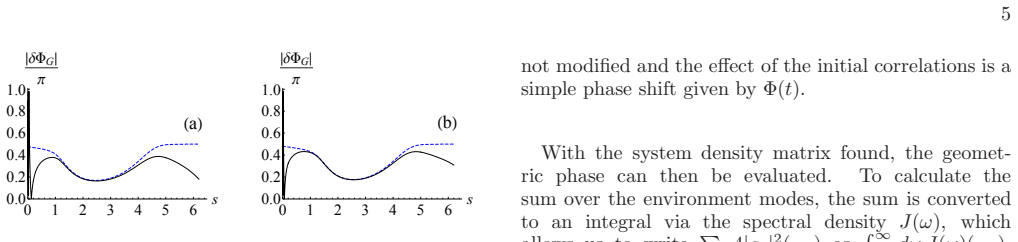
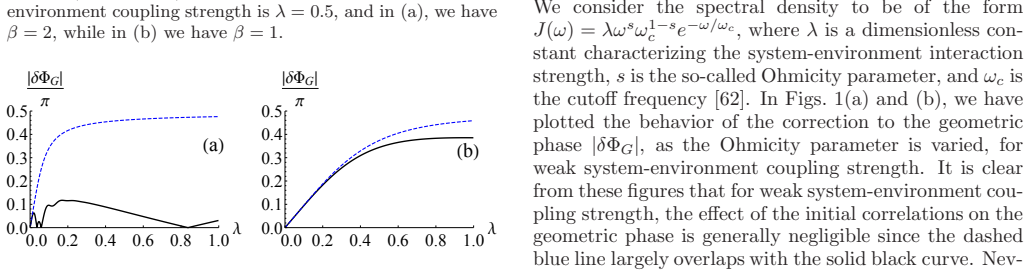
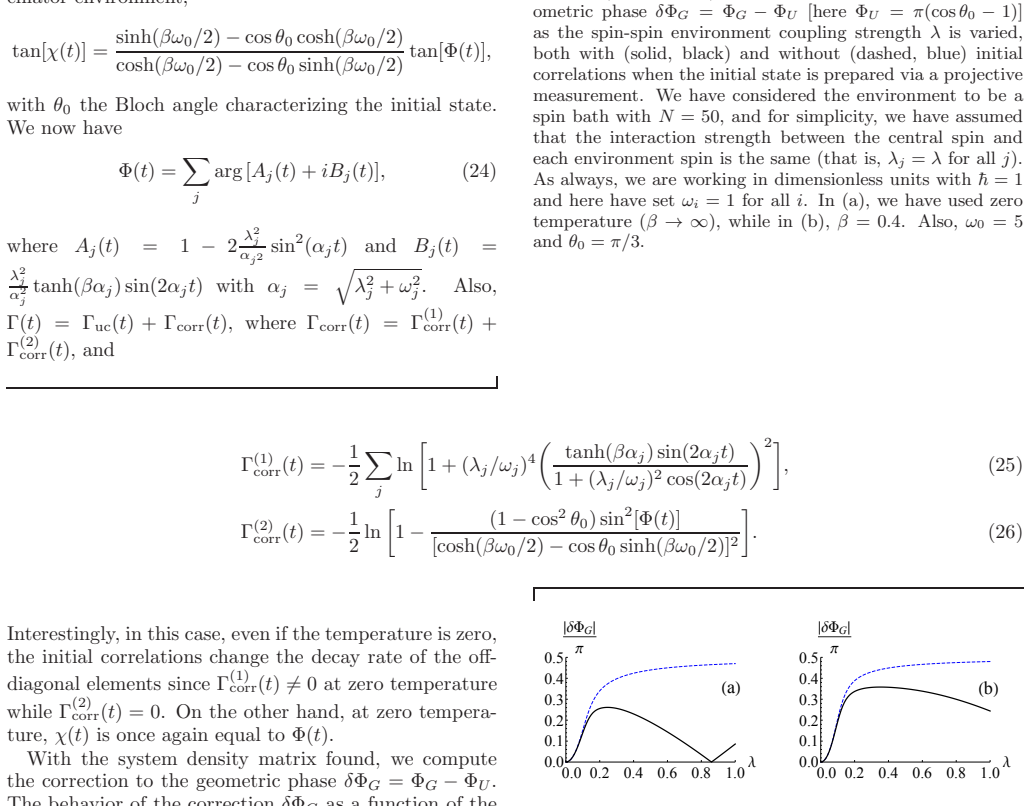
The central claim is that the geometric phase of a dephasing qubit is not merely perturbed by initial system-environment correlations: accounting for them shifts the phase and, in favorable parameter ranges, can make the environment's total correction vanish. When the initial state is generated from the joint thermal equilibrium of system plus environment by a projective measurement or unitary operation, the decoherence factor and phase shift in the qubit's off-diagonal density-matrix elements are modified relative to the uncorrelated case. Inserting these exactly solved modified dynamics into the kinematic geometric-phase formula for nonunitary evolution, the authors find that the correction $\delta\Phi_G=\Phi_G-(-\pi+\pi\cos\theta_0)$ is generally smaller in magnitude than for an uncorrelated starting state, and for particular values of the Ohmicity parameter (bosonic bath) or the system-environment coupling strength (spin bath) it is exactly zero. This robustness appears already for weak and moderate coupling and weakens as temperature rises. The contribution is to extend geometric-phase studies, previously limited to uncorrelated initial states, to the correlated case.
Load-bearing premise
The calculation fixes the time of one 'cycle' by the bare qubit frequency, $\omega_0\tau=2\pi$, and applies a formula intended for cyclic evolution even though the reduced state is not actually periodic because decoherence has set in, so the quantitative results—including the zero-correction points—depend on that choice.
Editorial extensions
If this is right
- The standard assumption of a factorized initial state overestimates the environmental correction to the geometric phase for dephasing qubits.
- For particular environment parameters the geometric phase equals its uncoupled value even though the evolution is nonunitary, so geometric-phase operations can stay accurate without perfect isolation from the bath.
- Increasing the system-environment coupling strength does not necessarily increase the geometric-phase error when initial correlations are included; it can reduce the error and drive it to zero.
- The same qualitative robustness appears for bosonic and spin environments and for both projective-measurement and unitary-preparation protocols, indicating a general feature of pure dephasing rather than a model-specific accident.
- The correlation-induced benefit diminishes at higher temperatures, so the effect is most relevant in the low-temperature regime.
Reading between the lines
- A natural testable extension is to engineer the initial correlated state deliberately as a protection strategy for geometric quantum gates, using the paper's zero-correction parameters as operating points.
- Because the cycle time is fixed by the free system Hamiltonian, a path-independent or gauge-invariant definition of the open-system geometric phase would be needed to decide whether the zero-correction points are physical or a bookkeeping effect.
- The same correlated-initial-state formalism could be applied to non-dephasing channels such as amplitude damping, where the reduced-state eigenvalues also evolve and the cancellation mechanism may take a different form.
- In platforms with spin baths, such as solid-state qubits surrounded by nuclear spins, preparing the qubit by a projective measurement from the global thermal state could yield geometric phases less sensitive to coupling-strength fluctuations.
Signed reviews
Editorial analysis
A structured set of objections, weighed in public.
Referee Report
Summary. The paper develops a formalism for computing the geometric phase of a two-level system undergoing pure dephasing when the initial system-environment state is correlated. The authors derive general expressions for both initially pure and mixed system states and apply them to harmonic oscillator and spin environments, with the initial state prepared by projective measurement or unitary operation. They find that the correction to the unperturbed geometric phase is generally smaller when initial correlations are included, and in some parameter regimes it vanishes exactly, which they interpret as increased robustness of the geometric phase.
Significance. The paper addresses a natural and timely question: whether initial system-environment correlations, which are generically present in solid-state qubits, can alter the geometric phase. The formalism is general, the dynamical solutions are exact (taken from Refs. [49,51] and re-derived in the appendices), and the paper treats two different environments and two preparation schemes. If the qualitative results hold beyond the specific evolution time chosen, the finding that correlations can reduce the environmental correction to the geometric phase would be of practical interest for geometric quantum computation. However, the central robustness claim is not yet established with full generality because the authors fix the evolution time to the free-system period without analyzing the path-dependence of the open-system geometric phase.
major comments (1)
- [Section II.A, around Eq. (8)] The paper sets the evolution time τ by requiring ω0τ = 2π and refers to the evolution as 'cyclic.' Since the decoherence factor Γ(τ) is positive, the reduced density matrix is not periodic, ρ(τ) ≠ ρ(0), and the geometric phase computed from Eq. (4) is path-dependent. The principal results—for instance, the vanishing of |δΦ_G| at specific coupling strengths in Figs. 4(a) and 6(a)—are obtained at this single value of τ. The abstract's statement that the correction 'generally becomes smaller' and 'can even be zero' with initial correlations is not shown to be independent of the choice of τ. To support the central claim, the authors should either study the dependence of δΦ_G on τ (e.g., at τ = 4π/ω0 or as a continuous function) or explicitly restrict the claims to the open path defined by τ = 2π/ω0.
minor comments (3)
- [Section IV.A] The sentence 'this model has not been solved taking initial correlations into account before' appears to conflict with Ref. [61] (Majeed and Chaudhry, Eur. Phys. J. D 73, 16 (2019)), which analyzes a spin environment with initial correlations. Please clarify the relation to that work and cite it accordingly.
- [Introduction] The reference to 'Aharonov and Anand' should be 'Aharonov and Anandan'.
- [Appendix A, Eq. (A14)] The exponent in the expression for Z contains a typographical error: it should read e^{-βω0(-1)^l/2} rather than e^{-βω0(-l)l/2}.
Circularity Check
No circularity found: the geometric-phase corrections are outputs of exact dephasing dynamics plus the standard kinematic phase formula, not re-statements of the inputs.
full rationale
The paper's central claim is not assumed in its input dynamics. The geometric-phase formalism in Sec. II starts from the general dephased density matrix (3) and applies the Tong et al. kinematic formula (4), giving closed expressions (8)-(10) and (13)-(16) that are then evaluated using Γ(t) and χ(t). No parameter is fitted to the geometric phase, and the 'correction' δΦG is a computed difference, not a definitional identity. The correlated dynamics for the harmonic-oscillator bath are quoted from Refs [49,51] but are also re-derived in Appendix A from an exact Magnus/coherent-state solution; the spin-bath correlated dynamics are derived in Appendix B. These dynamical results specify only how the off-diagonal coherences evolve; they do not encode the geometric-phase answer. The observation that the correction can vanish is a numerical consequence of cancellation between χ(τ), Γ(τ), and the overlap phases, not an algebraic tautology. The choice τ = 2π/ω0 fixes the free-system period and is used consistently for both correlated and uncorrelated curves; while the evolution is not truly cyclic because Γ(τ)>0, and the numerical values would shift under a different τ, this is a modeling-validity concern rather than a circular step. The self-citations (e.g., Refs [49,51,61]) supply exact dynamical inputs from the same group, but because those inputs are re-derived here and are independent of the geometric-phase result, they do not make the derivation circular.
Assumptions & free parameters
assumptions (5)
- standard math The geometric phase formula of Tong et al. (Eq. 4) is a valid definition for the mixed-state evolution considered here.
- domain assumption The initial correlated state is the global thermal state e^{-βH}/Z followed by a projective measurement or a unitary operation on the system.
- domain assumption The pure dephasing condition [H_S, H_SB] = 0 holds, so populations are constant.
- domain assumption The environment spectral density has the Ohmic form J(ω)=λω^s ω_c^{1-s} e^{-ω/ω_c}.
- ad hoc to paper The time τ at which the geometric phase is evaluated is set by ω0τ=2π, i.e., the period of the free system Hamiltonian.
Cite this review
Pith. "Pith review of Geometric phase corrected by initial system-environment correlations." pith.science (2026). https://pith.science/paper/3NIQQXFO
@misc{pith2026190810545,
  author       = {Pith},
  title        = {Pith review of: Geometric phase corrected by initial system-environment correlations},
  year         = {2026},
  howpublished = {\url{https://pith.science/paper/3NIQQXFO}},
  note         = {Machine review of arXiv:1908.10545}
}
read the original abstract
We find the geometric phase of a two-level system undergoing pure dephasing via interaction with an arbitrary environment, taking into account the effect of the initial system-environment correlations. We use our formalism to calculate the geometric phase for the two-level system in the presence of both harmonic oscillator and spin environments, and we consider the initial state of the two-level system to be prepared by a projective measurement or a unitary operation. The geometric phase is evaluated for a variety of parameters such as the system-environment coupling strength to show that the initial correlations can affect the geometric phase very significantly even for weak and moderate system-environment coupling strengths. Moreover, the correction to the geometric phase due to the system-environment coupling generally becomes smaller (and can even be zero) if initial system-environment correlations are taken into account, thus implying that the system-environment correlations can increase the robustness of the geometric phase.
Figures


Figures from the paper (4 more)


Reference graph
Works this paper leans on
- [61]
-
[1]
Sjoqvist, Geometric phases in quantum information, Int
E. Sjoqvist, Geometric phases in quantum information, Int. J. Quantum Chem. 115, 1311 (2015)
work page 2015
- [2]
-
[3]
Pancharatnam, Generalized theory of interference an d its applications, Proc
S. Pancharatnam, Generalized theory of interference an d its applications, Proc. Indian Acad. Sci. A44, 398 (1956)
work page 1956
-
[4]
and Stone [5] in quantum chemistry. Berry’s finding that the geometric phase arises generally in the study of closed quantum systems undergoing cyclic adiabatic evo- lutions ignited interest in the subject [6]. Aharonov and Anand thereafter generalized the geometric phase to non- adiabatic evolutions, showing that the phase depends on the geometry of the p...
work page 2016
-
[5]
Longuet-Higgins, The intersection of potential ener gy surfaces in polyatomic molecules, Proc
H. Longuet-Higgins, The intersection of potential ener gy surfaces in polyatomic molecules, Proc. R. Soc. London A 344, 147 (1975)
work page 1975
-
[6]
A. J. Stone, Spin-orbit coupling and the intersection of potential energy surfaces in polyatomic molecules, Proc. R. Soc. London A 351, 141 (1976)
work page 1976
-
[7]
M. V. Berry, Quantal phase factors accompanying adia- batic changes, Proc. R. Soc. London A 392, 45 (1984)
work page 1984
Show all 68 references
-
[8]
Aharonov and J
Y. Aharonov and J. Anandan, Phase change during a cyclic quantum evolution, Phys. Rev. Lett. 58, 1593 (1987)
1987
-
[9]
Uhlmann, On berry phases along mixtures of states, Ann
A. Uhlmann, On berry phases along mixtures of states, Ann. Phys. 501, 63 (1989)
1989
-
[10]
Sj¨ oqvist, A
E. Sj¨ oqvist, A. K. Pati, A. Ekert, J. S. Anan- dan, M. Ericsson, D. K. L. Oi, and V. Vedral, Ge- ometric phases for mixed states in interferometry, Phys. Rev. Lett. 85, 2845 (2000)
2000
-
[11]
Suter, G
D. Suter, G. Chingas, R. Harris, and A. Pines, Berry’s phase in magnetic resonance, Mol. Phys. 61, 1327 (1987)
1987
-
[12]
P. J. Leek, J. M. Fink, A. Blais, R. Bianchetti, M. G¨ oppl, J. M. Gambetta, D. I. Schuster, L. Frunzio, R. J. Schoelkopf, and A. Wallraff, Observation of berry’s phase in a solid-state qubit, Science 318, 1889 (2007)
2007
-
[13]
Simon, H
R. Simon, H. J. Kimble, and E. C. G. Sudarshan, Evolving geometric phase and its dynamical manifes- tation as a frequency shift: An optical experiment, Phys. Rev. Lett. 61, 19 (1988)
1988
-
[14]
Zanardi and M
P. Zanardi and M. Rasetti, Holonomic quantum compu- tation, Phys. Lett. A 264, 94 (1999)
1999
-
[15]
J. A. Jones, V. Vedral, A. Ekert, and G. Castagnoli, Geo- metric quantum computation using nuclear magnetic res- onance, Nature 403, 869 (2000)
2000
-
[16]
Falci, R
G. Falci, R. Fazio, G. Massimo Palma, J. Siewert, and V. Vedral, Detection of geometric phases in supercon- ducting nanocircuits, Nature 407, 355 (2000)
2000
-
[17]
L.-M. Duan, J. I. Cirac, and P. Zoller, Geometric ma- nipulation of trapped ions for quantum computation, Science 292, 1695 (2001)
2001
-
[18]
Xiang-Bin and M
W. Xiang-Bin and M. Keiji, Nonadiabatic conditional geometric phase shift with nmr, Phys. Rev. Lett. 87, 097901 (2001)
2001
-
[19]
Liebfried, B
D. Liebfried, B. DeMarco, V. Meyer, D. Lucas, M. Bar- rett, J. Britton, W. M. Itano, B. Jelenkovic, C. Langer, T. Rosenband, and D. J. Wineland, Experimental demonstration of a robust, high-fidelity geometric two ion-qubit phase gate, Nature 422, 412 (2000)
2000
-
[20]
Ericsson, E
M. Ericsson, E. Sj¨ oqvist, J. Br¨ annlund, D. K. L. Oi, and A. K. Pati, Generalization of the geometric phase to com- pletely positive maps, Phys. Rev. A 67, 020101 (2003)
2003
-
[21]
Carollo, I
A. Carollo, I. Fuentes-Guridi, M. F. m. c. Santos, and V. Vedral, Geometric phase in open systems, Phys. Rev. Lett. 90, 160402 (2003). 11
2003
-
[22]
D. M. Tong, E. Sj¨ oqvist, L. C. Kwek, and C. H. Oh, Kinematic approach to the mixed state geometric phase in nonunitary evolution, Phys. Rev. Lett. 93, 080405 (2004)
2004
-
[23]
R. S. Whitney, Y. Makhlin, A. Shnirman, and Y. Gefen, Geometric nature of the environment- induced berry phase and geometric dephasing, Phys. Rev. Lett. 94, 070407 (2005)
2005
-
[24]
X. X. Yi, D. M. Tong, L. C. Wang, L. C. Kwek, and C. H. Oh, Geometric phase in open systems: Be- yond the markov approximation and weak-coupling limit, Phys. Rev. A 73, 052103 (2006)
2006
-
[25]
F. C. Lombardo and P. I. Villar, Geometric phases in open systems: A model to study how they are corrected by decoherence, Phys. Rev. A 74, 042311 (2006)
2006
-
[26]
Dajka, M
J. Dajka, M. Mierzejewski, and J. /suppress Luczka, Geometric phase of a qubit in dephasing environments, J. Phys. A: Math. Theor. 41, 012001 (2008)
2008
-
[27]
F. C. Lombardo and P. I. Villar, Environmen- tally induced effects on a bipartite two-level sys- tem: Geometric phase and entanglement properties, Phys. Rev. A 81, 022115 (2010)
2010
-
[28]
F. M. Cucchietti, J.-F. Zhang, F. C. Lombardo, P. I. Villar, and R. Laflamme, Geometric phase with nonuni- tary evolution in the presence of a quantum critical bath, Phys. Rev. Lett. 105, 240406 (2010)
2010
-
[29]
P. I. Villar and F. C. Lombardo, Geometric phases in the presence of a composite environment, Phys. Rev. A 83, 052121 (2011)
2011
-
[30]
F. C. Lombardo and P. I. Villar, Nonunitary geometric phases: A qubit coupled to an environment with random noise, Phys. Rev. A 87, 032338 (2013)
2013
-
[31]
F. C. Lombardo and P. I. Villar, Correction to the geo- metric phase by structured environments: The onset of non-markovian effects, Phys. Rev. A 91, 042111 (2015)
2015
-
[32]
Hakim and V
V. Hakim and V. Ambegaokar, Quantum theory of a free particle interacting with a linearly dissipative environ- ment, Phys. Rev. A 32, 423 (1985)
1985
-
[33]
Haake and R
F. Haake and R. Reibold, Strong damping and low- temperature anomalies for the harmonic oscillator, Phys. Rev. A 32, 2462 (1985)
1985
-
[34]
Grabert, P
H. Grabert, P. Schramm, and G.-L. Ingold, Quantum brownian motion: The functional integral approach, Phys. Rep. 168, 115 (1988)
1988
-
[35]
C. M. Smith and A. O. Caldeira, Application of the generalized feynman-vernon approach to a simple system: The damped harmonic oscillator, Phys. Rev. A 41, 3103 (1990)
1990
-
[36]
Karrlein and H
R. Karrlein and H. Grabert, Exact time evolution and master equations for the damped harmonic oscillator, Phys. Rev. E 55, 153 (1997)
1997
-
[37]
D´ avila Romero and J
L. D´ avila Romero and J. Pablo Paz, Decoherence and initial correlations in quantum brownian motion, Phys. Rev. A 55, 4070 (1997)
1997
-
[38]
Lutz, Effect of initial correlations on short-time de co- herence, Phys
E. Lutz, Effect of initial correlations on short-time de co- herence, Phys. Rev. A 67, 022109 (2003)
2003
-
[39]
Banerjee and R
S. Banerjee and R. Ghosh, General quantum brownian motion with initially correlated and nonlinearly coupled environment, Phys. Rev. E 67, 056120 (2003)
2003
-
[40]
N. G. van Kampen, A new approach to noise in quantum mechanics, J. Stat. Phys. 115, 1057 (2004)
2004
-
[41]
Ban, Quantum master equation for dephasing of a two-level system with an initial correlation, Phys
M. Ban, Quantum master equation for dephasing of a two-level system with an initial correlation, Phys. Rev. A 80, 064103 (2009)
2009
-
[42]
Campisi, P
M. Campisi, P. Talkner, and P. H¨ anggi, Fluctua- tion theorem for arbitrary open quantum systems, Phys. Rev. Lett. 102, 210401 (2009)
2009
-
[43]
Uchiyama and M
C. Uchiyama and M. Aihara, Role of initial quantum correlation in transient linear response, Phys. Rev. A 82, 044104 (2010)
2010
-
[44]
A. G. Dijkstra and Y. Tanimura, Non-markovian entan- glement dynamics in the presence of system-bath coher- ence, Phys. Rev. Lett. 104, 250401 (2010)
2010
-
[45]
Smirne, H.-P
A. Smirne, H.-P. Breuer, J. Piilo, and B. Vacchini, Ini- tial correlations in open-systems dynamics: The jaynes- cummings model, Phys. Rev. A 82, 062114 (2010)
2010
-
[46]
Dajka and J
J. Dajka and J. /suppress Luczka, Distance growth of quantum states due to initial system-environment correlations, Phys. Rev. A 82, 012341 (2010)
2010
-
[47]
Zhang, X.-B
Y.-J. Zhang, X.-B. Zou, Y.-J. Xia, and G.-C. Guo, Different entanglement dynamical behav- iors due to initial system-environment correlations, Phys. Rev. A 82, 022108 (2010)
2010
-
[48]
Tan and W.-M
H.-T. Tan and W.-M. Zhang, Non-markovian dy- namics of an open quantum system with initial system-reservoir correlations: A nanocavity cou- pled to a coupled-resonator optical waveguide, Phys. Rev. A 83, 032102 (2011)
2011
-
[49]
C. K. Lee, J. Cao, and J. Gong, Noncanonical statistics of a spin-boson model: Theory and exact monte carlo simulations, Phys. Rev. E 86, 021109 (2012)
2012
-
[50]
V. G. Morozov, S. Mathey, and G. R¨ opke, De- coherence in an exactly solvable qubit model with initial qubit-environment correlations, Phys. Rev. A 85, 022101 (2012)
2012
-
[51]
Semin, I
V. Semin, I. Sinayskiy, and F. Petruccione, Initial cor re- lation in a system of a spin coupled to a spin bath through an intermediate spin, Phys. Rev. A 86, 062114 (2012)
2012
-
[52]
A. Z. Chaudhry and J. Gong, Amplification and suppres- sion of system-bath-correlation effects in an open many- body system, Phys. Rev. A 87, 012129 (2013)
2013
-
[53]
A. Z. Chaudhry and J. Gong, Role of initial system- environment correlations: A master equation approach, Phys. Rev. A 88, 052107 (2013)
2013
-
[54]
A. Z. Chaudhry and J. Gong, The effect of state prepa- ration in a many-body system, Can. J. Chem. 92, 119 (2013)
2013
-
[55]
Reina, C
J. Reina, C. Susa, and F. Fanchini, Extract- ing information from qubit-environment correlations, Sci. Rep. 4, 7443 (2014)
2014
-
[56]
Zhang, W
Y.-J. Zhang, W. Han, Y.-J. Xia, Y.-M. Yu, and H. Fan, Role of initial system-bath correlation on coherence trap- ping, Sci. Rep. 5, 13359 (2015)
2015
-
[57]
Chen and H.-S
C.-C. Chen and H.-S. Goan, Effects of ini- tial system-environment correlations on open- quantum-system dynamics and state preparation, Phys. Rev. A 93, 032113 (2016)
2016
-
[58]
de Vega and D
I. de Vega and D. Alonso, Dynamics of non-markovian open quantum systems, Rev. Mod. Phys. 89, 015001 (2017)
2017
-
[59]
J. C. Halimeh and I. de Vega, Weak-coupling master equation for arbitrary initial conditions, Phys. Rev. A 95, 052108 (2017)
2017
-
[60]
Kitajima, M
S. Kitajima, M. Ban, and F. Shibata, Expansion formu- las for quantum master equations including initial corre- lation, J. Phys. A: Math. Theor 50, 125303 (2017)
2017
-
[62]
Majeed and A
M. Majeed and A. Z. Chaudhry, Effect of initial syste- menvironment correlations with spin environments, Eur. Phys. J. D 73, 16 (2019)
2019
-
[63]
Breuer and F
H.-P. Breuer and F. Petruccione, The Theory of Open Quantum Systems (Oxford University Press, Oxford, 2007)
2007
-
[64]
Weiss, Quantum dissipative systems (World Scientific, Singapore, 2008)
U. Weiss, Quantum dissipative systems (World Scientific, Singapore, 2008)
2008
-
[65]
Cucchietti, J
F. Cucchietti, J. P. Paz, and W. Zurek, Decoherence from spin environments, Phys. Rev. A 72, 052113 (2005)
2005
-
[66]
Camalet and R
S. Camalet and R. Chitra, Effect of ran- dom interactions in spin baths on decoherence, Phys. Rev. B 75, 094434 (2007)
2007
-
[67]
Schlosshauer, Decoherence and the quantum-to- classical transition (Springer, Berlin, 2007)
M. Schlosshauer, Decoherence and the quantum-to- classical transition (Springer, Berlin, 2007)
2007
-
[68]
P. I. Villar, Spin bath interaction effects on the geometric phase, Phys. Lett. A 373, 206 (2009)
2009
Reviewed August 14, 2026 · model on record in the stance chip above.
Discussion (0). Continue with ORCID to comment.