Thermal cycling memory in phase separated manganites
Pith reviewed 2026-05-24 15:11 UTC · model grok-4.3
The pith
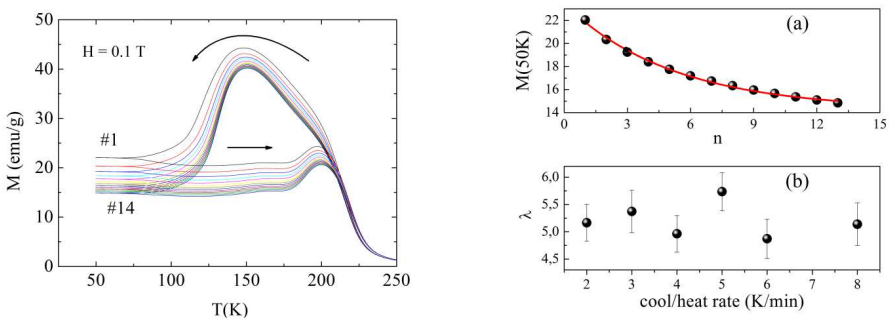
Magnetization in La0.5Ca0.5MnO3 decreases with each thermal cycle between 300 K and 50 K according to a phenomenological model.
A machine-rendered reading of the paper's core claim, the machinery that carries it, and where it could break.
Core claim
In La0.5Ca0.5MnO3, which shows phase coexistence at low temperature, each thermal cycle between 300 K and 50 K produces a further decrease in magnetization. The decrease arises because the fraction of non-ferromagnetic phase grows, driven by strain at the interfaces between the coexisting phases. A phenomenological model reproduces the observed magnetization values after any number of cycles.
What carries the argument
A phenomenological model that correlates the magnetization value after cycling with the exact number of thermal cycles performed.
If this is right
- The magnetization measured at low temperature directly encodes the number of prior thermal cycles.
- The material response can be used to monitor or record cumulative thermal changes.
- The underlying mechanism is an increase in the non-ferromagnetic phase fraction driven by interfacial strain.
- The same cycling protocol applied to similar phase-separated compounds is expected to produce analogous magnetization memory.
Where Pith is reading between the lines
- If the model remains accurate over hundreds of cycles, the compound could function as a passive, non-volatile thermal-cycle counter in sensors or packaging.
- Varying the upper and lower temperature limits of the cycle would test whether the memory effect depends on crossing specific phase-transition temperatures.
- Comparison of magnetization loss rates across different manganite compositions could map how phase coexistence strength controls the memory magnitude.
Load-bearing premise
The magnetization decrease is produced by growth of the non-ferromagnetic phase fraction caused by strain at the interfaces between coexisting phases.
What would settle it
Direct measurement of phase fractions after successive cycles that shows no increase in the non-ferromagnetic volume while magnetization continues to fall, or a clear mismatch between new cycle data and the model's predicted magnetization values.
Figures
read the original abstract
We have studied the irreversibility of the magnetization induced by thermal cycles in La0.5Ca0.5MnO3 manganites, which present a low temperature state characterized by the coexistence of phases. The effect is evidenced by a decrease of the magnetization after cycling the sample between 300 and 50 K. We developed a phenomenological model that allows us to correlate the value of the magnetization with the number of cycles performed. The experimental results show excellent agreement with our model, suggesting that this material could be used for the development of a device to monitor thermal changes. The effect of thermal cycling is towards an increase of the amount of the non ferromagnetic phase in the compounds and it might be directly related with the strain at the contact surface among the coexisting phases.
Editorial analysis
A structured set of objections, weighed in public.
Referee Report
Summary. The manuscript reports an irreversible decrease in low-temperature magnetization of La_{0.5}Ca_{0.5}MnO_3 upon repeated thermal cycling between 300 K and 50 K. The effect is interpreted as an increase in the non-ferromagnetic phase fraction driven by interfacial strain. A phenomenological model is introduced that directly relates the measured magnetization to the number of completed thermal cycles; the experimental magnetization values are stated to show excellent agreement with this model, and a possible application to thermal-monitoring devices is suggested.
Significance. The reported thermal-cycling memory effect in a phase-separated manganite is of interest for understanding the stability of coexisting phases under repeated temperature excursions. The phenomenological correlation between cycle count and magnetization drop, if the parameters can be shown to be independent of the fitted data set, supplies a compact description that could be tested in other compounds. The experimental protocol (magnetization loops after defined cycle numbers) is straightforward and internally consistent.
major comments (2)
- [Phenomenological model (section following experimental results)] The central claim of 'excellent agreement' between data and the phenomenological model rests on the model equations (described after the experimental section). The manuscript provides no information on whether the cycle-dependent scaling parameters were chosen before inspecting the data or optimized afterward, nor are uncertainties or error bars on the magnetization values reported. This information is required to determine whether the agreement constitutes an independent test or a post-hoc fit.
- [Discussion / abstract] The interpretation that the magnetization drop arises specifically from strain-driven growth of the non-FM phase fraction at interfaces is presented as a possible mechanism (final sentence of abstract and discussion). No direct measurement (e.g., local strain or phase-fraction quantification via diffraction or microscopy after cycling) is provided to support this over alternative explanations such as defect accumulation or oxygen migration; the claim is therefore an interpretation rather than a tested conclusion.
minor comments (2)
- [Model equations] Notation for the model parameters should be defined explicitly with symbols and units in a single location to improve readability.
- [Experimental methods] The temperature protocol (ramp rates, dwell times) is described qualitatively; quantitative values would allow exact reproduction of the cycling conditions.
Simulated Author's Rebuttal
We thank the referee for the positive evaluation of our work and for the constructive comments, which help clarify the presentation of the phenomenological model and the status of the proposed mechanism. We respond to each major comment below.
read point-by-point responses
-
Referee: [Phenomenological model (section following experimental results)] The central claim of 'excellent agreement' between data and the phenomenological model rests on the model equations (described after the experimental section). The manuscript provides no information on whether the cycle-dependent scaling parameters were chosen before inspecting the data or optimized afterward, nor are uncertainties or error bars on the magnetization values reported. This information is required to determine whether the agreement constitutes an independent test or a post-hoc fit.
Authors: The functional form of the model was selected on physical grounds (saturation of the effect after repeated cycling due to progressive interface modification) before any numerical comparison to the data sets. The two scaling parameters were then determined by matching the overall trend. To remove any ambiguity, the revised manuscript will include an explicit statement of this procedure together with error bars on the magnetization values (smaller than the plotted symbols). These additions will allow readers to judge the independence of the test. revision: partial
-
Referee: [Discussion / abstract] The interpretation that the magnetization drop arises specifically from strain-driven growth of the non-FM phase fraction at interfaces is presented as a possible mechanism (final sentence of abstract and discussion). No direct measurement (e.g., local strain or phase-fraction quantification via diffraction or microscopy after cycling) is provided to support this over alternative explanations such as defect accumulation or oxygen migration; the claim is therefore an interpretation rather than a tested conclusion.
Authors: We agree that the strain-driven interface mechanism remains an interpretation; the present study contains no local structural or microscopic data that would distinguish it from alternatives such as defect accumulation. The suggestion is motivated by the established role of interfacial strain in phase-separated manganites. In the revised version we will rephrase the abstract and discussion to present the mechanism as a plausible explanation consistent with the observations, while noting that other processes cannot be ruled out without further experiments. revision: yes
Circularity Check
No significant circularity detected
full rationale
The paper develops an explicitly phenomenological model to correlate magnetization values with thermal cycle count and reports agreement with its own experimental data. No equations, self-citations, or uniqueness claims are provided that would reduce the central correlation to a tautology or to a fit renamed as a prediction. The model is presented as a descriptive tool rather than a first-principles derivation, and the agreement is framed as empirical validation within the stated scope. No load-bearing steps match the enumerated circularity patterns.
Axiom & Free-Parameter Ledger
free parameters (1)
- cycle-dependent scaling parameters in the phenomenological model
axioms (1)
- domain assumption Magnetization decrease is produced by growth of the non-ferromagnetic phase fraction due to interfacial strain
Reference graph
Works this paper leans on
-
[1]
Introduction Phase separated manganites [1], have been the focus of extensive research during the last 15 years due to the high interplay between their electric, magnetic and stru ctural degrees of freedom. That interplay gives ris e to a wide variety of physical properties with many potential technological applications, as for example the colo ssal magne...
-
[2]
We followed the route detailed in [27] to obtain a sample with 950 nm average grain size
Experimental Polycrystalline samples of LCMO were synthesized by Liquid Mix. We followed the route detailed in [27] to obtain a sample with 950 nm average grain size. Che mical composition and crystalline structure were ve rified by EDS and X ray diffraction, respectively. Magnetizat ion measurements were performed in a commercial vib rating sample magnet...
-
[3]
Results In figure 1 we present the Magnetization as a funct ion of Temperature, for consecutive thermal cycles. We can see that Magnetization below 200 K monotonously dec reases on each cycle. The low temperature magnetiza tion of LCMO is a direct measure of the relative FM fractio n [27,32]. Thus, our results indicate a cumulative reduction of the relati...
work page 2018
-
[4]
Conclusions In conclusion, we observed that thermal cycles indu ce changes in the low temperature magnetic properti es of LCMO, which is a prototypical manganite exhibiting PS. The observed changes are related with variation s in the relative content of the coexisting phases and are l ikely to occur due to the appearance of defects in the interfaces betwe...
work page 2001
discussion (0)
Sign in with ORCID, Apple, or X to comment. Anyone can read and Pith papers without signing in.