Structural, optical and magnetic properties of nanostructured Cr-substituted Ni-Zn spinel ferrites synthesized by a microwave combustion method
Pith reviewed 2026-05-24 14:04 UTC · model grok-4.3
The pith
Cr substitution in Ni-Zn ferrites raises saturation magnetization to 70 emu/g, narrows the band gap, and boosts dye degradation to 30 percent.
A machine-rendered reading of the paper's core claim, the machinery that carries it, and where it could break.
Core claim
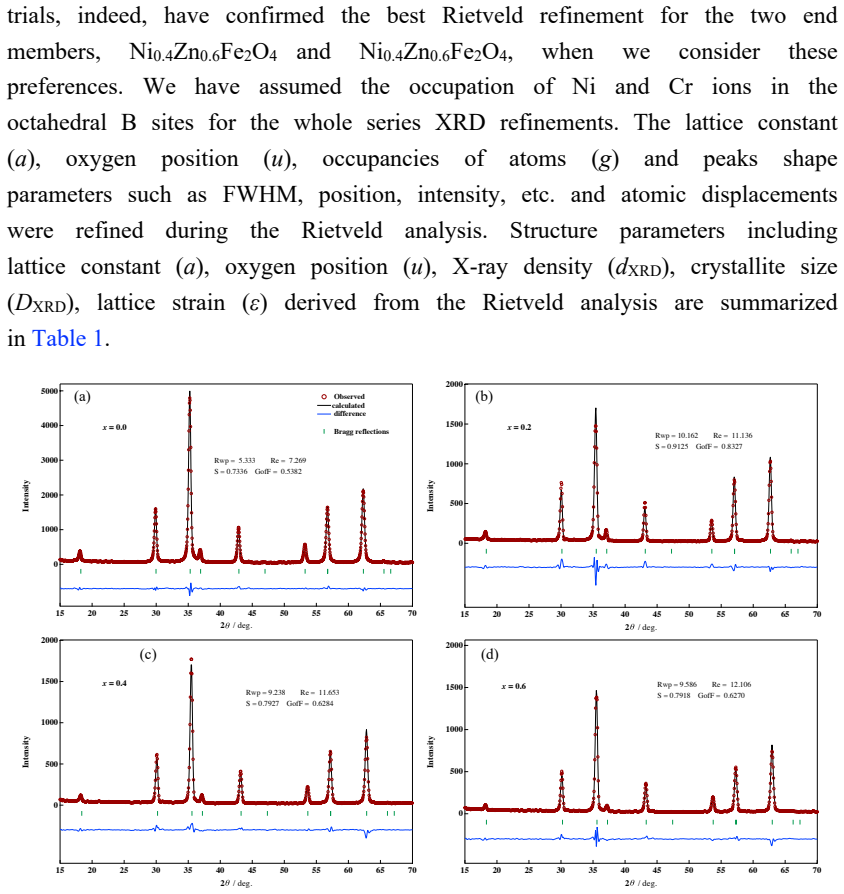
Nanoparticles with formula Ni0.4Zn0.6-xCrxFe2O4 (x = 0.0-0.6) form a single spinel phase whose lattice parameter falls monotonically with chromium content in line with Vegard's law. Rietveld and XPS data show chromium prefers B sites, increasing the inversion factor and producing the charge-balanced composition (Ni2+)0.4(Zn2+, Cr3+)0.6(Fe2+, Fe3+)2(O2-)4. Optical spectra indicate allowed direct transitions whose energy decreases from 3.9 eV to 3.7 eV, while room-temperature VSM data record saturation magnetization rising from about 60 to 70 emu/g at x = 0.1 and coercivity increasing throughout the series; photocatalytic tests show methyl orange decomposition reaching 30 percent for the x = 0
What carries the argument
Cr3+ B-site preference in the spinel lattice that raises the inversion factor and forces partial Fe3+ to Fe2+ reduction to maintain charge neutrality.
If this is right
- Lattice parameter decreases steadily with rising chromium content following Vegard's law for solid solutions.
- Band gap energy falls from 3.9 eV to 3.7 eV while optical transitions remain direct and allowed.
- Photocatalytic methyl orange degradation reaches 30 percent after six hours for the x = 0.6 composition.
- Saturation magnetization of the base Ni-Zn ferrite increases from 60 to 70 emu/g at x = 0.1.
- Coercivity rises across the entire chromium doping range from 0 to 0.6.
Where Pith is reading between the lines
- The peak magnetization at low chromium levels could be tested in other spinel hosts to see whether the same B-site preference produces comparable gains without zinc.
- The microwave route that yields 23-32 nm particles might allow rapid adjustment of inversion factor in related ferrites for combined magnetic and catalytic uses.
- If particle-size distribution is narrowed further, the observed coercivity rise might separate more cleanly from the cation-inversion contribution.
Load-bearing premise
All measured changes in lattice size, band gap, magnetization, and photocatalytic rate are caused only by the chromium substitution and resulting cation rearrangement rather than by differences in synthesis conditions or undetected impurities.
What would settle it
Synthesis of the same nominal compositions under identical microwave conditions but with no observed change in saturation magnetization or band gap when chromium content is varied would falsify the claimed causal link.
Figures


read the original abstract
Nanoparticles of Cr3+-substituted Ni-Zn ferrites with a general formula Ni0.4Zn0.6-xCrxFe2O4 (x = 0.0 - 0.6) have been synthesized via a facile microwave combustion route. The crystalline phase has been characterized by XRD, TEM, FT-I and XPS revealing the spinel ferrite structure without extra phases. Crystallite sizes of 23 - 32 nm as estimated by XRD analyses, after corrections for crystal stains by Williamson-Hall method, are comparable to the average particle sizes observed by TEM which indicates successfully synthesized nanocrystals. Rietveld refinement analyses of the XRD patterns have inferred a monotonic decrease behavior of the lattice parameter with Cr doping in agreement with Vegard's law of solid solution series. Furthermore, cations distribution with an increased inversion factor indicate the B-site preference of Cr3+ ions. The oxidation states and cations distribution indicated by XPS results imply the Cr3+ doping on the account of Zn2+ ions and a partial reduction of Fe3+ to Fe2+ to keep the charge balance in a composition series of (Ni2+)0.4(Zn2+, Cr3+)0.6(Fe2+, Fe3+)2(O2-)4. The optical properties were explored by optical UV-Vis spectroscopy indicating allowed direct transitions with band gap energy that decreases from 3.9 eV to 3.7 eV with Cr doping. Furthermore, the photocatalytic activity for the degradation of methyl orange (MO) dye was investigated showing largely enhanced photodecomposition up to 30% of MO dye over Ni0.4Cr0.6Fe2O4 for 6 hours. A vibrating sample magnetometry (VSM) measurements at room temperature show further enhancement in the saturation magnetization of Ni0.4Zn0.6Fe2O4 , the highest in Ni-Zn ferrites, from about 60 to 70 emu/g with the increase of Cr concentration up to x = 0.1, while the coercivity shows a general increase in the whole range of Cr doping.
Editorial analysis
A structured set of objections, weighed in public.
Referee Report
Summary. The manuscript reports the microwave combustion synthesis of Cr-substituted Ni0.4Zn0.6-xCrxFe2O4 (x = 0.0–0.6) nanoparticles. Using XRD with Rietveld refinement, TEM, FTIR, XPS, UV-Vis, and VSM, it claims a pure spinel phase with crystallite sizes 23–32 nm, monotonic decrease in lattice parameter per Vegard's law, increased inversion with B-site Cr3+ preference, XPS-derived cation distribution implying partial Fe3+→Fe2+ reduction, direct band-gap reduction from 3.9 eV to 3.7 eV, up to 30% methyl-orange photodegradation at x=0.6, and saturation magnetization increase from ~60 to 70 emu/g at x=0.1 with rising coercivity.
Significance. If the observed trends prove robustly attributable to Cr substitution rather than synthesis artifacts, the work supplies additional experimental data on how Cr3+ affects cation inversion, optical gap, photocatalysis, and room-temperature magnetism in Ni-Zn ferrites. The use of multiple orthogonal techniques (XRD/Rietveld, TEM, XPS, VSM) is a strength, but the modest effect sizes and absence of quantified uncertainties limit the potential impact on the field.
major comments (3)
- [Abstract] Abstract and Results (VSM, UV-Vis, photocatalysis paragraphs): the central claims of Ms rising from ~60 to 70 emu/g at x=0.1, Eg falling from 3.9 to 3.7 eV, and 30% MO degradation at x=0.6 are presented without error bars, replicate statistics, or uncertainty estimates; this directly undermines that the modest shifts arise from Cr incorporation rather than crystallite-size variation (23–32 nm) or undetected synthesis differences.
- [Experimental] Experimental section (synthesis paragraph): full microwave-combustion parameters (power, duration, precursor masses, atmosphere) and any exclusion criteria for batches are omitted, leaving open the possibility that property changes reflect uncontrolled process variation instead of the reported cation distribution.
- [XPS analysis] XPS and cation-distribution discussion: the inferred composition (Ni2+)0.4(Zn2+,Cr3+)0.6(Fe2+,Fe3+)2(O2-)4 and partial Fe3+→Fe2+ reduction rest on standard XPS peak fitting without reported uncertainties, raw spectra, or quantitative fitting residuals, weakening the charge-balance argument that underpins the inversion and magnetic interpretation.
minor comments (2)
- [Abstract] Abstract contains the abbreviation 'FT-I' (presumably FTIR) and a minor grammatical issue in the VSM sentence ('show further enhancement... while the coercivity shows').
- [Experimental] No mention of how many independent syntheses or measurements underlie the reported trends; adding this would strengthen the experimental section without altering the central claims.
Simulated Author's Rebuttal
We thank the referee for the constructive comments, which help improve the clarity and robustness of our manuscript. We address each major comment point by point below, indicating where revisions will be made.
read point-by-point responses
-
Referee: [Abstract] Abstract and Results (VSM, UV-Vis, photocatalysis paragraphs): the central claims of Ms rising from ~60 to 70 emu/g at x=0.1, Eg falling from 3.9 to 3.7 eV, and 30% MO degradation at x=0.6 are presented without error bars, replicate statistics, or uncertainty estimates; this directly undermines that the modest shifts arise from Cr incorporation rather than crystallite-size variation (23–32 nm) or undetected synthesis differences.
Authors: We agree that explicit uncertainty estimates and replicate statistics would strengthen confidence in the modest effect sizes. The reported Ms, Eg, and degradation values were obtained from standard single-run analyses (VSM hysteresis loops, Tauc plots, and UV-Vis absorbance), with trends supported by monotonic behavior across compositions and consistency with Vegard's law from Rietveld-refined XRD. Crystallite-size effects were already corrected via Williamson-Hall. Since replicate syntheses per composition were not performed, statistical error bars from multiple batches cannot be added. In revision we will include estimated uncertainties from fitting procedures and instrument specifications, plus a limitations paragraph noting the single-batch nature of the data. revision: partial
-
Referee: [Experimental] Experimental section (synthesis paragraph): full microwave-combustion parameters (power, duration, precursor masses, atmosphere) and any exclusion criteria for batches are omitted, leaving open the possibility that property changes reflect uncontrolled process variation instead of the reported cation distribution.
Authors: The referee correctly identifies that detailed synthesis parameters were omitted. We will expand the Experimental section in the revised manuscript to report the complete microwave-combustion conditions (power, duration, exact precursor masses, and atmosphere) together with a statement that all prepared batches were characterized without exclusion. This will allow readers to assess process reproducibility. revision: yes
-
Referee: [XPS analysis] XPS and cation-distribution discussion: the inferred composition (Ni2+)0.4(Zn2+,Cr3+)0.6(Fe2+,Fe3+)2(O2-)4 and partial Fe3+→Fe2+ reduction rest on standard XPS peak fitting without reported uncertainties, raw spectra, or quantitative fitting residuals, weakening the charge-balance argument that underpins the inversion and magnetic interpretation.
Authors: We acknowledge that transparency would be improved by additional XPS documentation. The cation distribution and partial Fe reduction were derived from standard peak fitting using literature binding energies and charge-balance constraints. In the revised manuscript we will add the raw high-resolution XPS spectra (and survey spectra) to the Supplementary Information, report fitting residuals, and include estimated uncertainties on atomic percentages. This will better support the charge-balance interpretation linking XPS to the observed magnetic trends. revision: yes
Circularity Check
No circularity: purely experimental measurements with no derivations or predictions
full rationale
The paper reports synthesis of nanoparticles followed by standard characterization (XRD with Rietveld, TEM, FT-IR, XPS, UV-Vis for band gap via Tauc, VSM, photocatalytic tests). No equations, models, or 'predictions' are claimed; all reported values (lattice parameters, crystallite sizes, band gaps, Ms, degradation %) are direct experimental outputs or standard analysis results. No self-citations, fitted parameters renamed as predictions, or self-definitional steps appear. The central claims rest on measured data, not on any chain that reduces to its own inputs by construction.
Axiom & Free-Parameter Ledger
axioms (1)
- domain assumption Vegard's law governs the monotonic lattice-parameter decrease with Cr substitution in the solid-solution series
Reference graph
Works this paper leans on
-
[1]
Introduction Magnetic spinels, AB2O4 with A and B are divalent and/or trivalent transition metals, have attracted much interest particularly in nanosized forms because of their fascinating magnetic, optical and electrical properties with theoretical and technological values [1–5]. Among spinel compounds, spinel ferrites (AFe2O4) have most remarkable featu...
-
[2]
Results and discussion 3.1.X-ray diffraction and structural properties The X-ray diffraction patterns for the Ni0.4Zn0.6−xCrxFe2O4 series are shown in Fig. 1(a). The diffraction patterns exhibit a crystalline nature with all possible reflections belong to a spinel ferrite phase, indexed in the figure, without no impurity peaks were detected. The line broa...
-
[3]
XRD and FT-IR clearly exhibited the formation of single-phase spinel ferrite
Conclusion Microwave combustion process was successfully used to fabricate Ni0.4Zn0.6−xCrxFe2O4 nanoparticles. XRD and FT-IR clearly exhibited the formation of single-phase spinel ferrite. The lattice parameters decreased with increasing Cr ion content owing to its smaller ionic radius in compared to Zn ion the octahedral coordination. The crystallite siz...
discussion (0)
Sign in with ORCID, Apple, or X to comment. Anyone can read and Pith papers without signing in.