Discrete Bessel and Mathieu functions
Pith reviewed 2026-05-24 13:05 UTC · model grok-4.3
The pith
The Helmholtz equation with discrete dihedral symmetry yields discrete Bessel and Mathieu functions that closely approximate the continuous versions.
A machine-rendered reading of the paper's core claim, the machinery that carries it, and where it could break.
Core claim
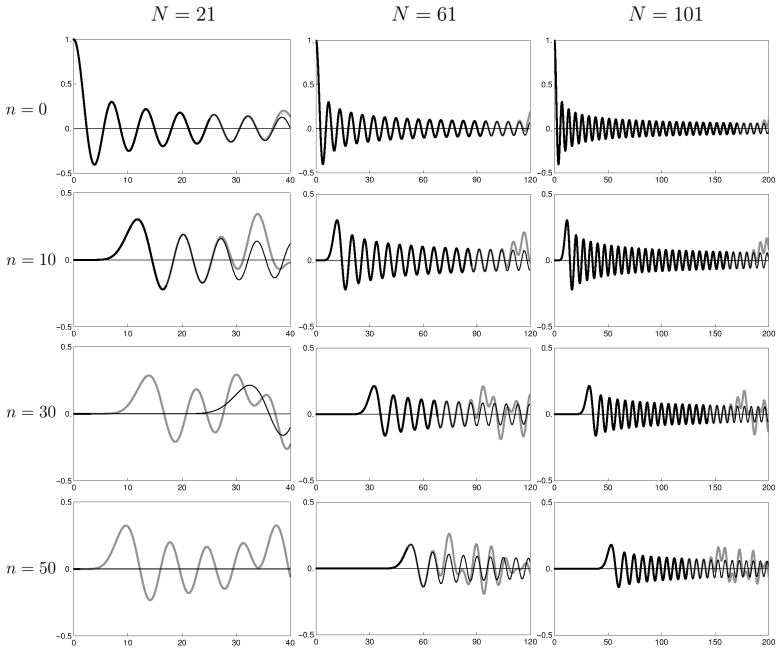
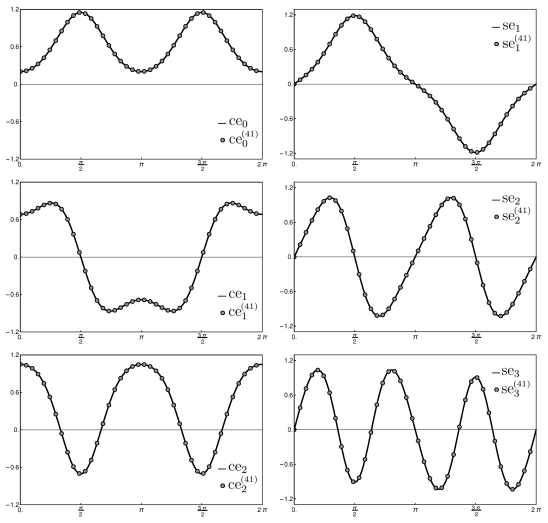
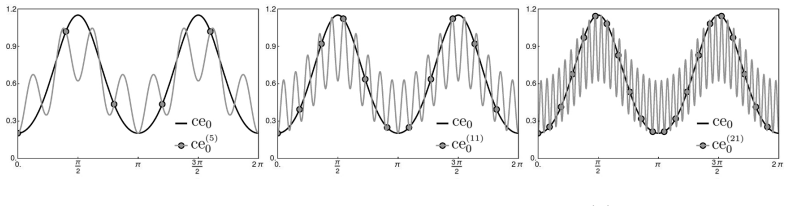
Replacing the invariance under the continuous Euclidean orthogonal group by invariance under the discrete dihedral group of N rotations and reflections allows separation of variables in the Helmholtz equation to define discrete Bessel and Mathieu functions. These functions are constructed explicitly through finite sums that parallel the N-point Fourier transform, and direct numerical evaluation shows they approximate the values of the continuous functions very closely while preserving key special-function relations.
What carries the argument
The discrete dihedral group of N rotations and reflections, which replaces the continuous orthogonal group so that separation of variables produces functions defined by finite sums rather than integrals.
If this is right
- The discrete functions approximate the numerical values of continuous Bessel and Mathieu functions very closely.
- They preserve some key special function relations.
- The construction uses N-point Fourier transforms in place of the continuous Fourier transform over the circle.
Where Pith is reading between the lines
- The same replacement of continuous by discrete symmetry could be applied to other equations or coordinate systems that admit separation of variables.
- For large N the approximation error is expected to decrease, allowing systematic improvement toward the continuous limit.
- Direct use on finite point sets invariant under dihedral symmetry may avoid interpolation steps required when using continuous special functions.
- Comparison of these sum-based definitions with other discrete analogues, such as those from finite-difference schemes, could highlight which analytic properties survive discretization.
- keywords:[
Load-bearing premise
That separation of variables for the Helmholtz equation remains valid and produces well-defined functions when continuous rotations are replaced by the finite dihedral group.
What would settle it
Numerical evaluation for a fixed N showing that the discrete functions differ by more than a few percent from the continuous Bessel or Mathieu values at corresponding arguments, or that a preserved recurrence relation fails to hold.
Figures
read the original abstract
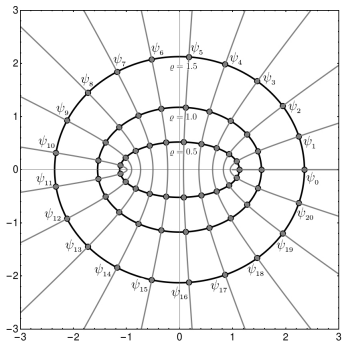
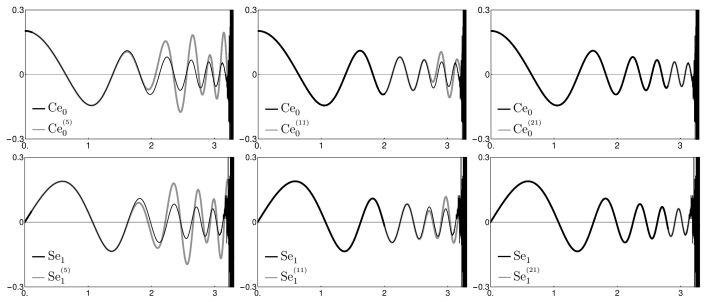
The two-dimensional Helmholtz equation separates in elliptic coordinates based on two distinct foci, a limit case of which includes polar coordinate systems when the two foci coalesce. This equation is invariant under the Euclidean group of translations and orthogonal transformations; we replace the latter by the discrete dihedral group of N discrete rotations and reflections. The separation of variables in polar and elliptic coordinates is then used to define discrete Bessel and Mathieu functions, as approximants to the well-known continuous Bessel and Mathieu functions, as N-point Fourier transforms approximate the Fourier transform over the circle, with integrals replaced by finite sums. We find that these 'discrete' functions approximate the numerical values of their continuous counterparts very closely and preserve some key special function relations.
Editorial analysis
A structured set of objections, weighed in public.
Referee Report
Summary. The manuscript defines discrete Bessel and Mathieu functions by replacing the continuous O(2) invariance of the 2D Helmholtz equation with the finite dihedral group D_N, using N-point sums in place of angular integrals during separation of variables in polar and elliptic coordinates. These discrete functions are presented as approximants to the classical continuous versions, with the central claims being close numerical agreement and preservation of some key special-function relations.
Significance. The explicit, parameter-free discretization (directly analogous to the DFT approximating the circle Fourier transform) is a clear strength and could be useful for finite-symmetry problems if the approximation quality is quantified. The construction follows immediately from the group replacement and does not rely on unstated assumptions about the separated ODEs remaining exactly satisfied.
major comments (2)
- [Abstract] Abstract: the assertion that the discrete functions 'approximate the numerical values of their continuous counterparts very closely' is not supported by any quantitative error measures (e.g., maximum absolute or relative deviations, L2 norms, or tabulated values for representative N, z, and q). This is load-bearing for the main approximation claim.
- [Relations section] Discussion of preserved relations: it is not shown whether the claimed relations follow algebraically from the finite-sum definitions or are only observed numerically after the fact; an explicit verification or derivation from the N-point sums is needed to substantiate the second central claim.
minor comments (2)
- Notation for the discrete functions (e.g., J_n^{(N)}(z) or similar) should be introduced once and used consistently to avoid confusion with the continuous case.
- Figure captions and axis labels in any numerical comparison plots should explicitly state the value of N and the range of the continuous parameter being compared.
Simulated Author's Rebuttal
We thank the referee for the careful reading, positive assessment, and recommendation for minor revision. The comments highlight two areas where the manuscript can be strengthened with explicit quantitative support and derivations. We address each point below and have revised the manuscript accordingly.
read point-by-point responses
-
Referee: [Abstract] Abstract: the assertion that the discrete functions 'approximate the numerical values of their continuous counterparts very closely' is not supported by any quantitative error measures (e.g., maximum absolute or relative deviations, L2 norms, or tabulated values for representative N, z, and q). This is load-bearing for the main approximation claim.
Authors: We agree that the original manuscript relied on visual agreement in figures without providing explicit quantitative error metrics. In the revised version we have added a new subsection (Section 4.3) containing tabulated maximum absolute deviations, relative errors, and discrete L2 norms for representative values of N (8, 16, 32), z, and q. These tables directly quantify the approximation quality and support the claim in the abstract with concrete numbers. revision: yes
-
Referee: [Relations section] Discussion of preserved relations: it is not shown whether the claimed relations follow algebraically from the finite-sum definitions or are only observed numerically after the fact; an explicit verification or derivation from the N-point sums is needed to substantiate the second central claim.
Authors: The referee correctly notes that the manuscript did not explicitly derive the relations from the finite-sum definitions. Several key relations (recurrence relations, orthogonality, and certain addition formulas) follow algebraically from the discrete orthogonality of the N-point sums and the underlying group representation; we have added explicit derivations of these in a new subsection. For relations that hold only approximately we now state the numerical error bounds and clarify their status. This provides the requested algebraic verification where possible. revision: yes
Circularity Check
No significant circularity identified
full rationale
The paper explicitly constructs the discrete Bessel and Mathieu functions by replacing the continuous Euclidean invariance with the finite dihedral group D_N and substituting N-point sums for angular integrals in the separated solutions of the Helmholtz equation. This is presented as a direct discretization analogous to the DFT, with the functions defined to be the resulting approximants. The subsequent numerical checks of closeness to continuous counterparts and preservation of selected relations follow immediately from this definition without any fitted parameters, self-referential normalizations, or load-bearing self-citations. The derivation chain is therefore self-contained and does not reduce any claimed result to its own inputs by construction.
Axiom & Free-Parameter Ledger
axioms (1)
- domain assumption The two-dimensional Helmholtz equation separates in elliptic coordinates and remains separable when the continuous orthogonal group is replaced by the finite dihedral group.
Reference graph
Works this paper leans on
-
[1]
Miller Jr., Symmetry and Separation of Variables , Encyclopedia of Mathematics, Vol
W. Miller Jr., Symmetry and Separation of Variables , Encyclopedia of Mathematics, Vol. 4 (Cambridge Univerity Press, 1984)
work page 1984
-
[2]
G. Biagetti, P. Crippa, L. Falaschetti, and C. Turchetti, Discrete Bessel functions for representing the Class of Finite Duration Decaying Se- quences, European Signal Analysis Conference, pp. 2126–2130 (Bu- dapest, 2016)
work page 2016
-
[3]
Discrete Bessel functions and transform
K. Uriostegui and K.B. Wolf, Discrete Bessel functions and transform, (submitted) arXiv:2005.06076 [math-ph]
work page internal anchor Pith review Pith/arXiv arXiv 2005
-
[4]
Boyer, Discrete Bessel functions, J
R.H. Boyer, Discrete Bessel functions, J. Math. Anal. Appl. 2, 509–524 (1961)
work page 1961
-
[5]
M. Bohner and T. Cuchta, The Bessel difference equation, Proc. Amer. Math. Soc. 145, 1567–1580 (2017)
work page 2017
-
[6]
Slav´ ık, Discrete Bessel functions and partial differential equations,J
A. Slav´ ık, Discrete Bessel functions and partial differential equations,J. Diff. Eqs. Applics. DOI:10.1080/10236198.2017.141610 (2017)
-
[7]
I.S. Gradshteyn and I.M. Ryzhik, Tables of Integrals, Series and Prod- ucts, A. Jeffrey and D. Zwillinger Eds, (Academic Press, 2007)
work page 2007
-
[8]
Watson, Theory of Bessel Functions (Cambridge University Press, 1922)
G.N. Watson, Theory of Bessel Functions (Cambridge University Press, 1922)
work page 1922
-
[9]
Erd´ elyiet al., Higher Transcendental Functions (Based on notes by H
A. Erd´ elyiet al., Higher Transcendental Functions (Based on notes by H. Bateman) Vol. 2 (McGraw-Hill, New York, 1953)
work page 1953
-
[10]
P. Winternitz, K.B. Wolf, G.S. Pogosyan, and A.N. Sissakian, Graf’s addition theorem obtained from SO(3) contraction, Theor. Mat. Phys. 129, 1501–1503 (2001)
work page 2001
-
[11]
McLachlan, Theory and Application of Mathieu Functions(Oxford University Press, 1947)
N.W. McLachlan, Theory and Application of Mathieu Functions(Oxford University Press, 1947)
work page 1947
-
[12]
L. Chaos-Cador and E. Ley-Koo, Mathieu functions, matrix evaluation, and generating functions, Rev. Mex. F´ ıs.48, 67–75 (2002). 16
work page 2002
discussion (0)
Sign in with ORCID, Apple, or X to comment. Anyone can read and Pith papers without signing in.