Synthetic likelihood in misspecified models
Pith reviewed 2026-05-24 13:22 UTC · model grok-4.3
The pith
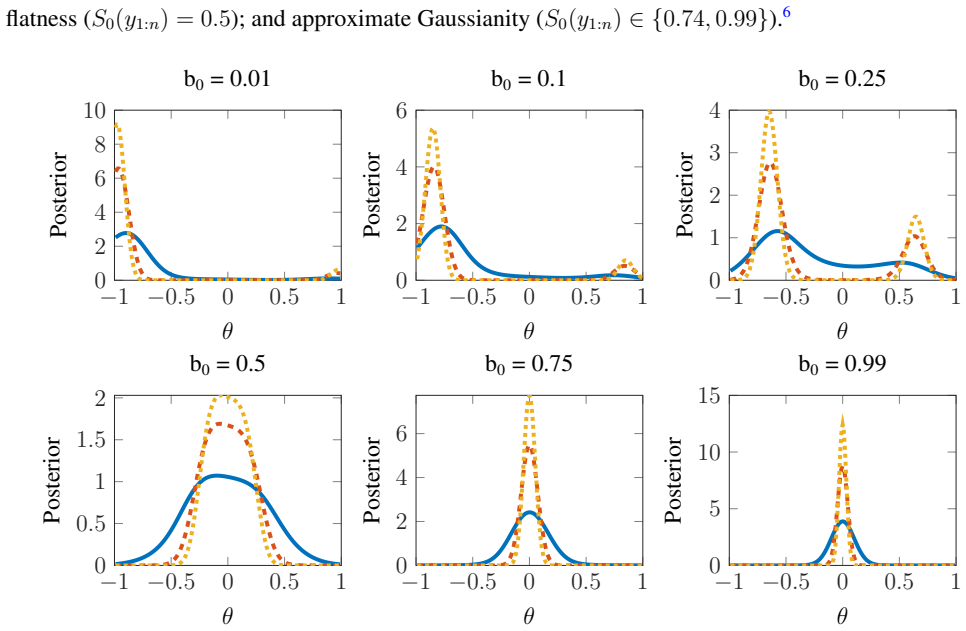
Bayesian synthetic likelihood posteriors can become multimodal or asymptotically non-Gaussian under model misspecification.
A machine-rendered reading of the paper's core claim, the machinery that carries it, and where it could break.
Core claim
When the model is misspecified, the Bayesian synthetic likelihood posterior can display multimodality and asymptotic non-Gaussianity. Likelihood tempering fails for synthetic likelihood, but recently proposed robust synthetic likelihood approaches can ameliorate this behavior and deliver reliable posterior inference under model misspecification.
What carries the argument
The Bayesian synthetic likelihood posterior, constructed by approximating the likelihood via summaries of simulated data from the assumed model.
If this is right
- The posterior may fail to concentrate around any single value as data volume grows.
- Standard likelihood tempering cannot be relied upon to restore robustness.
- Robust synthetic likelihood variants become necessary for stable inference.
- Posterior behavior varies systematically with the level of misspecification.
Where Pith is reading between the lines
- Practitioners may need to inspect synthetic likelihood posteriors for multiple modes before trusting point estimates.
- The results suggest that simulation-based inference methods require misspecification diagnostics tailored to the summary statistics used.
- Similar non-standard behavior could appear in other simulation-based approaches that rely on matching simulated and observed summaries.
Load-bearing premise
The non-standard behaviors observed in the simple running example generalize to the complex models where synthetic likelihood is typically used.
What would settle it
Apply Bayesian synthetic likelihood to a complex simulation model with controlled levels of misspecification and check whether the posterior becomes multimodal or loses asymptotic normality as the misspecification increases.
Figures





read the original abstract
Bayesian synthetic likelihood is a widely used approach for conducting Bayesian analysis in complex models where evaluation of the likelihood is infeasible but simulation from the assumed model is tractable. We analyze the behaviour of the Bayesian synthetic likelihood posterior when the assumed model differs from the actual data generating process. We demonstrate that the Bayesian synthetic likelihood posterior can display a wide range of non-standard behaviours depending on the level of model misspecification, including multimodality and asymptotic non-Gaussianity. Our results suggest that likelihood tempering, a common approach for robust Bayesian inference, fails for synthetic likelihood whilst recently proposed robust synthetic likelihood approaches can ameliorate this behavior and deliver reliable posterior inference under model misspecification. All results are illustrated using a simple running example.
Editorial analysis
A structured set of objections, weighed in public.
Referee Report
Summary. The paper analyzes the Bayesian synthetic likelihood (SL) posterior under model misspecification. It claims that this posterior can exhibit a range of non-standard behaviors, including multimodality and asymptotic non-Gaussianity, depending on the degree of misspecification. Likelihood tempering is shown to fail in this setting, while recently proposed robust SL methods succeed in delivering reliable posterior inference. All claims and illustrations are based on a single simple running example.
Significance. If the observed pathologies generalize beyond the simple example, the work would be significant for highlighting risks in standard SL and tempering under misspecification and for supporting robust alternatives in simulation-based inference. The paper does not provide machine-checked proofs or reproducible code for the claims.
major comments (2)
- [Abstract / running example] Abstract and running-example section: the central claims (multimodality, asymptotic non-Gaussianity, failure of tempering, success of robust SL) are demonstrated exclusively in a simple low-dimensional model where misspecification can be varied directly. No theorem, high-dimensional numerical example, or standard SL application (e.g., g-and-k or SDE) is provided to show that these behaviors persist when summary statistics are high-dimensional or the simulator is complex and only partially misspecified.
- [Abstract] The weakest-assumption paragraph and the abstract together indicate that the paper assumes behaviors observed in the simple example generalize to the complex models that motivate SL; this assumption is load-bearing for the practical implications but is not tested or proved.
Simulated Author's Rebuttal
We thank the referee for their detailed and constructive report. We address the major comments point by point below. Our response acknowledges the illustrative nature of the running example while clarifying the paper's scope and intent.
read point-by-point responses
-
Referee: [Abstract / running example] Abstract and running-example section: the central claims (multimodality, asymptotic non-Gaussianity, failure of tempering, success of robust SL) are demonstrated exclusively in a simple low-dimensional model where misspecification can be varied directly. No theorem, high-dimensional numerical example, or standard SL application (e.g., g-and-k or SDE) is provided to show that these behaviors persist when summary statistics are high-dimensional or the simulator is complex and only partially misspecified.
Authors: We agree that all demonstrations are confined to the simple low-dimensional running example. This choice was deliberate to permit direct and transparent variation of the misspecification level, enabling clear illustration of the resulting posterior pathologies without confounding factors. The manuscript does not contain a general theorem because its contribution is to identify and exhibit these non-standard behaviors rather than to establish their universality. We will add a dedicated discussion paragraph on the potential extension of these phenomena to higher-dimensional or partially misspecified settings, though we do not claim to resolve that extension here. revision: partial
-
Referee: [Abstract] The weakest-assumption paragraph and the abstract together indicate that the paper assumes behaviors observed in the simple example generalize to the complex models that motivate SL; this assumption is load-bearing for the practical implications but is not tested or proved.
Authors: The abstract and the weakest-assumption paragraph are written to indicate that the pathologies can arise under misspecification, thereby motivating caution with standard SL and tempering. We do not assert or prove that the behaviors always generalize. We will revise both the abstract and the relevant paragraph to state more explicitly that the results are obtained in a controlled illustrative example and that further study in complex simulators is needed to assess prevalence. revision: yes
Circularity Check
No circularity; results are direct simulation in running example
full rationale
The paper states that all results are illustrated using a simple running example and contains no claimed general derivation, theorem, or prediction that reduces by construction to fitted inputs, self-citations, or ansatzes. The demonstrations of multimodality and non-Gaussianity are obtained by direct computation on the example under controlled misspecification levels; no step equates a 'prediction' to a quantity defined from the same data or prior author work. Self-citations, if present for robust SL methods, are not load-bearing for the core observations. The chain is therefore self-contained as an illustrative study.
Axiom & Free-Parameter Ledger
Reference graph
Works this paper leans on
-
[1]
Allingham, D., King, R., and Mengersen, K. (2009). B ayesian estimation of quantile distributions. Statistics and Computing , 19:189--201
work page 2009
-
[2]
An, Z., Nott, D. J., and Drovandi, C. (2020). Robust B ayesian synthetic likelihood via a semi-parametric approach. Statistics and Computing , 30(3):543--557
work page 2020
-
[3]
An, Z., South, L. F., and Drovandi, C. (2019). BSL : An R package for efficient parameter estimation for simulation-based models via B ayesian synthetic likelihood. arXiv preprint arXiv:1907.10940
work page internal anchor Pith review Pith/arXiv arXiv 2019
-
[4]
Bhattacharya, A., Pati, D., Yang, Y., et al. (2019). B ayesian fractional posteriors. The Annals of Statistics , 47(1):39--66
work page 2019
-
[5]
Bissiri, P. G., Holmes, C. C., and Walker, S. G. (2016). A general framework for updating belief distributions. Journal of the Royal Statistical Society. Series B, Statistical methodology , 78(5):1103
work page 2016
-
[6]
Chen, C.-F. (1985). On asymptotic normality of limiting density functions with B ayesian implications. Journal of the Royal Statistical Society: Series B (Methodological) , 47(3):540--546
work page 1985
-
[7]
Croissant, Y. and Graves, S. (2020). Ecdat: Data Sets for Econometrics . R package version 0.3-7
work page 2020
-
[8]
De Gooijer, J. (1981). An investigation of the moments of the sample autocovariances and autocorrelations for general arma processes. Journal of Statistical Computation and Simulation , 12(3-4):175--192
work page 1981
-
[9]
Drovandi, C. C. and Pettitt, A. N. (2011). Likelihood-free B ayesian estimation of multivariate quantile distributions. 55(9):2541?2556
work page 2011
-
[10]
Frazier, D. T. and Drovandi, C. (2021). Robust approximate B ayesian inference with synthetic likelihood. Journal of Computational and Graphical Statistics , pages 1--39
work page 2021
-
[11]
T., Drovandi, C., and Loaiza-Maya, R
Frazier, D. T., Drovandi, C., and Loaiza-Maya, R. (2020a). Robust approximate B ayesian computation: An adjustment approach. arXiv preprint arXiv:2008.04099
-
[12]
Frazier, D. T., Nott, D. J., Drovandi, C., and Kohn, R. (2021). B ayesian inference using synthetic likelihood: asymptotics and adjustments. arXiv preprint arXiv:1902.04827
-
[13]
Frazier, D. T., Robert, C. P., and Rousseau, J. (2020b). Model misspecification in approximate B ayesian computation: consequences and diagnostics. Journal of the Royal Statistical Society: Series B (Statistical Methodology)
-
[14]
Gr \"u nwald, P., Van Ommen, T., et al. (2017). Inconsistency of B ayesian inference for misspecified linear models, and a proposal for repairing it. B ayesian Analysis , 12(4):1069--1103
work page 2017
-
[15]
A., MacGillivray, H., and Mengersen, K
Haynes, M. A., MacGillivray, H., and Mengersen, K. (1997). Robustness of ranking and selection rules using generalised g-and-k distributions. Journal of Statistical Planning and Inference , 65(1):45--66
work page 1997
- [16]
-
[17]
Kleijn, B. and van der Vaart, A. (2012). The B ernstein-von- M ises theorem under misspecification. Electron. J. Statist. , 6:354--381
work page 2012
-
[18]
Marin, J.-M., Pillai, N. S., Robert, C. P., and Rousseau, J. (2014). Relevant statistics for B ayesian model choice. Journal of the Royal Statistical Society: Series B: Statistical Methodology , pages 833--859
work page 2014
-
[19]
Marin, J.-M., Pudlo, P., Robert, C. P., and Ryder, R. J. (2012). Approximate B ayesian computational methods. Statistics and Computing , 22(6):1167--1180
work page 2012
-
[20]
Miller, J. W. and Dunson, D. B. (2019). Robust B ayesian inference via coarsening. Journal of the American Statistical Association , 114(527):1113--1125
work page 2019
-
[21]
M\" u ller, U. K. (2013). Risk of B ayesian inference in misspecified models, and the sandwich covariance matrix. Econometrica , 81(5):1805--1849
work page 2013
-
[22]
Prangle, D. (2020). gk: An R Package for the g-and-k and generalized g-and-h distributions . The R Journal , 12(1):7--20
work page 2020
-
[23]
Price, L. F., Drovandi, C. C., Lee, A., and Nott, D. J. (2018). B ayesian synthetic likelihood. Journal of Computational and Graphical Statistics , 27(1):1--11
work page 2018
-
[24]
Priddle, J. W., Sisson, S. A., Frazier, D. T., and Drovandi, C. (2019). Efficient B ayesian synthetic likelihood with whitening transformations. arXiv preprint arXiv:1909.04857
-
[25]
Sisson, S. A., Fan, Y., and Beaumont, M. (2018). Handbook of Approximate B ayesian Computation . Chapman and Hall/CRC, New York
work page 2018
-
[26]
Wood, S. N. (2010). Statistical inference for noisy nonlinear ecological dynamic systems. Nature , 466(7310):1102--1104
work page 2010
-
[27]
Yuan, K.-H. and Jennrich, R. I. (1998). Asymptotics of estimating equations under natural conditions. Journal of Multivariate Analysis , 65(2):245--260
work page 1998
discussion (0)
Sign in with ORCID, Apple, or X to comment. Anyone can read and Pith papers without signing in.