An Alternating Direction Method of Multipliers for Inverse Lithography Problem
Pith reviewed 2026-05-24 11:06 UTC · model grok-4.3
The pith
An ADMM algorithm solves inverse lithography optimization by splitting it into subproblems with an analytical solution for the imaging term.
A machine-rendered reading of the paper's core claim, the machinery that carries it, and where it could break.
Core claim
By variable splitting the misfit, binary penalty, and total variation terms, the augmented Lagrangian framework yields subproblems that can be solved efficiently; the imaging subproblem is solved analytically via threshold truncation of the imaging function, and the resulting ADMM iteration converges for the inverse lithography problem.
What carries the argument
Alternating direction method of multipliers applied after variable splitting on the three-term objective, with the imaging subproblem solved by direct threshold truncation.
If this is right
- The binary mask constraint and total variation term can be enforced without solving a full non-smooth optimization at each step.
- The imaging step requires only a simple truncation operation rather than repeated sigmoid evaluations.
- Convergence guarantees apply directly to the split formulation used for lithography mask design.
- Numerical examples confirm that the decomposed iteration produces usable masks for standard test patterns.
Where Pith is reading between the lines
- The same splitting pattern could be tested on other inverse imaging problems that combine fidelity, binarity, and edge-preserving penalties.
- Runtime comparisons against gradient-based or level-set methods on the same mask targets would quantify the practical speedup.
- If the threshold truncation step generalizes, the method may extend to related binary design tasks in optics or materials.
Load-bearing premise
The variable splitting and augmented Lagrangian produce subproblems whose solutions remain efficient and cover the original objective under the specific constraints and regularizers used.
What would settle it
A concrete lithography mask design instance in which the ADMM iterates fail to reduce the misfit below a known lower bound or produce a non-convergent sequence.
Figures
read the original abstract
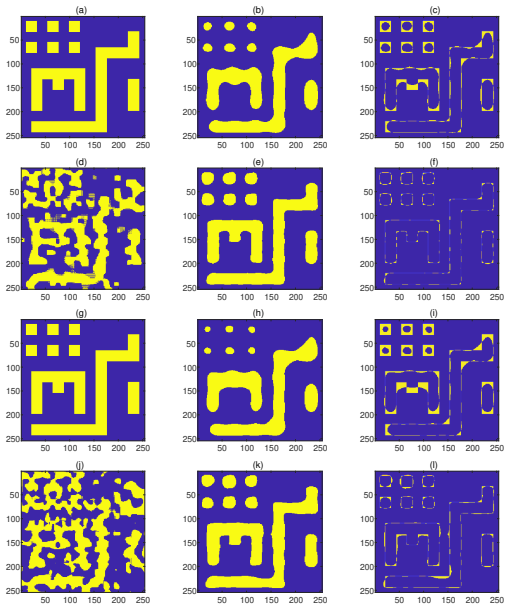
We propose an alternating direction method of multipliers (ADMM) to solve an optimization problem stemming from inverse lithography. The objective functional of the optimization problem includes three terms: the misfit between the imaging on wafer and the target pattern, the penalty term which ensures the mask is binary and the total variation regularization term. By variable splitting, we introduce an augmented Lagrangian for the original objective functional. In the framework of ADMM method, the optimization problem is divided into several subproblems. Each of the subproblems can be solved efficiently. We give the convergence analysis of the proposed method. Specially, instead of solving the subproblem concerning sigmoid, we solve directly the threshold truncation imaging function which can be solved analytically. We also provide many numerical examples to illustrate the effectiveness of the method.
Editorial analysis
A structured set of objections, weighed in public.
Referee Report
Summary. The manuscript proposes an ADMM algorithm for an inverse lithography optimization problem whose objective combines an imaging misfit term, a binary-mask penalty, and total-variation regularization. Variable splitting produces an augmented Lagrangian that is minimized by alternating subproblem solves; the imaging subproblem is replaced by direct threshold truncation (claimed to be analytically solvable) rather than a sigmoid, and a convergence analysis together with numerical examples is supplied.
Significance. If the convergence result can be shown to apply to the threshold-truncation variant, the method would supply a practical, splitting-based solver for a class of non-smooth ILT problems that is currently handled by more expensive gradient or heuristic approaches.
major comments (2)
- [Abstract / convergence section] Abstract (and the convergence-analysis section referenced therein): the statement that 'the convergence analysis of the proposed method' is given is load-bearing, yet the implemented algorithm replaces the sigmoid imaging subproblem by a hard threshold truncation operator. Standard ADMM convergence arguments rely on convexity or Lipschitz continuity of the original proximal mappings; the paper must explicitly verify that the analysis carries over to the non-differentiable, set-valued threshold operator under the binary penalty and TV terms, or supply a separate proof.
- [Method description (variable splitting and subproblem derivation)] The claim that 'each of the subproblems can be solved efficiently' and that the imaging subproblem 'can be solved analytically' via threshold truncation is central to the contribution, but no derivation is supplied showing how the augmented-Lagrangian subproblem for the imaging term reduces exactly to a simple threshold operation once the binary and TV terms are split.
minor comments (1)
- Notation for the imaging operator, the sigmoid approximation, and the threshold truncation should be introduced with explicit functional definitions before they are used in the algorithm statement.
Simulated Author's Rebuttal
We thank the referee for the careful reading and constructive comments on our manuscript. We address the major comments point by point below.
read point-by-point responses
-
Referee: [Abstract / convergence section] Abstract (and the convergence-analysis section referenced therein): the statement that 'the convergence analysis of the proposed method' is given is load-bearing, yet the implemented algorithm replaces the sigmoid imaging subproblem by a hard threshold truncation operator. Standard ADMM convergence arguments rely on convexity or Lipschitz continuity of the original proximal mappings; the paper must explicitly verify that the analysis carries over to the non-differentiable, set-valued threshold operator under the binary penalty and TV terms, or supply a separate proof.
Authors: We thank the referee for this observation. The convergence analysis in the manuscript applies to the ADMM iterates with the specific proximal mappings used, including the threshold truncation (which is the proximal operator of the indicator function of the binary set and hence firmly nonexpansive). The other terms (binary penalty and TV) are also handled via proximal operators of convex functions, satisfying the standard conditions for ADMM convergence. To make the applicability explicit for the threshold operator, we will add a clarifying paragraph in the convergence section of the revised manuscript. revision: partial
-
Referee: [Method description (variable splitting and subproblem derivation)] The claim that 'each of the subproblems can be solved efficiently' and that the imaging subproblem 'can be solved analytically' via threshold truncation is central to the contribution, but no derivation is supplied showing how the augmented-Lagrangian subproblem for the imaging term reduces exactly to a simple threshold operation once the binary and TV terms are split.
Authors: We agree that an explicit derivation strengthens the paper. In the revised manuscript we will insert a step-by-step derivation of the imaging subproblem: after splitting, the relevant augmented-Lagrangian term decouples into a quadratic misfit plus a quadratic penalty on the auxiliary variable; the minimizer is obtained exactly by applying the threshold truncation operator (setting the imaging variable to 1 or 0 according to whether the adjusted target exceeds the threshold determined by the penalty parameter and multiplier). This derivation will be placed immediately after the variable-splitting step. revision: yes
Circularity Check
No circularity; derivation applies standard ADMM to stated objective with explicit modifications
full rationale
The paper states an objective with misfit, binary penalty, and TV terms; introduces variable splitting and augmented Lagrangian; divides into subproblems solved efficiently (imaging via direct threshold truncation instead of sigmoid); and separately states convergence analysis for the resulting algorithm. No equation reduces to an input by construction, no parameter is fitted then renamed as prediction, and no load-bearing claim rests on self-citation or imported uniqueness. The threshold truncation is presented as an explicit replacement for analytical solvability, with the analysis asserted to cover the implemented method. This is self-contained against external benchmarks (standard ADMM theory plus numerical validation).
Axiom & Free-Parameter Ledger
axioms (1)
- standard math Convergence of ADMM iterations under suitable conditions on the objective and splitting
Lean theorems connected to this paper
-
IndisputableMonolith/Foundation/RealityFromDistinction.leanreality_from_one_distinction unclear?
unclearRelation between the paper passage and the cited Recognition theorem.
By variable splitting, we introduce an augmented Lagrangian... instead of solving the subproblem concerning sigmoid, we solve directly the threshold truncation imaging function which can be solved analytically.
-
IndisputableMonolith/Cost/FunctionalEquation.leanwashburn_uniqueness_aczel unclear?
unclearRelation between the paper passage and the cited Recognition theorem.
We give the convergence analysis of the proposed method... assume that ρ/2 − lh/ρ − lh > 0, then there is a subsequence which converges to a stationary point
What do these tags mean?
- matches
- The paper's claim is directly supported by a theorem in the formal canon.
- supports
- The theorem supports part of the paper's argument, but the paper may add assumptions or extra steps.
- extends
- The paper goes beyond the formal theorem; the theorem is a base layer rather than the whole result.
- uses
- The paper appears to rely on the theorem as machinery.
- contradicts
- The paper's claim conflicts with a theorem or certificate in the canon.
- unclear
- Pith found a possible connection, but the passage is too broad, indirect, or ambiguous to say the theorem truly supports the claim.
Reference graph
Works this paper leans on
-
[1]
Inverse lithography technology (ILT): What is the impact to the photomask industry?
L. Pang, Y. Liu, and D. Abrams, “Inverse lithography technology (ILT): What is the impact to the photomask industry?” in Photomask and Next- Generation Lithography Mask Technology XIII , vol. 6283. International Society for Optics and Photonics, 2006, p. 62830X. 1
work page 2006
-
[2]
Introduction to fourier optics,
J. W. Goodman, “Introduction to fourier optics,” Introduction to Fourier optics, 3rd ed., by JW Goodman. Englewood, CO: Roberts & Co. Publishers, 2005, vol. 1, 2005. 1, 2.1, 2.1
work page 2005
-
[3]
Fast pixel-based mask optimization for inverse lithography,
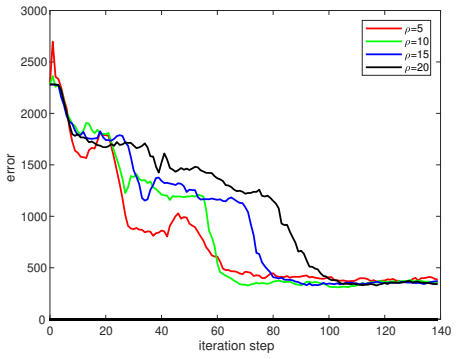
Y. Granik, “Fast pixel-based mask optimization for inverse lithography,” Journal of Micro/Nanolithography, MEMS, and MOEMS , vol. 5, no. 4, p. 043002, 2006. 1 22 0 20 40 60 80 100 120 140 iteration step 0 500 1000 1500 2000 2500 3000error =5 =10 =15 =20 Figure 7: Error decreasing with respect to ρ, with γ = 50,β 1 = 0.005,β 2 = 0.01
work page 2006
-
[4]
Gradient-based source and mask optimization in optical lithography,
Y. Peng, J. Zhang, Y. Wang, and Z. Yu, “Gradient-based source and mask optimization in optical lithography,” IEEE Transactions on image process- ing, vol. 20, no. 10, pp. 2856–2864, 2011. 1
work page 2011
-
[5]
Pixel-based OPC optimization based on conjugate gradients,
X. Ma and G. R. Arce, “Pixel-based OPC optimization based on conjugate gradients,” Optics express, vol. 19, no. 3, pp. 2165–2180, 2011. 1
work page 2011
-
[6]
Inverse image problem of designing phase shifting masks in optical lithography,
S. H. Chan and E. Y. Lam, “Inverse image problem of designing phase shifting masks in optical lithography,” in 2008 15th IEEE International Conference on Image Processing. IEEE, 2008, pp. 1832–1835. 1
work page 2008
-
[7]
S. H. Chan, A. K. Wong, and E. Y. Lam, “Initialization for robust inverse synthesis of phase-shifting masks in optical projection lithography,” Optics Express, vol. 16, no. 19, pp. 14 746–14 760, 2008. 1
work page 2008
-
[8]
Generalized inverse lithography methods for phase- shifting mask design,
X. Ma and G. R. Arce, “Generalized inverse lithography methods for phase- shifting mask design,” Optics Express, vol. 15, no. 23, pp. 15 066–15 079,
-
[9]
Double-exposure mask synthesis us- ing inverse lithography,
A. A. Poonawala and P. Milanfar, “Double-exposure mask synthesis us- ing inverse lithography,” Journal of Micro/Nanolithography, MEMS, and MOEMS, vol. 6, no. 4, p. 043001, 2007. 1
work page 2007
-
[10]
Model-based assist feature placement: an inverse imaging approach,
A. Poonawala, B. Painter, and J. Mayhew, “Model-based assist feature placement: an inverse imaging approach,” in Photomask Technology 2008, vol. 7122. SPIE, 2008, pp. 277–286. 1
work page 2008
-
[11]
Level-set-based inverse lithography for photomask synthesis,
Y. Shen, N. Wong, and E. Y. Lam, “Level-set-based inverse lithography for photomask synthesis,” Optics Express, vol. 17, no. 26, pp. 23 690–23 701,
-
[12]
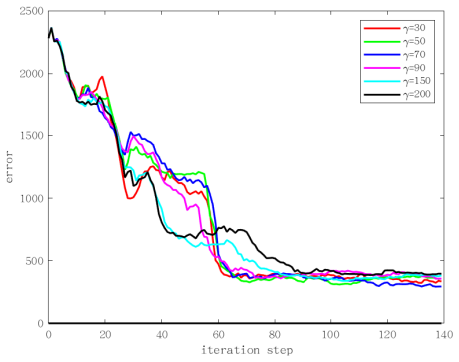
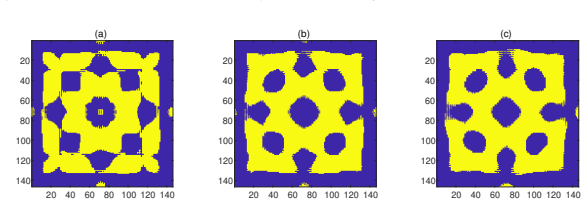
1 23 Figure 8: A heuristic choice of γ, with fixed ρ = 10,β 1 = 0.005,β 2 = 0.01. (a) 20 40 60 80 100 120 140 20 40 60 80 100 120 140 (b) 20 40 60 80 100 120 140 20 40 60 80 100 120 140 (c) 20 40 60 80 100 120 140 20 40 60 80 100 120 140 Figure 9: The optimal mask with different β1. From left to right β1 = 0.005, 0.01, 0.015
-
[13]
Semi-implicit level set formulation for lithographic source and mask optimization,
Y. Shen, F. Peng, and Z. Zhang, “Semi-implicit level set formulation for lithographic source and mask optimization,” Optics Express, vol. 27, no. 21, pp. 29 659–29 668, 2019. 1
work page 2019
-
[14]
Toward automatic mask and source optimization for optical lithography,
A. Erdmann, T. Fuehner, T. Schnattinger, and B. Tollkuehn, “Toward automatic mask and source optimization for optical lithography,” inOptical Microlithography XVII, vol. 5377. International Society for Optics and Photonics, 2004, pp. 646–657. 1
work page 2004
-
[15]
H. Sun, J. Du, C. Jin, J. Feng, J. Wang, S. Hu, and J. Liu, “Global source optimisation based on adaptive nonlinear particle swarm optimisation al- gorithm for inverse lithography,” IEEE Photonics Journal , vol. 13, no. 4, pp. 1–7, 2021. 1
work page 2021
-
[16]
GAN-OPC: Mask optimization with lithography-guided generative adversarial nets,
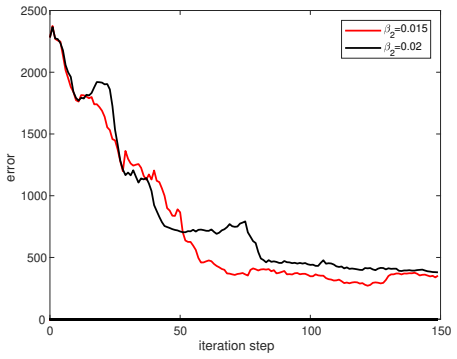
H. Yang, S. Li, Z. Deng, Y. Ma, B. Yu, and E. F. Young, “GAN-OPC: Mask optimization with lithography-guided generative adversarial nets,” 24 0 50 100 150 iteration step 0 500 1000 1500 2000 2500error 2=0.015 2=0.02 Figure 10: The output pattern with different β2. IEEE Transactions on Computer-Aided Design of Integrated Circuits and Systems, vol. 39, no. 10...
work page 2000
-
[17]
Generic lithography mod- eling with dual-band optics-inspired neural networks,
H. Yang, Z. Li, K. Sastry, S. Mukhopadhyay, M. Kilgard, A. Anand- kumar, B. Khailany, V. Singh, and H. Ren, “Generic lithography mod- eling with dual-band optics-inspired neural networks,” arXiv preprint arXiv:2203.08616, 2022. 1
-
[18]
Inverse lithography technology: 30 years from concept to prac- tical, full-chip reality,
L. Pang, “Inverse lithography technology: 30 years from concept to prac- tical, full-chip reality,” Journal of Micro/Nanopatterning, Materials, and Metrology, vol. 20, no. 3, p. 030901, 2021. 1
work page 2021
-
[19]
H. W. Engl, M. Hanke, and A. Neubauer, Regularization of Inverse Prob- lems. Kluwer Academic Publishers, 2000. 1
work page 2000
-
[20]
Mask design for optical microlithogra- phy—an inverse imaging problem,
A. Poonawala and P. Milanfar, “Mask design for optical microlithogra- phy—an inverse imaging problem,” IEEE Transactions on Image Process- ing, vol. 16, no. 3, pp. 774–788, 2007. 1
work page 2007
-
[21]
Nonlinear compressive inverse lithography aided by low-rank regularization,
X. Ma, Z. Wang, J. Zhu, S. Zhang, G. R. Arce, and S. Zhao, “Nonlinear compressive inverse lithography aided by low-rank regularization,” Optics express, vol. 27, no. 21, pp. 29 992–30 008, 2019. 1, 2.3
work page 2019
-
[22]
Edge-preserving and scale-dependent properties of total variation regularization,
D. Strong and T. Chan, “Edge-preserving and scale-dependent properties of total variation regularization,” Inverse problems, vol. 19, no. 6, p. S165,
-
[23]
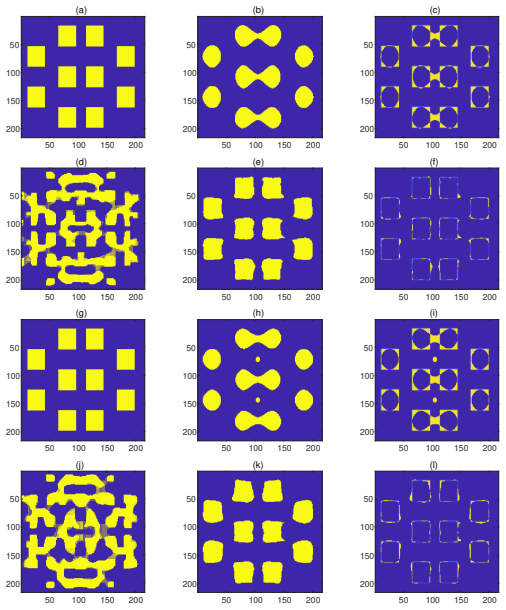
S. K. Choy, N. Jia, C. S. Tong, M. L. Tang, and E. Y. Lam, “A robust computational algorithm for inverse photomask synthesis in optical projec- 25 (a) 50 100 150 200 50 100 150 200 (b) 50 100 150 200 50 100 150 200 (c) 50 100 150 200 50 100 150 200 (d) 50 100 150 200 50 100 150 200 (e) 50 100 150 200 50 100 150 200 (f) 50 100 150 200 50 100 150 200 (g) 50...
work page 2012
-
[24]
An augmented lagrangian method for identifying discontinuous parameters in elliptic systems,
Z. Chen and J. Zou, “An augmented lagrangian method for identifying discontinuous parameters in elliptic systems,” SIAM Journal on Control and Optimization, vol. 37, no. 3, pp. 892–910, 1999. 1, 2.4, 2.4
work page 1999
-
[25]
An algorithm for total variation minimization and appli- cations,
A. Chambolle, “An algorithm for total variation minimization and appli- cations,” Journal of Mathematical imaging and vision , vol. 20, no. 1, pp. 89–97, 2004. 1
work page 2004
-
[26]
A nonlinear primal-dual method for total variation-based image restoration,
T. F. Chan, G. H. Golub, and P. Mulet, “A nonlinear primal-dual method for total variation-based image restoration,” SIAM journal on scientific computing, vol. 20, no. 6, pp. 1964–1977, 1999. 1
work page 1964
-
[27]
An iterative regu- larization method for total variation-based image restoration,
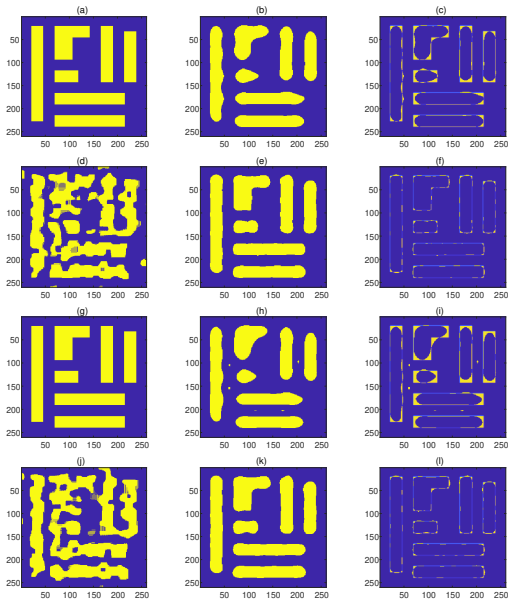
S. Osher, M. Burger, D. Goldfarb, J. Xu, and W. Yin, “An iterative regu- larization method for total variation-based image restoration,” Multiscale Modeling & Simulation , vol. 4, no. 2, pp. 460–489, 2005. 1 26 (a) 50 100 150 200 250 50 100 150 200 250 (b) 50 100 150 200 250 50 100 150 200 250 (c) 50 100 150 200 250 50 100 150 200 250 (d) 50 100 150 200 2...
work page 2005
-
[28]
D. Gabay and B. Mercier, “A dual algorithm for the solution of nonlin- ear variational problems via finite element approximation,” Computers & mathematics with applications , vol. 2, no. 1, pp. 17–40, 1976. 1
work page 1976
-
[29]
Alternating direction methods for classical and ptychographic phase retrieval,
Z. Wen, C. Yang, X. Liu, and S. Marchesini, “Alternating direction methods for classical and ptychographic phase retrieval,” Inverse Problems, vol. 28, no. 11, p. 115010, 2012. 1
work page 2012
-
[30]
A nonconvex ADMM algorithm for group sparsity with sparse groups,
R. Chartrand and B. Wohlberg, “A nonconvex ADMM algorithm for group sparsity with sparse groups,” in 2013 IEEE international conference on acoustics, speech and signal processing. IEEE, 2013, pp. 6009–6013. 1
work page 2013
-
[31]
A splitting method for orthogonality constrained problems,
R. Lai and S. Osher, “A splitting method for orthogonality constrained problems,” Journal of Scientific Computing , vol. 58, no. 2, pp. 431–449,
-
[32]
1 27 (a) 50 100 150 200 250 50 100 150 200 250 (b) 50 100 150 200 250 50 100 150 200 250 (c) 50 100 150 200 250 50 100 150 200 250 (d) 50 100 150 200 250 50 100 150 200 250 (e) 50 100 150 200 250 50 100 150 200 250 (f) 50 100 150 200 250 50 100 150 200 250 (g) 50 100 150 200 250 50 100 150 200 250 (h) 50 100 150 200 250 50 100 150 200 250 (i) 50 100 150 2...
-
[33]
Global convergence of ADMM in non- convex nonsmooth optimization,
Y. Wang, W. Yin, and J. Zeng, “Global convergence of ADMM in non- convex nonsmooth optimization,” Journal of Scientific Computing , vol. 78, no. 1, pp. 29–63, 2019. 1, 3.1
work page 2019
-
[34]
Wong, Alfred Kwok-Kit, Resolution enhancement techniques in optical lithography. SPIE press, 2001, vol. 47. 2.1
work page 2001
-
[35]
A. K.-K. Wong, Optical imaging in projection microlithography . SPIE press, 2005, vol. 66. 2.1, 2.3
work page 2005
- [36]
-
[37]
Efficient source and mask optimization with augmented lagrangian methods in optical lithography,
J. Li, S. Liu, and E. Y. Lam, “Efficient source and mask optimization with augmented lagrangian methods in optical lithography,”Optics express, vol. 21, no. 7, pp. 8076–8090, 2013. 2.3 28
work page 2013
-
[38]
OPC and PSM design using inverse lithog- raphy: a nonlinear optimization approach,
A. Poonawala and P. Milanfar, “OPC and PSM design using inverse lithog- raphy: a nonlinear optimization approach,” in Optical Microlithography XIX, vol. 6154. International Society for Optics and Photonics, 2006, p. 61543H. 2.3
work page 2006
-
[39]
T. F. Chan and J. Shen, Image processing and analysis: variational, PDE, wavelet, and stochastic methods. Society for Industrial and Applied Mathematics, 2005. [Online]. Available: https://portal.igpublish.com/ iglibrary/search/SIAMB0000033.html 2.3
work page 2005
-
[40]
R. A. Adams and J. J. Fournier, Sobolev spaces. Elsevier, 2003. 2.4, 2.4
work page 2003
-
[41]
Nesterov et al., Lectures on convex optimization
Y. Nesterov et al., Lectures on convex optimization . Springer, 2018, vol
work page 2018
-
[42]
The split bregman method for L1-regularized problems,
T. Goldstein and S. Osher, “The split bregman method for L1-regularized problems,” SIAM journal on imaging sciences , vol. 2, no. 2, pp. 323–343,
-
[43]
N. Jorge and J. W. Stephen, “Numerical optimization,” 2006. 3.2.1 29
work page 2006
discussion (0)
Sign in with ORCID, Apple, or X to comment. Anyone can read and Pith papers without signing in.