Economics of NFTs: The Value of Creator Royalties
Pith reviewed 2026-05-24 10:04 UTC · model grok-4.3
The pith
Royalties on NFTs allow creators to benefit from speculators through risk sharing, information asymmetry mitigation, and price discrimination under realistic market conditions.
A machine-rendered reading of the paper's core claim, the machinery that carries it, and where it could break.
Core claim
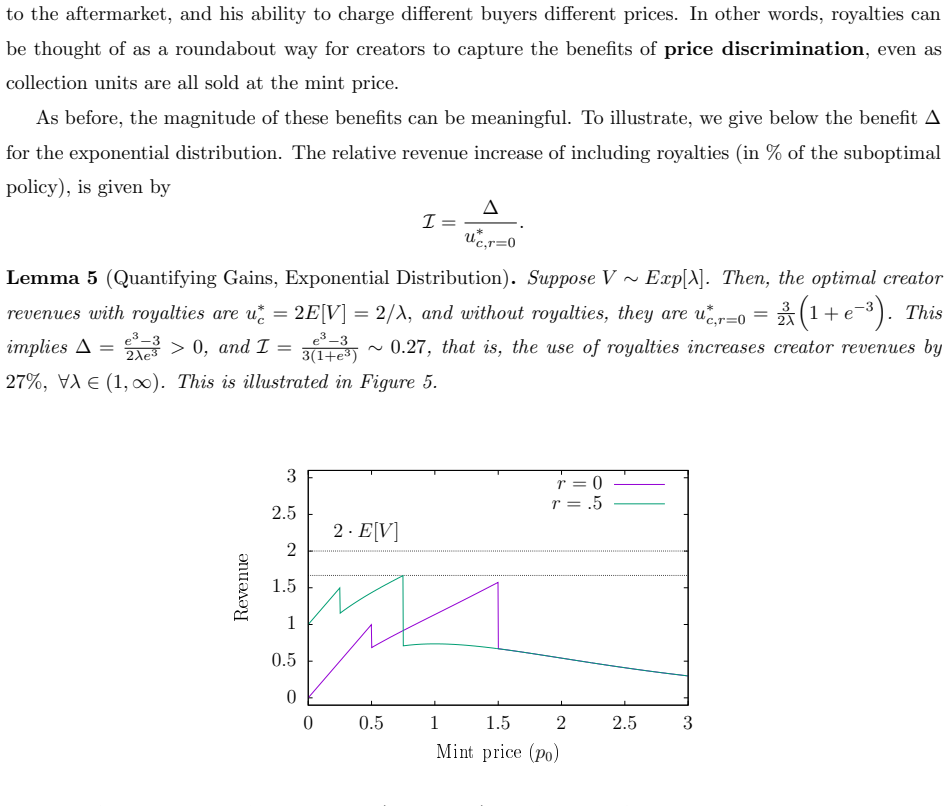
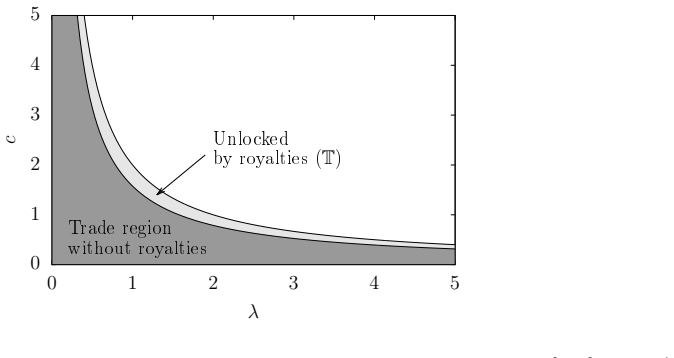
Under more realistic market conditions, royalties enable creators to capitalize on the presence of speculators in at least three ways: They can enable risk sharing (under risk aversion), mitigate information asymmetry (when speculators are better informed), and unlock price discrimination benefits (in multi-unit settings). Moreover, in all three cases, royalties meaningfully expand trade, implying increased transaction volume for platforms.
What carries the argument
Economic models of secondary NFT markets that incorporate risk-averse participants, asymmetric information between creators and speculators, and multi-unit demand to derive equilibrium effects of royalties on prices and quantities.
If this is right
- Royalties increase transaction volume for platforms across all three modeled scenarios.
- Creators extract value from speculator participation rather than seeing it neutralized.
- The zero net impact of royalties occurs only when markets are perfectly frictionless.
- The three mechanisms generate testable predictions for empirical work on NFT data.
Where Pith is reading between the lines
- The same logic could apply to royalties or resale rights in other creator markets with speculators, such as digital collectibles outside blockchain.
- Platform designers could adjust royalty rates to target the specific friction present in their user base.
- Removing royalties might reduce overall market activity if the identified frictions are material.
Load-bearing premise
NFT markets contain risk aversion, information asymmetries between speculators and creators, or multi-unit sales opportunities.
What would settle it
An empirical study of NFT platforms that finds no increase in trade volume or creator revenue when royalties are introduced or maintained in markets where risk aversion, information differences, or repeated sales are observable.
Figures
read the original abstract
Non-Fungible Tokens (NFTs) are transforming how content creators, such as artists, price and sell their work. A key feature of NFTs is the inclusion of royalties, which grant creators a share of all future resale proceeds. Although widely used, critics argue that sophisticated speculators, who dominate NFT markets, simply price in royalties upfront, neutralizing their impact. We show this intuition holds only under perfect, frictionless markets. Under more realistic market conditions, royalties enable creators to capitalize on the presence of speculators in at least three ways: They can enable risk sharing (under risk aversion), mitigate information asymmetry (when speculators are better informed), and unlock price discrimination benefits (in multi-unit settings). Moreover, in all three cases, royalties meaningfully expand trade, implying increased transaction volume for platforms. These results offer testable predictions that can guide both empirical research and platform design.
Editorial analysis
A structured set of objections, weighed in public.
Referee Report
Summary. The paper develops three theoretical models showing that NFT creator royalties, which critics claim are neutralized by speculators pricing them in, generate value for creators under realistic frictions: risk sharing when agents are risk averse, mitigation of information asymmetry when speculators are better informed, and price discrimination in multi-unit sales. In each case the models predict that royalties expand trade volume relative to the zero-royalty benchmark.
Significance. If the derivations hold, the work supplies a coherent theoretical counter to the frictionless-market critique of royalties and generates testable predictions for empirical NFT research and platform design. The use of standard market-friction mechanisms (risk aversion, asymmetric information, multi-unit monopoly pricing) is a strength.
major comments (2)
- [Abstract and concluding discussion] The central claim that royalties 'meaningfully expand trade' under 'more realistic market conditions' is load-bearing on the empirical relevance of the three frictions; the manuscript supplies no calibration, survey evidence, or reduced-form test establishing that risk aversion, speculator-creator information gaps, or repeated multi-unit sales are first-order in observed NFT transaction data (see abstract and concluding section).
- [Models 1–3 (risk-sharing, information, and multi-unit sections)] Each of the three mechanisms reverts exactly to the zero-impact benchmark once its required friction is removed; without quantitative assessment of friction magnitudes, the policy implication that royalties are welfare-improving for creators remains conditional rather than general.
minor comments (1)
- Notation for the royalty rate and the speculator's information structure could be unified across the three models to improve readability.
Simulated Author's Rebuttal
We thank the referee for the careful reading and insightful comments. The manuscript is a theoretical analysis identifying mechanisms by which creator royalties can generate value when standard market frictions are present. We address each major comment below.
read point-by-point responses
-
Referee: [Abstract and concluding discussion] The central claim that royalties 'meaningfully expand trade' under 'more realistic market conditions' is load-bearing on the empirical relevance of the three frictions; the manuscript supplies no calibration, survey evidence, or reduced-form test establishing that risk aversion, speculator-creator information gaps, or repeated multi-unit sales are first-order in observed NFT transaction data (see abstract and concluding section).
Authors: The paper is explicitly theoretical. Its contribution is to demonstrate that the frictionless neutralization result does not hold once risk aversion, asymmetric information, or multi-unit monopoly pricing are introduced, and that each friction generates both creator value and expanded trade volume. The abstract already states that the results 'offer testable predictions that can guide both empirical research and platform design.' We do not claim to have calibrated the frictions or provided reduced-form evidence; that is outside the scope of the current manuscript. revision: no
-
Referee: [Models 1–3 (risk-sharing, information, and multi-unit sections)] Each of the three mechanisms reverts exactly to the zero-impact benchmark once its required friction is removed; without quantitative assessment of friction magnitudes, the policy implication that royalties are welfare-improving for creators remains conditional rather than general.
Authors: This is correct: each model recovers the zero-royalty outcome when its friction is shut down. The manuscript's central point is precisely that the neutralization critique relies on the absence of these frictions. We argue that risk aversion, information asymmetry between creators and speculators, and repeated multi-unit sales are realistic features of NFT markets, but we do not assert that royalties are unconditionally welfare-improving. The policy takeaway is that royalties can expand trade and benefit creators once any of the three frictions is present. We are willing to add an explicit sentence in the conclusion underscoring the conditional nature of the results. revision: partial
Circularity Check
No circularity: theoretical models derive royalty benefits from standard frictions without self-referential reduction
full rationale
The paper presents three separate theoretical models showing that royalties expand trade under risk aversion, information asymmetry, or multi-unit sales. These are standard economic mechanisms applied to NFT settings; the derivations do not reduce to fitted parameters, self-citations, or definitions that presuppose the result. The abstract and provided text contain no equations or claims that rename inputs as predictions or import uniqueness via author citations. The results are explicitly conditional on the presence of the named frictions, which is an assumption rather than a circular construction. This is the normal case of a self-contained theoretical contribution.
Axiom & Free-Parameter Ledger
axioms (3)
- domain assumption Market participants (creators and speculators) exhibit risk aversion
- domain assumption Speculators possess superior information relative to creators in some trades
- domain assumption Multi-unit sales opportunities exist for creators
Lean theorems connected to this paper
-
IndisputableMonolith/Cost/FunctionalEquation.leanwashburn_uniqueness_aczel unclear?
unclearRelation between the paper passage and the cited Recognition theorem.
Under risk aversion... mean-variance utility... uc = E[vc]−ηc Var[vc]
-
IndisputableMonolith/Foundation/ArithmeticFromLogic.leanreality_from_one_distinction unclear?
unclearRelation between the paper passage and the cited Recognition theorem.
Theorem 1... when both... risk neutral (ηs=ηc=0)... royalties play no effective role
What do these tags mean?
- matches
- The paper's claim is directly supported by a theorem in the formal canon.
- supports
- The theorem supports part of the paper's argument, but the paper may add assumptions or extra steps.
- extends
- The paper goes beyond the formal theorem; the theorem is a base layer rather than the whole result.
- uses
- The paper appears to rely on the theorem as machinery.
- contradicts
- The paper's claim conflicts with a theorem or certificate in the canon.
- unclear
- Pith found a possible connection, but the passage is too broad, indirect, or ambiguous to say the theorem truly supports the claim.
Reference graph
Works this paper leans on
-
[1]
Ante, L. (2021), ‘The non-fungible token (NFT) market and its relationship with Bitcoin and Ethereum’, Available at SSRN 3861106
work page 2021
-
[2]
Benhaim, A., Falk, B. H. and Tsoukalas, G. (2022), ‘Scaling blockchains: Can committee-based consensus help?’, Working Paper
work page 2022
-
[3]
Burks, Z., Morgan, J., Malone, B. and Seibel, J. (2020), ‘EIP-2981: NFT royalty standard’, https://eips.ethereum. org/EIPS/eip-2981
work page 2020
-
[4]
Cachon, G. P. and Swinney, R. (2009), ‘Purchasing, pricing, and quick response in the presence of strategic consumers’, Management Science 55(3), 497–511. URL: http://www.jstor.org/stable/40539162 7https://twitter.com/metaplex/status/1583235585992720384?ref_src=twsrc%5Etfw%7Ctwcamp%5Etweetembed 8https://decrypt.co/112595/solana-enforceable-nft-royalties-n...
-
[5]
Carreras, T. (2022), ‘Art Gobbler NFTs top $20,000 within minutes of free mint’, https://cryptobriefing.com/ art-gobbler-nfts-top-20000-within-minutes-of-free-mint/
work page 2022
- [6]
-
[7]
Gan, J., Tsoukalas, G. and Netessine, S. (2021), ‘Initial coin offerings, speculation, and asset tokenization’, Manage- ment Science 67(2), 914–931
work page 2021
-
[8]
Gan, R., Tsoukalas, G. and Netessine, S. (2022), ‘Financing platforms with cryptocurrency: Token retention, sales commission, and ico caps’, Available at SSRN 3776411
work page 2022
-
[9]
Geron, T. (2022), ‘Otherside’s utterly avoidable NFT disaster’, https://www.protocol.com/newsletters/ protocol-fintech/otherside-yuga-labs-ethereum
work page 2022
-
[10]
(2021), ‘Artists have been attempting to secure royalties on their work for more than a century
Kent, C. (2021), ‘Artists have been attempting to secure royalties on their work for more than a century. blockchain finally offers them a breakthrough’, https://news.artnet.com/opinion/ artists-blockchain-resale-royalties-1956903
work page 2021
-
[11]
Kireyev, P. (2022), ‘NFT marketplace design and market intelligence’,https://papers.ssrn.com/sol3/papers.cfm? abstract_id=4002303
work page 2022
-
[12]
Lovo, S. and Spaenjers, C. (2018), ‘A model of trading in the art market’,American Economic Review 108(3), 744–74
work page 2018
-
[13]
Marcobello, M. (2022), ‘CryptoPunks, CryptoCats and CryptoKitties: How they started and how they’re going’, https://www.coindesk.com/learn/ cryptopunks-cryptocats-and-cryptokitties-how-they-started-and-how-theyre-going/
work page 2022
-
[14]
Murray, M. D. (2022), ‘NFTs rescue resale royalties? the wonderfully complicated ability of NFT smart contracts to allow resale royalty rights’, https://papers.ssrn.com/sol3/papers.cfm?abstract_id=4164029
work page 2022
-
[15]
Nadini, M., Alessandretti, L., Di Giacinto, F., Martino, M., Aiello, L. M. and Baronchelli, A. (2021), ‘Mapping the NFT revolution: market trends, trade networks, and visual features’, Scientific reports 11(1), 1–11
work page 2021
-
[16]
Nelson, D. (2022), ‘Solana goes dark for 7 hours as bots swarm ‘candy machine’ NFT minting tool’, https://www.coindesk.com/tech/2022/05/01/ solana-goes-dark-for-7-hours-as-bots-swarm-candy-machine-nft-minting-tool/ . NFTStatistics.eth (2022), Deep dives: NFT royalties, Technical report, proof.xyz. NonFungible.com (2022), Q3 nft market report 2022, Technic...
work page 2022
-
[17]
Qadir, S. and Parker, G. (2022), NFT royalties: The $1.8bn question, Technical report, Galaxy Digital
work page 2022
-
[18]
(2021), ‘Blockchain without waste: Proof-of-stake’, The Review of financial studies 34(3), 1156–1190
Saleh, F. (2021), ‘Blockchain without waste: Proof-of-stake’, The Review of financial studies 34(3), 1156–1190
work page 2021
-
[19]
(2010), ‘Optimal pricing with speculators and strategic consumers’, Management Science 56(1), 25–40
Su, X. (2010), ‘Optimal pricing with speculators and strategic consumers’, Management Science 56(1), 25–40
work page 2010
-
[20]
Tsoukalas, G. and Falk, B. H. (2020), ‘Token-weighted crowdsourcing’, Management Science 66(9), 3843–3859. van Haaften-Schick, L. and Whitaker, A. (2022), ‘From the artist’s contract to the blockchain ledger: New forms of artists’ funding using equity and resale royalties’, Journal of Cultural Economics pp. 1–29. 21
work page 2020
-
[21]
Vasan, K., Janosov, M. and Barab´ asi, A.-L. (2022), ‘Quantifying NFT-driven networks in crypto art’, Scientific Reports 12(1), 1–11
work page 2022
-
[22]
Whitaker, A. and Kr¨ aussl, R. (2020), ‘Fractional equity, blockchain, and the future of creative work’, Management Science 66(10), 4359–4919. A Proofs Proof of Lemma 1. Note that Pr[ V > p0] = 1 −F (p0), with f,F being the density and cumulative distribution functions of V . Take the first and second-order derivatives of the objective function: FOC ⇔ ∂ ∂p...
work page 2020
discussion (0)
Sign in with ORCID, Apple, or X to comment. Anyone can read and Pith papers without signing in.