Tensor-Network Formulation of the Traveling Salesman Problem and Variants
Pith reviewed 2026-05-24 05:35 UTC · model grok-4.3
The pith
Tensor networks represent traveling salesman tours so their zero-temperature marginals select an optimal feasible path via sequential rules.
A machine-rendered reading of the paper's core claim, the machinery that carries it, and where it could break.
Core claim
Candidate tours are represented with tensor-network layers, weighted by Boltzmann factors, and constrained through explicit counting filters. The construction yields an explicit tensor-network marginal formula whose zero-temperature, exact-arithmetic limit identifies an optimal feasible tour through a sequential marginal rule.
What carries the argument
The tensor-network marginal formula obtained from layers weighted by Boltzmann factors and constrained by counting filters; it supplies the sequential marginal rule that recovers the optimum in the zero-temperature exact limit.
If this is right
- The same tensor-network layers and filters extend without change to several standard generalizations of the TSP.
- The construction supplies a concrete tensor-network implementation for the job reassignment problem.
- At any finite temperature the extraction procedure becomes a heuristic whose success depends on numerical contrast, calibration, and near-degeneracies.
- The experiments remain deliberately small and serve only to illustrate the method against exact and heuristic references.
Where Pith is reading between the lines
- If tensor-network contraction routines can be applied at scale, the same marginal formula might serve as a contraction-based solver for other routing or assignment problems.
- The sequential marginal rule could be compared directly with belief-propagation or message-passing heuristics on the same constraint graphs.
- Near-degeneracies that appear at finite temperature might be used to generate diverse near-optimal tours without additional sampling steps.
Load-bearing premise
The counting filters and Boltzmann weighting together produce a tensor network whose marginals remain numerically stable and contractible enough to extract the optimum without the extraction rule itself becoming equivalent to exhaustive search.
What would settle it
For any small TSP instance whose optimum is known by exhaustive enumeration, the sequential marginal rule applied to the exact-arithmetic tensor-network marginals fails to recover that optimum.
Figures
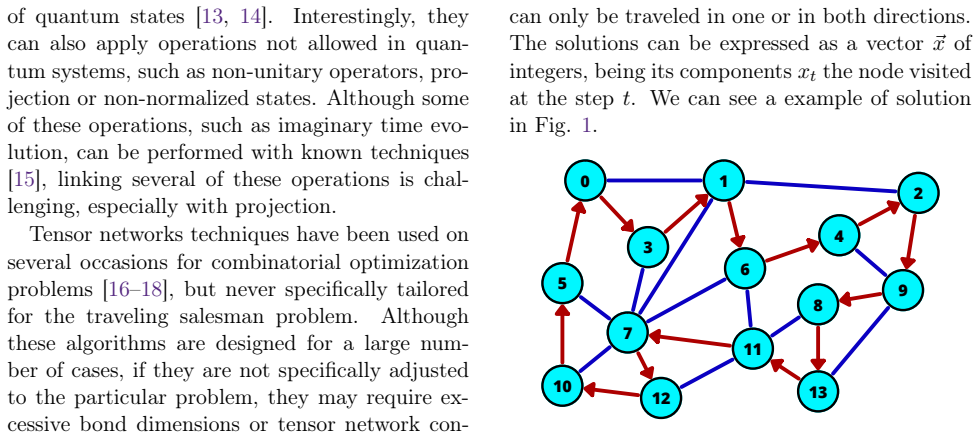


read the original abstract
This work presents a tensor-network formulation of the Traveling Salesman Problem (TSP) and several of its variants. The approach represents candidate tours with tensor-network layers, weights them by Boltzmann factors, and enforces constraints through explicit counting filters. This formalism also yields an explicit tensor-network marginal formula whose zero-temperature, exact-arithmetic limit identifies an optimal feasible tour through a sequential marginal rule. At finite $\tau$ and finite precision, the implemented extraction is a heuristic whose behavior depends on numerical contrast, calibration, and near-degeneracies. We adapt the construction to several generalizations of the TSP and apply it to the Job Reassignment Problem, as a representative industrial integration. The experiments are deliberately small and illustrative; they contextualize the method against exact and heuristic references but do not establish general computational superiority over specialized classical solvers.
Editorial analysis
A structured set of objections, weighed in public.
Referee Report
Summary. The manuscript presents a tensor-network formulation of the Traveling Salesman Problem (TSP) and variants. Candidate tours are represented via tensor-network layers, weighted by Boltzmann factors according to tour cost, and constrained by explicit counting-filter tensors (e.g., visit-once and degree-2 conditions). The central claim is that this construction yields an explicit tensor-network marginal formula whose zero-temperature, exact-arithmetic limit recovers an optimal feasible tour via a sequential marginal rule. The approach is adapted to several TSP generalizations and demonstrated on the Job Reassignment Problem; all experiments are small and illustrative, with finite-τ extraction explicitly qualified as heuristic.
Significance. If the unshown derivation of the marginal formula and its limiting behavior can be supplied and verified, the work would supply a novel, constraint-explicit encoding of combinatorial optimization inside the tensor-network formalism. This could open routes to contraction-based solvers or quantum-inspired algorithms. The manuscript's honesty about the heuristic status of finite-τ extraction and its deliberate choice of illustrative rather than competitive experiments are positive features that keep the claims proportionate.
major comments (1)
- [Abstract] Abstract (and the corresponding construction section): the central claim that the zero-temperature, exact-arithmetic limit of the tensor-network marginal formula identifies an optimal feasible tour through a sequential marginal rule is stated without any derivation steps, explicit marginal expression, or proof that the resulting marginals remain supported only on feasible tours and select a minimum-cost one. This derivation is load-bearing for the paper's primary contribution.
minor comments (1)
- The manuscript repeatedly notes that finite-τ behavior is heuristic and depends on numerical contrast and near-degeneracies, but does not supply a quantitative characterization (e.g., condition-number bounds or failure-mode examples) that would help readers assess when the heuristic is reliable.
Simulated Author's Rebuttal
We thank the referee for their careful reading, balanced summary, and recognition that a verified marginal formula would constitute a novel contribution. We agree that the central claim requires explicit derivation and supporting proofs, which were omitted from the original manuscript.
read point-by-point responses
-
Referee: [Abstract] Abstract (and the corresponding construction section): the central claim that the zero-temperature, exact-arithmetic limit of the tensor-network marginal formula identifies an optimal feasible tour through a sequential marginal rule is stated without any derivation steps, explicit marginal expression, or proof that the resulting marginals remain supported only on feasible tours and select a minimum-cost one. This derivation is load-bearing for the paper's primary contribution.
Authors: We fully agree that the derivation, explicit marginal expression, and supporting proofs are missing and constitute a load-bearing gap. In the revised manuscript we will insert a dedicated subsection (placed after the tensor-network construction) that (i) writes the explicit marginal formula obtained by contracting all but one index of the weighted, filtered network, (ii) proves by induction on the filter tensors that every marginal is supported exclusively on feasible partial tours, and (iii) shows that, in the joint limit of exact arithmetic and τ→0, the Boltzmann weights concentrate on minimum-cost configurations, so that the sequential marginal rule recovers an optimal feasible tour. The added material will also clarify the precise sense in which finite-τ extraction remains heuristic. revision: yes
Circularity Check
No significant circularity; derivation self-contained
full rationale
The paper defines a tensor-network encoding of TSP tours via explicit layers, Boltzmann weighting, and counting-filter tensors for constraints. The marginal formula and its zero-temperature limit are direct mathematical consequences of this network definition and the sequential marginal rule; they do not reduce to fitted parameters, renamed inputs, or load-bearing self-citations. No uniqueness theorem or ansatz is smuggled in via prior author work. The construction is presented as a fresh encoding whose formal properties follow from the tensor algebra without circular reduction.
Axiom & Free-Parameter Ledger
Reference graph
Works this paper leans on
-
[1]
A branch-and-cut algorithm for the resolution of large-scale symmetric traveling salesman problems
Manfred Padberg and Giovanni Rinaldi. A branch-and-cut algorithm for the resolution of large-scale symmetric traveling salesman problems. SIAM Review, 33(1):60–100, 1991. DOI: 10.1137/1033004. URLhttps://doi. org/10.1137/1033004
- [2]
-
[3]
A genetic algorithm for solving travelling salesman problem
Adewole Philip, Akinwale Adio Taofiki, and Otunbanowo Kehinde. A genetic algorithm for solving travelling salesman problem. International Journal of Advanced Com- puter Science and Applications , 2(1), 2011. DOI: 10.14569/IJACSA.2011.020104. URL http://dx.doi.org/10.14569/IJACSA. 2011.020104
-
[4]
Worst-case analysis of a new heuristic for the travelling salesman problem
Nicos Christofides. Worst-case analysis of a new heuristic for the travelling salesman problem. Operations Research Forum , 3 (1):20, Mar 2022. ISSN 2662-2556. DOI: 10.1007/s43069-021-00101-z. URLhttps:// doi.org/10.1007/s43069-021-00101-z
-
[5]
P.W. Shor. Algorithms for quantum com- putation: discrete logarithms and fac- toring. In Proceedings 35th Annual Symposium on Foundations of Computer Science, pages 124–134, 1994. DOI: 10.1109/SFCS.1994.365700
-
[6]
A quantum approximate opti- mization algorithm, 2014
Edward Farhi, Jeffrey Goldstone, and Sam Gutmann. A quantum approximate opti- mization algorithm, 2014
work page 2014
-
[7]
Nature Communications , author =
Alberto Peruzzo, Jarrod McClean, Peter Shadbolt, Man-Hong Yung, Xiao-Qi Zhou, Peter J. Love, Alán Aspuru-Guzik, and Jeremy L. O’Brien. A variational eigen- value solver on a photonic quantum pro- cessor. Nature Communications , 5(1): 4213, Jul 2014. ISSN 2041-1723. DOI: 10.1038/ncomms5213. URL https://doi. org/10.1038/ncomms5213
-
[8]
Fixed-point grover adaptive search for binary optimiza- tion problems, 2024
ÁkosNagy, JaimePark, CindyZhang, Atithi Acharya, and Alex Khan. Fixed-point grover adaptive search for binary optimiza- tion problems, 2024
work page 2024
-
[9]
Karthik Srinivasan, Saipriya Satyajit, Bikash K. Behera, and Prasanta K. Pan- igrahi. Efficient quantum algorithm for solving travelling salesman problem: An ibm quantum experience, 2018
work page 2018
-
[10]
A realizable gas-based quantum algorithm for traveling salesman problem, 2022
Jieao Zhu, Yihuai Gao, Hansen Wang, Tiefu Li, and Hao Wu. A realizable gas-based quantum algorithm for traveling salesman problem, 2022
work page 2022
-
[11]
DOI: 10.1137/1.9781611975482.107
Andris Ambainis, Kaspars Balodis, J¯ anis Iraids, Martins Kokainis, Krišj¯ anis Pr¯ usis, and Jevg¯ enijs Vihrovs.Quantum Speedups for Exponential-Time Dynamic Pro- gramming Algorithms , pages 1783–1793. DOI: 10.1137/1.9781611975482.107. URL https://epubs.siam.org/doi/abs/10. 1137/1.9781611975482.107
-
[12]
Tensor networks in a nutshell, 2017
Jacob Biamonte and Ville Bergholm. Tensor networks in a nutshell, 2017
work page 2017
-
[13]
D. Perez-Garcia, F. Verstraete, M. M. Wolf, and J. I. Cirac. Matrix product state repre- sentations, 2007
work page 2007
-
[14]
V. Murg F. Verstraete and J.I. Cirac. Matrix product states, projected en- tangled pair states, and variational renormalization group methods for quantum spin systems. Advances in Physics, 57(2):143–224, 2008. DOI: Accepted inQuantum 9999-99-99, click title to verify. Published under CC-BY 4.0. 12 Case Steps without reuse Space without reuse Steps with re...
-
[15]
Hirofumi Nishi, Taichi Kosugi, and Yu- ichiro Matsushita. Implementation of quantum imaginary-time evolution method on nisq devices by introducing nonlocal approximation. npj Quantum Informa- tion, 7(1):85, Jun 2021. ISSN 2056-
work page 2021
-
[16]
URL https://doi.org/10.1038/ s41534-021-00409-y
DOI: 10.1038/s41534-021-00409- y. URL https://doi.org/10.1038/ s41534-021-00409-y
-
[17]
Konstantin Sozykin, Andrei Chertkov, Ro- man Schutski, Anh-Huy Phan, Andrzej Ci- chocki, and Ivan Oseledets. Ttopt: A max- imum volume quantized tensor train-based optimization and its application to reinforce- ment learning, 2022
work page 2022
-
[18]
Kalayci, and Alejandro Perdomo- Ortiz
Javier Alcazar, Mohammad Ghazi Vakili, Can B. Kalayci, and Alejandro Perdomo- Ortiz. Enhancing combinatorial opti- mization with classical and quantum gen- erative models. Nature Communica- tions, 15(1):2761, Mar 2024. ISSN 2041-1723. DOI: 10.1038/s41467-024- 46959-5. URL https://doi.org/10.1038/ s41467-024-46959-5
-
[19]
A quantum-inspired tensor network algorithm for constrained combinatorial optimization problems
Tianyi Hao, Xuxin Huang, Chunjing Jia, and Cheng Peng. A quantum-inspired tensor network algorithm for constrained combinatorial optimization problems. Frontiers in Physics , 10, 2022. ISSN 2296-424X. DOI: 10.3389/fphy.2022.906590. URL https://www.frontiersin.org/ articles/10.3389/fphy.2022.906590
- [20]
-
[21]
Iñigo Perez Delgado, Beatriz García Markaida, Alejandro Mata Ali, and Aitor Moreno Fdez de Leceta. Qubo resolu- tion of the job reassignment problem. In 2023 IEEE 26th International Conference on Intelligent Transportation Systems (ITSC), pages 4847–4852, 2023. DOI: 10.1109/ITSC57777.2023.10422467. Accepted inQuantum 9999-99-99, click title to verify. Pub...
discussion (0)
Sign in with ORCID, Apple, or X to comment. Anyone can read and Pith papers without signing in.