Room-temperature Magnetic Thermal Switching by Suppressing Phonon-Magnon Scattering
Pith reviewed 2026-05-24 04:28 UTC · model grok-4.3
The pith
Magnetic fields suppress phonon-magnon scattering to increase the thermal conductivity of gadolinium near room temperature.
A machine-rendered reading of the paper's core claim, the machinery that carries it, and where it could break.
Core claim
In gadolinium the lattice thermal conductivity near room temperature is reduced by phonon-magnon scattering; an applied magnetic field suppresses that scattering and thereby raises the phononic thermal conductivity, enabling magnetic-field-controlled thermal switching.
What carries the argument
Phonon-magnon scattering whose rate is lowered by an external magnetic field that alters magnon populations in ferromagnetic gadolinium.
If this is right
- Gadolinium exhibits a field-tunable lattice thermal conductivity near room temperature.
- Phonon-magnon scattering must be included when predicting thermal transport in other ferromagnetic metals.
- Magnetic control of heat flow becomes feasible in materials that lack strong electronic magnetoresistance.
- Thermal switching ratios are set by the field dependence of the magnon spectrum rather than by electronic band shifts.
Where Pith is reading between the lines
- The same scattering channel may produce larger switching effects in ferromagnets that have stronger spin-lattice coupling or lower Curie temperatures.
- Device geometries that concentrate the magnetic field could achieve switching at modest external fields.
- Temperature-dependent measurements below and above the Curie point would isolate the magnon contribution from other scattering mechanisms.
Load-bearing premise
The measured field-induced change in thermal conductivity is caused mainly by reduced phonon-magnon scattering and not by other field-dependent processes such as domain-wall scattering or electronic contributions.
What would settle it
A calculation or measurement in which the phonon-magnon scattering term is removed or held fixed while the magnetic field is varied, yet the thermal conductivity still changes by the same amount.
Figures
read the original abstract
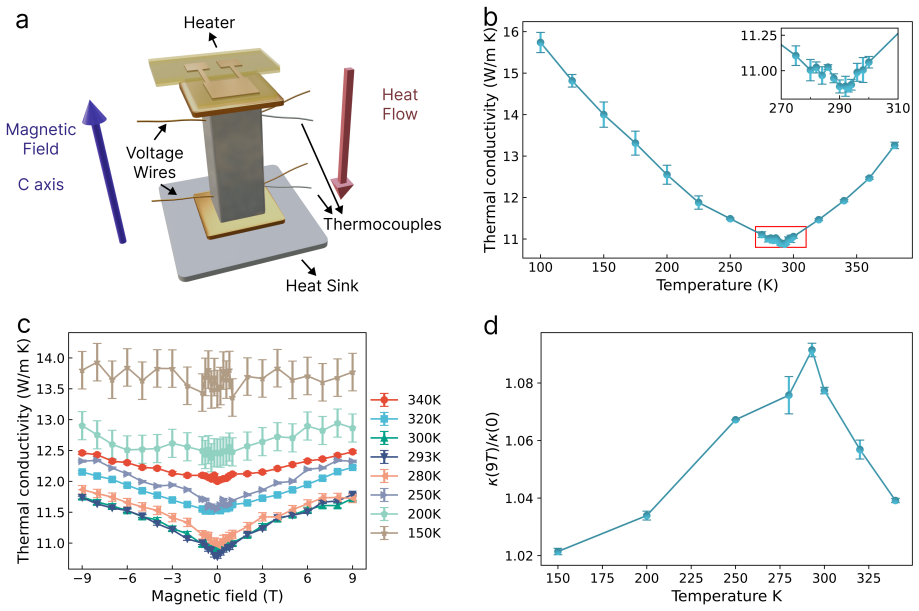
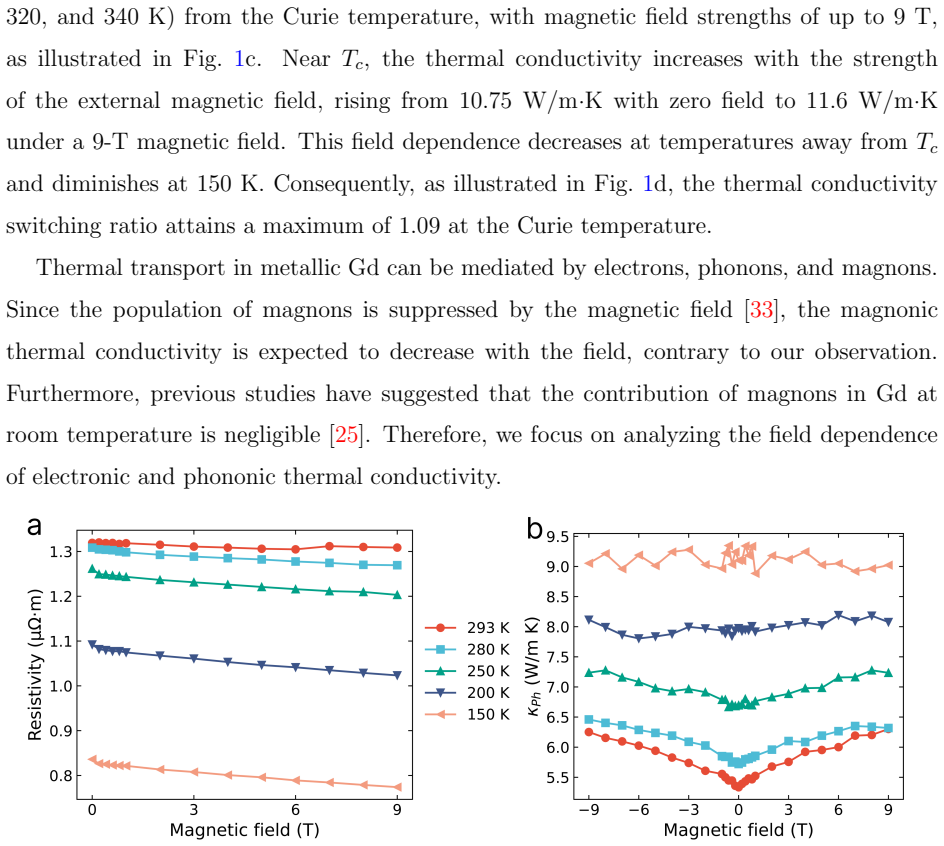
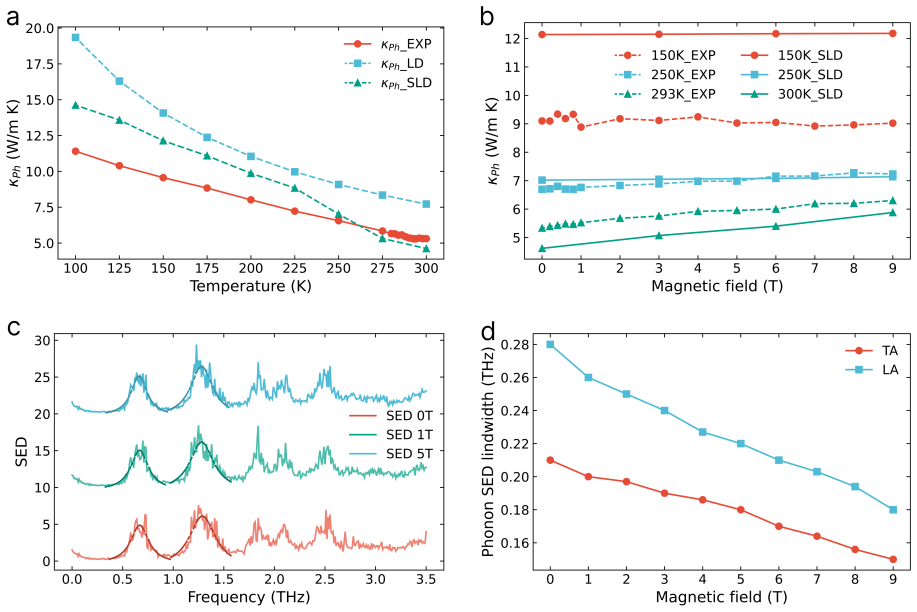
Thermal switching materials, whose thermal conductivity can be controlled externally, show great potential in contemporary thermal management. Manipulating thermal transport properties through magnetic fields has been accomplished in materials that exhibit a high magnetoresistance. However, it is generally understood that the lattice thermal conductivity attributed to phonons is not significantly impacted by the magnetic fields. In this study, we experimentally demonstrate the significant impact of phonon-magnon scattering on the thermal conductivity of the rare-earth metal gadolinium near room temperature, which can be controlled by a magnetic field to realize thermal switching. Using first-principles lattice dynamics and spin-lattice dynamics simulations, we attribute the observed change in phononic thermal conductivity to field-suppressed phonon-magnon scattering. This research suggests that phonon-magnon scattering in ferromagnetic materials is crucial for determining their thermal conductivity, opening the door to innovative magnetic-field-controlled thermal switching materials.
Editorial analysis
A structured set of objections, weighed in public.
Referee Report
Summary. The manuscript claims to experimentally demonstrate room-temperature magnetic thermal switching in gadolinium via a magnetic-field-induced increase in thermal conductivity, attributed to suppression of phonon-magnon scattering. This is supported by first-principles lattice dynamics and spin-lattice dynamics simulations that compute the relevant scattering rates with and without applied field.
Significance. If the central attribution holds after ruling out alternatives, the result would be significant: it identifies a mechanism for external control of lattice thermal conductivity in a ferromagnetic metal near 300 K, contrary to the conventional view that phononic κ is insensitive to magnetic fields. The combination of direct thermal-conductivity measurements with independent spin-lattice simulations is a methodological strength.
major comments (2)
- [Results and Discussion (attribution paragraph)] The attribution of the observed field-induced Δκ near 300 K to suppressed phonon-magnon scattering is load-bearing for the central claim, yet the manuscript provides no quantitative decomposition demonstrating that the electronic contribution (via ordinary magnetoresistance and spin-disorder scattering) and domain-wall scattering are both smaller than the reported Δκ and field-independent in the measured geometry. This concern is not resolved by the simulations alone.
- [Abstract and Experimental Methods] The abstract and main text supply no numerical values for the switching ratio, error bars, sample thickness/purity, or explicit exclusion criteria for alternative mechanisms; without these it is impossible to assess whether the claimed dominance of phonon-magnon scattering is experimentally isolated.
minor comments (1)
- [Theory and Simulation section] Notation for the decomposed thermal-conductivity channels (phononic vs. electronic) should be defined consistently in the first use.
Simulated Author's Rebuttal
We thank the referee for the constructive comments that highlight important aspects for strengthening the attribution and clarity of our results. We address each major comment below and will incorporate revisions accordingly.
read point-by-point responses
-
Referee: [Results and Discussion (attribution paragraph)] The attribution of the observed field-induced Δκ near 300 K to suppressed phonon-magnon scattering is load-bearing for the central claim, yet the manuscript provides no quantitative decomposition demonstrating that the electronic contribution (via ordinary magnetoresistance and spin-disorder scattering) and domain-wall scattering are both smaller than the reported Δκ and field-independent in the measured geometry. This concern is not resolved by the simulations alone.
Authors: We agree that a quantitative decomposition is necessary to fully support the central attribution. The spin-lattice dynamics simulations isolate the field dependence of phonon-magnon scattering rates, but to address this directly we will add to the revised manuscript estimates of the electronic thermal conductivity change using our measured electrical resistivity under field combined with the Wiedemann-Franz law, showing the electronic Δκ is substantially smaller than the total observed change. For domain-wall scattering we will include a discussion of the sample geometry and field orientation demonstrating that measurements are performed in the saturated state where domain walls are eliminated and any residual effect is field-independent. revision: yes
-
Referee: [Abstract and Experimental Methods] The abstract and main text supply no numerical values for the switching ratio, error bars, sample thickness/purity, or explicit exclusion criteria for alternative mechanisms; without these it is impossible to assess whether the claimed dominance of phonon-magnon scattering is experimentally isolated.
Authors: We will update the abstract to report the measured switching ratio with associated error bars from multiple samples. In the Experimental Methods we will add the sample thickness, purity level, and a new paragraph providing explicit quantitative exclusion of alternative mechanisms (electronic magnetoresistance via Wiedemann-Franz and domain-wall effects) using the measured data and literature values for Gd. revision: yes
Circularity Check
No significant circularity; central attribution rests on independent measurements and simulations
full rationale
The paper reports direct experimental measurements of field-dependent thermal conductivity in Gd and uses separate first-principles spin-lattice dynamics simulations to compute phonon-magnon scattering rates with and without field. No equation or result is shown to reduce by construction to a fitted parameter defined from the same data, nor does any load-bearing step rely on a self-citation chain whose content is unverified. The derivation chain is self-contained against external benchmarks (experiment + ab initio computation) and does not exhibit self-definitional, fitted-input, or ansatz-smuggling patterns.
Axiom & Free-Parameter Ledger
axioms (1)
- domain assumption Phonon-magnon scattering is the primary mechanism by which an external magnetic field alters the lattice thermal conductivity of gadolinium near room temperature.
Reference graph
Works this paper leans on
-
[1]
G. Wehmeyer, T. Yabuki, C. Monachon, J. Wu, and C. Dames, Thermal diodes, regulators, and switches: Physical mechanisms and potential applications, Applied Physics Reviews 4 (2017)
work page 2017
-
[2]
P. Shirron, M. DiPirro, M. Jirmanus, Z. Zhao, and B. Shields, A portable, cryogen-free ultra- low temperature cooling system using a continuous ADR, in AIP Conference Proceedings, Vol. 710 (American Institute of Physics, 2004) pp. 1746–1753
work page 2004
-
[3]
A. E. Jahromi and D. F. Sullivan, A piezoelectric cryogenic heat switch, Review of Scientific Instruments 85 (2014)
work page 2014
-
[4]
M. Hao, J. Li, S. Park, S. Moura, and C. Dames, Efficient thermal management of Li-ion batteries with a passive interfacial thermal regulator based on a shape memory alloy, Nature Energy 3, 899 (2018)
work page 2018
-
[5]
S. A. Atouei, A. Rezania, A. Ranjbar, and L. A. Rosendahl, Protection and thermal man- agement of thermoelectric generator system using phase change materials: An experimental investigation, Energy 156, 311 (2018). 11
work page 2018
-
[6]
K. Aryana, J. A. Tomko, R. Gao, E. R. Hoglund, T. Mimura, S. Makarem, A. Salanova, M. S. B. Hoque, T. W. Pfeifer, D. H. Olson, et al. , Observation of solid-state bidirectional thermal conductivity switching in antiferroelectric lead zirconate PbZrO 3, Nature Communi- cations 13, 1573 (2022)
work page 2022
-
[7]
J. F. Ihlefeld, B. M. Foley, D. A. Scrymgeour, J. R. Michael, B. B. McKenzie, D. L. Medlin, M. Wallace, S. Trolier-McKinstry, and P. E. Hopkins, Room-temperature voltage tunable phonon thermal conductivity via reconfigurable interfaces in ferroelectric thin films, Nano Letters 15, 1791 (2015)
work page 2015
-
[8]
C. Liu, Y. Si, H. Zhang, C. Wu, S. Deng, Y. Dong, Y. Li, M. Zhuo, N. Fan, B. Xu, et al. , Low voltage–driven high-performance thermal switching in antiferroelectric PbZrO3 thin films, Science 382, 1265 (2023)
work page 2023
-
[9]
B. L. Wooten, R. Iguchi, P. Tang, J. S. Kang, K.-i. Uchida, G. E. Bauer, and J. P. Heremans, Electric field–dependent phonon spectrum and heat conduction in ferroelectrics, Science Ad- vances 9, eadd7194 (2023)
work page 2023
-
[10]
M. Li, H. Wu, E. M. Avery, Z. Qin, D. P. Goronzy, H. D. Nguyen, T. Liu, P. S. Weiss, and Y. Hu, Electrically gated molecular thermal switch, Science 382, 585 (2023)
work page 2023
-
[11]
J. Kimling, R. Wilson, K. Rott, J. Kimling, G. Reiss, and D. G. Cahill, Spin-dependent thermal transport perpendicular to the planes of Co/Cu multilayers, Physical Review B 91, 144405 (2015)
work page 2015
-
[12]
Q. Lu, S. Huberman, H. Zhang, Q. Song, J. Wang, G. Vardar, A. Hunt, I. Waluyo, G. Chen, and B. Yildiz, Bi-directional tuning of thermal transport in SrCoO x with electrochemically induced phase transitions, Nature Materials 19, 655 (2020)
work page 2020
-
[13]
T. Zhang and T. Luo, High-contrast, reversible thermal conductivity regulation utilizing the phase transition of polyethylene nanofibers, ACS nano 7, 7592 (2013)
work page 2013
-
[14]
R. Shrestha, Y. Luan, S. Shin, T. Zhang, X. Luo, J. S. Lundh, W. Gong, M. R. Bockstaller, S. Choi, T. Luo, et al. , High-contrast and reversible polymer thermal regulator by structural phase transition, Science advances 5, eaax3777 (2019)
work page 2019
-
[15]
J. Shin, J. Sung, M. Kang, X. Xie, B. Lee, K. M. Lee, T. J. White, C. Leal, N. R. Sottos, P. V. Braun, et al. , Light-triggered thermal conductivity switching in azobenzene polymers, Proceedings of the National Academy of Sciences 116, 5973 (2019). 12
work page 2019
-
[16]
A. Sood, F. Xiong, S. Chen, H. Wang, D. Selli, J. Zhang, C. J. McClellan, J. Sun, D. Donadio, Y. Cui, et al., An electrochemical thermal transistor, Nature Communications 9, 4510 (2018)
work page 2018
-
[17]
G. Zhu, J. Liu, Q. Zheng, R. Zhang, D. Li, D. Banerjee, and D. G. Cahill, Tuning thermal con- ductivity in molybdenum disulfide by electrochemical intercalation, Nature Communications 7, 13211 (2016)
work page 2016
-
[18]
J. A. Tomko, A. Pena-Francesch, H. Jung, M. Tyagi, B. D. Allen, M. C. Demirel, and P. E. Hopkins, Tunable thermal transport and reversible thermal conductivity switching in topo- logically networked bio-inspired materials, Nature Nanotechnology 13, 959 (2018)
work page 2018
- [19]
-
[20]
H. Jin, O. D. Restrepo, N. Antolin, S. R. Boona, W. Windl, R. C. Myers, and J. P. Heremans, Phonon-induced diamagnetic force and its effect on the lattice thermal conductivity, Nature Materials 14, 601 (2015)
work page 2015
-
[21]
I. Stockem, A. Bergman, A. Glensk, T. Hickel, F. K¨ ormann, B. Grabowski, J. Neugebauer, and B. Alling, Anomalous phonon lifetime shortening in paramagnetic CrN caused by spin- lattice coupling: a combined spin and ab initio molecular dynamics study, Physical Review Letters 121, 125902 (2018)
work page 2018
-
[22]
C. Kittel and P. McEuen, Introduction to solid state physics (John Wiley & Sons, 2018)
work page 2018
-
[23]
Douglass, Heat transport by spin waves in yttrium iron garnet, Physical Review 129, 1132 (1963)
R. Douglass, Heat transport by spin waves in yttrium iron garnet, Physical Review 129, 1132 (1963)
work page 1963
-
[24]
S. R. Boona and J. P. Heremans, Magnon thermal mean free path in yttrium iron garnet, Phys. Rev. B 90, 064421 (2014)
work page 2014
-
[25]
P. Jacobsson and B. Sundqvist, Thermal conductivity and electrical resistivity of gadolinium as functions of pressure and temperature, Physical Review B 40, 9541 (1989)
work page 1989
-
[26]
C. Bhandari and G. Verma, Scattering of magnons and phonons in the thermal conductivity of yttrium iron garnet, Physical Review 152, 731 (1966)
work page 1966
-
[27]
D. Sanders and D. Walton, Effect of magnon-phonon thermal relaxation on heat transport by magnons, Physical Review B 15, 1489 (1977)
work page 1977
-
[28]
P. A. Sharma, J. Ahn, N. Hur, S. Park, S. B. Kim, S. Lee, J.-G. Park, S. Guha, and S.-W. Cheong, Thermal conductivity of geometrically frustrated, ferroelectric YMnO 3: Extraordi- 13 nary spin-phonon interactions, Physical Review Letters 93, 177202 (2004)
work page 2004
-
[29]
L. Patra and B. Liao, Indirect exchange interaction leads to large lattice contribution to magnetocaloric entropy change, Phys. Rev. Lett. 131, 066703 (2023)
work page 2023
-
[30]
S. Arajs and R. Colvin, Thermal conductivity and Lorenz function of gadolinium between 5 and 310 K, Journal of Applied Physics 35, 1043 (1964)
work page 1964
-
[31]
C. Glorieux, J. Thoen, G. Bednarz, M. A. White, and D. Geldart, Photoacoustic investigation of the temperature and magnetic-field dependence of the specific-heat capacity and thermal conductivity near the Curie point of gadolinium, Physical Review B 52, 12770 (1995)
work page 1995
-
[32]
J. Jensen and A. R. Mackintosh, Rare earth magnetism (Clarendon Press Oxford, 1991)
work page 1991
-
[33]
B. Liao, J. Zhou, and G. Chen, Generalized two-temperature model for coupled phonon- magnon diffusion, Physical Review Letters 113, 025902 (2014)
work page 2014
-
[34]
T. Hiraoka and M. Suzuki, Magnetoresistance effect in single crystals of Gd, Journal of the Physical Society of Japan 31, 1361 (1971)
work page 1971
- [35]
-
[36]
Ziman, Electrons and Phonons (Oxford University Press UK, 1960)
J. Ziman, Electrons and Phonons (Oxford University Press UK, 1960)
work page 1960
-
[37]
D. D. Vu, R. A. Nelson, B. L. Wooten, J. Barker, J. E. Goldberger, and J. P. Heremans, Magnon gap mediated lattice thermal conductivity in MnBi 2Te4, Physical Review B 108, 144402 (2023)
work page 2023
- [38]
-
[39]
S. Y. Dan’Kov, A. Tishin, V. Pecharsky, K. Gschneidner, et al. , Magnetic phase transitions and the magnetothermal properties of gadolinium, Physical Review B 57, 3478 (1998)
work page 1998
-
[40]
D. A. Broido, M. Malorny, G. Birner, N. Mingo, and D. Stewart, Intrinsic lattice thermal conductivity of semiconductors from first principles, Applied Physics Letters 91 (2007)
work page 2007
-
[41]
P.-W. Ma, C. Woo, and S. Dudarev, Large-scale simulation of the spin-lattice dynamics in ferromagnetic iron, Physical Review B 78, 024434 (2008)
work page 2008
-
[42]
X. Wu, Z. Liu, and T. Luo, Magnon and phonon dispersion, lifetime, and thermal conductivity of iron from spin-lattice dynamics simulations, Journal of Applied Physics 123 (2018). 14
work page 2018
discussion (0)
Sign in with ORCID, Apple, or X to comment. Anyone can read and Pith papers without signing in.