Quantum Switches for Gottesman-Kitaev-Preskill Qubit-based All-Photonic Quantum Networks
Pith reviewed 2026-05-24 03:32 UTC · model grok-4.3
The pith
A quantum switch using GKP qubits and graph states can support quantum networks of arbitrary topology when paired with repeaters.
A machine-rendered reading of the paper's core claim, the machinery that carries it, and where it could break.
Core claim
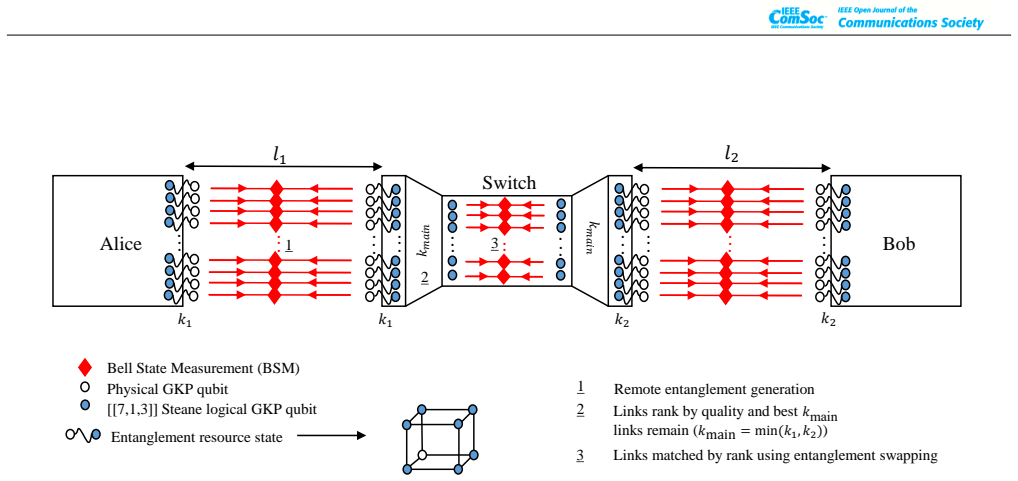
The central claim is that a quantum switch based on multiplexed GKP-qubit entanglement generation and all-photonic storage via graph states, using a generalized entanglement-ranking link matching protocol, enables efficient bipartite entanglement distribution. Optimal resource allocation under total budget constraints maximizes sum throughput fairly, and together with repeaters realizes arbitrary topology networks.
What carries the argument
The quantum switch with GKP-qubit graph state resources and the multi-client entanglement-ranking-based link matching protocol for allocation.
If this is right
- Optimal allocation of GKP resources maximizes sum throughput for client connections.
- The switch supports fair individual entanglement rates across pairs.
- Compatible with quantum repeaters for long-distance arbitrary topologies.
- The data center scenario captures gateway router connections to global networks.
Where Pith is reading between the lines
- Such switches could integrate with existing optical infrastructure for hybrid classical-quantum networks.
- Testing the protocol in small-scale GKP experiments would validate the heuristic's effectiveness.
- Resource optimization might extend to dynamic client layouts or varying channel losses.
- Arbitrary topologies could enable fully connected quantum internet backbones.
Load-bearing premise
The multi-client generalization of the entanglement-ranking-based link matching protocol heuristic remains effective for maximizing sum throughput while preserving fairness when applied to GKP-qubit graph-state resources.
What would settle it
A simulation or experiment demonstrating that the generalized matching protocol fails to achieve high sum throughput or fairness for GKP graph-state resources in a multi-client setting would falsify the central claim.
Figures


read the original abstract
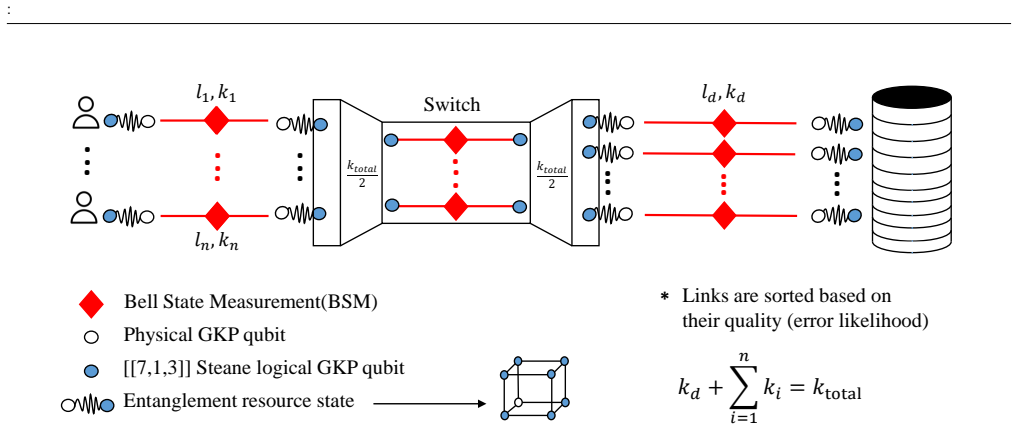
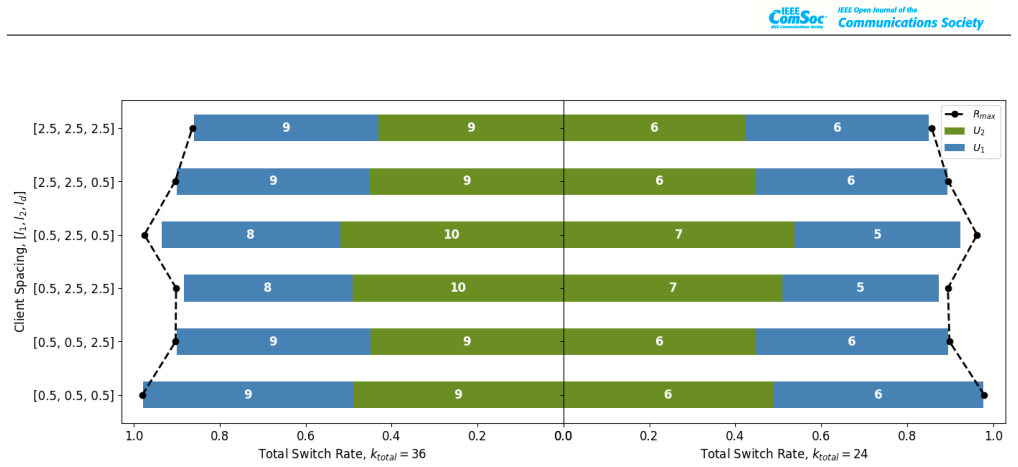
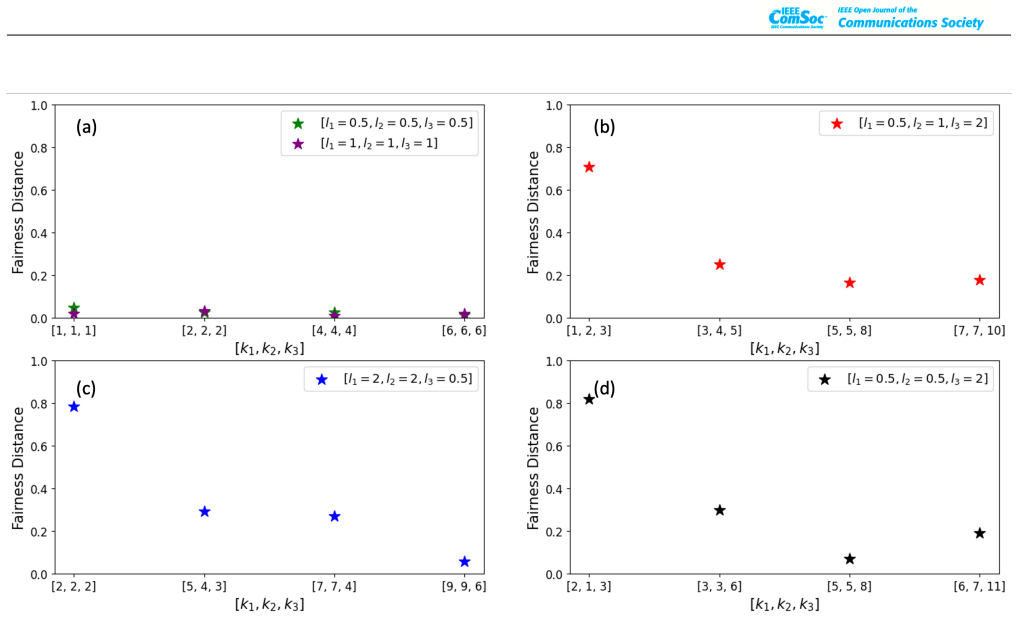
The Gottesman-Kitaev-Preskill (GKP) code, being information theoretically near optimal for quantum communication over Gaussian thermal-loss optical channels, is likely to be the encoding of choice for advanced quantum networks of the future. Quantum repeaters based on GKP-encoded light have been shown to support high end-to-end entanglement rates across large distances despite realistic finite squeezing in GKP code preparation and homodyne detection inefficiencies. Here, we introduce a quantum switch for GKP-qubit-based quantum networks, whose architecture involves multiplexed GKP-qubit-based entanglement link generation with clients, and their all-photonic storage, together enabled by GKP-qubit graph state resources. For bipartite entanglement distribution between clients via entanglement swapping, the switch uses a multi-client generalization of a recently introduced $\textit{entanglement-ranking-based link matching}$ protocol heuristic. Since generating the GKP-qubit graph state resource is hardware intensive, given a total resource budget and an arbitrary layout of clients, we address the question of their optimal allocation towards the different client-pair connections served by the switch such that the sum throughput of the switch is maximized while also being fair in terms of the individual entanglement rates. We illustrate our results for an exemplary data center network, where the data center is a client of a switch and all of its other clients aim to connect to the data center alone -- a scenario that also captures the general case of a gateway router connecting a local area network to a global network. Together with compatible quantum repeaters, our quantum switch provides a way to realize quantum networks of arbitrary topology.
Editorial analysis
A structured set of objections, weighed in public.
Referee Report
Summary. The manuscript proposes a quantum switch architecture for GKP-qubit-based all-photonic quantum networks. The design uses multiplexed GKP-qubit entanglement link generation with clients, enabled by GKP-qubit graph-state resources for all-photonic storage. For bipartite entanglement distribution, it employs a multi-client generalization of an entanglement-ranking-based link matching protocol heuristic. Given a fixed total resource budget and arbitrary client layouts, the work optimizes allocation across client-pair connections to maximize sum throughput while preserving fairness in individual rates. Results are illustrated for an exemplary data-center gateway scenario (where all other clients connect only to the data center), and the architecture is positioned, together with compatible quantum repeaters, as enabling quantum networks of arbitrary topology.
Significance. If the architecture and allocation results hold, the work supplies a concrete, all-photonic design for GKP-based switches that leverages the near-optimality of GKP encoding for Gaussian thermal-loss channels and extends prior repeater results to network switching. A strength is the explicit treatment of resource budgeting and fairness under arbitrary client layouts, together with the data-center illustration that also covers the gateway-router case. The constructive proposal for arbitrary topologies via repeaters is a clear contribution to scalable quantum-network engineering.
minor comments (2)
- [switch architecture description] The description of the multi-client generalization of the entanglement-ranking-based link matching protocol would benefit from an explicit statement of how the ranking and matching steps are extended from the two-client case (e.g., in the paragraph introducing the switch architecture).
- [data center illustration] Figure or table presenting the data-center allocation results should include the numerical values of the optimized rates and the fairness metric used, to allow direct assessment of the claimed maximization.
Simulated Author's Rebuttal
We thank the referee for their positive summary of our work, recognition of its significance for GKP-based quantum networks, and recommendation of minor revision. The absence of specific major comments in the report means we have no points requiring direct rebuttal at this stage; we will incorporate any editorial suggestions for minor changes in the revised manuscript.
Circularity Check
No significant circularity; architecture proposal with independent heuristic reference
full rationale
The manuscript is a design proposal for a GKP-qubit quantum switch using graph-state resources and a generalized matching heuristic. No load-bearing derivations, fitted parameters renamed as predictions, or self-referential definitions appear in the abstract or described architecture. The central claim (arbitrary-topology networks via compatible repeaters) is a constructive statement, not a closed-form result forced by the paper's own inputs. The referenced 'recently introduced' heuristic is treated as an external starting point rather than a self-citation chain that bears the result. The paper is self-contained as a proposal against external benchmarks.
Axiom & Free-Parameter Ledger
axioms (1)
- domain assumption GKP code is information-theoretically near optimal for quantum communication over Gaussian thermal-loss optical channels
Reference graph
Works this paper leans on
-
[1]
Quantum technology: the second quantum revolution,
J. P. Dowling and G. J. Milburn, “Quantum technology: the second quantum revolution,” Philos. Trans. A Math. Phys. Eng. Sci. , vol. 361, no. 1809, pp. 1655–1674, Aug. 2003
work page 2003
-
[2]
Validating quantum computers using randomized model circuits,
A. W. Cross, L. S. Bishop, S. Sheldon, P. D. Nation, and J. M. Gambetta, “Validating quantum computers using randomized model circuits,” Phys. Rev. A , vol. 100, p. 032328, Sep 2019. [Online]. Available: https://link.aps.org/doi/10.1103/PhysRevA.100.032328
-
[3]
Modular quantum computation in a trapped ion system,
K. Zhang, J. Thompson, X. Zhang, Y . Shen, Y . Lu, S. Zhang, J. Ma, V . Vedral, M. Gu, and K. Kim, “Modular quantum computation in a trapped ion system,” Nat. Commun., vol. 10, no. 1, p. 4692, Oct. 2019
work page 2019
-
[4]
Large-scale modular quantum-computer architecture with atomic memory and photonic interconnects,
C. Monroe, R. Raussendorf, A. Ruthven, K. R. Brown, P. Maunz, L.-M. Duan, and J. Kim, “Large-scale modular quantum-computer architecture with atomic memory and photonic interconnects,” Phys. Rev. A, vol. 89, no. 2, p. 022317, Feb. 2014
work page 2014
-
[5]
Microarchitectures for heterogeneous superconducting quantum computers,
S. Stein, S. Sussman, T. Tomesh, C. Guinn, E. Tureci, S. F. Lin, W. Tang, J. Ang, S. Chakram, A. Li, M. Martonosi, F. T. Chong, A. A. Houck, I. L. Chuang, and M. A. DeMarco, “Microarchitectures for heterogeneous superconducting quantum computers,” 2023
work page 2023
-
[6]
A modular quantum computer based on a quantum state router,
C. Zhou, P. Lu, M. Praquin, T.-C. Chien, R. Kaufman, X. Cao, M. Xia, R. Mong, W. Pfaff, D. Pekker, and M. Hatridge, “A modular quantum computer based on a quantum state router,” Research Square, May 2022
work page 2022
-
[7]
Photonic quantum networks formed from nv centers,
K. Nemoto, M. Trupke, S. J. Devitt, B. Scharfenberger, K. Buczak, J. Schmiedmayer, and W. J. Munro, “Photonic quantum networks formed from nv centers,” Sci. Rep., vol. 6, no. 1, p. 26284, May 2016
work page 2016
-
[8]
W ¨olk, Towards Quantum Technologies for Information Processing with Distributed Quantum Systems
S. W ¨olk, Towards Quantum Technologies for Information Processing with Distributed Quantum Systems . Universit ¨at Ulm, 2021
work page 2021
-
[9]
Data centers with quantum random access memory and quantum networks,
J. Liu, C. T. Hann, and L. Jiang, “Data centers with quantum random access memory and quantum networks,” Phys. Rev. A, vol. 108, no. 3, p. 032610, Sep. 2023
work page 2023
-
[10]
Private quantum computation: an introduction to blind quantum computing and related protocols,
J. F. Fitzsimons, “Private quantum computation: an introduction to blind quantum computing and related protocols,” npj Quantum Infor- mation, vol. 3, no. 1, pp. 1–11, Jun. 2017
work page 2017
-
[11]
Quantum key distribution: A networking perspective,
M. Mehic, M. Niemiec, S. Rass, J. Ma, M. Peev, A. Aguado, V . Martin, S. Schauer, A. Poppe, C. Pacher, and M. V oznak, “Quantum key distribution: A networking perspective,” ACM Comput. Surv., vol. 53, no. 5, pp. 1–41, Sep. 2020
work page 2020
-
[12]
Dis- tributed quantum sensing with mode-entangled spin-squeezed atomic states,
B. K. Malia, Y . Wu, J. Mart ´ınez-Rinc´on, and M. A. Kasevich, “Dis- tributed quantum sensing with mode-entangled spin-squeezed atomic states,” Nature, vol. 612, no. 7941, pp. 661–665, Dec. 2022
work page 2022
-
[13]
Z. Zhang and Q. Zhuang, “Distributed quantum sensing,” Quantum Sci. Technol., vol. 6, no. 4, p. 043001, Jul. 2021
work page 2021
-
[14]
Distributed quantum sensing in a continuous-variable entangled network,
X. Guo, C. R. Breum, J. Borregaard, S. Izumi, M. V . Larsen, T. Gehring, M. Christandl, J. S. Neergaard-Nielsen, and U. L. Ander- sen, “Distributed quantum sensing in a continuous-variable entangled network,” Nat. Phys., vol. 16, no. 3, pp. 281–284, Dec. 2019
work page 2019
-
[15]
Photonic quantum information processing: A concise review,
S. Slussarenko and G. J. Pryde, “Photonic quantum information processing: A concise review,” Applied Physics Reviews, vol. 6, no. 4, 2019
work page 2019
-
[16]
Photonic quantum informa- tion processing: a review,
F. Flamini, N. Spagnolo, and F. Sciarrino, “Photonic quantum informa- tion processing: a review,” Rep. Prog. Phys., vol. 82, no. 1, p. 016001, Jan. 2019
work page 2019
-
[17]
C. Weedbrook, S. Pirandola, R. Garc ´ıa-Patr´on, N. J. Cerf, T. C. Ralph, J. H. Shapiro, and S. Lloyd, “Gaussian quantum information,” Rev. Mod. Phys., vol. 84, no. 2, pp. 621–669, May 2012
work page 2012
-
[18]
Encoding a qubit in an oscillator,
D. Gottesman, A. Kitaev, and J. Preskill, “Encoding a qubit in an oscillator,” Phys. Rev. A, vol. 64, no. 1, p. 012310, Jun. 2001
work page 2001
-
[19]
K. Noh, V . V . Albert, and L. Jiang, “Quantum capacity bounds of gaussian thermal loss channels and achievable rates with Gottesman- Kitaev-Preskill codes,” pp. 2563–2582, 2019
work page 2019
-
[20]
W. J. Munro, K. Azuma, K. Tamaki, and K. Nemoto, “Inside quantum repeaters,” IEEE J. Sel. Top. Quantum Electron. , vol. 21, no. 3, pp. 78–90, May 2015
work page 2015
-
[21]
A quantum router architecture for high-fidelity entanglement flows in quantum networks,
Y . Lee, E. Bersin, A. Dahlberg, S. Wehner, and D. Englund, “A quantum router architecture for high-fidelity entanglement flows in quantum networks,” npj Quantum Information , vol. 8, no. 1, p. 75, 2022
work page 2022
-
[22]
On the capac- ity region of bipartite and tripartite entanglement switching,
G. Vardoyan, P. Nain, S. Guha, and D. Towsley, “On the capac- ity region of bipartite and tripartite entanglement switching,” ACM Transactions on Modeling and Performance Evaluation of Computing Systems, vol. 8, no. 1-2, pp. 1–18, 2023
work page 2023
-
[23]
A continuous variable quantum switch,
I. Tillman, T. Vasantam, and K. P. Seshadreesan, “A continuous variable quantum switch,” in 2022 IEEE International Conference on Quantum Computing and Engineering (QCE) . IEEE, Sep. 2022, pp. 365–371
work page 2022
-
[24]
Fundamen- tal limits of repeaterless quantum communications,
S. Pirandola, R. Laurenza, C. Ottaviani, and L. Banchi, “Fundamen- tal limits of repeaterless quantum communications,” Nat. Commun. , vol. 8, p. 15043, Apr. 2017
work page 2017
-
[25]
Error-corrected quantum repeaters with GKP qudits,
F. Schmidt, D. Miller, and P. van Loock, “Error-corrected quantum repeaters with GKP qudits,” Mar. 2023
work page 2023
-
[26]
F. Rozpedek, K. P. Seshadreesan, P. Polakos, L. Jiang, and S. Guha, “All-photonic gottesman-kitaev-preskill–qubit repeater using analog-information-assisted multiplexed entanglement ranking,” Phys. Rev. Res. , vol. 5, p. 043056, Oct 2023. [Online]. Available: https://link.aps.org/doi/10.1103/PhysRevResearch.5.043056
-
[27]
All-optical long- distance quantum communication with Gottesman-Kitaev-Preskill qubits,
K. Fukui, R. N. Alexander, and P. van Loock, “All-optical long- distance quantum communication with Gottesman-Kitaev-Preskill qubits,” Phys. Rev. Res., vol. 3, no. 3, p. 033118, Aug. 2021
work page 2021
-
[28]
Quantum repeaters based on concatenated bosonic and discrete-variable quantum codes,
F. Rozpedek, K. Noh, Q. Xu, S. Guha, and L. Jiang, “Quantum repeaters based on concatenated bosonic and discrete-variable quantum codes,” npj Quantum Information , vol. 7, no. 1, pp. 1–12, Jun. 2021
work page 2021
-
[29]
Progress towards practical qubit computation using approximate Gottesman-Kitaev-Preskill codes,
I. Tzitrin, J. E. Bourassa, N. C. Menicucci, and K. K. Sabapathy, “Progress towards practical qubit computation using approximate Gottesman-Kitaev-Preskill codes,” Phys. Rev. A , vol. 101, no. 3, p. 032315, Mar. 2020
work page 2020
-
[30]
Optimal eavesdropping in quantum cryptography with six states,
D. Bruß, “Optimal eavesdropping in quantum cryptography with six states,” Phys. Rev. Lett. , vol. 81, pp. 3018–3021, Oct 1998. [Online]. Available: https://link.aps.org/doi/10.1103/PhysRevLett.81.3018
-
[31]
Quantum error correction for beginners,
S. J. Devitt, W. J. Munro, and K. Nemoto, “Quantum error correction for beginners,” Rep. Prog. Phys., vol. 76, no. 7, p. 076001, Jul. 2013. VOLUME , 13
work page 2013
discussion (0)
Sign in with ORCID, Apple, or X to comment. Anyone can read and Pith papers without signing in.