SparrowSNN: A Hardware/software Co-design for Energy Efficient ECG Classification
Pith reviewed 2026-05-24 01:42 UTC · model grok-4.3
The pith
SparrowSNN uses a Sum-Spike-and-Fire function and hybrid ANN-SNN model to reach state-of-the-art ECG accuracy at 20 to 100 times lower energy.
A machine-rendered reading of the paper's core claim, the machinery that carries it, and where it could break.
Core claim
SparrowSNN proposes the hardware-friendly SSF spike activation function, a customizable μW-level quantized hybrid ANN-SNN model, and a compact reconfigurable ASIC architecture. Evaluated on the MIT-BIH ECG and DEAP EEG datasets, the combination achieves state-of-the-art accuracy while consuming 20× to 100× less energy than existing ultra-low-power solutions.
What carries the argument
The Sum-Spike-and-Fire (SSF) activation function, which accumulates spikes in one pass to avoid weight re-reading across timesteps, together with the hybrid quantized ANN-SNN model and reconfigurable ASIC.
If this is right
- The hybrid model can be customized per biomedical application while staying within microwatt power budgets.
- The reconfigurable ASIC reduces control and data-movement energy for small edge models that do not need large many-core neuromorphic chips.
- The SSF function directly lowers dynamic energy by eliminating repeated weight accesses across timesteps.
- State-of-the-art accuracy is maintained on both ECG and EEG tasks without increasing model size.
Where Pith is reading between the lines
- The same co-design pattern of SSF plus hybrid quantization could be tested on other sensor time-series tasks such as activity recognition.
- Further energy gains might appear if the ASIC is extended with application-specific data paths for different quantization widths.
- Real silicon measurements beyond simulation would be needed to verify the energy numbers under process variation.
Load-bearing premise
The reported energy and accuracy numbers rest on fair comparisons to prior solutions and on the assumption that mapping the SSF function and hybrid model to the ASIC adds no hidden overheads or accuracy loss.
What would settle it
A side-by-side measurement of energy per inference and classification accuracy on the MIT-BIH dataset using the fabricated SparrowSNN ASIC versus a prior ultra-low-power SNN implementation would confirm or refute the 20-100x claim.
Figures


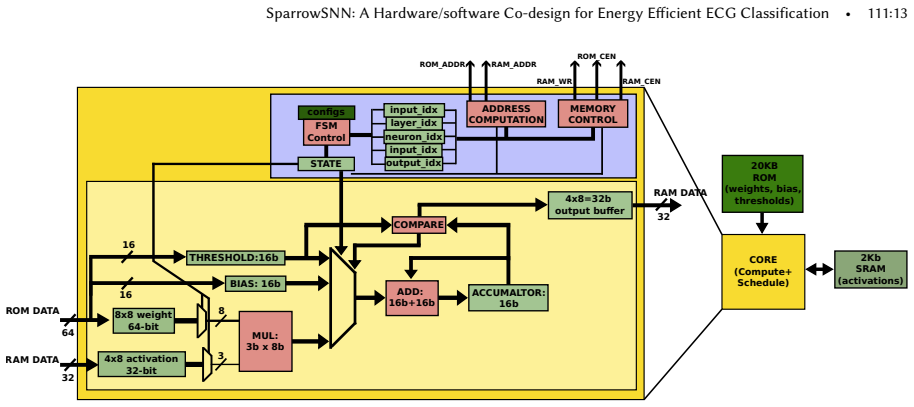


read the original abstract
Deep learning has driven significant technological advancements, but its high energy consumption limits its use on battery-operated edge devices. Spiking Neural Networks (SNNs) offer promising reductions in inference-time energy consumption. However, existing neuromorphic architectures optimize scalable, many-core NoC execution, suited to large models but mismatched to edge devices, and their prevalent integrate-and-fire neurons re-read weights across \(T\) timesteps, inflating data-movement and dynamic-control energy. To address this challenge, we propose SparrowSNN, an optimized end-to-end design tailored for edge applications. SparrowSNN proposes: (1) a hardware-friendly spike activation function SSF (Sum-Spike-and-Fire); (2) a customizable $\mu$W-level-power quantized hybrid ANN-SNN model that can be designed per application; (3) a compact and low-power reconfigurable ASIC architecture, supporting the aforementioned designs. Evaluated on biomedical MIT-BIH ECG and DEAP EEG datasets, SparrowSNN achieves state-of-the-art accuracy with $20\times$ to $100\times$ lower energy consumption, significantly outperforming existing ultra-low power solutions.
Editorial analysis
A structured set of objections, weighed in public.
Referee Report
Summary. The paper proposes SparrowSNN, an end-to-end hardware/software co-design for edge ECG/EEG classification. It introduces a hardware-friendly Sum-Spike-and-Fire (SSF) neuron, a customizable μW-level quantized hybrid ANN-SNN model, and a compact reconfigurable ASIC. Evaluated on MIT-BIH and DEAP datasets, it claims state-of-the-art accuracy together with 20×–100× lower energy consumption than prior ultra-low-power solutions.
Significance. If the energy-reduction claims hold under normalized, reproducible comparisons, the work would be significant for battery-constrained biomedical edge devices. The hybrid model and reconfigurable fabric target the mismatch between large-scale neuromorphic NoCs and small edge workloads; the SSF neuron aims to reduce repeated weight reads. These are concrete, application-driven contributions.
major comments (2)
- [Abstract] Abstract: the central claim of 20×–100× energy reduction is load-bearing for the paper’s contribution, yet the abstract (and by extension the evaluation) provides no experimental details, error bars, baseline implementations, process nodes, supply voltages, or measurement methodology. Without these, the multiplier cannot be verified.
- [Abstract] Abstract: the reported energy figures rest on cross-paper comparisons that are not shown to be normalized for CMOS node, activity factor, or memory-access cost; no renormalization procedure or post-synthesis overhead accounting for the SSF neuron and hybrid ANN-SNN mapping is described. Violation of any of these assumptions directly scales the claimed multiplier.
Simulated Author's Rebuttal
We thank the referee for the constructive feedback on the energy claims. We agree that greater transparency is needed in the abstract and evaluation to support the reported multipliers, and we will revise accordingly.
read point-by-point responses
-
Referee: [Abstract] Abstract: the central claim of 20×–100× energy reduction is load-bearing for the paper’s contribution, yet the abstract (and by extension the evaluation) provides no experimental details, error bars, baseline implementations, process nodes, supply voltages, or measurement methodology. Without these, the multiplier cannot be verified.
Authors: We agree that the abstract should be expanded to include key experimental parameters supporting the energy claim. In the revised version we will add a concise statement referencing the evaluation setup (process node, supply voltage, post-layout power estimation methodology, baseline implementations, and error bars from repeated trials). The full details already appear in Section 5 and the associated figures; the revision will make these visible from the abstract without altering the reported numbers. revision: yes
-
Referee: [Abstract] Abstract: the reported energy figures rest on cross-paper comparisons that are not shown to be normalized for CMOS node, activity factor, or memory-access cost; no renormalization procedure or post-synthesis overhead accounting for the SSF neuron and hybrid ANN-SNN mapping is described. Violation of any of these assumptions directly scales the claimed multiplier.
Authors: We acknowledge that the current manuscript does not explicitly describe a renormalization procedure. We will add a dedicated paragraph in the evaluation section (and a brief reference in the abstract) that states the comparison methodology, lists the process nodes of each baseline, notes any scaling assumptions applied for node and activity factor, and quantifies the post-synthesis overhead introduced by the SSF neuron and hybrid mapping. This will allow readers to assess the sensitivity of the 20×–100× range. revision: yes
Circularity Check
No circularity: empirical design and evaluation chain is self-contained
full rationale
The provided abstract and description contain no equations, derivations, or self-referential steps that reduce a claimed result to its own inputs by construction. The paper introduces SSF, a hybrid ANN-SNN model, and an ASIC architecture, then reports empirical accuracy and energy numbers on fixed datasets. No fitted parameter is renamed as a prediction, no uniqueness theorem is imported from self-citation, and no ansatz is smuggled. Central claims rest on hardware mapping and measurement rather than a closed definitional loop. This is the expected outcome for a co-design paper whose load-bearing content is experimental comparison, not mathematical derivation.
Axiom & Free-Parameter Ledger
Lean theorems connected to this paper
-
IndisputableMonolith/Foundation/DimensionForcing.leanreality_from_one_distinction (8-tick period forced by 2^D=8) echoes?
echoesECHOES: this paper passage has the same mathematical shape or conceptual pattern as the Recognition theorem, but is not a direct formal dependency.
our SNN operates with a time window size of 8... T=15... SSF model... memory access cost from T to log2(T+1)
-
IndisputableMonolith/Cost/FunctionalEquation.leanwashburn_uniqueness_aczel (J-cost uniqueness) echoes?
echoesECHOES: this paper passage has the same mathematical shape or conceptual pattern as the Recognition theorem, but is not a direct formal dependency.
E_SMLP = (d_i·d_o + d_o)·E_m,1 + ... + 2·d_o·T/8·E_m,3 ... SSF mechanism... better energy efficiency
What do these tags mean?
- matches
- The paper's claim is directly supported by a theorem in the formal canon.
- supports
- The theorem supports part of the paper's argument, but the paper may add assumptions or extra steps.
- extends
- The paper goes beyond the formal theorem; the theorem is a base layer rather than the whole result.
- uses
- The paper appears to rely on the theorem as machinery.
- contradicts
- The paper's claim conflicts with a theorem or certificate in the canon.
- unclear
- Pith found a possible connection, but the passage is too broad, indirect, or ambiguous to say the theorem truly supports the claim.
Forward citations
Cited by 1 Pith paper
-
Reconsidering the energy efficiency of spiking neural networks
Rate-encoded SNNs with T timesteps outperform bit-equivalent QNNs in energy only when average spike rate falls below 6.4% for T in [5,10] under typical neuromorphic hardware, per an analytical model covering computati...
Reference graph
Works this paper leans on
-
[1]
Pytorch Post Training Static Quantization
2023. Pytorch Post Training Static Quantization. https://pytorch.org/docs/stable/quantization.html
work page 2023
-
[2]
2024. Heart Disease Fact. https://www.cdc.gov/heartdisease/facts.htm
work page 2024
-
[3]
Raafat O Aburukba, Mazin AliKarrar, Taha Landolsi, and Khaled El-Fakih. 2020. Scheduling Internet of Things requests to minimize latency in hybrid Fog–Cloud computing. Future Generation Computer Systems 111 (2020), 539–551
work page 2020
-
[4]
Adel A Ahmed, Waleed Ali, Talal AA Abdullah, and Sharaf J Malebary. 2023. Classifying cardiac arrhythmia from ECG signal using 1D CNN deep learning model. Mathematics 11, 3 (2023), 562
work page 2023
-
[5]
Filipp Akopyan, Jun Sawada, Andrew Cassidy, Rodrigo Alvarez-Icaza, John Arthur, Paul Merolla, Nabil Imam, Yutaka Nakamura, Pallab Datta, Gi-Joon Nam, et al. 2015. Truenorth: Design and tool flow of a 65 mw 1 million neuron programmable neurosynaptic chip. IEEE transactions on computer-aided design of integrated circuits and systems 34, 10 (2015), 1537–1557
work page 2015
-
[6]
Douglas G Altman and J Martin Bland. 1994. Statistics Notes: Diagnostic tests 2: predictive values. Bmj 309, 6947 (1994), 102
work page 1994
-
[7]
Dimitra Azariadi, Vasileios Tsoutsouras, Sotirios Xydis, and Dimitrios Soudris. 2016. ECG signal analysis and arrhythmia detection on IoT wearable medical devices. In 2016 5th International conference on modern circuits and systems technologies (MOCAST) . IEEE, 1–4
work page 2016
-
[8]
Abhiroop Bhattacharjee, Ruokai Yin, Abhishek Moitra, and Priyadarshini Panda. 2024. Are SNNs Truly Energy-efficient?—A Hardware Perspective. In ICASSP 2024-2024 IEEE International Conference on Acoustics, Speech and Signal Processing (ICASSP) . IEEE, 13311–13315
work page 2024
-
[9]
Romain Brette. 2015. Philosophy of the spike: rate-based vs. spike-based theories of the brain. Frontiers in systems neuroscience 9 (2015), 151
work page 2015
-
[10]
Qiao Cai, Xinzi Xu, Yang Zhao, Liang Ying, Yongfu Li, and Yong Lian. 2021. A 1.3 𝜇W event-driven ANN core for cardiac arrhythmia classification in wearable sensors. IEEE Transactions on Circuits and Systems II: Express Briefs 68, 9 (2021), 3123–3127
work page 2021
-
[11]
Nitesh V Chawla, Kevin W Bowyer, Lawrence O Hall, and W Philip Kegelmeyer. 2002. SMOTE: synthetic minority over-sampling technique. Journal of artificial intelligence research 16 (2002), 321–357
work page 2002
-
[12]
Shichao Chen, Qijie Li, Mengchu Zhou, and Abdullah Abusorrah. 2021. Recent advances in collaborative scheduling of computing tasks in an edge computing paradigm. Sensors 21, 3 (2021), 779
work page 2021
-
[13]
Haoming Chu, Yulong Yan, Leijing Gan, Hao Jia, Liyu Qian, Yuxiang Huan, Lirong Zheng, and Zhuo Zou. 2022. A neuromorphic processing system with spike-driven SNN processor for wearable ECG classification. IEEE Transactions on Biomedical Circuits and Systems 16, 4 (2022), 511–523
work page 2022
-
[14]
Yu-Chuan Chuang, Yi-Ta Chen, Huai-Ting Li, and An-Yeu Andy Wu. 2021. An arbitrarily reconfigurable extreme learning machine inference engine for robust ECG anomaly detection. IEEE Open Journal of Circuits and Systems 2 (2021), 196–209
work page 2021
-
[15]
Philip De Chazal, Maria O’Dwyer, and Richard B Reilly. 2004. Automatic classification of heartbeats using ECG morphology and heartbeat interval features. IEEE transactions on biomedical engineering 51, 7 (2004), 1196–1206
work page 2004
-
[16]
Diego di Bernardo and Alan Murray. 2000. Explaining the T-wave shape in the ECG. Nature 403, 6765 (2000), 40–40
work page 2000
-
[17]
Peter U Diehl, Daniel Neil, Jonathan Binas, Matthew Cook, Shih-Chii Liu, and Michael Pfeiffer. 2015. Fast-classifying, high-accuracy spiking deep networks through weight and threshold balancing. In 2015 International Joint Conference on Neural Networks (IJCNN) . IEEE, 1–8
work page 2015
-
[18]
Jason K Eshraghian, Max Ward, Emre O Neftci, Xinxin Wang, Gregor Lenz, Girish Dwivedi, Mohammed Bennamoun, Doo Seok Jeong, and Wei D Lu. 2023. Training spiking neural networks using lessons from deep learning. Proc. IEEE (2023)
work page 2023
-
[19]
Yifei Feng, Shijia Geng, Jianjun Chu, Zhaoji Fu, and Shenda Hong. 2022. Building and training a deep spiking neural network for ECG classification. Biomedical Signal Processing and Control 77 (2022), 103749
work page 2022
-
[20]
Association for the Advancement of Medical Instrumentation et al. 1998. Testing and reporting performance results of cardiac rhythm and ST segment measurement algorithms. ANSI/AAMI EC38 1998 (1998)
work page 1998
-
[21]
Chittotosh Ganguly and Saswat Chakrabarti. 2020. A discrete time framework for spike transfer process in a cortical neuron with asynchronous epsp, ipsp, and variable threshold. IEEE Transactions on Neural Systems and Rehabilitation Engineering 28, 4 (2020), 772–781
work page 2020
-
[22]
V Jahmunah, Shu Lih Oh, Joel Koh En Wei, Edward J Ciaccio, Kuang Chua, Tan Ru San, and U Rajendra Acharya. 2019. Computer-aided diagnosis of congestive heart failure using ECG signals–A review. Physica Medica 62 (2019), 95–104
work page 2019
-
[23]
Congfeng Jiang, Tiantian Fan, Honghao Gao, Weisong Shi, Liangkai Liu, Christophe Cérin, and Jian Wan. 2020. Energy aware edge computing: A survey. Computer Communications 151 (2020), 556–580
work page 2020
- [24]
-
[25]
Yanzhen Liu, Zhijin Qin, and Geoffrey Ye Li. 2024. Energy-Efficient Distributed Spiking Neural Network for Wireless Edge Intelligence. IEEE Transactions on Wireless Communications (2024)
work page 2024
-
[26]
Ying Liu, Zhixuan Wang, Wei He, Linxiao Shen, Yihan Zhang, Peiyu Chen, Meng Wu, Hao Zhang, Peng Zhou, Jinguang Liu, et al. 2022. An 82nW 0.53 pJ/SOP clock-free spiking neural network with 40𝜇s latency for AloT wake-up functions using ultimate-event-driven bionic architecture and computing-in-memory technique. In 2022 IEEE International Solid-State Circuit...
work page 2022
-
[27]
Eduardo José da S Luz, William Robson Schwartz, Guillermo Cámara-Chávez, and David Menotti. 2016. ECG-based heartbeat classification for arrhythmia detection: A survey. Computer methods and programs in biomedicine 127 (2016), 144–164
work page 2016
-
[28]
Sumit Majumder, Emad Aghayi, Moein Noferesti, Hamidreza Memarzadeh-Tehran, Tapas Mondal, Zhibo Pang, and M Jamal Deen. 2017. Smart homes for elderly healthcare—Recent advances and research challenges. Sensors 17, 11 (2017), 2496
work page 2017
-
[29]
Ruixin Mao, Sixu Li, Zhaomin Zhang, Zihan Xia, Jianbiao Xiao, Zixuan Zhu, Jiahao Liu, Weiwei Shan, Liang Chang, and Jun Zhou. 2022. An ultra-energy-efficient and high accuracy ECG classification processor with SNN inference assisted by on-chip ANN learning. IEEE Transactions on Biomedical Circuits and Systems 16, 5 (2022), 832–841
work page 2022
-
[30]
Tanis Mar, Sebastian Zaunseder, Juan Pablo Martínez, Mariano Llamedo, and Rüdiger Poll. 2011. Optimization of ECG classification by means of feature selection. IEEE transactions on Biomedical Engineering 58, 8 (2011), 2168–2177
work page 2011
-
[31]
Abhishek Moitra, Abhiroop Bhattacharjee, Runcong Kuang, Gokul Krishnan, Yu Cao, and Priyadarshini Panda. 2023. Spikesim: An end- to-end compute-in-memory hardware evaluation tool for benchmarking spiking neural networks. IEEE Transactions on Computer-Aided Design of Integrated Circuits and Systems (2023)
work page 2023
-
[32]
George B Moody and Roger G Mark. 2001. The impact of the MIT-BIH arrhythmia database. IEEE Engineering in Medicine and Biology Magazine 20, 3 (2001), 45–50
work page 2001
-
[33]
Markus Nagel, Marios Fournarakis, Rana Ali Amjad, Yelysei Bondarenko, Mart Van Baalen, and Tijmen Blankevoort. 2021. A white paper on neural network quantization. arXiv preprint arXiv:2106.08295 (2021)
work page internal anchor Pith review Pith/arXiv arXiv 2021
-
[34]
Nafiul Rashid, Manik Dautta, Peter Tseng, and Mohammad Abdullah Al Faruque. 2020. HEAR: Fog-enabled energy-aware online human eating activity recognition. IEEE Internet of Things Journal 8, 2 (2020), 860–868
work page 2020
-
[35]
Nafiul Rashid, Berken Utku Demirel, Mohanad Odema, and Mohammad Abdullah Al Faruque. 2022. Template matching based early exit cnn for energy-efficient myocardial infarction detection on low-power wearable devices. Proceedings of the ACM on Interactive, Mobile, Wearable and Ubiquitous Technologies 6, 2 (2022), 1–22
work page 2022
-
[36]
Bodo Rueckauer, Iulia-Alexandra Lungu, Yuhuang Hu, Michael Pfeiffer, and Shih-Chii Liu. 2017. Conversion of continuous-valued deep networks to efficient event-driven networks for image classification. Frontiers in Neuroscience 11 (2017), 682
work page 2017
-
[37]
Richard B Stein, E Roderich Gossen, and Kelvin E Jones. 2005. Neuronal variability: noise or part of the signal? Nature Reviews Neuroscience 6, 5 (2005), 389–397
work page 2005
-
[38]
Aboozar Taherkhani, Ammar Belatreche, Yuhua Li, Georgina Cosma, Liam Maguire, and T.M. Mcginnity. 2019. A review of learning in biologically plausible spiking neural networks. Neural Networks 122 (10 2019). https://doi.org/10.1016/j.neunet.2019.09.036
-
[39]
Chengcheng Tang and Jie Han. 2023. Hardware efficient weight-binarized spiking neural networks. In 2023 Design, Automation & Test in Europe Conference & Exhibition (DATE). IEEE, 1–6
work page 2023
-
[40]
Amina Tihak, Lejla Smajlovic, and Dusanka Boskovic. 2023. Classification of Atrial Fibrillation ECG Signals Using 2D CNN. In Mediterranean Conference on Medical and Biological Engineering and Computing . Springer, 57–65
work page 2023
-
[41]
Alex Vigneron and Jean Martinet. 2020. A critical survey of STDP in Spiking Neural Networks for Pattern Recognition (Preprint). (03 2020). https://doi.org/10.13140/RG.2.2.24086.09287
-
[42]
K Vinutha and Usharani Thirunavukkarasu. 2023. Prediction of arrhythmia from MIT-BIH database using random forest (RF) and voted perceptron (VP) classifiers. In AIP Conference Proceedings, Vol. 2822. AIP Publishing
work page 2023
-
[43]
Ning Wang, Jun Zhou, Guanghai Dai, Jiahui Huang, and Yuxiang Xie. 2019. Energy-efficient intelligent ECG monitoring for wearable devices. IEEE transactions on biomedical circuits and systems 13, 5 (2019), 1112–1121
work page 2019
-
[44]
Xiyan Wu, Yufei Zhao, Yong Song, Yurong Jiang, Yashuo Bai, Xinyi Li, Ya Zhou, Xin Yang, and Qun Hao. 2023. Dynamic threshold integrate and fire neuron model for low latency spiking neural networks. Neurocomputing 544 (2023), 126247
work page 2023
-
[45]
Yujie Wu, Lei Deng, Guoqi Li, Jun Zhu, Yuan Xie, and Luping Shi. 2019. Direct training for spiking neural networks: Faster, larger, better. In Proceedings of the AAAI Conference on Artificial Intelligence , Vol. 33. 1311–1318
work page 2019
-
[46]
Yulong Yan, Haoming Chu, Yi Jin, Yuxiang Huan, Zhuo Zou, and Lirong Zheng. 2022. Backpropagation with sparsity regularization for spiking neural network learning. Frontiers in Neuroscience 16 (2022), 760298
work page 2022
-
[47]
Zhanglu Yan, Jun Zhou, and Weng-Fai Wong. 2021. Energy efficient ECG classification with spiking neural network. Biomedical Signal Processing and Control 63 (2021), 102170
work page 2021
-
[48]
Zhanglu Yan, Jun Zhou, and Weng-Fai Wong. 2021. Near lossless transfer learning for spiking neural networks. InProceedings of the AAAI conference on artificial intelligence , Vol. 35. 10577–10584
work page 2021
-
[49]
Zhanglu Yan, Jun Zhou, and Weng-Fai Wong. 2023. CQ + Training: Minimizing Accuracy Loss in Conversion from Convolutional Neural Networks to Spiking Neural Networks. IEEE Transactions on Pattern Analysis and Machine Intelligence (2023), 1–12. https: //doi.org/10.1109/TPAMI.2023.3286121
-
[50]
Chen Zhang, Junfeng Chang, Yujiang Guan, Qiuping Li, Xin’an Wang, and Xing Zhang. 2023. A Low-Power ECG Processor ASIC Based on an Artificial Neural Network for Arrhythmia Detection. Applied Sciences 13, 17 (2023), 9591
work page 2023
-
[51]
Yuxuan Zhao, Jiadong Ren, Bing Zhang, Jinxiao Wu, and Yongqiang Lyu. 2023. An explainable attention-based TCN heartbeats classification model for arrhythmia detection. Biomedical Signal Processing and Control 80 (2023), 104337. Proc. ACM Interact. Mob. Wearable Ubiquitous Technol., Vol. 37, No. 4, Article 111. Publication date: August 2018. 111:22 • XXX e...
work page 2023
discussion (0)
Sign in with ORCID, Apple, or X to comment. Anyone can read and Pith papers without signing in.