SaTor: Exploring Satellite Routing in Tor to Reduce Latency
Pith reviewed 2026-05-24 00:20 UTC · model grok-4.3
The pith
Equipping 100 top Tor relays with satellite links speeds up over 40% of circuits by 21.8 ms on average.
A machine-rendered reading of the paper's core claim, the machinery that carries it, and where it could break.
Core claim
SaTor is a satellite-assisted routing scheme that equips Tor relays with satellite network access, allowing slow circuits to use satellite transmission for the long-distance segments while leaving the existing path selection algorithm unchanged. The evaluation finds that this yields an expected speed-up of 21.8 ms for over 40% of circuits in the long term when only 100 top relays are equipped.
What carries the argument
SaTor, the satellite-assisted routing scheme that integrates satellite network access into selected Tor relays to accelerate slow circuits without biasing path selection.
If this is right
- A substantial fraction of Tor circuits can be accelerated while the randomness required for anonymity stays intact.
- Network-wide latency reduction is achievable by upgrading only a small number of relays.
- The method supplies a concrete reference point for future Tor enhancements focused on performance.
- Satellite links can be added on top of existing routing without requiring changes to client software.
Where Pith is reading between the lines
- The same satellite-access idea could be tested on other overlay networks that suffer from geographic latency.
- Real deployment would need to verify whether satellite links introduce detectable timing patterns usable for traffic analysis.
- Pairing SaTor with existing Tor latency-reduction proposals might produce larger combined gains than either alone.
- The cost and availability of satellite service for relays would determine whether the scheme scales beyond the simulated 100-relay case.
Load-bearing premise
The custom simulator together with the real-world measurements accurately predict the latency gains that satellite links would produce on live Tor circuits, and equipping 100 relays with satellite service is feasible without major new costs or security problems.
What would settle it
Deploy satellite service on the 100 highest-traffic Tor relays and measure whether the observed circuit latencies match the simulator's predicted 21.8 ms average improvement for more than 40% of circuits.
Figures




read the original abstract
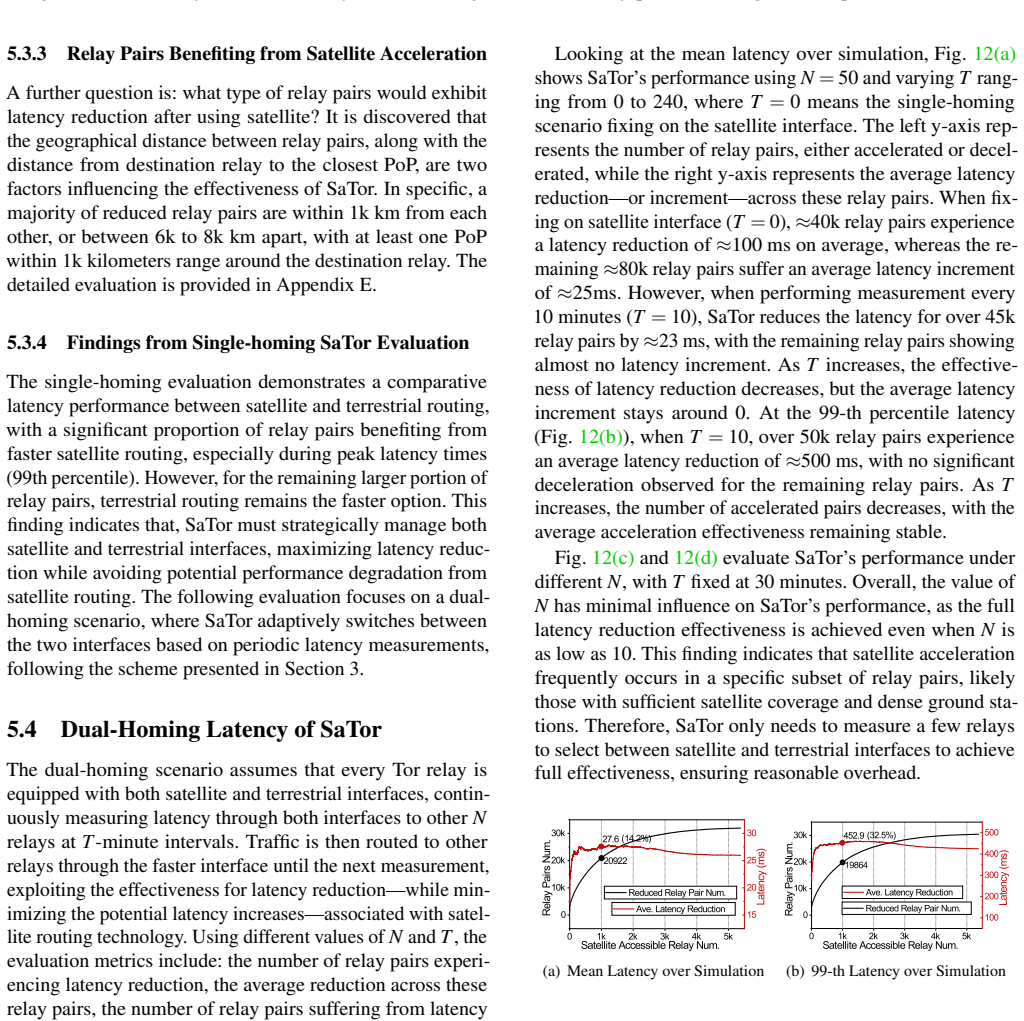
High latency is a critical limitation within the Tor network that has a negative impact on web application responsiveness. A key factor exacerbating Tor latency is the creation of lengthy circuits that span across geographically distant regions, causing significant transmission delays. A common solution involves modifying Tor's circuit-building process to reduce the likelihood of selecting lengthy circuits. However, this strategy compromises Tor's routing randomness, increasing the risk of deanonymization. Reducing Tor's latency while minimizing security degradation presents a challenge. This paper proposes and investigates SaTor, a satellite-assisted routing scheme to reduce Tor latency. By equipping Tor relays with satellite network access, SaTor could accelerate slow circuits via satellite transmission, without biasing the existing path selection process. Our performance evaluation, using a simulator we developed along with real-world measurements, shows that over the long term, SaTor provides an expected speed-up of 21.8 ms for over 40% of circuits, with only 100 top relays equipped with satellite service. Our research uncovers a viable way to overcome Tor's latency bottleneck, serving as a practical reference for its future enhancement.
Editorial analysis
A structured set of objections, weighed in public.
Referee Report
Summary. The paper proposes SaTor, a satellite-assisted routing scheme for Tor in which selected relays are equipped with satellite network access. This allows slow circuits to use satellite links for transmission without modifying Tor's existing path-selection algorithm or introducing additional deanonymization risk. Using a custom simulator and real-world measurements, the authors report that equipping the top 100 relays yields an expected latency speedup of 21.8 ms for more than 40% of circuits over the long term.
Significance. If the simulator and measurement methodology are shown to be accurate, the result would demonstrate a practical, low-impact method for mitigating Tor's latency bottleneck while preserving the randomness properties of circuit construction. The approach of augmenting a small number of high-degree relays rather than altering path selection is a notable design choice that avoids the usual anonymity-performance trade-off.
major comments (2)
- [§5] §5 (Performance Evaluation) and the abstract: the headline quantitative claim—an expected 21.8 ms speedup for >40% of circuits with only 100 equipped relays—is produced entirely by the authors' custom simulator plus their own measurements. No validation of the simulator against public Tor Metrics circuit-latency distributions, published LEO satellite traces, or independent Tor path-selection traces is described, so any systematic bias in modeling baseline latencies, satellite gains, or the fraction of benefiting circuits directly scales the reported figure.
- [§4] §4 (SaTor Design) and §6 (Discussion): the claim that satellite augmentation can be added to 100 top relays “without biasing the existing path selection process” and without introducing prohibitive costs or new security risks is asserted but not supported by any quantitative analysis of deployment feasibility, bandwidth pricing for satellite links, or potential side-channel or traffic-analysis implications of satellite-equipped relays.
minor comments (2)
- [Abstract] The abstract and §1 refer to “over the long term” without defining the time scale or the number of circuits simulated; a precise definition would improve reproducibility.
- [§4] Notation for circuit latency components (terrestrial vs. satellite segments) is introduced inconsistently between the design description and the evaluation figures.
Simulated Author's Rebuttal
We thank the referee for the constructive feedback. We address each major comment below and will revise the manuscript accordingly to improve the presentation of our evaluation methodology and deployment considerations.
read point-by-point responses
-
Referee: [§5] §5 (Performance Evaluation) and the abstract: the headline quantitative claim—an expected 21.8 ms speedup for >40% of circuits with only 100 equipped relays—is produced entirely by the authors' custom simulator plus their own measurements. No validation of the simulator against public Tor Metrics circuit-latency distributions, published LEO satellite traces, or independent Tor path-selection traces is described, so any systematic bias in modeling baseline latencies, satellite gains, or the fraction of benefiting circuits directly scales the reported figure.
Authors: Our simulator parameters are derived directly from the real-world measurements described in §5, including latency samples collected from Tor relays and satellite test links. We agree that an explicit comparison to external references such as Tor Metrics latency distributions would strengthen confidence in the results. In the revised manuscript we will add a dedicated validation subsection in §5 that reports the match between simulated baseline circuit latencies and publicly available Tor Metrics data, along with sensitivity analysis for satellite gain assumptions. revision: yes
-
Referee: [§4] §4 (SaTor Design) and §6 (Discussion): the claim that satellite augmentation can be added to 100 top relays “without biasing the existing path selection process” and without introducing prohibitive costs or new security risks is asserted but not supported by any quantitative analysis of deployment feasibility, bandwidth pricing for satellite links, or potential side-channel or traffic-analysis implications of satellite-equipped relays.
Authors: The core design argument is that SaTor leaves Tor’s path-selection algorithm unchanged, so the probability distribution over circuits remains identical; only the transmission latency on selected links is reduced when a satellite-equipped relay is chosen. We acknowledge that the submitted version provides limited quantitative support for deployment costs and side-channel considerations. The revised §6 will include (1) an estimate of monthly satellite bandwidth costs for the top 100 relays drawn from current commercial LEO pricing, and (2) a brief analysis of potential traffic-analysis vectors, noting that the satellite hop occurs inside an otherwise standard Tor relay and does not expose additional metadata beyond what is already visible at the relay. revision: yes
Circularity Check
No circularity: results from external simulator and measurements
full rationale
The paper's central quantitative claim (21.8 ms expected speedup for >40% of circuits using 100 relays) is produced by running a custom simulator on real-world latency measurements. No derivation step reduces a prediction to a fitted parameter by construction, invokes a self-citation as the sole justification for a uniqueness theorem, or renames an input quantity as an output. The evaluation chain is therefore self-contained against external data rather than tautological.
Axiom & Free-Parameter Ledger
Lean theorems connected to this paper
-
IndisputableMonolith/Cost/FunctionalEquation.leanwashburn_uniqueness_aczel unclear?
unclearRelation between the paper passage and the cited Recognition theorem.
We develop SaTor-simulator, a tool to estimate the satellite transmission latencies in Tor, allowing for simulating various network connectivity and routing strategies within satellite constellations.
-
IndisputableMonolith/Foundation/DimensionForcing.leanalexander_duality_circle_linking unclear?
unclearRelation between the paper passage and the cited Recognition theorem.
satellite traffic transmits at the speed of light in a vacuum via spot-beams, while terrestrial traffic may reach at most two-thirds of the light speed
What do these tags mean?
- matches
- The paper's claim is directly supported by a theorem in the formal canon.
- supports
- The theorem supports part of the paper's argument, but the paper may add assumptions or extra steps.
- extends
- The paper goes beyond the formal theorem; the theorem is a base layer rather than the whole result.
- uses
- The paper appears to rely on the theorem as machinery.
- contradicts
- The paper's claim conflicts with a theorem or certificate in the canon.
- unclear
- Pith found a possible connection, but the passage is too broad, indirect, or ambiguous to say the theorem truly supports the claim.
Reference graph
Works this paper leans on
-
[1]
Advanced Television. Starlink’s laser craft update. https: //advanced-television.com/2023/09/28/starlinks-laser -craft-update/, 2023. Online
work page 2023
-
[2]
Lastor: A low-latency as-aware tor client
Masoud Akhoondi, Curtis Yu, and Harsha V Mad- hyastha. Lastor: A low-latency as-aware tor client. In 2012 IEEE Symposium on Security and Privacy, pages 476–490. IEEE, 2012
work page 2012
-
[3]
The path less travelled: Overcoming tor’s bottlenecks with traffic splitting
Mashael AlSabah, Kevin Bauer, Tariq Elahi, and Ian Goldberg. The path less travelled: Overcoming tor’s bottlenecks with traffic splitting. In Privacy Enhanc- ing Technologies: 13th International Symposium, PETS 2013, Bloomington, IN, USA, July 10-12, 2013. Proceed- ings 13, pages 143–163. Springer, 2013
work page 2013
-
[4]
Performance and security improvements for tor: A survey
Mashael AlSabah and Ian Goldberg. Performance and security improvements for tor: A survey. ACM Comput- ing Surveys (CSUR), 49(2):1–36, 2016
work page 2016
-
[5]
Navigator: Finding faster paths to anonymity
Robert Annessi and Martin Schmiedecker. Navigator: Finding faster paths to anonymity. In 2016 IEEE Euro- pean Symposium on Security and Privacy (EuroS&P), pages 214–226. IEEE, 2016
work page 2016
-
[6]
Impact of response latency on user behavior in web search
Ioannis Arapakis, Xiao Bai, and B Barla Cambazoglu. Impact of response latency on user behavior in web search. In Proceedings of the international ACM SIGIR conference on Research & development in information retrieval, pages 103–112, 2014
work page 2014
-
[7]
(Nothing else) MATor(s): Mon- itoring the Anonymity of Tor’s Path Selection
Michael Backes, Aniket Kate, Sebastian Meiser, and Esfandiar Mohammadi. (Nothing else) MATor(s): Mon- itoring the Anonymity of Tor’s Path Selection. InPro- ceedings of the 21th ACM conference on Computer and Communications Security (CCS 2014), November 2014
work page 2014
-
[8]
Michael Backes, Sebastian Meiser, and Marcin Slowik. Your choice mator(s): Large-scale quantitative anonymity assessment of tor path selection algorithms against structural attacks. Proceedings on Privacy Enhancing Technologies, 2016(2), April 2016
work page 2016
-
[9]
Denasa: Destination-naive as-awareness in anonymous commu- nications
Armon Barton and Matthew Wright. Denasa: Destination-naive as-awareness in anonymous commu- nications. Proceedings on Privacy Enhancing Technolo- gies, 2016
work page 2016
-
[10]
Towards predicting efficient and anony- mous tor circuits
Armon Barton, Matthew Wright, Jiang Ming, and Mohsen Imani. Towards predicting efficient and anony- mous tor circuits. In 27th USENIX Security Symposium (USENIX Security 18), pages 429–444, 2018
work page 2018
-
[11]
Ting: Measuring and exploiting latencies between all tor nodes
Frank Cangialosi, Dave Levin, and Neil Spring. Ting: Measuring and exploiting latencies between all tor nodes. In Proceedings of the 2015 Internet Measurement Conference, pages 289–302, 2015
work page 2015
-
[12]
Analysis of inter-satellite link paths for leo mega-constellation networks
Quan Chen, Giovanni Giambene, Lei Yang, Chengguang Fan, and Xiaoqian Chen. Analysis of inter-satellite link paths for leo mega-constellation networks. IEEE Trans- actions on Vehicular Technology , 70(3):2743–2755, 2021. 14
work page 2021
-
[13]
Waiting for anonymity: Under- standing delays in the tor overlay
Prithula Dhungel, Moritz Steiner, Ivinko Rimac, V olker Hilt, and Keith W Ross. Waiting for anonymity: Under- standing delays in the tor overlay. In 2010 IEEE Tenth International Conference on Peer-to-Peer Computing (P2P), pages 1–4. IEEE, 2010
work page 2010
-
[14]
Roger Dingledine and Nick Mathewson. Tor specifica- tions, 2023
work page 2023
-
[15]
Tor: The second-generation onion router
Roger Dingledine, Nick Mathewson, Paul F Syverson, et al. Tor: The second-generation onion router. In USENIX security symposium, volume 4, pages 303–320, 2004
work page 2004
-
[16]
Performance improvements on tor or, why tor is slow and what we’re going to do about it
Roger Dingledine and Steven J Murdoch. Performance improvements on tor or, why tor is slow and what we’re going to do about it. Online: http://www. torpro- ject. org/press/presskit/2009-03-11-performance. pdf, page 68, 2009
work page 2009
-
[17]
As-awareness in tor path selection
Matthew Edman and Paul Syverson. As-awareness in tor path selection. In Proceedings of the 16th ACM conference on Computer and communications security, pages 380–389, 2009
work page 2009
-
[18]
Changing of the guards: A framework for understanding and improving entry guard selection in tor
Tariq Elahi, Kevin Bauer, Mashael AlSabah, Roger Din- gledine, and Ian Goldberg. Changing of the guards: A framework for understanding and improving entry guard selection in tor. In Proceedings of the 2012 ACM Work- shop on Privacy in the Electronic Society, pages 43–54, 2012
work page 2012
-
[19]
Delay is not an option: Low latency rout- ing in space
Mark Handley. Delay is not an option: Low latency rout- ing in space. In Proceedings of the 17th ACM Workshop on Hot Topics in Networks, pages 85–91, 2018
work page 2018
-
[20]
Using ground relays for low-latency wide-area routing in megaconstellations
Mark Handley. Using ground relays for low-latency wide-area routing in megaconstellations. InProceedings of the 18th ACM Workshop on Hot Topics in Networks, pages 125–132, 2019
work page 2019
-
[21]
Shortor: Improving tor network latency via multi- hop overlay routing
Kyle Hogan, Sacha Servan-Schreiber, Zachary Newman, Ben Weintraub, Cristina Nita-Rotaru, and Srinivas De- vadas. Shortor: Improving tor network latency via multi- hop overlay routing. In 2022 IEEE Symposium on Secu- rity and Privacy (SP), pages 1933–1952. IEEE, 2022
work page 2022
-
[22]
Swirl: A scalable watermark to detect correlated network flows
Amir Houmansadr and Nikita Borisov. Swirl: A scalable watermark to detect correlated network flows. In Pro- ceedings of the Network and Distributed System Security Symposium. Citeseer, 2011
work page 2011
-
[23]
Modified relay selection and circuit selection for faster tor
Mohsen Imani, Mehrdad Amirabadi, and Matthew Wright. Modified relay selection and circuit selection for faster tor. IET Communications, 13(17):2723–2734, 2019
work page 2019
-
[24]
Smf-28tm optical fiber product information, 2002
Corning Incorporated. Smf-28tm optical fiber product information, 2002
work page 2002
-
[25]
Starlink ground station locations: An overview
Starlink Insider. Starlink ground station locations: An overview. https://starlinkinsider.com/starlink-gateway-l ocations, 2024. Online
work page 2024
-
[26]
Ipinfo: Trusted ip data provider
IPinfo. Ipinfo: Trusted ip data provider. https://ipinfo.io/, 2024
work page 2024
-
[27]
Democratizing leo satellite network measurement
Liz Izhikevich, Manda Tran, Katherine Izhikevich, Gau- tam Akiwate, and Zakir Durumeric. Democratizing leo satellite network measurement. Proceedings of the ACM on Measurement and Analysis of Computing Systems , 8(1):1–26, 2024
work page 2024
-
[28]
Users get routed: Traffic correlation on tor by realistic adversaries
Aaron Johnson, Chris Wacek, Rob Jansen, Micah Sherr, and Paul Syverson. Users get routed: Traffic correlation on tor by realistic adversaries. InProceedings of the 20th ACM Conference on Computer and Communications Security, 2013
work page 2013
-
[29]
Defending tor from net- work adversaries: A case study of network path predic- tion
Joshua Juen, Aaron Johnson, Anupam Das, Nikita Borisov, and Matthew Caesar. Defending tor from net- work adversaries: A case study of network path predic- tion. Proceedings on Privacy Enhancing Technologies, 2015(2):1–17, 2015
work page 2015
-
[30]
Ishan Karunanayake, Nadeem Ahmed, Robert Malaney, Rafiqul Islam, and Sanjay K Jha. De-anonymisation attacks on tor: A survey.IEEE Communications Surveys & Tutorials, 23(4):2324–2350, 2021
work page 2021
-
[31]
A browser-side view of starlink connectivity
Mohamed M Kassem, Aravindh Raman, Diego Perino, and Nishanth Sastry. A browser-side view of starlink connectivity. In Proceedings of the 22nd ACM Internet Measurement Conference, pages 151–158, 2022
work page 2022
-
[32]
Simon Kassing, Debopam Bhattacherjee, André Bap- tista Águas, Jens Eirik Saethre, and Ankit Singla. Ex- ploring the" internet from space" with hypatia. In Pro- ceedings of the ACM Internet Measurement conference, pages 214–229, 2020
work page 2020
-
[33]
T.S. Kelso. Celestrak: Current norad two-line element sets. https://www.celestrak.com/NORAD/elements/, 2024
work page 2024
-
[34]
{StarryNet}: Empowering researchers to evaluate futuristic integrated space and terrestrial networks
Zeqi Lai, Hewu Li, Yangtao Deng, Qian Wu, Jun Liu, Yuanjie Li, Jihao Li, Lixin Liu, Weisen Liu, and Jianping Wu. {StarryNet}: Empowering researchers to evaluate futuristic integrated space and terrestrial networks. In 20th USENIX Symposium on Networked Systems Design and Implementation (NSDI 23), pages 1309–1324, 2023. 15
work page 2023
-
[35]
Starperf: Char- acterizing network performance for emerging mega- constellations
Zeqi Lai, Hewu Li, and Jihao Li. Starperf: Char- acterizing network performance for emerging mega- constellations. In 2020 IEEE 28th International Confer- ence on Network Protocols (ICNP), pages 1–11. IEEE, 2020
work page 2020
-
[36]
Kali Linux. hping3. https://www.kali.org/tools/hping3/, 2024
work page 2024
-
[37]
Sami Ma, Yi Ching Chou, Haoyuan Zhao, Long Chen, Xiaoqiang Ma, and Jiangchuan Liu. Network charac- teristics of leo satellite constellations: A starlink-based measurement from end users. In IEEE INFOCOM 2023- IEEE Conference on Computer Communications, pages 1–10. IEEE, 2023
work page 2023
-
[38]
Michael Maltsev. Stem. https://github.com/torproject/st em, 2023
work page 2023
-
[39]
MaxMind. Geoip accuracy comparison. https://www. maxmind.com/en/geoip-accuracy-comparison, 2024
work page 2024
-
[40]
Jonathan McDowell. Jonathan’s Space Report. https: //planet4589.org/, 2023. Online
work page 2023
-
[41]
SpaceX Launches Upgraded Starlink Satellites Featuring Laser Links
Michael Kan. SpaceX Launches Upgraded Starlink Satellites Featuring Laser Links. https://uk.pcmag.com /networking/135644/spacex-launches-upgraded-starli nk-satellites-featuring-laser-links, 2021. Online
work page 2021
-
[42]
Stealthy traffic analysis of low-latency anonymous communication using through- put fingerprinting
Prateek Mittal, Ahmed Khurshid, Joshua Juen, Matthew Caesar, and Nikita Borisov. Stealthy traffic analysis of low-latency anonymous communication using through- put fingerprinting. In Proceedings of the 18th ACM conference on Computer and Communications Security, pages 215–226, 2011
work page 2011
-
[43]
A multifaceted look at starlink perfor- mance
Nitinder Mohan, Andrew Ferguson, Hendrik Cech, Prakita Rayyan Renatin, Rohan Bose, Mahesh Marina, and Jörg Ott. A multifaceted look at starlink perfor- mance. In Proceedings of the ACM Web Conference 2024 (WWW ’24), 2024
work page 2024
-
[44]
The space cloud: Satellite strategies for aws, google and microsoft
Doug Mohney. The space cloud: Satellite strategies for aws, google and microsoft. https://www.datacenterfron tier.com/cloud/article/11428161/the-space-cloud-sate llite-strategies-for-aws-google-and-microsoft, 2021
-
[45]
Deepcorr: Strong flow correlation attacks on tor using deep learning
Milad Nasr, Alireza Bahramali, and Amir Houmansadr. Deepcorr: Strong flow correlation attacks on tor using deep learning. In Proceedings of the 2018 ACM SIGSAC Conference on Computer and Communications Security, pages 1962–1976, 2018
work page 2018
-
[46]
OneWeb. Oneweb. https://oneweb.net/, 2023. Online
work page 2023
-
[47]
The Tor Project. Relay requirements. https://comm unity.torproject.org/relay/relays-requirements/, 2024. Online
work page 2024
-
[48]
The Tor Project. Tor metrics. https://metrics.torproject .org/, 2024. Online
work page 2024
-
[49]
How satellites are becoming a game changer for cloud service providers
Aaron Raj. How satellites are becoming a game changer for cloud service providers. https://techwireasia.com/0 3/2023/heres-how-satellites-are-enhancing-connectivi ty-for-cloud-service-providers/, 2023
work page 2023
-
[50]
Anonymous connections and onion routing
Michael G Reed, Paul F Syverson, and David M Gold- schlag. Anonymous connections and onion routing. IEEE Journal on Selected areas in Communications , 16(4):482–494, 1998
work page 1998
- [51]
-
[52]
Dropping on the edge: Flexibility and traffic confirmation in onion rout- ing protocols
Florentin Rochet and Olivier Pereira. Dropping on the edge: Flexibility and traffic confirmation in onion rout- ing protocols. Proceedings on Privacy Enhancing Tech- nology, 2018(2):27–46, 2018
work page 2018
-
[53]
Claps: Client-location-aware path selection in tor
Florentin Rochet, Ryan Wails, Aaron Johnson, Prateek Mittal, and Olivier Pereira. Claps: Client-location-aware path selection in tor. In Proceedings of the 2020 ACM SIGSAC Conference on Computer and Communications Security, pages 17–34, 2020
work page 2020
-
[54]
Scal- able link-based relay selection for anonymous routing
Micah Sherr, Matt Blaze, and Boon Thau Loo. Scal- able link-based relay selection for anonymous routing. In Privacy Enhancing Technologies: 9th International Symposium, PETS 2009, Seattle, WA, USA, August 5-7,
work page 2009
- [55]
-
[56]
Connecting the dots in the sky: Website finger- printing in low earth orbit satellite internet
Prabhjot Singh, Diogo Barradas, Tariq Elahi, and Noura Limam. Connecting the dots in the sky: Website finger- printing in low earth orbit satellite internet. Network and Distributed System Security Symposium (NDSS), 2024
work page 2024
-
[57]
A tune-up for tor: Improving security and performance in the tor network
Robin Snader and Nikita Borisov. A tune-up for tor: Improving security and performance in the tor network. In Proceedings of the Network and Distributed System Security Symposium, volume 8, page 127, 2008
work page 2008
- [58]
-
[59]
SPACEX NON- GEOSTATIONARY SATELLITE SYSTEM
SpaceX FCC update. SPACEX NON- GEOSTATIONARY SATELLITE SYSTEM. https://licensing.fcc.gov/myibfs/download. do?attachment_key=1569860, 2018. Online
work page 2018
-
[60]
Starlink. Starlink service plans. https://www.starlink.c om/service-plans/, 2024. Online
work page 2024
-
[61]
Broadband leo satellite communications: Architectures and key technologies
Yongtao Su, Yaoqi Liu, Yiqing Zhou, Jinhong Yuan, Huan Cao, and Jinglin Shi. Broadband leo satellite communications: Architectures and key technologies. IEEE Wireless Communications, 26(2):55–61, 2019. 16
work page 2019
-
[62]
Counter-raptor: Safeguarding tor against active routing attacks
Yixin Sun, Anne Edmundson, Nick Feamster, Mung Chi- ang, and Prateek Mittal. Counter-raptor: Safeguarding tor against active routing attacks. In 2017 IEEE Sym- posium on Security and Privacy (SP), pages 977–992. IEEE, 2017
work page 2017
-
[63]
An anonymity vulnerability in tor
Qingfeng Tan, Xuebin Wang, Wei Shi, Jian Tang, and Zhihong Tian. An anonymity vulnerability in tor. IEEE/ACM Transactions on Networking, 30(6):2574– 2587, 2022
work page 2022
-
[64]
Nolan J Taylor, Alan R Dennis, and Jeff W Cummings. Situation normality and the shape of search: The effects of time delays and information presentation on search behavior. Journal of the American Society for Informa- tion Science and Technology, 64(5):909–928, 2013
work page 2013
-
[65]
Space-Track Team. Space-track. https://www.space-tr ack.org/, 2024. Online
work page 2024
-
[66]
Starlink inter-satellite links
Elon Musk Twitter. Starlink inter-satellite links. https: //twitter.com/elonmusk/status/153539435937344307 3?lang=en, 2023. Online
-
[67]
An empirical evaluation of relay selection in tor
Chris Wacek, Henry Tan, Kevin S Bauer, and Micah Sherr. An empirical evaluation of relay selection in tor. In Proceedings of the Network and Distributed System Security Symposium, 2013
work page 2013
-
[68]
Guard placement attacks on path selection algorithms for tor
Gerry Wan, Aaron Johnson, Ryan Wails, Sameer Wagh, and Prateek Mittal. Guard placement attacks on path selection algorithms for tor. Proceedings on Privacy Enhancing Technologies, 2019(4), 2019
work page 2019
-
[69]
Congestion-aware path selection for tor
Tao Wang, Kevin Bauer, Clara Forero, and Ian Goldberg. Congestion-aware path selection for tor. In Financial Cryptography and Data Security: 16th International Conference, FC 2012, Kralendijk, Bonaire, Februray 27-March 2, 2012, Revised Selected Papers 16, pages 98–113. Springer, 2012
work page 2012
-
[70]
Finding the k shortest loopless paths in a network
Jin Y Yen. Finding the k shortest loopless paths in a network. management Science, 17(11):712–716, 1971
work page 1971
-
[71]
Jinwei Zhao and Jianping Pan. Lens: A leo satellite network measurement dataset. In Proceedings of the 15th ACM Multimedia Systems Conference, pages 278– 284, 2024. A Satellite’s Potential for Lower Latency Fiber optic cables work on the principle of total internal re- flection. A light signal (carrying information encoded in this form) is sent down the c...
work page 2024
discussion (0)
Sign in with ORCID, Apple, or X to comment. Anyone can read and Pith papers without signing in.