Low-Crosstalk, Silicon-Fabricated Optical Waveguides for Laser Delivery to Matter Qubits
Pith reviewed 2026-05-24 00:17 UTC · model grok-4.3
The pith
Silicon nitride waveguides fabricated in a CMOS foundry deliver laser light to eight trapped barium ions with at least 50.8 dB crosstalk suppression between adjacent outputs.
A machine-rendered reading of the paper's core claim, the machinery that carries it, and where it could break.
Core claim
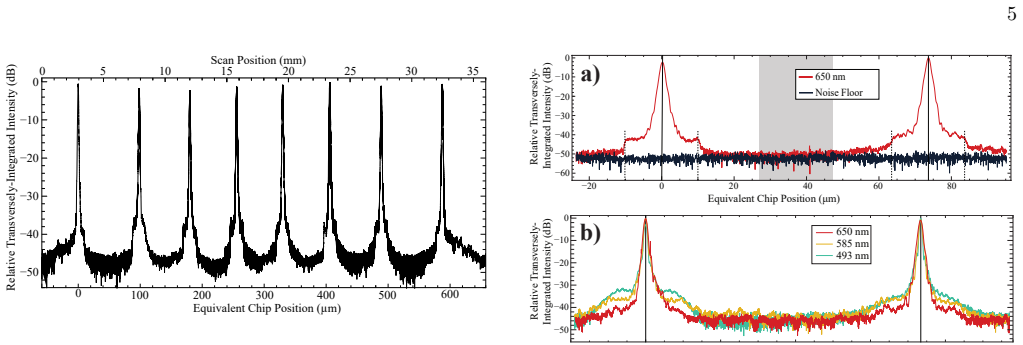
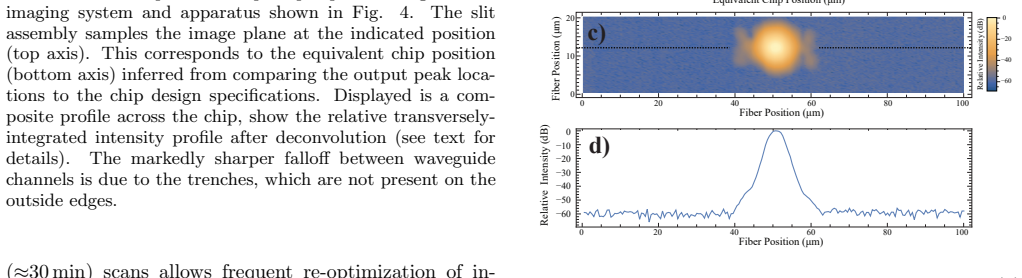
The central claim is that the incorporated crosstalk mitigation techniques in the silicon nitride waveguide design achieve a reduction of the measured optical field by at least 50.8(1.3) dB between adjacent waveguide outputs near 650 nm, with similar behavior for devices at 493 nm and 585 nm, and that these outputs combined with a global 493 nm laser successfully laser-cool a chain of eight barium-138 ions whose fluorescence is imaged at 493 nm.
What carries the argument
The crosstalk mitigation techniques incorporated into the chip design for the CMOS-foundry silicon nitride waveguides.
If this is right
- The same mitigation approach produces comparable crosstalk suppression in waveguide devices designed for 493 nm and 585 nm.
- The 650 nm waveguide outputs together with a global 493 nm laser enable laser cooling of an eight-ion barium-138 chain.
- The achieved crosstalk level is compatible with scalable quantum information processing using trapped ions.
Where Pith is reading between the lines
- Unequal ion spacing combined with the waveguide layout may permit denser qubit packing while preserving the reported isolation.
- Standard foundry processes could allow replication of the addressing chip across many ion traps without custom fabrication.
- The approach separates the laser delivery hardware from the ion trap electrodes, potentially simplifying integration of control optics.
Load-bearing premise
The optical power measured at the waveguide outputs accurately represents the electric-field amplitude experienced by the ions once the chip is aligned to the trap, without additional scattering or mode mismatch that would increase effective crosstalk at the ion locations.
What would settle it
A measurement of the actual electric field or gate error rates at the ion locations that shows crosstalk exceeding the reported 50 dB level after chip alignment.
Figures

read the original abstract
Reliable control of quantum information in matter-based qubits requires precisely applied external fields, and unaccounted for spatial cross-talk of these fields between adjacent qubits leads to loss of fidelity. We report a CMOS foundry-produced, micro-fabricated silicon nitride (Si3N4) optical waveguide for addressing a chain of eight, unequally-spaced trapped barium ions with crosstalk compatible with scalable quantum information processing. The crosstalk mitigation techniques incorporated into the chip design result in a reduction of the measured optical field by at least 50.8(1.3) dB between adjacent waveguide outputs near 650 nm and similar behavior for devices designed for 493 nm and 585 nm. The waveguide outputs near 650 nm, along with a global laser near 493 nm were used to laser-cool a chain of eight barium-138 ions, and a camera imaged the resulting fluorescence at 493 nm.
Editorial analysis
A structured set of objections, weighed in public.
Referee Report
Summary. The manuscript reports fabrication of silicon-nitride waveguides in a CMOS foundry for delivering laser light to a chain of eight unequally spaced trapped Ba-138 ions. It states that crosstalk-mitigation techniques yield a measured optical-field reduction of at least 50.8(1.3) dB between adjacent waveguide outputs near 650 nm (with analogous performance at 493 nm and 585 nm). The 650 nm waveguides, together with a global 493 nm laser, are used to laser-cool the eight-ion chain, with the resulting fluorescence imaged by camera.
Significance. If the reported output-plane suppression is shown to translate to the ion plane after trap alignment, the work would supply a foundry-compatible route to low-crosstalk individual addressing in trapped-ion arrays, directly addressing a scalability bottleneck for high-fidelity multi-qubit control.
major comments (2)
- [Abstract] Abstract: the assertion that the measured crosstalk is 'compatible with scalable quantum information processing' rests on output-plane power measurements; no section quantifies additional contributions from diffraction across the ~100 µm gap, electrode scattering, or mode mismatch that could raise effective crosstalk at the ion locations.
- [Results (cooling demonstration)] Cooling demonstration paragraph: the experiment shows that the waveguides can address the ions for laser cooling, yet supplies no adjacent-ion fluorescence ratios or addressing-fidelity data that would bound the actual crosstalk experienced by the ions once the chip is aligned to the trap.
minor comments (1)
- [Abstract] The uncertainty 50.8(1.3) dB is stated without accompanying methods, raw data, or error-propagation details in the text provided.
Simulated Author's Rebuttal
We thank the referee for their careful review and constructive comments. We address each major comment below.
read point-by-point responses
-
Referee: [Abstract] Abstract: the assertion that the measured crosstalk is 'compatible with scalable quantum information processing' rests on output-plane power measurements; no section quantifies additional contributions from diffraction across the ~100 µm gap, electrode scattering, or mode mismatch that could raise effective crosstalk at the ion locations.
Authors: We agree that the reported crosstalk values are measured at the waveguide output plane and that the manuscript provides no quantitative analysis of diffraction over the ~100 µm gap, electrode scattering, or mode mismatch. These effects could increase effective crosstalk at the ions. We will revise the abstract to qualify the compatibility claim and add a discussion section with order-of-magnitude estimates of these contributions based on the waveguide mode profiles and chip geometry. revision: yes
-
Referee: [Results (cooling demonstration)] Cooling demonstration paragraph: the experiment shows that the waveguides can address the ions for laser cooling, yet supplies no adjacent-ion fluorescence ratios or addressing-fidelity data that would bound the actual crosstalk experienced by the ions once the chip is aligned to the trap.
Authors: We acknowledge that the cooling demonstration shows the waveguides can deliver light for cooling but does not include adjacent-ion fluorescence ratios or addressing-fidelity measurements to bound crosstalk at the ion plane. The manuscript reports only output-plane suppression. We will revise the paragraph to state this limitation explicitly and note that ion-plane crosstalk quantification requires additional measurements not present in the current work. revision: partial
Circularity Check
No circularity: result is direct experimental measurement
full rationale
The paper reports fabrication of Si3N4 waveguides and direct measurement of optical field reduction (50.8(1.3) dB) at the chip outputs near 650 nm, with similar results at other wavelengths, followed by an ion cooling demonstration. No equations, fitted parameters, or derivations are presented that reduce the crosstalk figure to prior inputs or self-citations. The central claim is an empirical observation from power measurements, independent of any model that could introduce circularity by construction.
Axiom & Free-Parameter Ledger
Reference graph
Works this paper leans on
-
[1]
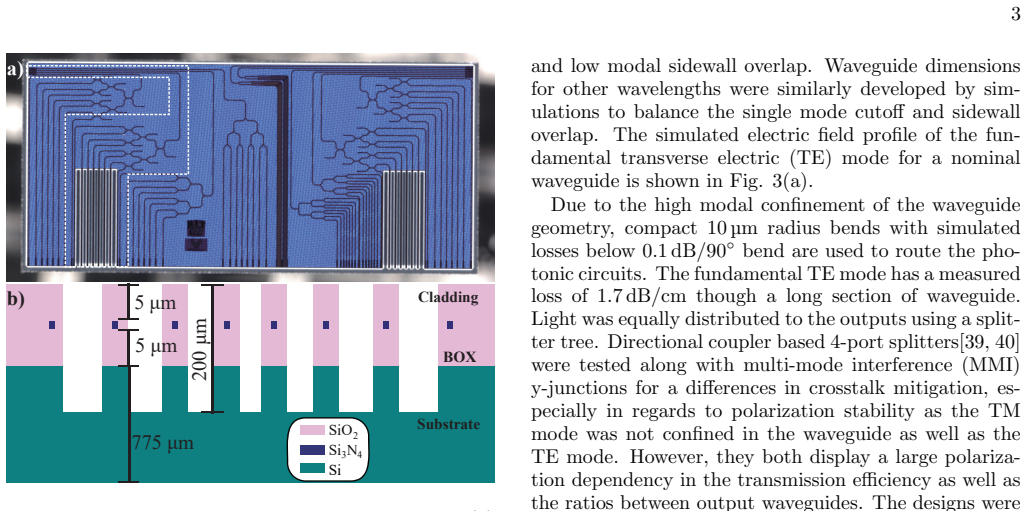
The mode-matching capabilities come from tapering the waveguide outputs and patterning their spacing to re- flect the relative spacing between the qubits. There is a tradeoff between optimizing mode-matching capabilities and limiting crosstalk as increasing waveguide spacing re- duces crosstalk but requires higher magnification imag- ing optics to match t...
-
[2]
A 0.55 NA ob- jective with a 200 mm tube lens formed a 50 ×-magnified image
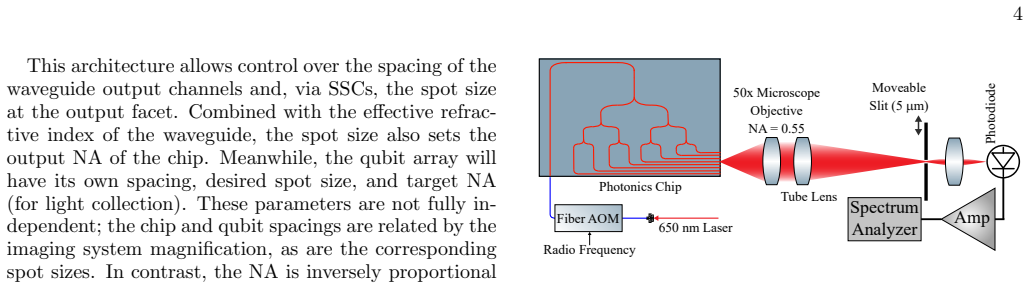
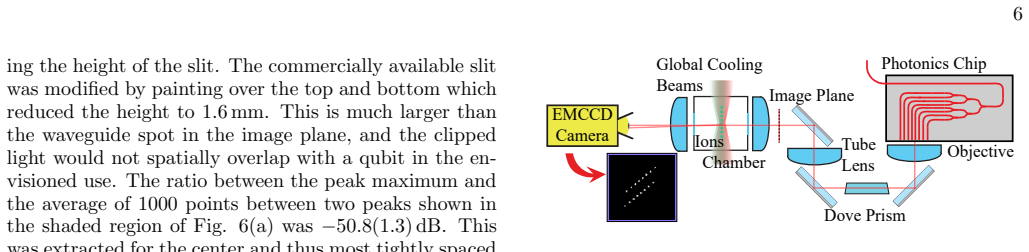
A fiber acousto-optic modulator (AOM) modulates the amplitude of the input laser so that the signal light can be isolated from any background. A 0.55 NA ob- jective with a 200 mm tube lens formed a 50 ×-magnified image. A 5 µm width, 3 mm height slit moving along a linear positioning stage at 1 µm steps transmits a small slice of the image. The intensity ...
-
[3]
Thus, a measurement of the waveguide output profile using the ions as a probe is limited
to much less than the light extinction measured in this work. Thus, a measurement of the waveguide output profile using the ions as a probe is limited. However, it is useful to demonstrate one envisioned use of the photonic circuit by directly addressing the D3/2 ↔P1/2 repumping transition of Ba +. The ions are illuminated by the indi- vidual beams from t...
work page 2024
- [4]
-
[5]
S. A. Moses, C. H. Baldwin, M. S. Allman, R. An- cona, L. Ascarrunz, C. Barnes, J. Bartolotta, B. Bjork, P. Blanchard, M. Bohn, J. G. Bohnet, N. C. Brown, N. Q. Burdick, W. C. Burton, S. L. Campbell, J. P. Campora, C. Carron, J. Chambers, J. W. Chan, Y. H. Chen, A. Chernoguzov, E. Chertkov, J. Colina, J. P. Curtis, R. Daniel, M. DeCross, D. Deen, C. Delan...
work page 2023
-
[6]
I. Pogorelov, T. Feldker, C. D. Marciniak, L. Postler, G. Jacob, O. Krieglsteiner, V. Podlesnic, M. Meth, V. Negnevitsky, M. Stadler, B. H¨ ofer, C. W¨ achter, K. Lakhmanskiy, R. Blatt, P. Schindler, and T. Monz, Compact ion-trap quantum computing demonstrator, PRX Quantum 2, 020343 (2021)
work page 2021
-
[7]
S. J. Evered, D. Bluvstein, M. Kalinowski, S. Ebadi, T. Manovitz, H. Zhou, S. H. Li, A. A. Geim, T. T. Wang, N. Maskara, et al., High-fidelity parallel entangling gates on a neutral-atom quantum computer, Nature 622, 268 (2023)
work page 2023
-
[8]
H. Bernien, S. Schwartz, A. Keesling, H. Levine, A. Om- ran, H. Pichler, S. Choi, A. S. Zibrov, M. Endres, M. Greiner, V. Vuleti´ c, and M. D. Lukin, Probing many- body dynamics on a 51-atom quantum simulator, Nature 551, 579 (2017)
work page 2017
-
[9]
K. Barnes, P. Battaglino, B. J. Bloom, K. Cassella, R. Coxe, N. Crisosto, J. P. King, S. S. Kondov, K. Kotru, S. C. Larsen, J. Lauigan, B. J. Lester, M. McDonald, E. Megidish, S. Narayanaswami, C. Nishiguchi, R. Noter- mans, L. S. Peng, A. Ryou, T.-S. Wu, and M. Yarwood, Assembly and coherent control of a register of nuclear spin qubits, Nature Communicat...
work page 2022
-
[10]
M. L. Goldman, T. L. Patti, D. Levonian, S. F. Yelin, and M. D. Lukin, Optical control of a single nuclear spin in the solid state, Phys. Rev. Lett. 124, 153203 (2020)
work page 2020
-
[11]
C. E. Bradley, S. W. de Bone, P. F. W. M¨ oller, S. Baier, M. J. Degen, S. J. H. Loenen, H. P. Bartling, M. Markham, D. J. Twitchen, R. Hanson, D. Elkouss, and T. H. Taminiau, Robust quantum-network memory based on spin qubits in isotopically engineered diamond, npj Quantum Information 8, 122 (2022)
work page 2022
-
[12]
A. R. Mills, C. R. Guinn, M. J. Gullans, A. J. Sigillito, M. M. Feldman, E. Nielsen, and J. R. Petta, Two-qubit silicon quantum processor with operation fidelity exceed- ing 99%, Science Advances 8, eabn5130 (2022)
work page 2022
-
[13]
P. Wang, C.-Y. Luan, M. Qiao, M. Um, J. Zhang, Y. Wang, X. Yuan, M. Gu, J. Zhang, and K. Kim, Single ion qubit with estimated coherence time exceeding one hour, Nature Communications 12 (2021)
work page 2021
-
[14]
A. W. Young, W. J. Eckner, W. R. Milner, D. Kedar, M. A. Norcia, E. Oelker, N. Schine, J. Ye, and A. M. Kaufman, Half-minute-scale atomic coherence and high relative stability in a tweezer clock, Nature 588, 408 (2020)
work page 2020
-
[15]
M. H. Abobeih, Y. Wang, J. Randall, S. J. H. Loenen, C. E. Bradley, M. Markham, D. J. Twitchen, B. M. Ter- hal, and T. H. Taminiau, Fault-tolerant operation of a logical qubit in a diamond quantum processor, Nature 606, 884 (2022)
work page 2022
-
[16]
C. R. Clark, H. N. Tinkey, B. C. Sawyer, A. M. Meier, K. A. Burkhardt, C. M. Seck, C. M. Shappert, N. D. Guise, C. E. Volin, S. D. Fallek, H. T. Hayden, W. G. Rel- lergert, and K. R. Brown, High-fidelity bell-state prepa- ration with 40Ca+ optical qubits, Phys. Rev. Lett. 127, 130505 (2021)
work page 2021
-
[17]
C. J. Ballance, T. P. Harty, N. M. Linke, M. A. Sepiol, and D. M. Lucas, High-fidelity quantum logic gates using trapped-ion hyperfine qubits, Physical review letters117, 060504 (2016)
work page 2016
-
[18]
J. P. Gaebler, T. R. Tan, Y. Lin, Y. Wan, R. Bowler, A. C. Keith, S. Glancy, K. Coakley, E. Knill, D. Leibfried, and D. J. Wineland, High-fidelity universal gate set for 9Be+ ion qubits, Phys. Rev. Lett. 117, 060505 (2016)
work page 2016
-
[19]
F. A. An, A. Ransford, A. Schaffer, L. R. Sletten, J. Gae- bler, J. Hostetter, and G. Vittorini, High fidelity state preparation and measurement of ion hyperfine qubits with I>1/2, Physical Review Letters 129, 130501 (2022)
work page 2022
- [20]
-
[21]
L. J. Stephenson, D. P. Nadlinger, B. C. Nichol, S. An, P. Drmota, T. G. Ballance, K. Thirumalai, J. F. Good- win, D. M. Lucas, and C. J. Ballance, High-rate, high- fidelity entanglement of qubits across an elementary quantum network, Phys. Rev. Lett. 124, 110501 (2020)
work page 2020
-
[22]
J. P. Covey, H. Weinfurter, and H. Bernien, Quantum networks with neutral atom processing nodes, npj Quan- tum Information 9, 90 (2023)
work page 2023
-
[23]
P. C. Humphreys, N. Kalb, J. P. J. Morits, R. N. Schouten, R. F. L. Vermeulen, D. J. Twitchen, M. Markham, and R. Hanson, Deterministic delivery of remote entanglement on a quantum network, Nature 558, 268 (2018)
work page 2018
-
[24]
J. Kwon, W. J. Setzer, M. Gehl, N. Karl, J. V. D. Wall, R. Law, M. G. Blain, D. Stick, and H. J. McGuinness, Multi-site integrated optical addressing of trapped ions, Nature Communications 15, 3709 (2024)
work page 2024
-
[25]
D. Bluvstein, S. J. Evered, A. A. Geim, S. H. Li, H. Zhou, T. Manovitz, S. Ebadi, M. Cain, M. Kalinowski, D. Hangleiter, J. P. B. Ataides, N. Maskara, I. Cong, X. Gao, P. S. Rodriguez, T. Karolyshyn, G. Semeghini, M. J. Gullans, M. Greiner, V. Vuleti¨A‡, and M. D. Lukin, Logical quantum processor based on reconfigurable atom arrays, Nature 626, 58 (2024)
work page 2024
-
[26]
R. J. Niffenegger, J. Stuart, C. Sorace-Agaskar, D. Kha- ras, S. Bramhavar, C. D. Bruzewicz, W. Loh, R. T. Max- son, R. McConnell, D. Reens, G. N. West, J. M. Sage, and J. Chiaverini, Integrated multi-wavelength control of an ion qubit, Nature 586, 538 (2020)
work page 2020
-
[27]
K. K. Mehta and R. J. Ram, Precise and diffraction- limited waveguide-to-free-space focusing gratings, Scien- tific reports 7, 2019 (2017)
work page 2019
-
[28]
A. R. Vasquez, C. Mordini, C. Verni` ere, M. Stadler, M. Malinowski, C. Zhang, D. Kienzler, K. K. Mehta, and J. P. Home, Control of an atomic quadrupole transition in a phase-stable standing wave, Phys. Rev. Lett. 130, 133201 (2023)
work page 2023
-
[29]
C. W. Hogle, D. Dominguez, M. Dong, A. Leenheer, H. J. McGuinness, B. P. Ruzic, M. Eichenfield, and D. Stick, High-fidelity trapped-ion qubit operations with scalable photonic modulators, npj Quantum Information 9 (2023)
work page 2023
-
[30]
A. Binai-Motlagh, M. L. Day, N. Videnov, N. Greenberg, C. Senko, and R. Islam, A guided light system for agile individual addressing of Ba + qubits with 10 -4 level in- tensity crosstalk, Quantum Science and Technology 8, 045012 (2023)
work page 2023
-
[31]
F. Timpu, R. Matt, S. Piacentini, G. Corbelli, M. Marinelli, C. Hempel, R. Osellame, and J. Home, Laser-written waveguide array optimized for individual control of trapped ion qubits in a chain, inEuropean Con- ference and Exhibition on Optical Communication (Op- tica Publishing Group, 2022) p. We5.70
work page 2022
-
[32]
D. Zhu, G. D. Kahanamoku-Meyer, L. Lewis, C. Noel, 9 O. Katz, B. Harraz, Q. Wang, A. Risinger, L. Feng, D. Biswas, et al. , Interactive cryptographic proofs of quantumness using mid-circuit measurements, Nature Physics , 1 (2023)
work page 2023
-
[33]
M. Foss-Feig, A. Tikku, T.-C. Lu, K. Mayer, M. Iqbal, T. M. Gatterman, J. A. Gerber, K. Gilmore, D. Gresh, A. Hankin, et al. , Experimental demonstration of the advantage of adaptive quantum circuits, arXiv preprint arXiv:2302.03029 (2023)
-
[34]
A. L. Carter, J. Oˆ a€™ Reilly, G. Toh, S. Saha, M. Sha- laev, I. Goetting, and C. Monroe, Ion trap with in- vacuum high numerical aperture imaging for a dual- species modular quantum computer, Rev. Sci. Instrum. 95, 033201 (2024)
work page 2024
-
[35]
N. M. Fahrenkopf, C. McDonough, G. L. Leake, Z. Su, E. Timurdogan, and D. D. Coolbaugh, The AIM photon- ics MPW: A highly accessible cutting edge technology for rapid prototyping of photonic integrated circuits, IEEE Journal of Selected Topics in Quantum Electronics 25, 1 (2019)
work page 2019
-
[36]
C. Sorace-Agaskar, D. Kharas, S. Yegnanarayanan, R. T. Maxson, G. N. West, W. Loh, S. Bramhavar, R. J. Ram, J. Chiaverini, J. Sage, and P. W. Juodawlkis, Versatile silicon nitride and alumina integrated photonic platforms for the ultraviolet to short-wave infrared, IEEE Journal of Selected Topics in Quantum Electronics 25, 1 (2019)
work page 2019
-
[37]
W. D. Sacher, Y. Lin, H. Chen, S. S. Azadeh, Z. Yong, X. Luo, H. Chua, J. C. C. Mak, A. Govdeli, A. Sharma, J. C. Mikkelsen, X. Mu, A. Stalmashonak, G.-Q. Lo, and J. K. S. Poon, An active visible-light integrated photon- ics platform on 200-mm Si, in Optical Fiber Communica- tion Conference (OFC) 2023 (Optica Publishing Group,
work page 2023
-
[38]
J. A. Smith, H. Francis, G. Navickaite, and M. J. Strain, SiN foundry platform for high performance visible light integrated photonics, Optical Materials Express 13, 458 (2023)
work page 2023
-
[39]
V. S. S. Sundaram, E. Manfreda-Schulz, T. H. Stievater, N. F. Tyndall, T. Palone, V. Deenadayalan, C. Tison, Z. Smith, D. Hucul, G. A. Howland, M. L. Fanto, and S. F. Preble, Highly-confined, low-loss visible photonics using foundry-fabricated silicon nitride circuits, in Con- ference on Lasers and Electro-Optics (Optica Publishing Group, 2022) p. JTh3B.14
work page 2022
-
[40]
N. F. Tyndall, T. H. Stievater, D. A. Kozak, M. W. Pruessner, W. S. Rabinovich, N. M. Fahrenkopf, A. O. Antohe, and K. A. McComber, A low-loss SiN pho- tonic integrated circuit foundry platform for waveguide- enhanced raman spectroscopy, in Smart Photonic and Optoelectronic Integrated Circuits XXIII , Vol. 11690 (SPIE, 2021) pp. 40–46
work page 2021
-
[41]
N. F. Tyndall, M. W. Pruessner, N. M. Fahrenkopf, A. Antohe, and T. H. Stievater, A visible-light foundry platform from aim photonics, in Optical Fiber Com- munication Conference (OFC) 2023 (Optica Publishing Group, 2023) p. W3B.4
work page 2023
- [42]
-
[43]
C. M. Lalau-Keraly, S. Bhargava, O. D. Miller, and E. Yablonovitch, Adjoint shape optimization applied to electromagnetic design, Optics Express 21, 21693 (2013)
work page 2013
-
[44]
V. R. Almeida, R. R. Panepucci, and M. Lipson, Nano- taper for compact mode conversion, Opt. Lett. 28, 1302 (2003)
work page 2003
-
[45]
The NAs at the chip and qubit are also related by the magnification, but this constraint is redundant and can be obtained by combining the earlier constraints of spot size, NA, and magnification
-
[46]
T. P. Meyrath and D. F. James, Theoretical and numer- ical studies of the positions of cold trapped ions, Physics Letters A 240, 37 (1998)
work page 1998
-
[47]
W. R. Inc., Mathematica, Version 13.2 (2022), Cham- paign, IL
work page 2022
-
[48]
R. Noek, G. Vrijsen, D. Gaultney, E. Mount, T. Kim, P. Maunz, and J. Kim, High speed, high fidelity detection of an atomic hyperfine qubit, Opt. Lett. 38, 4735 (2013)
work page 2013
discussion (0)
Sign in with ORCID, Apple, or X to comment. Anyone can read and Pith papers without signing in.