From AoI to QVAoI: Query-Based Semantics-Aware Scheduling for Energy-Harvesting IoT Systems
Pith reviewed 2026-05-23 22:44 UTC · model grok-4.3
The pith
Optimizing for Query Version Age of Information yields fresher relevant updates or fewer transmissions than simpler age metrics in energy-harvesting IoT systems.
A machine-rendered reading of the paper's core claim, the machinery that carries it, and where it could break.
Core claim
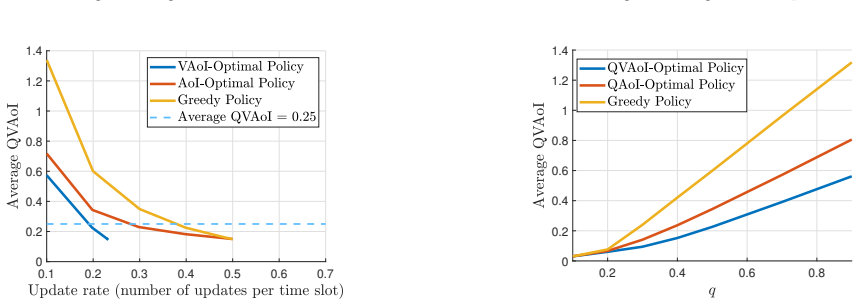
The central claim is that the QVAoI-Optimal policy demonstrates a significant performance improvement either by providing fresher, more relevant, and more valuable updates with the same energy arrivals or by reducing the number of transmissions in the system while maintaining the same level of freshness and information significance as the QAoI-Optimal and other policies.
What carries the argument
The Query Version Age of Information (QVAoI) metric, which augments age measures with query arrivals and version semantics and is minimized via a Markov Decision Process subject to energy harvesting constraints.
If this is right
- All semantics-aware policies achieve better performance than the greedy policy.
- The QVAoI-Optimal policy can maintain the same freshness and significance levels with fewer transmissions than QAoI-Optimal and other policies.
- Closed-form expressions for average update rate and QVAoI provide analytical benchmarks for the unit-capacity battery case.
- Semantics-aware policies deliver updates that are fresher, more relevant, and more valuable with fixed energy arrivals.
Where Pith is reading between the lines
- The MDP formulation could be extended to include stochastic channel fading to check whether the reported gains persist outside idealized energy models.
- Query-driven scheduling may generalize to multi-source or multi-destination IoT networks where different queries have distinct version requirements.
- Adaptive versions of the policy could respond to observed changes in query statistics without recomputing the full MDP solution each time.
Load-bearing premise
The model assumes query arrivals and version semantics can be captured by a finite-state Markov Decision Process whose optimal policy remains effective under real channel and energy variability not detailed in the abstract.
What would settle it
A deployment test showing that the QVAoI-Optimal policy neither supplies higher-value updates nor reduces transmissions relative to the QAoI-Optimal policy under measured energy arrivals and channel conditions would disprove the performance advantage.
Figures




read the original abstract
In this work, we study the freshness and significance of information in an IoT status update system in which an Energy Harvesting (EH) device samples an information source and forwards update packets to a destination node via a direct channel. We introduce and optimize a semantics-aware metric, Query Version Age of Information (QVAoI), in the system along with other metrics: Query Age of Information (QAoI), Version Age of Information (VAoI), and Age of Information (AoI). We formulate the optimization problem as a Markov Decision Process to determine the optimal transmission policy at the device, which decides the time slots for transmitting updates, subject to the device's battery energy limitations and the energy arrivals. Furthermore, we derive closed-form expressions for the average update rate and the QVAoI for a unit-capacity battery, serving as analytical benchmarks. We compare the performance of QVAoI-Optimal, QAoI-Optimal, VoI-Optimal, and AoI-Optimal policies with a baseline greedy policy. All semantics-aware policies achieve better performance than the greedy policy. The QVAoI-Optimal policy, in particular, demonstrates a significant performance improvement either by providing fresher, more relevant, and more valuable updates with the same energy arrivals or by reducing the number of transmissions in the system while maintaining the same level of freshness and information significance as the QAoI-Optimal and other policies.
Editorial analysis
A structured set of objections, weighed in public.
Referee Report
Summary. The manuscript introduces the Query Version Age of Information (QVAoI) metric for semantics-aware status updates in an energy-harvesting IoT system. It formulates the transmission scheduling problem as a finite-state MDP whose optimal policy (QVAoI-Optimal) decides when to transmit subject to battery constraints and energy arrivals. Closed-form expressions are derived for the average update rate and QVAoI under unit-capacity battery. Simulations compare QVAoI-Optimal against QAoI-Optimal, VoI-Optimal, AoI-Optimal, and a greedy baseline, claiming that QVAoI-Optimal either delivers fresher/more valuable updates with the same energy or reduces transmissions while preserving freshness and significance.
Significance. If the MDP optimality and closed-forms are verified, the work supplies a new semantics-aware metric that jointly accounts for query relevance and version age, together with analytical benchmarks for the unit-battery case. The explicit comparison of four semantics-aware policies against greedy provides concrete evidence that incorporating query and version information can improve the freshness-significance-energy trade-off in EH IoT.
major comments (2)
- [Abstract] Abstract: the central performance claim that 'QVAoI-Optimal demonstrates a significant performance improvement' rests on the optimality of the finite-state MDP policy, yet no section demonstrates that this policy remains near-optimal when the channel is replaced by a non-i.i.d. fading process or energy arrivals deviate from the modeled distribution; the reported gains could therefore be an artifact of the discrete-state abstraction.
- [Abstract] Abstract: closed-form expressions are supplied only for unit-capacity battery, but the manuscript does not indicate how (or whether) the same expressions or the MDP policy extend to arbitrary battery capacities that are used in the general simulations; this limits the analytical support for the cross-policy comparison.
minor comments (1)
- [Abstract] The abstract states that 'all semantics-aware policies achieve better performance than the greedy policy' but does not reference the specific figures or tables that quantify the improvement; adding such pointers would improve readability.
Simulated Author's Rebuttal
We thank the referee for the constructive feedback. We address each major comment below and will revise the manuscript to improve clarity on the scope of our results.
read point-by-point responses
-
Referee: [Abstract] Abstract: the central performance claim that 'QVAoI-Optimal demonstrates a significant performance improvement' rests on the optimality of the finite-state MDP policy, yet no section demonstrates that this policy remains near-optimal when the channel is replaced by a non-i.i.d. fading process or energy arrivals deviate from the modeled distribution; the reported gains could therefore be an artifact of the discrete-state abstraction.
Authors: The optimality of the QVAoI-Optimal policy and all reported performance gains are established exactly for the i.i.d. channel and energy-arrival model under which the finite-state MDP is formulated. The discrete-state MDP yields the precise optimal policy within this model rather than an approximation. We agree that the abstract should explicitly qualify the modeling assumptions to avoid any implication of robustness beyond the considered setting, and we will revise the abstract accordingly. revision: yes
-
Referee: [Abstract] Abstract: closed-form expressions are supplied only for unit-capacity battery, but the manuscript does not indicate how (or whether) the same expressions or the MDP policy extend to arbitrary battery capacities that are used in the general simulations; this limits the analytical support for the cross-policy comparison.
Authors: The closed-form expressions are derived only for the unit-capacity battery as analytical benchmarks for that special case. The underlying MDP formulation is defined for arbitrary finite battery capacities, and the optimal policies used in the general simulations are obtained directly from the MDP for each battery size. The cross-policy comparisons therefore rest on the MDP solutions rather than on the unit-battery closed forms. We will add a clarifying statement in the abstract and introduction to distinguish these two contributions. revision: yes
Circularity Check
No circularity; MDP optimization and closed-forms are independent of baselines
full rationale
The paper introduces QVAoI as a distinct metric, formulates a finite-state MDP over discrete battery, AoI, version age and query states, solves for the QVAoI-optimal policy, and supplies closed-form expressions only for the unit-capacity battery case as analytical benchmarks. These quantities are derived directly from the MDP transition structure and are not obtained by fitting parameters to the QAoI or VoI baselines. Policy comparisons are performed by evaluating each metric-specific optimal policy on the shared state space; no equation reduces a reported performance gain to a quantity defined by the same fitted inputs, and no load-bearing step relies on self-citation chains. The derivation chain is therefore self-contained.
Axiom & Free-Parameter Ledger
axioms (1)
- domain assumption The joint process of energy arrivals, battery state, and query-driven information value can be modeled as a finite-state Markov Decision Process.
Reference graph
Works this paper leans on
-
[1]
Age of information: An introduction and survey,
R. D. Y ates, Y . Sun, D. R. Brown, S. K. Kaul, E. Modiano, and S. Ulukus, “Age of information: An introduction and survey, ” IEEE Journal on Selected Areas in Commun. , vol. 39, no. 5, 2021. 9
work page 2021
-
[2]
On the ro le of age of information in the internet of things,
M. A. Abd-Elmagid, N. Pappas, and H. S. Dhillon, “On the ro le of age of information in the internet of things,” IEEE Commun. Magazine , vol. 57, no. 12, 2019
work page 2019
-
[3]
Semantics-empowered comm unication for networked intelligent systems,
M. Kountouris and N. Pappas, “Semantics-empowered comm unication for networked intelligent systems,” IEEE Commun. Magazine , vol. 59, no. 6, 2021
work page 2021
-
[4]
Real-time status: Ho w often should one update?
S. Kaul, R. Y ates, and M. Gruteser, “Real-time status: Ho w often should one update?” in 2012 Proceedings IEEE INFOCOM , 2012
work page 2012
-
[5]
X. Zheng, S. Zhou, Z. Jiang, and Z. Niu, “Closed-form anal ysis of non- linear age of information in status updates with an energy ha rvesting transmitter,” IEEE Trans. on Wireless Commun. , vol. 18, no. 8, 2019
work page 2019
-
[6]
T he age of incorrect information: A new performance metric for status updates,
A. Maatouk, S. Kriouile, M. Assaad, and A. Ephremides, “T he age of incorrect information: A new performance metric for status updates,” IEEE/ACM Trans. on Networking , vol. 28, no. 5, 2020
work page 2020
-
[7]
Query age of information: Freshness in pul l-based communication,
F. Chiariotti, J. Holm, A. E. Kalør, B. Soret, S. K. Jensen , T. B. Pedersen, and P . Popovski, “Query age of information: Freshness in pul l-based communication,” IEEE Trans. on Commun. , vol. 70, no. 3, 2022
work page 2022
-
[8]
The age of gossip in networks,
R. D. Y ates, “The age of gossip in networks,” in 2021 IEEE ISIT , 2021
work page 2021
-
[9]
State-awar e timeliness in energy harvesting iot systems monitoring a markovian sourc e,
E. Delfani, G. J. Stamatakis, and N. Pappas, “State-awar e timeliness in energy harvesting iot systems monitoring a markovian sourc e,” arXiv preprint arXiv:2405.03628, 2024
-
[10]
A comprehensive survey on age of information in massive iot ne tworks,
Q. Abbas, S. A. Hassan, H. K. Qureshi, K. Dev, and H. Jung, “A comprehensive survey on age of information in massive iot ne tworks,” Computer Commun. , vol. 197, 2023
work page 2023
- [11]
-
[12]
V ersion age o f information in clustered gossip networks,
B. Buyukates, M. Bastopcu, and S. Ulukus, “V ersion age o f information in clustered gossip networks,” IEEE Journal on Selected Areas in Information Theory , vol. 3, no. 1, 2022
work page 2022
-
[13]
Timely gossiping with file slic ing and network coding,
P . Kaswan and S. Ulukus, “Timely gossiping with file slic ing and network coding,” in IEEE ISIT , 2022
work page 2022
-
[14]
Susceptibility of age of gossip to timestomping,
——, “Susceptibility of age of gossip to timestomping,” in IEEE Information Theory W orkshop (ITW) , 2022
work page 2022
-
[15]
Asuman: Age sense updating mult iple access in networks,
P . Mitra and S. Ulukus, “Asuman: Age sense updating mult iple access in networks,” in 58th Annual Allerton Conference on Communication, Control, and Computing , 2022
work page 2022
-
[16]
Age of gossip in ring networks i n the presence of jamming attacks,
P . Kaswan and S. Ulukus, “Age of gossip in ring networks i n the presence of jamming attacks,” in 56th Asilomar Conference on Signals, Systems, and Computers , 2022
work page 2022
-
[17]
Age-aware gossiping in network topologies,
P . Mitra and S. Ulukus, “Age-aware gossiping in network topologies,” IEEE Trans. on Commun. , 2024
work page 2024
-
[18]
V ersion age-optimal cached s tatus updates in a gossiping network with energy harvesting sensor,
E. Delfani and N. Pappas, “V ersion age-optimal cached s tatus updates in a gossiping network with energy harvesting sensor,” in 2023 21st WiOpt Conference, 2023
work page 2023
-
[19]
A learning based scheme for fair timeliness in sparse gossip networks,
P . Mitra and S. Ulukus, “A learning based scheme for fair timeliness in sparse gossip networks,” arXiv preprint arXiv:2310.01396 , 2023
-
[20]
Distribution of th e age of gossip in networks,
M. A. Abd-Elmagid and H. S. Dhillon, “Distribution of th e age of gossip in networks,” Entropy, vol. 25, no. 2, 2023
work page 2023
-
[21]
M. Hatami, M. Leinonen, Z. Chen, N. Pappas, and M. Codrea nu, “On-demand aoi minimization in resource-constrained cach e-enabled iot networks with energy harvesting sensors,” IEEE Trans. on Commun. , vol. 70, no. 11, 2022
work page 2022
-
[22]
P ull or wait: How to optimize query age of information,
M. E. Ildiz, O. T. Y avascan, E. Uysal, and O. T. Kartal, “P ull or wait: How to optimize query age of information,” IEEE Journal on Selected Areas in Information Theory , 2023
work page 2023
-
[23]
T. K. O˘ guz, E. T. Ceran, E. Uysal, and T. Girici, “Implem entation and evaluation of age-aware downlink scheduling policies in pu sh-based and pull-based communication,” Entropy, vol. 24, no. 5, 2022
work page 2022
-
[24]
E ffective communication: When to pull updates?
P . Agheli, N. Pappas, P . Popovski, and M. Kountouris, “E ffective communication: When to pull updates?” in IEEE ICC , 2024
work page 2024
-
[25]
D. P . Bertsekas, Dynamic Programming and Optimal Control, V ol. II , 3rd ed. Athena Scientific, 2007. APPENDIX A PROOF OF THEOREM 1 Proof. The Bellman equation at state s = (b, ∆, r) is given by: J ∗ +V (s) = min a∈{ 0,1} { ∑ s′∈ S P [ s′⏐ ⏐s, a ]( r∆′+V (s′) ) △ = Q(a) } (27) a∗ (s) = arg min a∈{ 0,1} Q(a) = { 0, DV (s) ≥ 0, 1, DV (s) < 0, (28) wh...
work page 2007
discussion (0)
Sign in with ORCID, Apple, or X to comment. Anyone can read and Pith papers without signing in.