SU(2) gauge theory with one and two adjoint fermions towards the continuum limit
Pith reviewed 2026-05-23 22:05 UTC · model grok-4.3
The pith
SU(2) gauge theories with one and two adjoint fermions reach continuum limits with anomalous dimensions gamma* of 0.170(6) and 0.291(9), showing infrared behavior incompatible with chiral symmetry breaking.
A machine-rendered reading of the paper's core claim, the machinery that carries it, and where it could break.
Core claim
In the continuum limit the SU(2) theory with one adjoint Dirac fermion has an anomalous dimension of the condensate gamma* = 0.170(6) while the two-flavor theory has gamma* = 0.291(9); both theories exhibit infrared behavior incompatible with spontaneous breaking of chiral symmetry, as established by consistent results from hyperscaling of the spectrum, mode-number analysis, and mass ratios together with chiral perturbation theory.
What carries the argument
Finite-size hyperscaling relations applied to the mass spectrum, an improved mode-number analysis of the Dirac operator, and the ratio of the lightest spin-2 to scalar masses, combined with chiral perturbation theory fits to the spectrum.
If this is right
- The one-flavor theory lies in the conformal window with a small anomalous dimension.
- The two-flavor theory also lies in the conformal window with a larger anomalous dimension.
- Neither theory breaks chiral symmetry spontaneously in the infrared.
- Previous estimates of gamma* are revised downward for the one-flavor case as the continuum is approached.
Where Pith is reading between the lines
- If confirmed, these gamma* values could guide model building for walking technicolor or composite Higgs scenarios seeking specific scaling behaviors.
- The improved mode-number method might be applied to other gauge theories near the conformal boundary to extract anomalous dimensions more reliably.
- The incompatibility with chiral breaking suggests these theories could serve as benchmarks for testing new lattice methods aimed at distinguishing conformal from confining phases.
Load-bearing premise
The finite-size hyperscaling relations and mode-number analysis remain valid and free of dominant lattice artifacts when the results are extrapolated to the continuum limit.
What would settle it
A direct measurement at even finer lattice spacings showing that the extracted gamma* for the one-flavor theory stops decreasing or that the spectrum fits chiral perturbation theory with a non-zero chiral condensate would falsify the claim.
Figures




read the original abstract
We provide an extended lattice study of the SU(2) gauge theory coupled to one Dirac fermion flavour ($N_{\mathrm{f}} =1$) transforming in the adjoint representation as the continuum limit is approached. This investigation is supplemented by numerical results obtained for the SU(2) gauge theory with two Dirac fermion flavours ($N_{\mathrm{f}} =2$) transforming in the adjoint representation, for which we perform numerical investigations at three values of the lattice spacing. The purpose of our study is to advance the characterisation of the infrared properties of both theories, which previous investigations have concluded to be in the conformal window. For both, we determine the mass spectrum and the anomalous dimension of the fermion condensate using finite-size hyperscaling of the spectrum, mode number analysis of the Dirac operator (for which we improve on our previous proposal) and the ratio of masses of the lightest spin-2 particle over the lightest scalar. All methods provide a consistent picture, with the anomalous dimension of the condensate $\gamma_*$ decreasing significantly as one approaches the continuum limit for the $N_{\mathrm{f}} = 1$ theory towards a value consistent with $\gamma_* = 0.170(6)$, while for $N_{\mathrm{f}} = 2$ the anomalous dimension converges more rapidly with $\beta$ to a value of $\gamma_* = 0.291(9)$. A chiral perturbation theory analysis shows that the infrared behaviour of both theories is incompatible with the breaking of chiral symmetry.
Editorial analysis
A structured set of objections, weighed in public.
Referee Report
Summary. The paper reports extended lattice simulations of SU(2) gauge theory with Nf=1 and Nf=2 adjoint Dirac fermions, determining the mass spectrum and the anomalous dimension γ* of the fermion condensate via finite-size hyperscaling, an improved mode-number analysis of the Dirac operator, and spin-2/scalar mass ratios. It finds that γ* decreases with β for Nf=1, extrapolating to 0.170(6) in the continuum, while for Nf=2 it converges faster to 0.291(9); a chiral perturbation theory analysis is used to argue that the infrared behaviour of both theories is incompatible with spontaneous chiral symmetry breaking.
Significance. If the continuum extrapolations hold, the work supplies benchmark values of γ* for adjoint SU(2) theories inside the conformal window, obtained from three independent methods that are reported to be internally consistent. The improvement to the mode-number proposal and the explicit chiral-PT test are concrete strengths that would aid future comparisons with other lattice studies of near-conformal theories.
major comments (2)
- [spectrum analysis and mode-number sections] The central continuum values γ*=0.170(6) (Nf=1) and 0.291(9) (Nf=2) rest on the premise that finite-size hyperscaling relations and the improved mode-number analysis remain valid and free of dominant lattice artifacts at the simulated β values; the manuscript must supply explicit tests (e.g., volume dependence of the extracted γ* at fixed β, or comparison of different fit windows) to substantiate that the observed decrease for Nf=1 is not an artifact of the extrapolation procedure.
- [chiral PT analysis] The chiral perturbation theory analysis ruling out chiral symmetry breaking relies on the same mass-spectrum results used for the γ* extrapolations; any residual lattice artifacts that affect the lightest scalar or pseudoscalar masses would propagate directly into this conclusion and therefore require a dedicated systematic study before the incompatibility claim can be considered robust.
minor comments (2)
- The abstract states that error estimates on the final γ* values are reported, yet the main text should make the full covariance matrices or bootstrap procedures for the multi-β extrapolations explicit so that readers can assess the quoted uncertainties.
- Notation for the improved mode-number proposal should be defined once in a dedicated subsection rather than referenced only to prior work, to improve readability.
Simulated Author's Rebuttal
We thank the referee for the positive evaluation of our work's significance and for the detailed comments. We address each major point below, providing additional evidence where possible and committing to revisions that strengthen the manuscript without altering its core conclusions.
read point-by-point responses
-
Referee: [spectrum analysis and mode-number sections] The central continuum values γ*=0.170(6) (Nf=1) and 0.291(9) (Nf=2) rest on the premise that finite-size hyperscaling relations and the improved mode-number analysis remain valid and free of dominant lattice artifacts at the simulated β values; the manuscript must supply explicit tests (e.g., volume dependence of the extracted γ* at fixed β, or comparison of different fit windows) to substantiate that the observed decrease for Nf=1 is not an artifact of the extrapolation procedure.
Authors: We agree that explicit tests of volume dependence and fit stability would further substantiate the continuum extrapolations. In the revised version we will add two new figures: (i) γ* extracted from hyperscaling at fixed β for multiple volumes (showing convergence for both Nf=1 and Nf=2), and (ii) mode-number results for three different fit windows at the largest β, confirming that the downward trend for Nf=1 persists and is not window-dependent. These tests, together with the internal consistency across the three independent methods already reported, indicate that the decrease is physical rather than an artifact of the extrapolation procedure. revision: yes
-
Referee: [chiral PT analysis] The chiral perturbation theory analysis ruling out chiral symmetry breaking relies on the same mass-spectrum results used for the γ* extrapolations; any residual lattice artifacts that affect the lightest scalar or pseudoscalar masses would propagate directly into this conclusion and therefore require a dedicated systematic study before the incompatibility claim can be considered robust.
Authors: We acknowledge the dependence on the spectrum results. In revision we will insert a dedicated subsection that quantifies residual lattice artifacts in the lightest scalar and pseudoscalar masses by comparing mass ratios at the three β values and across volumes. The ratios remain stable within statistical errors, and the chiral-PT fits continue to exclude spontaneous breaking at the same confidence level. While a fully exhaustive artifact study would require additional ensembles at finer spacings (beyond the scope of the present work), the existing multi-method consistency and β-independence of the ratios provide sufficient support for the incompatibility claim at the level presented. revision: partial
Circularity Check
No circularity in numerical extrapolation of anomalous dimensions
full rationale
The paper reports numerical lattice results for the mass spectrum and anomalous dimension γ* extracted via finite-size hyperscaling, an improved mode-number analysis of the Dirac operator, and spin-2/scalar mass ratios, followed by continuum extrapolations in β. These are data-driven fits and extrapolations from simulations at multiple lattice spacings; the reported γ* values (0.170(6) for Nf=1, 0.291(9) for Nf=2) are outputs of those extrapolations rather than inputs reused as predictions. The single self-reference to improving a prior mode-number proposal is a standard methodological citation and does not bear the load of the central claims, which remain independently supported by the new simulation data and cross-method consistency. No self-definitional loops, fitted-input predictions, or ansatz smuggling via citation are present in the derivation chain.
Axiom & Free-Parameter Ledger
free parameters (2)
- lattice spacing a
- bare fermion mass am
axioms (2)
- domain assumption Finite-size hyperscaling relations hold for the mass spectrum in the conformal regime
- domain assumption The mode-number analysis of the Dirac operator accurately isolates the anomalous dimension without dominant lattice artifacts
Forward citations
Cited by 1 Pith paper
-
Adiabatic continuity in a partially reduced twisted Eguchi-Kawai model with one adjoint Dirac fermion
Simulations of a partially reduced twisted Eguchi-Kawai model with one adjoint Dirac fermion show the Polyakov loop remains near zero for periodic boundary conditions as the compactified circle shrinks, supporting adi...
Reference graph
Works this paper leans on
-
[1]
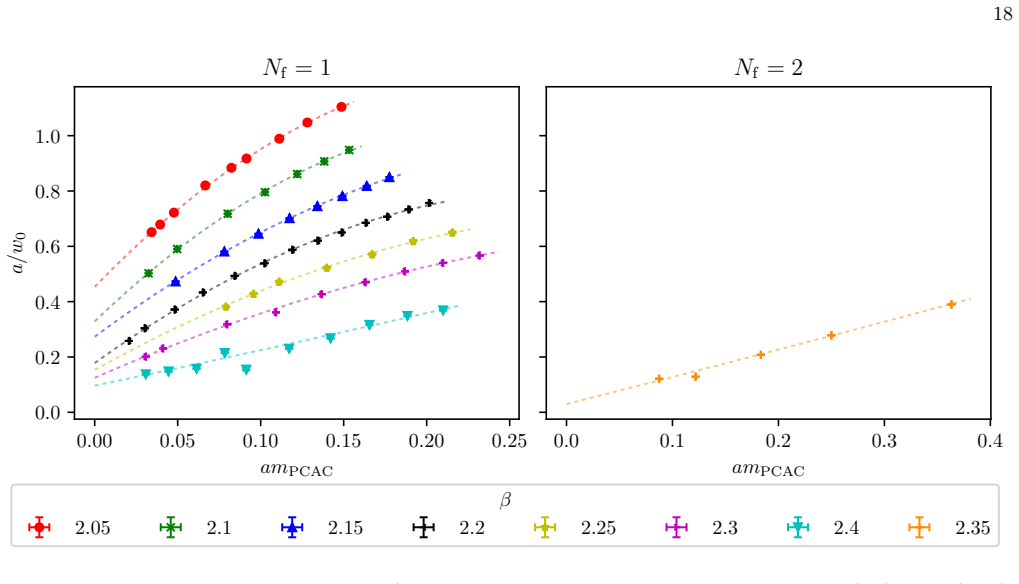
Finite-size hyperscaling of particle spectrum In a mass-deformed conformal theory in a finite vol- ume, we expect the massesM of states to hyperscale with the deforming mass (which we approximate bymPCAC) and the lattice extentL as LaM = f L (amPCAC) 1 1+γ∗ . (25) While we do nota priori know the functional form of f (L (amPCAC)), wemaylookforavalueof γ∗ ...
-
[2]
γ∗ from the mode number of the Dirac operator The other method we employ to calculate the mass anomalous dimension is studying the low-lying mode number of the Dirac operator. A similar computa- tion to extract γ∗ was performed in previous publica- tions [39, 44], to which we will refer to for additional details. However, the final analysis of the data ha...
-
[3]
We have suf- ficiently many values ofβ to attempt a continuum limit extrapolation
γ∗ in the continuum limit Wehavepreviouslyobserved, andconfirmedinthepre- vious subsection, that for theNf = 1 case, the value ofγ∗ is not stable as the couplingβ is changed. We have suf- ficiently many values ofβ to attempt a continuum limit extrapolation. Since the mode number method described above allows computation ofγ∗ for individual ensembles, and ...
-
[4]
This is fitted using Eq. (35), giving a continuum limit valueγcont. ∗ = 0.1751(65). fining properties due to the mass deformation. Con- versely, at very small volumes, the theory transitions to the so-called “femto-universe" regime [123], where previ- ous studies suggestR approaches unity [125–127]. How- ever, for L large enough and m small enough, an int...
work page 2020
-
[5]
S. Weinberg, Phys. Rev. D13, 974 (1976), [Addendum: Phys.Rev.D 19, 1277–1280 (1979)]
work page 1976
- [6]
-
[7]
E.EichtenandK.D.Lane,Phys.Lett.B 90,125(1980)
work page 1980
- [8]
- [9]
-
[10]
K. Yamawaki, M. Bando, and K.-i. Matumoto, Phys. Rev. Lett. 56, 1335 (1986)
work page 1986
-
[11]
T. W. Appelquist, D. Karabali, and L. C. R. Wijeward- hana, Phys. Rev. Lett.57, 957 (1986). 22
work page 1986
-
[12]
D. B. Kaplan and H. Georgi, Phys. Lett. B136, 183 (1984)
work page 1984
- [13]
-
[14]
M. J. Dugan, H. Georgi, and D. B. Kaplan, Nucl. Phys. B 254, 299 (1985)
work page 1985
-
[15]
UV descriptions of composite Higgs models without elementary scalars
J. Barnard, T. Gherghetta, and T. S. Ray, JHEP02, 002, arXiv:1311.6562 [hep-ph]
work page internal anchor Pith review Pith/arXiv arXiv
-
[16]
Fermionic UV completions of Composite Higgs models
G. Ferretti and D. Karateev, JHEP 03, 077, arXiv:1312.5330 [hep-ph]
work page internal anchor Pith review Pith/arXiv arXiv
-
[17]
Gauge theories of Partial Compositeness: Scenarios for Run-II of the LHC
G. Ferretti, JHEP06, 107, arXiv:1604.06467 [hep-ph]
work page internal anchor Pith review Pith/arXiv arXiv
-
[18]
G. Cacciapaglia, G. Ferretti, T. Flacke, and H. Serôdio, Front. in Phys.7, 22 (2019), arXiv:1902.06890 [hep-ph]
-
[19]
Effective Lagrangians for Orientifold Theories
F. Sannino and M. Shifman, Phys. Rev. D69, 125004 (2004), arXiv:hep-th/0309252
work page internal anchor Pith review Pith/arXiv arXiv 2004
-
[20]
Orientifold theory dynamics and symmetry breaking
F. Sannino and K. Tuominen, Phys. Rev. D71, 051901 (2005), arXiv:hep-ph/0405209
work page internal anchor Pith review Pith/arXiv arXiv 2005
-
[21]
D. D. Dietrich, F. Sannino, and K. Tuominen, Phys. Rev. D 72, 055001 (2005), arXiv:hep-ph/0505059
work page internal anchor Pith review Pith/arXiv arXiv 2005
-
[22]
D. D. Dietrich and F. Sannino, Phys. Rev. D75, 085018 (2007), arXiv:hep-ph/0611341
work page internal anchor Pith review Pith/arXiv arXiv 2007
-
[23]
N. Evans and K. S. Rigatos, Phys. Rev. D103, 094022 (2021), arXiv:2012.00032 [hep-ph]
- [24]
-
[25]
G. Aad et al. (ATLAS), Phys. Lett. B716, 1 (2012), arXiv:1207.7214 [hep-ex]
work page internal anchor Pith review Pith/arXiv arXiv 2012
-
[26]
Observation of a new boson at a mass of 125 GeV with the CMS experiment at the LHC
S. Chatrchyan et al. (CMS), Phys. Lett. B 716, 30 (2012), arXiv:1207.7235 [hep-ex]
work page internal anchor Pith review Pith/arXiv arXiv 2012
-
[27]
Conformal vs confining scenario in SU(2) with adjoint fermions
L. Del Debbio, B. Lucini, A. Patella, C. Pica, and A. Rago, Phys. Rev. D 80, 074507 (2009), arXiv:0907.3896 [hep-lat]
work page internal anchor Pith review Pith/arXiv arXiv 2009
-
[28]
A. J. Hietanen, K. Rummukainen, and K. Tuominen, Phys. Rev. D80, 094504 (2009), arXiv:0904.0864 [hep- lat]
work page internal anchor Pith review Pith/arXiv arXiv 2009
-
[29]
Nearly conformal gauge theories in finite volume
Z. Fodor, K. Holland, J. Kuti, D. Nogradi, and C. Schroeder, Phys. Lett. B 681, 353 (2009), arXiv:0907.4562 [hep-lat]
work page internal anchor Pith review Pith/arXiv arXiv 2009
-
[30]
Mass anomalous dimension in SU(2) with two adjoint fermions
F. Bursa, L. Del Debbio, L. Keegan, C. Pica, and T. Pickup, Phys. Rev. D 81, 014505 (2010), arXiv:0910.4535 [hep-ph]
work page internal anchor Pith review Pith/arXiv arXiv 2010
-
[31]
Mesonic spectroscopy of Minimal Walking Technicolor
L. Del Debbio, B. Lucini, A. Patella, C. Pica, and A. Rago, Phys. Rev. D 82, 014509 (2010), arXiv:1004.3197 [hep-lat]
work page internal anchor Pith review Pith/arXiv arXiv 2010
-
[32]
The infrared dynamics of Minimal Walking Technicolor
L. Del Debbio, B. Lucini, A. Patella, C. Pica, and A. Rago, Phys. Rev. D 82, 014510 (2010), arXiv:1004.3206 [hep-lat]
work page internal anchor Pith review Pith/arXiv arXiv 2010
-
[33]
Twelve massless flavors and three colors below the conformal window
Z. Fodor, K. Holland, J. Kuti, D. Nogradi, C. Schroeder, K. Holland, J. Kuti, D. Nogradi, and C. Schroeder, Phys. Lett. B 703, 348 (2011), arXiv:1104.3124 [hep- lat]
work page internal anchor Pith review Pith/arXiv arXiv 2011
-
[34]
Improved Lattice Spectroscopy of Minimal Walking Technicolor
F. Bursa, L. Del Debbio, D. Henty, E. Kerrane, B. Lu- cini, A. Patella, C. Pica, T. Pickup, and A. Rago, Phys. Rev. D 84, 034506 (2011), arXiv:1104.4301 [hep-lat]
work page internal anchor Pith review Pith/arXiv arXiv 2011
-
[35]
MCRG Minimal Walking Technicolor
S. Catterall, L. Del Debbio, J. Giedt, and L. Keegan, Phys. Rev. D85, 094501 (2012), arXiv:1108.3794 [hep- ph]
work page internal anchor Pith review Pith/arXiv arXiv 2012
-
[36]
Infrared fixed point in SU(2) gauge theory with adjoint fermions
T. DeGrand, Y. Shamir, and B. Svetitsky, Phys. Rev. D 83, 074507 (2011), arXiv:1102.2843 [hep-lat]
work page internal anchor Pith review Pith/arXiv arXiv 2011
-
[37]
Minimal Walking on the Lattice
S. Catterall and F. Sannino, Phys. Rev. D76, 034504 (2007), arXiv:0705.1664 [hep-lat]
work page internal anchor Pith review Pith/arXiv arXiv 2007
-
[38]
Higher representations on the lattice: numerical simulations. SU(2) with adjoint fermions
L. Del Debbio, A. Patella, and C. Pica, Phys. Rev. D 81, 094503 (2010), arXiv:0805.2058 [hep-lat]
work page internal anchor Pith review Pith/arXiv arXiv 2010
-
[39]
A. J. Hietanen, J. Rantaharju, K. Rummukainen, and K. Tuominen, JHEP05, 025, arXiv:0812.1467 [hep-lat]
work page internal anchor Pith review Pith/arXiv arXiv
-
[40]
Phase diagram of SU(2) with 2 flavors of dynamical adjoint quarks
S. Catterall, J. Giedt, F. Sannino, and J. Schneible, JHEP 11, 009, arXiv:0807.0792 [hep-lat]
work page internal anchor Pith review Pith/arXiv arXiv
-
[41]
Large-volume results in SU(2) with adjoint fermions
L. Del Debbio, B. Lucini, C. Pica, A. Patella, A. Rago, and S. Roman, in31st International Symposium on Lat- tice Field Theory(2013) arXiv:1311.5597 [hep-lat]
work page internal anchor Pith review Pith/arXiv arXiv 2013
-
[42]
Nonperturbative beta function of eight-flavor SU(3) gauge theory
A. Hasenfratz, D. Schaich, and A. Veernala, JHEP06, 143, arXiv:1410.5886 [hep-lat]
work page internal anchor Pith review Pith/arXiv arXiv
-
[43]
The infrared regime of SU(2) with one adjoint Dirac flavour
A. Athenodorou, E. Bennett, G. Bergner, and B. Lucini, Phys. Rev. D91, 114508 (2015), arXiv:1412.5994 [hep- lat]
work page internal anchor Pith review Pith/arXiv arXiv 2015
-
[44]
Strongly interacting dynamics and the search for new physics at the LHC
T. Appelquistet al., Phys. Rev. D93, 114514 (2016), arXiv:1601.04027 [hep-lat]
work page internal anchor Pith review Pith/arXiv arXiv 2016
-
[45]
Nonperturbative beta function of twelve-flavor SU(3) gauge theory
A. Hasenfratz and D. Schaich, JHEP 02, 132, arXiv:1610.10004 [hep-lat]
work page internal anchor Pith review Pith/arXiv arXiv
-
[46]
G. Bergner, P. Giudice, I. Montvay, G. Münster, and S. Piemonte, Phys. Rev. D 96, 034504 (2017), arXiv:1610.01576 [hep-lat]
-
[47]
Low energy properties of SU(2) gauge theory with N_f = 3/2 flavours of adjoint fermions
G. Bergner, P. Giudice, G. Münster, P. Scior, I. Mont- vay, and S. Piemonte, JHEP01, 119, arXiv:1712.04692 [hep-lat]
work page internal anchor Pith review Pith/arXiv arXiv
-
[48]
A. Athenodorou, E. Bennett, G. Bergner, and B. Lu- cini,Phys.Rev.D 104,074519(2021),arXiv:2103.10485 [hep-lat]
-
[49]
SU(4) lattice gauge theory with decuplet fermions: Schr\"odinger functional analysis
T. DeGrand, Y. Shamir, and B. Svetitsky, Phys. Rev. D 85, 074506 (2012), arXiv:1202.2675 [hep-lat]
work page internal anchor Pith review Pith/arXiv arXiv 2012
-
[50]
Near the sill of the conformal window: gauge theories with fermions in two-index representations
T. DeGrand, Y. Shamir, and B. Svetitsky, Phys. Rev. D 88, 054505 (2013), arXiv:1307.2425 [hep-lat]
work page internal anchor Pith review Pith/arXiv arXiv 2013
-
[51]
Spectroscopy of SU(4) gauge theory with two flavors of sextet fermions
T. DeGrand, Y. Liu, E. T. Neil, Y. Shamir, and B. Svetitsky, Phys. Rev. D 91, 114502 (2015), arXiv:1501.05665 [hep-lat]
work page internal anchor Pith review Pith/arXiv arXiv 2015
-
[52]
One-loop anomalous dimension of top-partner hyperbaryons in a family of composite Higgs models
T. DeGrand and Y. Shamir, Phys. Rev. D92, 075039 (2015), arXiv:1508.02581 [hep-ph]
work page internal anchor Pith review Pith/arXiv arXiv 2015
-
[53]
One-loop Chiral Perturbation Theory with two fermion representations
T. DeGrand, M. Golterman, E. T. Neil, and Y. Shamir, Phys. Rev. D94, 025020 (2016), arXiv:1605.07738 [hep- ph]
work page internal anchor Pith review Pith/arXiv arXiv 2016
-
[54]
T. A. DeGrand, M. Golterman, W. I. Jay, E. T. Neil, Y. Shamir, and B. Svetitsky, Phys. Rev. D94, 054501 (2016), arXiv:1606.02695 [hep-lat]
work page internal anchor Pith review Pith/arXiv arXiv 2016
-
[55]
Spectroscopy of SU(4) composite Higgs theory with two distinct fermion representations
V. Ayyar, T. DeGrand, M. Golterman, D. C. Hackett, W. I. Jay, E. T. Neil, Y. Shamir, and B. Svetitsky, Phys. Rev. D 97, 074505 (2018), arXiv:1710.00806 [hep-lat]
work page internal anchor Pith review Pith/arXiv arXiv 2018
-
[56]
E. Bennett, D. K. Hong, J.-W. Lee, C. J. D. Lin, B. Lucini, M. Piai, and D. Vadacchino, JHEP03, 185, arXiv:1712.04220 [hep-lat]
-
[57]
Baryon spectrum of SU(4) composite Higgs theory with two distinct fermion representations
V. Ayyar, T. Degrand, D. C. Hackett, W. I. Jay, E. T. Neil, Y. Shamir, and B. Svetitsky, Phys. Rev. D 97, 114505 (2018), arXiv:1801.05809 [hep-ph]
work page internal anchor Pith review Pith/arXiv arXiv 2018
-
[58]
Finite-temperature phase structure of SU(4) gauge theory with multiple fermion representations
V. Ayyar, T. DeGrand, D. C. Hackett, W. I. Jay, E. T. Neil, Y. Shamir, and B. Svetitsky, Phys. Rev. D 97, 114502 (2018), arXiv:1802.09644 [hep-lat]
work page internal anchor Pith review Pith/arXiv arXiv 2018
-
[59]
Partial compositeness and baryon matrix elements on the lattice
V. Ayyar, T. DeGrand, D. C. Hackett, W. I. Jay, E. T. Neil, Y. Shamir, and B. Svetitsky, Phys. Rev. D 99, 094502 (2019), arXiv:1812.02727 [hep-ph]
work page internal anchor Pith review Pith/arXiv arXiv 2019
-
[60]
E. Bennett, D. K. Hong, J.-W. Lee, C. J. D. Lin, B. Lucini, M. Piai, and D. Vadacchino, JHEP12, 053, arXiv:1909.12662 [hep-lat]
-
[61]
E. Bennett, D. K. Hong, J.-W. Lee, C.-J. D. Lin, B. Lucini, M. Mesiti, M. Piai, J. Rantaharju, and D. Vadacchino, Phys. Rev. D 101, 074516 (2020), arXiv:1912.06505 [hep-lat]
- [62]
-
[63]
E. Bennett, D. K. Hong, H. Hsiao, J.-W. Lee, C. J. D. Lin, B. Lucini, M. Mesiti, M. Piai, and D. Vadacchino, 23 Phys. Rev. D 106, 014501 (2022), arXiv:2202.05516 [hep-lat]
-
[64]
L. Del Debbio, A. Lupo, M. Panero, and N. Tantalo, Eur. Phys. J. C83, 220 (2023), arXiv:2211.09581 [hep- lat]
-
[65]
E. Bennett, J. Holligan, D. K. Hong, H. Hsiao, J.-W. Lee, C. J. D. Lin, B. Lucini, M. Mesiti, M. Piai, and D. Vadacchino, Universe 9, 236 (2023), arXiv:2304.01070 [hep-lat]
-
[66]
E. Bennett et al., Phys. Rev. D 108, 094508 (2023), arXiv:2306.11649 [hep-lat]
-
[67]
A. Maas and F. Zierler, PoS LA TTICE2021, 130 (2022), arXiv:2109.14377 [hep-lat]
- [68]
-
[69]
S. Kulkarni, A. Maas, S. Mee, M. Nikolic, J. Pradler, and F. Zierler, SciPost Phys. 14, 044 (2023), arXiv:2202.05191 [hep-ph]
-
[70]
Strongly Interacting Dynamics beyond the Standard Model on a Spacetime Lattice
B. Lucini, Phil. Trans. Roy. Soc. Lond. A368, 3657 (2010), arXiv:0911.0020 [hep-ph]
work page internal anchor Pith review Pith/arXiv arXiv 2010
-
[71]
Hyperscaling relations in mass-deformed conformal gauge theories
L. Del Debbio and R. Zwicky, Phys. Rev. D82, 014502 (2010), arXiv:1005.2371 [hep-ph]
work page internal anchor Pith review Pith/arXiv arXiv 2010
-
[72]
Dilaton EFT Framework For Lattice Data
T. Appelquist, J. Ingoldby, and M. Piai, JHEP07, 035, arXiv:1702.04410 [hep-ph]
work page internal anchor Pith review Pith/arXiv arXiv
-
[73]
T. Appelquist, J. Ingoldby, and M. Piai, Phys. Rev. D 101, 075025 (2020), arXiv:1908.00895 [hep-ph]
-
[74]
A precise determination of the psibar-psi anomalous dimension in conformal gauge theories
A. Patella, Phys. Rev. D 86, 025006 (2012), arXiv:1204.4432 [hep-lat]
work page internal anchor Pith review Pith/arXiv arXiv 2012
-
[75]
The Yang-Mills gradient flow in finite volume
Z. Fodor, K. Holland, J. Kuti, D. Nogradi, and C. H. Wong, JHEP11, 007, arXiv:1208.1051 [hep-lat]
work page internal anchor Pith review Pith/arXiv arXiv
-
[76]
Mass anomalous dimension of Adjoint QCD at large N from twisted volume reduction
M. García Pérez, A. González-Arroyo, L. Keegan, and M. Okawa, JHEP08, 034, arXiv:1506.06536 [hep-lat]
work page internal anchor Pith review Pith/arXiv arXiv
-
[77]
Beyond the Standard Model: Charting Fundamental Interactions via Lattice Simulations
C. Pica, PoS LA TTICE2016, 015 (2016), arXiv:1701.07782 [hep-lat]
work page internal anchor Pith review Pith/arXiv arXiv 2016
-
[78]
Review on Composite Higgs Models
O. Witzel, PoS LA TTICE2018, 006 (2019), arXiv:1901.08216 [hep-lat]
work page internal anchor Pith review Pith/arXiv arXiv 2019
-
[79]
García Pérez, PoS LA TTICE2019, 276 (2020), arXiv:2001.10859 [hep-lat]
M. García Pérez, PoS LA TTICE2019, 276 (2020), arXiv:2001.10859 [hep-lat]
-
[80]
T. Appelquist, J. Ingoldby, and M. Piai, Universe9, 10 (2023), arXiv:2209.14867 [hep-ph]
discussion (0)
Sign in with ORCID, Apple, or X to comment. Anyone can read and Pith papers without signing in.