Recognition: unknown
Adiabatic continuity in a partially reduced twisted Eguchi-Kawai model with one adjoint Dirac fermion
Pith reviewed 2026-05-10 03:57 UTC · model grok-4.3
The pith
Numerical evidence from a reduced model indicates the center-symmetric confined phase of large-N gauge theory with one adjoint fermion persists under spatial compactification.
A machine-rendered reading of the paper's core claim, the machinery that carries it, and where it could break.
Core claim
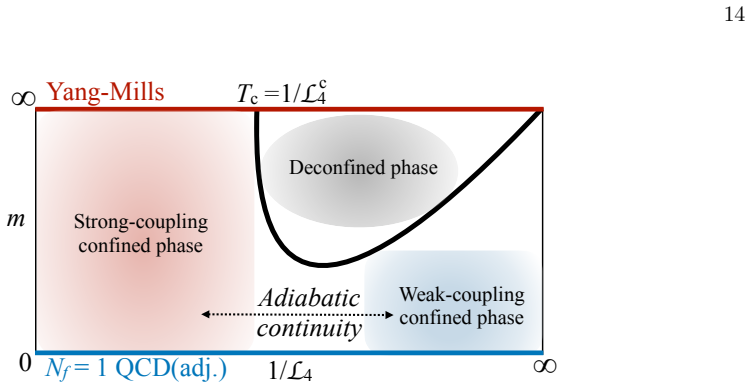
Within the partially reduced TEK model at N=36, L4=2, b from 0.30 to 0.46 and kappa from 0.03 to 0.16, the Polyakov loop around S1 remains near zero in the light-fermion regime under periodic boundary conditions as the circle size decreases, while volume-independence order parameters stay consistent with zero. This supplies numerical evidence, inside the reduced-model setup, for an adiabatic-continuity scenario in which the center-symmetric confined phase is smoothly connected between large and small circles. The scenario is compatible with the anomaly constraints of the underlying four-dimensional theory.
What carries the argument
The partially reduced twisted Eguchi-Kawai model on a 1^3 x L4 lattice with one adjoint Wilson fermion, used to track the Polyakov loop and volume-independence order parameters while reducing computational volume.
If this is right
- The center-symmetric confined phase remains connected across a range of circle sizes under periodic boundary conditions.
- Volume independence in the reduced directions holds for the explored parameters and fermion masses.
- The adiabatic continuity scenario is compatible with the anomaly constraints of the four-dimensional theory.
- Antiperiodic boundary conditions produce a deconfinement transition instead.
Where Pith is reading between the lines
- Confirmation at larger N would imply that reduced models can capture four-dimensional large-N confinement physics on small lattices.
- The same continuity might extend to other representations or numbers of adjoint fermions.
- The approach offers a route to test whether confinement in higher-dimensional theories survives compactification without phase transitions.
Load-bearing premise
The observations at N=36 and L4=2 in the partially reduced model faithfully represent the phase structure of the full unreduced four-dimensional large-N theory without major finite-N or lattice artifacts.
What would settle it
A statistically clear departure of the Polyakov loop from zero or a violation of volume independence when N is increased or the lattice spacing is decreased would show that the adiabatic continuity does not hold.
Figures


read the original abstract
We numerically investigate whether the center-symmetric confined phase of large-$N$ $SU(N)$ gauge theory with one adjoint Dirac fermion persists under spatial compactification on $\mathbb{R}^3 \times S^1$. To this end, we employ a partially reduced twisted Eguchi-Kawai (TEK) model on a $1^3 \times L_4$ lattice with an adjoint Wilson fermion, and measure both the Polyakov loop around $S^1$ and order parameters for volume independence in the reduced directions. For $N=36$, $L_4=2$, $b=0.30\text{-}0.46$, and $\kappa=0.03\text{-}0.16$, we find that, with periodic boundary conditions, the Polyakov loop remains near zero in the light-fermion regime as the circle size is reduced. For the modified twist, the volume-independence order parameters are also consistent with zero in the explored region, supporting the validity of the partially reduced description. These results provide numerical evidence, within the reduced-model setup and parameter range studied, for an adiabatic-continuity scenario in which the confined phase is smoothly connected between large and small circles. By contrast, with antiperiodic boundary conditions, the Polyakov loop exhibits a clear deconfinement transition. We also discuss how this scenario is compatible with the anomaly constraints of the underlying four-dimensional theory. The symmetric twist is examined as a useful comparison, although its volume-independence properties appear less robust at the present value of $N$.
Editorial analysis
A structured set of objections, weighed in public.
Referee Report
Summary. The paper numerically investigates the persistence of the center-symmetric confined phase in large-N SU(N) gauge theory with one adjoint Dirac fermion under spatial compactification on R^3 x S^1. Using a partially reduced twisted Eguchi-Kawai model on a 1^3 x L_4 lattice with an adjoint Wilson fermion at N=36 and L_4=2, it measures the Polyakov loop and volume-independence order parameters for b in 0.30-0.46 and kappa in 0.03-0.16. With periodic boundary conditions the Polyakov loop remains near zero in the light-fermion regime, and for the modified twist the volume-independence parameters are consistent with zero; this is presented as evidence for adiabatic continuity between large and small circles. The study contrasts this with a deconfinement transition under antiperiodic boundary conditions and discusses compatibility with 4D anomaly constraints, while noting less robust volume independence for the symmetric twist at this N.
Significance. If the reduced-model results accurately capture the large-N limit without dominant artifacts, the work would supply concrete numerical support for adiabatic-continuity scenarios in adjoint-fermion gauge theories. This strengthens the case that the confined phase can be smoothly connected across compactification radii, with potential implications for lattice studies of large-N confinement and for anomaly-matching arguments in compactified theories. The explicit contrast between periodic and antiperiodic boundary conditions and the use of volume-independence diagnostics are positive features.
major comments (2)
- [Numerical results and discussion of volume independence] The central claim that the observations support adiabatic continuity in the full un-reduced 4D large-N theory rests on the assumption that finite-N and reduction artifacts are negligible at N=36, L_4=2. The manuscript notes that the symmetric twist has less robust volume independence at this N, yet provides no quantitative estimate (e.g., comparison runs at larger N or explicit scaling checks) of residual artifacts for the modified twist; this is load-bearing for mapping the reduced-model data to the target theory.
- [Results for periodic boundary conditions] No large-N or continuum extrapolation is reported in the explored parameter window (b=0.30-0.46, kappa=0.03-0.16). Because the Polyakov-loop and order-parameter measurements are presented as evidence for the persistence of the confined phase, the absence of such extrapolations leaves open the possibility that the near-zero values are influenced by lattice or finite-N effects rather than reflecting the infinite-N, continuum limit.
minor comments (2)
- [Abstract and introduction] The abstract and introduction would benefit from a brief explicit statement of the precise definition of the 'modified twist' versus the symmetric twist, including the twist angles or boundary conditions employed.
- [Results section] Figure captions or tables summarizing the Polyakov-loop and order-parameter values should include statistical uncertainties and the number of configurations used, to allow readers to assess the significance of 'near zero' and 'consistent with zero'.
Simulated Author's Rebuttal
We thank the referee for the careful reading of our manuscript and the constructive comments. We address the two major comments point by point below, indicating the revisions we intend to make.
read point-by-point responses
-
Referee: The central claim that the observations support adiabatic continuity in the full un-reduced 4D large-N theory rests on the assumption that finite-N and reduction artifacts are negligible at N=36, L_4=2. The manuscript notes that the symmetric twist has less robust volume independence at this N, yet provides no quantitative estimate (e.g., comparison runs at larger N or explicit scaling checks) of residual artifacts for the modified twist; this is load-bearing for mapping the reduced-model data to the target theory.
Authors: We agree that controlling finite-N and reduction artifacts is essential for interpreting the reduced-model results in the context of the full 4D large-N theory. The modified twist was deliberately chosen because earlier TEK studies indicate substantially better volume independence at moderate N than the symmetric twist. In our data, the volume-independence order parameters remain consistent with zero within errors for the modified twist across the scanned range, which we view as supporting evidence that residual artifacts are small for the quantities we measure. We will revise the manuscript to expand the discussion of expected 1/N^2 corrections, reference the relevant prior TEK literature, and explicitly state that a dedicated larger-N scaling study lies beyond the present computational resources. This will make the limitations of the current N=36, L_4=2 results clearer while preserving the numerical evidence we report. revision: partial
-
Referee: No large-N or continuum extrapolation is reported in the explored parameter window (b=0.30-0.46, kappa=0.03-0.16). Because the Polyakov-loop and order-parameter measurements are presented as evidence for the persistence of the confined phase, the absence of such extrapolations leaves open the possibility that the near-zero values are influenced by lattice or finite-N effects rather than reflecting the infinite-N, continuum limit.
Authors: The b and kappa window was selected to remain inside the scaling region where the gauge coupling is moderate and the fermion mass is light enough to test the adiabatic-continuity hypothesis. The near-zero Polyakov-loop values are stable across several b and kappa points, and this stability is reinforced by the volume-independence diagnostics. We nevertheless accept that explicit extrapolations would strengthen the claim. In the revised manuscript we will add a dedicated paragraph on possible lattice-spacing and finite-N systematics, clarify that our conclusions apply within the reduced-model setup and parameter range explored, and note that a full continuum/large-N extrapolation is left for future work. This will address the referee’s concern without overstating the present results. revision: partial
Circularity Check
No significant circularity; results are direct numerical measurements
full rationale
The paper reports lattice simulations of the partially reduced TEK model, measuring Polyakov loop and volume-independence order parameters for specific N=36, L4=2, b and kappa ranges under periodic and antiperiodic boundary conditions. No derivation chain exists that reduces a claimed prediction or first-principles result to fitted inputs or self-citations by construction. The adiabatic-continuity evidence is presented as empirical observation within the reduced-model setup, with no renaming of known results, ansatz smuggling, or uniqueness theorems invoked to force outcomes. Any prior self-citations on TEK reductions are background context, not load-bearing for the central numerical findings, which remain independently falsifiable via the reported observables.
Axiom & Free-Parameter Ledger
free parameters (2)
- b (inverse coupling)
- kappa (hopping parameter)
axioms (2)
- domain assumption The partially reduced twisted Eguchi-Kawai model on a 1^3 x L4 lattice approximates the large-N limit of SU(N) gauge theory with adjoint fermions.
- domain assumption The Polyakov loop and volume-independence order parameters correctly identify the confined phase and validity of reduction.
Reference graph
Works this paper leans on
-
[1]
A Planar Diagram Theory for Strong Interactions,
G. ’t Hooft, “A Planar Diagram Theory for Strong Interactions,”Nucl. Phys.B72(1974) 461. 21
1974
-
[2]
Reduction of Dynamical Degrees of Freedom in the Large N Gauge Theory,
T. Eguchi and H. Kawai, “Reduction of Dynamical Degrees of Freedom in the Large N Gauge Theory,”Phys. Rev. Lett.48(1982) 1063
1982
-
[3]
The Quenched Eguchi-Kawai Model,
G. Bhanot, U. M. Heller, and H. Neuberger, “The Quenched Eguchi-Kawai Model,”Phys. Lett.113B (1982) 47–50
1982
-
[4]
A Twisted Model for LargeNLattice Gauge Theory,
A. Gonzalez-Arroyo and M. Okawa, “A Twisted Model for LargeNLattice Gauge Theory,”Phys. Lett. B120(1983) 174–178
1983
-
[5]
The Twisted Eguchi-Kawai Model: A Reduced Model for Large N Lattice Gauge Theory,
A. Gonzalez-Arroyo and M. Okawa, “The Twisted Eguchi-Kawai Model: A Reduced Model for Large N Lattice Gauge Theory,”Phys. Rev. D27(1983) 2397
1983
-
[6]
Large N reduction in continuum,
R. Narayanan and H. Neuberger, “Large N reduction in continuum,”Phys. Rev. Lett.91(2003) 081601,arXiv:hep-lat/0303023 [hep-lat]
-
[7]
Non-perturbative volume-reduction of large-N QCD with adjoint fermions,
B. Bringoltz and S. R. Sharpe, “Non-perturbative volume-reduction of large-N QCD with adjoint fermions,”Phys. Rev. D80(2009) 065031,arXiv:0906.3538 [hep-lat]
-
[8]
Large-N reduction in QCD with two adjoint Dirac fermions,
B. Bringoltz, M. Koren, and S. R. Sharpe, “Large-N reduction in QCD with two adjoint Dirac fermions,”Phys. Rev. D85(2012) 094504,arXiv:1106.5538 [hep-lat]
-
[9]
The string tension from smeared Wilson loops at large N,
A. Gonzalez-Arroyo and M. Okawa, “The string tension from smeared Wilson loops at large N,” Phys. Lett. B718(2013) 1524–1528,arXiv:1206.0049 [hep-th]
-
[10]
Large N meson masses from a matrix model,
A. Gonz´ alez-Arroyo and M. Okawa, “Large N meson masses from a matrix model,”Phys. Lett. B755 (2016) 132–137,arXiv:1510.05428 [hep-lat]
-
[11]
Meson spectrum in the largeNlimit,
M. G. P´ erez, A. Gonz´ alez-Arroyo, and M. Okawa, “Meson spectrum in the largeNlimit,”JHEP04 (2021) 230,arXiv:2011.13061 [hep-lat]
-
[12]
The large-N limit of the chiral condensate from twisted reduced models,
C. Bonanno, P. Butti, M. Garc´ ıa Per´ ez, A. Gonz´ alez-Arroyo, K.-I. Ishikawa, and M. Okawa, “The large-N limit of the chiral condensate from twisted reduced models,”JHEP12(2023) 034, arXiv:2309.15540 [hep-lat]
-
[13]
A. Gonzalez-Arroyo and M. Okawa, “LargeNreduction with the Twisted Eguchi-Kawai model,” JHEP07(2010) 043,arXiv:1005.1981 [hep-th]
-
[14]
Z. Guralnik, R. C. Helling, K. Landsteiner, and E. Lopez, “Perturbative instabilities on the noncommutative torus, Morita duality and twisted boundary conditions,”JHEP05(2002) 025, arXiv:hep-th/0204037
-
[15]
A Non-perturbative study of 4-D U(1) non-commutative gauge theory: The Fate of one-loop instability,
W. Bietenholz, J. Nishimura, Y. Susaki, and J. Volkholz, “A Non-perturbative study of 4-D U(1) non-commutative gauge theory: The Fate of one-loop instability,”JHEP10(2006) 042, arXiv:hep-th/0608072
-
[16]
Symmetry breaking in twisted Eguchi–Kawai models,
M. Teper and H. Vairinhos, “Symmetry breaking in twisted Eguchi–Kawai models,”Phys. Lett. B 652(2007) 359–369,arXiv:hep-th/0612097
-
[17]
Large-N reduction in QCD-like theories with massive adjoint fermions,
T. Azeyanagi, M. Hanada, M. Unsal, and R. Yacoby, “Large-N reduction in QCD-like theories with massive adjoint fermions,”Phys. Rev. D82(2010) 125013,arXiv:1006.0717 [hep-th]
-
[18]
Twisted reduction in large N QCD with two adjoint Wilson fermions,
A. Gonzalez-Arroyo and M. Okawa, “Twisted reduction in large N QCD with two adjoint Wilson fermions,”PoSLATTICE2012(2012) 046,arXiv:1210.7881 [hep-lat]. 22
-
[19]
Twisted space-time reduced model of large N QCD with two adjoint Wilson fermions,
A. Gonz´ alez-Arroyo and M. Okawa, “Twisted space-time reduced model of large N QCD with two adjoint Wilson fermions,”Phys. Rev. D88(2013) 014514,arXiv:1305.6253 [hep-lat]
-
[20]
Twisted reduction in largeNQCD with adjoint Wilson fermions,
A. Gonz´ alez-Arroyo and M. Okawa, “Twisted reduction in largeNQCD with adjoint Wilson fermions,” inKMI-GCOE Workshop on Strong Coupling Gauge Theories in the LHC Perspective, pp. 352–358. 2014.arXiv:1304.0306 [hep-lat]
-
[21]
Mass anomalous dimension from large N twisted volume reduction,
M. Garcia Perez, A. Gonzalez-Arroyo, L. Keegan, and M. Okawa, “Mass anomalous dimension from large N twisted volume reduction,”PoSLATTICE2013(2014) 098,arXiv:1311.2395 [hep-lat]
-
[22]
Mass anomalous dimension of Adjoint QCD at large N from twisted volume reduction,
M. Garc´ ıa P´ erez, A. Gonz´ alez-Arroyo, L. Keegan, and M. Okawa, “Mass anomalous dimension of Adjoint QCD at large N from twisted volume reduction,”JHEP08(2015) 034,arXiv:1506.06536 [hep-lat]
-
[23]
ZN stability and continuity in the twisted Eguchi-Kawai model with two-flavor adjoint fermions,
Y. Hamada and T. Misumi, “ZN stability and continuity in the twisted Eguchi-Kawai model with two-flavor adjoint fermions,”Phys. Rev. D112no. 9, (2025) 094503,arXiv:2507.20123 [hep-lat]
-
[24]
A FINITE TEMPERATURE TWISTED EGUCHI-KAWAI MODEL,
A. Gocksch, P. Rossi, and F. Neri, “A FINITE TEMPERATURE TWISTED EGUCHI-KAWAI MODEL,”Phys. Lett. B130(1983) 407–410
1983
-
[25]
The Deconfining Phase Transition in the Finite Temperature Twisted Eguchi-kawai Model,
A. Gocksch, F. Neri, and P. Rossi, “The Deconfining Phase Transition in the Finite Temperature Twisted Eguchi-kawai Model,”Nucl. Phys. B238(1984) 674–682
1984
-
[26]
Gluino condensate and magnetic monopoles in supersymmetric gluodynamics
N. M. Davies, T. J. Hollowood, V. V. Khoze, and M. P. Mattis, “Gluino condensate and magnetic monopoles in supersymmetric gluodynamics,”Nucl. Phys. B559(1999) 123–142, arXiv:hep-th/9905015
-
[27]
Monopoles, affine algebras and the gluino condensate,
N. M. Davies, T. J. Hollowood, and V. V. Khoze, “Monopoles, affine algebras and the gluino condensate,”J. Math. Phys.44(2003) 3640–3656,arXiv:hep-th/0006011 [hep-th]
-
[28]
Unsal,Abelian duality, confinement, and chiral symmetry breaking in QCD(adj),Phys
M. Unsal, “Abelian duality, confinement, and chiral symmetry breaking in QCD(adj),”Phys. Rev. Lett.100(2008) 032005,arXiv:0708.1772 [hep-th]
-
[29]
M. Unsal, “Magnetic bion condensation: A New mechanism of confinement and mass gap in four dimensions,”Phys. Rev.D80(2009) 065001,arXiv:0709.3269 [hep-th]
-
[30]
Volume independence in large N(c) QCD-like gauge theories,
P. Kovtun, M. Unsal, and L. G. Yaffe, “Volume independence in large N(c) QCD-like gauge theories,” JHEP06(2007) 019,arXiv:hep-th/0702021 [HEP-TH]
-
[31]
M. Shifman and M. Unsal, “QCD-like Theories on R(3) x S(1): A Smooth Journey from Small to Large r(S(1)) with Double-Trace Deformations,”Phys. Rev.D78(2008) 065004,arXiv:0802.1232 [hep-th]
-
[32]
Large-N volume independence in conformal and confining gauge theories,
M. Unsal and L. G. Yaffe, “Large-N volume independence in conformal and confining gauge theories,” JHEP08(2010) 030,arXiv:1006.2101 [hep-th]
-
[33]
Conformality or confinement: (IR)relevance of topological excitations,
E. Poppitz and M. Unsal, “Conformality or confinement: (IR)relevance of topological excitations,” JHEP09(2009) 050,arXiv:0906.5156 [hep-th]
-
[34]
Microscopic Structure of Magnetic Bions,
M. M. Anber and E. Poppitz, “Microscopic Structure of Magnetic Bions,”JHEP06(2011) 136, arXiv:1105.0940 [hep-th]
-
[35]
Continuity, Deconfinement, and (Super) Yang-Mills Theory,
E. Poppitz, T. Sch¨ afer, and M. ¨Unsal, “Continuity, Deconfinement, and (Super) Yang-Mills Theory,” 23 JHEP10(2012) 115,arXiv:1205.0290 [hep-th]
-
[36]
T. Misumi and T. Kanazawa, “Adjoint QCD onR 3 ×S 1 with twisted fermionic boundary conditions,”JHEP06(2014) 181,arXiv:1405.3113 [hep-ph]
-
[37]
From 4d Yang-Mills to 2dCP N−1 model: IR problem and confinement at weak coupling,
M. Yamazaki and K. Yonekura, “From 4d Yang-Mills to 2dCP N−1 model: IR problem and confinement at weak coupling,”JHEP07(2017) 088,arXiv:1704.05852 [hep-th]
-
[38]
Anomaly constraints on deconfinement and chiral phase transition
H. Shimizu and K. Yonekura, “Anomaly constraints on deconfinement and chiral phase transition,” Phys. Rev.D97no. 10, (2018) 105011,arXiv:1706.06104 [hep-th]
-
[39]
Circle compactification and ’t Hooft anomaly,
Y. Tanizaki, T. Misumi, and N. Sakai, “Circle compactification and ’t Hooft anomaly,”JHEP12 (2017) 056,arXiv:1710.08923 [hep-th]
-
[40]
Anomaly matching for the phase diagram of masslessZ N-QCD
Y. Tanizaki, Y. Kikuchi, T. Misumi, and N. Sakai, “Anomaly matching for phase diagram of massless ZN-QCD,”Phys. Rev.D97(2018) 054012,arXiv:1711.10487 [hep-th]
- [41]
-
[42]
Fractionalθangle, ’t Hooft anomaly, and quantum instantons in charge-qmulti-flavor Schwinger model,
T. Misumi, Y. Tanizaki, and M. ¨Unsal, “Fractionalθangle, ’t Hooft anomaly, and quantum instantons in charge-qmulti-flavor Schwinger model,”JHEP07(2019) 018,arXiv:1905.05781 [hep-th]
-
[43]
T. Fujimori, E. Itou, T. Misumi, M. Nitta, and N. Sakai, “Confinement-deconfinement crossover in the latticeCP N−1 model,”Phys. Rev. D100no. 9, (2019) 094506,arXiv:1907.06925 [hep-th]
- [44]
-
[45]
T. Fujimori, E. Itou, T. Misumi, M. Nitta, and N. Sakai, “LatticeCP N−1 model withZ N twisted boundary condition: bions, adiabatic continuity and pseudo-entropy,”JHEP08no. 08, (2020) 011, arXiv:2006.05106 [hep-th]
-
[46]
Ünsal,Strongly coupled QFT dynamics via TQFT coupling,JHEP11(2021) 134, [2007.03880]
M. ¨Unsal, “Strongly coupled QFT dynamics via TQFT coupling,”JHEP11(2021) 134, arXiv:2007.03880 [hep-th]
-
[47]
E. Poppitz, “Notes on Confinement on R3×S1: From Yang–Mills, Super-Yang–Mills, and QCD (adj) to QCD(F),”Symmetry14no. 1, (2022) 180,arXiv:2111.10423 [hep-th]
-
[48]
Y. Tanizaki and M. ¨Unsal, “Center vortex and confinement in Yang-Mills theory and QCD with anomaly-preserving compactifications,”PTEP2022(2022) 04A108,arXiv:2201.06166 [hep-th]
-
[49]
Semiclassics with ’t Hooft flux background for QCD with 2-index quarks,
Y. Tanizaki and M. ¨Unsal, “Semiclassics with ’t Hooft flux background for QCD with 2-index quarks,”JHEP08(2022) 038,arXiv:2205.11339 [hep-th]
-
[50]
Semiclassical analysis of the bifundamental QCD onR 2 ×T 2 with ’t Hooft flux,
Y. Hayashi, Y. Tanizaki, and H. Watanabe, “Semiclassical analysis of the bifundamental QCD onR 2 ×T 2 with ’t Hooft flux,”JHEP10(2023) 146,arXiv:2307.13954 [hep-th]
-
[51]
Semiclassics for the QCD vacuum structure through T2-compactification with the baryon-’t Hooft flux,
Y. Hayashi and Y. Tanizaki, “Semiclassics for the QCD vacuum structure through T2-compactification with the baryon-’t Hooft flux,”JHEP08(2024) 001,arXiv:2402.04320 [hep-th]
-
[52]
Y. Hayashi, Y. Tanizaki, and H. Watanabe, “Non-supersymmetric duality cascade of QCD(BF) via semiclassics onR 2×T 2 with the baryon-’t Hooft flux,”JHEP07(2024) 033,arXiv:2404.16803 24 [hep-th]
-
[53]
Y. Hayashi and Y. Tanizaki, “Unifying Monopole and Center Vortex as the Semiclassical Confinement Mechanism,”Phys. Rev. Lett.133no. 17, (2024) 171902,arXiv:2405.12402 [hep-th]
-
[54]
Monopole-vortex continuity ofN= 1 super Yang-Mills theory onR 2 ×S 1 ×S 1 with ’t Hooft twist,
Y. Hayashi, T. Misumi, and Y. Tanizaki, “Monopole-vortex continuity ofN= 1 super Yang-Mills theory onR 2 ×S 1 ×S 1 with ’t Hooft twist,”arXiv:2410.21392 [hep-th]
-
[55]
C. G¨ uvendik, T. Schaefer, and M. ¨Unsal, “The metamorphosis of semi-classical mechanisms of confinement: From monopoles onR 3 ×S 1 to center-vortices onR 2 ×T 2,”arXiv:2405.13696 [hep-th]
-
[56]
Higher-order gaugino condensates on a twistedT 4: In the beginning, there was semi-classics,
M. M. Anber and E. Poppitz, “Higher-order gaugino condensates on a twistedT 4: In the beginning, there was semi-classics,”arXiv:2408.16058 [hep-th]
-
[57]
Fractional instantons in 2dCP N−1 model and 4d Yang-Mills theory with ’t Hooft twists,
Y. Hayashi, T. Misumi, M. Nitta, K. Ohashi, and Y. Tanizaki, “Fractional instantons in 2dCP N−1 model and 4d Yang-Mills theory with ’t Hooft twists,”arXiv:2507.12802 [hep-th]
-
[58]
On 2d perimeter law inN= 1 super Yang-Mills theory on R2 ×S 1 ×S 1 with ’t Hooft twist from Monopole-Vortex continuity,
Y. Hayashi, T. Misumi, and Y. Tanizaki, “On 2d perimeter law inN= 1 super Yang-Mills theory on R2 ×S 1 ×S 1 with ’t Hooft twist from Monopole-Vortex continuity,”Int. J. Mod. Phys. A41no. 07, (2026) 2548006
2026
-
[59]
Tachyonic instabilities in 2 + 1 dimensional Yang–Mills theory and its connection to number theory,
F. Chamizo and A. Gonzalez-Arroyo, “Tachyonic instabilities in 2 + 1 dimensional Yang–Mills theory and its connection to number theory,”J. Phys. A50no. 26, (2017) 265401,arXiv:1610.07972 [hep-th]
-
[60]
Y. Hayashi, Y. Tanizaki, and M. ¨Unsal, “Center-vortex semiclassics with non-minimal ’t Hooft fluxes onR 2 ×T 2 and center stabilization at largeN,”arXiv:2505.07467 [hep-th]
-
[61]
The conformal window on the lattice,
L. Del Debbio, “The conformal window on the lattice,”PoSLattice2010(2014) 004, arXiv:1102.4066 [hep-lat]
-
[62]
SU(2) gauge theory with one and two adjoint fermions towards the continuum limit
A. Athenodorou, E. Bennett, G. Bergner, P. Butti, J. Lenz, and B. Lucini, “SU(2) gauge theory with one and two adjoint fermions toward the continuum limit,”Phys. Rev. D113no. 7, (2026) 074505, arXiv:2408.00171 [hep-lat]
work page internal anchor Pith review Pith/arXiv arXiv 2026
-
[63]
Gonz´ alez-Arroyo and M
A. Gonz´ alez-Arroyo and M. Okawa, in private communication(2025)
2025
-
[64]
Theta, Time Reversal, and Temperature
D. Gaiotto, A. Kapustin, Z. Komargodski, and N. Seiberg, “Theta, Time Reversal, and Temperature,”JHEP05(2017) 091,arXiv:1703.00501 [hep-th]
work page Pith review arXiv 2017
-
[65]
Anomaly matching in QCD thermal phase transition,
K. Yonekura, “Anomaly matching in QCD thermal phase transition,”JHEP05(2019) 062, arXiv:1901.08188 [hep-th]
-
[66]
The mixed 0-form/1-form anomaly in Hilbert space: pouring the new wine into old bottles,
A. A. Cox, E. Poppitz, and F. D. Wandler, “The mixed 0-form/1-form anomaly in Hilbert space: pouring the new wine into old bottles,”JHEP10(2021) 069,arXiv:2106.11442 [hep-th]
-
[67]
Order parameters and color-flavor center symmetry in QCD,
A. Cherman, S. Sen, M. Unsal, M. L. Wagman, and L. G. Yaffe, “Order parameters and color-flavor center symmetry in QCD,”Phys. Rev. Lett.119no. 22, (2017) 222001,arXiv:1706.05385 [hep-th]
-
[68]
Quark-gluon thermodynamics with the Z(N(c)) symmetry,
H. Kouno, Y. Sakai, T. Makiyama, K. Tokunaga, T. Sasaki, and M. Yahiro, “Quark-gluon thermodynamics with the Z(N(c)) symmetry,”J. Phys.G39(2012) 085010
2012
-
[69]
The quarkyonic phase and the Z Nc symmetry,
Y. Sakai, H. Kouno, T. Sasaki, and M. Yahiro, “The quarkyonic phase and the Z Nc symmetry,”Phys. 25 Lett.B718(2012) 130–135,arXiv:1204.0228 [hep-ph]
-
[70]
Confinement andZ 3 symmetry in three-flavor QCD,
H. Kouno, T. Makiyama, T. Sasaki, Y. Sakai, and M. Yahiro, “Confinement andZ 3 symmetry in three-flavor QCD,”J. Phys.G40(2013) 095003,arXiv:1301.4013 [hep-ph]
-
[71]
Differences and similarities between fundamental and adjoint matters in SU(N) gauge theories,
H. Kouno, T. Misumi, K. Kashiwa, T. Makiyama, T. Sasaki, and M. Yahiro, “Differences and similarities between fundamental and adjoint matters in SU(N) gauge theories,”Phys. Rev.D88 no. 1, (2013) 016002,arXiv:1304.3274 [hep-ph]
-
[72]
Understanding QCD at high density from a Z 3-symmetric QCD-like theory,
H. Kouno, K. Kashiwa, J. Takahashi, T. Misumi, and M. Yahiro, “Understanding QCD at high density from a Z 3-symmetric QCD-like theory,”Phys. Rev.D93no. 5, (2016) 056009, arXiv:1504.07585 [hep-ph]
-
[73]
Lattice study on QCD-like theory with exact center symmetry,
T. Iritani, E. Itou, and T. Misumi, “Lattice study on QCD-like theory with exact center symmetry,” JHEP11(2015) 159,arXiv:1508.07132 [hep-lat]
-
[74]
Finite-temperature phase transition ofN f = 3 QCD with exact center symmetry,
T. Misumi, T. Iritani, and E. Itou, “Finite-temperature phase transition ofN f = 3 QCD with exact center symmetry,”PoSLATTICE2015(2016) 152,arXiv:1510.07227 [hep-lat]
-
[75]
Quantum Distillation of Hilbert Spaces, Semi-classics and Anomaly Matching,
G. V. Dunne, Y. Tanizaki, and M. ¨Unsal, “Quantum Distillation of Hilbert Spaces, Semi-classics and Anomaly Matching,”JHEP08(2018) 068,arXiv:1803.02430 [hep-th]
-
[76]
P. C. Argyres and M. Unsal, “The semi-classical expansion and resurgence in gauge theories: new perturbative, instanton, bion, and renormalon effects,”JHEP08(2012) 063,arXiv:1206.1890 [hep-th]
-
[77]
A semiclassical realization of infrared renormalons,
P. Argyres and M. Unsal, “A semiclassical realization of infrared renormalons,”Phys. Rev. Lett.109 (2012) 121601,arXiv:1204.1661 [hep-th]
-
[78]
G. V. Dunne and M. Unsal, “Resurgence and Trans-series in Quantum Field Theory: The CP(N-1) Model,”JHEP11(2012) 170,arXiv:1210.2423 [hep-th]
-
[79]
Continuity and Resurgence: towards a continuum definition of the CP(N-1) model,
G. V. Dunne and M. Unsal, “Continuity and Resurgence: towards a continuum definition of the CP(N-1) model,”Phys. Rev.D87(2013) 025015,arXiv:1210.3646 [hep-th]
- [80]
discussion (0)
Sign in with ORCID, Apple, or X to comment. Anyone can read and Pith papers without signing in.