Satisficing Equilibrium
Pith reviewed 2026-05-23 20:51 UTC · model grok-4.3
The pith
In satisficing equilibrium each agent plays one of her top k_i actions in response to others' choices.
A machine-rendered reading of the paper's core claim, the machinery that carries it, and where it could break.
Core claim
In a satisficing equilibrium each agent i plays one of her top k_i actions in response to the actions of the other agents. Our concept unifies models of bounded rationality and yields predictions that differ from canonical solution concepts. We study its theoretical properties and show that it provides sharp predictions, exists in most games as well as in a broad new class of economic environments, admits standard epistemic and dynamic foundations, and is empirically falsifiable.
What carries the argument
The satisficing equilibrium, defined by each agent choosing from her top k_i actions given the profile of others' actions.
If this is right
- Satisficing equilibria exist in most finite normal-form games.
- The concept extends to a broad new class of economic environments beyond standard games.
- Standard epistemic foundations justify the equilibrium as the outcome of common belief in the top-k rule.
- Dynamic processes such as learning or adjustment lead players to satisficing equilibria.
- The equilibria produce sharp, testable predictions that differ from Nash equilibrium.
Where Pith is reading between the lines
- The concept could explain experimental data in which players avoid strict best replies yet still coordinate on limited action sets.
- It opens the possibility of equilibrium selection based on the size of each player's k_i rather than payoff dominance alone.
- Empirical work could estimate individual k_i values from choice data under fixed opponent behavior.
- The framework might apply to mechanism design by relaxing incentive constraints to top-k rather than exact optimality.
Load-bearing premise
Each agent has a well-defined strict ranking over actions that identifies a fixed top-k_i set for any given actions of the others.
What would settle it
An experiment in which observed play lies outside every agent's stated top k_i set for the realized profile of others' actions, even though within-set profiles exist, would falsify the equilibrium concept.
Figures
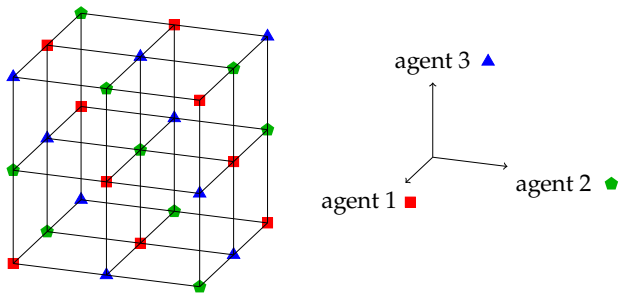
read the original abstract
In a satisficing equilibrium each agent $i$ plays one of her top $k_i$ actions in response to the actions of the other agents. Our concept unifies models of bounded rationality and yields predictions that differ from canonical solution concepts. We study its theoretical properties and show that it provides sharp predictions, exists in most games as well as in a broad new class of economic environments, admits standard epistemic and dynamic foundations, and is empirically falsifiable.
Editorial analysis
A structured set of objections, weighed in public.
Referee Report
Summary. The paper introduces satisficing equilibrium, in which each agent i selects one of her top k_i actions given the actions of the others. It claims the concept unifies models of bounded rationality, yields predictions distinct from canonical solution concepts, exists in most games as well as a broad new class of economic environments, admits standard epistemic and dynamic foundations, and is empirically falsifiable.
Significance. If the central claims hold after clarification of the definition, the work would provide a parameterized yet structured way to capture bounded rationality that unifies disparate models while remaining falsifiable and admitting standard foundations. Existence results in new economic environments would be a notable addition to the literature on solution concepts.
major comments (1)
- [Definition (likely §2)] The definition (presumably in §2) requires that, for every action profile of the others, each agent possesses a strict ranking over her actions that identifies a determinate top-k_i set. No structure is given on how k_i is chosen or fixed, nor on resolution of ties or incomplete orders. This renders the equilibrium correspondence potentially empty or set-valued in standard finite games, directly undermining the existence claims in most games and the sharpness of predictions.
Simulated Author's Rebuttal
We thank the referee for the careful and constructive report. The single major comment raises an important issue of definitional precision, which we address below with clarifications that strengthen rather than alter the core claims.
read point-by-point responses
-
Referee: [Definition (likely §2)] The definition (presumably in §2) requires that, for every action profile of the others, each agent possesses a strict ranking over her actions that identifies a determinate top-k_i set. No structure is given on how k_i is chosen or fixed, nor on resolution of ties or incomplete orders. This renders the equilibrium correspondence potentially empty or set-valued in standard finite games, directly undermining the existence claims in most games and the sharpness of predictions.
Authors: We agree that greater explicitness is warranted. The definition takes as primitives a fixed profile (k_i) for each player together with, for every action profile of the opponents, a strict complete ranking of player i's own actions; the top-k_i set is then the unique k_i highest-ranked actions under that ranking. This is the standard maintained assumption that renders the best-response correspondence single-valued or set-valued in the usual way. The vector k = (k_i) is a model parameter that indexes the degree of satisficing (exactly as the depth parameter indexes k-level reasoning or the quantal-response parameter indexes noise); it is not derived inside the equilibrium concept. Under these maintained assumptions the correspondence that maps opponents' profiles into each player's top-k_i set is non-empty, compact-valued, and upper hemicontinuous on finite action spaces, so Kakutani's theorem directly yields existence of a satisficing equilibrium. The same argument extends to the broader class of environments claimed in the paper. We will add a short paragraph in §2 making these maintained assumptions explicit and noting that extensions to weak orders or endogenous k_i are left for future work; the existence and sharpness results are unaffected. revision: partial
Circularity Check
No circularity: satisficing equilibrium introduced by primitive definition; properties derived independently
full rationale
The paper defines satisficing equilibrium directly as each agent playing one of her top k_i actions given others' play. All subsequent claims (unification of bounded-rationality models, existence in most games, epistemic/dynamic foundations, sharp predictions, empirical falsifiability) are presented as consequences of analyzing this definition under standard game-theoretic assumptions. No parameter is fitted to data and then relabeled a prediction, no self-citation chain bears the central load, and no uniqueness theorem or ansatz is smuggled in. The derivation chain is therefore self-contained and does not reduce any result to its own inputs by construction.
Axiom & Free-Parameter Ledger
free parameters (1)
- k_i
axioms (1)
- standard math Players have finite action sets and complete, transitive preferences over action profiles that induce a ranking of own actions given others' play.
Reference graph
Works this paper leans on
-
[1]
The Quarterly Journal of Economics, 136, 1611--1663
Abaluck, Jason and Abi Adams-Prassl (2021), What do consumers consider before they choose? identification from asymmetric demand responses. The Quarterly Journal of Economics, 136, 1611--1663. abaluck2021consumers
work page 2021
-
[2]
Alon, Noga, Kirill Rudov, and Leeat Yariv (2021), Dominance solvability in random games. Available at SSRN 3850992. alon2021dominance
work page 2021
-
[3]
Mathematics of Operations Research, 46, 1552--1572
Amiet, Ben, Andrea Collevecchio, Marco Scarsini, and Ziwen Zhong (2021), Pure N ash equilibria and best-response dynamics in random games. Mathematics of Operations Research, 46, 1552--1572. amiet2021pure
work page 2021
-
[4]
Apesteguia, Jose and Miguel A Ballester (2009), A theory of reference-dependent behavior. Economic Theory, 40, 427--455. apesteguia2009theory
work page 2009
-
[5]
Addison-Wesley series in Mathematics, Addison-Wesley, Reading, MA
Apostol, Tom M (1974), Mathematical Analysis; 2nd ed. Addison-Wesley series in Mathematics, Addison-Wesley, Reading, MA. Apostol:105425
work page 1974
-
[6]
American Economic Review, 102, 3561--3573
Arad, Ayala and Ariel Rubinstein (2012), The 11--20 money request game: A level-k reasoning study. American Economic Review, 102, 3561--3573. arad201211
work page 2012
-
[7]
Arratia, Richard, Larry Goldstein, and Louis Gordon (1990), Poisson approximation and the C hen- S tein method. Statistical Science, 403--424. arratia1990poisson
work page 1990
-
[8]
Journal of Economic Literature, 60, 598--635
Artinger, Florian M, Gerd Gigerenzer, and Perke Jacobs (2022), Satisficing: Integrating two traditions. Journal of Economic Literature, 60, 598--635. artinger2022satisficing
work page 2022
-
[9]
Aumann, Robert and Adam Brandenburger (1995), Epistemic conditions for nash equilibrium. Econometrica, 1161--1180. aumann1995epistemic
work page 1995
-
[10]
Baigent, Nick and Wulf Gaertner (1996), Never choose the uniquely largest a characterization. Economic Theory, 8, 239--249. baigent1996never
work page 1996
-
[11]
Random Structures & Algorithms, 31, 391--405
B \'a r \'a ny, Imre, Santosh Vempala, and Adrian Vetta (2007), Nash equilibria in random games. Random Structures & Algorithms, 31, 391--405. barany2007nash
work page 2007
-
[12]
Barber \`a , Salvador, Geoffroy De Clippel, Alejandro Neme, and Kareen Rozen (2022), Order-k rationality. Economic Theory, 1--19. Bar22
work page 2022
-
[13]
Barseghyan, Levon, Maura Coughlin, Francesca Molinari, and Joshua C Teitelbaum (2021), Heterogeneous choice sets and preferences. Econometrica, 89, 2015--2048. barseghyan2021heterogeneous
work page 2021
-
[14]
American Economic Review, 84, 391--395
Basu, Kaushik (1994), The traveler's dilemma: Paradoxes of rationality in game theory. American Economic Review, 84, 391--395. basu1994traveler
work page 1994
-
[15]
Scientific American, 296, 90--95
Basu, Kaushik (2007), The traveler’s dilemma. Scientific American, 296, 90--95. basu2007traveler
work page 2007
-
[16]
Journal of the European Economic Association, 11, 1231--1255
Benjamin, Daniel J, Sebastian A Brown, and Jesse M Shapiro (2013), Who is ‘behavioral’? C ognitive ability and anomalous preferences. Journal of the European Economic Association, 11, 1231--1255. benjamin2013behavioral
work page 2013
-
[17]
Bernheim, B Douglas (1984), Rationalizable strategic behavior. Econometrica, 1007--1028. bernheim1984rationalizable
work page 1984
-
[18]
The Quarterly Journal of Economics, 127, 1243--1285
Bordalo, Pedro, Nicola Gennaioli, and Andrei Shleifer (2012), Salience theory of choice under risk. The Quarterly Journal of Economics, 127, 1243--1285. bordalo2012salience
work page 2012
-
[19]
Annual Review of Economics, 14, 521--544
Bordalo, Pedro, Nicola Gennaioli, and Andrei Shleifer (2022), Salience. Annual Review of Economics, 14, 521--544. bordalo2022salience
work page 2022
-
[20]
American Economic Review, 105, 2183--2203
Caplin, Andrew and Mark Dean (2015), Revealed preference, rational inattention, and costly information acquisition. American Economic Review, 105, 2183--2203. caplin2015revealed
work page 2015
-
[21]
American Economic Review, 101, 2899--2922
Caplin, Andrew, Mark Dean, and Daniel Martin (2011), Search and satisficing. American Economic Review, 101, 2899--2922. Caplin2011
work page 2011
-
[22]
Capra, C Monica, Jacob K Goeree, Rosario Gomez, and Charles A Holt (1999), Anomalous behavior in a traveler's dilemma? American Economic Review, 89, 678--690. capra1999anomalous
work page 1999
-
[23]
Management Science, 58, 21--34
Cesarini, David, Magnus Johannesson, Patrik KE Magnusson, and Bj \"o rn Wallace (2012), The behavioral genetics of behavioral anomalies. Management Science, 58, 21--34. cesarini2012behavioral
work page 2012
-
[24]
Conlisk, John (1996), Why bounded rationality? Journal of Economic Literature, 34, 669--700. conlisk1996bounded
work page 1996
-
[25]
Journal of Economic Literature, 51, 5--62
Crawford, Vincent P, Miguel A Costa-Gomes, and Nagore Iriberri (2013), Structural models of nonequilibrium strategic thinking: Theory, evidence, and applications. Journal of Economic Literature, 51, 5--62. crawford2013structural
work page 2013
-
[26]
Dardanoni, Valentino, Paola Manzini, Marco Mariotti, and Christopher J Tyson (2020), Inferring cognitive heterogeneity from aggregate choices. Econometrica, 88, 1269--1296. dardanoni2020inferring
work page 2020
-
[27]
Journal of Economic Literature, 62, 995--1039
de Clippel, Geoffroy and Kareen Rozen (2024), Bounded rationality in choice theory: A survey. Journal of Economic Literature, 62, 995--1039. Clippel2024
work page 2024
-
[28]
Dinitz, Jeffrey H (2007), Handbook of combinatorial designs. Chapman & Hall/CRC. dinitz2007handbook
work page 2007
-
[29]
Journal of Combinatorial Theory, 8, 134--145
Dresher, Melvin (1970), Probability of a pure equilibrium point in n-person games. Journal of Combinatorial Theory, 8, 134--145. dresher1970probability
work page 1970
-
[30]
Review of Economic Studies, 78, 235--262
Eliaz, Kfir and Ran Spiegler (2011), Consideration sets and competitive marketing. Review of Economic Studies, 78, 235--262. eliaz2011consideration
work page 2011
-
[31]
The Quarterly Journal of Economics, 138, 2021--2067
Enke, Benjamin and Thomas Graeber (2023), Cognitive uncertainty. The Quarterly Journal of Economics, 138, 2021--2067. enke2023cognitive
work page 2023
-
[32]
Eyster, Erik and Matthew Rabin (2005), Cursed equilibrium. Econometrica, 73, 1623--1672. eyster2005cursed
work page 2005
-
[33]
Games and Economic Behavior, 21, 40--55
Foster, Dean P and Rakesh V Vohra (1997), Calibrated learning and correlated equilibrium. Games and Economic Behavior, 21, 40--55. foster1997calibrated
work page 1997
-
[34]
Friedman, Daniel and Shuchen Zhao (2021), When are mixed equilibria relevant? Journal of Economic Behavior & Organization, 191, 51--65. Fri21
work page 2021
- [35]
-
[36]
The Quarterly Journal of Economics, 129, 1661--1710
Gabaix, Xavier (2014), A sparsity-based model of bounded rationality. The Quarterly Journal of Economics, 129, 1661--1710. gabaix2014sparsity
work page 2014
-
[37]
American Economic Review, 96, 1043--1068
Gabaix, Xavier, David Laibson, Guillermo Moloche, and Stephen Weinberg (2006), Costly information acquisition: Experimental analysis of a boundedly rational model. American Economic Review, 96, 1043--1068. gabaix2006costly
work page 2006
-
[38]
Goeree, Michelle Sovinsky (2008), Limited information and advertising in the us personal computer industry. Econometrica, 76, 1017--1074. goeree2008limited
work page 2008
-
[39]
Journal of Research of the National Bureau of Standards, 72, 93--101
Goldberg, K, AJ Goldman, and M Newman (1968), The probability of an equilibrium point. Journal of Research of the National Bureau of Standards, 72, 93--101. goldberg1968probability
work page 1968
-
[40]
Cambridge University Press, UK
Hardy, Godfrey Harold (1940), Ramanujan: Twelve lectures on subjects suggested by his life and work, volume 136. Cambridge University Press, UK. hardy1940ramanujan
work page 1940
-
[41]
Proceedings of the National Academy of Sciences, 101, 3999--4002
Holt, Charles A and Alvin E Roth (2004), The N ash equilibrium: A perspective. Proceedings of the National Academy of Sciences, 101, 3999--4002. Hol04
work page 2004
-
[42]
arXiv preprint arXiv:2309.10609
Johnston, Tom, Michael Savery, Alex Scott, and Bassel Tarbush (2023), Game connectivity and adaptive dynamics. arXiv preprint arXiv:2309.10609. Jon23
work page internal anchor Pith review arXiv 2023
-
[43]
Journal of Economic Perspectives, 5, 193--206
Kahneman, Daniel, Jack L Knetsch, and Richard H Thaler (1991), Anomalies: The endowment effect, loss aversion, and status quo bias. Journal of Economic Perspectives, 5, 193--206. kahneman1991anomalies
work page 1991
-
[44]
Kalai, Ehud and William Stanford (1988), Finite rationality and interpersonal complexity in repeated games. Econometrica, 56, 397--410. kalai1988finite
work page 1988
-
[45]
Kalai, Gil, Ariel Rubinstein, and Ran Spiegler (2002), Rationalizing choice functions by multiple rationales. Econometrica, 70, 2481--2488. kalai2002rationalizing
work page 2002
-
[46]
The Quarterly Journal of Economics, 128, 53--104
K o szegi, Botond and Adam Szeidl (2013), A model of focusing in economic choice. The Quarterly Journal of Economics, 128, 53--104. koszegi2013model
work page 2013
-
[47]
Journal of Economic Theory, 170, 70--85
Lleras, Juan Sebastian, Yusufcan Masatlioglu, Daisuke Nakajima, and Erkut Y Ozbay (2017), When more is less: Limited consideration. Journal of Economic Theory, 170, 70--85. lleras2017more
work page 2017
-
[48]
The Quarterly Journal of Economics, 116, 1149--1187
Madrian, Brigitte C and Dennis F Shea (2001), The power of suggestion: Inertia in 401 (k) participation and savings behavior. The Quarterly Journal of Economics, 116, 1149--1187. madrian2001power
work page 2001
-
[49]
American Economic Review, 97, 1824--1839
Manzini, Paola and Marco Mariotti (2007), Sequentially rationalizable choice. American Economic Review, 97, 1824--1839. manzini2007sequentially
work page 2007
-
[50]
Manzini, Paola and Marco Mariotti (2014), Stochastic choice and consideration sets. Econometrica, 82, 1153--1176. manzini2014stochastic
work page 2014
-
[51]
American Economic Review, 102, 2183--2205
Masatlioglu, Yusufcan, Daisuke Nakajima, and Erkut Y Ozbay (2012), Revealed attention. American Economic Review, 102, 2183--2205. masatlioglu2012revealed
work page 2012
-
[52]
Review of Economic Studies, 81, 851--883
Masatlioglu, Yusufcan and Efe A Ok (2014), A canonical model of choice with initial endowments. Review of Economic Studies, 81, 851--883. masatlioglu2014canonical
work page 2014
-
[53]
Random Structures & Algorithms, 59, 3--24
McDiarmid, Colin, Alex Scott, and Paul Withers (2021), The component structure of dense random subgraphs of the hypercube. Random Structures & Algorithms, 59, 3--24. mcdiarmid2021component
work page 2021
-
[54]
SIAM Journal on Discrete Mathematics, 22, 719--736
McKay, Brendan D and Ian M Wanless (2008), A census of small latin hypercubes. SIAM Journal on Discrete Mathematics, 22, 719--736. mckay2008census
work page 2008
-
[55]
Games and Economic Behavior, 14, 124--143
Monderer, Dov and Lloyd S Shapley (1996), Potential games. Games and Economic Behavior, 14, 124--143. monderer1996potential
work page 1996
-
[56]
American Economic Review, 85, 1313--1326
Nagel, Rosemarie (1995), Unraveling in guessing games: A n experimental study. American Economic Review, 85, 1313--1326. nagel1995unraveling
work page 1995
-
[57]
Proceedings of the National Academy of Sciences, 36, 48--49
Nash, John F (1950), Equilibrium points in n -person games. Proceedings of the National Academy of Sciences, 36, 48--49. nash1950equilibrium
work page 1950
-
[58]
Newton, Jonathan (2018), Evolutionary game theory: A renaissance. Games, 9, 31. newton2018evolutionary
work page 2018
-
[59]
Economics Letters, 19, 227--229
Neyman, Abraham (1985), Bounded complexity justifies cooperation in the finitely repeated prisoners' dilemma. Economics Letters, 19, 227--229. neyman1985bounded
work page 1985
-
[60]
Oprea, Ryan (2020), What makes a rule complex? American Economic Review, 110, 3913--3951. oprea2020makes
work page 2020
-
[61]
American Economic Review, 834--847
Osborne, Martin J and Ariel Rubinstein (1998), Games with procedurally rational players. American Economic Review, 834--847. osborne1998games
work page 1998
-
[62]
Pearce, David G (1984), Rationalizable strategic behavior and the problem of perfection. Econometrica, 1029--1050. pearce1984rationalizable
work page 1984
-
[63]
International Journal of Game Theory, 25, 13--34
Peleg, Bezalel and Stef Tijs (1996), The consistency principle for games in strategic form. International Journal of Game Theory, 25, 13--34. peleg1996consistency
work page 1996
-
[64]
International Journal of Game Theory, 19, 277--286
Powers, Imelda Young (1990), Limiting distributions of the number of pure strategy N ash equilibria in n -person games. International Journal of Game Theory, 19, 277--286. powers1990limiting
work page 1990
-
[65]
American Economic Review, 101, 900--926
Reutskaja, Elena, Rosemarie Nagel, Colin F Camerer, and Antonio Rangel (2011), Search dynamics in consumer choice under time pressure: An eye-tracking study. American Economic Review, 101, 900--926. reutskaja2011search
work page 2011
-
[66]
Games and Economic Behavior, 33, 274--293
Rinott, Yosef and Marco Scarsini (2000), On the number of pure strategy N ash equilibria in random games. Games and Economic Behavior, 33, 274--293. Rin00
work page 2000
-
[67]
Journal of Economic Theory, 39, 83--96
Rubinstein, Ariel (1986), Finite automata play the repeated prisoner's dilemma. Journal of Economic Theory, 39, 83--96. rubinstein1986finite
work page 1986
-
[68]
Rubinstein, Ariel (1991), Comments on the interpretation of game theory. Econometrica, 909--924. rubinstein1991comments
work page 1991
-
[69]
Rubinstein, Ariel (2006), Dilemmas of an economic theorist. Econometrica, 865--883. rubinstein2006dilemmas
work page 2006
-
[70]
The Quarterly Journal of Economics, 131, 859--890
Rubinstein, Ariel (2016), A typology of players: Between instinctive and contemplative. The Quarterly Journal of Economics, 131, 859--890. rubinstein2016typology
work page 2016
-
[71]
Theoretical Economics, 1, 3--17
Rubinstein, Ariel and Yuval Salant (2006), A model of choice from lists. Theoretical Economics, 1, 3--17. rubinstein2006model
work page 2006
-
[72]
American Economic Review, 101, 724--748
Salant, Yuval (2011), Procedural analysis of choice rules with applications to bounded rationality. American Economic Review, 101, 724--748. salant2011procedural
work page 2011
-
[73]
Technical report, National Bureau of Economic Research
Salant, Yuval and Jorg L Spenkuch (2023), Complexity and satisficing: T heory with evidence from chess. Technical report, National Bureau of Economic Research. salant2023complexity
work page 2023
-
[74]
Journal of Economic Perspectives, 16, 47--66
Samuelson, Larry (2002), Evolution and game theory. Journal of Economic Perspectives, 16, 47--66. samuelson2002evolution
work page 2002
-
[75]
Journal of Economic Perspectives, 30, 107--130
Samuelson, Larry (2016), Game theory in economics and beyond. Journal of Economic Perspectives, 30, 107--130. samuelson2016game
work page 2016
-
[76]
Journal of Risk and Uncertainty, 1, 7--59
Samuelson, William and Richard Zeckhauser (1988), Status quo bias in decision making. Journal of Risk and Uncertainty, 1, 7--59. samuelson1988status
work page 1988
-
[77]
American Economic Review, 102, 2955--2980
Santos, Babur De los, Ali Horta c su, and Matthijs R Wildenbeest (2012), Testing models of consumer search using data on web browsing and purchasing behavior. American Economic Review, 102, 2955--2980. santos2012testing
work page 2012
-
[78]
Sen, Amartya (1993), Internal consistency of choice. Econometrica, 61, 495--521. Sen1993
work page 1993
-
[79]
Simon, Herbert A (1947), Administrative Behavior: A Study of Decision-making Processes in Administrative Organization. Macmillan, New York. Simon1947
work page 1947
-
[80]
The Quarterly Journal of Economics, 69, 99--118
Simon, Herbert A (1955), A behavioral model of rational choice. The Quarterly Journal of Economics, 69, 99--118. simon1955behavioral
work page 1955
discussion (0)
Sign in with ORCID, Apple, or X to comment. Anyone can read and Pith papers without signing in.