TextBoost: Boosting Text Encoder for Personalized Text-to-Image Generation
Pith reviewed 2026-05-23 20:47 UTC · model grok-4.3
The pith
TextBoost personalizes text-to-image models by fine-tuning only the text encoder with lightweight adapters.
A machine-rendered reading of the paper's core claim, the machinery that carries it, and where it could break.
Core claim
TextBoost is an efficient one-shot personalization approach for text-to-image diffusion models that selectively fine-tunes only the text encoder. A causality-preserving adaptation mechanism maintains the original semantic integrity of the encoder, while lightweight adapters locally refine text embeddings immediately before they reach the cross-attention layers. This design delivers faster convergence, substantially lower storage needs through fewer trainable parameters, comparable subject fidelity, superior text fidelity, and greater generation diversity relative to prior personalization techniques.
What carries the argument
Causality-preserving adaptation mechanism plus lightweight adapters applied directly to the text encoder, which enables selective fine-tuning while preserving semantics and boosting expressiveness with minimal added cost.
If this is right
- Personalization training converges faster than methods that update larger portions of the model.
- Storage requirements drop sharply because only a small number of parameters are trained and saved.
- Subject fidelity remains comparable to heavier personalization baselines.
- Text fidelity improves over existing approaches, allowing generated images to match prompts more accurately.
- Output diversity increases, producing more varied images for the same subject and prompt.
Where Pith is reading between the lines
- The reduced parameter count could make on-device personalization feasible on phones or laptops with limited memory.
- The same selective update pattern might transfer to other conditioning signals such as depth maps or style references.
- Lower storage per user profile would allow services to host many personalized models without proportional increases in disk use.
- Faster convergence might shorten the time users wait between providing a reference image and receiving usable outputs.
Load-bearing premise
The causality-preserving adaptation and lightweight adapters can be added to the text encoder without introducing semantic drift or reducing the model's ability to follow complex prompts.
What would settle it
A controlled test in which TextBoost images show visibly lower fidelity to the reference subject or diverge from specific details in complex prompts compared with full-model fine-tuning baselines.
Figures


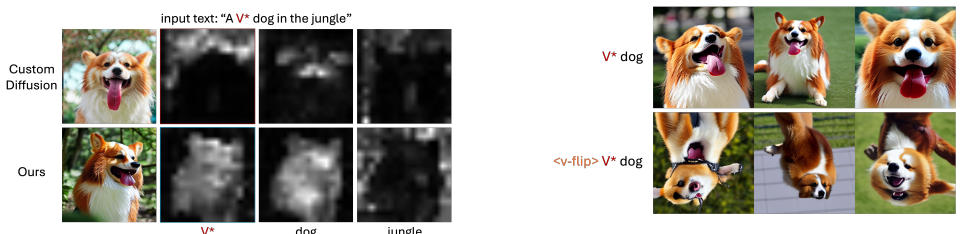


read the original abstract
In this paper, we introduce TextBoost, an efficient one-shot personalization approach for text-to-image diffusion models. Traditional personalization methods typically involve fine-tuning extensive portions of the model, leading to substantial storage requirements and slow convergence. In contrast, we propose selectively fine-tuning only the text encoder, significantly improving computational and storage efficiency. To preserve the original semantic integrity, we develop a novel causality-preserving adaptation mechanism. Additionally, lightweight adapters are employed to locally refine text embeddings immediately before their interaction with cross-attention layers, greatly enhancing the expressiveness of text embeddings with minimal computational overhead. Empirical evaluations across diverse concepts demonstrate that TextBoost achieves faster convergence and substantially reduces storage demands by minimizing the number of trainable parameters. Furthermore, TextBoost maintains comparable subject fidelity, superior text fidelity, and greater generation diversity compared to existing methods. We show that our proposed method offers an efficient, scalable, and practically applicable solution for high-quality text-to-image personalization, particularly beneficial in resource-constrained environments.
Editorial analysis
A structured set of objections, weighed in public.
Referee Report
Summary. The paper introduces TextBoost, an efficient one-shot personalization approach for text-to-image diffusion models by selectively fine-tuning only the text encoder. It develops a causality-preserving adaptation mechanism and employs lightweight adapters to refine text embeddings before cross-attention, claiming faster convergence, reduced storage via fewer trainable parameters, comparable subject fidelity, superior text fidelity, and greater generation diversity compared to existing methods.
Significance. If the empirical claims hold, the method offers a practical efficiency gain for personalization tasks by minimizing parameter updates and storage overhead while addressing semantic integrity, which could make high-quality customization more feasible in resource-limited environments.
major comments (1)
- [Abstract] Abstract: The abstract reports empirical results across concepts but provides no quantitative tables, baselines, error bars, or dataset details; central performance claims cannot be verified from the given text.
Simulated Author's Rebuttal
We thank the referee for the detailed review and constructive comment. We address the point regarding the abstract below and will incorporate revisions in the next version of the manuscript.
read point-by-point responses
-
Referee: [Abstract] Abstract: The abstract reports empirical results across concepts but provides no quantitative tables, baselines, error bars, or dataset details; central performance claims cannot be verified from the given text.
Authors: We agree that the abstract, as currently written, summarizes empirical outcomes at a high level without including specific quantitative values, baselines, or dataset references, which limits verifiability from the abstract alone. While abstracts are inherently concise and full experimental details (including tables with metrics, baselines, error bars, and dataset descriptions) appear in Section 4 of the manuscript, we will revise the abstract to incorporate a small number of key quantitative highlights—such as approximate parameter reduction percentages, convergence speed improvements, and relative fidelity/diversity gains—drawn from the experimental results. This will better support the central claims without exceeding typical abstract length constraints. revision: yes
Circularity Check
No significant circularity; empirical method only
full rationale
The paper introduces TextBoost as an empirical one-shot personalization technique that selectively fine-tunes the text encoder plus lightweight adapters, supported by a causality-preserving adaptation mechanism. All performance claims (faster convergence, reduced storage, comparable subject fidelity, superior text fidelity) are framed as outcomes of empirical evaluations across diverse concepts rather than any derivation, equation, or fitted prediction. No self-referential fitting, self-citation load-bearing premises, or reductions of predictions to inputs by construction appear in the described approach. The method is therefore self-contained against external benchmarks.
Axiom & Free-Parameter Ledger
Lean theorems connected to this paper
-
IndisputableMonolith/Cost/FunctionalEquation.leanwashburn_uniqueness_aczel unclear?
unclearRelation between the paper passage and the cited Recognition theorem.
We propose selectively fine-tuning only the text encoder... augmentation token... knowledge-preservation loss... SNR-weighted sampling
-
IndisputableMonolith/Foundation/RealityFromDistinction.leanreality_from_one_distinction unclear?
unclearRelation between the paper passage and the cited Recognition theorem.
Our approach is memory and storage-efficient, requiring only 0.7M parameters
What do these tags mean?
- matches
- The paper's claim is directly supported by a theorem in the formal canon.
- supports
- The theorem supports part of the paper's argument, but the paper may add assumptions or extra steps.
- extends
- The paper goes beyond the formal theorem; the theorem is a base layer rather than the whole result.
- uses
- The paper appears to rely on the theorem as machinery.
- contradicts
- The paper's claim conflicts with a theorem or certificate in the canon.
- unclear
- Pith found a possible connection, but the passage is too broad, indirect, or ambiguous to say the theorem truly supports the claim.
Forward citations
Cited by 1 Pith paper
-
Adversarial Concept Distillation for One-Step Diffusion Personalization
OPAD enables reliable high-quality personalization of one-step diffusion models via multi-step teacher distillation combined with adversarial alignment losses.
Reference graph
Works this paper leans on
-
[1]
, " * write output.state after.block = add.period write newline
ENTRY address archivePrefix author booktitle chapter edition editor eid eprint howpublished institution isbn journal key month note number organization pages publisher school series title type volume year label extra.label sort.label short.list INTEGERS output.state before.all mid.sentence after.sentence after.block FUNCTION init.state.consts #0 'before.a...
-
[2]
" write newline "" before.all 'output.state := FUNCTION n.dashify 't := "" t empty not t #1 #1 substring "-" = t #1 #2 substring "--" = not "--" * t #2 global.max substring 't := t #1 #1 substring "-" = "-" * t #2 global.max substring 't := while if t #1 #1 substring * t #2 global.max substring 't := if while FUNCTION word.in bbl.in capitalize " " * FUNCT...
-
[3]
Alaluf, Y.; Richardson, E.; Metzer, G.; and Cohen-Or, D. 2023. A Neural Space - Time Representation for Text -to- Image Personalization . ACM Transactions on Graphics (TOG), 42
work page 2023
-
[4]
Balaji, Y.; Nah, S.; Huang, X.; Vahdat, A.; Song, J.; Kreis, K.; Aittala, M.; Aila, T.; Laine, S.; Catanzaro, B.; Karras, T.; and Liu, M.-Y. 2022. eDiff - I : Text -to- Image Diffusion Models with an Ensemble of Expert Denoisers . ArXiv:2211.01324 [cs]
work page internal anchor Pith review Pith/arXiv arXiv 2022
-
[5]
Black, K.; Janner, M.; Du, Y.; Kostrikov, I.; and Levine, S. 2024. Training Diffusion Models with Reinforcement Learning
work page 2024
-
[6]
Brooks, T.; Holynski, A.; and Efros, A. A. 2023. InstructPix2Pix : Learning to Follow Image Editing Instructions . In IEEE Conference on Computer Vision and Pattern Recognition
work page 2023
-
[7]
Chen, H.; Zhang, Y.; Wu, S.; Wang, X.; Duan, X.; Zhou, Y.; and Zhu, W. 2024 a . DisenBooth : Identity - Preserving Disentangled Tuning for Subject - Driven Text -to- Image Generation . In International Conference on Learning Representations
work page 2024
- [8]
- [9]
-
[10]
Fan, Y.; Watkins, O.; Du, Y.; Liu, H.; Ryu, M.; Boutilier, C.; Abbeel, P.; Ghavamzadeh, M.; Lee, K.; and Lee, K. 2023. DPOK : Reinforcement Learning for Fine -tuning Text -to- Image Diffusion Models
work page 2023
-
[11]
H.; Chechik, G.; and Cohen-Or, D
Gal, R.; Alaluf, Y.; Atzmon, Y.; Patashnik, O.; Bermano, A. H.; Chechik, G.; and Cohen-Or, D. 2023. An Image is Worth One Word : Personalizing Text -to- Image Generation using Textual Inversion . In International Conference on Learning Representations
work page 2023
-
[12]
Z.; Shi, Y.; Chen, Y.; Fan, Z.; Xiao, W.; Zhao, R.; Chang, S.; Wu, W.; Ge, Y.; Shan, Y.; and Shou, M
Gu, Y.; Wang, X.; Wu, J. Z.; Shi, Y.; Chen, Y.; Fan, Z.; Xiao, W.; Zhao, R.; Chang, S.; Wu, W.; Ge, Y.; Shan, Y.; and Shou, M. Z. 2023. Mix-of- Show : Decentralized Low - Rank Adaptation for Multi - Concept Customization of Diffusion Models . In Advances in Neural Information Processing Systems
work page 2023
-
[13]
Han, L.; Li, Y.; Zhang, H.; Milanfar, P.; Metaxas, D.; and Yang, F. 2023. SVDiff : Compact Parameter Space for Diffusion Fine - Tuning . In Proceedings of the IEEE / CVF Conference on Computer Vision and Pattern Recognition ( CVPR )
work page 2023
- [14]
-
[15]
Ho, J.; Jain, A.; and Abbeel, P. 2020. Denoising Diffusion Probabilistic Models . In Advances in Neural Information Processing Systems . ArXiv: 2006.11239
work page internal anchor Pith review Pith/arXiv arXiv 2020
-
[16]
J.; Shen, Y.; Wallis, P.; Allen-Zhu, Z.; Li, Y.; Wang, S.; Wang, L.; and Chen, W
Hu, E. J.; Shen, Y.; Wallis, P.; Allen-Zhu, Z.; Li, Y.; Wang, S.; Wang, L.; and Chen, W. 2022. LoRA : Low - Rank Adaptation of Large Language Models
work page 2022
- [17]
-
[18]
Jun, H.; Child, R.; Chen, M.; Schulman, J.; Ramesh, A.; Radford, A.; and Sutskever, I. 2020. Distribution Augmentation for Generative Modeling . In Proceedings of the 37th International Conference on Machine Learning , 5006--5019. PMLR
work page 2020
-
[19]
Kang, M.; Zhang, J.; Zhang, J.; Wang, X.; Chen, Y.; Ma, Z.; and Huang, X. 2023. Alleviating Catastrophic Forgetting of Incremental Object Detection via Within - Class and Between - Class Knowledge Distillation . In 2023 IEEE / CVF International Conference on Computer Vision ( ICCV ) , 18848--18858. Paris, France: IEEE. ISBN 9798350307184
work page 2023
-
[20]
Karras, T.; Aittala, M.; Hellsten, J.; Laine, S.; Lehtinen, J.; and Aila, T. 2020. Training Generative Adversarial Networks with Limited Data . In Advances in Neural Information Processing Systems
work page 2020
-
[21]
Kingma, D. P.; Salimans, T.; Poole, B.; and Ho, J. 2021. Variational Diffusion Models . In Advances in Neural Information Processing Systems . ArXiv:2107.00630 [cs, stat]
-
[22]
Kumari, N.; Zhang, B.; Zhang, R.; Shechtman, E.; and Zhu, J.-Y. 2023. Multi- Concept Customization of Text -to- Image Diffusion . In IEEE Conference on Computer Vision and Pattern Recognition
work page 2023
-
[23]
Lee, J.; Cho, K.; and Kiela, D. 2019. Countering Language Drift via Visual Grounding . In Inui, K.; Jiang, J.; Ng, V.; and Wan, X., eds., Proceedings of the 2019 Conference on Empirical Methods in Natural Language Processing and the 9th International Joint Conference on Natural Language Processing ( EMNLP - IJCNLP ) , 4385--4395. Hong Kong, China: Associa...
work page 2019
-
[24]
Li, D.; Li, J.; and Hoi, S. C. H. 2023. BLIP - Diffusion : Pre -trained Subject Representation for Controllable Text -to- Image Generation and Editing . In Advances in Neural Information Processing Systems
work page 2023
-
[25]
Li, Y.; Zhang, R.; Lu, J. C.; and Shechtman, E. 2020. Few-shot Image Generation with Elastic Weight Consolidation . In Advances in Neural Information Processing Systems
work page 2020
-
[26]
Liu, Z.; Feng, R.; Zhu, K.; Zhang, Y.; Zheng, K.; Liu, Y.; Zhao, D.; Zhou, J.; and Cao, Y. 2023. Cones: Concept Neurons in Diffusion Models for Customized Generation . In Proceedings of the 40th International Conference on Machine Learning . PMLR
work page 2023
-
[27]
Loshchilov, I.; and Hutter, F. 2019. Decoupled Weight Decay Regularization . In International Conference on Learning Representations
work page 2019
-
[28]
Nichol, A.; Dhariwal, P.; Ramesh, A.; Shyam, P.; Mishkin, P.; McGrew, B.; Sutskever, I.; and Chen, M. 2023. GLIDE : Towards Photorealistic Image Generation and Editing with Text - Guided Diffusion Models . In Proceedings of the 39th International Conference on Machine Learning . PMLR
work page 2023
-
[29]
Oquab, M.; Darcet, T.; Moutakanni, T.; Vo, H.; Szafraniec, M.; Khalidov, V.; Fernandez, P.; Haziza, D.; Massa, F.; El-Nouby, A.; Assran, M.; Ballas, N.; Galuba, W.; Howes, R.; Huang, P.-Y.; Li, S.-W.; Misra, I.; Rabbat, M.; Sharma, V.; Synnaeve, G.; Xu, H.; Jegou, H.; Mairal, J.; Labatut, P.; Joulin, A.; and Bojanowski, P. 2024. DINOv2 : Learning Robust V...
work page 2024
-
[30]
Podell, D.; English, Z.; Lacey, K.; Blattmann, A.; Dockhorn, T.; Müller, J.; Penna, J.; and Rombach, R. 2024. SDXL : Improving Latent Diffusion Models for High - Resolution Image Synthesis . In International Conference on Learning Representations
work page 2024
-
[31]
Radford, A.; Kim, J. W.; Hallacy, C.; Ramesh, A.; Goh, G.; Agarwal, S.; Sastry, G.; Askell, A.; Mishkin, P.; Clark, J.; Krueger, G.; and Sutskever, I. 2021. Learning Transferable Visual Models From Natural Language Supervision . In Proceedings of the 38th International Conference on Machine Learning . PMLR
work page 2021
-
[32]
Ramesh, A.; Dhariwal, P.; Nichol, A.; Chu, C.; and Chen, M. 2022. Hierarchical Text - Conditional Image Generation with CLIP Latents
work page 2022
-
[33]
Rolnick, D.; Ahuja, A.; Schwarz, J.; Lillicrap, T. P.; and Wayne, G. 2019. Experience Replay for Continual Learning . In Advances in Neural Information Processing Systems . arXiv. ArXiv:1811.11682 [cs, stat]
-
[34]
Rombach, R.; Blattmann, A.; Lorenz, D.; Esser, P.; and Ommer, B. 2022. High- Resolution Image Synthesis with Latent Diffusion Models . In IEEE Conference on Computer Vision and Pattern Recognition
work page 2022
-
[35]
Ronneberger, O.; Fischer, P.; and Brox, T. 2015. U- Net : Convolutional Networks for Biomedical Image Segmentation . In International Conference on Medical Image Computing and Computer - Assisted Intervention
work page 2015
-
[36]
Ruiz, N.; Li, Y.; Jampani, V.; Pritch, Y.; Rubinstein, M.; and Aberman, K. 2023. DreamBooth : Fine Tuning Text -to- Image Diffusion Models for Subject - Driven Generation . In Proceedings of the IEEE / CVF Conference on Computer Vision and Pattern Recognition ( CVPR ) . ArXiv:2208.12242 [cs]
-
[37]
Saharia, C.; Chan, W.; Saxena, S.; Li, L.; Whang, J.; Denton, E.; Ghasemipour, S. K. S.; Ayan, B. K.; Mahdavi, S. S.; Lopes, R. G.; Salimans, T.; Ho, J.; Fleet, D. J.; and Norouzi, M. 2022. Photorealistic Text -to- Image Diffusion Models with Deep Language Understanding . In Advances in Neural Information Processing Systems
work page 2022
- [38]
-
[39]
Shi, J.; Xiong, W.; Lin, Z.; and Jung, H. J. 2024. InstantBooth : Personalized Text -to- Image Generation without Test - Time Finetuning . In Proceedings of the IEEE / CVF Conference on Computer Vision and Pattern Recognition ( CVPR )
work page 2024
-
[40]
A.; Maheswaranathan, N.; and Ganguli, S
Sohl-Dickstein, J.; Weiss, E. A.; Maheswaranathan, N.; and Ganguli, S. 2015. Deep Unsupervised Learning using Nonequilibrium Thermodynamics . In Proceedings of the 32nd International Conference on Machine Learning , 2256--2265. PMLR
work page 2015
-
[41]
Sohn, K.; Ruiz, N.; Lee, K.; Chin, D. C.; Blok, I.; Chang, H.; Barber, J.; Jiang, L.; Entis, G.; Li, Y.; Hao, Y.; Essa, I.; Rubinstein, M.; and Krishnan, D. 2023. StyleDrop : Text -to- Image Generation in Any Style . In Advances in Neural Information Processing Systems
work page 2023
-
[42]
Tewel, Y.; Gal, R.; Chechik, G.; and Atzmon, Y. 2023. Key- Locked Rank One Editing for Text -to- Image Personalization . ACM SIGGRAPH 2023 Conference Proceedings
work page 2023
- [43]
- [44]
-
[45]
Wei, Y.; Zhang, Y.; Ji, Z.; Bai, J.; Zhang, L.; and Zuo, W. 2023. ELITE : Encoding Visual Concepts into Textual Embeddings for Customized Text -to- Image Generation . In Proceedings of the IEEE / CVF Conference on Computer Vision and Pattern Recognition ( CVPR )
work page 2023
-
[46]
Xiao, G.; Yin, T.; Freeman, W. T.; Durand, F.; and Han, S. 2023. FastComposer : Tuning - Free Multi - Subject Image Generation with Localized Attention . ArXiv:2305.10431 [cs]
-
[47]
Zhang, X.; Wei, X.-Y.; Wu, J.; Zhang, T.; Zhang, Z.; Lei, Z.; and Li, Q. 2024 a . Compositional Inversion for Stable Diffusion Models . In Proceedings of the AAAI Conference on Artificial Intelligence
work page 2024
- [48]
-
[49]
Zhang, Y.; Yang, M.; Zhou, Q.; and Wang, Z. 2024 c . Attention Calibration for Disentangled Text -to- Image Personalization . In IEEE Conference on Computer Vision and Pattern Recognition
work page 2024
discussion (0)
Sign in with ORCID, Apple, or X to comment. Anyone can read and Pith papers without signing in.