Fragmented charged domain wall below the tetragonal-orthorhombic phase transition in BaTiO3
Pith reviewed 2026-05-23 18:40 UTC · model grok-4.3
The pith
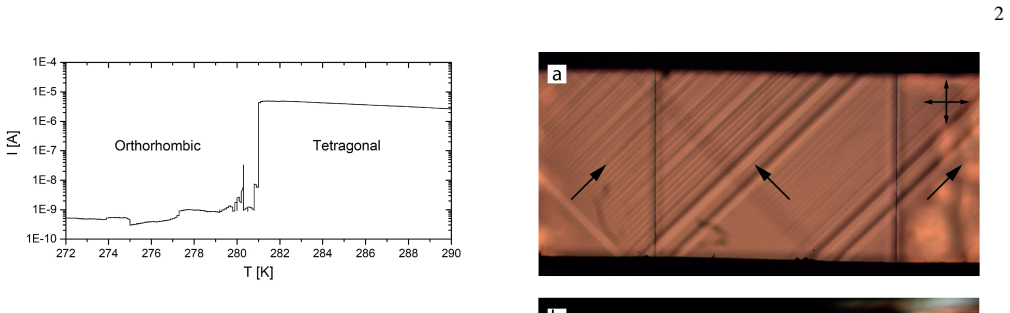
Below the tetragonal-orthorhombic transition in BaTiO3 the head-to-head charged domain wall fragments into alternating charged and neutral segments that break the conductive path.
A machine-rendered reading of the paper's core claim, the machinery that carries it, and where it could break.
Core claim
The head-to-head charged domain wall transforms below the phase transition into a superdomain wall broken into alternating micron-scale segments with and without the excess bound charge; the adjacent domains become twinned in the orthorhombic phase. These observations explain the observed loss of domain wall conductivity because the macroscopic conductive channel along such a fragmented superdomain wall is disrupted.
What carries the argument
The superdomain wall created by twinning of domains adjacent to the original charged wall, which splits the wall into charged and uncharged micron-scale segments.
If this is right
- The macroscopic conductive channel along the domain wall is disrupted.
- Conductivity drops by several orders of magnitude at the transition.
- Domains adjacent to the charged wall become twinned in the orthorhombic phase.
- The transformation occurs precisely at the tetragonal-orthorhombic phase boundary.
Where Pith is reading between the lines
- Device designs relying on these walls would need to remain above the transition temperature to maintain conductivity.
- The same twinning-driven segmentation may appear in other ferroelectrics that undergo phase transitions accompanied by additional domain variants.
- The length scale of the segments could be tuned by crystal orientation or cooling conditions to control the conductivity drop.
- Surface-only imaging leaves open whether the segments extend through the full crystal thickness.
Load-bearing premise
The micron-scale segmentation seen by optical microscopy accurately reflects the three-dimensional structure that controls macroscopic conductivity rather than being a surface artifact or incomplete view of the twinning.
What would settle it
Local probe measurements that find continuous high conductivity along the entire length of the wall at low temperature, or three-dimensional tomography that reveals an unbroken charge path not visible in the optical images.
Figures


read the original abstract
Ferroelectric charged domain walls are known for their high electrical conductivity, making them promising candidates for applications in modern electronics. A remarkably high conductivity and nominal charge density has been found in the head-to-head ferroelastic domain wall of tetragonal barium titanate. Interestingly, the conductivity of this domain wall decreases by several orders of magnitude when the temperature drops down below about 5 degrees Celsius when the tetragonal phase transforms to the orthorhombic one. We thus explored the evolution of the ferroelectric charged domain walls in BaTiO3 crystals while they undergo this phase transition by in-situ optical microscopy. Our results reveal that, below the phase transition, the domains adjacent to charge domain walls become twinned and the head-to-head charged domain wall transforms into a superdomain wall, which is broken into alternating micron-scale segments with and without the excess bound charge. These observations naturally explains the observed loss of the domain wall conductivity below the phase transition because the macroscopic conductive channel along such fragmented superdomain wall is disrupted.
Editorial analysis
A structured set of objections, weighed in public.
Referee Report
Summary. The paper reports in-situ optical microscopy observations of BaTiO3 during the tetragonal-to-orthorhombic transition near 5°C. It claims that the head-to-head charged domain wall transforms into a superdomain wall fragmented into alternating micron-scale segments that do and do not carry excess bound charge; this fragmentation is presented as the structural reason for the observed drop in domain-wall conductivity.
Significance. If the surface segmentation is shown to control through-thickness transport, the work supplies a direct microstructural explanation for a large conductivity change at a phase transition. The in-situ optical approach during the transition itself is a clear experimental strength and could be extended to other ferroelectrics.
major comments (1)
- [Results (superdomain wall observations)] Results section describing the superdomain-wall formation: the explanation that fragmentation 'naturally explains' the conductivity loss assumes the micron-scale alternation observed at the surface is continuous and representative along the wall normal; no serial sectioning, confocal data, or finite-element transport model is supplied to test whether charged segments remain percolating through the crystal thickness.
minor comments (2)
- [Abstract] Abstract: subject-verb agreement error ('These observations naturally explains').
- [Introduction/Results] Notation for 'superdomain wall' is introduced without a clear definition or comparison to prior literature on superdomains in BaTiO3.
Simulated Author's Rebuttal
We thank the referee for the positive assessment of the experimental approach and for the constructive comment on the interpretation of the superdomain-wall fragmentation. We address the point below.
read point-by-point responses
-
Referee: [Results (superdomain wall observations)] Results section describing the superdomain-wall formation: the explanation that fragmentation 'naturally explains' the conductivity loss assumes the micron-scale alternation observed at the surface is continuous and representative along the wall normal; no serial sectioning, confocal data, or finite-element transport model is supplied to test whether charged segments remain percolating through the crystal thickness.
Authors: We agree that the optical microscopy data are surface observations. The fragmentation into alternating charged and uncharged segments is directly visualized at the surface during the tetragonal-to-orthorhombic transition. Because the phase transition occurs uniformly throughout the crystal volume and the ferroelastic domains in these BaTiO3 plates are known to extend through the full thickness, the surface segmentation is expected to be representative along the wall normal. This leads to the inference that a continuous percolating conductive path is disrupted. We did not perform serial sectioning, confocal imaging, or transport modeling, as the study focused on real-time optical tracking of the transition itself. In the revised manuscript we will qualify the relevant sentence to state explicitly that the through-thickness continuity is inferred rather than directly measured. revision: partial
Circularity Check
No circularity: purely observational experimental report
full rationale
The paper reports in-situ optical microscopy observations of domain wall evolution across the tetragonal-orthorhombic transition in BaTiO3 and offers a qualitative structural explanation for the measured conductivity drop. No equations, fitted parameters, ansatzes, uniqueness theorems, or self-citations appear in the derivation chain. The central inference (fragmented superdomain wall disrupts the conductive channel) is a direct reading of the imaged surface pattern rather than a reduction of any quantity to itself by construction. The 3D-continuity concern raised by the skeptic is a question of experimental interpretation and falsifiability, not circularity.
Axiom & Free-Parameter Ledger
axioms (1)
- domain assumption The tetragonal-to-orthorhombic phase transition in BaTiO3 occurs near 5 °C and alters domain structure.
Lean theorems connected to this paper
-
IndisputableMonolith/Foundation/AlexanderDuality.leanalexander_duality_circle_linking unclear?
unclearRelation between the paper passage and the cited Recognition theorem.
none of the above orthorhombic domain states form a pair satisfying the mechanical compatibility at the (1¯10) plane... it can be a superdomain wall
What do these tags mean?
- matches
- The paper's claim is directly supported by a theorem in the formal canon.
- supports
- The theorem supports part of the paper's argument, but the paper may add assumptions or extra steps.
- extends
- The paper goes beyond the formal theorem; the theorem is a base layer rather than the whole result.
- uses
- The paper appears to rely on the theorem as machinery.
- contradicts
- The paper's claim conflicts with a theorem or certificate in the canon.
- unclear
- Pith found a possible connection, but the passage is too broad, indirect, or ambiguous to say the theorem truly supports the claim.
Reference graph
Works this paper leans on
-
[1]
title Functional domain walls in multiferroics
author Meier, D. title Functional domain walls in multiferroics . journal Journal of Physics: Condensed Matter volume 27 , pages 463003 ( year 2015 )
work page 2015
-
[2]
author Sluka, T. , author Bednyakov, P. , author Yudin, P. , author Crassous, A. & author Tagantsev, A. title Topological structures in ferroic materials: domain walls, vortices and skyrmions , chap. chapter Charged domain walls in ferroelectrics , pages 103--138 ( publisher Springer International Publishing , year 2016 )
work page 2016
-
[3]
author Bednyakov, P. S. , author Sturman, B. I. , author Sluka, T. , author Tagantsev, A. K. & author Yudin, P. V. title Physics and applications of charged domain walls . journal npj Computational Materials volume 4 , pages 65 ( year 2018 )
work page 2018
-
[4]
author Tagantsev, A. K. , author Cross, L. E. & author Fousek, J. title Domains in ferroic crystals and thin films ( publisher Springer , year 2010 )
work page 2010
-
[5]
author Sluka, T. , author Tagantsev, A. K. , author Bednyakov, P. & author Setter, N. title Free-electron gas at charged domain walls in insulating B a T i O _3 . journal Nature Communications volume 4 , pages 1808 ( year 2013 )
work page 2013
-
[6]
author Kirbus, B. et al. title Real-time 3d imaging of nanoscale ferroelectric domain wall dynamics in lithium niobate single crystals under electric stimuli: Implications for domain-wall-based nanoelectronic devices . journal ACS Applied Nano Materials volume 2 , pages 5787--5794 ( year 2019 )
work page 2019
-
[7]
author Maksymovych, P. et al. title Tunable metallic conductance in ferroelectric nanodomains . journal Nano Letters volume 12 , pages 209--213 ( year 2012 )
work page 2012
-
[8]
author Bednyakov, P. , author Sluka, T. , author Tagantsev, A. , author Damjanovic, D. & author Setter, N. title Free-carrier-compensated charged domain walls produced with super-bandgap illumination in insulating ferroelectrics . journal Advanced Materials volume 28 , pages 9498--9503 ( year 2016 )
work page 2016
-
[9]
author Bednyakov, P. S. , author Sluka, T. , author Tagantsev, A. K. , author Damjanovic, D. & author Setter, N. title Formation of charged ferroelectric domain walls with controlled periodicity . journal Scientific Reports volume 5 , pages 15819 ( year 2015 )
work page 2015
-
[10]
author Marton, P. , author Rychetsky, I. & author Hlinka, J. title Domain walls of ferroelectric B a T i O _3 within the ginzburg-landau-devonshire phenomenological model . journal Phys. Rev. B volume 81 , pages 144125 ( year 2010 )
work page 2010
-
[11]
author Wieder, H. H. title Electrical behavior of barium titanatge single crystals at low temperatures . journal Phys. Rev. volume 99 , pages 1161--1165 ( year 1955 )
work page 1955
-
[12]
author Ignatans, R. , author Damjanovic, D. & author Tileli, V. title Local hard and soft pinning of 180 ^ domain walls in B a T i O _3 probed by in situ transmission electron microscopy . journal Phys. Rev. Mater. volume 4 , pages 104403 ( year 2020 )
work page 2020
-
[13]
T. Mitsui and J. Furuichi, Domain structure of rochelle salt and K H _2 P O _4 . Phys. Rev. 90, 193 (1953)
work page 1953
-
[14]
A. K. Tagantsev, L. E. Cross, J. Fousek, Domains in ferroic crystals and thin films (Springer, 2010)
work page 2010
- [15]
-
[16]
P. S. Bednyakov, B. I. Sturman, T. Sluka, A. K. Tagantsev and P. V. Yudin, Physics and applications of charged domain walls, npj Comp. Mat. 4, 65 (2018)
work page 2018
-
[17]
P. S. Bednyakov, T. Sluka, A. K. Tagantsev, D. Damjanovic and N. Setter, Formation of charged ferroelectric domain walls with controlled periodicity, Sci. Rep. 5, 15819 (2015)
work page 2015
-
[18]
Real and imaginary permittivity measured by thermal noise dielectric spectroscopy
P. Bednyakov, T. Sluka, A. Tagantsev, D. Damjanovic and N. Setter, Free-carrier-compensated charged domain walls produced with super-bandgap illumination in insulating ferroelectrics, Adv. Mater. 28, 9498 (2016) naturemag ReferencesLess document ReferencesLess.bib0000664000000000000000000005102114704464633013156 0ustar rootroot @article sluka2013free, tit...
discussion (0)
Sign in with ORCID, Apple, or X to comment. Anyone can read and Pith papers without signing in.