Certifying classes of d-outcome measurements with quantum steering
Pith reviewed 2026-05-23 19:14 UTC · model grok-4.3
The pith
Maximal violation of tailored steering inequalities certifies classes of d-outcome measurements and the maximally entangled two-qudit state.
A machine-rendered reading of the paper's core claim, the machinery that carries it, and where it could break.
Core claim
We prove that the maximal quantum violation of those inequalities can be used for certification of those measurements and the maximally entangled state of two qudits. Importantly, in our self-testing proof, we do not assume the shared state to be pure, nor do we assume the measurements to be projective.
What carries the argument
A family of steering inequalities tailored to linear combinations of Heisenberg-Weyl operators, whose maximal quantum violation certifies the measurements and the two-qudit state.
If this is right
- The measurements on the untrusted side and the shared state can be certified using only steering correlations.
- The certification applies to large classes of d-outcome measurements without requiring projectivity.
- The statement holds even when the shared state may be mixed.
- The certification is robust to noise of a certain strength.
Where Pith is reading between the lines
- Similar inequalities could be constructed for other families of measurements beyond linear combinations of Heisenberg-Weyl operators.
- The robustness analysis could be used to derive explicit noise thresholds for experimental implementations with qudits.
- This steering-based method might be combined with other semi-device-independent techniques to certify additional properties such as entanglement dimension.
Load-bearing premise
The untrusted measurements belong to the specific class of linear combinations of Heisenberg-Weyl operators.
What would settle it
Observation of a quantum strategy that achieves the maximal violation value but where the untrusted measurements are not linear combinations of Heisenberg-Weyl operators or the shared state is not maximally entangled.
Figures

read the original abstract
Device-independent (DI) certification schemes are based on minimal assumptions about the quantum system under study, which makes the most desirable among certification schemes. However, they are often the most challenging to implement. In order to reduce the implementation cost one can consider semi-DI (SDI) schemes such as those based on quantum steering. Here we provide a construction of a family of steering inequalities which are tailored to large classes of d-outcomes projective measurements being a certain linear combination of the Heisenberg-Weyl operators on the untrusted side and a fixed set of known measurements on the trusted side. We then prove that the maximal quantum violation of those inequalities can be used for certification of those measurements and the maximally entangled state of two qudits. Importantly, in our self-testing proof, we do not assume the shared state to be pure, nor do we assume the measurements to be projective. Before concluding, we also show how robust to noise our self-testing statement is. We believe that our construction broadens the scope of SDI certification, paving the way for more general but still less costly quantum certification protocols.
Editorial analysis
A structured set of objections, weighed in public.
Referee Report
Summary. The manuscript constructs a family of steering inequalities tailored to d-outcome measurements that are linear combinations of Heisenberg-Weyl operators on the untrusted side (with a fixed set of measurements on the trusted side). It proves that maximal quantum violation of these inequalities certifies the target measurements together with the maximally entangled two-qudit state, without assuming purity of the shared state or projectivity of the measurements; a noise-robustness analysis is also provided.
Significance. If the central self-testing claim holds, the result meaningfully broadens semi-device-independent certification by relaxing two standard assumptions (purity and projectivity) while remaining within a concrete, algebraically motivated class of measurements. The use of the steering assemblage to handle mixed states and the explicit robustness bounds are concrete strengths that increase practical relevance.
minor comments (3)
- [Abstract] Abstract, sentence 3: the clause 'large classes of d-outcomes projective measurements being a certain linear combination' is grammatically awkward and should be rephrased for clarity.
- The definition of the steering inequalities (presumably in §3 or §4) should explicitly state the dimension of the trusted-side measurements and confirm that they are tomographically complete for the chosen reference.
- In the robustness section, the noise model (e.g., white noise or depolarizing) and the precise figure of merit for the robustness bound should be stated in a single, self-contained paragraph.
Simulated Author's Rebuttal
We thank the referee for the positive summary, significance assessment, and recommendation of minor revision. No major comments were raised in the report.
Circularity Check
No significant circularity; derivation self-contained
full rationale
The paper derives steering inequalities directly from the algebraic relations satisfied by linear combinations of Heisenberg-Weyl operators on the untrusted side (with fixed trusted measurements). Maximal violation is shown to recover the target state and measurement operators up to local isometries via the steering assemblage, without purity or projectivity assumptions. The result is scoped exactly to the operator class for which the inequalities are constructed; no step reduces a claimed prediction or certification to a fitted parameter, self-definition, or load-bearing self-citation. The argument stands on its own algebraic and assemblage-based reasoning and is externally falsifiable.
Axiom & Free-Parameter Ledger
axioms (1)
- domain assumption Quantum mechanics and the formalism of quantum steering inequalities
Reference graph
Works this paper leans on
-
[1]
Although very general, the DI self-testing schemes of Ref
for a general method to certify any quantum state, projec- tive measurement and rank-one extremal non-projective mea- surements). Although very general, the DI self-testing schemes of Ref
-
[2]
and [19] are at the same time very expensive to imple- ment, e.g. in terms of the number of measurements that par- ties must perform to certify a given state or measurement. For instance, the scheme of Ref. [19] requires that both parties perform altogether O(d3) measurements to certify a given real projective measurement acting on a Hilbert space of dime...
-
[3]
Certifying classes of $d$-outcome measurements with quantum steering
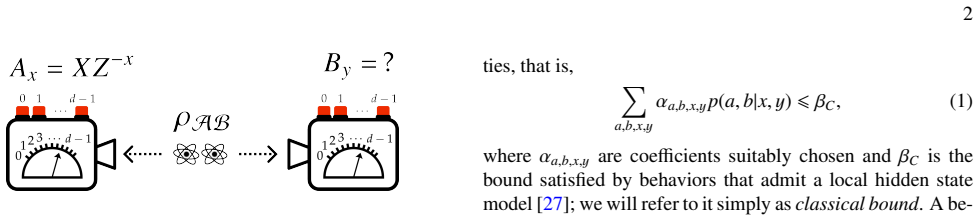
independently of the measurements to be certified on Bob’s side. The state giving rise to the maximal quantum value is always the maximally entangled state of two qudits. With that in mind, we derive steering inequalities tailored to every dif- ferent linear combination. Our steering inequalities are max- arXiv:2410.20477v1 [quant-ph] 27 Oct 2024 2 FIG. 1...
work page internal anchor Pith review Pith/arXiv arXiv 2024
-
[4]
That implies that Bob’s local Hilbert space admits the decomposition HB = V1 ⊕ V2 ⊕
to conclude that the local supports Vs are mutually or- thogonal. That implies that Bob’s local Hilbert space admits the decomposition HB = V1 ⊕ V2 ⊕ . . . ⊕ Vk = (Cd)B′ ⊗ HB′′, where the second equality is due to the fact that dim Vs = d for every s = 1, . . . ,K. It is possible to show that the local supports Vs are orthogonal subspaces. Therefore, ther...
-
[5]
2 for a particular case of d = 3
to more general classes of measurements, which comes however at the cost of assuming that one of the measuring de- vices is trusted; this is illustrated on Fig. 2 for a particular case of d = 3. It is important to note that for a measure zero set of points in Fig. 2, the classical bound reaches the value 6, which is also the quantum bound in dimension 3. ...
work page 2020
-
[6]
N. Brunner, D. Cavalcanti, S. Pironio, V . Scarani, and S. Wehner, Bell nonlocality, Rev. Mod. Phys.86, 419 (2014)
work page 2014
- [7]
-
[8]
D. Mayers and A. Yao, Quantum cryptography with imperfect apparatus, in Proceedings 39th Annual Symposium on Founda- tions of Computer Science (Cat. No.98CB36280)(1998) p. 503
work page 1998
-
[9]
D. Mayers and A. Yao, Self testing quantum apparatus, Quan- tum Info. Comput. 4, 273 (2004)
work page 2004
-
[10]
I. ˇSupi´c and J. Bowles, Self-testing of quantum systems: a re- view, Quantum 4, 337 (2020)
work page 2020
-
[11]
M. McKague, T. H. Yang, and V . Scarani, Robust self-testing of the singlet, J. Phys. A: Math. Theo. 45, 455304 (2012)
work page 2012
-
[12]
B. W. Reichardt, F. Unger, and U. Vazirani, Classical command of quantum systems, Nature 496, 456 (2013)
work page 2013
-
[13]
M. McKague, Self-Testing Graph States, in Theory of Quantum Computation, Communication, and Cryptography (Springer, Berlin, Germany, 2014) p. 104
work page 2014
-
[14]
X. Wu, Y . Cai, T. H. Yang, H. N. Le, J.-D. Bancal, and V . Scarani, Robust self-testing of the three-qubitW state, Phys. Rev. A 90, 042339 (2014)
work page 2014
-
[15]
C. Bamps and S. Pironio, Sum-of-squares decompositions for a family of Clauser-Horne-Shimony-Holt-like inequalities and their application to self-testing, Phys. Rev. A 91, 052111 (2015)
work page 2015
-
[16]
Y . Wang, X. Wu, and V . Scarani, All the self-testings of the singlet for two binary measurements, New J. Phys. 18, 025021 (2016)
work page 2016
-
[17]
I. ˇSupi´c, R. Augusiak, A. Salavrakos, and A. Ac´ın, Self-testing protocols based on the chained Bell inequalities, New J. Phys. 18, 035013 (2016)
work page 2016
-
[18]
A. Coladangelo, K. T. Goh, and V . Scarani, All pure bipartite entangled states can be self-tested, Nat. Commun. 8, 1 (2017)
work page 2017
-
[19]
J. Kaniewski, I. ˇSupi´c, J. Tura, F. Baccari, A. Salavrakos, and R. Augusiak, Maximal nonlocality from maximal entangle- ment and mutually unbiased bases, and self-testing of two-qutrit quantum systems, Quantum 3, 198 (2019)
work page 2019
-
[20]
L. Man ˇcinska, J. Prakash, and C. Schafhauser, Constant-sized robust self-tests for states and measurements of unbounded di- mension, arXiv:2103.01729 (2021)
-
[21]
A. Tavakoli, M. Farkas, D. Rosset, J.-D. Bancal, and J. Kaniewski, Mutually unbiased bases and symmetric informa- tionally complete measurements in Bell experiments, Sci. Adv. 7, eabc3847 (2021)
work page 2021
- [22]
-
[23]
I. ˇSupi´c, J. Bowles, M.-O. Renou, A. Ac ´ın, and M. J. Hoban, Quantum networks self-test all entangled states, Nat. Phys. 19, 670 (2023)
work page 2023
-
[24]
R. Chen, L. Man ˇcinska, and J. V olˇciˇc, All real projective mea- surements can be self-tested, Nat. Phys. 20, 1642 (2024)
work page 2024
- [25]
-
[26]
P. Mironowicz and M. Pawłowski, Experimentally feasi- ble semi-device-independent certification of four-outcome positive-operator-valued measurements, Phys. Rev. A 100, 8 030301 (2019)
work page 2019
-
[27]
M. Farkas and J. Kaniewski, Self-testing mutually unbiased bases in the prepare-and-measure scenario, Phys. Rev. A 99, 032316 (2019)
work page 2019
-
[28]
A. Tavakoli, D. Rosset, and M.-O. Renou, Enabling Compu- tation of Correlation Bounds for Finite-Dimensional Quantum Systems via Symmetrization, Phys. Rev. Lett. 122, 070501 (2019)
work page 2019
-
[29]
H. M. Wiseman, S. J. Jones, and A. C. Doherty, Steering, Entan- glement, Nonlocality, and the Einstein-Podolsky-Rosen Para- dox, Phys. Rev. Lett. 98, 140402 (2007)
work page 2007
-
[30]
E. G. Cavalcanti, S. J. Jones, H. M. Wiseman, and M. D. Reid, Experimental criteria for steering and the Einstein-Podolsky- Rosen paradox, Phys. Rev. A 80, 032112 (2009)
work page 2009
-
[31]
A. C. S. Costa and R. M. Angelo, Quantification of Einstein- Podolski-Rosen steering for two-qubit states, Phys. Rev. A 93, 020103 (2016)
work page 2016
-
[32]
R. Uola, A. C. S. Costa, H. C. Nguyen, and O. G¨uhne, Quantum steering, Rev. Mod. Phys. 92, 015001 (2020)
work page 2020
-
[33]
I. ˇSupi´c and M. J. Hoban, Self-testing through EPR-steering, New J. Phys. 18, 075006 (2016)
work page 2016
- [34]
-
[35]
S. Bandyopadhyay, P. O. Boykin, V . Roychowdhury, and F. Vatan, A new proof for the existence of mutually unbiased bases, Algorithmica 34, 512 (2002). Appendix A: Construction of the steering operator Let us consider the Steering scenario with two qudits of local dimensiond, where Alice performs d measurements Ax = XZ −x, for x = 0, . . . ,d − 1, and Bob ...
work page 2002
discussion (0)
Sign in with ORCID, Apple, or X to comment. Anyone can read and Pith papers without signing in.