Genus two KdV soliton gases and their long-time asymptotics
Pith reviewed 2026-05-23 19:23 UTC · model grok-4.3
The pith
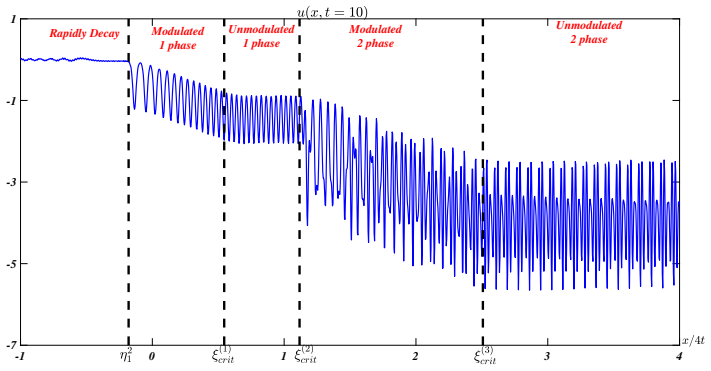
The two-genus KdV soliton gas equals a two-phase Riemann theta function for large positive x and decays to zero for large negative x.
A machine-rendered reading of the paper's core claim, the machinery that carries it, and where it could break.
Core claim
The two-genus soliton gas is related to the two-phase Riemann-Theta function as x → +∞, and approaches to zero as x → -∞. The long-time asymptotic behavior can be categorized into five distinct regions in the x-t plane: rapidly decay, modulated one-phase wave, unmodulated one-phase wave, modulated two-phase wave, and unmodulated two-phase wave. An innovative method is introduced to solve the model problem associated with the high-genus Riemann surface, leading to the determination of the leading terms, which is also related with the multi-phase Riemann-Theta function. A general discussion on the case of arbitrary N-genus soliton gas is also presented.
What carries the argument
Riemann-Hilbert problem formulation for the high-genus KdV soliton gas, whose solution produces the asymptotic regions and the associated multi-phase Riemann theta functions.
If this is right
- The x-t plane partitions into five explicit regions with rapid decay on the left and unmodulated two-phase waves on the right.
- Leading-order behavior in each region is given by a multi-phase Riemann theta function obtained from the model problem on the high-genus surface.
- The same Riemann-Hilbert construction and region classification extend directly to arbitrary N-genus soliton gases.
- Transitions between modulated and unmodulated phases occur at definite curves in the x-t plane determined by the spectral data.
Where Pith is reading between the lines
- The region boundaries obtained here could be compared with predictions from Whitham modulation theory for the same initial data.
- The method may extend to other integrable equations that admit Riemann-Hilbert formulations for their soliton gases.
- Numerical checks of the predicted theta-function amplitudes in the far-right region would test the leading-term accuracy.
- The decay to zero on the left suggests possible connections to the stability of the vacuum state under high-genus perturbations.
Load-bearing premise
The high-genus KdV soliton gas admits a Riemann-Hilbert formulation whose solution directly yields the stated asymptotic regions and theta-function expressions without additional restrictions on the spectral data or initial conditions.
What would settle it
A numerical integration of the KdV equation starting from two-genus soliton-gas initial data that fails to approach the two-phase theta function for large positive x or that fails to decay for large negative x.
Figures


read the original abstract
This paper employs the Riemann-Hilbert problem to provide a comprehensive analysis of the asymptotic behavior of the high-genus Korteweg-de Vries soliton gases. It is demonstrated that the two-genus soliton gas is related to the two-phase Riemann-Theta function as \(x \to +\infty\), and approaches to zero as \(x \to -\infty\). Additionally, the long-time asymptotic behavior of this two-genus soliton gas can be categorized into five distinct regions in the \(x\)-\(t\) plane, which from left to right are rapidly decay, modulated one-phase wave, unmodulated one-phase wave, modulated two-phase wave, and unmodulated two-phase wave. Moreover, an innovative method is introduced to solve the model problem associated with the high-genus Riemann surface, leading to the determination of the leading terms, which is also related with the multi-phase Riemann-Theta function. A general discussion on the case of arbitrary \(N\)-genus soliton gas is also presented.
Editorial analysis
A structured set of objections, weighed in public.
Referee Report
Summary. This paper employs the Riemann-Hilbert problem to analyze the asymptotic behavior of high-genus Korteweg-de Vries soliton gases. For the two-genus case, it claims the solution is related to the two-phase Riemann-Theta function as x → +∞ and decays to zero as x → -∞. The long-time asymptotics are classified into five regions in the x-t plane (rapid decay, modulated one-phase wave, unmodulated one-phase wave, modulated two-phase wave, unmodulated two-phase wave). An innovative method is introduced for the model problem on the high-genus Riemann surface to obtain leading terms related to multi-phase theta functions, with a general discussion for arbitrary N-genus cases.
Significance. If the central claims hold with rigorous justification, the work would extend the Riemann-Hilbert analysis of soliton gases to higher genus, providing an explicit classification of asymptotic regimes and connections to theta functions. This could be of interest in integrable systems for understanding transitions between modulated and unmodulated waves. The innovative method for the high-genus model problem, if shown to be free of hidden restrictions and reproducible, would be a notable technical contribution.
major comments (2)
- [Abstract] Abstract: The central claim requires that the high-genus KdV soliton gas admits an RH formulation whose solution directly yields the five asymptotic regions and the explicit two-phase theta-function connection (for x → +∞) and decay (for x → -∞) without additional restrictions on the spectral data, branch points, or initial conditions. The abstract states these results but exhibits neither the RH jump matrix nor the contour deformation steps, leaving the direct mapping unsubstantiated.
- [Innovative method for the model problem] The section describing the innovative method for the model problem: This step is load-bearing for determining the leading terms related to the multi-phase Riemann-Theta function. Without explicit verification that the construction produces the stated regions and theta expressions without extra assumptions on the measure on the spectrum, the classification into the five regions cannot be confirmed as general.
minor comments (2)
- [Abstract] Abstract: The phrasing 'approaches to zero' should be corrected to 'approaches zero' for grammatical precision.
- [Abstract] The abstract mentions 'rapidly decay' as one region; this should be clarified as 'rapid decay' or 'rapidly decaying region' for consistency with standard terminology in asymptotic analysis.
Simulated Author's Rebuttal
We thank the referee for the careful reading of our manuscript and for the constructive comments. We address each major comment below, providing clarifications on the structure and content of the paper.
read point-by-point responses
-
Referee: [Abstract] Abstract: The central claim requires that the high-genus KdV soliton gas admits an RH formulation whose solution directly yields the five asymptotic regions and the explicit two-phase theta-function connection (for x → +∞) and decay (for x → -∞) without additional restrictions on the spectral data, branch points, or initial conditions. The abstract states these results but exhibits neither the RH jump matrix nor the contour deformation steps, leaving the direct mapping unsubstantiated.
Authors: The abstract is intended as a concise summary of the main results. The Riemann-Hilbert formulation for the two-genus KdV soliton gas, including the explicit jump matrix on the appropriate contours and the sequence of contour deformations leading to the model problem, is presented in full detail in Section 2 and Section 3 of the manuscript. The long-time analysis proceeds from this RH problem by deforming to a model problem whose solution is expressed via Riemann theta functions; the five asymptotic regions in the x-t plane are then obtained by analyzing the phase functions and the resulting theta-function expressions in each regime. The derivation holds for the class of spectral measures and branch-point configurations specified in the setup of the soliton gas (no further restrictions are imposed). All steps are carried out without additional assumptions beyond those stated in the problem formulation. revision: no
-
Referee: [Innovative method for the model problem] The section describing the innovative method for the model problem: This step is load-bearing for determining the leading terms related to the multi-phase Riemann-Theta function. Without explicit verification that the construction produces the stated regions and theta expressions without extra assumptions on the measure on the spectrum, the classification into the five regions cannot be confirmed as general.
Authors: The construction of the model problem on the high-genus Riemann surface and the verification that its solution yields the leading-order terms involving the multi-phase theta functions are given explicitly in Section 4. The method is applied to the two-genus case to recover the five regions (rapid decay, modulated and unmodulated one-phase waves, modulated and unmodulated two-phase waves) and the corresponding theta-function expressions; the same construction is shown to extend directly to the N-genus setting in the final section. The verification is performed for the spectral measures arising from the soliton-gas initial data, without introducing extra assumptions on the measure beyond those already present in the RH formulation. revision: no
Circularity Check
No circularity; derivation uses standard RH framework for integrable systems
full rationale
The paper applies the established Riemann-Hilbert formulation for soliton gases to derive the long-time asymptotics, including the two-genus theta-function connection for x → +∞ and the five-region classification in the x-t plane. No quoted step shows a result that reduces by construction to a fitted parameter, self-defined quantity, or load-bearing self-citation whose validity depends on the present work. The 'innovative method' for the high-genus model problem is presented as an independent technical contribution within the standard RH contour-deformation approach. The derivation is therefore self-contained against external benchmarks in integrable systems theory.
Axiom & Free-Parameter Ledger
axioms (1)
- domain assumption The high-genus KdV soliton gas admits a Riemann-Hilbert formulation whose solution yields the stated asymptotics.
Lean theorems connected to this paper
-
IndisputableMonolith/Foundation/RealityFromDistinction.leanreality_from_one_distinction unclear?
unclearRelation between the paper passage and the cited Recognition theorem.
two-genus soliton gas ... related to the two-phase Riemann-Theta function ... five distinct regions ... modulated one-phase wave, unmodulated two-phase wave
-
IndisputableMonolith/Foundation/AlexanderDuality.leanalexander_duality_circle_linking unclear?
unclearRelation between the paper passage and the cited Recognition theorem.
Riemann surface Ŝ of genus two ... period matrix τ̂ ... Θ(Ω/2πi; τ̂)
What do these tags mean?
- matches
- The paper's claim is directly supported by a theorem in the formal canon.
- supports
- The theorem supports part of the paper's argument, but the paper may add assumptions or extra steps.
- extends
- The paper goes beyond the formal theorem; the theorem is a base layer rather than the whole result.
- uses
- The paper appears to rely on the theorem as machinery.
- contradicts
- The paper's claim conflicts with a theorem or certificate in the canon.
- unclear
- Pith found a possible connection, but the passage is too broad, indirect, or ambiguous to say the theorem truly supports the claim.
Forward citations
Cited by 1 Pith paper
-
Large-space and large-time asymptotics for the mKdV soliton gas with any odd genus
The mKdV soliton gas of genus 2n-1 admits large-space asymptotics via Riemann-theta functions and large-time asymptotics in 2n+1 regions of the (x,t) half-plane with uniform error estimates.
Reference graph
Works this paper leans on
-
[1]
M. J. A BLOWITZ , P. A. C LARKSON , Solitons, nonlinear evolution equations and inverse scattering, Cambridge University Press, 1991
work page 1991
-
[2]
M. J. A BLOWITZ , J. T. C OLE , G. A. E L, M. A. H OEFER , X.-D. L UO, Soliton–mean field interaction in Korteweg–de Vries dispersive hydrodynamics, Stud. Appl. Math., 151 (2023), pp. 795–856
work page 2023
-
[3]
M. B ERTOLA , R. J ENKINS , A. T OVBIS , Partial degeneration of finite gap solutions to the Korteweg-de Vries equation: soliton gas and scattering on elliptic backgrounds, Nonlinearity, 36 (2023), pp. 3622–3660
work page 2023
-
[4]
B ERTOLA , Tau functions in integrable systems: theory and applications , 2018
M. B ERTOLA , Tau functions in integrable systems: theory and applications , 2018. (available at: http://mypage.concordia.ca/mathstat/bertola/ThetaCourse/ThetaCourse.pdf)
work page 2018
-
[5]
M. B ERTOLA , T. G RAVA, G. O RSATTI , Soliton Shielding of the Focusing Nonlinear Schrödinger Equation, Phys. Rev. Lett., 130 (2023), 127201
work page 2023
-
[6]
M. B ERTOLA , T. G RAVA, G. O RSATTI , ¯∂-problem for focusing nonlinear Schrödinger equation and soliton shielding, arXiv:2409.14825
-
[7]
D. B ILMAN , T. T ROGDON , On numerical inverse scattering for the Korteweg-de Vries equation with discontin- uous step-like data, Nonlinearity, 33 (2020), pp. 2211-2269
work page 2020
-
[8]
T. CLAEYS , T. G RAVA, Solitonic asymptotics for the Korteweg-de Vries equation in the small dispersion limit, SIAM J. Math. Anal., 42 (2010), pp.2132-2154
work page 2010
-
[9]
G. B IONDINI , G. A. E L, X.-D. L UO, J. O REGERO , A. T OVBIS , Breather gas fission from elliptic potentials in self-focusing media, arXiv:2407.15758
-
[10]
C. C HARLIER , J. L ENELLS , Miura transformation for the “good” Boussinesq equation, Stud. Appl. Math., 152 (2024), pp. 73–110
work page 2024
-
[11]
T. BONNEMAIN , B. D OYON , G. A. E L, Generalized hydrodynamics of the KdV soliton gas, J. Phys. A, 55 (2022), 374004
work page 2022
- [12]
-
[13]
P. D EIFT , S. V ENAKIDES , X. Z HOU, The collisionless shock region for the long-time behavior of solutions of the KdV equation, Comm. Pure Appl. Math., 46 (1994), pp. 199-206
work page 1994
- [14]
-
[15]
S. D YACHENKO , D. Z AKHAROV , V. Z AKHAROV , Primitive potentials and bounded solutions of the KdV equation, Phys. D, 333 (2016), pp. 148-156
work page 2016
-
[16]
I. E GOROVA, Z. G LADKA , V. KOTLYAROV, G. T ESCHL , Long-time asymptotics for the Korteweg-de Vries equation with step-like initial data, Nonlinearity, 26 (2013), pp. 1839-1864. 35
work page 2013
-
[17]
G. A. E L, The thermodynamic limit of the Whitham equations, Phys. Lett. A, 311 (2003), pp. 374-383
work page 2003
-
[18]
G. A. E L, A. M. K AMCHATNOV , M. V. P AVLOV, S. A. Z YKOV, Kinetic equation for a soliton gas and its hydrodynamic reductions, J. Nonlinear Sci., 21 (2011), pp. 151-191
work page 2011
-
[19]
E. V. F ERAPONTOV , M. V. PAVLOV, Kinetic equation for soliton gas: integrable reductions, J. Nonlinear Sci., 32 (2022), 26
work page 2022
-
[20]
M. G IROTTI , T. G RAVA, R. J ENKINS , K. D. T.-R. M CLAUGHLIN , Rigorous asymptotics of a KdV soliton gas, Comm. Math. Phys., 384 (2021), pp. 733-784
work page 2021
-
[21]
M. G IROTTI , T. G RAVA, R. J ENKINS , K. D. T.-R. M CLAUGHLIN , A. M INAKOV , Soliton versus the gas: Fredholm determinants, analysis, and the rapid oscillations behind the kinetic equation , Comm. Pure Appl. Math., 76 (2023), pp. 3233-3299
work page 2023
-
[22]
T. G RAVA, Whitham modulation equations and application to small dispersion asymptotics and long time asymptotics of nonlinear dispersive equations, In: M. Onorato, S. Resitori, F. Baronio (eds), Rogue and Shock Waves in Nonlinear Dispersive Media, Lect. Notes Phys., vol. 926, Springer, 2016
work page 2016
- [23]
-
[24]
P. D. L AX, Integrals of nonlinear equations of evolution and solitary waves , Comm. Pure Appl. Math., 21 (1968), pp. 467-490
work page 1968
-
[25]
C. D. L EVERMORE , The hyperbolic nature of the zero dispersion KdV limit , Comm. Partial Differential Equations, 13(4) (1988), pp. 495-514
work page 1988
-
[26]
K. D. T.-R. M CLAUGHLIN , P. V. N ABELEK , A Riemann-Hilbert problem approach to infinite gap Hill’s operators and the Korteweg–de Vries equation, Int. Math. Res. Not., 2 (2021), pp. 1288-1352
work page 2021
-
[27]
P. D. M ILLER , S. R. C LARKE , An exactly solvable model for the interaction of linear waves with Korteweg-de Vries solitons, SIAM J. Math. Anal., 33 (2001), pp.261-285
work page 2001
-
[28]
I. E GOROVA, Z. G LADKA , V. KOTLYAROV, G. T ESCHL , Long-time asymptotics for the Korteweg-de Vries equation with step-like initial data, Nonlinearity, 26 (2013), pp. 1839-1864
work page 2013
-
[29]
A. T OVBIS , F. WANG, Recent developments in spectral theory of the focusing NLS soliton and breather gases: the thermodynamic limit of average densities, fluxes and certain meromorphic differentials; periodic gases, J. Phys. A, 55 (2022), 424006
work page 2022
-
[30]
M. P IORKOWSKI , G. T ESCHL , A scalar Riemann–Hilbert problem on the torus: applications to the KdV equation, Anal. Math. Phys., 12, (2022) 112
work page 2022
-
[31]
E. G. S HURGALINA , E. N. P ELINOVSKY , Nonlinear dynamics of a soliton gas: Modified Korteweg–de Vries equation framework, Phys. Lett. A, 380 (2016), pp. 2049-2053
work page 2016
-
[32]
P. ZHAO, E. F AN, A Riemann-Hilbert method to algebro-geometric solutions of the Korteweg–de Vries equation, Phys. D, 454 (2023), 133879
work page 2023
-
[33]
Z AKHAROV , Kinetic equation for solitons, Sov
V. Z AKHAROV , Kinetic equation for solitons, Sov. Phys. JETP, 33(3) (1971), pp. 538-541. 36
work page 1971
discussion (0)
Sign in with ORCID, Apple, or X to comment. Anyone can read and Pith papers without signing in.