REVIEW 4 major objections 4 minor 1 cited by
Anomalous Hall effect from inter-superlattice scattering in a noncollinear antiferromagnet
T0 review · 4 major / 4 minor · reviewed 2026-08-12 · deepseek-v4-flash
Pith's one-line read Cr1/4TaS2 is a bulk noncollinear antiferromagnet whose anomalous Hall effect comes from scattering between coexisting 2×2 and √3×√3 superlattice domains below 145 K.
desk verdict A well-characterized new material with a real domain-coexistence finding; the inter-superlattice scattering mechanism is plausible but asserted too strongly in the abstract. read the letter →
The pith
A machine-rendered reading of the paper's core claim, the machinery that carries it, and where it could break.
The reading
What carries the argument
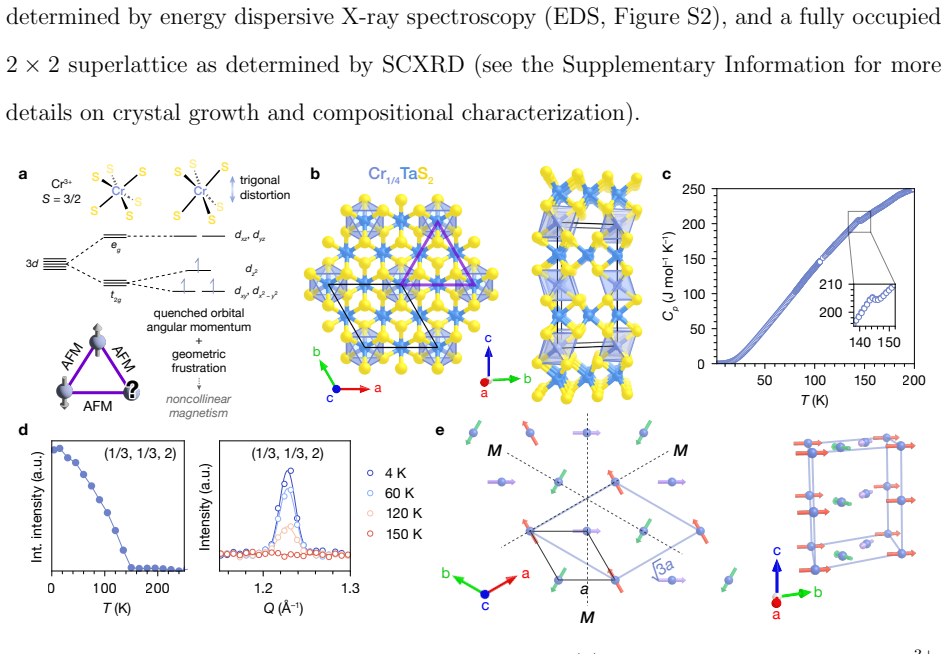
The load-bearing object is the inter-superlattice domain boundary: a nanoscale interface between the dominant $2\times2$ Cr order and defective $\sqrt{3}\times\sqrt{3}$-containing regions, imaged by four-dimensional scanning transmission electron microscopy. Symmetry analysis first rules out an intrinsic anomalous Hall effect in the 120° antiferromagnet, since the magnetic structure has mirror planes that make the Berry curvature vanish when integrated over the Brillouin zone. The mechanism then relies on inelastic scattering of conduction electrons at these domain boundaries as the source of the extrinsic response, with the phase sequence of the minority domains (paramagnetic, ferromagnetic, spin glass) supplying the temperature structure that explains sign changes and hysteresis in the Hall and magnetoresistance data.
What would settle it
A crystal of Cr$_{1/4}$TaS$_2$ containing only $2\times2$ domains, or a spatially resolved transport measurement that shows no anomalous Hall signal when the probe avoids the minority $\sqrt{3}\times\sqrt{3}$ regions, would falsify the inter-superlattice scattering mechanism.
Extended reading notes
Core claim
The central claim is that Cr$_{1/4}$TaS$_2$, nominally a $2\times2$ intercalation compound, is a bulk noncollinear antiferromagnet with a $\Gamma_6$ 120° in-plane spin structure (moment $2.07(8)\,\mu_B$/Cr, $T_N=145$ K) that also contains minority $\sqrt{3}\times\sqrt{3}$ Cr domains within the same crystal. Because the majority 120° antiferromagnet is invariant under mirror planes perpendicular to the moments, its intrinsic Berry-curvature anomalous Hall conductivity vanishes, so the observed anomalous Hall effect must be extrinsic. The paper attributes it to inelastic scattering of spin-up and spin-down carriers at interfaces between the antiferromagnetic $2\times2$ domains and the minority domains, which are paramagnetic between 145 and 98 K, ferromagnetic between 98 and 40 K, and spin-glass below 40 K. The sign change in the anomalous Hall signal near 100 K is tied to the onset of ferromagnetic order in the minority domains, and the magnetoresistance behavior tracks the same phase boundaries.
Load-bearing premise
The explanation stands or falls on the assumption that the minority $\sqrt{3}\times\sqrt{3}$ domains carry the ferromagnetic and spin-glass signatures seen in bulk magnetometry, and that electrons scatter inelastically at the boundaries between the two superlattice types; no experiment in the paper directly measures such domain-boundary scattering.
Editorial extensions
If this is right
- Composition alone does not determine superlattice identity once growth kinetics can freeze metastable domains; stoichiometric crystals may still contain minority structures.
- An anomalous Hall effect can arise from domain-boundary scattering in a compensated antiferromagnet, so the absence of a net moment does not preclude a Hall response.
- The temperature window of the transport response follows the magnetic phase diagram of the minority domains, so tuning their ordering temperature shifts where the Hall sign changes.
- Engineering the size, density, and topology of superlattice domains during crystal growth becomes a route to designing macroscopic magnetotransport in intercalated transition metal dichalcogenides.
Reading between the lines
- If the mechanism is correct, annealing Cr$_{1/4}$TaS$_2$ in the temperature window where $2\times2$ domains grow but Cr stays mobile should shrink the minority domains and reduce or eliminate the anomalous Hall signal; the paper does not report such an experiment.
- The same kinetically arrested coexistence may be hiding in other nominally stoichiometric intercalated compounds, so routine Raman or electron-diffraction screening could reveal minority superlattices in materials previously classified as single-phase.
- Because the minority domains are defective $\sqrt{3}\times\sqrt{3}$, introducing controlled Cr vacancies could tune the ferromagnetic transition temperature of the minority phase and therefore the temperature at which the Hall sign changes.
Signed reviews
Editorial analysis
A structured set of objections, weighed in public.
Referee Report
Summary. The paper reports the synthesis and multi-technique characterization of Cr1/4TaS2, a nominally stoichiometric intercalated TMD. The authors claim that Cr1/4TaS2 is a bulk noncollinear antiferromagnet with a 120-degree (Gamma6) ground state below TN=145 K, that minority sqrt3 x sqrt3 Cr superlattice domains coexist with the dominant 2x2 superlattice, and that scattering between the bulk and minority superlattice domains produces the observed anomalous Hall effect and complex magnetoresistance. They also propose a kinetic mechanism for the nucleation and freezing of disparate superlattice domains during crystal growth.
Significance. If the central causal claim is established, the paper is significant because it proposes superlattice-domain patterning as a composition-independent route to engineering magnetotransport in intercalated TMDs, and it documents a promising material with a 120-degree AFM ground state. The paper has substantial experimental strengths: the heat-capacity and neutron-diffraction determination of TN and the Gamma6 magnetic structure, the 4D-STEM visualization of nanoscale superlattice domains, the ARPES evidence for 2x2 electronic reconstruction, and the extensive magnetometry including AC susceptibility and thermoremanent magnetization. However, the mechanism that the abstract asserts as demonstrated is not directly tested; the evidence is correlative and the control material cannot isolate the proposed minority-domain scattering mechanism.
major comments (4)
- [Abstract and Conclusions; Figure 5c] The abstract states that scattering between bulk and minority superlattice domains 'engenders' the AHE and complex magnetotransport, but the manuscript provides no direct test of this causal mechanism: there is no transport sample with pure 2x2 order, no measurement of domain-boundary scattering, and no scattering calculation. The Cr0.23TaS2 control (SI Section 8, Figure S14) differs from Cr1/4TaS2 in stoichiometry, carrier density (about 10 vs 2 x 10^21 cm^-3), mobility, RRR (1.6 vs about 10), and defect structure, so it cannot isolate the minority-domain mechanism. The temperature correlations in Figures 2c,d and 5b are consistent with the proposal but do not demonstrate it; the Discussion appropriately uses 'attribute' and 'propose', but the abstract's 'demonstrate' overstates the evidence. This should be reframed as a well-supported hypothesis, or supplemented with a decisive experiment or calculation.
- [Discussion, Figure 5b; Magnetometry, Figure 3f-i] The assignment of the bulk ferromagnetic transition at TC=98 K to the minority sqrt3 x sqrt3-containing domains is an assumption rather than a measurement: the magnetization, AC susceptibility, and Arrott-plot analyses are bulk averages, while the 4D-STEM data (Figure 3d,e) show that the sqrt3 x sqrt3 regions also retain 2x2 order with out-of-plane mixing, so the magnetic state of those regions is not directly known. A local magnetic probe (for example Lorentz TEM, MFM, or magnetic X-ray microscopy) or a sample with a controlled fraction of sqrt3 domains is needed to support the assignment that underlies the proposed phase diagram and the AHE mechanism.
- [Results, electrical transport; Discussion, Figure S11] The AHE sign changes and MR features are correlated with the proposed AFM, FM, and SG phase boundaries, but no quantitative model links these features to inter-superlattice scattering. In particular, the proposed extrinsic AHE from 'spin defects at domain walls' is not estimated, and the scaling plot of sigma_AHE versus sigma_xx (Figure S11) is presented without a fit or a specific mechanism. Because the paper correctly notes that the intrinsic AHC vanishes by mirror symmetry, the extrinsic mechanism is the load-bearing claim; it currently rests on correlation rather than on a quantitative analysis.
- [Results, heat capacity and neutron diffraction; Tables S3-S5] The magnetic structure refinement that establishes the 120-degree Gamma6 ground state was performed on a Cr0.226(6)TaS2 crystal, not on the stoichiometric Cr1/4TaS2 sample, because of crystal size requirements. Since the bulk AFM ground state is a central claim, the paper should either report neutron data on a stoichiometric crystal or explicitly discuss whether the Cr deficiency affects the magnetic structure; at present the ground state of the actual material is inferred from a deficient sample.
minor comments (4)
- [Figure 2 caption] In the caption, 'Colors indicate temperatures as labeled in (C)' should refer to panel (c) with lowercase; the panel labels are otherwise inconsistent in capitalization.
- [EDS results, Figure S2] The EDS analysis yields Cr0.252(3)TaS1.78(5), so the S stoichiometry is somewhat below the ideal S2; the text's description of the crystal as compositionally 'perfect' is based on the Cr occupancy and should be clarified in light of the S deficiency.
- [Discussion, reference 62] Reference [62], used to support the claim that 2x2 ordering is thermodynamically favorable, is a preprint from the same group; this should be flagged and, if possible, supplemented with an independent or peer-reviewed source.
- [Methods, ARPES] The inner potential V0=8 eV used for the momentum conversion is stated without a description of how it was determined; a brief criterion for the chosen value would improve reproducibility.
Circularity Check
No significant circularity: the AHE and magnetotransport are measured observables, and the minority-domain mechanism is an interpretive attribution rather than a fit-derived prediction.
full rationale
The central derivation chain is empirical and self-contained: single-crystal X-ray and neutron diffraction establish the 2x2 Cr superlattice and the 120-degree noncollinear AFM order; 4D-STEM and SAED directly image minority sqrt3 x sqrt3 domains; magnetometry and AC susceptibility establish the FM and spin-glass features; transport measurements show the AHE and MR appear below TN. The only numerical extraction from transport is the standard single-band decomposition rho_xy = (1/ne)mu0 H + rho_AHE, which is a data reduction, not a theory fitted to produce the AHE. The paper then attributes the sign and temperature dependence of the measured rho_AHE to scattering between the majority AFM and minority FM/PM/SG domains. That is a mechanistic hypothesis supported by correlation and a control sample, not a quantity derived from a fitted parameter or from a self-referential premise. A few citations are to the authors' own work (refs 50, 51, 62), but they are used for Raman mode assignments and a growth-model consistency check, both of which are corroborated within this paper by independent diffraction and STEM data; the central claim does not reduce to these citations. Weaknesses such as the confounded Cr0.23 control and the absence of a pure-2x2 transport sample bear on experimental support and causal underdetermination, not on circularity under the defined standards.
Assumptions & free parameters
free parameters (4)
- Hubbard U on Cr =
4 eV
- ARPES inner potential V0 =
8 eV
- Curie-Weiss C and theta_CW =
C = 1.77(4) emu K (mol Cr)^-1; theta_CW = 32(1) K
- Single-band Hall carrier density and mobility =
nh near 2 x 10^21 cm^-3; mu_h up to 138 cm^2 V^-1 s^-1
assumptions (5)
- domain assumption The magnetic structure is determined by representation analysis selecting the Gamma6 irreducible representation with an equal-moment constraint.
- ad hoc to paper The minority sqrt3 x sqrt3 domains order ferromagnetically below 98 K and are responsible for the magnetotransport anomalies.
- standard math The intrinsic anomalous Hall conductivity vanishes because the magnetic structure is invariant under mirror planes perpendicular to the moments.
- domain assumption In-plane superlattice ordering during growth is the only relevant ordering; out-of-plane mixing is noted but not included in the growth model.
- domain assumption DFT+U with U=4 eV and kz=0.5 reproduces the measured ARPES band structure.
invented entities (1)
-
Spin defects at domain walls between 2x2 AFM domains and minority sqrt3 superlattice domains
Cite this review
Pith. "Pith review of Anomalous Hall effect from inter-superlattice scattering in a noncollinear antiferromagnet." pith.science (2026). https://pith.science/paper/BJBOPWM4
@misc{pith2026241108381,
  author       = {Pith},
  title        = {Pith review of: Anomalous Hall effect from inter-superlattice scattering in a noncollinear antiferromagnet},
  year         = {2026},
  howpublished = {\url{https://pith.science/paper/BJBOPWM4}},
  note         = {Machine review of arXiv:2411.08381}
}
abstract
Superlattice formation dictates the physical properties of many materials, including the nature of the ground state in magnetic materials. Chemical composition is commonly considered to be the primary determinant of superlattice identity, especially in intercalation compounds. Here, we find that, contrary to this conventional wisdom, kinetic control of superlattice growth leads to the coexistence of disparate domains within a compositionally "perfect" single crystal. We demonstrate that Cr$_{1/4}$TaS$_2$ is a bulk noncollinear antiferromagnet in which scattering between bulk and minority superlattice domains engenders complex magnetotransport below the N\'{e}el temperature, including an anomalous Hall effect. We characterize the magnetic phases in different domains, image their nanoscale morphology, and propose a mechanism for nucleation and growth. These results provide a blueprint for the deliberate engineering of macroscopic transport responses via microscopic patterning of magnetic exchange interactions in superlattice domains.
Figures


Figures from the paper (2 more)


Forward citations
Cited by 1 Pith paper
-
Coexistence of Commensurate and Incommensurate Antiferromagnetic Groundstates in Co$_x$NbSe$_2$ Single Crystal
Co0.28NbSe2 single crystals show both a 169 K A-type antiferromagnetic phase and a 28 K lower-temperature phase whose spin structure was solved for the first time in powder.
Reference graph
Works this paper leans on
-
[1]
Mulder, C. A. M., van Duyneveldt, A. J. & Mydosh, J. A. Frequency and field de- pendence of the ac susceptibility of the AuMn spin-glass. Phys. Rev. B 25, 515–518 (1982)
work page 1982
-
[2]
Mydosh, J. A. Spin Glasses: An Experimental Introduction(CRC Press, 1993)
work page 1993
-
[3]
Anand, V. K., Adroja, D. T. & Hillier, A. D. Ferromagnetic cluster spin-glass behavior in PrRhSn3. Phys. Rev. B85, 014418 (2012)
work page 2012
-
[4]
Bag, P., Baral, P. R. & Nath, R. Cluster spin-glass behavior and memory effect in Cr0.5Fe0.5Ga. Phys. Rev. B98, 144436 (2018). S20
work page 2018
Reviewed August 12, 2026 · model on record in the stance chip above.
Discussion (0). Continue with ORCID to comment.