REVIEW 4 major objections 4 minor 9 references
Approximately Jumping Towards the Origin
T0 review · 4 major / 4 minor · reviewed 2026-08-11 · deepseek-v4-flash
Pith's one-line read The paper establishes that a greedy random walk on the sphere—always choosing the sign that moves closer to the origin—has, in every dimension $d\ge2$, a unique invariant radial measure with mean…
desk verdict The random-case theorem is likely correct and worth refereeing; the Harris-recurrence proof in §2.2 is a real gap, but a fillable one. read the letter →
The pith
A machine-rendered reading of the paper's core claim, the machinery that carries it, and where it could break.
The reading
What carries the argument
The carrying object is the radial representation $r_{n+1} = (r_n^2 - 2X_n r_n +1)^{1/2}$, where $X_n = |\gamma_1|/(\gamma_1^2+\chi^2(d-1))^{1/2}$ is the absolute value of the first coordinate of a uniformly random point on $\mathbb{S}^{d-1}$; its density is $c_d(1-x^2)^{(d-3)/2}$, and it carries the drift toward and away from the origin. The Harris-chain framework with the set $A=[\sqrt{d},\sqrt{d}+1/2]$ establishes existence and uniqueness of the invariant measure; the Lyapunov function $e^{\alpha x^2}$ converts the one-step bound $\mathbb{E}e^{\alpha r_{n+1}^2} \le e^{\alpha}\frac{c_d}{2\alpha r_n} e^{\alpha r_n^2}$ into finiteness of exponential moments; the identity $\mathbb{E}[\|x\|]=1/(2\mathbb{E}[X])$ then gives the exact mean. For $d=3$ the transition kernel simplifies to $P_3(x,y)=y/x$, yielding a curious self-referential integral identity for $\pi_3$.
What would settle it
Simulate the radial chain in $d=100$ starting at $r=0$ for many trajectories; Theorem 1 requires a positive fraction (bounded away from 0) to hit $[\sqrt{d},\sqrt{d}+1/2]$ within $2d$ steps, and requires the long-run empirical mean of $r_n$ to converge to $\sqrt{\pi d/8}$. A run showing the hitting fraction going to 0 as $d$ grows, or the empirical mean deviating from the formula, would refute the central claim.
Extended reading notes
Core claim
The paper's central claim is Theorem 1: for each $d\ge2$, the greedy random walk's radial coordinate $\|x_n\|$ is a positively recurrent Harris chain on $[0,\infty)$ with a unique invariant probability $\pi_d$, whose mean is $\frac{\sqrt{\pi}}{2}\frac{\Gamma((d+1)/2)}{\Gamma(d/2)}$, and for which $\int_0^\infty e^{\alpha x^2}\,d\pi_d(x)<\infty$ for every $\alpha>0$. In particular, the walker's typical distance from the origin is asymptotically $(\sqrt{\pi/8}+o(1))\sqrt{d}$. The proof decouples angular and radial motion, writes the radial update as $r_{n+1}^2 = r_n^2 - 2X_n r_n +1$ with $X_n$ the absolute first coordinate of a uniform sphere point, verifies Harris recurrence with a minorization condition on the interval $[\sqrt{d},\sqrt{d}+1/2]$, constructs a Lyapunov function $V(x)=e^{\alpha x^2}$ to get exponential tail decay, and then computes the mean exactly from the steady-state balance $0 = 1 - 2\mathbb{E}[X]\mathbb{E}[\|x\|]$.
Load-bearing premise
The load-bearing premise is that the radial process, from any starting radius no larger than $\sqrt{d}$, has a uniformly positive chance of reaching the interval $[\sqrt{d},\sqrt{d}+1/2]$ within about $2d$ steps, and drifts back from above that interval; if that fails, the invariant measure may not exist.
Editorial extensions
If this is right
- In all dimensions $d\ge2$, the invariant radial law is unique and has expectation exactly $\frac{\sqrt{\pi}}{2}\frac{\Gamma((d+1)/2)}{\Gamma(d/2)}$, so the long-run average distance from the origin is $(\sqrt{\pi/8}+o(1))\sqrt{d}$.
- Every exponential moment of the radial law is finite; in particular, excursions far beyond the mean radius are exponentially rare with a rate stronger than Gaussian.
- For the base-2 van der Corput sequence in the plane, any real starting value reaches $B(0,\sqrt{2})$ within $O(|z|)$ steps, provided the sign choice never becomes indeterminate.
- In base 2, every nonzero point in the unit disk is a periodic start: the orbit is confined to a point plus a semicircle around it, whereas for base $b\ge4$, periodic starts exist exactly for odd $b$, in two open triangles, and each periodic orbit is a rotated regular $b$-gon.
Reading between the lines
- Beyond the paper: the steady-state identity $\mathbb{E}[\|x\|] = 1/(2\mathbb{E}[X])$ is derived for uniform sphere steps, but the balance argument only needs isotropy and a finite second moment; a natural extension is that any centered isotropic step distribution with finite second moment yields an invariant mean of the form $1/(2\mathbb{E}|\cos\Theta|)$ in the appropriate scaling.
- Beyond the paper: the faster-than-Gaussian decay, combined with the paper's conjecture that $\pi_d$ approaches $\exp(-(x-\mu_d)^2)/\sqrt{\pi}$, suggests the radial fluctuations are $O(1)$ while the mean radius grows like $\sqrt{d}$; if true, the walker is localized in a shell of constant thickness, a sharp concentration effect.
- Beyond the paper: the base-2 van der Corput result and the periodic-start classification suggest a threshold phenomenon in $b$: for low base, the greedy planar walk is trapped near the origin, while for even $b\ge4$ it cannot be trapped at all; testing intermediate bases such as $b=3$, where the paper notes periodic starts exist empirically but are unproved, could locate the exact threshold.
Signed reviews
Editorial analysis
A structured set of objections, weighed in public.
Referee Report
Summary. The paper studies a greedy sequence in R^d: given x_{n-1} and a unit vector v_n, one chooses x_n = x_{n-1} ± v_n to minimize ||x_n||. For i.i.d. uniform v_n on S^{d-1}, the main result (Theorem 1) claims that the radial process r_n = ||x_n|| has a unique invariant probability measure π_d on [0,∞), with mean (√π/2) Γ((d+1)/2)/Γ(d/2) ~ √(πd/8), and that π_d has finite exponential moments of every order. The proof proceeds by a Harris chain argument for existence (Section 2.2), a Lyapunov function for exponential moments (Sections 2.3–2.4), and a stationarity computation for the mean (Section 2.7). The paper also analyzes a deterministic planar example using the van der Corput sequence, proving that the process reaches a fixed neighborhood of the origin in O(|z|) steps, that initial points in B(0,1) are periodic starts in base 2, and that periodic starts exist or not depending on the parity of the base.
Significance. If Theorem 1 is established, it provides a clean and surprising answer for a natural random greedy process: the radial chain self-stabilizes at distance ~√(πd/8), with sub-Gaussian tails. The mean computation is self-contained and elegant, and the Lyapunov argument for exponential moments is a nice application of Meyn–Tweedie theory. The deterministic sections contain several original elementary results and are interesting in their own right. However, the existence of the invariant measure is not rigorously proved: the Harris recurrence verification in Section 2.2 is sketched and contains gaps that are load-bearing for the whole probabilistic program. As written, the central probabilistic claim is conditional on an unproved positive-recurrence statement, so the paper requires a substantial revision before the main theorem can be accepted.
major comments (4)
- [§2.2, block-growth into A] The argument that starting from r ≤ √d one reaches A in about 2d steps is not justified. The paper derives the upper bound ||x_{n+1}|| ≤ (||x_n||^2+1)^{1/2} and concludes that after ~2d steps the sequence will surpass √d. An upper bound cannot imply growth; what is needed is a lower bound on the squared increment ||x_{n+1}||^2 − ||x_n||^2 = 1 − 2X||x_n|| under the stated event. The paper never writes this lower bound, and without it the hitting-time argument fails. Note also that the event |γ1|≤1/100 alone does not control X = |γ1|/(γ1^2+χ^2(d−1))^{1/2}; the normalization by the chi-squared denominator is essential and is absent from the text.
- [§2.2, drift from large radius] The proof that the chain drifts back from the region ||x_n|| > √d + 1/2 is not complete. The displayed inequality E[||x_{n+1}||^2 − ||x_n||^2] ≤ 1 − 2E[|γ1|/(γ1^2+χ^2)^{1/2}]√d is not a negative-drift bound for the full tail, since for r just above √d+1/2 the term 2E[X]r is close to the critical value. The paper splits into 'large dimensions' using χ²(d−1)=d±O(√d) and 'small dimensions' by replacing √d with 10000√d, but this does not cover the entire interval [√d+1/2, 10000√d] uniformly for all d≥2. No Foster–Lyapunov function is exhibited, and finite expected hitting time of A from every starting point is not established.
- [§2.2, minorization condition] The minorization condition on A = [√d, √d+1/2] is asserted rather than verified. The paper states that the transition density is 'uniformly bounded away from 0 in any strict subinterval' and proposes ρ as a multiple of Lebesgue measure on (√d−1/4, √d). However, it does not prove a uniform lower bound over all x ∈ A for the probability of landing in that interval. Since the proposed ρ is supported outside A, one must show that from every x ∈ A the chain can reach that interval with probability bounded below; this is plausible from the density P_d(x,y) in Lemma 3, but the calculation is not provided.
- [Theorem 1 and §2.7] The mean formula E[||x||] = 1/(2E[X]) and the exponential-moment estimate both presuppose the existence of a unique invariant probability π_d with finite second moment. Because the Harris-chain verification in §2.2 is incomplete, the foundation of Theorem 1 is missing. The mean computation itself is formally correct given such a stationary distribution, but the existence of that distribution is the load-bearing unsupported step.
minor comments (4)
- [§2.2] The phrase 'conditioning on ||x_n||^2 ≥ √d' appears to be a typo; it should be '||x_n|| ≥ √d' to match the surrounding inequalities.
- [§2.7] In the Beta integral computation, after the substitution u = x^2, the differential 'dx' should be 'du' in the displayed integral; also the line 'cd/2 ∫_0^1 (1−u)^{(d−3)/2} dx' should read 'du'.
- [Theorem 1] The invariant measure is stated to be on [0, ∞]; since the chain lives on [0, ∞), the closed bracket at infinity is likely a typo and should be [0, ∞).
- [Theorem 2] The statement says 'Let b = 2 and z−1 ∈ R', but the process is in the plane; this should be z−1 ∈ R^2.
Circularity Check
No circularity: Theorem 1's mean and decay bounds follow from a self-contained stochastic representation; the sole self-citation is motivational.
full rationale
The derivation chain for Theorem 1 is self-contained and does not reduce to its inputs. The mean formula E[||x_n||] = 1/(2E[X]) is obtained from the stationarity recursion ||x_{n+1}||^2 = ||x_n||^2 - 2X||x_n|| + 1, where X = |gamma_1|/(gamma_1^2 + chi^2(d-1))^{1/2}; the density p_d(x) = c_d(1-x^2)^{(d-3)/2} is computed directly from the uniform sphere, and the Beta integral evaluates E[X] without fitting any parameter. The exponential-moment bound is an independent Lyapunov argument using Lemma 1, which itself follows from the same explicit density. The only self-citation, Steinerberger-Zeng [8], appears as motivation for the deterministic variant and is not load-bearing for Theorem 1; uniqueness of the invariant measure is imported from the external Meyn-Tweedie theorem, not from the authors' prior work. The weakest point is Section 2.2's assertion that the radial chain is a positively recurrent Harris chain: the argument that 2d steps with |gamma_1| small forces growth, and the drift-back estimate for large radii, are heuristic and incomplete there. However, an incomplete or under-proved recurrence step is a correctness gap, not a circular reduction; no equation in the paper is defined in terms of the claimed conclusion, and no fitted quantity is later renamed as a prediction. Therefore the circularity score is 0.
Assumptions & free parameters
assumptions (4)
- domain assumption The random vectors v_n are i.i.d. uniform on S^{d-1}; equivalently, v_n is a normalized Gaussian vector.
- standard math The radial process can be written as r_{n+1} = (r_n^2 - 2 X_n r_n + 1)^{1/2}, where X_n = |v_{n,1}| independently of r_n.
- standard math The Markov chain satisfies the Meyn-Tweedie drift criterion and Harris recurrence theorems (Theorem 14.3.7 and Theorem 10.0.1).
- domain assumption For the deterministic sections, the sequence is assumed not to be indeterminate, i.e., ||z_{n-1} + v_n|| is not equal to ||z_{n-1} - v_n|| for the steps considered.
Cite this review
Pith. "Pith review of Approximately Jumping Towards the Origin." pith.science (2026). https://pith.science/paper/BEE5EDMI
@misc{pith2026241204284,
  author       = {Pith},
  title        = {Pith review of: Approximately Jumping Towards the Origin},
  year         = {2026},
  howpublished = {\url{https://pith.science/paper/BEE5EDMI}},
  note         = {Machine review of arXiv:2412.04284}
}
abstract
Given an initial point $x_0 \in \mathbb{R}^d$ and a sequence of vectors $v_1, v_2, \dots$ in $\mathbb{R}^d$, we define a greedy sequence by setting $x_{n} = x_{n-1} \pm v_n$ where the sign is chosen so as to minimize $\|x_n\|$. We prove that if the vectors $v_i$ are chosen uniformly at random from $\mathbb{S}^{d-1}$ then elements of the sequence are, on average, approximately at distance $\|x_n\| \sim \sqrt{\pi d/8}$ from the origin. We show that the sequence $(\|x_n\|)_{n=1}^{\infty}$ has an invariant measure $\pi_d$ depending only on $d$ and we determine its mean and study its decay for all $d$. We also investigate a completely deterministic example in $d=2$ where the $v_n$ are derived from the van der Corput sequence. Several additional examples are considered.
Figures
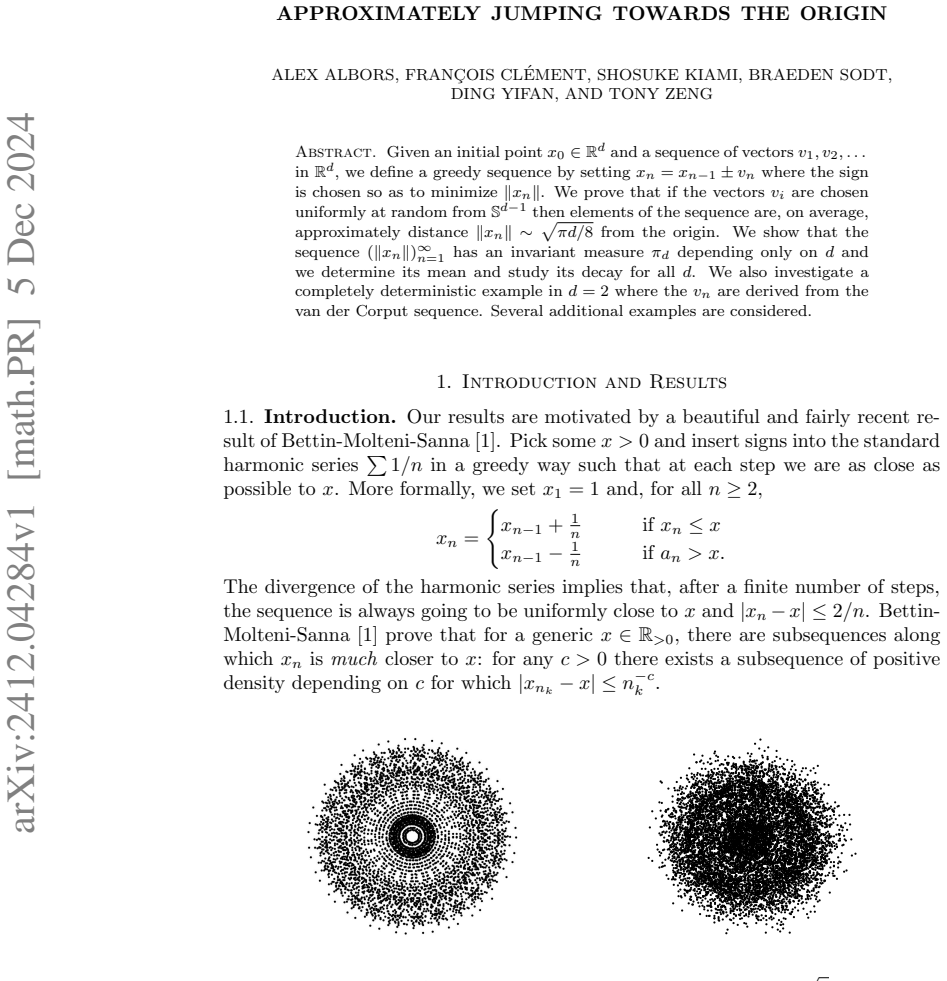


Figures from the paper (15 more)


Reference graph
Works this paper leans on
- [1]
-
[2]
Goetz, Dynamics of a piecewise rotation
A. Goetz, Dynamics of a piecewise rotation. Disc. Cont. Dyn. Systems 4 (1998), p. 593-608
work page 1998
-
[3]
A. Goetz, Piecewise isometries—an emerging area of dynamical systems, Fractals in Graz 2001: Analysis—Dynamics—Geometry—Stochastics (2003): 135–144
work page 2003
-
[4]
Harris (1956) The existence of stationary measures for certain Markov processes
T.E. Harris (1956) The existence of stationary measures for certain Markov processes. Proc. 3rd Berkeley Symp., Vol. II, 113–124
work page 1956
-
[5]
Ledoux, The concentration of measure phenomenon (No
M. Ledoux, The concentration of measure phenomenon (No. 89), AMS, 2001
work page 2001
-
[6]
S. P. Meyn and R. L. Tweedie, Markov chains and stochastic stability, Springer, 1996
work page 1996
-
[7]
H. Niederreiter, Random Number Generation and Quasi-Monte Carlo Methods, SIAM CBMS-NSF Regional Conference Series in Applied Mathematics (63), 1992
work page 1992
-
[8]
A curious dynamical system in the plane
S. Steinerberger and T. Zeng, A curious dynamical system in the plane, arXiv:2409.08961
Show all 9 references
-
[9]
van der Corput, Verteilungsfunktionen II, Akad
J.G. van der Corput, Verteilungsfunktionen II, Akad. Wetensch. Amsterdam Proc. (38), 1058– 1066, 1935 Department of Mathematics, University of W ashington, Seattle, W A 98195, USA Email address: aalbors@uw.edu Email address: fclement@uw.eu Email address: shokiami@uw.edu Email ...
1935
Reviewed August 11, 2026 · model on record in the stance chip above.
Discussion (0). Continue with ORCID to comment.