REVIEW 4 major objections 3 minor 2 cited by
Strong Formulations for Hybrid System Control
T0 review · 4 major / 3 minor · reviewed 2026-08-11 · deepseek-v4-flash
Pith's one-line read The paper establishes that the single-period two-mode hybrid control problem has a convex hull in the original variables, captured by two new cut families that, applied period-wise, make the n-period problem substantially faster to solve.
desk verdict A solid 1D convexification result with a load-bearing gap: the multi-dimensional cut validity is unproven and the cut formulas as written are invalid. read the letter →
The pith
A machine-rendered reading of the paper's core claim, the machinery that carries it, and where it could break.
The reading
What carries the argument
The load-bearing object is a one-dimensional projection problem $\tau(x_1,x_2,y,z)=\min_p (x_2-ap)^2$ over bounds $p$ derived from the disjunctive convex hull representation in an extended space. Projecting out the auxiliary variable $p$ produces two cut families: feasibility cuts, which are linear inequalities ensuring the projection is feasible, and a nonlinear cut, a convex piecewise-quadratic inequality that reduces to the perspective cut when $x_2$ lies inside the projected interval and strengthens it otherwise. In computations the nonlinear cut is implemented through its gradient linear underestimators, giving convex quadratic cuts that can be added to a MIQP solver without auxiliary variables. The multi-dimensional extension decomposes coordinate-wise when the quadratic cost matrix $Q_2$ is diagonal, and the multi-mode extension uses a two-way disjunction on the index set of modes.
What would settle it
Fix state dimension $dx=2$ and run the With-Cuts gradient model and the SPP model on the same random instances for horizons $n=40,50,60$ with a one-hour time limit; if WC-G's solve time grows past SPP's as $n$ increases, the claim that original-space cuts give a practical speedup over extended-space formulations for long horizons is false.
Extended reading notes
Core claim
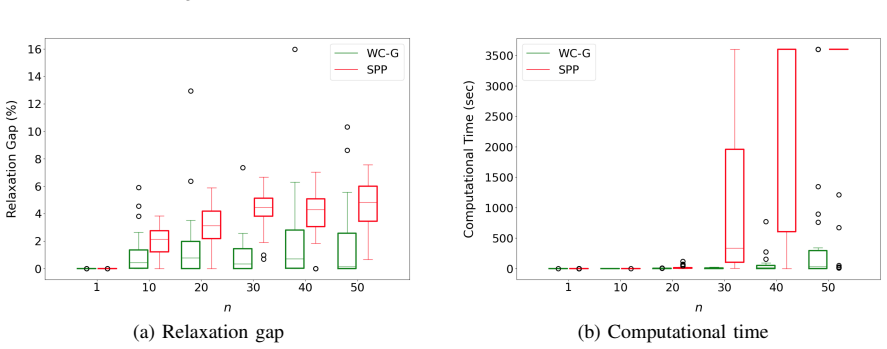
The central claim is that the epigraph of a single-period hybrid control problem with convex quadratic cost and linear dynamics has a convex hull that can be described, after projecting out auxiliary variables, by two classes of valid cuts in the original variable space: feasibility cuts that enforce the bounds needed for the projection to be feasible, and a nonlinear cut that improves on the perspective cut by exploiting the linear dynamics constraint $x_2 = ax_1 + by + cz$. The same projection argument is extended, with a diagonal quadratic cost matrix assumption for the multi-dimensional case, to multi-mode and multi-dimensional problems, and the cuts are generated independently for each period of the $n$-period problem. The paper reports that the resulting With-Cuts formulation substantially reduces relaxation gaps and computation times relative to the plain MIQP, and that in the vehicle study the gradient-cut version is about ten times faster on average, with worst-case times that remain manageable within the sampling period.
Load-bearing premise
The n-period extension generates cuts for each period independently, ignoring the coupling between consecutive periods, so the relaxation gap can grow with the horizon; the multi-dimensional cut derivation also assumes the quadratic cost matrix $Q_2$ is diagonal, and either assumption, if it fails in practice, would undercut the practical advantage the paper claims.
Editorial extensions
If this is right
- The single-period two-mode problem has an explicit convex hull in the original variables, so a solver can apply the two cut families without adding auxiliary variables.
- Because each cut is generated from the linear dynamics constraint, the resulting relaxation is at least as strong as the perspective cut and is strictly stronger whenever the state variable falls outside the projected interval.
- For high state dimension ($dx \ge 4$) the With-Cuts model beats the SPP extended-space model in computation time, while for small $dx$ SPP remains faster, so the two formulations are complementary rather than one dominating.
- Applying the cuts period by period keeps the variable count small; in the vehicle application the gradient-cut model runs about ten times faster on average than the plain MIQP and finishes within the MPC sampling time.
Reading between the lines
- A natural extension not pursued in the paper is to choose the two-way mode split $K_1$ adaptively inside branch-and-bound. Because any nonempty $K_1$ yields valid cuts, a dynamic separation rule could tighten the relaxation exactly where the current period-wise cuts are weak.
- The period-wise construction ignores coupling between consecutive periods, so a hybrid strategy that uses SPP-style coupling for small state dimensions or long horizons and original-space cuts for large state dimensions would plausibly outperform either method alone; the paper's own $dx=2$ results hint at this.
- Because the multi-dimensional derivation assumes the quadratic cost matrix $Q_2$ is diagonal, a concrete stress test is to rotate the coordinates so that $Q_2$ becomes dense; the resulting gap between the cut relaxation and the true convex hull would show how much of the strengthening depends on that assumption.
Signed reviews
Editorial analysis
A structured set of objections, weighed in public.
Referee Report
Summary. The paper studies an n-period hybrid control problem (HCP) formulated as a mixed-integer quadratic program with convex quadratic cost and linear dynamics. The authors first derive, for a single-period two-mode one-dimensional problem, an extended-space convex hull representation and then project out the auxiliary variable to obtain feasibility cuts and nonlinear/gradient cuts. They claim that these cuts are generalized to multi-dimensional state/control spaces, to multi-mode problems via a two-way disjunction, and then applied period-by-period to the full n-period problem. Computational experiments on synthetic instances and a power-split hybrid electric vehicle energy-management problem report substantially reduced solution times, especially for the gradient-cut variant WC-G.
Significance. If the generalized cuts are valid, the paper offers a practically attractive alternative to extended-space formulations because it keeps the number of variables small while improving the continuous relaxation. The one-dimensional derivation in Section III-A is careful and largely coherent, and the computational comparison against the shortest-path formulation of Marcucci et al. is informative. However, the multi-dimensional and multi-mode extensions are asserted rather than proved, and the relationship between the implemented models and the claimed 'convex hull in the original variable space' is not fully clear. The significance is therefore conditional on closing the proof gaps, but the underlying idea is valuable and the experimental evidence is promising.
major comments (4)
- [Abstract and Section IV] The abstract states that the paper gives a convex hull description 'in the original variable space' and that the cuts are generalized to the multi-dimensional, multi-mode case. However, Section IV describes WC-NL as adding 'nonlinear cuts as in (3a)', and (3a) is the extended-space inequality with the auxiliary variable p from Proposition 1. Only the gradient-cut model WC-G appears to operate purely in the original variables. This discrepancy should be resolved: either state explicitly that the exact hull is only obtained before linearization, or clarify what is actually implemented in each model.
- [Section III-B, Eqs. (10)-(11)] The validity of the multi-dimensional cuts is the load-bearing step for the numerical claims, but it is not proved. After relaxing the projection problem by replacing the bound constraints with S2, by dropping sigma in C(A), and by decomposing coordinate-wise, the paper asserts that 'the same cut-generation process can be employed.' The text does not demonstrate that the elementwise max/min definitions of ell and u produce a feasible box that is a relaxation of the true projection's feasible set in the direction needed for tau' <= tau, nor does it prove that the resulting cut is valid for (7) and, after period-wise application, for (1). Please provide a formal statement and proof analogous to Corollary 5 for the multi-dimensional case.
- [Corollary 6 and Table II] The displayed cuts use the reference value (\bar{x}_2 - \bar{\sigma})^2 in the first quadratic term, making that term constant, while the remaining terms depend on x2, y, and z. As written, this is not a well-defined valid inequality for (2) unless it is only the point value used to construct the gradient cut in (6). The same ambiguity appears in the 'Cut' row of Table II, where \bar{x}_{2,i} appears in the leading term. Please clarify which object is added to the solver and prove that it is a valid underestimator of the projected nonlinear cut.
- [Section III-D / Appendix C] Proposition 9 is stated for the multi-mode case, and Corollary 10 depends on it, but the proof in Appendix C gives details for cases (A) and (B) and only says that (C)-(H) 'can also be proved by negating each condition.' Since these feasibility cuts are the foundation for generating the Table II cuts at arbitrary relaxation points, the missing cases should be supplied explicitly or the proof should be completed in the appendix.
minor comments (3)
- [Section I and Eq. (2)] There is a typo 'singe-period' in the introduction, and the constraint in (2) writes 'q2x2^2 + ry2 + z' where the control term appears to be r y^2; please check the notation and make it consistent with the later expressions such as Corollary 5.
- [End of Section III-A] The sentence 'Note that all results in this section hold for dy >= 1 as well' is not proved and is not immediate because y enters through a quadratic term y^T R y; either provide the argument or soften the claim.
- [Section III-E and Figures 3-4] The paper acknowledges that generating cuts period-by-period ignores coupling between periods, and Figure 3 shows that the WC-G relaxation gap grows with n for dx=2 and some instances time out for n >= 40. The abstract and conclusion should state more precisely that the practical advantage is dimension-dependent rather than claiming a uniform substantial reduction for all n-period instances.
Circularity Check
No significant circularity: the cut derivations start from the disjunctive definition of the feasible set and are not fitted or self-citation-forced.
full rationale
The paper's central derivation begins with the definition of the single-period feasible set as a union of mode-specific convex sets and applies disjunctive programming, convex combination, and projection. Proposition 1 and Corollary 3 are derived from that definition rather than from any assumed target result, and the nonlinear cut in Corollary 5 is obtained by explicitly solving the projection problem (4). The gradient cut in Corollary 6 follows from convexity of the resulting function, so it is not a fitted quantity renamed as a prediction. There are no calibrated parameters, no term fitted to the reported benchmarks, and no external claim that is load-bearing: the perspective reformulation citations [44], [45] appear as background and as a comparison point, and the remark that the new cut 'enhances' that reformulation is supported by the preceding derivation rather than imported from those references. The multi-dimensional generalization in Section III-B does replace the exact projection by a coordinate-wise relaxation and the multi-period extension in Section III-E generates cuts period-by-period while conceding a larger relaxation gap, but these are potential correctness or strength concerns, not circularity: they do not make the claimed result equivalent to its own input by construction. Similarly, the ambiguity about barred values in Corollary 6 and Table II is a clarity or validity issue, not a circular reduction. The paper is self-contained against the external SPP benchmark, and the self-citations are not used to force the main claim. Therefore the circularity score is 0.
Assumptions & free parameters
assumptions (4)
- domain assumption Cost matrices Q_t, R_t, S_t are symmetric positive semidefinite and Q2 is diagonal in the multi-dimensional derivation.
- standard math Disjunctive programming projection principle: the convex hull of a union of convex sets is the projection of the convex combination of points in those sets.
- domain assumption State bounds and mode-dependent control bounds define the feasible region; the bounds are finite so the projection problem (4) is well posed.
- domain assumption The linearized PS-HEV model (19) is an adequate local approximation of the nonlinear powertrain model (18).
Cite this review
Pith. "Pith review of Strong Formulations for Hybrid System Control." pith.science (2026). https://pith.science/paper/HLQ4IERZ
@misc{pith2026241211541,
  author       = {Pith},
  title        = {Pith review of: Strong Formulations for Hybrid System Control},
  year         = {2026},
  howpublished = {\url{https://pith.science/paper/HLQ4IERZ}},
  note         = {Machine review of arXiv:2412.11541}
}
abstract
We study the mixed-integer quadratic programming formulation of an $n$-period hybrid control problem with a convex quadratic cost function and linear dynamics. We first give the convex hull description of the single-period, two-mode problem in the original variable space through two new classes of valid cuts. These cuts are then generalized to the single-period, multi-mode, multi-dimensional case and applied to solve the general $n$-period hybrid control problem. Computational experiments demonstrate the effectiveness of the proposed strong formulations derived through the cut generation process in the original variable space. These formulations yield a substantial reduction in computational effort for synthetic test instances and instances from the energy management problem of a power-split hybrid electric vehicle.
Figures


Figures from the paper (1 more)
Forward citations
Cited by 2 Pith papers
-
Rank-one convexification for quadratic optimization problems with step function penalties
An explicit convex hull for rank-one quadratic optimization with step function penalties is derived, enabling stronger copositive and SDP relaxations and a robust convex SVM surrogate.
-
Mixed Discrete and Continuous Planning using Shortest Walks in Graphs of Convex Sets
Shortest walks in graphs of convex sets, guided by SDP-computed cost-to-go lower bounds, provide a unified approximate planner for robot motion, skill chaining, and hybrid control.
Reference graph
Works this paper leans on
-
[1]
F. Borrelli, A. Bemporad, and M. Morari, Pre- dictive Control for Linear and Hybrid Systems . Cambridge University Press, 2017
work page 2017
-
[2]
Computational complexity of the capacitated lot size problem,
G. R. Bitran and H. H. Yanasse, “Computational complexity of the capacitated lot size problem,” Management Science , vol. 28, no. 10, pp. 1174– 1186, 1982
work page 1982
-
[3]
The explicit linear quadratic regu- lator for constrained systems,
A. Bemporad, M. Morari, V . Dua, and E. N. Pistikopoulos, “The explicit linear quadratic regu- lator for constrained systems,” Automatica, vol. 38, no. 1, pp. 3–20, 2002
work page 2002
-
[4]
Dynamic programming for constrained optimal control of discrete-time linear hybrid sys- tems,
F. Borrelli, M. Baoti ´c, A. Bemporad, and M. Morari, “Dynamic programming for constrained optimal control of discrete-time linear hybrid sys- tems,” Automatica, vol. 41, no. 10, pp. 1709–1721, 2005
work page 2005
-
[5]
A multiparametric programming approach for mixed- integer quadratic engineering problems,
V . Dua, N. A. Bozinis, and E. N. Pistikopoulos, “A multiparametric programming approach for mixed- integer quadratic engineering problems,” Comput- ers & Chemical Engineering , vol. 26, no. 4-5, pp. 715–733, 2002
work page 2002
-
[6]
Multi-parametric toolbox (MPT),
M. Kvasnica, P. Grieder, M. Baoti ´c, and M. Morari, “Multi-parametric toolbox (MPT),” 2004, available: http://control.ee.ethz.ch/œmpt/
work page 2004
-
[7]
Improved complexity analysis of branch and bound for hybrid MPC,
D. Axehill and M. Morari, “Improved complexity analysis of branch and bound for hybrid MPC,” in 49th IEEE Conference on Decision and Control (CDC), 2010, pp. 4216–4222
work page 2010
-
[8]
A multiresolution approximation method for fast explicit model predictive control,
S. Summers, C. N. Jones, J. Lygeros, and M. Morari, “A multiresolution approximation method for fast explicit model predictive control,” 15 IEEE Transactions on Automatic Control , vol. 56, no. 11, pp. 2530–2541, 2011
work page 2011
Show all 47 references
-
[9]
A parametric branch and bound ap- proach to suboptimal explicit hybrid MPC,
D. Axehill, T. Besselmann, D. M. Raimondo, and M. Morari, “A parametric branch and bound ap- proach to suboptimal explicit hybrid MPC,” Auto- matica, vol. 50, no. 1, pp. 240–246, 2014
2014
-
[10]
Learning binary warm starts for multiparametric mixed-integer quadratic programming,
D. Masti and A. Bemporad, “Learning binary warm starts for multiparametric mixed-integer quadratic programming,” in 18th European Control Confer- ence (ECC) . IEEE, 2019, pp. 1494–1499
2019
-
[11]
Safe and near-optimal policy learning for model predic- tive control using primal-dual neural networks,
X. Zhang, M. Bujarbaruah, and F. Borrelli, “Safe and near-optimal policy learning for model predic- tive control using primal-dual neural networks,” in 2019 American Control Conference (ACC) . IEEE, 2019, pp. 354–359
2019
-
[12]
Near-optimal rapid MPC using neural net- works: A primal-dual policy learning framework,
——, “Near-optimal rapid MPC using neural net- works: A primal-dual policy learning framework,” IEEE Transactions on Control Systems Technology , vol. 29, no. 5, pp. 2102–2114, 2020
2020
-
[13]
Fast non-parametric learning to accelerate mixed-integer program- ming for hybrid model predictive control,
J.-J. Zhu and G. Martius, “Fast non-parametric learning to accelerate mixed-integer program- ming for hybrid model predictive control,” IF AC- PapersOnLine, vol. 53, no. 2, pp. 5239–5245, 2020
2020
-
[14]
Learning mixed- integer convex optimization strategies for robot planning and control,
A. Cauligi, P. Culbertson, B. Stellato, D. Bertsimas, M. Schwager, and M. Pavone, “Learning mixed- integer convex optimization strategies for robot planning and control,” in 59th IEEE Conference on Decision and Control (CDC) , 2020, pp. 1698– 1705
2020
-
[15]
CoCo: Online mixed-integer control via supervised learning,
A. Cauligi, P. Culbertson, E. Schmerling, M. Schwager, B. Stellato, and M. Pavone, “CoCo: Online mixed-integer control via supervised learning,” IEEE Robotics and Automation Letters , vol. 7, no. 2, pp. 1447–1454, 2021
2021
-
[16]
Online mixed- integer optimization in milliseconds,
D. Bertsimas and B. Stellato, “Online mixed- integer optimization in milliseconds,” INFORMS Journal on Computing , vol. 34, no. 4, pp. 2229– 2248, 2022
2022
-
[17]
Learning disagreement regions with deep neural networks to reduce practical complex- ity of mixed-integer MPC,
A. Chakrabarty, R. Quirynen, D. Romeres, and S. Di Cairano, “Learning disagreement regions with deep neural networks to reduce practical complex- ity of mixed-integer MPC,” in IEEE International Conference on Systems, Man, and Cybernetics (SMC), 2021, pp. 3238–3244
2021
-
[18]
Learning for online mixed-integer model predic- tive control with parametric optimality certificates,
L. Russo, S. H. Nair, L. Glielmo, and F. Borrelli, “Learning for online mixed-integer model predic- tive control with parametric optimality certificates,” IEEE Control Systems Letters , vol. 7, pp. 2215– 2220, 2023
2023
-
[19]
A dual gradient pro- jection quadratic programming algorithm tailored for model predictive control,
D. Axehill and A. Hansson, “A dual gradient pro- jection quadratic programming algorithm tailored for model predictive control,” in 47th IEEE Con- ference on Decision and Control , 2008, pp. 3057– 3064
2008
-
[20]
Embedded mixed- integer quadratic optimization using accelerated dual gradient projection,
V . V . Naik and A. Bemporad, “Embedded mixed- integer quadratic optimization using accelerated dual gradient projection,” IF AC-PapersOnLine, vol. 50, no. 1, pp. 10 723–10 728, 2017
2017
-
[21]
A numerically stable solver for positive semidefinite quadratic programs based on nonnegative least squares,
A. Bemporad, “A numerically stable solver for positive semidefinite quadratic programs based on nonnegative least squares,” IEEE Transactions on Automatic Control , vol. 63, no. 2, pp. 525–531, 2017
2017
-
[22]
A numerically robust mixed-integer quadratic programming solver for embedded hybrid model predictive control,
A. Bemporad and V . V . Naik, “A numerically robust mixed-integer quadratic programming solver for embedded hybrid model predictive control,” IF AC- PapersOnLine, vol. 51, no. 20, pp. 412–417, 2018
2018
-
[23]
OSQP: An operator splitting solver for quadratic programs,
B. Stellato, G. Banjac, P. Goulart, A. Bemporad, and S. Boyd, “OSQP: An operator splitting solver for quadratic programs,” Mathematical Program- ming Computation , vol. 12, no. 4, pp. 637–672, 2020
2020
-
[24]
Embedded mixed-integer quadratic optimization using the OSQP solver,
B. Stellato, V . V . Naik, A. Bemporad, P. Goulart, and S. Boyd, “Embedded mixed-integer quadratic optimization using the OSQP solver,” in 2018 Eu- ropean Control Conference (ECC) . IEEE, 2018, pp. 1536–1541
2018
-
[25]
Warm start of mixed- integer programs for model predictive control of hybrid systems,
T. Marcucci and R. Tedrake, “Warm start of mixed- integer programs for model predictive control of hybrid systems,” IEEE Transactions on Automatic Control, vol. 66, no. 6, pp. 2433–2448, 2020
2020
-
[26]
BnB-DAQP: A mixed-integer QP solver for embedded applica- tions,
D. Arnstr ¨om and D. Axehill, “BnB-DAQP: A mixed-integer QP solver for embedded applica- tions,” IF AC-PapersOnLine, vol. 56, no. 2, pp. 7420–7427, 2023
2023
-
[27]
A dual active-set solver for embedded quadratic pro- gramming using recursive LDL T updates,
D. Arnstr ¨om, A. Bemporad, and D. Axehill, “A dual active-set solver for embedded quadratic pro- gramming using recursive LDL T updates,” IEEE Transactions on Automatic Control , vol. 67, no. 8, pp. 4362–4369, 2022
2022
-
[28]
Early termination of convex QP solvers in mixed-integer programming for real-time decision making,
J. Liang, S. Di Cairano, and R. Quirynen, “Early termination of convex QP solvers in mixed-integer programming for real-time decision making,” IEEE Control Systems Letters , vol. 5, no. 4, pp. 1417– 1422, 2020
2020
-
[29]
FORCES: Fast optimization for real-time control on embedded systems,
A. Domahidi, “FORCES: Fast optimization for real-time control on embedded systems,” 2012
2012
-
[30]
Embedded optimization for mixed logical dynamical systems,
D. Frick, A. Domahidi, and M. Morari, “Embedded optimization for mixed logical dynamical systems,” Computers & Chemical Engineering , vol. 72, pp. 21–33, 2015
2015
-
[31]
A structure exploiting branch-and-bound algorithm for mixed-integer model predictive control,
P. Hespanhol, R. Quirynen, and S. Di Cairano, “A structure exploiting branch-and-bound algorithm for mixed-integer model predictive control,” in 18th European Control Conference (ECC). IEEE, 2019, pp. 2763–2768
2019
-
[32]
Tailored presolve techniques in branch-and-bound method for fast 16 mixed-integer optimal control applications,
R. Quirynen and S. Di Cairano, “Tailored presolve techniques in branch-and-bound method for fast 16 mixed-integer optimal control applications,” Opti- mal Control Applications and Methods , vol. 44, no. 6, pp. 3139–3167, 2023
2023
-
[33]
Convex relaxations for mixed integer predictive control,
D. Axehill, L. Vandenberghe, and A. Hansson, “Convex relaxations for mixed integer predictive control,” Automatica, vol. 46, no. 9, pp. 1540–1545, 2010
2010
-
[34]
Mixed-integer for- mulations for optimal control of piecewise-affine systems,
T. Marcucci and R. Tedrake, “Mixed-integer for- mulations for optimal control of piecewise-affine systems,” in Proceedings of the 22nd ACM Interna- tional Conference on Hybrid Systems: Computation and Control, 2019, pp. 230–239
2019
-
[35]
A more scalable mixed- integer encoding for metric temporal logic,
V . Kurtz and H. Lin, “A more scalable mixed- integer encoding for metric temporal logic,” IEEE Control Systems Letters , vol. 6, pp. 1718–1723, 2021
2021
-
[36]
Shortest paths in graphs of convex sets,
T. Marcucci, J. Umenberger, P. Parrilo, and R. Tedrake, “Shortest paths in graphs of convex sets,” SIAM Journal on Optimization , vol. 34, no. 1, pp. 507–532, 2024
2024
-
[37]
Piecewise affine modeling and constrained optimal control for a pneumatic artificial muscle,
G. Andrikopoulos, G. Nikolakopoulos, I. Arvani- takis, and S. Manesis, “Piecewise affine modeling and constrained optimal control for a pneumatic artificial muscle,” IEEE Transactions on Industrial Electronics, vol. 61, no. 2, pp. 904–916, 2013
2013
-
[38]
Feedback design for multi-contact push recovery via LMI approxima- tion of the piecewise-affine quadratic regulator,
W. Han and R. Tedrake, “Feedback design for multi-contact push recovery via LMI approxima- tion of the piecewise-affine quadratic regulator,” in IEEE-RAS 17th International Conference on Humanoid Robotics (Humanoids) , 2017, pp. 842– 849
2017
-
[39]
Footstep planning on uneven terrain with mixed-integer convex optimiza- tion,
R. Deits and R. Tedrake, “Footstep planning on uneven terrain with mixed-integer convex optimiza- tion,” in 2014 IEEE-RAS International Conference on Humanoid Robots , 2014, pp. 279–286
2014
-
[40]
Simultaneous contact, gait, and motion plan- ning for robust multilegged locomotion via mixed- integer convex optimization,
B. Aceituno-Cabezas, C. Mastalli, H. Dai, M. Foc- chi, A. Radulescu, D. G. Caldwell, J. Cappelletto, J. C. Grieco, G. Fern ´andez-L´opez, and C. Sem- ini, “Simultaneous contact, gait, and motion plan- ning for robust multilegged locomotion via mixed- integer convex optimizatio...
2017
-
[41]
Supermodularity and valid inequalities for quadratic optimization with indicators,
A. Atamt ¨urk and A. G ´omez, “Supermodularity and valid inequalities for quadratic optimization with indicators,” Mathematical Programming, vol. 201, no. 1, pp. 295–338, 2023
2023
-
[42]
2x2- convexifications for convex quadratic optimization with indicator variables,
S. Han, A. G ´omez, and A. Atamt ¨urk, “2x2- convexifications for convex quadratic optimization with indicator variables,” Mathematical Program- ming, vol. 202, no. 1, pp. 95–134, 2023
2023
-
[43]
On the convex hull of convex quadratic optimization problems with indicators,
L. Wei, A. Atamt ¨urk, A. G ´omez, and S. K ¨uc ¸¨ukyavuz, “On the convex hull of convex quadratic optimization problems with indicators,” Mathematical Programming , vol. 204, no. 1, pp. 703–737, 2024
2024
-
[44]
A strong conic quadratic reformulation for machine- job assignment with controllable processing times,
M. S. Akt ¨urk, A. Atamt ¨urk, and S. G ¨urel, “A strong conic quadratic reformulation for machine- job assignment with controllable processing times,” Operations Research Letters , vol. 37, no. 3, pp. 187–191, 2009
2009
-
[45]
Perspective reformu- lation and applications,
O. G ¨unl¨uk and J. Linderoth, “Perspective reformu- lation and applications,” in Mixed Integer Nonlin- ear Programming. Springer, 2012, pp. 61–89
2012
-
[46]
Drake: Model-based design and verification for robotics,
R. Tedrake and the Drake Development Team, “Drake: Model-based design and verification for robotics,” 2019, available: https://drake.mit.edu
2019
-
[47]
MPC-based energy management of a power-split hybrid electric vehicle,
H. Borhan, A. Vahidi, A. M. Phillips, M. L. Kuang, I. V . Kolmanovsky, and S. Di Cairano, “MPC-based energy management of a power-split hybrid electric vehicle,” IEEE Transactions on Control Systems Technology, vol. 20, no. 3, pp. 593–603, 2011
2011
Reviewed August 11, 2026 · model on record in the stance chip above.
Discussion (0). Continue with ORCID to comment.