Logic-Constrained Shortest Paths for Flight Planning
Pith reviewed 2026-05-23 06:37 UTC · model grok-4.3
The pith
A branch-and-bound algorithm for logic-constrained shortest paths computes aircraft routes under real traffic restrictions an order of magnitude faster when its control rules are chosen well.
A machine-rendered reading of the paper's core claim, the machinery that carries it, and where it could break.
Core claim
The logic-constrained shortest path problem can be solved by a branch-and-bound algorithm whose performance depends on the choice of node selection rule, branching rule, and the set of variables called the conflict; tailored variants of these rules, together with an analysis of the conflict's theoretical effect, produce solutions an order of magnitude faster than uninformed selections when applied to flight planning instances.
What carries the argument
The branch-and-bound algorithm for the logic-constrained shortest path problem, whose performance is governed by the node selection rule, the branching rule, and the conflict (the set of variables to which the branching rule is applied).
If this is right
- Aircraft routes that obey thousands of simultaneous traffic flow restrictions can be computed on a worldwide network without violating any single restriction.
- Dynamic shortest-path subroutines can be embedded inside the branch-and-bound search to reduce the cost of repeated distance queries.
- The theoretical impact of different conflict definitions on the size of the search tree can be used to prune unproductive branches earlier.
- Public release of the flight graph and restriction set allows direct comparison of any new logic-constrained solver against the reported baselines.
Where Pith is reading between the lines
- The same three-rule framework could be tested on other routing tasks that combine metric costs with logical exclusion rules, such as pipeline routing or vehicle routing with time windows.
- Independent implementers can now measure whether the reported order-of-magnitude gap persists when the underlying shortest-path oracle is replaced by a different dynamic algorithm.
- The conflict analysis may suggest analogous variable-selection heuristics for other satisfiability-augmented shortest-path problems that do not yet have tailored branching rules.
Load-bearing premise
The modeling of traffic flow restrictions as satisfiability constraints on the routing graph accurately captures the real constraints imposed by ATC authorities without introducing modeling errors that would invalidate the computed routes.
What would settle it
Running the algorithm on the released global flight graph together with the 20000 restrictions and checking whether the fastest rule combinations produce feasible routes at the claimed speeds while any slower combinations fail to match reported runtimes.
Figures




read the original abstract
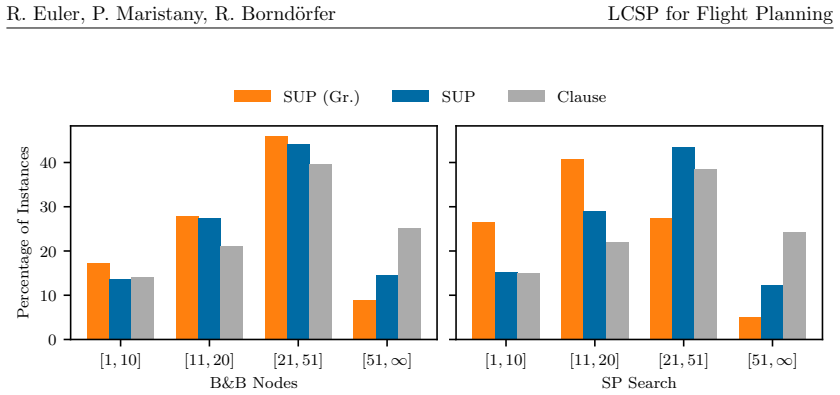
The logic-constrained shortest path problem (LCSPP) combines a one-to-one shortest path problem with satisfiability constraints imposed on the routing graph. This setting arises in flight planning, where air traffic control (ATC) authorities are enforcing a set of traffic flow restrictions (TFRs) on aircraft routes in order to increase safety and throughput. We propose a new branch and bound-based algorithm for the LCSPP. The resulting algorithm has three main degrees of freedom: the node selection rule, the branching rule and the conflict. While node selection and branching rules have been long studied in the MIP and SAT communities, most of them cannot be applied out of the box for the LCSPP. We review the existing literature and develop tailored variants of the most prominent rules. The conflict, the set of variables to which the branching rule is applied, is unique to the LCSPP. We analyze its theoretical impact on the B&B algorithm. In the second part of the paper, we show how to model the flight planning problem with TFRs as an LCSPP and solve it using the branch and bound algorithm. We demonstrate the algorithm's efficiency on a dataset consisting of a global flight graph and a set of around 20000 real TFRs obtained from our industry partner Lufthansa Systems GmbH. We make this dataset publicly available. Finally, we conduct an empirical in-depth analysis of dynamic shortest path algorithms, node selection rules, branching rules and conflicts. Carefully choosing an appropriate combination yields an improvement of an order of magnitude compared to an uninformed choice.
Editorial analysis
A structured set of objections, weighed in public.
Referee Report
Summary. The paper claims to develop a branch-and-bound algorithm for the logic-constrained shortest path problem (LCSPP) with tailored node selection rules, branching rules, and conflict analysis; it models flight planning under ~20,000 real traffic flow restrictions (TFRs) as an LCSPP instance, solves it on a global flight graph from Lufthansa data (made public), and reports an order-of-magnitude runtime improvement from careful choice of B&B components.
Significance. If the LCSPP modeling of TFRs is faithful to real ATC constraints and the empirical gains are robust, the work supplies a practical algorithmic framework plus a reusable dataset for incorporating complex safety constraints into flight planning. The public dataset and theoretical analysis of the conflict set are clear strengths.
major comments (2)
- [Modeling of the flight planning problem as LCSPP] The modeling of ~20,000 real TFRs as satisfiability constraints on the routing graph (described in the second part of the paper) is load-bearing for the practical claim, yet the manuscript provides no validation against actual ATC-approved routes, no expert review of the encoding, and no discussion of whether conditional logic or spatial interactions are omitted. If the encoding introduces modeling errors, the reported speedups on the derived LCSPP instance do not translate to the motivating application.
- [Empirical in-depth analysis] The headline empirical claim of an order-of-magnitude improvement (abstract and empirical analysis section) is presented without error bars, statistical significance tests, or ablation controls isolating the contributions of node selection, branching rules, and conflict choices; this weakens confidence that the gains are attributable to the proposed tailoring rather than instance-specific effects.
minor comments (1)
- [Abstract] The abstract states the performance claim without any mention of variance, statistical testing, or controls, which should be added for clarity even if the full paper contains the details.
Simulated Author's Rebuttal
Thank you for the constructive review and for recognizing the strengths of the public dataset and conflict analysis. We address each major comment below with planned revisions where feasible.
read point-by-point responses
-
Referee: [Modeling of the flight planning problem as LCSPP] The modeling of ~20,000 real TFRs as satisfiability constraints on the routing graph (described in the second part of the paper) is load-bearing for the practical claim, yet the manuscript provides no validation against actual ATC-approved routes, no expert review of the encoding, and no discussion of whether conditional logic or spatial interactions are omitted. If the encoding introduces modeling errors, the reported speedups on the derived LCSPP instance do not translate to the motivating application.
Authors: The encodings were developed directly from real TFR descriptions supplied by Lufthansa Systems, our industry partner, and are detailed in Section 4. We will add a new subsection explicitly discussing modeling assumptions, including potential omissions around conditional logic and spatial interactions. However, direct validation against ATC-approved routes is not feasible within the paper as such proprietary route data is outside the public dataset scope. revision: partial
-
Referee: [Empirical in-depth analysis] The headline empirical claim of an order-of-magnitude improvement (abstract and empirical analysis section) is presented without error bars, statistical significance tests, or ablation controls isolating the contributions of node selection, branching rules, and conflict choices; this weakens confidence that the gains are attributable to the proposed tailoring rather than instance-specific effects.
Authors: The empirical section already compares multiple combinations of the three components across the full dataset and shows consistent gains. We agree additional rigor is warranted and will revise to include explicit ablation tables isolating each component, error bars on runtime metrics over instance subsets, and statistical significance tests (e.g., Wilcoxon) where variance exists. The deterministic nature of the solver limits some statistical options, but these additions will strengthen attribution of the gains. revision: yes
Circularity Check
No significant circularity; derivation relies on external literature and real-world data.
full rationale
The paper reviews existing MIP/SAT literature to adapt node selection and branching rules, introduces a conflict concept unique to LCSPP with theoretical analysis, models TFRs as satisfiability constraints on a routing graph, and evaluates the resulting B&B algorithm on a public dataset of ~20000 real TFRs from Lufthansa. No equations or claims reduce by construction to fitted parameters, self-defined quantities, or load-bearing self-citations. The order-of-magnitude improvement is an empirical observation on external data, not a statistical artifact of internal fitting. The modeling step is presented as a direct encoding without circular validation loops.
Axiom & Free-Parameter Ledger
axioms (2)
- standard math Standard shortest-path algorithms such as Dijkstra or A* can be extended with satisfiability constraints via branch-and-bound.
- domain assumption The routing graph and TFRs can be faithfully represented as a graph plus logical constraints without loss of real-world validity.
Reference graph
Works this paper leans on
- [1]
-
[2]
M. Blanco, R. Bornd¨ orfer, N.-D. Hoang, A. Kaier, A. Schienle, T. Schlechte, S. Schlobach, Solving time dependent shortest path problems on airway networks using super-optimal wind, in: M. Goerigk, R. F. Werneck (Eds.), 16th Workshop on Algorithmic Approaches for Transportation Modelling, Optimization, and Systems, number 54 in Open Access Series in Info...
-
[3]
M. Blanco, R. Bornd¨ orfer, N. D. Ho` ang, A. Kaier, P. Maristany de las Casas, T. Schlechte, S. Schlobach, Cost projection methods for the shortest path problem with crossing costs, in: G. D’Angelo, T. Dollevoet (Eds.), 17th Workshop on Algorithmic Approaches for Trans- portation Modelling, Optimization, and Systems, number 59 in OpenAccess Series in Inf...
-
[4]
A. N. Knudsen, M. Chiarandini, K. S. Larsen, Constraint handling in flight planning, in: J. C. Beck (Ed.), Principles and Practice of Constraint Programming, number 10416 in Lecture Notes in Computer Science, Springer International Publishing, 2017, pp. 354–369. doi:10.1007/978-3-319-66158-2_23 . 26 R. Euler, P. Maristany, R. Bornd¨ orfer LCSP for Flight Planning
-
[5]
A. N. Knudsen, M. Chiarandini, K. S. Larsen, Heuristic variants of A∗search for 3d flight planning, in: W.-J. van Hoeve (Ed.), Integration of Constraint Programming, Artificial Intelligence, and Operations Research, number 10848 in Lecture Notes in Computer Science, Springer, 2018, pp. 361–376. doi: 10.1007/978-3-319-93031-2_26
-
[6]
A. Schienle, P. Maristany de las Casas, M. Blanco, A priori search space pruning in the flight planning problem, in: V. Cacchiani, A. Marchetti-Spaccamela (Eds.), 19th Symposium on Algorithmic Approaches for Transportation Modelling, Optimization, and Systems, num- ber 75 in Open Access Series in Informatics (OASIcs), Schloss Dagstuhl – Leibniz-Zentrum f¨...
-
[7]
A. K¨ uhner, Shortest Paths with Boolean Constraints, Master’s thesis, Freie Universit¨ at Berlin, Department of Mathematics, 2020
work page 2020
-
[8]
M. Blanco, R. Bornd¨ orfer, P. Maristany de las Casas, An A* algorithm for flight planning based on idealized vertical profiles, in: M. D’Emidio, N. Lindner (Eds.), 22nd Symposium on Algorithmic Approaches for Transportation Modelling, Optimization, and Systems, number 106 in Open Access Series in Informatics (OASIcs), Schloss Dagstuhl – Leibniz-Zentrum f...
-
[9]
G. Ramalingam, T. Reps, An incremental algorithm for a generalization of the shortest- path problem, Journal of Algorithms 21 (1996) 267–305. doi: 10.1006/jagm.1996.0046
-
[10]
G. Ramalingam, T. Reps, On the computational complexity of dynamic graph problems, Theoretical Computer Science 158 (1996) 233–277. doi: 10.1016/0304-3975(95)00079-8
-
[11]
D. Frigioni, A. Marchetti-Spaccamela, U. Nanni, Fully dynamic algorithms for maintaining shortest paths trees, Journal of Algorithms 34 (2000) 251–281. doi: 10.1006/jagm.1999. 1048
-
[12]
P. Narvaez, K.-Y. Siu, H.-Y. Tzeng, New dynamic algorithms for shortest path tree com- putation, IEEE/ACM Transactions on Networking 8 (2000) 734–746. doi: 10.1109/90. 893870
work page doi:10.1109/90 2000
-
[13]
S. Koenig, M. Likhachev, D. Furcy, Lifelong planning A⋆, Artificial Intelligence 155 (2004) 93–146. doi:10.1016/j.artint.2003.12.001
-
[14]
R. Bauer, D. Wagner, Batch dynamic single-source shortest-path algorithms: An experi- mental study, in: J. Vahrenhold (Ed.), Experimental Algorithms, number 5526 in Lecture Notes in Computer Science, Springer, 2009, pp. 51–62. doi: 10.1007/978-3-642-02011-7_ 7
-
[15]
A. D’Andrea, M. D’Emidio, D. Frigioni, S. Leucci, G. Proietti, Experimental evaluation of dynamic shortest path tree algorithms on homogeneous batches, in: J. Gudmundsson, J. Katajainen (Eds.), Experimental Algorithms, Springer International Publishing, 2014, pp. 283–294. doi: 10.1007/978-3-319-07959-2_24
-
[16]
Bellman, On a routing problem, Quarterly of Applied Mathematics 16 (1958) 87–90
R. Bellman, On a routing problem, Quarterly of Applied Mathematics 16 (1958) 87–90. doi:10.1090/qam/102435
-
[17]
E. W. Dijkstra, A note on two problems in connexion with graphs, Numerische Mathematik 1 (1959) 269–271
work page 1959
-
[18]
R. W. Floyd, Algorithm 97: Shortest path, Communications of the ACM 5 (1962) 345–345. 27 R. Euler, P. Maristany, R. Bornd¨ orfer LCSP for Flight Planning
work page 1962
-
[19]
K. L. Cooke, E. Halsey, The shortest route through a network with time-dependent intern- odal transit times, Journal of Mathematical Analysis and Applications 14 (1966) 493–498. doi:10.1016/0022-247X(66)90009-6
-
[20]
E. Q. V. Martins, On a multicriteria shortest path problem, European Journal of Opera- tional Research 16 (1984) 236–245. doi: 10.1016/0377-2217(84)90077-8
-
[21]
X. Gandibleux, F. Beugnies, S. Randriamasy, Martins’ algorithm revisited for multi- objective shortest path problems with a maxmin cost function, 4OR 4 (2006) 47–59. doi:10.1007/s10288-005-0074-x
-
[22]
D. Delling, T. Pajor, R. F. Werneck, Round-based public transit routing, Transportation Science 49 (2015) 591–604. doi: 10.1287/trsc.2014.0534
-
[23]
A. Parmentier, Algorithms for non-linear and stochastic resource constrained shortest path, Mathematical Methods of Operations Research 89 (2019) 281–317. doi: 10.1007/ s00186-018-0649-x
work page 2019
-
[25]
F. A. Aloul, B. Al Rawi, M. Aboelaze, Identifying the shortest path in large networks using boolean satisfiability, in: 2006 3rd International Conference on Electrical and Electronics Engineering, IEEE, 2006, pp. 1–4. doi: 10.1109/ICEEE.2006.251924
-
[26]
H. N. Gabow, S. N. Maheshwari, L. J. Osterweil, On two problems in the generation of program test paths, IEEE Transactions on Software Engineering SE-2 (1976) 227–231. doi:10.1109/TSE.1976.233819
-
[27]
B. Pamuk, T. ¨Oncan, ˙I. K. Altınel, An efficient branch-and-bound algorithm for the one- to-many shortest path problem with additional disjunctive conflict constraints, European Journal of Operational Research 324 (2025) 398–413. doi: 10.1016/j.ejor.2025.01.044
-
[28]
C. Barrett, R. Jacob, M. Marathe, Formal-language-constrained path problems, SIAM Journal on Computing 30 (2000) 809–837. doi: 10.1137/S0097539798337716
-
[29]
M. Nishino, N. Yasuda, S.-i. Minato, M. Nagata, BDD-constrained search: A unified approach to constrained shortest path problems, Proceedings of the AAAI Conference on Artificial Intelligence 29 (2015). doi: 10.1609/aaai.v29i1.9373
-
[30]
P. Kolman, O. Pangr´ ac, On the complexity of paths avoiding forbidden pairs, Discrete Applied Mathematics 157 (2009) 2871–2876. doi: 10.1016/j.dam.2009.03.018
-
[31]
J. Kov´ aˇ c, Complexity of the path avoiding forbidden pairs problem revisited, Discrete Applied Mathematics 161 (2013) 1506–1512. doi: 10.1016/j.dam.2012.12.022
-
[32]
M. Blanco, R. Bornd¨ orfer, M. Br¨ uckner, N. D. Ho` ang, T. Schlechte, On the path avoiding forbidden pairs polytope, Electronic Notes in Discrete Mathematics 50 (2015) 343–348. doi:10.1016/j.endm.2015.07.057
-
[33]
D. Ferone, P. Festa, M. Salani, Branch and bound and dynamic programming approaches for the path avoiding forbidden pairs problem, in: R. Cerulli, M. Dell’Amico, F. Guer- riero, D. Pacciarelli, A. Sforza (Eds.), Optimization and Decision Science: ODS, Virtual Conference, November 19, 2020, number 7 in AIRO Springer Series, Springer International Publishin...
-
[34]
A. Darmann, U. Pferschy, J. Schauer, G. J. Woeginger, Paths, trees and matchings under disjunctive constraints, Discrete Applied Mathematics 159 (2011) 1726–1735. doi:10.1016/ j.dam.2010.12.016
work page 2011
-
[35]
B. Aspvall, M. F. Plass, R. E. Tarjan, A linear-time algorithm for testing the truth of certain quantified boolean formulas, Information Processing Letters 8 (1979) 121–123. doi:https://doi.org/10.1016/0020-0190(79)90002-4
-
[36]
S. A. Cook, The Complexity of Theorem-Proving Procedures, 1 ed., Association for Com- puting Machinery, 2023, p. 143–152. URL: https://dl.acm.org/doi/10.1145/3588287. 3588297
-
[37]
J. Dibbelt, Multimodal Route and Tour Planning in Urban Environments, Phd thesis, Karlsruher Institut f¨ ur Technologie, 2016
work page 2016
-
[38]
R. E. Bryant, Graph-based algorithms for Boolean function manipulation, IEEE Transac- tions on Computers 100 (1986) 677–691. doi: 10.1109/TC.1986.1676819
-
[39]
M. Desrochers, La fabrication d’horaires de travail pour les conducteurs d’autobus par une m´ ethode de g´ en´ eration de colonnes, Ph.D. thesis, Universit´ e de Montr´ eal, Centre de recherche sur les transports, 1986
work page 1986
-
[40]
S. Irnich, G. Desaulniers, Shortest Path Problems with Resource Constraints, Springer US, 2005, pp. 33–65. doi: 10.1007/0-387-25486-2_2
-
[41]
H. C. Joksch, The shortest route problem with constraints, Journal of Mathematical Analysis and Applications 14 (1966) 191–197. doi: 10.1016/0022-247X(66)90020-5
-
[42]
I. Dumitrescu, N. Boland, Improved preprocessing, labeling and scaling algorithms for the weight-constrained shortest path problem, Networks 42 (2003) 135–153. doi: 10.1002/net. 10090
work page doi:10.1002/net 2003
-
[43]
O. J. Smith, N. Boland, H. Waterer, Solving shortest path problems with a weight constraint and replenishment arcs, Computers & Operations Research 39 (2012) 964–984. doi: 10. 1016/j.cor.2011.07.017
work page 2012
-
[44]
M. Baum, J. Dibbelt, A. Gemsa, D. Wagner, T. Z¨ undorf, Shortest feasible paths with charging stops for battery electric vehicles, Transportation Science 53 (2019) 1627–1655. doi:10.1287/trsc.2018.0889
-
[45]
L. Lozano, A. L. Medaglia, On an exact method for the constrained shortest path problem, Computers & Operations Research 40 (2013) 378–384. doi: https://doi.org/10.1016/j. cor.2012.07.008
work page doi:10.1016/j 2013
-
[46]
B. W. Thomas, T. Calogiuri, M. Hewitt, An exact bidirectional A approach for solving resource-constrained shortest path problems, Networks 73 (2019) 187–205. doi: 10.1002/ net.21856
work page 2019
-
[47]
Z. Ren, Z. B. Rubinstein, S. F. Smith, S. Rathinam, H. Choset, ERCA: A new approach for the resource constrained shortest path problem, IEEE Transactions on Intelligent Trans- portation Systems 24 (2023) 14994–15005. doi: 10.1109/TITS.2023.3293039
-
[48]
S. Ahmadi, G. Tack, D. Harabor, P. Kilby, Weight constrained path finding with bidirec- tional A*, Proceedings of the International Symposium on Combinatorial Search 15 (2022) 2–10. doi:10.1609/socs.v15i1.21746. 29 R. Euler, P. Maristany, R. Bornd¨ orfer LCSP for Flight Planning
-
[49]
S. Ahmadi, G. Tack, D. Harabor, P. Kilby, M. Jalili, Enhanced methods for the weight constrained shortest path problem, Networks 84 (2024) 3–30. doi: 10.1002/net.22210
-
[50]
S. Ahmadi, A. Raith, M. Jalili, Resource constrained pathfinding with A* and negative weights, 2025. doi:10.48550/arXiv.2503.11037. arXiv:2503.11037, arXiv preprint
-
[51]
J. E. Beasley, N. Christofides, An algorithm for the resource constrained shortest path problem, Networks 19 (1989) 379–394. doi: 10.1002/net.3230190402
-
[52]
R. Bornd¨ orfer, M. Gr¨ otschel, A. L¨ obel, Scheduling Duties by Adaptive Column Genera- tion, ZIB Report 01-02, Zuse Institute Berlin, 2001. URL: https://webdoc.sub.gwdg.de/ ebook/e/2003/zib_2/reports/ZR-01-02.pdf
work page 2001
-
[53]
L. D. P. Pugliese, F. Guerriero, A survey of resource constrained shortest path problems: Exact solution approaches, Networks 62 (2013) 183–200. doi: 10.1002/net.21511
-
[54]
P. Festa, Constrained shortest path problems: State-of-the-art and recent advances, in: 2015 17th International Conference on Transparent Optical Networks (ICTON), 2015, pp. 1–17. doi:10.1109/ICTON.2015.7193456
- [55]
-
[56]
D. Villeneuve, G. Desaulniers, The shortest path problem with forbidden paths, European Journal of Operational Research 165 (2005) 97–107. doi: 10.1016/j.ejor.2004.01.032
-
[57]
Eppstein, Finding the k shortest paths, SIAM Journal on Computing 28 (1998) 652–673
D. Eppstein, Finding the k shortest paths, SIAM Journal on Computing 28 (1998) 652–673. doi:10.1137/S0097539795290477
-
[58]
J.-M. Champarnaud, J.-E. Pin, A maxmin problem on finite automata, Discrete Applied Mathematics 23 (1989) 91–96. doi: 10.1016/0166-218X(89)90037-1
-
[59]
Blanco, Optimization Algorithms for the Flight Planning Problem, Ph.D
M. Blanco, Optimization Algorithms for the Flight Planning Problem, Ph.D. thesis, Freie Universit¨ at Berlin, 2023. doi:10.17169/refubium-40665
-
[60]
R. Bornd¨ orfer, F. Danecker, M. Weiser, A discrete-continuous algorithm for globally optimal free flight trajectory optimization, in: M. D’Emidio, N. Lindner (Eds.), 22nd Symposium on Algorithmic Approaches for Transportation Modelling, Optimization, and Systems, number 106 in Open Access Series in Informatics (OASIcs), Schloss Dagstuhl – Leibniz-Zentrum...
-
[61]
R. Bornd¨ orfer, F. Danecker, M. Weiser, A discrete-continuous algorithm for free flight planning, Algorithms 14 (2020). doi: 10.3390/a14010004
-
[62]
R. Bornd¨ orfer, F. Danecker, M. Weiser, Error bounds for discrete-continuous free flight trajectory optimization, Journal of Optimization Theory and Applications 198 (2023) 830–
work page 2023
-
[63]
doi:10.1007/s10957-023-02264-7
-
[64]
R. Bornd¨ orfer, F. Danecker, M. Weiser, Newton’s method for global free flight trajectory optimization, Operations Research Forum 4 (2023). doi: 10.1007/s43069-023-00238-z
-
[65]
A. Jocas, Global Free Flight Optimization by a Hamilton-Jacobi-Bellman Approach, Mas- ter’s thesis, Technische Universit¨ at Berlin, 2024. 30 R. Euler, P. Maristany, R. Bornd¨ orfer LCSP for Flight Planning
work page 2024
-
[66]
C. Kehlet Jensen, M. Chiarandini, K. Larsen, Flight planning in free route airspaces, in: G. D’Angelo, T. Dollevoet (Eds.), 17th Workshop on Algorithmic Approaches for Transportation Modeling, Optimization, and Systems, OpenAccess Series in Informat- ics (OASIcs), Schloss Dagstuhl-Leibniz-Zentrum fuer Informatik, 2017, pp. 14:1–14:14. doi:10.4230/OASIcs.A...
-
[67]
F. Danecker, A Discrete-Continuous Algorithm for Globally Optimal Free Flight Trajec- tory Optimization, Ph.D. thesis, Freie Universit¨ at Berlin, 2023. URL:https://refubium. fu-berlin.de/handle/fub188/43811
work page 2023
-
[68]
G. S. Tseitin, On the complexity of derivation in propositional calculus, in: J. H. Siekmann, G. Wrightson (Eds.), Automation of Reasoning 2: Classical Papers on Computational Logic 1967–1970, Springer, 1983, pp. 466–483. doi: 10.1007/978-3-642-81955-1_28
-
[69]
A. Biere, A. Fr¨ ohlich, Evaluating CDCL variable scoring schemes, in: M. Heule, S. Weaver (Eds.), Theory and Applications of Satisfiability Testing – SAT 2015, number 9340 in Lecture Notes in Computer Science, Springer International Publishing, 2015, pp. 405–422. doi:10.1007/978-3-319-24318-4\_29
-
[70]
M. Davis, G. Logemann, D. W. Loveland, A machine program for theorem-proving, Com- munications of the ACM 5 (1962) 394–397. doi: 10.1145/368273.368557
-
[71]
J. P. Marques-Silva, K. A. Sakallah, GRASP-a new search algorithm for satisfiability, in: Proceedings of International Conference on Computer Aided Design, 1996, pp. 220–227. doi:10.1109/ICCAD.1996.569607
-
[72]
M. W. Moskewicz, C. F. Madigan, Y. Zhao, L. Zhang, S. Malik, Chaff: engineering an efficient SAT solver, in: Proceedings of the 38th Annual Design Automation Conference, Association for Computing Machinery, 2001, p. 530–535. doi: 10.1145/378239.379017
-
[73]
L. Ryan, Efficient Algorithms for Clause-Learning SAT Solvers, Master’s thesis, Si- mon Fraser University, 2004. URL: https://summit.sfu.ca/_flysystem/fedora/sfu_ migrate/2725/b35038871.pdf
work page 2004
- [74]
-
[75]
D. W. Loveland, A linear format for resolution, in: M. Laudet, D. Lacombe, L. Nolin, M. Sch¨ utzenberger (Eds.), Symposium on Automatic Demonstration, Springer, 1970, pp. 147–162. doi:10.1007/BFb0060630
-
[76]
A. B. Kahn, Topological sorting of large networks, Communications of the ACM 5 (1962) 558–562. doi:10.1145/368996.369025
-
[77]
N. E´ en, N. S¨ orensson, An extensible SAT-solver, in: International conference on theory and applications of satisfiability testing, number 2919 in Lecture Notes in Computer Science, Springer, 2003, pp. 502–518. doi: 10.1007/978-3-540-24605-3_37
-
[78]
J. P. Marques-Silva, I. Lynce, S. Malik, Conflict-driven clause learning SAT solvers, in: [73], 2021, pp. 133 –182. doi: 10.3233/FAIA336
-
[79]
Achterberg, Constraint Integer Programming, Ph.D
T. Achterberg, Constraint Integer Programming, Ph.D. thesis, Technische Universit¨ at Berlin, 2007. doi: 10.14279/depositonce-1634. 31 R. Euler, P. Maristany, R. Bornd¨ orfer LCSP for Flight Planning
-
[80]
R. J. Dakin, A Tree-Search Algorithm for Mixed Integer Programming Problems, The Computer Journal 8 (1965) 250–255. doi: 10.1093/comjnl/8.3.250
-
[81]
J. T. Linderoth, M. W. P. Savelsbergh, A computational study of search strategies for mixed integer programming, INFORMS Journal on Computing 11 (1999) 173–187. doi: 10. 1287/ijoc.11.2.173
work page 1999
discussion (0)
Sign in with ORCID, Apple, or X to comment. Anyone can read and Pith papers without signing in.