REVIEW 3 major objections 5 minor 35 references
Asynchronous Training of Mixed-Role Human Actors in a Partially-Observable Environment
T0 review · 3 major / 5 minor · reviewed 2026-08-11 · deepseek-v4-flash
Pith's one-line read Behavior clustering of human demonstrations makes asynchronous cooperative-training experiments tractable.
desk verdict A genuinely useful experimental design with an honest null result, but its condition-reduction mechanism rests on an unvalidated assumption about cluster stability—worth reviewing, not desk-rejecting. read the letter →
The pith
A machine-rendered reading of the paper's core claim, the machinery that carries it, and where it could break.
The reading
What carries the argument
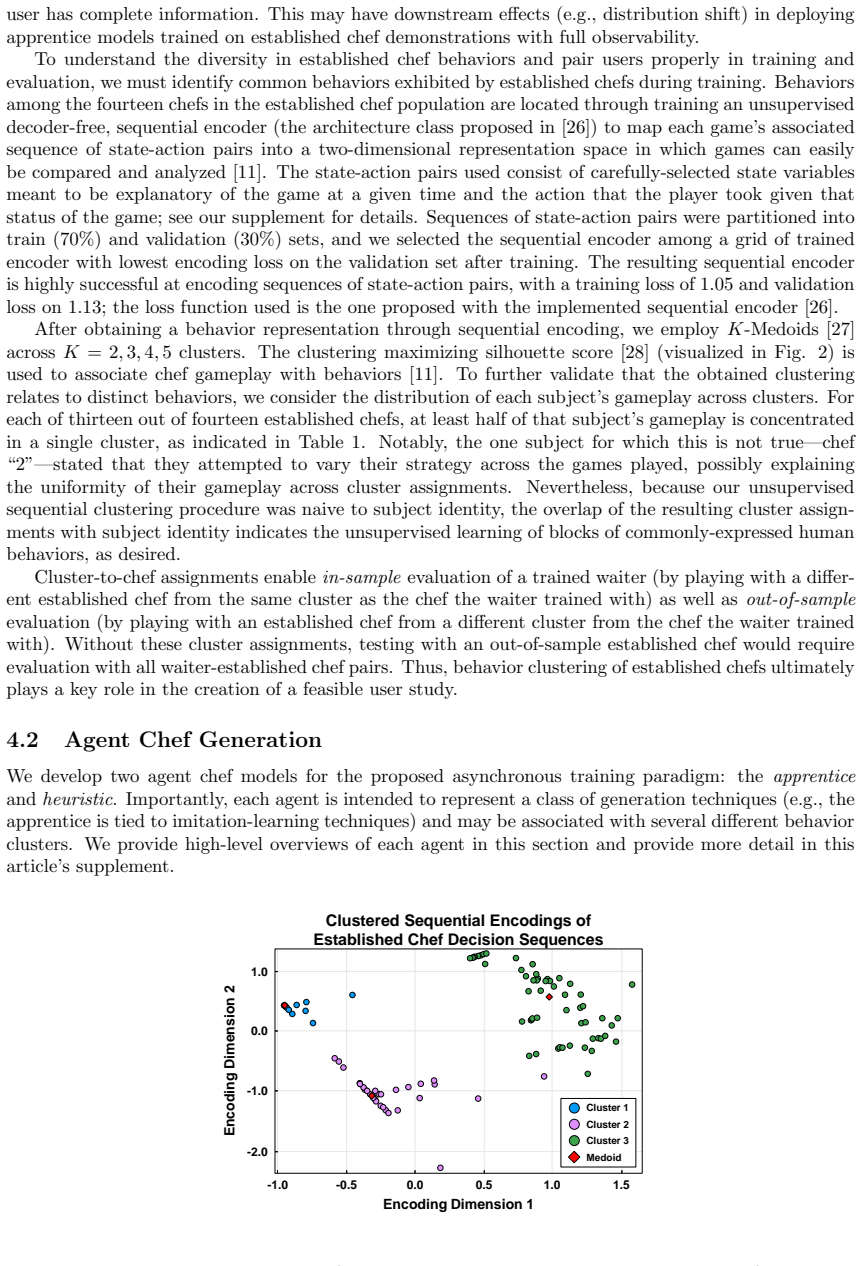
The central object is the behavior cluster: a group of chef demonstrations that share a style, found by training a decoder-free sequential encoder on state-action sequences, projecting each game into a two-dimensional representation, and applying K-medoids clustering with silhouette-score selection. The clusters do two jobs: they let the experiment define in-sample versus out-of-sample evaluation partners, and they condition the apprentice agent's personalized embeddings so that an autonomous chef can exhibit a cluster's style. The apprentice agent is trained with per-cluster embeddings using a personalized apprenticeship-learning objective, while the heuristic chef combines Monte Carlo Tree Search over macro-actions with a Goal-Oriented Action Planner and is programmed to obey waiter recommendations.
What would settle it
Re-encode each established chef's evaluation-session trajectories with the same encoder used in the study and compare their cluster assignments to the clusters assigned from self-play: if a large fraction of evaluation trajectories falls in a different cluster than assigned, or if one chef's trajectories scatter across clusters, then the in-sample versus out-of-sample contrast is not measuring what the design claims and the condition-reduction argument loses its foundation.
Extended reading notes
Core claim
On its own terms, the paper's central claim is that behavior clustering is the load-bearing experimental device: segmenting the design by learned behaviors instead of by individual demonstrators drastically reduces the number of conditions and hence participants required for evaluation. The discovery is methodological, a way to turn a factorial pairing problem into a small set of behavior-conditioned pairings, and it is demonstrated in a real human-subjects study. Within that demonstration, the training manipulation produced a null result on evaluation tips, and waiters rated human chefs significantly higher than both agent chefs on trust, reliance, adaptability, and predictability despite the two agents differing significantly in training performance.
Load-bearing premise
The load-bearing premise is that the behavior clusters learned from chefs playing alone with full information still describe those chefs' behavior when they play with a waiter under partial observability, even though the experiment never forced chefs to stick to their assigned style.
Editorial extensions
If this is right
- Future cooperative-training studies can stratify evaluation by behavior clusters rather than by individual demonstrators, reducing the factorial design from many waiter-chef pairs to a handful of behavior-conditioned pairings.
- Because the two agent chefs differed in training tips but were rated similarly by waiters, subsequent surrogate agents should be tuned for expressed behavior, not raw score, to improve the subjective training experience.
- The null evaluation-tip result implies that training benefits may be masked unless training and evaluation are matched in observability and scenario structure; the paper recommends deliberate scenario design and proficiency checks.
- Autonomous chefs can be generated per behavior cluster, with the apprentice conditioned on per-cluster embeddings and the heuristic given staged-ingredient variants, so waiters can practice with a chosen style.
Reading between the lines
- If chef behavior clusters are stable across partners and game contexts, the same clustering pipeline could be reused to design human-subjects experiments in any cooperative domain where a large population of demonstrators supplies the training partners.
- A natural next experiment would vary the enforcement of cluster identity during evaluation, making some chefs deliberately switch styles, to measure how much of the in-sample versus out-of-sample effect is due to the waiter's adaptation rather than the chef's consistency.
- The equal subjective ratings of the two agents despite their score gap suggest that perceived humanness, such as responsiveness to waiter recommendations and predictable staging habits, may be a better design target than task performance when building robot training partners.
Editorial analysis
A structured set of objections, weighed in public.
Referee Report
Summary. This paper presents a cooperative-asynchronous-training evaluation paradigm applied to a new two-role partial-observability game (HYBS) derived from Overcooked-AI. Established chefs play self-play games; their decision sequences are embedded with a sequential encoder and clustered via K-medoids; waiters are trained with a human, an apprentice agent, a heuristic agent, or no training, and are evaluated with human chefs from the assigned cluster (in-sample) and from a different cluster (out-of-sample). A 52-participant between-subjects study found significant training-tip differences across conditions but no significant differences in evaluation tip, which the authors report as a null training effect. The paper's main contribution is the clustered experimental design that reduces the number of conditions needed for the evaluation.
Significance. The proposed design is potentially valuable for reducing scheduling and participant burden in team-training studies, and the paper is careful and honest in its statistical reporting (normality checks, CIs, Tukey corrections, explicit acknowledgement of the null result). The game environment and clustering methodology are interesting, and the paper ships a real human-subjects demonstration rather than only a simulation. However, the design claim depends on an unvalidated assumption about cluster persistence across settings, and the current manuscript contains at least one internal statistical inconsistency. As a methodological contribution, the paper is promising but needs revision.
major comments (3)
- [Section 4.1 and Section 5] The central claim that behavior clustering enables a tractable experimental design rests on the assumption that cluster assignments learned from full-observability self-play continue to describe chefs' behavior during the partially observable evaluation with waiters. The paper explicitly states "we did not enforce established chefs' compliance with their previous behavior" (Section 5) and acknowledges "distribution shift" from full-observability training data (Section 4.1), yet no validation is provided that a chef assigned to a given cluster in self-play exhibits the corresponding cluster behavior during evaluation. If a chef's behavior changes when paired with an unfamiliar waiter, the in-sample/out-of-sample contrast collapses and the condition-reduction mechanism is invalid. Please add an empirical check of cluster persistence, such as re-encoding evaluation trajectories and comparing cluster assignments, or a behavioral consistency metric collected during evaluation.
- [Section 6.2 and footnote 4] The NULL condition was conducted as a post-hoc follow-on study rather than as part of the original randomized between-subjects design. This makes the comparison between NULL and the other conditions vulnerable to temporal confounds, including changes in the recruitment pool, experimenter experience, or any fixes to game scenarios over time. The Q3 null result (no training benefit) is therefore not a clean causal finding. The paper should either justify that these temporal factors are unlikely to affect the comparison, or explicitly restrict the causal interpretation of Q3.
- [Section 6.2 and Supplement Table 5] The reported evaluation-tip statistic "F(3, 29) = 2.184; p > 0.100" in Section 6.2 matches the Training Quality row of Supplement Table 5, not the evaluation-tip rows. The supplement reports Evaluation Tip (Seen): F(3, 29) = 0.698, p = 0.561 and Evaluation Tip (Unseen): F(3, 29) = 0.714, p = 0.551. The main text should report the correct test statistics; the null conclusion is unaffected, but the internal inconsistency must be corrected.
minor comments (5)
- [Supplement Section 5] The typo "Bonerroni" should be "Bonferroni".
- [Supplement Table 4] The p-value formatting is inconsistent (e.g., "5 .82 × 10−2" contains stray spaces); please standardize the scientific notation.
- [Section 5, first paragraph] The heading "Independent Variables" is followed by "We have one independent variable in our experiment"; the plural "Variables" should be "Variable" for consistency.
- [Section 4.1] The silhouette score that determined the number of clusters K is mentioned but no numeric values for K = 2, 3, 4, 5 are reported; providing those scores would make the clustering choice more transparent.
- [Abstract and Section 2.2] The claim of being "the first evaluation of a cooperative asynchronous training system in a partially observable, multi-agent setting" is strong; consider adding a qualifying phrase such as "to our knowledge" and briefly checking the recency of related literature.
Circularity Check
No significant circularity: the behavior clustering is an input to the experimental design, while the evaluation outcome (tip in new human-chef games) is measured independently of the fitted clustering and apprentice models.
full rationale
The paper's derivation chain is not circular. The central methodological claim is that clustering established-chef decision trajectories into behavior clusters reduces the number of training and evaluation conditions. That claim is supported by a counting argument (Section 4.1: "testing with an out-of-sample established chef would require evaluation with all waiter-established chef pairs") plus the empirical existence of a clustering, not by any equation that defines evaluation outcomes in terms of the fitted clusters. The apprentice agent [9] and sequential encoder/clustering [11, 26] are applied tools; the paper does not invoke them as a uniqueness theorem, and the cluster validation is internal (silhouette score and overlap with subject identity in Table 1). The evaluation metric, cumulative tip during evaluation with a new human chef, is not a fitted value or a renamed cluster label. The paper also reports a null training effect and explicitly lists limitations (Section 6.3: full-observability training versus partial-observability evaluation, inability to separate individual versus team effects, low sample size), and acknowledges in Section 5 that "we did not enforce established chefs' compliance with their previous behavior." These are external-validity concerns, not circularity: no result in the paper is equivalent by construction to its inputs. The self-citations to [9] and [11] are load-bearing as methods but are not unverified substitutes for the paper's argument; the clustering is applied to data and the evaluation outcome is independent of those fitted models.
Assumptions & free parameters
free parameters (6)
- Number of behavior clusters K =
3
- Apprentice embedding dimension =
3
- MCTS iterations for heuristic agent =
10000
- Waiter training duration =
75 minutes
- Games per established chef =
10
- Games sampled per cluster for apprentice training =
27
assumptions (4)
- domain assumption Behavior clusters from sequential encoding of self-play trajectories correspond to stable, distinct chef strategies that persist in team play
- domain assumption Full-observability self-play demonstrations transfer sufficiently to partially-observable team play for training an apprentice
- domain assumption Waiter participants cannot distinguish human from agent during training
- standard math Standard parametric statistics (ANOVA) assumptions hold given reported normality and equality-of-variance tests
Cite this review
Pith. "Pith review of Asynchronous Training of Mixed-Role Human Actors in a Partially-Observable Environment." pith.science (2026). https://pith.science/paper/DPWN3X2W
@misc{pith2026241217954,
  author       = {Pith},
  title        = {Pith review of: Asynchronous Training of Mixed-Role Human Actors in a Partially-Observable Environment},
  year         = {2026},
  howpublished = {\url{https://pith.science/paper/DPWN3X2W}},
  note         = {Machine review of arXiv:2412.17954}
}
read the original abstract
In cooperative training, humans within a team coordinate on complex tasks, building mental models of their teammates and learning to adapt to teammates' actions in real-time. To reduce the often prohibitive scheduling constraints associated with cooperative training, this article introduces a paradigm for cooperative asynchronous training of human teams in which trainees practice coordination with autonomous teammates rather than humans. We introduce a novel experimental design for evaluating autonomous teammates for use as training partners in cooperative training. We apply the design to a human-subjects experiment where humans are trained with either another human or an autonomous teammate and are evaluated with a new human subject in a new, partially observable, cooperative game developed for this study. Importantly, we employ a method to cluster teammate trajectories from demonstrations performed in the experiment to form a smaller number of training conditions. This results in a simpler experiment design that enabled us to conduct a complex cooperative training human-subjects study in a reasonable amount of time. Through a demonstration of the proposed experimental design, we provide takeaways and design recommendations for future research in the development of cooperative asynchronous training systems utilizing robot surrogates for human teammates.
Figures


Figures from the paper (2 more)


Reference graph
Works this paper leans on
-
[1]
Kristina R Gerencser, Jessica S Akers, Lorraine A Becerra, Thomas S Higbee, and Tyra P Sellers. A review of asynchronous trainings for the implementation of behavior analytic assessments and interventions. Journal of Behavioral Education , 29:122--152, 2020
work page 2020
-
[2]
A review of the literature on staff training strategies that minimize trainer involvement
Kathleen E Marano, Jason C Vladescu, Kenneth F Reeve, Tina M Sidener, and David J Cox. A review of the literature on staff training strategies that minimize trainer involvement. Behavioral Interventions , 35(4):604--641, 2020
work page 2020
-
[3]
Richard W Serna, Michelle M Foran, Caroline Cooke, Kaitlyn E Hurd, Ashley J Tello, Rishi Vangapalli, and Charles D Hamad. Teaching discrete trial training: The effects of asynchronous computer-based instruction on live implementation. Journal of Special Education Technology , 31(1):39--49, 2016
work page 2016
-
[4]
Mar \' a In \'e s Gaete, Francisca Belmar, Mat \' as Cort \'e s, Adnan Alseidi, Domenech Asbun, Valentina Dur \'a n, Gabriel Escalona, Pablo Achurra, Ignacio Villagr \'a n, Fernando Crovari, Fernando Pimentel, and Juli \'a n Varas. Remote and asynchronous training network: from a SAGES grant to an eight-country remote laparoscopic simulation training prog...
work page 2023
-
[5]
Ali Pourmand, Christina Woodward, Hamid Shokoohi, Jordan B King, M Reza Taheri, Jackson King, and Christopher Lawrence. Impact of asynchronous training on radiology learning curve among emergency medicine residents and clerkship students. The Permanente Journal , 22, 2018
work page 2018
-
[6]
The role of shared mental models in human- AI teams: a theoretical review
Robert W Andrews, J Mason Lilly, Divya Srivastava, and Karen M Feigh. The role of shared mental models in human- AI teams: a theoretical review. Theoretical Issues in Ergonomics Science , 24(2):129--175, 2023
work page 2023
-
[7]
Situation models: An avenue to the modeling of mental models
Mica R Endsley. Situation models: An avenue to the modeling of mental models. In Proceedings of the Human Factors and Ergonomics Society Annual Meeting , volume 44, pages 61--64, San Diego, CA, USA, 2000. SAGE Publications Sage CA: Los Angeles, CA
work page 2000
-
[8]
Shared mental models and shared displays: An empirical evaluation of team performance
Cheryl A Bolstad and Mica R Endsley. Shared mental models and shared displays: An empirical evaluation of team performance. In Proceedings of the Human Factors and Ergonomics Society Annual Meeting , volume 43, pages 213--217, Santa Monica, CA, USA, 1999. SAGE Publications Sage CA: Los Angeles, CA
work page 1999
Show all 35 references
-
[9]
Interpretable and personalized apprenticeship scheduling: Learning interpretable scheduling policies from heterogeneous user demonstrations
Rohan Paleja, Andrew Silva, Letian Chen, and Matthew Gombolay. Interpretable and personalized apprenticeship scheduling: Learning interpretable scheduling policies from heterogeneous user demonstrations. Advances in neural information processing systems , 33:6417--6428, 2020
2020
-
[10]
The utility of explainable ai in ad hoc human-machine teaming
Rohan Paleja, Muyleng Ghuy, Nadun Ranawaka Arachchige, Reed Jensen, and Matthew Gombolay. The utility of explainable ai in ad hoc human-machine teaming. Advances in neural information processing systems , 34:610--623, 2021
2021
-
[11]
Unsupervised behavior inference from human action sequences
Sam L Polk, Eric J Pabon-Cancel, Rohan Paleja, Kimberlee Chestnut Chang, Reed Jensen, and Mabel D Ramirez. Unsupervised behavior inference from human action sequences. In IEEE Conference on Games , pages 1--8, Milan, Italy, 2024. IEEE
2024
-
[12]
AI in CAI : An artificial intelligence approach to computer-assisted instruction
Jaime R Carbonell. AI in CAI : An artificial intelligence approach to computer-assisted instruction. IEEE Transactions on Man-Machine Systems , 11(4):190--202, 1970
1970
-
[13]
Jill watson: a virtual teaching assistant for online education
Ashok K Goel and Lalith Polepeddi. Jill watson: a virtual teaching assistant for online education. In C. Dede, J. Richards, and B. Saxberg, editors, Learning Engineering for Online Education , chapter 7, pages 120--143. Routledge, New York, NY, USA, 2018
2018
-
[14]
E-learning: Challenges and research opportunities using machine learning & data analytics
Abdallah Moubayed, Mohammadnoor Injadat, Ali Bou Nassif, Hanan Lutfiyya, and Abdallah Shami. E-learning: Challenges and research opportunities using machine learning & data analytics. IEEE Access , 6:39117--39138, 2018
2018
-
[15]
The potential transformation of higher education through computer-based adaptive learning systems
David Johnson and Dina Samora. The potential transformation of higher education through computer-based adaptive learning systems. Global Education Journal , 2016(1), 2016
2016
-
[16]
Using data to understand how to better design adaptive learning
Min Liu, Jina Kang, Wenting Zou, Hyeyeon Lee, Zilong Pan, and Stephanie Corliss. Using data to understand how to better design adaptive learning. Technology, Knowledge and Learning , 22:271--298, 2017
2017
-
[17]
Human-robot teaming configurations: A study of interpersonal communication perceptions and affective learning in higher education
Bryan Abendschein, Chad Edwards, Autumn Edwards, Varun Rijhwani, and Jasmine Stahl. Human-robot teaming configurations: A study of interpersonal communication perceptions and affective learning in higher education. Journal of Communication Pedagogy , 4:123--132, 2021
2021
-
[18]
A reinforcement learning approach to adaptive remediation in online training
Randall Spain, Jonathan Rowe, Andy Smith, Benjamin Goldberg, Robert Pokorny, Bradford Mott, and James Lester. A reinforcement learning approach to adaptive remediation in online training. The Journal of Defense Modeling and Simulation , 19(2):173--193, 2022
2022
-
[19]
Temporal game challenge tailoring
Alexander Zook and Mark O Riedl. Temporal game challenge tailoring. IEEE Transactions on Computational Intelligence and AI in Games , 7:336--346, 2015
2015
-
[20]
Symbolic representation of game world state: Toward real-time planning in games
Jeff Orkin. Symbolic representation of game world state: Toward real-time planning in games. In AAAI Workshop on Challenges in Game Artificial Intelligence , volume 5, pages 26--30, San Jose, CA, USA, 2004. AAAI
2004
-
[21]
Info GAIL : Interpretable imitation learning from visual demonstrations
Yunzhu Li, Jiaming Song, and Stefano Ermon. Info GAIL : Interpretable imitation learning from visual demonstrations. In Advances in neural information processing systems , volume 30, Long Beach, CA, USA, 2017
2017
-
[22]
Apprenticeship learning via inverse reinforcement learning
Pieter Abbeel and Andrew Y Ng. Apprenticeship learning via inverse reinforcement learning. In International Conference on Machine learning , page 1, Banff, Alberta, Canada, 2004. International Machine Learning Society
2004
-
[23]
Learning and comfort in human-robot interaction: A review
Weitian Wang, Yi Chen, Rui Li, and Yunyi Jia. Learning and comfort in human-robot interaction: A review. Applied Sciences , 9(23):5152, 2019
2019
-
[24]
Evaluation of human- AI teams for learned and rule-based agents in H anabi
Ho Chit Siu, Jaime Pe \ n a, Edenna Chen, Yutai Zhou, Victor Lopez, Kyle Palko, Kimberlee Chang, and Ross Allen. Evaluation of human- AI teams for learned and rule-based agents in H anabi. Advances in neural information processing systems , 34:16183--16195, 2021
2021
-
[25]
On the utility of learning about humans for human- ai coordination
Micah Carroll, Rohin Shah, Mark K Ho, Tom Griffiths, Sanjit Seshia, Pieter Abbeel, and Anca Dragan. On the utility of learning about humans for human- ai coordination. Advances in neural information processing systems , 32:5174--5185, 2019
2019
-
[26]
Unsupervised scalable representation learning for multivariate time series
Jean-Yves Franceschi, Aymeric Dieuleveut, and Martin Jaggi. Unsupervised scalable representation learning for multivariate time series. Advances in neural information processing systems , 32:4650--4661, 2019
2019
-
[27]
The elements of statistical learning: data mining, inference, and prediction , volume 2
Trevor Hastie, Robert Tibshirani, and Jerome H Friedman. The elements of statistical learning: data mining, inference, and prediction , volume 2. Springer, New York, NY, USA, 2009
2009
-
[28]
Silhouettes: a graphical aid to the interpretation and validation of cluster analysis
Peter J Rousseeuw. Silhouettes: a graphical aid to the interpretation and validation of cluster analysis. Journal of Computational and Applied Mathematics , 20:53--65, 1987
1987
-
[29]
Bandit based M onte- C arlo planning
Levente Kocsis and Csaba Szepesv \'a ri. Bandit based M onte- C arlo planning. In European Conference on Machine Learning , pages 282--293, Berlin, Germany, 2006. Springer
2006
-
[30]
The real MVP : quantifying individual performances in multiplayer online games
Johannes Pfau. The real MVP : quantifying individual performances in multiplayer online games. In IEEE Conference on Games , pages 1--8, Milan, Italy, 2024. IEEE
2024
-
[31]
The L ikert scale what it is and how to use it
Katherine A Batterton and Kimberly N Hale. The L ikert scale what it is and how to use it. Phalanx , 50(2):32--39, 2017
2017
-
[32]
Statistical models: theory and practice
David A Freedman. Statistical models: theory and practice . Cambridge University Press, New York, NY, USA, 2009
2009
-
[33]
Design of comparative experiments , volume 25
Rosemary A Bailey. Design of comparative experiments , volume 25. Cambridge University Press, New York, NY, USA, 2008
2008
-
[34]
`` A n ideal human'': Expectations of AI teammates in human- AI teaming
Rui Zhang, Nathan J McNeese, Guo Freeman, and Geoff Musick. `` A n ideal human'': Expectations of AI teammates in human- AI teaming. Human-Computer Interaction , 4(CSCW3):1--25, 2021
2021
-
[35]
Artificial Intelligence Planning Systems: Proceedings of the First Conference (AIPS 92)
James Hendler. Artificial Intelligence Planning Systems: Proceedings of the First Conference (AIPS 92) . Elsevier, 2014
2014
Reviewed August 11, 2026 · model on record in the stance chip above.
Discussion (0). Continue with ORCID to comment.