Dirichlet energy and focusing NLS condensates of minimal intensity
Pith reviewed 2026-05-23 07:03 UTC · model grok-4.3
The pith
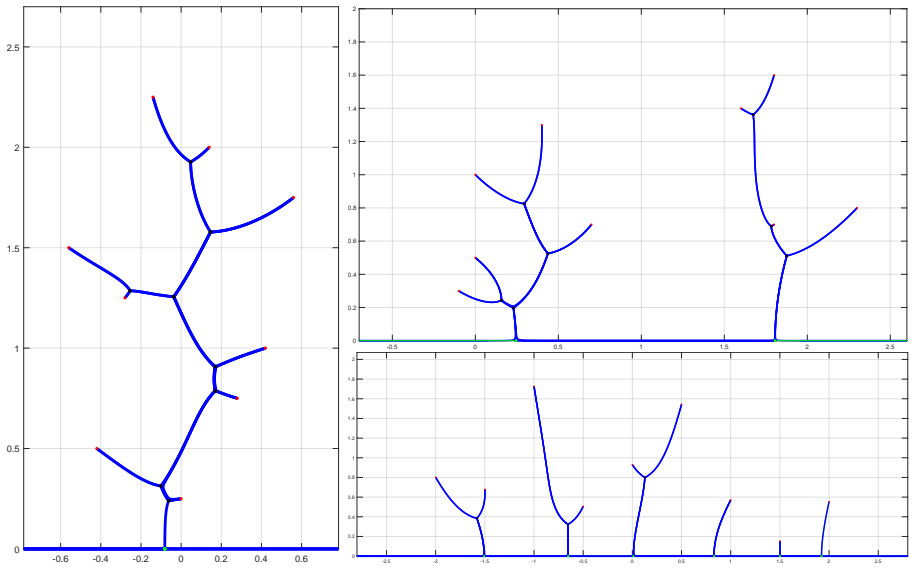
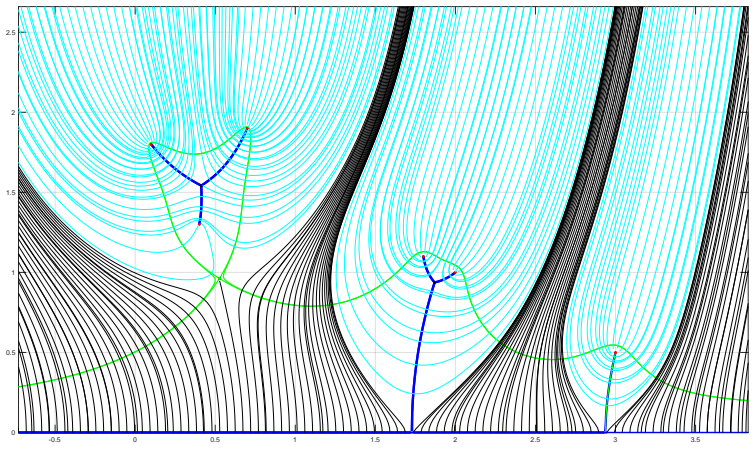
The Dirichlet energy minimizer K* within each connectivity class provides the spectral support for the focusing NLS soliton condensate of least average intensity anchored at E.
A machine-rendered reading of the paper's core claim, the machinery that carries it, and where it could break.
Core claim
For a given harmonic external field, the Dirichlet energy functional I(K) on polycontinua K containing the anchor set E attains its minimum in each connectivity class at a compact K* consisting of critical trajectories of a quadratic differential. In many cases this quadratic differential is the square of the real normalized quasimomentum differential dp associated with the finite gap solutions of the focusing NLS defined by the hyperelliptic Riemann surface branched at E union its conjugate. Consequently, K* is the spectral support of the fNLS soliton condensate of least average intensity within the connectivity class.
What carries the argument
The Dirichlet energy functional I(K) whose minimizers are critical trajectories of a quadratic differential that determines the minimal intensity fNLS soliton condensate.
If this is right
- The spectral support of the minimal intensity condensate is the energy minimizer K*.
- The structure of the minimal condensate is determined by trajectories of the quadratic differential.
- The average intensity is proportional to the minimal value of I(K).
- The connection to finite-gap solutions holds when the quadratic differential coincides with dp squared.
Where Pith is reading between the lines
- This approach could be used to numerically approximate minimal condensates by minimizing the energy functional.
- The method might generalize to other nonlinear wave equations with similar spectral problems.
- Extensions to infinite anchor sets or different external fields could be explored.
Load-bearing premise
That the quadratic differential arising from the energy minimizer coincides with the square of the real normalized quasimomentum differential for the finite-gap fNLS solutions on the hyperelliptic Riemann surface.
What would settle it
Finding or constructing a continuum K in the same connectivity class with strictly smaller Dirichlet energy than the proposed minimizer K*, or identifying a condensate with lower average intensity.
Figures



read the original abstract
We consider the family of (poly)continua $\K$ in the upper half-plane ${\mathbb H} $ that contain a preassigned finite {\it anchor} set $E\in\mathbb H$. For a given harmonic external field we define a Dirichlet energy functional $\mathcal I(\mathcal K)$ and show that within each ``connectivity class'' of the family, there exists a minimizing compact $\mathcal K^*$ consisting of critical trajectories of a quadratic differential. In many cases this quadratic differential coincides with the square of the real normalized quasimomentum differential ${\rm d} {\bf p}$ associated with the finite gap solutions of the focusing Nonlinear Schr\"{o}dinger equation (fNLS) defined by a hyperelliptic Riemann surface $\mathfrak R$ branched at the points $E\cup\bar E$. The motivation for this work lies in the problem of soliton condensate of least average intensity such that a given anchor set $E$ belongs to the poly-continuum $\mathcal K$. An fNLS soliton condensate is defined by a compact $\mathcal K\subset{\mathbb H} $ (its spectral support) whereas the average intensity of the condensate is proportional to $\mathcal I(\mathcal K)$. We prove that the spectral support $\mathcal K^*$ provides the fNLS soliton condensate of the least average intensity within a given ``connectivity class''.
Editorial analysis
A structured set of objections, weighed in public.
Referee Report
Summary. The manuscript considers families of polycontinua K in the upper half-plane containing a fixed finite anchor set E, equipped with a harmonic external field. It defines the Dirichlet energy functional I(K) and proves that, within each connectivity class, a minimizer K* exists and consists of critical trajectories of a quadratic differential. In many cases this quadratic differential is shown to coincide with the square of the real normalized quasimomentum differential dp associated to the hyperelliptic Riemann surface branched over E union conjugate(E), from which the authors conclude that K* realizes the focusing NLS soliton condensate of minimal average intensity (proportional to I(K)) within the given connectivity class.
Significance. If the identification between the energy minimizer and the finite-gap fNLS spectral support holds under clearly stated hypotheses, the work supplies a variational characterization of minimal-intensity soliton condensates via Dirichlet-energy minimization on polycontinua. The explicit description of K* in terms of critical trajectories of a quadratic differential furnishes a concrete geometric construction that links potential theory with the spectral theory of integrable systems, potentially enabling explicit computations of condensate intensity for given anchor sets.
major comments (2)
- [Abstract] Abstract: The central claim that 'K* provides the fNLS soliton condensate of the least average intensity within a given connectivity class' is stated without qualification, yet the preceding sentence asserts the required quadratic-differential identification only 'in many cases.' Because the minimal-intensity conclusion rests on this identification, the precise hypotheses (on E, the external field, or the connectivity class) under which the coincidence holds must be stated explicitly; otherwise the scope of the main theorem remains unclear.
- [Abstract] Abstract (motivation paragraph): The assertion that the average intensity of an fNLS soliton condensate is proportional to I(K) is used to translate the energy-minimization result into a statement about condensates. No derivation or reference is supplied in the abstract for this proportionality; if it is established only under the same 'many cases' restriction as the quadratic-differential coincidence, the translation step requires the same clarification.
Simulated Author's Rebuttal
We thank the referee for the careful reading of the manuscript and the constructive comments on the abstract. We agree that greater precision is needed in stating the scope of the results and will revise the abstract in the next version of the paper.
read point-by-point responses
-
Referee: [Abstract] Abstract: The central claim that 'K* provides the fNLS soliton condensate of the least average intensity within a given connectivity class' is stated without qualification, yet the preceding sentence asserts the required quadratic-differential identification only 'in many cases.' Because the minimal-intensity conclusion rests on this identification, the precise hypotheses (on E, the external field, or the connectivity class) under which the coincidence holds must be stated explicitly; otherwise the scope of the main theorem remains unclear.
Authors: The referee correctly identifies an inconsistency in the level of qualification between the two sentences in the abstract. The manuscript establishes the quadratic differential identification under specific hypotheses detailed in the body (particularly when the external field is harmonic and the anchor set E satisfies the conditions for the hyperelliptic surface to yield real normalized quasimomentum). We will revise the abstract to state these hypotheses explicitly, for example by adding 'when the quadratic differential coincides with dp² as in Theorem 4.2' or by rephrasing the claim to apply within the cases where the identification holds. This will clarify the scope without changing the mathematical content. revision: yes
-
Referee: [Abstract] Abstract (motivation paragraph): The assertion that the average intensity of an fNLS soliton condensate is proportional to I(K) is used to translate the energy-minimization result into a statement about condensates. No derivation or reference is supplied in the abstract for this proportionality; if it is established only under the same 'many cases' restriction as the quadratic-differential coincidence, the translation step requires the same clarification.
Authors: The proportionality is a general property of the soliton condensate definition and is derived in the introduction and Section 2 from the relation between the intensity measure and the Dirichlet integral of the Green potential; it does not depend on the 'many cases' restriction for the quadratic differential. A reference to this derivation (or to the equation establishing the proportionality) will be added to the revised abstract to address the lack of reference. We note that abstracts are space-limited, but a parenthetical note can be included. revision: yes
Circularity Check
No significant circularity; variational existence result is self-contained
full rationale
The paper defines the Dirichlet energy I(K) independently, proves existence of a minimizer K* within each connectivity class (consisting of critical trajectories of a quadratic differential), and separately notes that average intensity of an fNLS condensate is proportional to I(K). The claim that K* therefore yields the minimal-intensity condensate follows directly from this proportionality and the definition of K* as the I-minimizer; it is not a reduction of a derived quantity to a fitted input or self-referential definition. The quadratic-differential coincidence with dp² is stated only 'in many cases' and is not used as a load-bearing step to close the argument. No self-citations, ansatzes smuggled via citation, or renamings of known results appear in the provided text as central to the derivation. The result is a standard variational theorem in complex analysis whose central content does not collapse to its inputs by construction.
Axiom & Free-Parameter Ledger
axioms (2)
- domain assumption Existence of a minimizing compact K* consisting of critical trajectories of a quadratic differential within each connectivity class
- domain assumption The quadratic differential coincides with the square of the real normalized quasimomentum differential dp in many cases
Reference graph
Works this paper leans on
-
[1]
Algebro-geometric Approach to Non-linear Integrable Equations
E. D. Belokolos, A. I. Bobenko, V. Z. Enolski, A. R. Its, and V. B. Matveev, “Algebro-geometric Approach to Non-linear Integrable Equations”, Springer, New York, 1994
work page 1994
-
[2]
M. Bertola, Code for generating minimal Dirichlet energy sets: https://github.com/bertolamarco/NLS soliton condensates minimal intensity
-
[3]
Soliton shielding of the focusing nonlinear Schr¨ odinger
M. Bertola, T. Grava, and G. Orsatti, “Soliton shielding of the focusing nonlinear Schr¨ odinger” equation.Phys. Rev. Lett., 130(12):Paper No. 127201, 6, 2023
work page 2023
-
[4]
R. Bott, “Morse Theory Indomitable”. Publications Math´ ematiques de l’IHES (1988). 68: 99–114. doi:10.1007/bf02698544
-
[5]
The thermodynamic limit of the Whitham equations
G. A. El, “The thermodynamic limit of the Whitham equations”, Phys. Lett. A 311, 374-383 (2003)
work page 2003
-
[6]
Soliton gas in integrable dispersive hydrodynamics
G. A. El, “Soliton gas in integrable dispersive hydrodynamics”, J. Stat. Mech.: Theor. Exp., 114001, (2021)
work page 2021
-
[7]
Spectral theory of soliton and breather gases for the focusing nonlinear Schr¨ odinger equation
G.A. El and A. Tovbis, “Spectral theory of soliton and breather gases for the focusing nonlinear Schr¨ odinger equation”, Phys. Rev. E 101, 052207 (2020)
work page 2020
-
[8]
Theta functions on Riemann surfaces
J.D. Fay. “Theta functions on Riemann surfaces”. Lecture Notes in Mathematics, Vol. 352.Springer- Verlag, Berlin-New York,1973
work page 1973
-
[9]
Geometry and modulation theory for the periodic Nonlinear Schr¨ odinger equation
M. G. Forest and J.-E. Lee, “Geometry and modulation theory for the periodic Nonlinear Schr¨ odinger equation”, in Oscillation Theory, Computation, and Methods of Compensated Compactness, edited by C. Dafermos, J. L. Ericksen, D. Kinderlehrer, and M. Slemrod (Springer New York, New York, NY,
-
[10]
O. Frostman, “Potentiel d’´ equilibre et capacit´ e des ensembles avec quelques applications ` a la th´ eorie des fonctions” (Gleerup, Lund, 1935),Meddelanden Lunds Univ. Mat. Sem.3
work page 1935
-
[11]
M. Girotti, T. Grava, R. Jenkins, K. McLaughlin, and A. Minakov. “Soliton versus the gas: Fredholm determinants, analysis, and the rapid oscillations behind the kinetic equation”, Comm. Pure and Appl. Math., 76.11 (2023), pp. 3233–3299. doi: 10.1002/cpa.22106
-
[12]
Geometric theory of functions of a complex variable
G. M. Goluzin, “Geometric theory of functions of a complex variable”, Transl. Math. Monogr., Vol. 26 American Mathematical Society, Providence, RI, 1969. vi+676 pp
work page 1969
-
[13]
H. Gr¨ otzsch,“¨Uber die Verzerrung bei schlichten nichtkonformen Abbildungen und ¨ ubereine damit zusamenh¨ angende Erweiterung des Picardschen Satzes”. Ber. Verh. S¨ achs. Akad. Wiss. Leipz., Math.- Phys. Kl. 80 (1928), 503-507
work page 1928
-
[14]
Real-normalized differentials: limits on stable curves
S. Grushevsky, I. M. Krichever and C. Norton, “Real-normalized differentials: limits on stable curves”, Russ. Math. Surv., 74, 265, DOI 10.1070/RM9877 (2019)
-
[15]
Periodic problem for the nonlinear Schroedinger equation
A.R.Its and V.P.Kotlyarov, “Explicit formulas for solutions of the Schr¨ odinger nonlinear equation”, Doklady Akad.Nauk Ukrainian SSR, ser.A, no.10, 1976, 965-968. See translation by the author in the second half of arXiv:1401.4445
work page internal anchor Pith review Pith/arXiv arXiv 1976
-
[16]
Univalent functions and conformal mapping
J. A. Jenkins, “Univalent functions and conformal mapping”. Reihe: Moderne Funktionentheorie. Springer-Verlag, Berlin-G¨ ottingen-Heidelberg, 1958. Ergebnisse der Mathematik und ihrer Grenzgebi- ete, (N.F.), Heft 18. 37
work page 1958
-
[17]
On certain problems of minimal capacity
J. A. Jenkins, “On certain problems of minimal capacity”.Illinois J. Math., 10:460–465, 1966
work page 1966
-
[18]
J. A. Jenkins and D. C. Spencer. Hyperelliptic trajectories.Ann. of Math. (2), 53:4–35, 1951
work page 1951
-
[19]
R. Jenkins and A. Tovbis, “Approximation of the thermodynamic limit of finite-gap solutions of the focusing NLS hierarchy by multisoliton solutions”, submitted (arXiv:2408.13700)
-
[20]
A. Kuijlaars and A. Tovbis, “On minimal energy solutions to certain classes of integral equations related to soliton gases for integrable systems”, Nonlinearity 34 no. 10 7227 (2021) (arXiv:2101.03964)
-
[21]
The general coefficient theorem of Jenkins and the method of modules of curve families
G. V. Kuzmina, “The general coefficient theorem of Jenkins and the method of modules of curve families”, J. Math. Sci (N.Y.)207(2015) no. 6, 898–908
work page 2015
-
[22]
On the existence of quadratic differentials with poles of higher orders
G. V. Kuzmina, “On the existence of quadratic differentials with poles of higher orders”,J. Math. Sci. (New York) 83 (1997), no. 6, 772-778
work page 1997
-
[23]
On the existence of quadratic differentials with prescribed properties
G. V. Kuzmina, “On the existence of quadratic differentials with prescribed properties”,J. Math. Sci. (New York) 89 (1998), no. 1, 996-1007
work page 1998
-
[24]
Sur un probl` eme de maximum dans la repr´ esentation conforme
Lavrentieff, M, “Sur un probl` eme de maximum dans la repr´ esentation conforme”,C. R., 191, (1930), 827–829
work page 1930
-
[25]
On the theory of conformal mappings
Lavrentieff, M, “On the theory of conformal mappings”,Trudy Fiz.-Mat. Inst. Steklov. Otdel. Mat.,5, (1934), 159–245 (Russian)
work page 1934
-
[26]
Critical measures, quadratic differentials,and weak limits of zeros of Stieltjes polynomials
A. Martinez-Finkelshtein and E. A. Rakhmanov, “Critical measures, quadratic differentials,and weak limits of zeros of Stieltjes polynomials”,Comm. Math. Phys., 302 (2011), no. 1, 53-111
work page 2011
-
[27]
J. Milnor, “Morse theory”,Annals of Mathematics Studies, no. 51, Princeton University Press, Prince- ton, NJ, 1963
work page 1963
- [28]
-
[29]
Beitrag zur Verallgemeinerung des Verzerrungssatzes auf mehrfach zusammenh¨ angende Gebiete, III
G. P´ olya, “Beitrag zur Verallgemeinerung des Verzerrungssatzes auf mehrfach zusammenh¨ angende Gebiete, III”,Sitzungsberichte Preuss. Akad. Wiss.Berlin, Phys.-Math. Kl. (1929), 55–62 (in German)
work page 1929
-
[30]
Vandenhoeck Ruprecht, G¨ ottingen, 1975
Christian Pommerenke.Univalent functions, volume Band XXV ofStudia Mathematica/Mathematische Lehrb¨ ucher [Studia Mathematica/Mathematical Textbooks]. Vandenhoeck Ruprecht, G¨ ottingen, 1975. With a chapter on quadratic differentials by Gerd Jensen
work page 1975
-
[31]
Orthogonal polynomials and S-curves
E. A. Rakhmanov, “Orthogonal polynomials and S-curves”,Contemp. Math., 578, Amer.Math. Soc., Providence, RI, 2012
work page 2012
-
[32]
E.B. Saff and V. Totik, Logarithmic Potentials with External Fields, Springer Verlag, Berlin, 1997
work page 1997
-
[33]
M. Schiffer and D. Spencer, Functionals of finite Riemann surfaces, Princeton University Press, Prince- ton, N. J., 1954
work page 1954
-
[34]
Stahl, Extremal domains associated with an analytic function
H. Stahl, Extremal domains associated with an analytic function. I, II, Complex Variables Theory Appl. 4 (1985), no. 4, 311-324, 325-338
work page 1985
-
[35]
K. Strebel, “Quadratic differentials”, volume 5 ofErgebnisse der Mathematik und ihrer Grenzgebiete (3) [Results in Mathematics and Related Areas (3)]. Springer-Verlag, Berlin, 1984
work page 1984
-
[36]
A. Tovbis and F. Wang, Recent developments in spectral theory of the focusing NLS soliton and breather gases: the thermodynamic limit of average densities, fluxes and certain meromorphic differentials; periodic gases, J. Phys. A: Math. Theor.55, 424006 (2022)
work page 2022
-
[37]
Soliton condensates for the focusing Nonlinear Schrodinger Equation: a non-bound state case
A. Tovbis and F. Wang, “Soliton condensates for the focusing Nonlinear Schrodinger Equation: a non-bound state case”, SIGMA 20 (2024), 070, 26p (arXiv 2312.16406) 38
-
[38]
The continuum limit of theta functions
S. Venakides, “The continuum limit of theta functions”, Commun. Pure Appl. Math. 42 , (1989), 711-728
work page 1989
-
[39]
A. Vincent, A. Papadopoulos, “A commentary on Teichm¨ uller’s paper Vollst¨ andige L¨ osung einer Ex- tremalaufgabe der quasikonformen Abbildung” IRMA Lect. Math. Theor. Phys., 27 European Mathe- matical Society (EMS), Z¨ urich, 2016, 561-567
work page 2016
-
[40]
V. E. Zakharov, “Kinetic equation for solitons”, Sov. Phys. JETP, 33, 538 (1971). 39
work page 1971
discussion (0)
Sign in with ORCID, Apple, or X to comment. Anyone can read and Pith papers without signing in.