REVIEW 4 major objections 4 minor 1 cited by
gECC: A GPU-based high-throughput framework for Elliptic Curve Cryptography
T0 review · 4 major / 4 minor · reviewed 2026-08-11 · deepseek-v4-flash
Pith's one-line read A GPU framework that batches elliptic-curve operations and trims integer multiply-add instructions claims 5.56x ECDSA and 4.94x ECDH speedups over the leading GPU library.
desk verdict Real GPU-ECC engineering with a genuinely useful SASS-level analysis, but the headline speedups as printed do not match the paper's own tables, and the claimed ECDH result is not actually benchmarked. read the letter →
The pith
A machine-rendered reading of the paper's core claim, the machinery that carries it, and where it could break.
The reading
What carries the argument
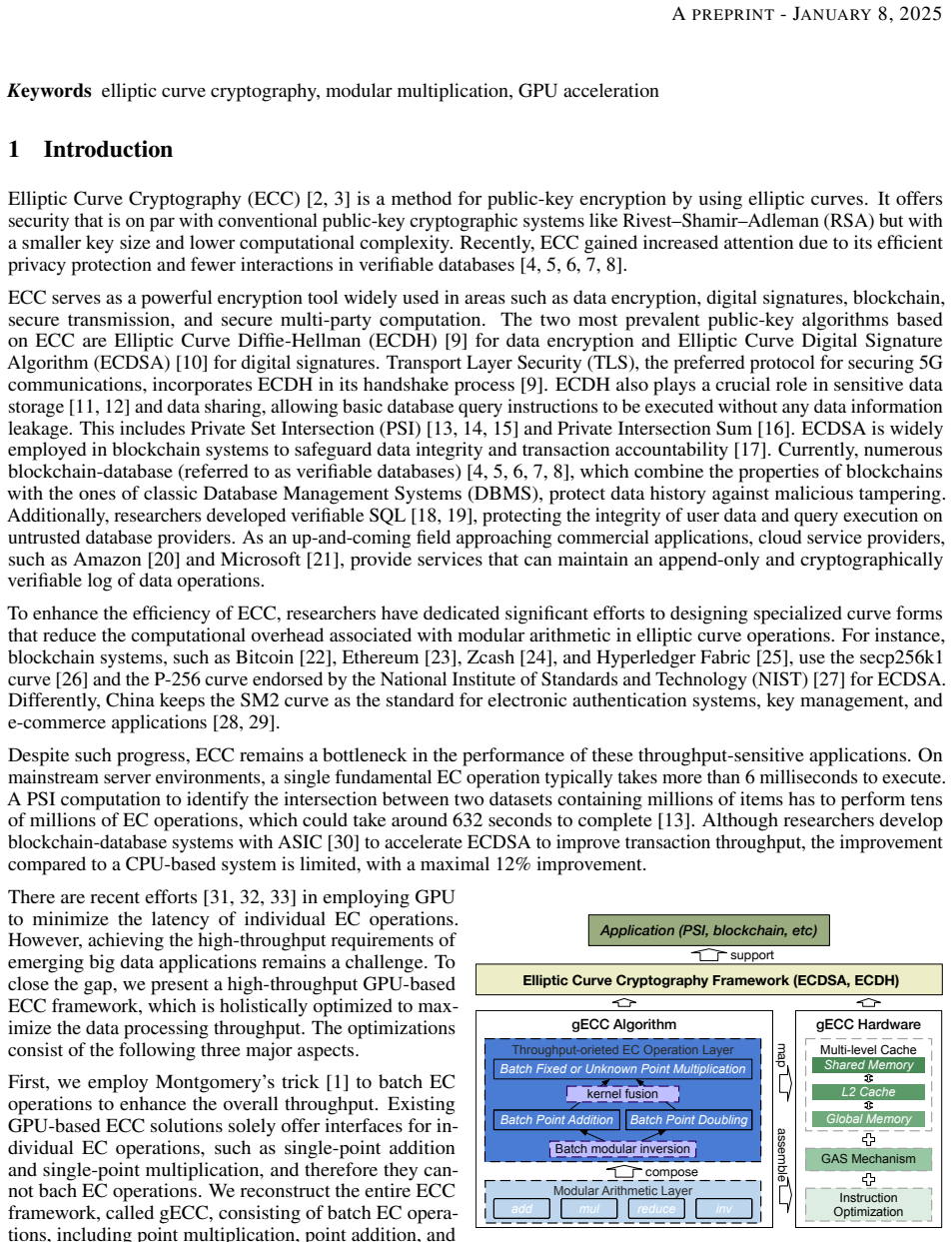
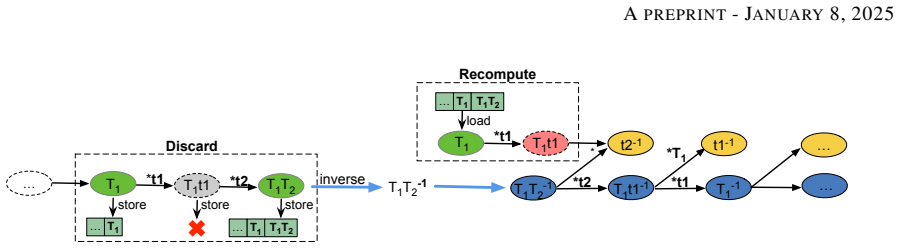
The load-bearing machinery is a stack of three moving parts. Montgomery's trick ([1]) compresses $N$ modular inversions into one inversion plus $3N$ multiplications, making affine-coordinate formulas competitive; a gather-apply-scatter (GAS) scheduling pattern ([34]) runs the compress/inverse/decompress steps across warps so that only one inversion per streaming processor is needed, avoiding divergence. The third part is the SASS-level instruction analysis: the paper measures issue rates of DFMA, DADD, IMAD, and IADD3 on Ampere GPUs, finds IMAD the bottleneck at roughly 136 instructions per 256-bit Montgomery multiplication, and cuts it by carrying the high-word carry through predicate registers, reordering IMADs to avoid register moves, and using the SM2 prime $q = 2^{256} - 2^{224} - 2^{96} + 2^{64} - 1$ to replace IMAD with IADD3 in the reduction phase. The L2 persistent cache and column-major data layout handle the large intermediate arrays.
What would settle it
Benchmark on an A100 the latency of a single 256-bit modular inversion versus a 256-bit modular multiplication, both using the SM2 prime; if the inversion-to-multiplication ratio is below about 20, the $N > 20$ crossover derived in Section 3.1 no longer holds and the reported batch-based speedups would not reproduce.
Extended reading notes
Core claim
The central discovery is that two seemingly unrelated bottlenecks dominate ECC throughput on GPUs and can be attacked together. First, batching: replacing point-by-point Jacobian computation with affine-coordinate formulas batched by Montgomery's trick converts $N$ modular inversions into one inversion plus $3N$ multiplications, and the paper derives that affine batching wins over Jacobian once the batch size $N$ exceeds 20. Second, microarchitecture: by disassembling SASS instructions and measuring issue rates, the paper finds that 256-bit modular multiplication is gated by IMAD instruction count and by register bank conflicts, not by floating-point throughput; their fix uses predicate registers to carry the high-word carry and reorders IMAD instructions to reduce register moves, then exploits the SM2 prime $q = 2^{256} - 2^{224} - 2^{96} + 2^{64} - 1$ to replace further IMADs with IADD3. On the author's measurements, these optimizations yield 1.63-1.72x faster modular multiplication than the fastest single-thread integer baseline, 4.18x faster ECDSA signature generation, 5.56x faster signature verification, 4.94x faster ECDH fixed-point multiplication, and 1.56x higher throughput in a FISCO-BCOS blockchain deployment.
Load-bearing premise
The batching advantage rests on the assumption, imported from CPU latency figures rather than measured on the A100, that modular inversion is roughly 100x more expensive than modular multiplication; if the real ratio is near 20x or below, affine-coordinate batching loses to Jacobian coordinates.
Editorial extensions
If this is right
- For batch sizes above about $N > 20$, affine-coordinate EC operations with Montgomery's-trick batching outperform Jacobian-coordinate operations, so throughput-oriented GPU ECC libraries can safely abandon the usual Jacobian choice.
- Minimizing IMAD instructions matters more than raw instruction count: programs with fewer SASS instructions can run slower if their issue rate is lower, so future GPU arithmetic optimization should be guided by issued-cycle estimation, not instruction totals.
- The SM2 curve's special prime admits a reduction phase built almost entirely from 72 IADD3 instructions instead of hundreds of IMADs, giving 1.63-1.72x over the fastest integer-based baseline on V100 and A100.
- End-to-end, the framework lifts ECDSA signature generation to 14,141,978 per second, signature verification to 4,372,853 per second, and a four-node FISCO-BCOS blockchain from about 5,948 to 9,313 transactions per second.
Reading between the lines
- The paper's IMAD-count analysis is framed for Ampere GPUs; applying the same framework to a different architecture would require re-measuring issue rates, since the 4-cycle IMAD issue interval and IADD3 2-cycle interval are hardware-specific.
- The affine-coordinate batching strategy is not curve-specific in principle, but the IADD3-based reduction gain depends on the SM2 prime's special form; other standardized curves like secp256k1 would need their own reduction identities to see the same arithmetic-level boost.
- The reported gains assume large concurrent workloads; applications with batch sizes below the $N > 20$ crossover would not see the inversion-amortization benefit and could even regress.
- The GAS-style batch inversion could carry over to other finite-field settings where inversion is expensive, such as pairing-based or post-quantum primitives that rely on modular inversions, though the instruction-level tuning would differ.
Signed reviews
Editorial analysis
A structured set of objections, weighed in public.
Referee Report
Summary. The paper presents gECC, a CUDA framework for high-throughput elliptic curve cryptography on GPUs, targeting the SM2 curve on NVIDIA A100 and V100. The framework batches EC operations via Montgomery's trick, uses a Gather-Apply-Scatter mechanism for batch modular inversion, introduces multi-level cache management and column-major data layout, fuses PADD/PDBL kernels, and optimizes modular multiplication at the SASS level by reducing IMAD instructions through predicate-register carries and IADD3 substitutions. The evaluation compares against RapidEC, CGBN, and DPF, and reports multi-fold speedups for ECDSA, ECDH, point multiplication, and modular multiplication, plus a 1.56x improvement in a FISCO-BCOS blockchain application. The claimed headline speedups are 5.56x for ECDSA and 4.94x for ECDH in the abstract; however, these numbers are not consistently reproduced by the tables in Section 5, and no end-to-end ECDH benchmark is presented.
Significance. If the reported results hold, gECC would be a strong systems contribution: it appears to be the first GPU implementation of batched PMUL using Montgomery's trick, it provides a detailed SASS-level analysis of modular multiplication bottlenecks, and it includes useful ablation experiments (RapidEC+OM, RapidEC+OM+BI, RapidEC+OM+BF, gECC-MO, gECC-MO-KF) that isolate the effect of each optimization. The paper also makes the code publicly available, which supports reproducibility. The main weakness is that the central quantitative claims in the abstract and introduction are internally inconsistent with Tables 4 and 5, and the ECDH claim is not backed by any dedicated experiment. These issues are correctable but must be fixed before the paper can be accepted.
major comments (4)
- [Abstract and §5.2] The abstract's headline '5.56x for ECDSA' is not reproduced by Table 4. Section 1 states 4.18x for signature generation and 5.56x for signature verification; Table 4 gives 14,141,978/3,386,544 = 4.18x for generation and 4,372,853/773,481 = 5.65x for verification. The value 5.56x does not appear in Table 4, so the abstract's ECDSA number appears to be a rounding or transcription of the verification-only speedup. Please correct the number to 5.65x and state that it refers to signature verification, or provide an end-to-end ECDSA experiment whose result is 5.56x, and update the abstract accordingly.
- [§5.1 and Table 5] The abstract's 4.94x for ECDH is not supported by any experiment in the paper. Section 5.1 states that ECDH throughput is dominated by FPMUL and that 'we only report the throughput value of the FPMUL operation,' but no ECDH benchmark appears in Section 5. Table 5 gives a maximum FPMUL speedup of 14,389,168/3,810,161 = 3.78x (batch size 2^14). The introduction's pair 'up to 4.04x and 4.94x' for FPMUL and UPMUL also does not match Table 5, whose maxima are 3.78x and 6,689,186/1,427,610 = 4.69x. The 4.94x figure must be either an actual ECDH measurement (which should be added) or a correctly labeled UPMUL value; as written, the most prominent quantitative claim is unverifiable.
- [§3.1] The crossover argument for affine coordinates with Montgomery's trick (N > 20) is derived from CPU latency ratios: Section 2.2 states that modinv/modadd is about 500 and modmul/modadd about 5 'on a mainstream server.' Since the target platform is the A100, and the affine-batching design depends on modular inversion being substantially more expensive than modular multiplication on that GPU, the crossover should be established on the target hardware. Please measure the modinv/modmul latency ratio on the A100 and V100, and if the ratio differs from the CPU-based estimate, re-derive the crossover and re-examine the batch-size claims in Section 5.3.
- [§3.4, Algorithm 3] The claim that 'our design ensures constant time' is not substantiated. Algorithm 3 contains a scalar-dependent branch 'if s[i] == 1 then Qj = Rj' (line 22), and Section 4.1's own microarchitectural analysis shows that instruction issue behavior is sensitive to instruction order and dependencies. On a GPU, a per-thread branch on a secret scalar can produce warp divergence whose timing depends on the scalar bits. Please either remove the constant-time claim, qualify it to 'no secret-dependent operation count' with supporting evidence, or provide a side-channel evaluation showing that the branch does not leak timing information.
minor comments (4)
- [§5.1 and §3.4] There are several typos and terminology issues: 'Votal V100' should be 'Volta V100', 'PUML operation' should be 'PMUL operation', and 'SP' is used for what appears to be the A100's SM or warp scheduler; please define the term consistently with CUDA terminology.
- [Table 3 and §5.4] The notation for the floating-point implementation is inconsistent: Table 3 and parts of Section 4 use 'DPF-1', while Section 5.4 and Figure 12 use 'DFP-1'. Please use one name throughout.
- [§2.2] The statement that modmul and modinv have about 5x and 500x the latency of modadd on a mainstream server has no citation or measurement; please add a reference or move the measurement to the evaluation section.
- [Figures 9 and 10] The normalized-throughput axis labels and the scientific-notation values in Figures 9 and 10 are difficult to read; please enlarge the fonts and label the bars with the exact numeric values used in the text.
Circularity Check
No significant circularity: gECC's results are empirical comparisons against independent baselines; the abstract/table speedup mismatch is a verifiability defect, not circular reasoning.
full rationale
The derivation chain is not circular. The central throughput claims (Section 5, Tables 4 and 5, Figures 9-12) are measured against independent baselines: RapidEC [33], CGBN-1/2/4 [35], DPF-1 [31], and the FISCO-BCOS CPU baseline. gECC's design choices are motivated by (a) the affine-versus-Jacobian operation counts in Table 1, (b) the latency ratios cited in Section 2.2 (modmul about 5x modadd, modinv about 500x modadd), and (c) the SASS instruction-issue microbenchmarks in Table 2. The crossover batch size N>20 in Section 3.1 is a derived design heuristic from those counts and ratios, not a fitted parameter later reported as a prediction; if the GPU's modinv/modmul ratio is lower than the cited CPU ratio, the heuristic weakens, but no fitted quantity is disguised as a prediction. The IMAD-minimization work in Section 4.1 uses a theoretical 136-IMAD count derived from the m^2 + m + m^2 structure of SOS Montgomery multiplication; the paper's claim that its disassembled implementation 'aligns with the theoretical prediction' is a validation against the algorithm structure, not an input-output tautology. No load-bearing step reduces to a self-citation: the cited prior works (Montgomery [1], RapidEC [33], CGBN [35], DPF [31], sppark [50], and the SM2 ASIC work [60]) are external, and none of the authors' own prior results are invoked to justify a design choice. The headline discrepancy between the abstract and introduction numbers (5.56x for ECDSA, 4.94x for ECDH, 4.04x for FPMUL) and Tables 4-5 (4.18x signature generation, 5.65x verification, maximum 3.78x FPMUL, maximum 4.69x UPMUL, and no separate ECDH benchmark) is a serious verifiability and internal-consistency problem, but it is a correctness and number-traceability issue, not circularity. Therefore, the circularity score is 0.
Assumptions & free parameters
free parameters (1)
- L2 persistent cache fraction =
not stated
assumptions (4)
- standard math Elliptic curve group laws and the double-and-add algorithm (Algorithm 1) are correct.
- domain assumption Modular inversion is roughly 100x more expensive than modular multiplication on the target GPU, making affine-coordinate batch inversion beneficial for batch sizes above 20.
- domain assumption The measured SASS instruction issue rates (IMAD/DFMA every 4 cycles, IADD3 every 2 cycles, Table 2) are stable and representative on the A100.
- standard math The SM2 prime q = 2^256 - 2^224 - 2^96 + 2^64 - 1 has q_inv equal to 1, enabling the reduction replacement of IMADs with IADD3s.
Cite this review
Pith. "Pith review of gECC: A GPU-based high-throughput framework for Elliptic Curve Cryptography." pith.science (2026). https://pith.science/paper/HPWZCHYD
@misc{pith2026250103245,
  author       = {Pith},
  title        = {Pith review of: gECC: A GPU-based high-throughput framework for Elliptic Curve Cryptography},
  year         = {2026},
  howpublished = {\url{https://pith.science/paper/HPWZCHYD}},
  note         = {Machine review of arXiv:2501.03245}
}
read the original abstract
Elliptic Curve Cryptography (ECC) is an encryption method that provides security comparable to traditional techniques like Rivest-Shamir-Adleman (RSA) but with lower computational complexity and smaller key sizes, making it a competitive option for applications such as blockchain, secure multi-party computation, and database security. However, the throughput of ECC is still hindered by the significant performance overhead associated with elliptic curve (EC) operations. This paper presents gECC, a versatile framework for ECC optimized for GPU architectures, specifically engineered to achieve high-throughput performance in EC operations. gECC incorporates batch-based execution of EC operations and microarchitecture-level optimization of modular arithmetic. It employs Montgomery's trick to enable batch EC computation and incorporates novel computation parallelization and memory management techniques to maximize the computation parallelism and minimize the access overhead of GPU global memory. Also, we analyze the primary bottleneck in modular multiplication by investigating how the user codes of modular multiplication are compiled into hardware instructions and what these instructions' issuance rates are. We identify that the efficiency of modular multiplication is highly dependent on the number of Integer Multiply-Add (IMAD) instructions. To eliminate this bottleneck, we propose techniques to minimize the number of IMAD instructions by leveraging predicate registers to pass the carry information and using addition and subtraction instructions (IADD3) to replace IMAD instructions. Our results show that, for ECDSA and ECDH, gECC can achieve performance improvements of 5.56x and 4.94x, respectively, compared to the state-of-the-art GPU-based system. In a real-world blockchain application, we can achieve performance improvements of 1.56x, compared to the state-of-the-art CPU-based system.
Figures


Figures from the paper (10 more)




Forward citations
Cited by 1 Pith paper
-
M-ary Precomputation-Based Accelerated Scalar Multiplication Algorithms for Enhanced Elliptic Curve Cryptography
The claimed Θ(Q log p / log Q) speedup is a restatement of known fixed-base precomputation tradeoffs, and the supplied experiments do not validate the stated memory and timing gains.
Reference graph
Works this paper leans on
-
[1]
Peter L Montgomery. Speeding the pollard and elliptic curve methods of factorization.Mathematics of computation, 48(177):243–264, 1987
work page 1987
-
[2]
Use of elliptic curves in cryptography
Victor S Miller. Use of elliptic curves in cryptography. In Conference on the theory and application of cryptographic techniques, pages 417–426. Springer, 1985
work page 1985
-
[3]
Neal Koblitz. Elliptic curve cryptosystems. Mathematics of computation, 48(177):203–209, 1987
work page 1987
-
[4]
Glassdb: An efficient verifiable ledger database system through transparency
Cong Yue, Tien Tuan Anh Dinh, Zhongle Xie, Meihui Zhang, Gang Chen, Beng Chin Ooi, and Xiaokui Xiao. Glassdb: An efficient verifiable ledger database system through transparency. arXiv preprint arXiv:2207.00944, 2022
arXiv 2022
-
[5]
Hybrid blockchain database systems: design and performance
Zerui Ge, Dumitrel Loghin, Beng Chin Ooi, Pingcheng Ruan, and Tianwen Wang. Hybrid blockchain database systems: design and performance. Proceedings of the VLDB Endowment, 15(5):1092–1104, 2022
work page 2022
-
[6]
The anatomy of blockchain database systems
Dumitrel Loghin. The anatomy of blockchain database systems. Data Engineering, page 48, 2022
work page 2022
-
[7]
Xinying Yang, Yuan Zhang, Sheng Wang, Benquan Yu, Feifei Li, Yize Li, and Wenyuan Yan. Ledgerdb: A centralized ledger database for universal audit and verification.Proceedings of the VLDB Endowment, 13(12):3138– 3151, 2020
work page 2020
-
[8]
Spitz: a verifiable database system
Meihui Zhang, Zhongle Xie, Cong Yue, and Ziyue Zhong. Spitz: a verifiable database system. Proc. VLDB Endow., 13(12):3449–3460, August 2020
work page 2020
Show all 61 references
-
[9]
Elliptic curve cryptography (ecc) cipher suites for transport layer security (tls)
Simon Blake-Wilson, Nelson Bolyard, Vipul Gupta, Chris Hawk, and Bodo Moeller. Elliptic curve cryptography (ecc) cipher suites for transport layer security (tls). Technical report, 2006. 17 A PREPRINT - JANUARY 8, 2025
2006
-
[10]
The elliptic curve digital signature algorithm (ecdsa)
Don Johnson, Alfred Menezes, and Scott Vanstone. The elliptic curve digital signature algorithm (ecdsa). International journal of information security, 1:36–63, 2001
2001
-
[11]
Than Myo Zaw, Min Thant, and S. V . Bezzateev. Database security with aes encryption, elliptic curve encryption and signature. In 2019 Wave Electronics and its Application in Information and Telecommunication Systems (WECONF), pages 1–6, 2019
2019
-
[12]
Secured data storage and retrieval using elliptic curve cryptography in cloud
Pradeep Suthanthiramani, Sannasy Muthurajkumar, Ganapathy Sannasi, and Kannan Arputharaj. Secured data storage and retrieval using elliptic curve cryptography in cloud. Int. Arab J. Inf. Technol., 18(1):56–66, 2021
2021
-
[13]
Spot-light: lightweight private set intersection from sparse ot extension
Benny Pinkas, Mike Rosulek, Ni Trieu, and Avishay Yanai. Spot-light: lightweight private set intersection from sparse ot extension. In Advances in Cryptology–CRYPTO 2019: 39th Annual International Cryptology Conference, Santa Barbara, CA, USA, August 18–22, 2019, Proceedings, ...
2019
-
[14]
Unbalanced private set intersection with linear communication complexity
Quanyu Zhao, Yuan Zhang Bingbing Jiang, Heng Wang, Yunlong Mao, and Sheng Zhong. Unbalanced private set intersection with linear communication complexity. SCIENCE CHINA Information Sciences, 67(3):132105–, 2024
2024
-
[15]
Efficient secure computation from sm series cryptography
Yibiao Lu, Zecheng Wu, Bingsheng Zhang, and Kui Ren. Efficient secure computation from sm series cryptography. Wireless Communications and Mobile Computing, 2023(1):6039034, 2023
2023
-
[16]
Practical private intersection-sum protocols with good scalability
Yuanyuan Li, Hanyue Xiao, Peng Han, and Zhihao Zhou. Practical private intersection-sum protocols with good scalability. In Jianming Zhu, Qianhong Wu, Yong Ding, Xianhua Song, and Zeguang Lu, editors, Blockchain Technology and Application, pages 49–63, Singapore, 2024. Springe...
2024
-
[17]
Cryptographic primitives in blockchains
Licheng Wang, Xiaoying Shen, Jing Li, Jun Shao, and Yixian Yang. Cryptographic primitives in blockchains. Journal of Network and Computer Applications, 127:43–58, 2019
2019
-
[18]
Integridb: Verifiable sql for outsourced databases
Yupeng Zhang, Jonathan Katz, and Charalampos Papamanthou. Integridb: Verifiable sql for outsourced databases. In Proceedings of the 22nd ACM SIGSAC Conference on Computer and Communications Security, pages 1480– 1491, 2015
2015
-
[19]
Scalable verification for outsourced dynamic databases
HweeHwa Pang, Jilian Zhang, and Kyriakos Mouratidis. Scalable verification for outsourced dynamic databases. Proceedings of the VLDB Endowment, 2(1):802–813, 2009
2009
-
[20]
Amazon quantum ledger database, 2019
Amazon. Amazon quantum ledger database, 2019. https://aws.amazon.com/qldb/
2019
-
[21]
Sql ledger: Cryptographically verifiable data in azure sql database
Panagiotis Antonopoulos, Raghav Kaushik, Hanuma Kodavalla, Sergio Rosales Aceves, Reilly Wong, Jason Anderson, and Jakub Szymaszek. Sql ledger: Cryptographically verifiable data in azure sql database. In Proceedings of the 2021 international conference on management of data, p...
2021
-
[22]
Bitcoin: A peer-to-peer electronic cash system
Satoshi Nakamoto. Bitcoin: A peer-to-peer electronic cash system. 2008
2008
-
[23]
Ethereum: A secure decentralised generalised transaction ledger
Gavin Wood et al. Ethereum: A secure decentralised generalised transaction ledger. Ethereum project yellow paper, 151(2014):1–32, 2014
2014
-
[24]
Zerocash: Decentralized anonymous payments from bitcoin
Eli Ben Sasson, Alessandro Chiesa, Christina Garman, Matthew Green, Ian Miers, Eran Tromer, and Madars Virza. Zerocash: Decentralized anonymous payments from bitcoin. In 2014 IEEE symposium on security and privacy, pages 459–474. IEEE, 2014
2014
-
[25]
Hyperledger fabric: a distributed operating system for permissioned blockchains
Elli Androulaki, Artem Barger, Vita Bortnikov, Christian Cachin, Konstantinos Christidis, Angelo De Caro, David Enyeart, Christopher Ferris, Gennady Laventman, Yacov Manevich, et al. Hyperledger fabric: a distributed operating system for permissioned blockchains. In Proceeding...
2018
-
[26]
Sec 2: Recommended elliptic curve domain parameters
Minghua Qu. Sec 2: Recommended elliptic curve domain parameters. Certicom Res., Mississauga, ON, Canada, Tech. Rep. SEC2-Ver-0.6, 1999
1999
-
[27]
Digital signature standard (dss)
National Institute of Standards and Technology (NIST). Digital signature standard (dss). Federal Information Processing Standards (FIPS) Publication 186-4, 2024. https://nvlpubs.nist.gov/nistpubs/fips/nist. fips.186-4.pdf
2024
-
[28]
Provably-secure (chinese government) sm2 and simplified sm2 key exchange protocols
Ang Yang, Junghyun Nam, Moonseong Kim, and Kim-Kwang Raymond Choo. Provably-secure (chinese government) sm2 and simplified sm2 key exchange protocols. The Scientific World Journal, 2014(1):825984, 2014
2014
-
[29]
Public key cryptographic algorithm sm2 based on elliptic curves, 2016
State Cryptography Administration of China (SCA). Public key cryptographic algorithm sm2 based on elliptic curves, 2016
2016
-
[30]
Baldur: A hybrid blockchain database with fpga or gpu acceleration
Rares Ifrim, Dumitrel Loghin, and Decebal Popescu. Baldur: A hybrid blockchain database with fpga or gpu acceleration. In Proceedings of the 1st Workshop on Verifiable Database Systems, VDBS ’23, page 19–27, New York, NY , USA, 2023. Association for Computing Machinery. 18 A P...
2023
-
[31]
Dpf-ecc: Accelerating elliptic curve cryptography with floating-point computing power of gpus
Lili Gao, Fangyu Zheng, Niall Emmart, Jiankuo Dong, Jingqiang Lin, and Charles Weems. Dpf-ecc: Accelerating elliptic curve cryptography with floating-point computing power of gpus. In 2020 IEEE International Parallel and Distributed Processing Symposium (IPDPS), pages 494–504....
2020
-
[32]
Dpf-ecc: A framework for efficient ecc with double precision floating-point computing power
Lili Gao, Fangyu Zheng, Rong Wei, Jiankuo Dong, Niall Emmart, Yuan Ma, Jingqiang Lin, and Charles Weems. Dpf-ecc: A framework for efficient ecc with double precision floating-point computing power. IEEE Transactions on Information Forensics and Security, 16:3988–4002, 2021
2021
-
[33]
Accelerating elliptic curve digital signature algorithms on gpus
Zonghao Feng, Qipeng Xie, Qiong Luo, Yujie Chen, Haoxuan Li, Huizhong Li, and Qiang Yan. Accelerating elliptic curve digital signature algorithms on gpus. In SC22: International Conference for High Performance Computing, Networking, Storage and Analysis, pages 1–13. IEEE, 2022
2022
-
[34]
Gonzalez, Yucheng Low, Haijie Gu, Danny Bickson, and Carlos Guestrin
Joseph E. Gonzalez, Yucheng Low, Haijie Gu, Danny Bickson, and Carlos Guestrin. PowerGraph: Distributed Graph-Parallel computation on natural graphs. In 10th USENIX Symposium on Operating Systems Design and Implementation (OSDI 12), pages 17–30, Hollywood, CA, October 2012. US...
2012
-
[35]
Cgbn: Cuda accelerated multiple precision arithmetic (big num) using cooperative groups, 2018
NVIDIA. Cgbn: Cuda accelerated multiple precision arithmetic (big num) using cooperative groups, 2018. https://github.com/NVlabs/CGBN
2018
-
[36]
Faster modular exponentiation using double precision floating point arithmetic on the gpu
Niall Emmart, Fangyu Zheng, and Charles Weems. Faster modular exponentiation using double precision floating point arithmetic on the gpu. In 2018 IEEE 25th Symposium on Computer Arithmetic (ARITH), pages 130–137. IEEE, 2018
2018
-
[37]
Tls/ssl and crypto library, 2024
OpenSSL Software Foundation. Tls/ssl and crypto library, 2024. https://github.com/openssl/openssl
2024
-
[38]
An efficient elliptic curve cryptography signature server with gpu acceleration
Wuqiong Pan, Fangyu Zheng, Yuan Zhao, Wen-Tao Zhu, and Jiwu Jing. An efficient elliptic curve cryptography signature server with gpu acceleration. IEEE Transactions on Information Forensics and Security, 12(1):111–122, 2017
2017
-
[39]
Guide to elliptic curve cryptography
Darrel Hankerson, Alfred J Menezes, and Scott Vanstone. Guide to elliptic curve cryptography. Springer Science & Business Media, 2006
2006
-
[40]
Accelerating sm2 digital signature algorithm using modern processor features
Long Mai, Yuan Yan, Songlin Jia, Shuran Wang, Jianqiang Wang, Juanru Li, Siqi Ma, and Dawu Gu. Accelerating sm2 digital signature algorithm using modern processor features. In International Conference on Information and Communications Security, pages 430–446. Springer, 2019
2019
-
[41]
Parallel implementation of sm2 elliptic curve cryptogra- phy on intel processors with avx2
Junhao Huang, Zhe Liu, Zhi Hu, and Johann Großschädl. Parallel implementation of sm2 elliptic curve cryptogra- phy on intel processors with avx2. In Information Security and Privacy: 25th Australasian Conference, ACISP 2020, Perth, WA, Australia, November 30–December 2, 2020, ...
2020
-
[42]
Modular multiplication without trial division
Peter L Montgomery. Modular multiplication without trial division. Mathematics of computation, 44(170):519– 521, 1985
1985
-
[43]
Analyzing and comparing montgomery multiplication algorithms
C Kaya Koc, Tolga Acar, and Burton S Kaliski. Analyzing and comparing montgomery multiplication algorithms. IEEE micro, 16(3):26–33, 1996
1996
-
[44]
Fast constant-time gcd computation and modular inversion
Daniel J Bernstein and Bo-Yin Yang. Fast constant-time gcd computation and modular inversion. IACR Transactions on Cryptographic Hardware and Embedded Systems, pages 340–398, 2019
2019
-
[45]
High-assurance field inversion for curve-based cryptography
Benjamin Salling Hvass, Diego F Aranha, and Bas Spitters. High-assurance field inversion for curve-based cryptography. In 2023 IEEE 36th Computer Security Foundations Symposium (CSF), pages 552–567. IEEE, 2023
2023
-
[46]
Bernstein, Billy Bob Brumley, Ming-Shing Chen, and Nicola Tuveri
Daniel J. Bernstein, Billy Bob Brumley, Ming-Shing Chen, and Nicola Tuveri. OpenSSLNTRU: Faster post- quantum TLS key exchange. In 31st USENIX Security Symposium (USENIX Security 22), pages 845–862, Boston, MA, August 2022. USENIX Association
2022
-
[47]
sdpf-rsa: Utilizing floating-point computing power of gpus for massive digital signature computations
Jiankuo Dong, Fangyu Zheng, Niall Emmart, Jingqiang Lin, and Charles Weems. sdpf-rsa: Utilizing floating-point computing power of gpus for massive digital signature computations. In 2018 IEEE International Parallel and Distributed Processing Symposium (IPDPS), pages 599–609, 2018
2018
-
[48]
Exploiting the potential of gpus for modular multiplication in ecc
Fangyu Zheng, Wuqiong Pan, Jingqiang Lin, Jiwu Jing, and Yuan Zhao. Exploiting the potential of gpus for modular multiplication in ecc. In International Workshop on Information Security Applications, pages 295–306. Springer, 2014
2014
-
[49]
Towards high- performance x25519/448 key agreement in general purpose gpus
Jiankuo Dong, Fangyu Zheng, Juanjuan Cheng, Jingqiang Lin, Wuqiong Pan, and Ziyang Wang. Towards high- performance x25519/448 key agreement in general purpose gpus. In 2018 IEEE Conference on Communications and Network Security (CNS), pages 1–9. IEEE, 2018
2018
-
[50]
Zero-knowledge template library, 2024
Supranational Corp. Zero-knowledge template library, 2024. https://github.com/supranational/sppark
2024
-
[51]
Accelerating the future of zero-knowledge cryptography, 2023
ZPrize. Accelerating the future of zero-knowledge cryptography, 2023. https://www.zprize.io/. 19 A PREPRINT - JANUARY 8, 2025
2023
-
[52]
Cuda c++ programming guide, 2024
Nvidia Corp. Cuda c++ programming guide, 2024. https://docs.nvidia.com/cuda/ cuda-c-programming-guide/index.html#arithmetic-instructions
2024
-
[53]
Nvidia a100 tensor core gpu architecture, 2022
NVIDIA. Nvidia a100 tensor core gpu architecture, 2022. https://images.nvidia.com/aem-dam/en-zz/ Solutions/data-center/nvidia-ampere-architecture-whitepaper.pdf
2022
-
[54]
Paul C. Kocher. Timing attacks on implementations of diffie-hellman, rsa, dss, and other systems. In Neal Koblitz, editor, Advances in Cryptology — CRYPTO ’96 , pages 104–113, Berlin, Heidelberg, 1996. Springer Berlin Heidelberg
1996
-
[55]
Cuda kernel profiling using nvidia nsight compute, 2019
Nvidia Corp. Cuda kernel profiling using nvidia nsight compute, 2019. https: //developer.download.nvidia.cn/video/gputechconf/gtc/2019/presentation/ s9345-cuda-kernel-profiling-using-nvidia-nsight-compute.pdf
2019
-
[56]
Nsight compute documentation, 2024
Nvida Corp. Nsight compute documentation, 2024. https://docs.nvidia.com/nsight-compute/2023.2/ index.html
2024
-
[57]
Communication optimization on gpu: A case study of sequence alignment algorithms
Jie Wang, Xinfeng Xie, and Jason Cong. Communication optimization on gpu: A case study of sequence alignment algorithms. In 2017 IEEE International Parallel and Distributed Processing Symposium (IPDPS), pages 72–81. IEEE, 2017
2017
-
[58]
Dissecting the nvidia volta gpu architecture via microbenchmarking
Zhe Jia, Marco Maggioni, Benjamin Staiger, and Daniele P Scarpazza. Dissecting the nvidia volta gpu architecture via microbenchmarking. arXiv preprint arXiv:1804.06826, 2018
2018 arXiv
-
[59]
Dissecting the ampere gpu architecture through microbenchmarking
Z Jia and PV Sandt. Dissecting the ampere gpu architecture through microbenchmarking. In GTC, 2021
2021
-
[60]
A high-performance elliptic curve cryptographic processor of sm2 over gf (p)
Xianghong Hu, Xin Zheng, Shengshi Zhang, Weijun Li, Shuting Cai, and Xiaoming Xiong. A high-performance elliptic curve cryptographic processor of sm2 over gf (p). Electronics, 8(4):431, 2019
2019
-
[61]
FISCO BCOS: an enterprise-level financial blockchain platform developed and open-sourced by the Financial Services Blockchain Consortium (Shenzhen) "FISCO" led by WeBank., 2024
FISCO. FISCO BCOS: an enterprise-level financial blockchain platform developed and open-sourced by the Financial Services Blockchain Consortium (Shenzhen) "FISCO" led by WeBank., 2024. https://github.com/ FISCO-BCOS/java-sdk-demo.git . 20
2024
Reviewed August 11, 2026 · model on record in the stance chip above.
Discussion (0). Continue with ORCID to comment.