REVIEW 3 major objections 4 minor 3 cited by
MixNet: A Runtime Reconfigurable Optical-Electrical Fabric for Distributed Mixture-of-Experts Training
T0 review · 3 major / 4 minor · reviewed 2026-08-10 · deepseek-v4-flash
Pith's one-line read MixNet's reconfigurable fabric matches fat-tree speed while cutting MoE networking cost up to 2.3x.
desk verdict Fresh architectural idea for MoE training interconnects, backed by real measurements and a working prototype, but the central performance claim leans on an unproven NIC re-activation fix. read the letter →
The pith
A machine-rendered reading of the paper's core claim, the machinery that carries it, and where it could break.
The reading
What carries the argument
The load-bearing mechanism is the regionally reconfigurable high-bandwidth domain: a commodity OCS with millisecond-scale reconfiguration (a few hundred ports) connected to a subset of each server's network cards, coordinated by a decentralized topology controller per region. The argument is carried by a greedy bottleneck-allocation algorithm (Algorithm 1) that repeatedly finds the server pair whose all-to-all transfer would take longest under the current circuit allocation and adds an optical circuit between them until the available ports are exhausted, producing a network-card-level mapping that the OCS then realizes. Around this sit the traffic monitor, which exploits the partial predictability of the four all-to-all phases per MoE block, and the collective communication runtime, which routes tensor-parallel traffic inside the server, expert-parallel traffic over the OCS fabric, and data- and pipeline-parallel traffic over the electrical packet-switched network.
What would settle it
Run the same 32-GPU prototype training a real MoE model and include the full reconfiguration turnaround, optical switch command, path switching, transceiver re-lock, and network-card re-activation, in every iteration. If the turnaround stays near the measured 5.7 seconds (99th percentile 6.33 s) instead of the 25 ms used in simulation, MixNet's speed parity with fat-tree would fail, since each training iteration contains multiple reconfigurations and the gaps between all-to-all phases are only tens of milliseconds.
Extended reading notes
Core claim
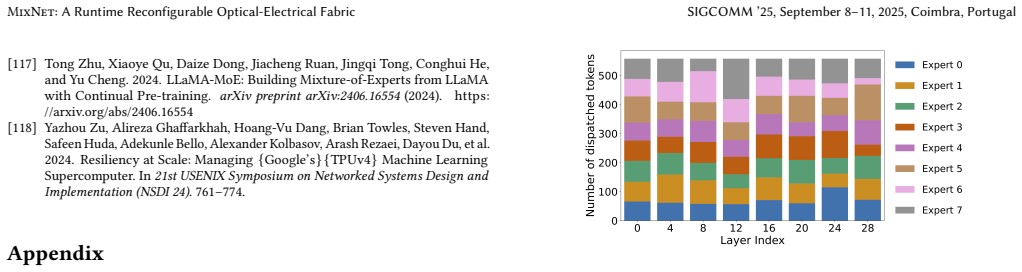
The central discovery is that MoE training's expert-parallel all-to-all traffic, although non-deterministic and non-uniform, is regionally local: it stays within a single MoE block and its pipeline-parallel stage, so a fabric only needs to reconfigure within a few hundred server ports, not globally. MixNet leverages this by placing a millisecond-reconfigurable OCS at the boundary of the scale-up and scale-out domains and reconfiguring it inside the training iteration, using the four all-to-all phases per MoE layer, which are identical or transposed and partially predictable, as scheduling windows. The paper argues that this regionally reconfigurable design reconciles the OCS trade-off between port count and reconfiguration delay, making in-training topology reconfiguration practical with commodity hardware at 30K+ GPU scales. The paper's stated result is parity in training iteration time with non-blocking fat-tree and rail-optimized fabrics at lower networking cost, which it quantifies as 1.2x-1.5x and 1.9x-2.3x better cost-efficiency at 100 Gbps and 400 Gbps, respectively.
Load-bearing premise
The whole benefit rests on the assumption that after each optical reconfiguration, the network cards and transceivers recover within the computation window, but the prototype measures an average recovery time of about 5.7 seconds, which the paper excludes from training time and attributes to a fixable transceiver limitation.
Editorial extensions
If this is right
- MoE training can run at fat-tree-level speed while using roughly half the networking hardware, because dense expert-pair traffic is carried by cheap optical circuits instead of over-provisioned electrical switches.
- In-training reconfiguration becomes a schedulable resource: since the four all-to-all communication phases per MoE layer share the same or transposed traffic matrices, topology changes can be prepared during attention and expert computation, hiding millisecond-scale OCS delays.
- The fabric scales by partitioning rather than by enlarging OCS port count, so commodity OCS devices (a few hundred ports) suffice for clusters of tens of thousands of GPUs.
- When co-packaged optical I/O reaches accelerator chips, the same regional OCS concept extends to high-radix scale-up systems, where MixNet's simulations show a 1.3x iteration-time improvement over an NVL72-style cluster.
- The EPS-OCS split gives natural fault tolerance: network-card and GPU failures can be worked around by forwarding through the other fabric, with simulation overheads of at most a few percent for network-card failures and up to about 13% for a full server failure.
Reading between the lines
- A direct consequence the paper leaves implicit is that MixNet's cost advantage is partly a trade of transceiver price for switch price; if OCS port or transceiver costs fall faster than electrical switch ports, the optimal optical degree and the breakeven cluster size both shift, changing the reported margins.
- The regional-locality measurement should be re-tested on models trained with auxiliary load-balancing losses, since the paper's own production data show that the total per-expert volumes converge while the sparse traffic matrix persists; models with explicit expert pruning or biased routing may exhibit stronger or qualitatively different locality.
- If burst-mode transceivers deliver the millisecond re-activation the paper assumes, the same regional reconfiguration mechanism is a natural fit for MoE inference serving, where token routing is even more dynamic; the paper does not evaluate this application.
Editorial analysis
A structured set of objections, weighed in public.
Referee Report
Summary. MixNet is a regionally reconfigurable optical-electrical fabric for distributed Mixture-of-Experts (MoE) training. The paper makes three main contributions: (1) a production measurement study of MoE all-to-all traffic showing that, despite temporal and spatial non-uniformity, the traffic has strong locality within MoE blocks; (2) an architecture that augments a static electrical packet-switched fabric with regional optical circuit switches (OCS) and a greedy topology-reconfiguration algorithm, together with a traffic predictor (MixNet-Copilot) and a custom collective communication runtime; and (3) an evaluation using a 32-GPU A100 prototype and large-scale packet-level simulations across four MoE models. The paper claims that MixNet achieves training speed comparable to non-blocking fat-tree and rail-optimized fabrics while improving networking cost-efficiency by 1.2x-1.5x at 100 Gbps and 1.9x-2.3x at 400 Gbps link bandwidths.
Significance. If the central claim holds, MixNet would be a substantial step toward cost-efficient, runtime-reconfigurable interconnects for MoE training, an increasingly important workload for large-scale AI clusters. The paper is commendable for its concrete measurement study, a working testbed, and a transparent cost model based on publicly available component prices. The evaluation is thorough in many respects: it compares against independent baselines (fat-tree, rail-optimized, TopoOpt), reports sensitivity to optical degree and reconfiguration latency, and includes failure-resilience experiments. However, the key hardware assumption that NIC/transceiver re-activation can be made fast enough to hide within MoE computation is not validated in the prototype; the measured 5.67 s average NIC activation time is excluded from the testbed training time. This makes the reported significance conditional on future burst-mode transceiver features. The core algorithmic and architectural ideas are sound, but the performance-cost conclusion is not yet established for current commodity hardware.
major comments (3)
- [Appendix C, Figures 22-23 and §6 Figure 10] The prototype evaluation excludes the measured NIC and transceiver activation time from the reported training iteration time. Appendix C explicitly states that the NIC activation time (average 5.67 s, 99th percentile 6.33 s) is excluded from the testbed training time, and the OCS-only reconfiguration is measured at 41.44-46.75 ms on average (99th percentile 60-68 ms). Because every in-training reconfiguration requires the OCS switch and the NIC/transceiver to re-activate before data transfer can resume, the testbed in Figure 10 does not demonstrate that MixNet delivers 'comparable performance' to the EPS baseline under actual current hardware behavior. The paper defers the resolution of this to future burst-mode transceivers, but the central performance claim in §7 is built on the same idealization, so the claim that MixNet is production-ready with commodity hardware is not supported by the presented evidence.
- [§7.1 and Appendix D.7, Figure 28] The large-scale simulations set the OCS reconfiguration latency to 25 ms, but the prototype's measured OCS-only reconfiguration time is 41-68 ms even before NIC activation is considered. Figure 28 presents sensitivity to reconfiguration time from 1 µs to 10 s, but it does not mark the 25 ms simulation point or the measured 41-68 ms range, and the y-axis shows only normalized iteration time without the NIC activation component. The manuscript should either repeat the key simulations with the measured OCS reconfiguration delays, or provide a documented engineering justification for why 25 ms is representative of the deployed system. Without this, the cost-efficiency headline (e.g., 1.9x-2.3x at 400 Gbps) is not tied to a validated performance denominator.
- [§B.1 and Figure 19] MixNet-Copilot is evaluated only on top-k prediction accuracy for expert load distributions; there is no end-to-end measurement or simulation of how prediction errors affect actual training iteration time. Since the first all-to-all communication in the forward pass relies on this predictor (or on the previous layer's topology), a wrong prediction could yield a suboptimal OCS topology and erase the intended performance benefit. The paper should report the training-time impact under realistic prediction error, even in simulation, to substantiate the claim that proactive reconfiguration for the first all-to-all is beneficial.
minor comments (4)
- [§10] The sentence about Shoal reads 'is not unsuitable for large-scale MoE training'; this appears to be a double negative and should probably be 'is not suitable' or 'is unsuitable'.
- [§B.1] The text refers to 'Sequential Least Squares Programming (SLAP)', but the standard name for this optimization method is SLSQP (Sequential Least SQuares Programming).
- [Appendix C] The exclusion of NIC activation time is a significant limitation that currently appears only in the appendix; it should be prominently disclosed in the main text and in the abstract, since it directly affects the interpretation of the prototype results.
- [Figure 28] The figure would be more informative if the x-axis marked the 25 ms simulation assumption and the measured 41-68 ms prototype range, and if the y-axis were annotated to indicate that the NIC activation time is not included.
Circularity Check
No circular derivation found; the central performance claim is evaluated against external baselines and an independent simulator, while the excluded NIC-activation time is an unverified hardware assumption rather than a circular step.
full rationale
The paper's derivation chain is self-contained against external benchmarks. MixNet's training-speed and cost-efficiency results are established by packet-level simulations (FlexFlow plus htsim) that compare against Fat-tree, Rail-optimized, TopoOpt, and oversubscribed Fat-tree, and by a 32-GPU hardware prototype compared with an EPS baseline. The greedy OCS allocation in Algorithm 1 takes traffic demands as input and produces a topology; it is not defined in terms of the resulting iteration time, so there is no self-definitional reduction. The MixNet-Copilot traffic predictor is fit to recent traffic records as a standard time-series estimator and is evaluated on prediction accuracy (Figure 19), not used to define the headline performance-per-dollar result. The only overlapping-author citations are FuseLink [93], used as the RDMA runtime base for the prototype, and TACC [111] in the acknowledgments; neither is load-bearing for the central architectural or performance claim. The most serious limitation asserted in the manuscript is that the prototype excludes the measured 5.67 s average NIC/transceiver activation time, with Appendix C stating 'we currently exclude this NIC activation time to calculate the actual training time in MixNet testbed experiments,' while the scale-out simulations assume a 25 ms reconfiguration. This is a correctness and falsifiability risk about an unproven burst-mode transceiver assumption, not a case where a result reduces by construction to its own inputs. No fitted parameter is renamed as a prediction, and no uniqueness theorem or ansatz is imported from same-author work to force the design. Score 1 reflects the presence of minor non-load-bearing self-citations; the derivation itself is not circular.
Assumptions & free parameters
free parameters (3)
- Traffic predictor window size k and weights w_i =
not reported
- Optical degree alpha =
6 per server in simulation; 3 per server in testbed
- OCS reconfiguration latency in simulation =
25 ms
assumptions (5)
- domain assumption MoE all-to-all traffic is strongly localized within MoE blocks and pipeline stages, so regional reconfiguration suffices
- domain assumption OCS reconfiguration latency can be hidden within the expert and attention computation phases (roughly 100 ms)
- ad hoc to paper NIC re-activation after OCS switching can be reduced to negligible levels via burst-mode transceivers
- domain assumption Packet-level simulation with htsim accurately captures RDMA and RoCEv2 dynamics
- domain assumption Cost model per-port prices in Table 4 reflect production pricing
Cite this review
Pith. "Pith review of MixNet: A Runtime Reconfigurable Optical-Electrical Fabric for Distributed Mixture-of-Experts Training." pith.science (2026). https://pith.science/paper/R4UX3J7S
@misc{pith2026250103905,
  author       = {Pith},
  title        = {Pith review of: MixNet: A Runtime Reconfigurable Optical-Electrical Fabric for Distributed Mixture-of-Experts Training},
  year         = {2026},
  howpublished = {\url{https://pith.science/paper/R4UX3J7S}},
  note         = {Machine review of arXiv:2501.03905}
}
read the original abstract
Mixture-of-Expert (MoE) models outperform conventional models by selectively activating different subnets, named experts, on a per-token basis. This gated computation generates dynamic communications that cannot be determined beforehand, challenging the existing GPU interconnects that remain static during the distributed training process. In this paper, we advocate for a first-of-its-kind system, called MixNet, that unlocks topology reconfiguration during distributed MoE training. Towards this vision, we first perform a production measurement study and show that the MoE dynamic communication pattern has strong locality, alleviating the requirement of global reconfiguration. Based on this, we design and implement a regionally reconfigurable high-bandwidth domain on top of existing electrical interconnects using optical circuit switching (OCS), achieving scalability while maintaining rapid adaptability. We have built a fully functional MixNet prototype with commodity hardware and a customized collective communication runtime that trains state-of-the-art MoE models with in-training topology reconfiguration across 32 A100 GPUs. Large-scale packet-level simulations show that MixNet delivers comparable performance as the non-blocking fat-tree fabric while boosting the training cost efficiency (e.g., performance per dollar) of four representative MoE models by 1.2x-1.5x and 1.9x-2.3x at 100 Gbps and 400 Gbps link bandwidths, respectively.
Figures


Figures from the paper (23 more)




Forward citations
Cited by 3 Pith papers
-
InfiniteHBD: Building Datacenter-Scale High-Bandwidth Domain for LLM with Optical Circuit Switching Transceivers
InfiniteHBD embeds optical circuit switching inside each transceiver to build reconfigurable ring networks for GPU clusters, claiming node-level fault isolation at roughly one-third the cost of NVL-72.
-
Opus: Photonic Rail-Optimized Fabric in ML Datacenters
Opus time-multiplexes a single photonic rail fabric across parallelism phases in ML training, achieving up to 23x network power reduction and 4x cost savings at under 6.7% training overhead in simulation.
-
Photonic Rails in ML Datacenters
A photonic rail design that reconfigures optical circuits between parallelism phases within a training job can emulate electrical rails with about 70% cost and 96% power savings and a few percent iteration-time overhe...
Reference graph
Works this paper leans on
-
[1]
[n. d.]. 100GBASE-SR4 850nm 100m DOM MPO-12/UPC MMF Optical Transceiver Module. https://www.fs.com/products/48354.html. ([n. d.])
-
[2]
[n. d.]. 200GBASE-SR4 850nm 100m DOM MPO-12/UPC MMF Optical Transceiver Module. https://www.fs.com/products/139696.html. ([n. d.])
-
[3]
[n. d.]. 400GBASE-SR4 PAM4 850nm 100m DOM MPO-12/APC MMF Optical Transceiver Module. https://www.fs.com/products/226577.html. ([n. d.])
-
[4]
[n. d.]. All-to-all traffic demand collection in Megatron-LM. https://github.com /NVIDIA/Megatron-LM/blob/461b06cd6d1fb4a625cebdbca499dac9484087fc/ megatron/core/transformer/moe/token_dispatcher.py#L432. ([n. d.])
-
[5]
[n. d.]. Breakout optical cables. https://arubanetworking.hpe.com/techdocs/S witches/xcvrs/xcvr_guide/Content/Chp_overview/spl-opt-cab.htm. ([n. d.])
-
[6]
[n. d.]. Calient Optical Circuit Switch. www.calient.net. ([n. d.])
-
[7]
[n. d.]. Calix ® 100-04482 Compatible TAA 10GBs XGS-PON OLT XFP Transceiver with Burst Mode (SMF, 1577nmTx/1270nmRx, SC, N1, DOM). https://www.addonnetworks.com/products/transceivers/calix/xfp/10gbase /100-04482-ao. ([n. d.])
-
[8]
[n. d.]. Context parallelism overview. https://docs.nvidia.com/megatron- core/developer-guide/latest/api-guide/context_parallel.html. ([n. d.])
Show all 125 references
-
[9]
[n. d.]. DeepSeek-V3. https://github.com/deepseek-ai/DeepSeek-V3/blob/mai n/DeepSeek_V3.pdf. ([n. d.])
-
[10]
[n. d.]. DeepSpeed. https://openai.com/index/gpt-3-apps/. ([n. d.])
-
[11]
[n. d.]. Doubling all2all Performance with NVIDIA Collective Communication Library 2.12. https://developer.nvidia.com/blog/doubling-all2all-performance- with-nvidia-collective-communication-library-2-12/. ([n. d.])
-
[12]
[n. d.]. FlexFlow. https://github.com/flexflow/FlexFlow. ([n. d.])
-
[13]
[n. d.]. Generic Compatible 800GBASE-SR8 QSFP-DD PAM4 850nm 50m DOM MPO-16/APC MMF Optical Transceiver Module. https://www.fs.com/product s/200921.html?attribute=93760&id=3569240. ([n. d.])
-
[14]
[n. d.]. Grok. https://x.ai/blog/grok-1.5v. ([n. d.])
-
[15]
[n. d.]. Grok training cluster. https://www.windowscentral.com/software- apps/elon-musk-flaunts-the-most-powerful-training-cluster-in-the-world- that-will-transform-grok-into-the-most-powerful-ai-by-december-to-take- on-microsoft-and-openai. ([n. d.])
-
[16]
[n. d.]. htsim simulator. https://github.com/nets-cs-pub-ro/NDP/wiki/NDP- Simulator. ([n. d.])
-
[17]
[n. d.]. IPRONICS One. https://ipronics.com/ipronics-optical-networking- engine/. ([n. d.])
-
[18]
[n. d.]. LC UPC to LC UPC, Duplex, 2 Fibers. https://www.fs.com/products/ 40191.html. ([n. d.])
-
[19]
[n. d.]. LightMatter. https://lightmatter.co/products/passage/. ([n. d.])
-
[20]
[n. d.]. LLaMA. https://llama.meta.com. ([n. d.])
-
[21]
[n. d.]. Mixtral 8x22B. https://huggingface.co/mistralai/Mixtral-8x22B- Instruct-v0.1. ([n. d.])
-
[22]
[n. d.]. Mixtral-8x7B-Instruct-v0.1. https://huggingface.co/mistralai/Mixtral- 8x7B-Instruct-v0.1. ([n. d.])
-
[23]
[n. d.]. Mixtral of experts. https://mistral.ai/news/mixtral-of-experts/. ([n. d.])
-
[24]
[n. d.]. MSN4700-WS2FC, NVIDIA ® Mellanox Spectrum-3 Based 32-Port Ether- net L3 Data Center Switch, 32 x 400Gb QSFP-DD. https://www.colfaxdirect.c om/store/pc/viewPrd.asp?idproduct=4135. ([n. d.])
-
[25]
[n. d.]. Nano-Second Speed PLZT Photonics. http://epiphotonics.com/product s.html. ([n. d.])
-
[26]
[n. d.]. NVIDIA Collective Communications Library (NCCL). https://developer. nvidia.com/nccl. ([n. d.])
-
[27]
[n. d.]. NVIDIA DGX SuperPOD. https://www.nvidia.com/en-us/data- center/dgx-superpod/. ([n. d.])
-
[28]
[n. d.]. NVIDIA GB200 NVL72 Delivers Trillion-Parameter LLM Training and Real-Time Inference. https://developer.nvidia.com/blog/nvidia-gb200-nvl72- delivers-trillion-parameter-llm-training-and-real-time-inference/. ([n. d.])
-
[29]
[n. d.]. NVIDIA Mellanox MCX515A-CCAT ConnectX®-5 EN Network Interface Card, 100GbE Single-Port QSFP28. https://www.fs.com/products/119648.html. ([n. d.])
-
[30]
[n. d.]. NVIDIA Mellanox MCX653105A-HDAT ConnectX®-6 InfiniBand/VPI Adapter Card 200GbE/HDR, Single-Port QSFP56. https://www.fs.com/product s/168437.html. ([n. d.])
-
[31]
[n. d.]. NVIDIA Mellanox MCX75310AAS-NEAT ConnectX®-7 InfiniBand/VPI Adapter Card 400GbE/NDR, Single-Port OSFP. https://www.fs.com/products/ 212161.html. ([n. d.])
-
[32]
[n. d.]. NVIDIA Mellanox Spectrum-4 SN5600 800G 64-Port 51.2Tb/s 2U Data Center Switch. https://fireowls.com/products/920-9n42f-00ri-7c0-nvidia- spectrum-sn5600-ethernet-switch?srsltid=AfmBOoqC5-OQefz1MpAi_2Qkz W2tnaCTXA_xGtgoj9b3NphWUXw8dBrl. ([n. d.])
-
[33]
[n. d.]. NVIDIA NVLink and NVLink Switch. https://www.nvidia.com/en- us/data-center/nvlink/. ([n. d.])
-
[34]
[n. d.]. NVIDIA NVSwitch Technical Overview. https://images.nvidia.com/co ntent/pdf/nvswitch-technical-overview.pdf. ([n. d.])
-
[35]
[n. d.]. NVIDIA Spectrum SN3700. https://marketplace.nvidia.com/en- us/enterprise/networking/sn3700/. ([n. d.])
-
[36]
[n. d.]. NVLink Switch Specifications. https://www.nvidia.com/en-us/data- center/nvlink/?ncid=no-ncid#nvlink-switch-specifications. ([n. d.])
-
[37]
[n. d.]. Polatis Optical Circuit Switch. https://www.polatis.com/series-7000- 384x384-port-software-controlled-optical-circuitswitch-sdn-enabled.asp. ([n. d.])
-
[38]
[n. d.]. Polatis Optical Switches. http://www.polatis.com/series-7000-384x384- port-software-controlled-optical-circuit-switch-sdn-enabled.asp. ([n. d.])
-
[39]
[n. d.]. PON/Burst-mode Transceivers. https://oesolutions.com/product- type/burst-mode-transceivers/. ([n. d.])
-
[40]
[n. d.]. Qwen1.5-MoE-A2.7B. https://huggingface.co/Qwen/Qwen1.5-MoE- A2.7B. ([n. d.])
-
[41]
[n. d.]. Rethinking AI Architectures with Optical I/O. https://www.windowsc entral.com/software-apps/elon-musk-flaunts-the-most-powerful-training- cluster-in-the-world-that-will-transform-grok-into-the-most-powerful-ai- by-december-to-take-on-microsoft-and-openai. ([n. d.])
-
[42]
[n. d.]. Telescent G4 Network Topology Manager. https://www.telescent.com/ products. ([n. d.])
-
[43]
[n. d.]. XVERSE-MoE-A36B MoE base model. https://huggingface.co/xverse/ XVERSE-MoE-A36B. ([n. d.])
-
[44]
Mohammad Al-Fares, Alexander Loukissas, and Amin Vahdat. 2008. A scalable, commodity data center network architecture. In ACM SIGCOMM Computer Communication Review, Vol. 38. ACM New York, NY, USA, 63–74
2008
-
[45]
Daniel Amir, Nitika Saran, Tegan Wilson, Robert Kleinberg, Vishal Shrivastav, and Hakim Weatherspoon. 2024. Shale: A Practical, Scalable Oblivious Recon- figurable Network. In Proceedings of the ACM SIGCOMM 2024 Conference (ACM SIGCOMM ’24). https://doi.org/10.1145/3651890.3672248
2024
-
[46]
Daniel Amir, Tegan Wilson, Vishal Shrivastav, Hakim Weatherspoon, and Robert Kleinberg. 2023. Poster: Scalability and congestion control in oblivious re- configurable networks. In Proceedings of the ACM SIGCOMM 2023 Conference . 1138–1140
2023
-
[47]
Daniel Amir, Tegan Wilson, Vishal Shrivastav, Hakim Weatherspoon, Robert Kleinberg, and Rachit Agarwal. 2022. Optimal oblivious reconfigurable net- works. In Proceedings of the 54th Annual ACM SIGACT Symposium on Theory of Computing. 1339–1352
2022
-
[48]
Hitesh Ballani, Paolo Costa, Raphael Behrendt, Daniel Cletheroe, Istvan Haller, Krzysztof Jozwik, Fotini Karinou, Sophie Lange, Kai Shi, Benn Thomsen, et al
-
[49]
Darius Bunandar, Shashank Gupta, Jessie Rosenberg, Clifford Chao, Kuang Liu, and Nicholas C Harris. 2024. Optical communication substrate using glass interposer. (Oct. 24 2024). US Patent App. 18/638,820
2024
-
[50]
Kai Chen, Ankit Singla, Atul Singh, Kishore Ramachandran, Lei Xu, Yueping Zhang, Xitao Wen, and Yan Chen. 2012. OSA: An Optical Switching Architec- ture for Data Center Networks with Unprecedented Flexibility. In 9th USENIX Symposium on Networked Systems Design and Implementat...
2012
-
[51]
Li Chen, Kai Chen, Zhonghua Zhu, Minlan Yu, George Porter, Chunming Qiao, and Shan Zhong. 2017. Enabling Wide-Spread Communications on Optical Fabric with MegaSwitch. In 14th USENIX Symposium on Networked Systems Design and Implementation (NSDI 17) . USENIX Association, Boston...
2017
-
[52]
Tianyu Chen, Shaohan Huang, Yuan Xie, Binxing Jiao, Daxin Jiang, Haoyi Zhou, Jianxin Li, and Furu Wei. 2022. Task-specific expert pruning for sparse mixture-of-experts. arXiv preprint arXiv:2206.00277 (2022)
2022 arXiv
-
[53]
Kari Clark, Hitesh Ballani, Polina Bayvel, Daniel Cletheroe, Thomas Gerard, Istvan Haller, Krzysztof Jozwik, Kai Shi, Benn Thomsen, Philip Watts, et al. 2018. Sub-nanosecond clock and data recovery in an optically-switched data centre network. In 2018 European Conference on Op...
2018
-
[54]
DeepSeek-AI, Daya Guo, Dejian Yang, Haowei Zhang, Junxiao Song, Ruoyu Zhang, Runxin Xu, Qihao Zhu, Shirong Ma, Peiyi Wang, Xiao Bi, Xiaokang Zhang, Xingkai Yu, Yu Wu, Z. F. Wu, Zhibin Gou, Zhihong Shao, Zhuoshu Li, Ziyi Gao, Aixin Liu, Bing Xue, Bingxuan Wang, Bochao Wu, Bei F...
2025 arXiv
-
[55]
Zhang, Hanwei Xu, Hao Yang, Haowei Zhang, Honghui Ding, Huajian Xin, Huazuo Gao, Hui Li, Hui Qu, J
DeepSeek-AI, Aixin Liu, Bei Feng, Bin Wang, Bingxuan Wang, Bo Liu, Cheng- gang Zhao, Chengqi Dengr, Chong Ruan, Damai Dai, Daya Guo, Dejian Yang, Deli Chen, Dongjie Ji, Erhang Li, Fangyun Lin, Fuli Luo, Guangbo Hao, Guanting Chen, Guowei Li, H. Zhang, Hanwei Xu, Hao Yang, Haow...
2024 arXiv
-
[56]
Abhimanyu Dubey, Abhinav Jauhri, Abhinav Pandey, Abhishek Kadian, Ahmad Al-Dahle, Aiesha Letman, Akhil Mathur, Alan Schelten, Amy Yang, Angela Fan, et al. 2024. The Llama 3 Herd of Models. arXiv preprint arXiv:2407.21783 (2024)
2024 arXiv
-
[57]
Nathan Farrington, Alex Forencich, George Porter, P-C Sun, Joseph E Ford, Yeshaiahu Fainman, George C Papen, and Amin Vahdat. 2013. A multiport microsecond optical circuit switch for data center networking. IEEE Photonics Technology Letters 25, 16 (2013), 1589–1592
2013
-
[58]
Nathan Farrington, George Porter, Sivasankar Radhakrishnan, Hamid Ha- jabdolali Bazzaz, Vikram Subramanya, Yeshaiahu Fainman, George Papen, and Amin Vahdat. 2010. Helios: a hybrid electrical/optical switch architec- ture for modular data centers. In Proceedings of the ACM SIGC...
2010
-
[59]
William Fedus, Barret Zoph, and Noam Shazeer. 2022. Switch transformers: Scaling to trillion parameter models with simple and efficient sparsity. Journal of Machine Learning Research 23, 120 (2022), 1–39
2022
-
[60]
Klaus-Tycho Foerster, Manya Ghobadi, and Stefan Schmid. 2018. Characteriz- ing the algorithmic complexity of reconfigurable data center architectures. In Proceedings of the 2018 Symposium on Architectures for Networking and Commu- nications Systems. 89–96
2018
-
[61]
Adithya Gangidi, Rui Miao, Shengbao Zheng, Sai Jayesh Bondu, Guilherme Goes, Hany Morsy, Rohit Puri, Mohammad Riftadi, Ashmitha Jeevaraj Shetty, Jingyi Yang, et al. 2024. RDMA over Ethernet for Distributed Training at Meta Scale. In Proceedings of the ACM SIGCOMM 2024 Conferen...
2024
-
[62]
Thomas Gerard, Kari Clark, Adam Funnell, Kai Shi, Benn Thomsen, Philip Watts, Krzysztof Jozwik, Istvan Haller, Hugh Williams, Paolo Costa, et al. 2021. Fast and uniform optically-switched data centre networks enabled by amplitude caching. In 2021 Optical Fiber Communications C...
2021
-
[63]
Dan Gibson, Hema Hariharan, Eric Lance, Moray McLaren, Behnam Montazeri, Arjun Singh, Stephen Wang, Hassan MG Wassel, Zhehua Wu, Sunghwan Yoo, et al. 2022. Aquila: A unified, low-latency fabric for datacenter networks. In19th USENIX Symposium on Networked Systems Design and Im...
2022
-
[64]
Albert Greenberg, James R Hamilton, Navendu Jain, Srikanth Kandula, Changhoon Kim, Parantap Lahiri, David A Maltz, Parveen Patel, Sushant Sen- gupta, Jennifer Rexford, et al . 2009. VL2: A scalable and flexible data center network. In ACM SIGCOMM Computer Communication Review ...
2009
-
[65]
Chuanxiong Guo, Hui Wu, Kai Tan, Lei Shiy, Yongguang Zhang, and Songnian Lu. 2009. Bcube: A high performance, server-centric network architecture for modular data centers. In ACM SIGCOMM Computer Communication Review , Vol. 39. ACM New York, NY, USA, 63–74
2009
-
[66]
Chuanxiong Guo, Hui Wu, Kai Tan, Lei Shiy, Yongguang Zhang, and Songnian Lu. 2010. Dcell: A scalable and fault-tolerant network structure for data centers. In ACM SIGCOMM Computer Communication Review , Vol. 40. ACM New York, NY, USA, 63–74
2010
-
[67]
Navid Hamedazimi, Zafar Qazi, Himanshu Gupta, Vyas Sekar, Samir R Das, Jon P Longtin, Himanshu Shah, and Ashish Tanwer. 2014. Firefly: A reconfigurable wireless data center fabric using free-space optics. In Proceedings of the 2014 ACM conference on SIGCOMM. 319–330
2014
-
[68]
Sushant Jain, Alok Kumar, Subhasree Mandal, Joon Ong, Leon Poutievski, Arjun Singh, Subbaiah Venkata, Jim Wanderer, Junlan Zhou, Min Zhu, Jon Zolla, Urs Hölzle, Stephen Stuart, and Amin Vahdat. 2013. B4: experience with a globally- deployed software defined wan. In Proceedings...
2013
-
[69]
Yimin Jiang, Yibo Zhu, Chang Lan, Bairen Yi, Yong Cui, and Chuanxiong Guo
-
[70]
Ziheng Jiang, Haibin Lin, Yinmin Zhong, Qi Huang, Yangrui Chen, Zhi Zhang, Yanghua Peng, Xiang Li, Cong Xie, Shibiao Nong, et al . 2024. {MegaScale}: Scaling large language model training to more than 10,000 {GPUs}. In 21st USENIX Symposium on Networked Systems Design and Impl...
2024
-
[71]
Norm Jouppi, George Kurian, Sheng Li, Peter Ma, Rahul Nagarajan, Lifeng Nai, Nishant Patil, Suvinay Subramanian, Andy Swing, Brian Towles, et al . 2023. Tpu v4: An optically reconfigurable supercomputer for machine learning with hardware support for embeddings. InProceedings o...
2023
-
[72]
In 14th USENIX Symposium on Operating Systems Design and Implementation (OSDI 20)
A unified architecture for accelerating distributed {DNN} training in heterogeneous{GPU/CPU} clusters. In 14th USENIX Symposium on Operating Systems Design and Implementation (OSDI 20) . 463–479
-
[73]
Abhishek Vijaya Kumar, Arjun Devraj, Darius Bunandar, and Rachee Singh
-
[74]
Dmitry Lepikhin, HyoukJoong Lee, Yuanzhong Xu, Dehao Chen, Orhan Firat, Yanping Huang, Maxim Krikun, Noam Shazeer, and Zhifeng Chen. 2020. Gshard: Scaling giant models with conditional computation and automatic sharding. arXiv preprint arXiv:2006.16668 (2020)
2020 arXiv
-
[75]
Mehrdad Khani, Manya Ghobadi, Mohammad Alizadeh, Ziyi Zhu, Madeleine Glick, Keren Bergman, Amin Vahdat, Benjamin Klenk, and Eiman Ebrahimi
-
[76]
Shen Li, Yanli Zhao, Rohan Varma, Omkar Salpekar, Pieter Noordhuis, Teng Li, Adam Paszke, Jeff Smith, Brian Vaughan, Pritam Damania, et al. 2020. Pytorch distributed: Experiences on accelerating data parallel training. arXiv preprint arXiv:2006.15704 (2020)
2020 arXiv
-
[77]
Wenxue Li, Xiangzhou Liu, Yuxuan Li, Yilun Jin, Han Tian, Zhizhen Zhong, Guyue Liu, Ying Zhang, and Kai Chen. 2024. Understanding communication characteristics of distributed training. In Proceedings of the 8th Asia-Pacific Workshop on Networking. 1–8
2024
-
[78]
Bin Lin, Zhenyu Tang, Yang Ye, Jiaxi Cui, Bin Zhu, Peng Jin, Junwu Zhang, Munan Ning, and Li Yuan. 2024. Moe-llava: Mixture of experts for large vision- language models. arXiv preprint arXiv:2401.15947 (2024)
2024 arXiv
-
[79]
Voelker, George Papen, Alex C
He Liu, Feng Lu, Alex Forencich, Rishi Kapoor, Malveeka Tewari, Geoffrey M. Voelker, George Papen, Alex C. Snoeren, and George Porter. 2014. Circuit Switching Under the Radar with REACToR. In 11th USENIX Symposium on Networked Systems Design and Implementation (NSDI 14) . USEN...
2014
-
[80]
Pingzhi Li, Zhenyu Zhang, Prateek Yadav, Yi-Lin Sung, Yu Cheng, Mohit Bansal, and Tianlong Chen. 2023. Merge, then compress: Demystify efficient SMoe with hints from its routing policy. arXiv preprint arXiv:2310.01334 (2023)
2023 arXiv
-
[81]
Hong Liu, Ryohei Urata, Kevin Yasumura, Xiang Zhou, Roy Bannon, Jill Berger, Pedram Dashti, Norm Jouppi, Cedric Lam, Sheng Li, Erji Mao, Daniel Nelson, George Papen, Mukarram Tariq, and Amin Vahdat. 2023. Lightwave Fabrics: At- Scale Optical Circuit Switching for Datacenter an...
2023
-
[82]
Juncai Liu, Jessie Hui Wang, and Yimin Jiang. 2023. Janus: A unified distributed training framework for sparse mixture-of-experts models. In Proceedings of the ACM SIGCOMM 2023 Conference. 486–498
2023
-
[83]
Xudong Lu, Qi Liu, Yuhui Xu, Aojun Zhou, Siyuan Huang, Bo Zhang, Junchi Yan, and Hongsheng Li. 2024. Not All Experts are Equal: Efficient Expert Pruning and Skipping for Mixture-of-Experts Large Language Models. arXiv preprint arXiv:2402.14800 (2024)
2024 arXiv
-
[84]
William M Mellette, Rajdeep Das, Yibo Guo, Rob McGuinness, Alex C Snoeren, and George Porter. 2020. Expanding across time to deliver bandwidth efficiency and low latency. In 17th USENIX Symposium on Networked Systems Design and Implementation (NSDI 20). 1–18
2020
-
[85]
He Liu, Matthew K Mukerjee, Conglong Li, Nicolas Feltman, George Papen, Ste- fan Savage, Srinivasan Seshan, Geoffrey M Voelker, David G Andersen, Michael Kaminsky, et al. 2015. Scheduling techniques for hybrid circuit/packet networks. In Proceedings of the 11th ACM Conference ...
2015
-
[86]
William M Mellette, Rob McGuinness, Arjun Roy, Alex Forencich, George Papen, Alex C Snoeren, and George Porter. 2017. Rotornet: A scalable, low-complexity, optical datacenter network. In Proceedings of the Conference of the ACM Special Interest Group on Data Communication . 267–280
2017
-
[87]
William Maxwell Mellette, Glenn M Schuster, George Porter, George Papen, and Joseph E Ford. 2016. A scalable, partially configurable optical switch for data center networks. Journal of Lightwave Technology 35, 2 (2016), 136–144
2016
-
[88]
Deepak Narayanan, Aaron Harlap, Amar Phanishayee, Vivek Seshadri, Nikhil R Devanur, Gregory R Ganger, Phillip B Gibbons, and Matei Zaharia. 2019. PipeDream: Generalized pipeline parallelism for DNN training. In Proceedings of the 27th ACM symposium on operating systems princip...
2019
-
[89]
George Porter, Richard Strong, Nathan Farrington, Alex Forencich, Pang Chen- Sun, Tajana Rosing, Yeshaiahu Fainman, George Papen, and Amin Vahdat. 2013. Integrating microsecond circuit switching into the data center. ACM SIGCOMM Computer Communication Review 43, 4 (2013), 447–458
2013
-
[90]
William M Mellette, Alex Forencich, Rukshani Athapathu, Alex C Snoeren, George Papen, and George Porter. 2024. Realizing RotorNet: Toward Practical Microsecond Scale Optical Networking. In Proceedings of the ACM SIGCOMM 2024 Conference. 392–414
2024
-
[91]
Kun Qian, Yongqing Xi, Jiamin Cao, Jiaqi Gao, Yichi Xu, Yu Guan, Binzhang Fu, Xuemei Shi, Fangbo Zhu, Rui Miao, Chao Wang, Peng Wang, Pengcheng Zhang, Xianlong Zeng, Eddie Ruan, Zhiping Yao, Ennan Zhai, and Dennis Cai. 2024. Alibaba HPN: A Data Center Network for Large Languag...
2024
-
[92]
Arslan Sajid Raja, Sophie Lange, Maxim Karpov, Kai Shi, Xin Fu, Raphael Behrendt, Daniel Cletheroe, Anton Lukashchuk, Istvan Haller, Fotini Karinou, Benn Thomsen, Krzysztof Jozwik, Junqiu Liu, Paolo Costa, Tobias Jan Kippen- berg, and Hitesh Ballani. 2021. Ultrafast optical ci...
2021 doi
-
[93]
Zhenghang Ren, Yuxuan Li, Zilong Wang, Xinyang Huang, Wenxue Li, Kaiqiang Xu, Xudong Liao, Yijun Sun, Bowen Liu, Han Tian, Junxue Zhang, Mingfei Wang, Zhizhen Zhong, Guyue Liu, Ying Zhang, and Kai Chen. 2025. Enabling Effi- cient GPU Communication over Multiple NICs with FuseL...
2025
-
[94]
R Ryf, J Kim, JP Hickey, A Gnauck, D Carr, F Pardo, C Bolle, R Frahm, N Basavan- hally, C Yoh, et al. 2001. 1296-port MEMS transparent optical crossconnect with 2.07 petabit/s switch capacity. In OFC 2001. Optical Fiber Communication Confer- ence and Exhibit. Technical Digest ...
2001
-
[95]
Leon Poutievski, Omid Mashayekhi, Joon Ong, Arjun Singh, Mukarram Tariq, Rui Wang, Jianan Zhang, Virginia Beauregard, Patrick Conner, Steve Gribble, Rishi Kapoor, Stephen Kratzer, Nanfang Li, Hong Liu, Karthik Nagaraj, Jason Ornstein, Samir Sawhney, Ryohei Urata, Lorenzo Vicis...
2022
-
[96]
Tae Joon Seok, Niels Quack, Sangyoon Han, Richard S Muller, and Ming C Wu
-
[97]
Noam Shazeer, Azalia Mirhoseini, Krzysztof Maziarz, Andy Davis, Quoc Le, Geoffrey Hinton, and Jeff Dean. 2017. Outrageously large neural networks: The sparsely-gated mixture-of-experts layer. arXiv preprint arXiv:1701.06538 (2017)
2017 arXiv
-
[98]
Mohammad Shoeybi, Mostofa Patwary, Raul Puri, Patrick LeGresley, Jared Casper, and Bryan Catanzaro. 2020. Megatron-LM: Training Multi-Billion Param- eter Language Models Using Model Parallelism. (2020). arXiv:cs.CL/1909.08053 https://arxiv.org/abs/1909.08053
2020 arXiv
-
[99]
Chenchen Shou, Guyue Liu, Hao Nie, Huaiyu Meng, Yu Zhou, Yimin Jiang, Wenqing Lv, Yelong Xu, Yuanwei Lu, Zhang Chen, Yanbo Yu, Yichen Shen, Yibo Zhu, and Daxin Jiang. 2025. InfiniteHBD: Building Datacenter-Scale High- Bandwidth Domain for LLM with Optical Circuit Switching Tra...
2025 arXiv
-
[100]
Nitika Saran, Daniel Amir, Tegan Wilson, Robert Kleinberg, Vishal Shrivastav, and Hakim Weatherspoon. 2024. Semi-Oblivious Reconfigurable Datacenter Networks. In Proceedings of the 23rd ACM Workshop on Hot Topics in Networks . 150–158
2024
-
[101]
Arjun Singh, Joon Ong, Amit Agarwal, Glen Anderson, Ashby Armistead, Roy Bannon, Seb Boving, Gaurav Desai, Bob Felderman, Paulie Germano, Anand Kanagala, Jeff Provost, Jason Simmons, Eiichi Tanda, Jim Wanderer, Urs Hölzle, Stephen Stuart, and Amin Vahdat. 2015. Jupiter Rising:...
2015
-
[102]
Sainbayar Sukhbaatar, Olga Golovneva, Vasu Sharma, Hu Xu, Xi Victoria Lin, Baptiste Rozière, Jacob Kahn, Daniel Li, Wen-tau Yih, Jason Weston, et al. 2024. Branch-Train-MiX: Mixing Expert LLMs into a Mixture-of-Experts LLM. arXiv preprint arXiv:2403.07816 (2024)
2024 arXiv
-
[103]
Qwen Team. 2024. Qwen2.5 technical report. arXiv preprint arXiv:2412.15115 (2024)
2024 arXiv
-
[104]
Xinchen Wan, Hong Zhang, Hao Wang, Shuihai Hu, Junxue Zhang, and Kai Chen. 2020. Rat-resilient allreduce tree for distributed machine learning. In Proceedings of the 4th Asia-Pacific Workshop on Networking . 52–57
2020
-
[105]
Guohui Wang, David G Andersen, Michael Kaminsky, Konstantina Papagiannaki, TS Eugene Ng, Michael Kozuch, and Michael Ryan. 2010. c-Through: Part-time optics in data centers. In Proceedings of the ACM SIGCOMM 2010 Conference . 327–338
2010
-
[106]
Vishal Shrivastav, Asaf Valadarsky, Hitesh Ballani, Paolo Costa, Ki Suh Lee, Han Wang, Rachit Agarwal, and Hakim Weatherspoon. 2019. Shoal: A network architecture for disaggregated racks. In 16th USENIX Symposium on Networked Systems Design and Implementation (NSDI 19) . 255–270
2019
-
[107]
Weiyang Wang, Moein Khazraee, Zhizhen Zhong, Manya Ghobadi, Zhihao Jia, Dheevatsa Mudigere, Ying Zhang, and Anthony Kewitsch. 2023. TopoOpt: Co-optimizing Network Topology and Parallelization Strategy for Distributed Training Jobs. In 20th USENIX Symposium on Networked Systems...
2023
-
[108]
Tegan Wilson, Daniel Amir, Nitika Saran, Robert Kleinberg, Vishal Shrivastav, and Hakim Weatherspoon. 2024. Breaking the VLB Barrier for Oblivious Re- configurable Networks. In Proceedings of the 56th Annual ACM Symposium on Theory of Computing. 1865–1876
2024
-
[109]
Tegan Wilson, Daniel Amir, Vishal Shrivastav, Hakim Weatherspoon, and Robert Kleinberg. 2023. Extending optimal oblivious reconfigurable networks to all n. In 2023 Symposium on Algorithmic Principles of Computer Systems (APOCS) . SIAM, 1–16
2023
-
[110]
Yiting Xia, Mike Schlansker, TS Eugene Ng, and Jean Tourrilhes. 2015. Enabling Topological Flexibility for Data Centers Using{OmniSwitch}. In 7th USENIX Workshop on Hot Topics in Cloud Computing (HotCloud 15)
2015
-
[111]
Kaiqiang Xu, Decang Sun, Hao Wang, Zhenghang Ren, Xinchen Wan, Xudong Liao, Zilong Wang, Junxue Zhang, and Kai Chen. 2025. Design and Operation of Shared Machine Learning Clusters on Campus. In Proceedings of the 30th ACM International Conference on Architectural Support for P...
2025 doi
-
[112]
Weiyang Wang, Manya Ghobadi, Kayvon Shakeri, Ying Zhang, and Naader Hasani. 2024. Rail-only: A Low-Cost High-Performance Network for Training LLMs with Trillion Parameters. (2024). arXiv:cs.NI/2307.12169 https://arxiv.or g/abs/2307.12169
2024 arXiv
-
[113]
Yufang Yu, Nan Hua, Zhizhen Zhong, Jialong Li, Ruijie Luo, Zelin Zheng, and Xiaoping Zheng. 2017. Fast-Reconfigurable Optical Interconnect Architecture Based on Time-Synchronized Node Coordination for High Performance Comput- ing, In Asia Communications and Photonics Conferenc...
2017 doi
-
[114]
Mingyang Zhang, Jianan Zhang, Rui Wang, Ramesh Govindan, Jeffrey C Mogul, and Amin Vahdat. 2021. Gemini: Practical reconfigurable datacenter networks with topology and traffic engineering. arXiv preprint arXiv:2110.08374 (2021)
2021 arXiv
-
[115]
Shicheng Zhang, Xuwei Xue, Bingli Guo, Yixuan Li, Wenzhe Li, Shikui Shen, Haoze Qian, Xiaojie Yin, Buzheng Wei, Guojun Yuan, et al. 2024. Fast-tunable Graphene-based AWGR for Deep Learning Training Networks. InProceedings of the 1st SIGCOMM Workshop on Hot Topics in Optical Te...
2024
-
[116]
Xiaosheng Zhang, Ming Chiang A Wu, Andrew S Michaels, and Johannes Henriksson. 2022. Beam-steering system based on a MEMS-actuated vertical- coupler array. (Sept. 13 2022). US Patent 11,441,353. MixNet: A Runtime Reconfigurable Optical-Electrical Fabric SIGCOMM ’25, September ...
2022
-
[117]
Tong Zhu, Xiaoye Qu, Daize Dong, Jiacheng Ruan, Jingqi Tong, Conghui He, and Yu Cheng. 2024. LLaMA-MoE: Building Mixture-of-Experts from LLaMA with Continual Pre-training. arXiv preprint arXiv:2406.16554 (2024). https: //arxiv.org/abs/2406.16554
2024 arXiv
-
[118]
Xiaohui Ye, SJ Ben Yoo, and Venkatesh Akella. 2012. AWGR-based optical topologies for scalable and efficient global communications in large-scale multi- processor systems. Journal of Optical Communications and Networking 4, 9 (2012), 651–662
2012
-
[124]
Yazhou Zu, Alireza Ghaffarkhah, Hoang-Vu Dang, Brian Towles, Steven Hand, Safeen Huda, Adekunle Bello, Alexander Kolbasov, Arash Rezaei, Dayou Du, et al
-
[125]
In 21st USENIX Symposium on Networked Systems Design and Implementation (NSDI 24)
Resiliency at Scale: Managing {Google’s}{ TPUv4} Machine Learning Supercomputer. In 21st USENIX Symposium on Networked Systems Design and Implementation (NSDI 24). 761–774. Appendix Appendices are supporting material that has not been peer-reviewed. A Production Measurement De...
2025
-
[593]
https://www.usenix.org/conference/nsdi17/technical-sessions/presentatio n/chen
-
[2016]
Optica 3, 1 (2016), 64–70
Large-scale broadband digital silicon photonic switches with vertical adiabatic couplers. Optica 3, 1 (2016), 64–70
2016
-
[2020]
Sirius: A flat datacenter network with nanosecond optical switching. In Proceedings of the Annual conference of the ACM Special Interest Group on Data Communication on the applications, technologies, architectures, and protocols for computer communication. 782–797
-
[2021]
In Proceedings of the 2021 ACM SIGCOMM 2021 Conference
SiP-ML: high-bandwidth optical network interconnects for machine learning training. In Proceedings of the 2021 ACM SIGCOMM 2021 Conference . 657–675
2021
-
[2024]
In Proceedings of the 23rd ACM Workshop on Hot Topics in Networks
A case for server-scale photonic connectivity. In Proceedings of the 23rd ACM Workshop on Hot Topics in Networks . 290–299
Reviewed August 10, 2026 · model on record in the stance chip above.
Discussion (0). Continue with ORCID to comment.