REVIEW 3 major objections 5 minor 4 cited by
Discovery of a likely Type II SN at $z$=3.6 with JWST
T0 review · 3 major / 5 minor · reviewed 2026-08-10 · deepseek-v4-flash
Pith's one-line read JWST data identify AT 2023adsv as a likely Type IIP supernova at z=3.6, the most distant one with a spectroscopic redshift.
desk verdict A careful, honest single-object paper reporting a record-breaking SN IIP candidate at z=3.6; the classification is provisional because the data cannot exclude a PISN, but the paper earns its place through transparency. read the letter →
The pith
A machine-rendered reading of the paper's core claim, the machinery that carries it, and where it could break.
The reading
What carries the argument
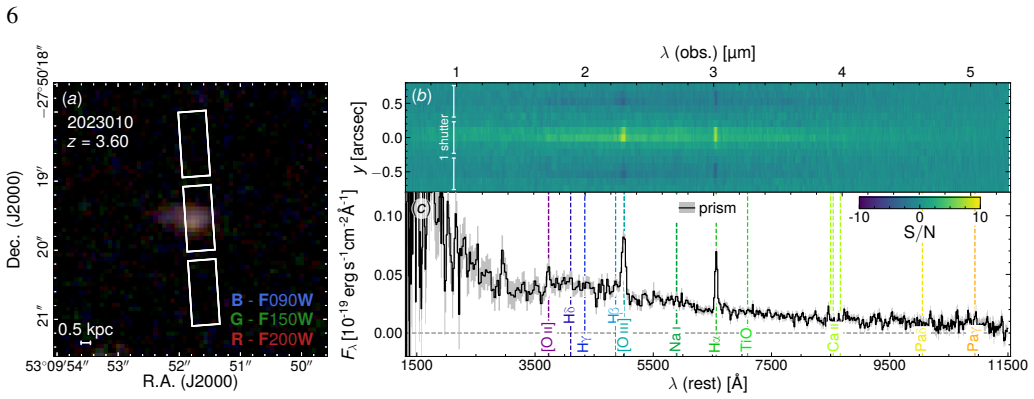
The argument is carried by light-curve template matching backed by synthetic explosion models. Observed spectral templates of supernova subtypes are redshifted and fitted to the photometry in the observer-frame JWST filters, with the best-fitting template determining both the type and the peak luminosity. A grid of red supergiant progenitor models with masses of 12, 16, and 20 solar masses at 0.3 solar metallicity, with and without a confined circumstellar shell, is evolved and exploded with varied energies to predict light curves; the 20 solar mass models with roughly $2\times10^{51}$ erg match best. Host metallicity is pinned by the O3O2 ratio (the [O III]/[O II] line ratio) of the forbidden oxygen lines in the NIRSpec spectrum, because the supernova's own spectral features are too contaminated by host light to measure directly.
What would settle it
A NIRSpec spectrum taken during the hydrogen-recombination plateau that shows broad $\mathrm{H}\alpha$ or Fe II $\lambda 5018$ absorption would confirm the Type II identification; a spectrum with no hydrogen features, or photometry that keeps rising instead of entering a plateau, would rule it out. A later JWST epoch that shows the source still bright hundreds of rest-frame days after peak would favor the $175\,M_\odot$ pair-instability alternative over the inferred red supergiant explosion.
Extended reading notes
Core claim
The central claim is that AT 2023adsv is a Type II supernova, specifically a Type IIP, defined as a hydrogen-rich core-collapse explosion whose light curve lingers on a plateau. The classification is photometric: the six-filter JWST light curve is fitted against empirical spectral templates, and the normal Type IIP template SN 2006kv wins with reduced $\chi^2/\nu = 1.10$, while Type Ia and Type Ib/c templates are strongly disfavored ($16.63$ and $6.76$). Matching that template to the observed brightness puts the peak at $M_B = -18.3 \pm 0.1$ mag, about $0.5$ mag brighter than SN 2006kv itself but still within the local Type II luminosity range. Synthetic light curves from red supergiant progenitors at $0.3\,Z_\odot$ favor a $20\,M_\odot$ zero-age main-sequence star exploding with about $2\times 10^{51}$ erg, and the authors explicitly note that a $175\,M_\odot$ pair-instability model also fits well enough that the current data cannot exclude it. They conclude that AT 2023adsv is the most distant photometrically classified Type IIP supernova with a spectroscopic redshift and may represent a redshift-dependent shift in Type IIP properties.
Load-bearing premise
The classification assumes that local Type IIP templates and the three red supergiant model families adequately represent what a low-metallicity supernova at $z=3.6$ looks like, even though the shortest-wavelength measurement had to be excluded from the template fit and none of the models reproduce the last epoch's redder detections.
Editorial extensions
If this is right
- AT 2023adsv becomes the most distant photometrically classified Type IIP supernova with a spectroscopic redshift, pushing the empirical baseline for core-collapse supernovae from $z\approx2.5$ out to $z=3.6$.
- The favored explosion model implies a roughly $20\,M_\odot$ red supergiant progenitor and an explosion energy near $2\times10^{51}$ erg, higher than typical local Type IIP energies.
- The host's low mass and low metallicity ($Z_* \approx 0.3\,Z_\odot$) fit the high-redshift mass-metallicity relation, making the object a test of whether low-metallicity Type IIP supernovae are brighter and bluer.
- The current data cannot distinguish a normal red supergiant explosion from a $175\,M_\odot$ pair-instability supernova, so continued monitoring of this source is required.
- If representative, JWST-era samples of high-redshift Type IIP supernovae could become probes of metallicity and massive-star populations in the first two billion years of cosmic history.
Reading between the lines
- The authors leave implicit that the one filter excluded from the template fit probes rest-frame $\sim2500$ Å, exactly where low-metallicity line blanketing is expected to weaken; future samples could turn that same excess into a photometric metallicity proxy for high-redshift Type II supernovae.
- Because every explosion model fails to reproduce the last epoch's F200W, F277W, and F444W detections, a single additional JWST epoch at matched depth would sharpen the choice between a fading Type IIP, late circumstellar interaction, and a pair-instability explosion.
- A post-fade NIRSpec observation of the same host, taken with the same shutters, would let the host serve as its own template and could reveal whether broad supernova features were hidden beneath the host light in the existing spectrum.
- The roughly $0.5$ mag overluminosity relative to SN 2006kv is attributed to higher explosion energy, but the degeneracy between progenitor radius, circumstellar material, and metallicity means one object cannot separate these; a survey sample would be required to establish a true redshift trend.
Editorial analysis
A structured set of objections, weighed in public.
Referee Report
Summary. The paper reports the discovery and multi-band JWST light curve of AT 2023adsv, a transient at z=3.613 in a JADES field, and argues that it is a likely Type II supernova (specifically SN IIP-like), most distant of its kind with a spectroscopic redshift. The classification rests on a template fit (SN 2006kv, χ²/ν=1.10) that strongly disfavors SN Ia and SN Ib/c templates, plus MESA/STELLA light-curve models that favor a 20 Msun red supergiant progenitor with explosion energy 2×10^51 erg. The paper also derives host-galaxy properties (log M* ≈ 8.4, Z* ≈ 0.3 Zsun) and discusses the possibility of a pair-instability supernova (PISN), which it cannot rule out.
Significance. If the classification holds, this is a valuable probe of core-collapse supernovae in the early universe, with implications for progenitor masses, explosion energies, and the SN II rate at z>3. The paper is honest about its main limitations: no SN spectral features are isolated, F115W is excluded from the template fit, the PISN model matches the photometry, and all MESA models fail to reproduce the last-epoch detections in F200W, F277W, and F444W. These caveats are stated clearly, and the accompanying MESA/STELLA modeling and public data release are strengths. However, because the central 'likely Type II' claim depends on a prior on PISN rates rather than on a secure fit, the paper's significance is conditional on further observations or a more complete model comparison.
major comments (3)
- [§3.1, Table 3] The template-fit χ²/ν comparison that drives the Type II classification is performed without F115W, the only filter probing rest-frame ~2500 Å at z=3.613. The paper states that no template covers this wavelength and therefore excludes it from the fit (§3.1). Yet the early blue UV flux seen in F115W and F150W is precisely the feature that motivates the confined-CSM and PISN alternatives in §3.3. The classification not only leaves out a discriminating band, but excludes the band where the empirical templates are most likely to be unrepresentative. Please quantify the effect of including F115W (for example, by using UV-extended templates or by showing the predicted F115W flux of SN 2006kv and the resulting change in Δχ²) or otherwise justify that the exclusion does not bias the Type II preference.
- [§3.3.1] The paper states that the 175 Msun PISN model 'matches well' to the photometry and that 'the dataset as it stands is not sufficient to differentiate between a PISN model and those explored' in §3.3. The conclusion that AT 2023adsv is 'likely to be a RSG explosion' is then justified by 'the expected low PISN event rates.' This is a prior, not an inference from the photometric data. The central claim 'likely Type II' therefore rests on an external rate argument. To make the claim quantitative, please present a formal comparison, e.g., the Δχ² between the best RSG model and the PISN model on the same photometric points, or a posterior probability that includes an explicit rate prior. As written, the abstract and conclusions overstate the evidential weight of the light curve alone.
- [§3.3, §3.4] Section 3.3 states that 'all models fail to fit the last epoch F200W, F277W, and F444W detections,' which are the same bands that would discriminate between SN II and PISN at late times. Despite this, the section concludes that the best overall fit is the 20 Msun progenitor. This conclusion is not supported by any reported fit statistic for the MESA/STELLA models (Table 3 lists only the empirical template fits; the model fits in Figure 6 are presented visually). Please report reduced χ² or equivalent goodness-of-fit values for the RSG models (with and without CSM) and for the PISN model, computed over all filters and epochs, so that the 'best overall fit' claim can be evaluated. Without such statistics, the preferred-progenitor inference is not quantitatively grounded.
minor comments (5)
- [References] The reference list contains duplicate entries: Kasen et al. (2011) appears twice, and Pierel et al. (2024a,b,c) each appear twice with identical bibliographic data. Please consolidate the list and renumber citations consistently.
- [§1] The text mentions 'SN 20015bs' in the Introduction; this is presumably a typo for SN 2015bs (or another object). Please verify the object name and year.
- [§3.2] In the sentence describing the horizontal dashed lines in Figure 5, 'the the 1.0, 0.3, and 0.1 solar oxygen abundance values' contains a duplicated article. Please fix this and similar typographical issues in the figure captions.
- [§5] The Conclusion contains 'we limited our our analysis' — the duplicated 'our' should be removed. Also, the companion paper Moriya et al. (2025) is cited as arXiv:2501.xxxxx; this placeholder needs to be replaced with the actual identifier before publication.
- [Figure 3] The legend labels 'T ype II', 'T ype Ib/c', and 'T ype Ia' contain a spurious space after the capital T. Please correct the label formatting.
Circularity Check
No significant circularity; the Type II classification rests on external empirical templates and independent radiation-hydrodynamics models, with only minor non-load-bearing self-citations.
full rationale
The central claim that AT 2023adsv is a likely Type II SN is obtained by comparing the measured multi-band photometry against external empirical spectral templates (SN 2006kv from D'Andrea et al. 2010, SALT3-NIR, and SDSS Ib/c templates) and against independent MESA/STELLA progenitor/explosion models, whose input assumptions are described in an accompanying paper (Moriya et al. 2025). The explosion energy, CSM mass, and progenitor mass are fitted model parameters, not quantities predicted from the same data and then presented as independent confirmations, so the fitted-input-called-prediction pattern does not apply. The host metallicity is used to set the model metallicity, and the models are then compared with the observed light curve; this is an input choice rather than a circular derivation, since the classification itself is not defined in terms of those models. The paper explicitly notes that the F115W filter is excluded from the template fitting because no template covers rest-frame ~2500 Å, and it states that all MESA models fail to fit the last-epoch F200W, F277W, and F444W detections and that a PISN model (R175) matches well enough that the dataset cannot differentiate PISN from RSG explosions. These are honest caveats about model coverage and discriminating power, not evidence that a result is being derived from itself. The preference for a normal SN II over a PISN is explicitly based on the expected low PISN event rates, an external rate prior rather than a circular step. Self-citations to companion and prior JADES papers (Moriya et al. 2025; DeCoursey et al. 2024) provide model details and context for the 'most distant' comparison, but the classification and light-curve interpretation do not reduce to those citations. No step in the derivation equates an output with an input by construction, and no fitted parameter is renamed as a prediction.
Assumptions & free parameters
free parameters (6)
- Explosion energy =
2.0e51 erg (grid 2.0-3.0e51 erg)
- Confined CSM mass =
0.07, 0.11, 0.16 Msun for 12, 16, 20 Msun progenitors
- Progenitor ZAMS mass =
20 Msun (grid 12, 16, 20 Msun)
- Host extinction Av =
0.15 mag
- Peak absolute magnitude M_B =
-18.3 AB mag
- Host metallicity Z* =
0.3 Zsun (O3O2 diagnostic)
assumptions (6)
- domain assumption Standard flat LCDM cosmology with H0=70 km/s/Mpc and Omega_m=0.315.
- domain assumption MESA and STELLA provide reliable red supergiant progenitor and SN light-curve models.
- domain assumption Empirical CC SN templates such as SN 2006kv represent SNe II, including at high redshift and low metallicity.
- domain assumption The O3O2 metallicity calibration of Curti et al. (2020), derived for low-redshift galaxies, applies at z=3.6.
- domain assumption The host galaxy's redshift and metallicity, measured from host emission lines, apply to the supernova.
- domain assumption Difference imaging and PSF photometry remove host light without systematic bias.
Cite this review
Pith. "Pith review of Discovery of a likely Type II SN at $z$=3.6 with JWST." pith.science (2026). https://pith.science/paper/KODGJHJJ
@misc{pith2026250105513,
  author       = {Pith},
  title        = {Pith review of: Discovery of a likely Type II SN at $z$=3.6 with JWST},
  year         = {2026},
  howpublished = {\url{https://pith.science/paper/KODGJHJJ}},
  note         = {Machine review of arXiv:2501.05513}
}
read the original abstract
Transient astronomy in the early, high-redshift (z > 3) Universe is an unexplored regime that offers the possibility of probing the first stars and the Epoch of Reionization. During Cycles 1 and 2 of the James Webb Space Telescope (JWST), the JWST Advanced Deep Extragalactic Survey (JADES) program enabled one of the first searches for transients in deep images (~30 AB mag) over a relatively wide area (25 arcmin^2). One transient, AT 2023adsv, was discovered with an F200W magnitude of 28.04 AB mag, and subsequent JWST observations revealed that the transient is a likely supernova (SN) in a host with z_spec = 3.613 +/- 0.001 and an inferred metallicity at the position of the SN of Z_* = 0.3 +/- 0.1 Z_{\odot}. At this redshift, the first detections in F115W and F150W show that AT 2023adsv had bright rest-frame ultraviolet flux at the time of discovery. The multi-band light curve of AT 2023adsv is best matched by a template of an SN IIP with a peak absolute magnitude of M_B ~ -18.3 AB mag. We find a good match to a 20 M_{\odot} red supergiant progenitor star with an explosion energy of 2.0x10^51 ergs, likely higher than normally observed in the local Universe, but consistent with SNe IIP drawn from local, lower metallicity environments. AT 2023adsv is the most distant photometrically classified SN IIP yet discovered with a spectroscopic redshift measurement, and may represent a global shift in SNe IIP properties as a function of redshift.
Figures


Figures from the paper (6 more)


Forward citations
Cited by 4 Pith papers
-
A Type Ia Supernova Candidate at $z\sim4.3$: A Transient Interloper in the Search for $z\sim14$ Galaxies
A JWST candidate z~14 galaxy is reclassified as a Type Ia supernova at z~4.3, implying SN Ia minimum delay times shorter than 1 Gyr.
-
Properties of high-redshift Type II supernovae discovered by the JADES transient survey
Modeling JWST light curves of six Type II supernovae at z = 0.66 - 3.61 yields explosion energies of (0.5 - 3) x 10^51 erg, with two high-energy events and two showing signs of dense circumstellar matter.
-
Testing for Intrinsic Type Ia Supernova Luminosity Evolution at z>2 with JWST
JWST spectroscopy confirms SN 2023aeax as a normal Type Ia supernova at z=2.15, and its standardized distance is consistent with the standard cosmological model.
-
Surrogate models for type II supernovae: Probing low-energy explosions and interaction-free regimes
Trained on STELLA grids, two autoencoder-plus-emulator surrogates reconstruct type II SN SEDs at ~1e-4 MSE and recover progenitor masses for SN 2005cs, SN 2012aw, and SN 1999em in minutes.
Reference graph
Works this paper leans on
-
[1]
2011, ApJS, 193, 29, doi: 10.1088/0067-0049/193/2/29
Aihara, H., Allende Prieto, C., An, D., et al. 2011, ApJS, 193, 29, doi: 10.1088/0067-0049/193/2/29
-
[2]
Hamuy, M., & Habergham, S. M. 2010, MNRAS, 407, 2660, doi: 10.1111/j.1365-2966.2010.17118.x
arXiv 2010
-
[3]
Anderson, J. P., Gutiérrez, C. P., Dessart, L., et al. 2016, A&A, 589, A110, doi: 10.1051/0004-6361/201527691
-
[4]
Anderson, J. P., Dessart, L., Gutiérrez, C. P., et al. 2018, Nature Astronomy, 2, 574, doi: 10.1038/s41550-018-0458-4
-
[5]
Asplund, M., Grevesse, N., Sauval, A. J., & Scott, P. 2009, ARA&A, 47, 481, doi: 10.1146/annurev.astro.46.060407.145222
arXiv 2009
-
[6]
2009, A&A, 499, 653, doi: 10.1051/0004-6361/200911847
Bazin, G., Palanque-Delabrouille, N., Rich, J., et al. 2009, A&A, 499, 653, doi: 10.1051/0004-6361/200911847
-
[7]
2015, HOTPANTS: High Order Transform of PSF ANd Template Subtraction
Becker, A. 2015, HOTPANTS: High Order Transform of PSF ANd Template Subtraction
2015
-
[8]
Berg, D. A., Skillman, E. D., Marble, A. R., et al. 2012, ApJ, 754, 98, doi: 10.1088/0004-637X/754/2/98
Show all 105 references
-
[9]
2000, ApJ, 532, 1132, doi: 10.1086/308588
Blinnikov, S., Lundqvist, P., Bartunov, O., Nomoto, K., & Iwamoto, K. 2000, ApJ, 532, 1132, doi: 10.1086/308588
2000 doi
-
[10]
A., & Woosley, S
Popolitov, V . A., & Woosley, S. E. 1998, ApJ, 496, 454, doi: 10.1086/305375
1998 doi
-
[11]
I., Röpke, F
Blinnikov, S. I., Röpke, F. K., Sorokina, E. I., et al. 2006, A&A, 453, 229, doi: 10.1051/0004-6361:20054594
2006 doi
-
[12]
T., Riello, M., Cappellaro, E., et al
Botticella, M. T., Riello, M., Cappellaro, E., et al. 2008, A&A, 479, 49, doi: 10.1051/0004-6361:20078011
2008 doi
-
[13]
2021, Nature, 589, 29, doi: 10.1038/s41586-020-03059-w
Burrows, A., & Vartanyan, D. 2021, Nature, 589, 29, doi: 10.1038/s41586-020-03059-w
2021 doi
-
[14]
2022, JWST Calibration Pipeline, Zenodo, doi: 10.5281/zenodo.7325378
Bushouse, H., Eisenhamer, J., Dencheva, N., et al. 2022, JWST Calibration Pipeline, Zenodo, doi: 10.5281/zenodo.7325378
2022 doi
-
[15]
1986, MNRAS, 223, 811, doi: 10.1093/mnras/223.4.811
Campbell, A., Terlevich, R., & Melnick, J. 1986, MNRAS, 223, 811, doi: 10.1093/mnras/223.4.811
1986 doi
-
[16]
L., Oguri, M., et al
Chen, W., Kelly, P. L., Oguri, M., et al. 2022, Nature, 611, 256, doi: 10.1038/s41586-022-05252-5
2022 doi
-
[17]
Conroy, C., & Gunn, J. E. 2010, ApJ, 712, 833, doi: 10.1088/0004-637X/712/2/833
2010 doi
-
[18]
E., & White, M
Conroy, C., Gunn, J. E., & White, M. 2009, ApJ, 699, 486, doi: 10.1088/0004-637X/699/1/486
2009 doi
-
[19]
2012, Nature, 491, 228, doi: 10.1038/nature11521
Cooke, J., Sullivan, M., Gal-Yam, A., et al. 2012, Nature, 491, 228, doi: 10.1038/nature11521
2012 doi
-
[20]
2020, MNRAS, 491, 944, doi: 10.1093/mnras/stz2910
Curti, M., Mannucci, F., Cresci, G., & Maiolino, R. 2020, MNRAS, 491, 944, doi: 10.1093/mnras/stz2910
2020 doi
-
[21]
2024, A&A, 684, A75, doi: 10.1051/0004-6361/202346698
Curti, M., Maiolino, R., Curtis-Lake, E., et al. 2024, A&A, 684, A75, doi: 10.1051/0004-6361/202346698
2024 doi
-
[22]
G., et al
Dahlen, T., Strolger, L.-G., Riess, A. G., et al. 2012, ApJ, 757, 70, doi: 10.1088/0004-637X/757/1/70
2012 doi
-
[23]
DeCoursey, C., Egami, E., Pierel, J. D. R., et al. 2024, arXiv e-prints, arXiv:2406.05060
2024 arXiv
-
[24]
Dessart, L., & Hillier, D. J. 2020, A&A, 642, A33, doi: 10.1051/0004-6361/202038148 —. 2022, A&A, 660, L9, doi: 10.1051/0004-6361/202243372
2020 doi
-
[25]
J., Waldman, R., & Livne, E
Dessart, L., Hillier, D. J., Waldman, R., & Livne, E. 2013, MNRAS, 433, 1745, doi: 10.1093/mnras/stt861
2013 doi
-
[26]
P., Hamuy, M., et al
Dessart, L., Gutierrez, C. P., Hamuy, M., et al. 2014, MNRAS, 440, 1856, doi: 10.1093/mnras/stu417
2014 doi
-
[27]
2017, ApJ, 840, 99, doi: 10.3847/1538-4357/aa6d10 D’Andrea, C
Dotter, A., Conroy, C., Cargile, P., & Asplund, M. 2017, ApJ, 840, 99, doi: 10.3847/1538-4357/aa6d10 D’Andrea, C. B., Sako, M., Dilday, B., et al. 2010, The Astrophysical Journal, 708, 661, doi: 10.1088/0004-637X/708/1/661
2017 doi
-
[28]
Pinto, P. A. 1994, ApJ, 430, 300, doi: 10.1086/174404
1994 doi
-
[29]
2023, JWST NIRSpec/NIRCam Follow-Up of the High-Redshift Transients Discovered in the GOODS-S JADES-Deep Field
Egami, E., Bonaventura, N., Charlot, S., et al. 2023, JWST NIRSpec/NIRCam Follow-Up of the High-Redshift Transients Discovered in the GOODS-S JADES-Deep Field
2023
-
[30]
J., Weinberg, D
Eisenstein, D. J., Weinberg, D. H., Agol, E., et al. 2011, AJ, 142, 72, doi: 10.1088/0004-6256/142/3/72
2011 doi
-
[31]
J., Johnson, B
Eisenstein, D. J., Johnson, B. D., Robertson, B., et al. 2023, arXiv e-prints, arXiv:2310.12340, doi: 10.48550/arXiv.2310.12340
2023 doi
- [32]
-
[33]
2022, A&A, 661, A81, doi: 10.1051/0004-6361/202142673
Ferruit, P., Jakobsen, P., Giardino, G., et al. 2022, A&A, 661, A81, doi: 10.1051/0004-6361/202142673
2022 doi
-
[34]
1999, Publications of the Astronomical Society of the Pacific, 111, 63, doi: 10.1086/316293 Förster, F., Moriya, T
Fitzpatrick, E. 1999, Publications of the Astronomical Society of the Pacific, 111, 63, doi: 10.1086/316293 Förster, F., Moriya, T. J., Maureira, J. C., et al. 2018, Nature Astronomy, 2, 808, doi: 10.1038/s41550-018-0563-4
1999 doi
-
[35]
S., Levan, A
Fruchter, A. S., Levan, A. J., Strolger, L., et al. 2006, Nature, 441, 463, doi: 10.1038/nature04787
2006 doi
-
[36]
2019, ARA&A, 57, 305, doi: 10.1146/annurev-astro-081817-051819
Gal-Yam, A. 2019, ARA&A, 57, 305, doi: 10.1146/annurev-astro-081817-051819
2019 doi
-
[37]
O., et al
Gal-Yam, A., Arcavi, I., Ofek, E. O., et al. 2014, Nature, 509, 471, doi: 10.1038/nature13304
2014 doi
-
[38]
O., Sanders, N
Gezari, S., Jones, D. O., Sanders, N. E., et al. 2015, ApJ, 804, 28, doi: 10.1088/0004-637X/804/1/28
2015 doi
-
[39]
C., Koekemoer, A
Giavalisco, M., Ferguson, H. C., Koekemoer, A. M., et al. 2004, ApJL, 600, L93, doi: 10.1086/379232
2004 doi
-
[40]
2024, MNRAS, 535, 471, doi: 10.1093/mnras/stae2270
Gomez, S., Nicholl, M., Berger, E., et al. 2024, MNRAS, 535, 471, doi: 10.1093/mnras/stae2270
2024 doi
-
[42]
A., Kocevski, D
Grogin, N. A., Kocevski, D. D., Faber, S. M., et al. 2011, ApJS, 197, 35, doi: 10.1088/0067-0049/197/2/35 Gutiérrez, C. P., Anderson, J. P., Hamuy, M., et al. 2017, ApJ, 850, 89, doi: 10.3847/1538-4357/aa8f52 Gutiérrez, C. P., Anderson, J. P., Sullivan, M., et al. 2018, MNRAS,...
2011 doi
-
[43]
Hartmann, D. H. 2003, ApJ, 591, 288, doi: 10.1086/375341
2003 doi
-
[44]
1986, PASP, 98, 609, doi: 10.1086/131801
Horne, K. 1986, PASP, 98, 609, doi: 10.1086/131801
1986 doi
-
[45]
J., et al
Hounsell, R., Scolnic, D., Foley, R. J., et al. 2018, The Astrophysical Journal, 867, 23, doi: 10.3847/1538-4357/aac08b
2018 doi
-
[46]
S., Bauer, E
Jermyn, A. S., Bauer, E. B., Schwab, J., et al. 2023, ApJS, 265, 15, doi: 10.3847/1538-4365/acae8d
2023 doi
-
[47]
D., Leja, J., Conroy, C., & Speagle, J
Johnson, B. D., Leja, J., Conroy, C., & Speagle, J. S. 2021, ApJS, 254, 22, doi: 10.3847/1538-4365/abef67
2021 doi
-
[49]
E., & Heger, A
Kasen, D., Woosley, S. E., & Heger, A. 2011, ApJ, 734, 102, doi: 10.1088/0004-637X/734/2/102
2011 doi
-
[50]
J., et al
Katz, H., Saxena, A., Cameron, A. J., et al. 2023, MNRAS, 518, 592, doi: 10.1093/mnras/stac2657
2023 doi
-
[51]
L., & Kirshner, R
Kelly, P. L., & Kirshner, R. P. 2012, ApJ, 759, 107, doi: 10.1088/0004-637X/759/2/107
2012 doi
-
[52]
A., & Skillman, E
Kobulnicky, H. A., & Skillman, E. D. 1997, ApJ, 489, 636, doi: 10.1086/304830
1997 doi
-
[53]
M., Faber, S
Koekemoer, A. M., Faber, S. M., Ferguson, H. C., et al. 2011, ApJS, 197, 36, doi: 10.1088/0067-0049/197/2/36
2011 doi
-
[54]
2000, ARA&A, 38, 613, doi: 10.1146/annurev.astro.38.1.613
Kudritzki, R.-P., & Puls, J. 2000, ARA&A, 38, 613, doi: 10.1146/annurev.astro.38.1.613
2000 doi
-
[55]
Lamers, H. J. G. L. M., & Cassinelli, J. P. 1999, Introduction to Stellar Winds
1999
-
[56]
A., de Koter, A., et al
Langer, N., Norman, C. A., de Koter, A., et al. 2007, A&A, 475, L19, doi: 10.1051/0004-6361:20078482
2007 doi
-
[57]
2023, ApJ, 957, 39, doi: 10.3847/1538-4357/acdbc1
Langeroodi, D., Hjorth, J., Chen, W., et al. 2023, ApJ, 957, 39, doi: 10.3847/1538-4357/acdbc1
2023 doi
-
[58]
Larson, R. B. 1998, MNRAS, 301, 569, doi: 10.1046/j.1365-8711.1998.02045.x
1998
-
[59]
2023, ApJL, 955, L18, doi: 10.3847/2041-8213/acf470
Li, M., Cai, Z., Bian, F., et al. 2023, ApJL, 955, L18, doi: 10.3847/2041-8213/acf470
2023 doi
-
[60]
2012, Reviews of Modern Physics, 84, 25, doi: 10.1103/RevModPhys.84.25
Maeder, A., & Meynet, G. 2012, Reviews of Modern Physics, 84, 25, doi: 10.1103/RevModPhys.84.25
2012 doi
-
[61]
2012, A&A, 545, A96, doi: 10.1051/0004-6361/201219364
Melinder, J., Dahlen, T., Mencía Trinchant, L., et al. 2012, A&A, 545, A96, doi: 10.1051/0004-6361/201219364
2012 doi
-
[62]
P., et al
Modjaz, M., Blondin, S., Kirshner, R. P., et al. 2014, AJ, 147, 99, doi: 10.1088/0004-6256/147/5/99
2014 doi
-
[63]
R., de Koter, A., Vink, J
Mokiem, M. R., de Koter, A., Vink, J. S., et al. 2007, A&A, 473, 603, doi: 10.1051/0004-6361:20077545
2007 doi
-
[64]
2024, ApJ, 971, 43, doi: 10.3847/1538-4357/ad5290
Morishita, T., Stiavelli, M., Grillo, C., et al. 2024, ApJ, 971, 43, doi: 10.3847/1538-4357/ad5290
2024 doi
-
[65]
I., Baklanov, P
Moriya, T., Tominaga, N., Blinnikov, S. I., Baklanov, P. V ., & Sorokina, E. I. 2011, MNRAS, 415, 199, doi: 10.1111/j.1365-2966.2011.18689.x
2011
-
[66]
J., Coulter, D
Moriya, T. J., Coulter, D. A., DeCoursey, C., et al. 2025, arXiv e-prints, arXiv:2501.xxxxx, doi: 10.48550/arXiv.2501.xxxxx
2025 doi
-
[67]
2023, ApJS, 269, 33, doi: 10.3847/1538-4365/acd556
Nakajima, K., Ouchi, M., Isobe, Y ., et al. 2023, ApJS, 269, 33, doi: 10.3847/1538-4365/acd556
2023 doi
-
[68]
R., & Snyder, H
Oppenheimer, J. R., & Snyder, H. 1939, Physical Review, 56, 455, doi: 10.1103/PhysRev.56.455
1939 doi
-
[69]
2011, ApJS, 192, 3, doi: 10.1088/0067-0049/192/1/3
Paxton, B., Bildsten, L., Dotter, A., et al. 2011, ApJS, 192, 3, doi: 10.1088/0067-0049/192/1/3
2011 doi
-
[70]
2013, ApJS, 208, 4, doi: 10.1088/0067-0049/208/1/4
Paxton, B., Cantiello, M., Arras, P., et al. 2013, ApJS, 208, 4, doi: 10.1088/0067-0049/208/1/4
2013 doi
-
[71]
2015, ApJS, 220, 15, doi: 10.1088/0067-0049/220/1/15
Paxton, B., Marchant, P., Schwab, J., et al. 2015, ApJS, 220, 15, doi: 10.1088/0067-0049/220/1/15
2015 doi
-
[72]
B., et al
Paxton, B., Schwab, J., Bauer, E. B., et al. 2018, ApJS, 234, 34, doi: 10.3847/1538-4365/aaa5a8 20
2018 doi
-
[73]
2019, ApJS, 243, 10, doi: 10.3847/1538-4365/ab2241
Paxton, B., Smolec, R., Schwab, J., et al. 2019, ApJS, 243, 10, doi: 10.3847/1538-4365/ab2241
2019 doi
-
[74]
Pettini, M., & Pagel, B. E. J. 2004, MNRAS, 348, L59, doi: 10.1111/j.1365-2966.2004.07591.x
2004
-
[75]
Pierel, J. D. R., Rodney, S., Avelino, A., et al. 2018, Publications of the Astronomical Society of the Pacific, 130, 114504, doi: 10.1088/1538-3873/aadb7a
2018 doi
-
[76]
Pierel, J. D. R., Jones, D. O., Kenworthy, W. D., et al. 2022, ApJ, 939, 11, doi: 10.3847/1538-4357/ac93f9
2022 doi
-
[77]
Pierel, J. D. R., Frye, B. L., Pascale, M., et al. 2024a, ApJ, 967, 50, doi: 10.3847/1538-4357/ad3c43
-
[81]
Pierel, J. D. R., Engesser, M., Coulter, D. A., et al. 2024a, ApJL, 971, L32, doi: 10.3847/2041-8213/ad6908
- [82]
- [83]
-
[84]
2012, ApJS, 199, 25, doi: 10.1088/0067-0049/199/2/25
Postman, M., Coe, D., Benítez, N., et al. 2012, ApJS, 199, 25, doi: 10.1088/0067-0049/199/2/25
2012 doi
-
[85]
M., Kulkarni, S
Quimby, R. M., Kulkarni, S. R., Kasliwal, M. M., et al. 2011, Nature, 474, 487, doi: 10.1038/nature10095
2011 doi
-
[86]
2023, arminrest/jhat: The JWST HST Alignment Tool (JHAT), Zenodo, doi: 10.5281/zenodo.7892935
Rest, A., Pierel, J., Correnti, M., et al. 2023, arminrest/jhat: The JWST HST Alignment Tool (JHAT), Zenodo, doi: 10.5281/zenodo.7892935
2023 doi
-
[87]
C., et al
Rest, A., Stubbs, C., Becker, A. C., et al. 2005, ApJ, 634, 1103, doi: 10.1086/497060
2005 doi
-
[88]
E., Wold, I
Rhoads, J. E., Wold, I. G. B., Harish, S., et al. 2023, ApJL, 942, L14, doi: 10.3847/2041-8213/acaaaf
2023 doi
-
[89]
2014, AJ, 147, 118, doi: 10.1088/0004-6256/147/5/118
Maddox, L. 2014, AJ, 147, 118, doi: 10.1088/0004-6256/147/5/118
2014 doi
- [90]
-
[91]
2017, A&A, 597, A71, doi: 10.1051/0004-6361/201629612
Grassitelli, L. 2017, A&A, 597, A71, doi: 10.1051/0004-6361/201629612
2017 doi
-
[92]
2022, A&A, 665, L4, doi: 10.1051/0004-6361/202244556
Schaerer, D., Marques-Chaves, R., Barrufet, L., et al. 2022, A&A, 665, L4, doi: 10.1051/0004-6361/202244556
2022 doi
-
[93]
F., & Finkbeiner, D
Schlafly, E. F., & Finkbeiner, D. P. 2011, ApJ, 737, 103, doi: 10.1088/0004-637X/737/2/103
2011 doi
-
[94]
Schlegel, E. M. 1990, MNRAS, 244, 269
1990
-
[95]
2019, ApJL, 870, L16, doi: 10.3847/2041-8213/aaf8ad
Berger, E. 2019, ApJL, 870, L16, doi: 10.3847/2041-8213/aaf8ad
2019 doi
- [96]
-
[97]
Smartt, S. J. 2009, ARA&A, 47, 63, doi: 10.1146/annurev-astro-082708-101737
2009 doi
-
[98]
2014, ARA&A, 52, 487, doi: 10.1146/annurev-astro-081913-040025
Smith, N. 2014, ARA&A, 52, 487, doi: 10.1146/annurev-astro-081913-040025
2014 doi
-
[99]
Speagle, J. S. 2020, MNRAS, 493, 3132, doi: 10.1093/mnras/staa278
2020 doi
-
[100]
A., et al
Strolger, L.-G., Dahlen, T., Rodney, S. A., et al. 2015, ApJ, 813, 93, doi: 10.1088/0004-637X/813/2/93
2015 doi
-
[101]
2016, A&A, 587, L7, doi: 10.1051/0004-6361/201527983
Taddia, F., Moquist, P., Sollerman, J., et al. 2016, A&A, 587, L7, doi: 10.1051/0004-6361/201527983
2016 doi
-
[102]
J., Barger, A
Taylor, A. J., Barger, A. J., & Cowie, L. L. 2022, ApJL, 939, L3, doi: 10.3847/2041-8213/ac959d
2022 doi
-
[103]
A., Hinkle, J., Angus, C
Tucker, M. A., Hinkle, J., Angus, C. R., et al. 2024, ApJ, 976, 178, doi: 10.3847/1538-4357/ad8448
2024 doi
-
[104]
1998, A&A Rv, 9, 63, doi: 10.1007/s001590050015
Vanbeveren, D., De Loore, C., & Van Rensbergen, W. 1998, A&A Rv, 9, 63, doi: 10.1007/s001590050015
1998 doi
-
[105]
S., de Koter, A., & Lamers, H
Vink, J. S., de Koter, A., & Lamers, H. J. G. L. M. 2001, A&A, 369, 574, doi: 10.1051/0004-6361:20010127
2001 doi
-
[106]
Woosley, S. E. 2017, ApJ, 836, 244, doi: 10.3847/1538-4357/836/2/244
2017 doi
- [107]
-
[108]
2021, ApJ, 906, 3, doi: 10.3847/1538-4357/abc87c
Wu, S., & Fuller, J. 2021, ApJ, 906, 3, doi: 10.3847/1538-4357/abc87c
2021 doi
-
[109]
Zeh, A., Klose, S., & Hartmann, D. H. 2004, ApJ, 609, 952, doi: 10.1086/421100
2004 doi
-
[110]
J., Edwards, T
Ziegler, J. J., Edwards, T. D. P., Suliga, A. M., et al. 2022, MNRAS, 517, 2471, doi: 10.1093/mnras/stac2748
2022 doi
Reviewed August 10, 2026 · model on record in the stance chip above.
Discussion (0). Continue with ORCID to comment.