REVIEW 3 major objections 4 minor 63 references
JWST photometry of a source initially selected as a z~14 galaxy shows it instead matches a Type Ia supernova at z~4.3, implying a minimum SN Ia delay time below 1 Gyr.
Reviewed by Pith at T0; open to challenge. T0 means a machine referee read the full paper against a public rubric. the ladder, T0–T4 →
2026-08-01 13:48 UTC pith:WGLA6PZD
load-bearing objection A careful single-object study that makes a plausible case for an SN Ia at z~4.3, but the photometric classification is not airtight and the DTD constraint is oversold in the abstract. the 3 major comments →
A Type Ia Supernova Candidate at zsim4.3: A Transient Interloper in the Search for zsim14 Galaxies
The pith
A machine-rendered reading of the paper's core claim, the machinery that carries it, and where it could break.
Core claim
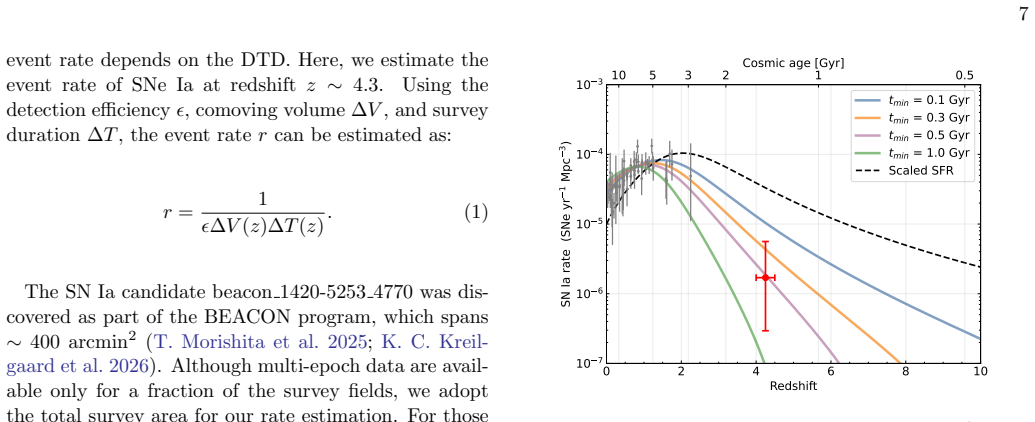
The central claim is that beacon_1420-5253_4770, selected as a z~14 galaxy candidate, is a Type Ia supernova at z~4.3. The SED at +3.4 days relative to maximum, with the spectrum of SN 2011fe shifted to z=4.3, reproduces the observed photometry with chi2/dof=3.0. The rest-frame UV flux drop comes from Fe-group absorption, which mimics a Lyman break; the inferred SN Ia rate of 1.7e-6 Mpc^-3 yr^-1 exceeds DTD models with t_min=1.0 Gyr, implying a minimum delay time shorter than 1 Gyr.
What carries the argument
The argument rests on comparing the source's 16-band JWST/NIRCam photometry with simulated transient light curves and with the rest-frame UV spectra of the prototypical SN Ia 2011fe. The Fe-group element blanketing in SN Ia spectra creates a sharp UV break that shifts into the F150W-F200W color window at z~4, mimicking the Lyman break used to select z~14 galaxies. The delay-time distribution (DTD), convolved with the cosmic star-formation history, converts a single rate measurement at z~4.3 into a constraint on the minimum delay time t_min.
Load-bearing premise
The classification assumes that the sharp ultraviolet flux drop is Fe-group blanketing in a Type Ia spectrum at z~4.3, not a Lyman break at z~14 or the continuum of a different fast transient; the paper itself concedes that FBOTs and rapidly evolving TDEs cannot be completely ruled out.
What would settle it
A single spectrum of the source (or of a subsequent similar dropout) that shows broad emission or a smooth continuum instead of SN Ia Fe-group absorption, or a second-epoch detection at the position with different colors, would disprove the SN Ia interpretation; likewise, detection of a z~4.3 host galaxy in deeper off-epoch imaging would support it.
If this is right
- If confirmed, this is the highest-redshift Type Ia supernova candidate to date, extending the SN Ia frontier from z~2.9 to z~4.3.
- The rate measurement, even as a lower limit, favors SN Ia progenitors with delay times under 1 Gyr, tightening models of the SN Ia delay-time distribution at early cosmic times.
- High-redshift galaxy dropout samples are vulnerable to transient contamination; even one interloper can bias number density estimates by ~0.25 dex.
- Multi-epoch JWST imaging is a robust way to remove transient impostors from single-epoch galaxy selections.
Where Pith is reading between the lines
- If the identification holds, it would imply that a substantial fraction of ultra-luminous z>10 galaxy candidates could be lower-redshift SNe, potentially affecting cosmic dawn luminosity function estimates beyond this one object.
- The lack of spectroscopic confirmation leaves room for alternative transient classes; a rest-frame optical spectrum around 1-1.5 micron with JWST/NIRSpec would discriminate Fe-group features from a TDE or FBOT continuum.
- The magnifying foreground galaxy at z~1.2 provides a testable lensing correction; deeper off-epoch stacking could reveal a faint host at z~4.3 and confirm the redshift.
Editorial analysis
A structured set of objections, weighed in public.
Referee Report
Summary. The paper reports a single unresolved point source, beacon_1420-5253_4770, found in JWST/NIRCam imaging as part of the BEACON program. The source was originally a z~14 galaxy candidate, but it appears in only one epoch and is absent in deeper off-epoch images, establishing its transient nature. The authors classify it photometrically as a Type Ia supernova at z~4.3 using color-magnitude diagnostics, light-curve simulations, and SED fits with SN 2011fe template spectra. They then derive a volumetric SN Ia rate of 1.7e-6 Mpc^-3 yr^-1, compare it with delay-time-distribution (DTD) models, and conclude that the minimum delay time is shorter than 1 Gyr. The paper also discusses the impact of transient contamination on high-redshift galaxy searches.
Significance. If the classification is correct, this would be the highest-redshift Type Ia supernova candidate known, probing the DTD at a cosmic age of ~1.5 Gyr and providing a concrete example of a transient masquerading as a z~14 Lyman-break galaxy. The multi-epoch detection and non-detection are well documented, and the host-galaxy upper limits are carefully treated. The paper is valuable as a cautionary case for transient contamination in JWST high-redshift galaxy surveys. However, the central SN Ia identification rests on a single-epoch SED with an acknowledged degeneracy against fast blue optical transients (FBOTs) and rapidly evolving TDEs, and the SED fit has a formally poor chi-square. The rate and DTD implications are therefore conditional on an unsecured classification.
major comments (3)
- [§3.1] The central classification as a SN Ia at z~4.3 is not secure. The authors explicitly state that fast blue optical transients (FBOTs) and rapidly evolving TDEs (e.g., AT 2020wey) 'cannot be completely ruled out'. The only quantitative argument against these alternatives is a rarity estimate (expected number ~10^-3-10^-2 over the survey area), which is not a strong exclusion for a single event. No FBOT or rapidly evolving TDE spectral templates are fitted to the SED. If the source is such a transient, the SN Ia rate and the DTD conclusion in §4.1 collapse. A direct template comparison (e.g., AT 2020wey at z~4) should be added before claiming a SN Ia identification.
- [§3.3, Fig. 4] The best-fitting SN 2011fe template at +3.4 d and z=4.3 gives chi^2/dof=3.0, which is a statistically poor fit (p~10^-3 for ~10 degrees of freedom). The wording 'reproduces the observed SED remarkably well' is not supported by this number. Moreover, the best-fit redshift varies from z=4.6 (-2.9 d) to z=4.0 (+9.6 d) depending on template phase, showing a strong phase-redshift degeneracy. The fit also assumes zero dust extinction, which is unconstrained given the non-detection of a host. These issues weaken the claim that Fe-group blanketing uniquely explains the observed UV drop.
- [§4.1, Eq. (1)-(4)] The event rate r=1.7e-6 Mpc^-3 yr^-1 and the resulting t_min<1 Gyr constraint depend entirely on the adopted SN Ia classification and on using SN Ia light-curve templates to define the survey volume/duration. Since the classification is not secure, the DTD conclusion should be presented as conditional ('if this is a SN Ia'). In addition, the 1sigma lower limit on the rate is 0.3e-6 Mpc^-3 yr^-1; the paper does not quantify whether the t_min=1.0 Gyr model is excluded at a meaningful confidence level. The 'implies' language in the abstract overstates the robustness of the result.
minor comments (4)
- [Throughout] The title/abstract include a typo: 'T ransient' appears with an extra space in the title line. Also, the phrase 'implies' in the abstract should be softened to 'suggests' if the classification remains a candidate.
- [§2, Table 2] The off-epoch limiting magnitudes are quoted at 2sigma, while the on-epoch non-detections in Table 1 are also 2sigma. It would help to state this consistently in the text and to give the aperture correction/PSF matching details for the multi-epoch photometry.
- [§3.2 / Fig. 3] In the right panel of Figure 3, the axes are not labeled in the caption (the text mentions phase and redshift, but the figure itself should show units). The light-curve comparison in Fig. 1 would benefit from showing the off-epoch upper limits as data points with arrows, rather than only model lines.
- [§4.2] The statement that the source would increase the z~14 galaxy number density by ~0.25 dex is illustrative but assumes the source would otherwise be included in the sample. This should be stated as conditional on the original selection, which is understood but could be made explicit.
Circularity Check
No significant circularity: SN Ia classification, rate estimate, and DTD constraint are model-dependent statistical inferences, not reductions to input definitions.
full rationale
The paper's derivation chain is not circular in the formal sense. The classification of beacon_1420-5253_4770 as a Type Ia supernova at z~4.3 is obtained by comparing observed colors, magnitudes, light curves, and SED against external templates (salt2-extended; SN 2011fe spectra from Mazzali et al. 2014). The rate estimate in Eq. (1) uses survey volume ΔV and duration ΔT computed by applying the high-redshift galaxy selection cuts to simulated SN Ia light curves (Appendix D); this is a standard visibility/volume calculation for the assumed model, not a fit to the target quantity. The DTD comparison ('The estimated event rate exceeds the model predictions for t_min = 1.0 Gyr') is a direct comparison of the derived rate with an external model; no DTD parameter is fitted from the source. The paper explicitly concedes that FBOTs or rapidly evolving TDEs 'cannot be completely ruled out' (Sec. 3.1), which is a correctness/robustness limitation rather than evidence that any result reduces to its inputs. Self-citations (BEACON program papers, Zhang et al. 2026a) supply data products and the original candidate selection, not a uniqueness theorem or ansatz, and are not load-bearing in a circular way. The conclusion is conditional on the SN Ia classification, but conditionality is not circularity.
Axiom & Free-Parameter Ledger
free parameters (6)
- Source redshift (z) =
4.3 (range 4.0-4.6 from different template epochs)
- Photometric phase (t0) =
+0 to +10 days from B-band maximum
- SN Ia stretch and color (x1, c) =
x1=0.945, c=-0.043
- SN Ia peak absolute magnitude (m_B - mu) =
-19.05
- Detection efficiency epsilon =
1
- Minimum delay time t_min =
tested values 0.1, 0.3, 0.5, 1.0 Gyr
axioms (6)
- domain assumption Flat ΛCDM cosmology with Ωm=0.3, ΩΛ=0.7, H0=70 km/s/Mpc
- domain assumption SN Ia spectral templates of SN 2011fe are representative of SNe Ia at z~4.3 (no redshift evolution in UV spectra)
- domain assumption The salt2-extended and Hsiao light curve models accurately predict SN Ia fluxes at high redshift and at rest-frame phases -20 to +50 days
- domain assumption The DTD shape Ψ(t)=A(t/t_min)^-1 and normalization N/M*=1.3e-3 M_sun^-1
- domain assumption The Madau & Fragos (2017) star formation rate density at z>4
- ad hoc to paper The source is not an FBOT or rapidly evolving TDE
read the original abstract
The James Webb Space Telescope (JWST) is opening a new window into the distant Universe by discovering galaxies and transients in the early Universe. We investigate a high-redshift transient candidate, beacon_1420-5253_4770. This object was initially identified as a high-redshift galaxy candidate at $z\sim14$. However, the source was not detected in epochs before and after the detection epoch, suggesting that the object is a transient source rather than a persistent galaxy. We classify the source by comparing the colors, magnitudes, light curves, and spectral energy distribution with various spectral templates of transients. Our analysis shows that the observed properties are consistent with a Type Ia supernova at $z\sim4.3$. Strong absorption by Fe-group elements seen in Type Ia supernova spectra can mimic the Lyman break used to detect high-redshift galaxies. At $z \sim 4.3$, corresponding to a cosmic age of only $\sim 1.5$ Gyr, our detection provides a direct probe of the delay time between star formation and supernova explosion. Our estimate of the event rate implies a minimum delay time shorter than 1 Gyr. We also discuss the implications of transient contamination for searches of galaxies in the early Universe.
Figures




Reference graph
Works this paper leans on
-
[1]
2021, The JWST-legacy narrow-band survey of H-alpha and [OIII] emitters in the epoch of reionization,, JWST Proposal
Banados, E., Connor, T., Decarli, R., et al. 2021, The JWST-legacy narrow-band survey of H-alpha and [OIII] emitters in the epoch of reionization,, JWST Proposal. Cycle 1, ID. #2234
2021
-
[2]
2016, SNCosmo: Python library for supernova cosmology,, Astrophysics Source Code Library, record ascl:1611.017 http://ascl.net/1611.017
Barbary, K., Barclay, T., Biswas, R., et al. 2016, SNCosmo: Python library for supernova cosmology,, Astrophysics Source Code Library, record ascl:1611.017 http://ascl.net/1611.017
2016
-
[3]
2014, A&A, 568, A22, doi: 10.1051/0004-6361/201423413
Betoule, M., Kessler, R., Guy, J., et al. 2014, A&A, 568, A22, doi: 10.1051/0004-6361/201423413
-
[4]
Bouwens, R. J., Oesch, P. A., Stefanon, M., et al. 2021, AJ, 162, 47, doi: 10.3847/1538-3881/abf83e Bradaˇ c, M., Willott, C., Asada, Y., et al. 2026, arXiv e-prints, arXiv:2604.23668, doi: 10.48550/arXiv.2604.23668
-
[5]
Bunker, A. J., Wilkins, S., Ellis, R. S., et al. 2010, MNRAS, 409, 855, doi: 10.1111/j.1365-2966.2010.17350.x
arXiv 2010
-
[6]
2024, Nature, 633, 318, doi: 10.1038/s41586-024-07860-9
Carniani, S., Hainline, K., D’Eugenio, F., et al. 2024, Nature, 633, 318, doi: 10.1038/s41586-024-07860-9
-
[7]
Charalampopoulos, P., Pursiainen, M., Leloudas, G., et al. 2023, A&A, 673, A95, doi: 10.1051/0004-6361/202245065 20 0 20 40 60 80 Phase (Days) 1 2 3 4 5 6 7 8Redshift F090W F115W F150W F277W All criteria Figure 9.The allowed phase and redshift region ob- tained by applying high-redshift galaxy cut (SNR F277W >4, SNRF150W <2, SNR F115W <2, and SNR F090W <2...
-
[8]
2012, Nature, 491, 228, doi: 10.1038/nature11521
Cooke, J., Sullivan, M., Gal-Yam, A., et al. 2012, Nature, 491, 228, doi: 10.1038/nature11521
-
[9]
Coulter, D. A., Pierel, J. D. R., DeCoursey, C., et al. 2025, arXiv e-prints, arXiv:2501.05513, doi: 10.48550/arXiv.2501.05513 12
-
[10]
Coulter, D. A., Larison, C., Pierel, J. D. R., et al. 2026, arXiv e-prints, arXiv:2601.04156, doi: 10.48550/arXiv.2601.04156
-
[11]
2025a, ApJ, 990, 31, doi: 10.3847/1538-4357/ade78c
DeCoursey, C., Egami, E., Sun, F., et al. 2025a, ApJ, 990, 31, doi: 10.3847/1538-4357/ade78c
-
[12]
DeCoursey, C., Egami, E., Pierel, J. D. R., et al. 2025b, ApJ, 979, 250, doi: 10.3847/1538-4357/ad8fab
-
[13]
2026, arXiv e-prints, arXiv:2607.12018
DeCoursey, C., Vassallo, C., Strolger, L.-G., et al. 2026, arXiv e-prints, arXiv:2607.12018. https://arxiv.org/abs/2607.12018
Pith/arXiv arXiv 2026
-
[14]
Donnan, C. T., McLeod, D. J., McLure, R. J., et al. 2026, arXiv e-prints, arXiv:2601.11515, doi: 10.48550/arXiv.2601.11515
-
[15]
Eldridge, J. J., Stanway, E. R., Xiao, L., et al. 2017, PASA, 34, e058, doi: 10.1017/pasa.2017.51
-
[16]
2026, The Open Journal of Astrophysics, 9, 62107, doi: 10.33232/001c.162107
Ferrara, A., Carniani, S., Morishita, T., & Stiavelli, M. 2026, The Open Journal of Astrophysics, 9, 62107, doi: 10.33232/001c.162107
-
[17]
Finkelstein, S. L., Bagley, M. B., Ferguson, H. C., et al. 2023, ApJL, 946, L13, doi: 10.3847/2041-8213/acade4
-
[18]
Finkelstein, S. L., Bagley, M. B., Arrabal Haro, P., et al. 2025, ApJL, 983, L4, doi: 10.3847/2041-8213/adbbd3
-
[19]
2026, A&A, 706, A364, doi: 10.1051/0004-6361/202557061
Gandolfi, G., Rodighiero, G., Castellano, M., et al. 2026, A&A, 706, A364, doi: 10.1051/0004-6361/202557061
-
[20]
1986, ApJ, 303, 336, doi: 10.1086/164079
Gehrels, N. 1986, ApJ, 303, 336, doi: 10.1086/164079
doi:10.1086/164079 1986
-
[21]
Gilliland, R. L., Nugent, P. E., & Phillips, M. M. 1999, ApJ, 521, 30, doi: 10.1086/307549
doi:10.1086/307549 1999
-
[22]
2024, MNRAS, 535, 471, doi: 10.1093/mnras/stae2270
Gomez, S., Nicholl, M., Berger, E., et al. 2024, MNRAS, 535, 471, doi: 10.1093/mnras/stae2270
-
[23]
Hainline, K. N., Helton, J. M., Miles, B. E., et al. 2025, arXiv e-prints, arXiv:2510.00111, doi: 10.48550/arXiv.2510.00111
-
[24]
2023, ApJ, 942, 9, doi: 10.3847/1538-4357/aca283
Hammerstein, E., van Velzen, S., Gezari, S., et al. 2023, ApJ, 942, 9, doi: 10.3847/1538-4357/aca283
-
[25]
Hayes, M. J., Tan, J. C., Ellis, R. S., et al. 2024, ApJL, 971, L16, doi: 10.3847/2041-8213/ad63a7
-
[26]
Ho, A. Y. Q., Perley, D. A., Gal-Yam, A., et al. 2023, ApJ, 949, 120, doi: 10.3847/1538-4357/acc533
-
[27]
Howell, D. A. 2011, Nature Communications, 2, 350, doi: 10.1038/ncomms1344
-
[28]
Hsiao, E. Y., Conley, A., Howell, D. A., et al. 2007, ApJ, 663, 1187, doi: 10.1086/518232
doi:10.1086/518232 2007
-
[29]
Y.-Y., Sun, F., Lin, X., et al
Hsiao, T. Y.-Y., Sun, F., Lin, X., et al. 2025, arXiv e-prints, arXiv:2505.03873, doi: 10.48550/arXiv.2505.03873
-
[30]
Assessing Ultra-Cool Dwarf Contamination in Photometrically Selected High-Redshift Galaxy Samples
Innala, O., Leethochawalit, N., Morishita, T., & Trenti, M. 2026, arXiv e-prints, arXiv:2607.02354, doi: 10.48550/arXiv.2607.02354
work page internal anchor Pith review Pith/arXiv arXiv doi:10.48550/arxiv.2607.02354 2026
-
[31]
Hsiao, T. Y.-Y. 2026, ApJ, 1001, 3, doi: 10.3847/1538-4357/ae517d
-
[32]
Kreilgaard, K. C., Mason, C. A., Morishita, T., et al. 2026, arXiv e-prints, arXiv:2604.17963. https://arxiv.org/abs/2604.17963
Pith/arXiv arXiv 2026
-
[33]
2005, ApJ, 624, 880, doi: 10.1086/428657
Levan, A., Nugent, P., Fruchter, A., et al. 2005, ApJ, 624, 880, doi: 10.1086/428657
-
[34]
2017, ApJ, 840, 39, doi: 10.3847/1538-4357/aa6af9
Madau, P., & Fragos, T. 2017, ApJ, 840, 39, doi: 10.3847/1538-4357/aa6af9
-
[35]
2017, ApJ, 848, 25, doi: 10.3847/1538-4357/aa8b6e
Maoz, D., & Graur, O. 2017, ApJ, 848, 25, doi: 10.3847/1538-4357/aa8b6e
-
[36]
Maoz, D., Mannucci, F., & Brandt, T. D. 2012, MNRAS, 426, 3282, doi: 10.1111/j.1365-2966.2012.21871.x
arXiv 2012
-
[37]
2014, ARA&A, 52, 107, doi: 10.1146/annurev-astro-082812-141031
Maoz, D., Mannucci, F., & Nelemans, G. 2014, ARA&A, 52, 107, doi: 10.1146/annurev-astro-082812-141031
-
[38]
Mason, C. A., Trenti, M., & Treu, T. 2015a, ApJ, 813, 21, doi: 10.1088/0004-637X/813/1/21
-
[39]
Mason, C. A., Treu, T., Schmidt, K. B., et al. 2015b, ApJ, 805, 79, doi: 10.1088/0004-637X/805/1/79
-
[40]
A., Sullivan, M., Hachinger, S., et al
Mazzali, P. A., Sullivan, M., Hachinger, S., et al. 2014, MNRAS, 439, 1959, doi: 10.1093/mnras/stu077
-
[41]
2020, ApJ, 904, 50, doi: 10.3847/1538-4357/abba83
Morishita, T., Stiavelli, M., Trenti, M., et al. 2020, ApJ, 904, 50, doi: 10.3847/1538-4357/abba83
-
[42]
Morishita, T., Mason, C. A., Kreilgaard, K. C., et al. 2025, ApJ, 983, 152, doi: 10.3847/1538-4357/adbbdc
-
[43]
J., Tanaka, M., Yasuda, N., et al
Moriya, T. J., Tanaka, M., Yasuda, N., et al. 2019, ApJS, 241, 16, doi: 10.3847/1538-4365/ab07c5
-
[44]
Muzzin, A., Suess, K. A., Marchesini, D., et al. 2025, arXiv e-prints, arXiv:2507.19706, doi: 10.48550/arXiv.2507.19706
-
[45]
2021, Where Cosmic Dawn Breaks First: Mapping the Primordial Overdensity Powering a z 9 Ionized Bubble,, JWST Proposal
Naidu, R., Bouwens, R., Conroy, C., et al. 2021, Where Cosmic Dawn Breaks First: Mapping the Primordial Overdensity Powering a z 9 Ionized Bubble,, JWST Proposal. Cycle 1, ID. #2279
2021
-
[46]
Naidu, R. P., Oesch, P. A., Brammer, G., et al. 2026, The Open Journal of Astrophysics, 9, 56033, doi: 10.33232/001c.156033
-
[47]
A., Matteucci, F., Della Valle, M., & Spitoni, E
Palicio, P. A., Matteucci, F., Della Valle, M., & Spitoni, E. 2024, A&A, 689, A203, doi: 10.1051/0004-6361/202449740
-
[48]
Pierel, J. D. R., Rodney, S., Avelino, A., et al. 2018, PASP, 130, 114504, doi: 10.1088/1538-3873/aadb7a
-
[49]
Pierel, J. D. R., Engesser, M., Coulter, D. A., et al. 2024, ApJL, 971, L32, doi: 10.3847/2041-8213/ad6908
-
[50]
Pierel, J. D. R., Coulter, D. A., Siebert, M. R., et al. 2025, ApJL, 981, L9, doi: 10.3847/2041-8213/adb1d9
-
[51]
Pirzkal, N., Sahu, K. C., Burgasser, A., et al. 2005, ApJ, 622, 319, doi: 10.1086/427896
doi:10.1086/427896 2005
-
[52]
Richardson, D., Jenkins, III, R. L., Wright, J., & Maddox, L. 2014, AJ, 147, 118, doi: 10.1088/0004-6256/147/5/118
-
[53]
Rodney, S. A., Riess, A. G., Strolger, L.-G., et al. 2014, AJ, 148, 13, doi: 10.1088/0004-6256/148/1/13 13
-
[54]
Schouws, S., Bouwens, R. J., Ormerod, K., et al. 2025, ApJ, 988, 19, doi: 10.3847/1538-4357/adbf1b
-
[55]
2016, ApJL, 822, L35, doi: 10.3847/2041-8205/822/2/L35
Scolnic, D., & Kessler, R. 2016, ApJL, 822, L35, doi: 10.3847/2041-8205/822/2/L35
-
[56]
Siebert, M. R., DeCoursey, C., Coulter, D. A., et al. 2024, ApJL, 972, L13, doi: 10.3847/2041-8213/ad6c32
-
[57]
C., Pettini, M., & Hamilton, D
Steidel, C. C., Pettini, M., & Hamilton, D. 1995, AJ, 110, 2519, doi: 10.1086/117709
-
[58]
Johnson, B. D. 2018, ApJ, 868, 92, doi: 10.3847/1538-4357/aae8e0 van Velzen, S., Stone, N. C., Metzger, B. D., et al. 2019, ApJ, 878, 82, doi: 10.3847/1538-4357/ab1844
-
[59]
2026, arXiv e-prints, arXiv:2607.12028
Vassallo, C., Mattila, S., DeCoursey, C., et al. 2026, arXiv e-prints, arXiv:2607.12028. https://arxiv.org/abs/2607.12028
Pith/arXiv arXiv 2026
-
[60]
2023, ApJL, 947, L1, doi: 10.3847/2041-8213/acc93f
Yan, H., Wang, L., Ma, Z., & Hu, L. 2023, ApJL, 947, L1, doi: 10.3847/2041-8213/acc93f
-
[61]
2023, ApJL, 955, L6, doi: 10.3847/2041-8213/acf216
Yao, Y., Ravi, V., Gezari, S., et al. 2023, ApJL, 955, L6, doi: 10.3847/2041-8213/acf216
-
[62]
2019, MNRAS, 483, 2983, doi: 10.1093/mnras/sty3241
Popping, G., & Dav´ e, R. 2019, MNRAS, 483, 2983, doi: 10.1093/mnras/sty3241
-
[63]
Zhang, Y., Morishita, T., Kreilgaard, K. C., et al. 2026a, arXiv e-prints, arXiv:2601.02861, doi: 10.48550/arXiv.2601.02861
This paper was first reviewed by deepseek-v4-flash on August 1, 2026.
discussion (0)
Sign in with ORCID, Apple, or X to comment. Anyone can read and Pith papers without signing in.