REVIEW 4 major objections 6 minor 51 references
Magnetic Properties of epitaxial $\text{Re}/\text{Co}_{1-x}\text{Au}_{x}/\text{Pt}$ heterostructures
T0 review · 4 major / 6 minor · reviewed 2026-08-10 · deepseek-v4-flash
Pith's one-line read The paper shows that raising the gold fraction in epitaxial Re/CoAu/Pt trilayers from 0 to 25% systematically reorients the easy axis, raises damping, and lowers chiral DMI, making Au content a single tuning knob for spintronic stacks.
desk verdict Solid new epitaxial CoAu data set undermined by a concrete factor-4π error in the spin-pumping analysis and an abstract that overstates it. read the letter →
The pith
A machine-rendered reading of the paper's core claim, the machinery that carries it, and where it could break.
The reading
What carries the argument
The carrying object is the epitaxial trilayer Re(10 Å)/Co$_{1-x}$Au$_x$(20 Å)/Pt(30 Å), grown by molecular-beam epitaxy on a Pt(400 Å) buffer, with asymmetric heavy-metal interfaces that supply both the perpendicular-anisotropy field and the chiral Dzyaloshinskii–Moriya interaction. The quantitative machinery combines SQUID magnetometry for $M_\mathrm{s}$ and $K_{\mathrm{eff}}$, vector-network-analyzer ferromagnetic resonance for the resonance condition and linewidth, and Brillouin light scattering for the Stokes–anti-Stokes frequency asymmetry that gives the DMI constant. The spin-pumping interpretation is carried by Eq. (3), which converts the excess damping $\alpha - \alpha_0$ into an effective spin-mixing conductance $g^{\uparrow\downarrow}$; this is the step that makes the damping data speak about interfacial spin transport.
What would settle it
Measure the FMR damping of Re/Co$_{1-x}$Au$_x$ stacks with a thin Cu or MgO spacer inserted between the CoAu layer and the Pt cap to block spin pumping: if the damping still rises with Au content, the central attribution to spin pumping would be disproved and the $g^{\uparrow\downarrow}$ values extracted from Eq. (3) would be artifacts.
Extended reading notes
Core claim
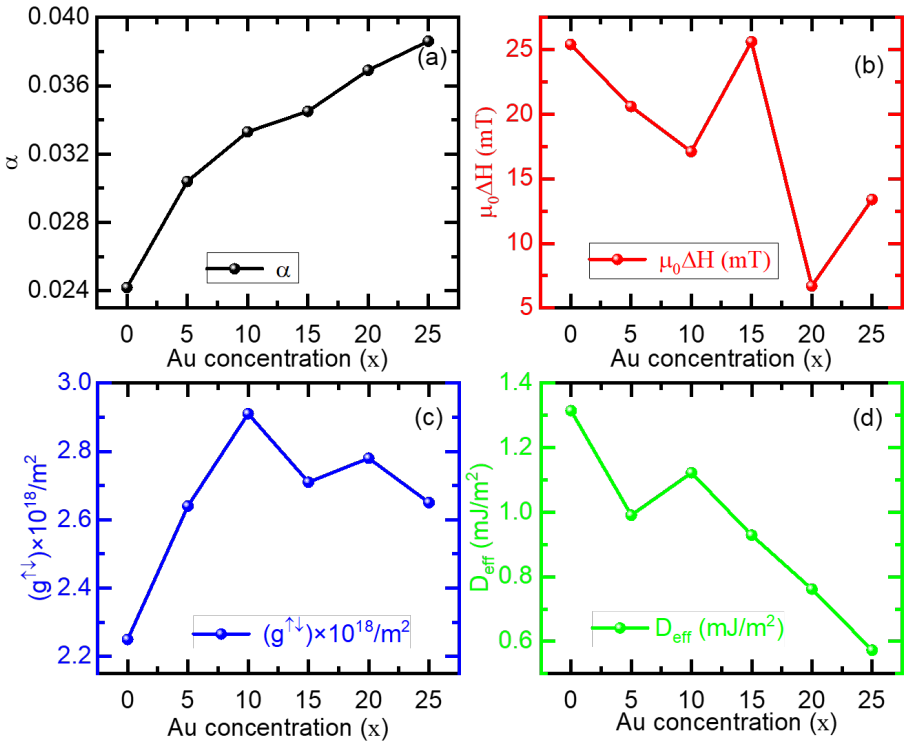
The central claim is that diluting the cobalt layer with gold in an epitaxial Re(10 Å)/Co$_{1-x}$Au$_x$(20 Å)/Pt(30 Å) stack gives systematic control over the magnetism: saturation magnetization falls from 1690 to 982 kA/m, the easy axis switches from in-plane to out-of-plane near $x \approx 0.13$, and the effective anisotropy constant $K_{\mathrm{eff}}$ reaches 0.33 MJ/m$^3$. The effective damping rises with Au concentration, which the paper attributes mainly to spin pumping, supported by an extracted effective spin-mixing conductance that peaks at $2.91\times10^{18}$ m$^{-2}$ for Co$_{90}$Au$_{10}$; the paper also notes that damping keeps rising while $g^{\uparrow\downarrow}$ falls for higher Au content, so spin pumping alone cannot explain the full trend. The interfacial Dzyaloshinskii–Moriya interaction decreases with Au content, from 2.62 pJ/m in pure Co to 1.14 pJ/m in Co$_{75}$Au$_{25}$, roughly tracking the saturation magnetization. The paper further shows that both Au content and Re buffer thickness raise the thickness at which the easy axis reorients, which is what a device engineer would need for thicker perpendicularly magnetized layers.
Load-bearing premise
The load-bearing assumption is that the intrinsic damping of the cobalt layer stays fixed at the bulk value $\alpha_0 = 0.011$ as gold is added, so the entire measured increase in damping can be assigned to interfacial spin pumping; the paper itself concedes that the spin-mixing conductance falls at higher gold concentrations while damping continues to rise.
Editorial extensions
If this is right
- Au concentration provides a one-parameter route to perpendicular magnetic anisotropy in thicker Co layers, because the spin-reorientation threshold moves to larger CoAu thickness as $x$ rises.
- Tuning Au from 0 to 25% raises the effective damping from 0.0242 to 0.0386, which is useful for applications that want faster magnetization switching.
- The effective spin-mixing conductance peaks at 10% Au, indicating an optimal composition for spin-current transfer before other damping channels grow stronger.
- Because interfacial DMI falls from 2.62 to 1.14 pJ/m as Au increases, a device designer can choose a composition at which perpendicular anisotropy, damping, and chiral interaction are mutually compatible.
- The observed near-linear tracking of DMI with saturation magnetization implies that the same interfacial spin-orbit mechanism controls both, so one measurement can be used to estimate the other.
Reading between the lines
- The non-monotonic $g^{\uparrow\downarrow}$ trend, which rises to 10% Au and then falls while damping keeps rising, implies that at high Au content the extra damping comes from channels other than spin pumping; inserting a spacer layer between CoAu and Pt would separate those channels.
- The same composition-tuning approach should generalize to other immiscible ferromagnet/noble-metal pairs, giving a generic alloy-composition knob for skyrmion-host materials.
- The claimed link between DMI and $M_\mathrm{s}$ could be tested by varying temperature instead of composition; the correlation should collapse if chemical disorder, rather than magnetization, drives the DMI reduction.
- The epitaxial stabilization of the normally immiscible Co–Au alloy suggests MBE-grown alloy films can serve as clean model systems for composition-dependent spin-orbit phenomena.
Editorial analysis
A structured set of objections, weighed in public.
Referee Report
Summary. The paper reports an MBE-grown epitaxial series Al2O3(0001)/Pt(400 Å)/Re(10 Å)/Co1-xAux(20 Å)/Pt(30 Å) with x = 0–25% and characterizes the static and dynamic magnetic properties with SQUID, VNA-FMR, BLS, RHEED, TEM, and MOKE. The central claims are that increasing Au concentration reduces Ms from 1690 to 982 kA/m, drives a spin-reorientation transition at about 13% Au, raises Keff up to 0.33 MJ/m3, increases the effective Gilbert damping from 0.0242 to 0.0386, and decreases the surface iDMI from 2.62 to 1.14 pJ/m. The damping increase is attributed in the abstract to spin pumping, and effective spin mixing conductances are extracted using Eq. (3).
Significance. If the reported trends hold, the paper provides a useful experimental demonstration that Au composition is a practical tuning parameter for PMA, damping, and iDMI in epitaxial Re/Co/Pt-type heterostructures. The multi-technique dataset is substantial and the static trends (Ms, Keff, SRT, iDMI) are internally consistent with the stated analysis. The comparison of the measured iDMI with literature values for Pt/Co/Re, W/Co/Pt, and Pt/Co/Ir is informative. However, the quantitative spin-pumping analysis contains an internal numerical inconsistency, and the abstract's attribution of the damping rise to spin pumping is contradicted by the paper's own discussion. These issues must be resolved before the quantitative claims can be accepted.
major comments (4)
- [Eq. (3), Tables II and III] The values of g↑↓ in Table III do not follow from Eq. (3) as written. For S1, Eq. (3) with α = 0.0242, α0 = 0.011, g = 2.13, Ms = 1690 kA/m, and tFM = 20 Å gives Δα = 0.0132 and g↑↓ = Δα / [(g μB)/(4π Ms tFM)] ≈ 2.8×10^19 m^-2, not the tabulated 2.25×10^18 m^-2. The tabulated values correspond to omitting the factor 4π from the denominator. This is a factor-4π unit/conversion error in the numerical evaluation. After correction the values are about 2.8–3.7×10^19 m^-2, which is unusually high and requires justification; the manuscript should discuss whether such large effective conductances are physically plausible for these interfaces and should clarify whether both the Re/Co and Co/Pt interfaces are included.
- [Abstract and Summary vs. discussion after Fig. 5(c)] The abstract states that the rise of effective damping with Au concentration 'can be attributed to the spin pumping effect,' and the Summary says 'We attribute this mainly to the spin-pumping phenomena.' This overstates the paper's own analysis. The discussion after Fig. 5(c) states that for S4–S6 the extracted g↑↓ decreases while the damping continues to rise, and concludes that 'an enhancement of the effective damping cannot be due to spin pumping only.' These statements are mutually inconsistent. The abstract and Summary should be revised to reflect the more nuanced conclusion that spin pumping contributes at low Au concentrations but that other channels (magnetic proximity effect, radiative damping, disorder, or the SRT transition) also play a role at higher x.
- [Eq. (3) and Fig. 3] The extraction of g↑↓ assumes α0 = 0.011, the bulk Co value, for every alloy composition. This assumption is load-bearing because the entire excess damping is assigned to spin pumping. The paper provides no justification that the intrinsic Gilbert damping of Co1-xAux is identical to bulk Co, and the RHEED data in Fig. 3 show that the streaks become 'blurry and less distinct' for x = 15–25%, indicating degraded crystalline quality that could raise the intrinsic damping independently of spin pumping. The TEM image for S4 shows a sharp interface, but it does not rule out intralayer alloy disorder. The authors should either model α0(x), provide a control experiment, or at a minimum state explicitly that the reported g↑↓ values are upper bounds under this assumption.
- [Tables II and III, Figs. 2 and 5] No error bars or uncertainties are reported for Ms, Keff, α, g↑↓, or Ds. This is particularly important for the claim that g↑↓ has a maximum at S3 (10% Au): the differences between S2 (2.64), S3 (2.91), and S4 (2.71) are of order 10%, and without uncertainties it is impossible to assess whether the non-monotonic behavior is significant. The claimed SRT at approximately 13% Au also lacks an uncertainty. The manuscript should provide error estimates for all extracted parameters, including fit uncertainties from the FMR linewidth and BLS frequency-asymmetry analyses.
minor comments (6)
- [Text near Fig. 2(a)] The sentence 'the sign of effective magnetization changes from positive to negative at around 13% Au' should read 'from negative to positive,' since the tabulated μ0Meff values go from -0.44 T for Co to +0.11 T for Co80Au20.
- [Eq. (4)] Equation (4) is garbled ('D_eff = Δf ... 2πk') and cannot be evaluated as printed. Please provide the standard BLS DMI expression with all symbols and units defined.
- [Summary] The Summary refers to 'Re(10 Å)/Co(20 Å)/Pt(20 Å)' and 'Re(10 Å)/Co75Au25(20 Å)/Pt(20 Å),' but the samples studied have a Pt(30 Å) cap. Please correct the stack notation.
- [References] The reference list contains malformed entries, e.g., ref. 21 is a patent citation with incomplete authors and title, and ref. 50 is a thesis citation with garbled title. Please format all references consistently.
- [Fig. 6] Several thickness labels in Fig. 6 are corrupted (e.g., 'tS= 19.90Å4.5Å'), which makes the SRT values difficult to read. Please provide a clean version with legible labels.
- [Throughout] The manuscript contains numerous OCR-type errors in equations and symbols (e.g., 'Keff' typeset inconsistently, 'μBΔH' formatting). A careful proofreading pass is needed.
Circularity Check
No significant circularity: measured parameters are extracted with standard literature formulas; self-citations are background or comparison only.
full rationale
The paper's quantitative claims rest on independent measurements reduced with standard formulas: SQUID magnetization loops give Ms, Keff, and Ku; VNA-FMR resonance-field and linewidth fits (Eqs. 1 and 2) give Ms_eff, g, and alpha; BLS Stokes/anti-Stokes asymmetry (Eq. 4) gives Deff and Ds. The spin-mixing conductance in Eq. (3) is obtained by inserting these measured values together with a literature bulk-Co alpha0 = 0.011 and t_FM = 20 A; this is an interpretive model assumption, not a circular definition, because the equation does not presuppose the Au-concentration trend of alpha or the extracted g_up_down values. The authors explicitly concede that for S4-S6, g_up_down decreases while alpha continues to rise, so the abstract's spin-pumping attribution is qualified in the body. Self-citations (Kurant et al. for W/Co/Pt, Jena et al. for W/Co/Pt DMI, Singh et al. for seed/capping effects) supply background and comparative benchmarks, but none is the load-bearing derivational input. No fitted parameter is renamed as a prediction, no uniqueness theorem is imported, and no ansatz is smuggled in through citation. A possible 4pi numerical discrepancy in the g_up_down values would be a correctness or units issue, not evidence of circularity.
Assumptions & free parameters
assumptions (5)
- standard math Kittel's perpendicular FMR resonance condition (Eq. 1) and the linear linewidth relation (Eq. 2) describe the measured spectra.
- domain assumption Bulk Co damping α0 = 0.011 (ref. 45) is the correct baseline for all Co1-xAux alloys in Eq. (3).
- domain assumption Re/Co and Co/Pt interfaces have the same iDMI sign and additive contributions, and this extends to the alloy interfaces.
- domain assumption Two-magnon scattering is inactive for out-of-plane FMR, and interfaces are sharp for all samples based on TEM of S4.
- standard math BLS frequency difference yields Deff via Eq. (4) with Ms from SQUID.
Cite this review
Pith. "Pith review of Magnetic Properties of epitaxial $\text{Re}/\text{Co}_{1-x}\text{Au}_{x}/\text{Pt}$ heterostructures." pith.science (2026). https://pith.science/paper/BA7Z6RDF
@misc{pith2026250112961,
  author       = {Pith},
  title        = {Pith review of: Magnetic Properties of epitaxial $\textRe/\textCo_1-x\textAu_x/\textPt$ heterostructures},
  year         = {2026},
  howpublished = {\url{https://pith.science/paper/BA7Z6RDF}},
  note         = {Machine review of arXiv:2501.12961}
}
abstract
We investigate epitaxial $\text{Co}(20 \, \text{\r{A}})$ and $\text{Co}_{1-x}\text{Au}_{x}(20 \, \text{\r{A}})$ alloy thin-films surrounded by asymmetric heavy metals layers of $\text{Re}(10 \, \text{\r{A}})$ as a buffer and $\text{Pt}(30 \, \text{\r{A}})$ as a cap to study the magnetic anisotropy, interfacial Dzyaloshinskii-Moriya interaction (iDMI) and damping. The increase of Au from 0% to 25% in the $\text{Co}_{1-x}\text{Au}_{x}$ alloy generates the spin-reorientation transition of around 13% of Au. The increase in Au concentration provides a significant decrease in saturation magnetization from 1690 kA/m to 982 kA/m measured for Co and $\text{Co}_{75}\text{Au}_{25}$, respectively. The effective anisotropy constant $\text{K}_{eff}$ is elevated up to 0.33 $\text{MJ/m}^{3}$ by changing the Au content. Further, our investigations of the magnetization dynamics have confirmed that the overall effective damping constant rises with the Au concentration which can be attributed to the spin pumping effect. The spin pumping leads to the highest value of effective spin mixing conductance $g^{(\uparrow \downarrow)} \approx 2.91 \times 10^{18} \, \text{m}^{-2}$ in the $\text{Co}_{90}\text{Au}_{10}(20 \, \text{\r{A}})$ system, while the lowest value of $g^{(\uparrow \downarrow)} \approx 2.25 \times 10^{18} \, \text{m}^{-2}$ is found for the $\text{Co}(20 \, \text{\r{A}})$ system. Additionally, we have investigated the iDMI strength, and the amplitude of iDMI decreases with increasing Au concentration. The highest surface iDMI constant value equal to 2.62 pJ/m is observed for Co.
Figures


Figures from the paper (1 more)
Reference graph
Works this paper leans on
-
[1]
Hellman, F., Hoffmann, A., Tserkovnyak, Y., Beach, G. S. D., Fullerton, E. E., Leighton, C., MacDonald, A. H., Ralph, D. C., Arena, D. A., Dürr, H. A., Fischer, P., Grollier, J., Heremans, J. P., Jungwirth, T., Kimel, A. V., Koopmans, B., Krivorotov, I. N., May, S. J., Petford-Long, A. K., Rondinelli, J. M., Samarth, N., Schuller, I. K., Slavin, A. N., St...
work page 2017
-
[2]
Johnson, M. T., Bloemen, P. J. H., Den Broeder, F. J. A. & De Vries, J. J. Magnetic anisotropy in metallic multilayers. Reports on Progress in Physics 59, 1409–1458 (1996)
work page 1996
-
[3]
Dieny, B. & Chshiev, M. Perpendicular magnetic anisotropy at transition metal/oxide interfaces and applications. Reviews of Modern Physics 89, (2017)
work page 2017
-
[4]
M., Jungwirth, T., Sinova, J., Thiaville, A., Garello, K
Manchon, A., Železný, J., Miron, I. M., Jungwirth, T., Sinova, J., Thiaville, A., Garello, K. & Gambardella, P. Current-induced spin-orbit torques in ferromagnetic and antiferromagnetic systems. Reviews of Modern Physics 91, (2019)
work page 2019
-
[5]
M., De Melo Costa, L., Olleros, P., Niño, M
Ajejas, F., Gudín, A., Guerrero, R., Anadón Barcelona, A., Diez, J. M., De Melo Costa, L., Olleros, P., Niño, M. A., Pizzini, S., Vogel, J., Valvidares, M., Gargiani, P., Cabero, M., Varela, M., Camarero, J., Miranda, R. & Perna, P. Unraveling Dzyaloshinskii-Moriya Interaction and Chiral Nature of Graphene/Cobalt Interface. Nano Letters 18, 5364–5372 (2018)
work page 2018
-
[6]
K., Matczak, M., Gieniusz, R., Sveklo, I., Kurant, Z., Guzowska, U., Stobiecki, F
Dhiman, A. K., Matczak, M., Gieniusz, R., Sveklo, I., Kurant, Z., Guzowska, U., Stobiecki, F. & Maziewski, A. Thickness dependence of interfacial Dzyaloshinskii-Moriya interaction, magnetic anisotropy and spin waves damping in Pt/Co/Ir and Ir/Co/Pt trilayers. Journal of Magnetism and Magnetic Materials 519, 167485 (2021)
work page 2021
-
[7]
Wawro, A., Kurant, Z., Tekielak, M., Nawrocki, P., Milińska, E., Pietruczik, A., Wójcik, M., Mazalski, P., Kanak, J., Ollefs, K., Wilhelm, F., Rogalev, A. & Maziewski, A. Engineering the magnetic anisotropy of an ultrathin Co layer sandwiched between films of Mo or Au. Journal of Physics D: Applied Physics 50, 215004 (2017)
work page 2017
-
[8]
Jakubowski, M. M., Liedke, M. O., Butterling, M., Dynowska, E., Sveklo, I., Milińska, E., Kurant, Z., Böttger, R., Von Borany, J., Maziewski, A., Wagner, A. & Wawro, A. On defects’ role in enhanced perpendicular magnetic anisotropy in Pt/Co/Pt, induced by ion irradiation. Journal of Physics Condensed Matter 31, (2019)
work page 2019
Show all 51 references
-
[9]
K., Gieniusz, R., Guzowska, U., Kisielewski, M., Mazalski, P., Sveklo, I., Pietruczik, A., Lynnyk, A., Wawro, A
Kurant, Z., Jena, S. K., Gieniusz, R., Guzowska, U., Kisielewski, M., Mazalski, P., Sveklo, I., Pietruczik, A., Lynnyk, A., Wawro, A. & Maziewski, A. Magnetic ordering in epitaxial ultrathin Pt/W/Co/Pt layers. Journal of Magnetism and Magnetic Materials 558, 169485 (2022)
2022
-
[10]
B., Nishizawa, T
Okamoto, H., Massalski, T. B., Nishizawa, T. & Hasebe, M. The Au-Co (Gold-Cobalt) system. Bulletin of Alloy Phase Diagrams 6, 449–454 (1985)
1985
-
[11]
& Mattei, G
Spizzo, F., Del Bianco, L., Coïsson, M., Chinni, F., Mattarello, V., Maurizio, C. & Mattei, G. Interplay between magnetic anisotropies in CoAu and Co films and antidot arrays: Effects on the spin configuration and hysteretic behavior. Physical Chemistry Chemical Physics 20, 16...
2018
-
[12]
& Bianco, L
Chinni, F., Spizzo, F., Montoncello, F., Mattarello, V., Maurizio, C., Mattei, G. & Bianco, L. Del. Magnetic Hysteresis in Nanocomposite Films Consisting of a Ferromagnetic AuCo Alloy and Ultrafine Co Particles. Materials 10, 717 (2017)
2017
-
[13]
& Mattei, G
Maurizio, C., Michieli, N., Kalinic, B., Mattarello, V., Bello, V., Wilhelm, F., Ollefs, K. & Mattei, G. Local structure and X-ray magnetic circular dichroism of Au in Au-Co nanoalloys. Applied Surface Science 433, 596–601 (2018)
2018
-
[14]
T., Mueller, C., Fumagalli, P., Rogalev, A
Wilhelm, F., Angelakeris, M., Jaouen, N., Poulopoulos, P., Papaioannou, E. T., Mueller, C., Fumagalli, P., Rogalev, A. & Flevaris, N. K. Magnetic moment of Au at Au/Co interfaces: A direct experimental determination. Physical Review B - Condensed Matter and Materials Physics 6...
2004
-
[15]
P., Watanabe, D., Wu, F., Miyazaki, T., Naganuma, H., Oogane, M
Mizukami, S., Sajitha, E. P., Watanabe, D., Wu, F., Miyazaki, T., Naganuma, H., Oogane, M. & Ando, Y. Gilbert damping in perpendicularly magnetized Pt/Co/Pt films investigated by all-optical pump-probe technique. Applied Physics Letters 96, (2010)
2010
-
[16]
Song, H.-S., Lee, K.-D., Sohn, J.-W., Yang, S.-H., Parkin, S. S. P., You, C.-Y. & Shin, S.-C. Observation of the intrinsic Gilbert damping constant in Co/Ni multilayers independent of the stack number with perpendicular anisotropy. Applied Physics Letters 102, (2013)
2013
-
[17]
& Takanashi, K
Ogiwara, M., Iihama, S., Seki, T., Kojima, T., Mizukami, S., Mizuguchi, M. & Takanashi, K. Magnetization damping of an L10-FeNi thin film with perpendicular magnetic anisotropy. Applied Physics Letters 103, (2013)
2013
-
[18]
& Piramanayagam, S
Bhatti, S., Sbiaa, R., Hirohata, A., Ohno, H., Fukami, S. & Piramanayagam, S. N. Spintronics based random access memory: a review. Materials Today 20, 530–548 (2017)
2017
-
[19]
O., McMichael, R
Rantschler, J. O., McMichael, R. D., Castillo, A., Shapiro, A. J., Egelhoff, W. F., Maranville, B. B., Pulugurtha, D., Chen, A. P. & Connors, L. M. Effect of 3d, 4d, and 5d transition metal doping on damping in permalloy thin films. Journal of Applied Physics 101, (2007)
2007
-
[20]
Ingvarsson, S., Xiao, G., Parkin, S. S. P. & Koch, R. H. Tunable magnetization damping in transition metal ternary alloys. Applied Physics Letters 85, 4995–4997 (2004)
2004
-
[21]
S., Jose, S
Plains, W., Parkin, S. S., Jose, S. & Xiao, G. ( 12 ) United States Patent. 85, (2002)
2002
-
[22]
A thermodynamic theory of “weak” ferromagnetism of antiferromagnetics
Dzyaloshinsky, I. A thermodynamic theory of “weak” ferromagnetism of antiferromagnetics. Journal of Physics and Chemistry of Solids 4, 241–255 (1958)
1958
-
[23]
Anisotropic Superexchange Interaction and Weak Ferromagnetism
Moriya, T. Anisotropic Superexchange Interaction and Weak Ferromagnetism. Physical Review 120, 91–98 (1960)
1960
-
[24]
& Cros, V
Fert, A., Reyren, N. & Cros, V. Magnetic skyrmions: advances in physics and potential applications. Nature Reviews Materials 2, 17031 (2017)
2017
-
[25]
Y., Kim, N
Kim, D. Y., Kim, N. H., Park, Y. K., Park, M. H., Kim, J. S., Nam, Y. S., Jung, J., Cho, J., Kim, D. H., Kim, J. S., Min, B. C., Choe, S. B. & You, C. Y. Quantitative accordance of Dzyaloshinskii-Moriya interaction between domain-wall and spin-wave dynamics. Physical Review B ...
2019
-
[26]
& Ando, K
Nomura, A., Gao, T., Haku, S. & Ando, K. Additive Dzyaloshinskii–Moriya interaction in Pt/Co/Re films. AIP Advances 12, (2022)
2022
-
[27]
Jadaun, P., Register, L. F. & Banerjee, S. K. The microscopic origin of DMI in magnetic bilayers and prediction of giant DMI in new bilayers. npj Computational Materials 6, 88 (2020)
2020
-
[28]
Moreau-Luchaire, C., Moutafis, C., Reyren, N., Sampaio, J., Vaz, C. A. F., Van Horne, N., Bouzehouane, K., Garcia, K., Deranlot, C., Warnicke, P., Wohlhüter, P., George, J.-M., Weigand, M., Raabe, J., Cros, V. & Fert, A. Additive interfacial chiral interaction in multilayers f...
2016
-
[29]
K., Islam, R., Milinska, E., Jakubowski, M
Jena, S. K., Islam, R., Milinska, E., Jakubowski, M. M., Minikayev, R., Lewinska, S., Lynnyk, A., Pietruczik, A., Aleszkiewicz, P., Autieri, C. & Wawro, A. Interfacial Dzyaloshinskii-Moriya interaction in the epitaxial W/Co/Pt multilayers. Nanoscale 13, 7685–7693 (2021)
2021
-
[30]
On the theory of ferromagnetic resonance absorption
Kittel, C. On the theory of ferromagnetic resonance absorption. Physical Review 73, 155–161 (1948)
1948
-
[31]
& Albrecht, M
Ciubotariu, O., Semisalova, A., Lenz, K. & Albrecht, M. Strain-induced perpendicular magnetic anisotropy and Gilbert damping of Tm3Fe5O12 thin films. Scientific Reports 9, 1–8 (2019)
2019
-
[32]
& Muduli, P
Kumar, A., Pandey, N., Kumar, D., Gupta, M., Chaudhary, S. & Muduli, P. K. Influence of annealing on spin pumping in sputtered deposited Co/Pt bilayer thin films. Physica B: Condensed Matter 570, 254–258 (2019)
2019
-
[33]
B., Jena, S
Singh, B. B., Jena, S. K. & Bedanta, S. Study of spin pumping in Co thin film vis-à-vis seed and capping layers using ferromagnetic resonance spectroscopy. Journal of Physics D: Applied Physics 50, 345001 (2017)
2017
-
[34]
Y., Xiao, G., Slonczewski, J
Ingvarsson, S., Ritchie, L., Liu, X. Y., Xiao, G., Slonczewski, J. C., Trouilloud, P. L. & Koch, R. H. Role of electron scattering in the magnetization relaxation of thin (formula presented) films. Physical Review B - Condensed Matter and Materials Physics 66, 1–5 (2002)
2002
-
[35]
V., Crozat, P., Chappert, C., Zoll, S
Counil, G., Devolder, T., Kim, J. V., Crozat, P., Chappert, C., Zoll, S. & Fournel, R. Temperature dependences of the resistivity and the ferromagnetic resonance linewidth in permalloy thin films. IEEE Transactions on Magnetics 42, 3323–3325 (2006)
2006
-
[36]
Hickey, M. C. & Moodera, J. S. Origin of intrinsic Gilbert damping. Physical Review Letters 102, 1–4 (2009)
2009
-
[37]
& Zhang, Z
Wu, K., Tang, M., Li, D., Guo, X., Cui, B., Yun, J., Zuo, Y., Xi, L. & Zhang, Z. Z. Modulation of magnetic damping constant of Fe 2 Co films by heavy doping of rare-earth Yb. Journal of Physics D: Applied Physics 50, 135001 (2017)
2017
-
[38]
A., Krumme, B., Wende, H., Mills, D
Barsukov, I., Landeros, P., Meckenstock, R., Lindner, J., Spoddig, D., Li, Z. A., Krumme, B., Wende, H., Mills, D. L. & Farle, M. Tuning magnetic relaxation by oblique deposition. Physical Review B - Condensed Matter and Materials Physics 85, 1–6 (2012)
2012
-
[39]
C., Reyren, N., Laczkowski, P., Savero, W., Attané, J
Rojas-Sánchez, J. C., Reyren, N., Laczkowski, P., Savero, W., Attané, J. P., Deranlot, C., Jamet, M., George, J. M., Vila, L. & Jaffrès, H. Spin pumping and inverse spin hall effect in platinum: The essential role of spin-memory loss at metallic interfaces. Physical Review Let...
2014
-
[40]
M., Choi, Y., Ortega, C
Lu, Y. M., Choi, Y., Ortega, C. M., Cheng, X. M., Cai, J. W., Huang, S. Y., Sun, L. & Chien, C. L. Pt magnetic polarization on Y3Fe5O12 and magnetotransport characteristics. Physical Review Letters 110, 1–5 (2013)
2013
-
[41]
P., Hillebrands, B
Conca, A., Keller, S., Mihalceanu, L., Kehagias, T., Dimitrakopulos, G. P., Hillebrands, B. & Papaioannou, E. T. Study of fully epitaxial Fe/Pt bilayers for spin pumping by ferromagnetic resonance spectroscopy. Physical Review B 93, 1–6 (2016)
2016
-
[42]
Schoen, M. A. W., Shaw, J. M., Nembach, H. T., Weiler, M. & Silva, T. J. Radiative damping in waveguide-based ferromagnetic resonance measured via analysis of perpendicular standing spin waves in sputtered permalloy films. Physical Review B - Condensed Matter and Materials Phy...
2015
-
[43]
& Bailey, W
Li, Y. & Bailey, W. E. Wave-Number-Dependent Gilbert Damping in Metallic Ferromagnets. Physical Review Letters 116, 1–5 (2016)
2016
-
[44]
A., Kakazei, G
Tokaç, M., Bunyaev, S. A., Kakazei, G. N., Schmool, D. S., Atkinson, D. & Hindmarch, A. T. Interfacial Structure Dependent Spin Mixing Conductance in Cobalt Thin Films. Physical Review Letters 115, 1–5 (2015)
2015
-
[45]
M., Sinha, J., Hindmarch, A
Azzawi, S., Ganguly, A., Tokaç, M., Rowan-Robinson, R. M., Sinha, J., Hindmarch, A. T., Barman, A. & Atkinson, D. Evolution of damping in ferromagnetic/nonmagnetic thin film bilayers as a function of nonmagnetic layer thickness. Physical Review B 93, 1–6 (2016)
2016
-
[46]
M., Freyermuth, J
Cheng, S., Bagués, N., Selcu, C. M., Freyermuth, J. B., Li, Z., Wang, B., Das, S., Hammel, P. C., Randeria, M., McComb, D. W. & Kawakami, R. K. Room-temperature magnetic skyrmions in Pt/Co/Cu multilayers. Physical Review B 108, 174433 (2023)
2023
-
[47]
V., Kozlov, A
Davydenko, A. V., Kozlov, A. G., Stebliy, M. E., Kolesnikov, A. G., Sarnavskiy, N. I., Iliushin, I. G. & Golikov, A. P. Dzyaloshinskii-Moriya interaction and chiral damping effect in symmetric epitaxial Pd/Co/Pd(111) trilayers. Physical Review B 103, 94435 (2021)
2021
-
[48]
B., Moore, T
Shahbazi, K., Hrabec, A., Moretti, S., Ward, M. B., Moore, T. A., Jeudy, V., Martinez, E. & Marrows, C. H. Magnetic properties and field-driven dynamics of chiral domain walls in epitaxial Pt/Co/AuxPt1-x trilayers. Physical Review B 98, 1–9 (2018)
2018
-
[49]
& Gilles, B
Dumur, E., Delsol, B., Weissl, T., Kung, B., Guichard, W., Hoarau, C., Naud, C., Hasselbach, K., Buisson, O., Ratter, K. & Gilles, B. Epitaxial Rhenium Microwave Resonators. IEEE Transactions on Applied Superconductivity 26, 1–4 (2016)
2016
-
[50]
Ratter, K. Epitaxial Rhenium , a clean limit superconductor for superconducting Qbits To cite this version : HAL Id : tel-01759239 Epitaxial Rhenium , un supraconducteur en limit e propre pour des Qbits supraconducteurs Epitaxial Rhenium , a clean limit superconduct. (2018). a...
2018
-
[2020]
AW would like to acknowledge the M-ERA.NET 3 (2022/04/Y/ST5/00164)
This work was supported by the Foundation for Polish Science (FNP) under the European Regional Development Fund – Program [REINTEGRATION 2017 OPIE 14-20] and by the Polish National Science Centre projects: [2016/23/G/ST3/04196] and OPUS-19 [2020/37/B/ST5/02299]. AW would like ...
2017
Reviewed August 10, 2026 · model on record in the stance chip above.
Discussion (0). Continue with ORCID to comment.