REVIEW 4 major objections 4 minor 86 references
Grain-size dependence of plastic-brittle transgranular fracture
T0 review · 4 major / 4 minor · reviewed 2026-08-10 · deepseek-v4-flash
Pith's one-line read The paper claims that cleavage fracture in BCC polycrystals is governed by two opposing grain-size laws—Hall-Petch nucleation and inverse Hall-Petch propagation—whose competition produces the non-monotonic toughness data.
desk verdict A credible computational framework whose headline grain-size effect is not yet established — the inverse Hall-Petch branch rests on an unsaturated Jmax and a mesh check that was flagged but not done. read the letter →
The pith
A machine-rendered reading of the paper's core claim, the machinery that carries it, and where it could break.
The reading
What carries the argument
The carrying object is a variational phase-field fracture model coupled to finite-strain, dislocation-density-based crystal viscoplasticity with 24 slip systems for body-centered cubic crystals, where the phase field $\alpha \in [0,1]$ regularizes the crack surface. A $K_s/\delta$ term in the dislocation evolution equations, with $\delta$ the distance to the nearest grain boundary, produces the Hall-Petch yield and nucleation strengthening. For propagation, mode-I surfing boundary conditions impose the asymptotic crack-tip displacement field moving at constant speed, and the effective toughness is read from the peak value of the far-field $J$-integral over the crack history, following the idea that this peak is the effective propagation threshold in heterogeneous media.
What would settle it
A direct numerical check is to repeat the 50 µm propagation case at the most brittle ductility ratio ($q=2.5\times10^2$) with the mesh size halved while holding the phase-field length scale fixed; if $J_{\max}$ drops toward the values obtained for 5 µm grains and the serrations disappear, the inverse Hall-Petch propagation trend is a discretization artifact rather than a physical grain-size effect.
Extended reading notes
Core claim
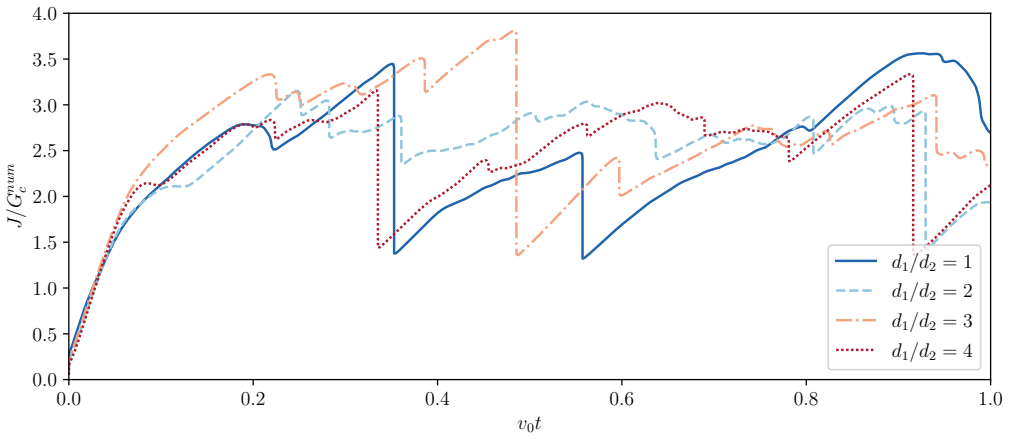
The central discovery is that transgranular cleavage in BCC polycrystals is governed by two grain-size-dependent thresholds that scale oppositely. In uniaxial plane-strain tension, both the 0.2% yield stress and the peak stress grow linearly with $1/\sqrt{d}$ for grain diameters from 1 to 100 µm, and the peak stress marks crack nucleation; the mechanism is heterogeneous slip and cross-hardening that concentrate stress more strongly in larger grains. In propagation simulations driven by mode-I surfing boundary conditions, the peak far-field $J$-integral $J_{\max}$ increases with grain size from 5 to 50 µm, an inverse Hall-Petch trend, because grain boundaries pin and deflect the transgranular crack through elastic and plastic heterogeneity. The competition gives a non-monotonic fracture resistance with a minimum near intermediate grain sizes, matching the scatter in reported data. In bimodal microstructures, coarse grains embedded in a fine-grained matrix raise $J_{\max}$ by roughly 67% over a uniformly fine microstructure at the same ductility ratio, showing how the two opposing trends can be used together.
Load-bearing premise
The load-bearing premise is that the largest-grain propagation calculation, where the paper itself flags mesh sensitivity, is nevertheless numerically resolved; without a reported mesh-refinement study, the elevated toughness at 50 µm grain size could be a discretization artifact rather than physical grain-boundary pinning.
Editorial extensions
If this is right
- Grain refinement strengthens a polycrystal but does not automatically toughen it: below the crossover, Hall-Petch nucleation resistance dominates, while above it, grain-boundary pinning of propagating cracks takes over.
- The same metal can show toughness that rises, falls, or is flat with grain size depending on which side of the minimum the measured grain sizes sit, which explains why collected experimental data look contradictory.
- Bimodal microstructures with coarse grains dispersed in a fine-grained matrix should combine Hall-Petch strength with propagation toughness, giving a design route that avoids the usual strength-toughness trade-off.
- The inverse Hall-Petch propagation effect weakens as the material becomes more brittle (smaller ratio of plastic zone size to process zone size), so the grain-size route to toughness is most effective when a substantial plastic zone is present.
- Texture has limited effect on the peak toughness value for grain aspect ratios up to 4, but it changes whether crack growth is continuous or proceeds by repeated jumps.
Reading between the lines
- Editorial extension: the model implies there is a crossover grain size at which nucleation resistance and propagation resistance are equal, and that crossover should be predictable from single-crystal yield stress, hardening, and toughness; mapping it experimentally would give a one-parameter design rule.
- Editorial extension: because the propagation mechanism is pinning by elastic and plastic heterogeneity, grain boundary character and misorientation distribution are predicted to matter as much as nominal grain diameter; experiments varying boundary types at fixed grain size could isolate this.
- Editorial extension: the ductility ratio $q$ depends on yield stress, so the toughness minimum should shift with temperature; low-temperature data should show a shallower inverse Hall-Petch effect, a testable consequence the paper does not develop.
- Editorial extension: a natural next step is three dimensions, where crack-front bowing between pinning boundaries may change the scaling exponent from the two-dimensional inverse Hall-Petch trend reported here.
Editorial analysis
A structured set of objections, weighed in public.
Referee Report
Summary. The paper develops a finite-strain phase-field fracture model coupled to dislocation-density-based crystal visco-plasticity for body-centered cubic polycrystals, and uses it to study grain-size effects in plastic-brittle transgranular fracture. In uniaxial tension simulations of polycrystals with grain sizes from 1 to 100 micrometers, the authors report that the yield stress and the peak stress (associated with crack nucleation) follow the Hall-Petch relation. In crack-propagation simulations using surfing boundary conditions with grain sizes from 5 to 50 micrometers and three ductility ratios, they report that the effective toughness, identified with the peak J-integral, increases with grain size, following an inverse Hall-Petch relation. The paper also examines bimodal and textured microstructures, concluding that a secondary population of larger grains provides significant toughening. The central claim is that the competition between Hall-Petch-controlled nucleation and inverse Hall-Petch-controlled propagation produces a non-monotonic grain-size dependence that reconciles contradictory experimental observations.
Significance. If the reported trends are robust, the paper would provide a mechanistic framework for reconciling the conflicting experimental observations on grain-size dependence of fracture toughness, and the model would be a valuable computational tool for studying size effects in plastic-brittle fracture. The paper has notable strengths: the model couples phase-field fracture with a detailed 24-slip-system dislocation-density crystal plasticity law, the code is open source, the microstructure generation is reproducible via Neper, and falsifiable predictions are made for bimodal and textured microstructures. The inclusion of the bimodal and texture studies, and the link to the experimental review of Reiser and Hartmaier, strengthen the paper's relevance. However, the quantitative support for the inverse Hall-Petch propagation branch is currently limited by statistical undersampling, by the censored J-integral for the largest grain size at the highest ductility, and by the absence of mesh-convergence evidence for exactly the case that carries the trend. These issues must be addressed before the central reconciliation claim can be accepted.
major comments (4)
- [Section 5.3 / Figure 11a / Figure 12] The effective toughness Jmax for the largest grain size d=50 µm at q=1.0e3 is taken from a curve that is still increasing at the end of the simulation, as explicitly acknowledged in Section 5.2. Section 5.3 defines Jmax as the peak value 'assuming that such a distance is reached in our simulations,' and for this case the assumption is not satisfied. Since the smaller-grain curves have saturated plateaus while the d=50 µm curve does not, the comparison underlying the inverse Hall-Petch trend and the reported 3.1x ratio is biased in the direction claimed. The authors should extend the simulation until a plateau is reached, or adopt an alternative steady-state definition of effective toughness, before drawing quantitative conclusions.
- [Section 5.2 / Figure 11c] The d=50 µm case at the lowest ductility (q=2.5e2) has a phase-field length-to-mesh ratio ell/h = 1, and the text states that this case displays 'sensitivity to the spatial discretization.' The subsequent assertion that a refined mesh 'would not drastically change the crack path, nor the J-integral values' is not supported by any convergence study in the manuscript. Because the elevated Jmax for d=50 µm is the central evidence for the inverse Hall-Petch branch at all ductility ratios, a mesh-convergence check (e.g., ell/h = 2 or smaller) for this specific case is needed to establish that the trend is not a numerical artifact.
- [Section 5.3 / Figure 12] The propagation trend is established from a single microstructure realization per grain size and only three grain sizes for each ductility ratio, with no error bars or repetition. The nucleation study in Section 4.2 uses four realizations per grain size and Figure 6 shows appreciable scatter between realizations, indicating that microstructure-specific fluctuations are non-negligible. With one realization per point, the claimed inverse Hall-Petch scaling and the quantitative ratios (3.1x, 2.4x, 1.6x) cannot be distinguished from a fluctuation in the toughness of one particular 50 µm microstructure. At least two or three realizations per grain size should be simulated for the propagation study.
- [Eq. (15) / Section 4.2] The Hall-Petch dependence of the yield and peak stresses is a direct consequence of the phenomenological grain-boundary source term K_s/delta introduced in the dislocation evolution equation (15). The paper acknowledges this term is a phenomenological model of pile-ups, but the highlight and conclusion that the model 'predicts' a Hall-Petch size effect on yield and nucleation overstates the status of this result: it is a consistency check of the imposed mechanism, not an emergent prediction. The explanatory claim in Section 6 should be framed accordingly, and the limitations of the K_s/delta assumption for the nucleation branch should be discussed explicitly.
minor comments (4)
- [Figure 11 caption] The caption text says '(c) The ductility ratio q is varied' but the described panel is (d); the panel labels in the caption should be corrected.
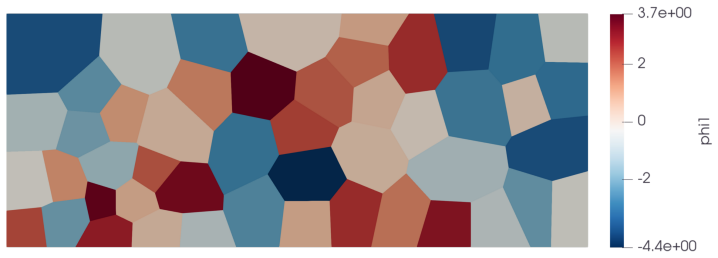
- [Figure 11 and text] The grain size is denoted d in the text and most figures, but the panels in Figure 11 use the symbol phi; the notation should be unified.
- [Section 4.2] There is a typo: 'frequently obeserved' should be 'frequently observed'.
- [Eq. (22) versus Eq. (20)] The symbol t is used for the tangent vector in the J-integral definition in Eq. (22), while t denotes time in the surfing boundary conditions of Eq. (20); a different symbol for the tangent vector would avoid confusion.
Circularity Check
Hall-Petch nucleation branch is partly built into the model via the Ks/δ source term, while the inverse Hall-Petch propagation branch is emergent and not imposed; the largest-grain Jmax is censored, but that is a robustness issue rather than circularity.
-
fitted input called prediction
[Section 3.4 (Eq. 15) and Section 4.2 (Hall-Petch size effect)]
"Following Haouala et al. (2020a), the Hall-Petch effect on the yield stress can be modeled with the term Ks/δ, where Ks is a non-dimensional material parameter and δ(xxx) is the distance between the material point located at xxx and the closest grain boundary. ... The normalized yield stress at 0.2% plastic strain (σ0.2%) and peak stress ... follow a linear relationship with the inverse square root of the mean grain diameter. ... This effect on the yield stress is captured through the grain size dependent evolution equations of dislocation densities in Eq. (15)."
The paper presents the Hall-Petch yield and peak-stress trend as one of its two discovered mechanisms (Abstract, Figure 1b, Section 6). But this trend is installed in the constitutive model before any simulation: Eq. (15) adds a grain-boundary dislocation source Ks/δ whose stated purpose is to model the Hall-Petch effect on yield, and the inverse-grain-size scaling (Eq. 17, δ̃ = ηδ/b) makes Ks/δ scale as η ∝ 1/d. Section 4.2 then says the Hall-Petch output is 'captured through' Eq. (15). Thus the nucleation branch of the central non-monotonic claim is partly a restatement of the model input rather than an independent first-principles derivation.
full rationale
Most of the fracture-propagation analysis is self-contained and non-circular. The surfing-boundary-condition J-integral simulations in Section 5 contain no parameter fitted to the reported trends; the inverse Hall-Petch Jmax branch emerges from anisotropic elastic/plastic heterogeneity and grain-boundary pinning in the simulations. The self-citations to Hossain et al. (2014), Brach et al. (2019a), and Brodnik et al. (2021) supply the Jmax-as-effective-toughness methodology; they are methodological imports rather than proofs of the physics, and they do not forbid alternative explanations, so they are not scored as load-bearing circularity. Two validity concerns should be separated from circularity: for d = 50 µm at q = 1.0 × 10^3, Figure 11a shows that J/Gnum_c 'continues to increase until the end of the simulation', so Jmax is a censored end-value rather than a true steady-state peak; and the same case has ℓ/h = 1 (Section 5.2), so the 3.1× toughness ratio could be influenced by simulation truncation and spatial resolution. These are robustness and correctness risks, not definitional circularity, and they do not increase the circularity score. The circularity that is present is confined to the Hall-Petch nucleation branch, which is pre-loaded by the Ks/δ source term; the central non-monotonic competition retains substantial independent content through the emergent inverse Hall-Petch propagation branch.
Assumptions & free parameters
free parameters (4)
- Hall-Petch grain-boundary coefficient K_s =
5 (non-dimensional)
- Initial critical resolved shear stress tau_0 =
10^-3, 2x10^-3, 4x10^-3 (non-dimensional)
- Phase-field length scale l =
10^-2/eta
- Fracture energy Gc =
10^-5/eta (non-dimensional)
assumptions (5)
- domain assumption 2D plane-strain polycrystals with 49 to 100 grains are representative of 3D polycrystalline fracture behavior
- domain assumption Isotropic phase-field fracture energy with no cleavage-plane dependence captures transgranular cleavage
- ad hoc to paper The K_s/delta term in Eq. (15) is a sufficient model of grain-boundary dislocation pile-ups
- domain assumption Surfing boundary conditions with far-field mode I displacement impose steady crack propagation and the peak J-integral measures effective toughness
- domain assumption The plastic zone to process zone ratio q approximately equals E0/tau_0 with alpha/beta ~ 1
Cite this review
Pith. "Pith review of Grain-size dependence of plastic-brittle transgranular fracture." pith.science (2026). https://pith.science/paper/HIVSHT6Q
@misc{pith2026250113882,
  author       = {Pith},
  title        = {Pith review of: Grain-size dependence of plastic-brittle transgranular fracture},
  year         = {2026},
  howpublished = {\url{https://pith.science/paper/HIVSHT6Q}},
  note         = {Machine review of arXiv:2501.13882}
}
read the original abstract
The role of grain size in determining fracture toughness in metals is incompletely understood with apparently contradictory experimental observations. We study this grain-size dependence computationally by building a model that combines the phase-field formulation of fracture mechanics with dislocation density-based crystal plasticity. We apply the model to cleavage fracture of body-centered cubic materials in plane strain conditions, and find non-monotonic grain-size dependence of plastic-brittle transgranular fracture. We find two mechanisms at play. The first is the nucleation of failure due to cross-slip in critically located grains within transgranular band of localized deformation, and this follows the classical Hall-Petch law that predicts a higher failure stress for smaller grains. The second is the resistance to the propagation of a mode I crack, where grain boundaries can potentially pin a crack, and this follows an inverse Hall-Petch law with higher toughness for larger grains. The result of the competition between the two mechanisms gives rise to non-monotonic behavior and reconciles the apparently contradictory experimental observations.
Figures


Figures from the paper (15 more)




Reference graph
Works this paper leans on
-
[1]
Alessi, J.-J
R. Alessi, J.-J. Marigo, and S. Vidoli. Gradient Damage Models Coupled with Plasticity and Nucleation of Cohesive Cracks . Archive for Rational Mechanics and Analysis, 214 0 (2): 0 575--615, Nov. 2014
2014
-
[2]
T. L. Anderson. Fracture mechanics: fundamentals and applications. Third Edition (3rd ed.). CRC press, 2005
2005
-
[3]
M. Ashby. Mechanisms of deformation and fracture. Advances in applied mechanics, 23: 0 117--177, 1983
1983
-
[4]
Balay, J
S. Balay, J. Brown, K. Buschelman, W. Gropp, D. Kaushik, M. Knepley, L. McInnes, B. Smith, and H. Zhang. Petsc/tao: Home page, 2024. https://petsc.org/release/manual/tao/, 2024
2024
-
[5]
W. T. Becker. Mechanisms and appearances of ductile and brittle fracture in metals. In Failure analysis and prevention, pages 587--626. ASM International, 2002
2002
-
[6]
U. Borg. A strain gradient crystal plasticity analysis of grain size effects in polycrystals. European Journal of Mechanics-A/Solids, 26 0 (2): 0 313--324, 2007
2007
-
[7]
Bourdin, G
B. Bourdin, G. A. Francfort, and J.-J. Marigo. Numerical experiments in revisited brittle fracture. Journal of the Mechanics and Physics of Solids, 48 0 (4): 0 797--826, 2000
2000
-
[8]
B. Bourdin, G. A. Francfort, and J.-J. Marigo. The variational approach to fracture. Journal of elasticity, 91: 0 5--148, 2008
work page 2008
Show all 86 references
-
[9]
S. Brach. Effects of plasticity on the anisotropy of the effective fracture toughness. International Journal of Fracture, 226 0 (2): 0 181--196, 2020
2020
-
[10]
Brach, M
S. Brach, M. Hossain, B. Bourdin, and K. Bhattacharya. Anisotropy of the effective toughness of layered media. Journal of the Mechanics and Physics of Solids, 131: 0 96--111, 2019 a
2019
-
[11]
Brach, E
S. Brach, E. Tann \'e , B. Bourdin, and K. Bhattacharya. Phase-field study of crack nucleation and propagation in elastic--perfectly plastic bodies. Computer Methods in Applied Mechanics and Engineering, 353: 0 44--65, 2019 b
2019
-
[12]
Brodnik, S
N. Brodnik, S. Brach, C. Long, G. Ravichandran, B. Bourdin, K. Faber, and K. Bhattacharya. Fracture diodes: Directional asymmetry of fracture toughness. Physical Review Letters, 126 0 (2): 0 025503, 2021
2021
-
[13]
Clayton and J
J. Clayton and J. Knap. Phase field modeling of directional fracture in anisotropic polycrystals. Computational Materials Science, 98: 0 158--169, 2015
2015
-
[14]
Cordero, A
N. Cordero, A. Gaubert, S. Forest, E. P. Busso, F. Gallerneau, and S. Kruch. Size effects in generalised continuum crystal plasticity for two-phase laminates. Journal of the Mechanics and Physics of Solids, 58 0 (11): 0 1963--1994, 2010
1963
-
[15]
A. H. Cottrell. Theory of brittle fracture in steel and similar metals. Transactions of the Metallurgical Society of AIME, 212, 1958
1958
-
[16]
A. H. Cottrell. The bakerian lecture, 1963. F racture. Proceedings of the Royal Society of London. Series A. Mathematical and Physical Sciences, 276 0 (1364): 0 1--18, 1963
1963
-
[17]
W. A. Counts, M. V. Braginsky, C. C. Battaile, and E. A. Holm. Predicting the hall--petch effect in fcc metals using non-local crystal plasticity. International journal of plasticity, 24 0 (7): 0 1243--1263, 2008
2008
-
[18]
D. Curry. Grain-size dependence of cleavage fracture toughness in mild steel. Nature, 276 0 (5683): 0 50--51, 1978
1978
-
[19]
de Sansal, B
C. de Sansal, B. Devincre, and L. P. Kubin. Grain size strengthening in microcrystalline copper: a three-dimensional dislocation dynamics simulation. Key Engineering Materials, 423: 0 25--32, 2010
2010
-
[20]
J. D. Eshelby, F. C. Frank, and F. Nabarro. The equilibrium of linear arrays of dislocations. The London, Edinburgh, and Dublin Philosophical Magazine and Journal of Science, 42 0 (327): 0 351--364, 1951
1951
-
[21]
L. P. Evers. Strain gradient crystal plasticity based on dislocation densities. Phd Thesis 1 (Research TU/e / Graduation TU/e), Mechanical Engineering. Technische Universiteit Eindhoven., 2003
2003
-
[22]
G. A. Francfort and J.-J. Marigo. Revisiting brittle fracture as an energy minimization problem. Journal of the Mechanics and Physics of Solids, 46 0 (8): 0 1319--1342, 1998
1998
-
[23]
Franciosi, M
P. Franciosi, M. Berveiller, and A. Zaoui. Latent hardening in copper and aluminium single crystals. Acta Metallurgica, 28 0 (3): 0 273--283, 1980
1980
-
[24]
J. Friedel. Propagation of cracks and work hardening. In Fracture. Proceedings of an International Conference on the Atomic Mechanisms of Fracture, pages 498--523. Wiley New York, 1959
1959
-
[25]
J. Friedel. Cleavage. In Dislocations: international series of monographs on solid state physics, chapter 12, pages 320--347. Elsevier, 1964
1964
-
[26]
Giang, A
N. Giang, A. Seupel, M. Kuna, and G. H \"u tter. Dislocation pile-up and cleavage: effects of strain gradient plasticity on micro-crack initiation in ferritic steel. International Journal of Fracture, 214: 0 1--15, 2018
2018
-
[27]
J. Gilman. Mechanism of ortho kink-band formation in compressed zinc monocrystals. JOM, 6: 0 621--629, 1954
1954
-
[28]
Gourgues-Lorenzon
A.-F. Gourgues-Lorenzon. Brittle fracture: physical mechanisms, mechanical assessment - application to brittle transgranular cleavage. In MEALOR II Damage Mechanics and Local Approach to Fracture , pages 167--206. Zenodo, 2023
2023
-
[29]
A. A. Griffith. The phenomena of rupture and flow in solids. Philosophical transactions of the royal society of london. Series A, containing papers of a mathematical or physical character, 221 0 (582-593): 0 163--198, 1921
1921
-
[30]
E. Hall. The deformation and ageing of mild steel: III discussion of results. Proceedings of the Physical Society. Section B, 64 0 (9): 0 747, 1951
1951
-
[31]
E. Hall. The brittle fracture of metals. Journal of the Mechanics and Physics of Solids, 1 0 (4): 0 227--233, 1953
1953
-
[32]
Hamid, H
M. Hamid, H. Lyu, and H. Zbib. A dislocation-based stress-strain gradient plasticity model for strength and ductility in materials with gradient microstructures. Philosophical Magazine, 98 0 (32): 0 2896--2916, 2018
2018
-
[33]
Haouala, J
S. Haouala, J. Segurado, and J. LLorca. An analysis of the influence of grain size on the strength of FCC polycrystals by means of computational homogenization. Acta Materialia, 148: 0 72--85, 2018. ISSN 1359-6454
2018
-
[34]
Haouala, R
S. Haouala, R. Alizadeh, T. Bieler, J. Segurado, and J. LLorca. Effect of slip transmission at grain boundaries in al bicrystals. International Journal of Plasticity, 126: 0 102600, 2020 a
2020
-
[35]
Haouala, S
S. Haouala, S. Lucarini, J. LLorca, and J. Segurado. Simulation of the hall-petch effect in fcc polycrystals by means of strain gradient crystal plasticity and fft homogenization. Journal of the Mechanics and Physics of Solids, 134: 0 103755, 2020 b
2020
-
[36]
He and J
M.-Y. He and J. W. Hutchinson. Crack deflection at an interface between dissimilar elastic materials. International journal of solids and structures, 25 0 (9): 0 1053--1067, 1989
1989
-
[37]
Helfer, B
T. Helfer, B. Michel, J.-M. Proix, M. Salvo, J. Sercombe, and M. Casella. Introducing the open-source mfront code generator: Application to mechanical behaviours and material knowledge management within the pleiades fuel element modelling platform. Computers & Mathematics with...
2015
-
[38]
Helfer, J
T. Helfer, J. Bleyer, T. Frondelius, I. Yashchuk, T. Nagel, and D. Naumov. The MFrontGenericInterfaceSupport project. Journal of Open Source Software, 5 0 (48): 0 1--8, 2020
2020
-
[39]
Hoc and S
T. Hoc and S. Forest. Polycrystal modelling of IF-Ti steel under complex loading path. International Journal of Plasticity, 17 0 (1): 0 65--85, 2001
2001
-
[40]
Hollomon and C
J. Hollomon and C. Zener. Problems in fracture of metals. Journal of Applied Physics, 17 0 (2): 0 82--90, 1946
1946
-
[41]
R. Honda. Cleavage fracture in single crystals of silicon iron. Journal of the Physical Society of Japan, 16 0 (7): 0 1309--1321, 1961
1961
-
[42]
Hossain, C.-J
M. Hossain, C.-J. Hsueh, B. Bourdin, and K. Bhattacharya. Effective toughness of heterogeneous media. Journal of the Mechanics and Physics of Solids, 71: 0 15--32, 2014
2014
-
[43]
Hsueh, L
C. Hsueh, L. Avellar, B. Bourdin, G. Ravichandran, and K. Bhattacharya. Stress fluctuation, crack renucleation and toughening in layered materials. Journal of the Mechanics and Physics of Solids, 120: 0 68--78, 2018
2018
-
[44]
Hsueh and K
C.-J. Hsueh and K. Bhattacharya. Homogenization and path independence of the j-integral in heterogeneous materials. Journal of Applied Mechanics, 83 0 (10): 0 101012, 2016
2016
-
[45]
D. Hull. Twinning and fracture of single crystals of 3\ Acta Metallurgica, 8 0 (1): 0 11--18, 1960
1960
-
[46]
D. Hull. Effect of grain size and temperature on slip, twinning and fracture in 3\ Acta metallurgica, 9 0 (3): 0 191--204, 1961
1961
-
[47]
Hure and J.-M
J. Hure and J.-M. Scherer. MFront implementation of a crystal plasticity law for 300 series austenitic stainless steels , 2023. URL https://doi.org/10.57745/KAFO01
2023 doi
-
[48]
Kocks and H
U. Kocks and H. Mecking. Physics and phenomenology of strain hardening: the fcc case. Progress in materials science, 48 0 (3): 0 171--273, 2003
2003
-
[49]
E. H. Lee. Elastic-plastic deformation at finite strains. Journal of Applied Mechanics, 36 0 (1), 1969
1969
-
[50]
Logg, K.-A
A. Logg, K.-A. Mardal, and G. Wells. Automated solution of differential equations by the finite element method: The FEniCS book, volume 84. Springer Science & Business Media, 2012
2012
-
[51]
J. R. Low Jr. The fracture of metals. Progress in materials science, 12: 0 3--96, 1963
1963
-
[52]
J. Mandel. Equations constitutives et directeurs dans les milieux plastiques et viscoplastiques. International Journal of Solids and Structures, 9 0 (6): 0 725--740, 1973 a
1973
-
[53]
J. Mandel. Thermodynamics and plasticity. In Foundations of continuum thermodynamics, pages 283--304. Springer, 1973 b
1973
-
[54]
McMahon Jr and M
C. McMahon Jr and M. Cohen. Initiation of cleavage in polycrystalline iron. Acta Metallurgica, 13 0 (6): 0 591--604, 1965
1965
-
[55]
S. Ohr. An electron microscope study of crack tip deformation and its impact on the dislocation theory of fracture. Materials Science and Engineering, 72 0 (1): 0 1--35, 1985
1985
-
[56]
E. Orowan. Fracture and strength of solids. Reports on progress in physics, 12 0 (1): 0 185, 1949
1949
-
[57]
E. Orowan. Dislocations in Metals. Editor Cohen, M. American Institute of Mining and Metallurgical Engineers, 1954. ISBN 9780598978615
1954
-
[58]
N. Pai, A. Prakash, I. Samajdar, and A. Patra. Study of grain boundary orientation gradients through combined experiments and strain gradient crystal plasticity modeling. International Journal of Plasticity, 156: 0 103360, 2022
2022
-
[59]
N. Petch. The fracture of metals. Progress in Metal Physics, 5: 0 1--52, 1954
1954
-
[60]
N. Petch. The ductile-brittle transition in the fracture of -iron: I. Philosophical Magazine, 3 0 (34): 0 1089--1097, 1958
1958
-
[61]
N. J. Petch. The cleavage strength of polycrystals. J. Iron Steel Inst., 174: 0 25--28, 1953
1953
-
[62]
Pineau, A
A. Pineau, A. A. Benzerga, and T. Pardoen. Failure of metals I : Brittle and ductile fracture. Acta Materialia, 107: 0 424--483, 2016 a
2016
-
[63]
Pineau, A
A. Pineau, A. A. Benzerga, and T. Pardoen. Failure of metals III : Fracture and fatigue of nanostructured metallic materials. Acta Materialia, 107: 0 508--544, 2016 b
2016
-
[64]
Pineau, D
A. Pineau, D. L. McDowell, E. P. Busso, and S. D. Antolovich. Failure of metals II : Fatigue. Acta Materialia, 107: 0 484--507, 2016 c
2016
-
[65]
Qiao and A
Y. Qiao and A. Argon. Cleavage crack-growth-resistance of grain boundaries in polycrystalline fe--2\ Mechanics of materials, 35 0 (1-2): 0 129--154, 2003
2003
-
[66]
Quey and M
R. Quey and M. Kasemer. The neper/fepx project: free/open-source polycrystal generation, deformation simulation, and post-processing. In IOP Conference Series: Materials Science and Engineering, volume 1249, page 012021. IOP Publishing, 2022
2022
-
[67]
R. Quey, P. R. Dawson, and F. Barbe. Large-scale 3d random polycrystals for the finite element method: Generation, meshing and remeshing. Computer Methods in Applied Mechanics and Engineering, 200 0 (17-20): 0 1729--1745, 2011
2011
-
[68]
Reiser and A
J. Reiser and A. Hartmaier. Elucidating the dual role of grain boundaries as dislocation sources and obstacles and its impact on toughness and brittle-to-ductile transition. Scientific reports, 10 0 (1): 0 2739, 2020
2020
-
[69]
J. R. Rice. Dislocation nucleation from a crack tip: an analysis based on the P eierls concept. Journal of the Mechanics and Physics of Solids, 40 0 (2): 0 239--271, 1992
1992
-
[70]
J. R. Rice and R. Thomson. Ductile versus brittle behaviour of crystals. The Philosophical Magazine: A Journal of Theoretical Experimental and Applied Physics, 29 0 (1): 0 73--97, 1974
1974
-
[71]
R. O. Ritchie. The conflicts between strength and toughness. Nature materials, 10 0 (11): 0 817--822, 2011
2011
-
[72]
R. O. Ritchie, J. F. Knott, and J. Rice. On the relationship between critical tensile stress and fracture toughness in mild steel. Journal of the Mechanics and Physics of Solids, 21 0 (6): 0 395--410, 1973
1973
-
[73]
Sasaki and M
G. Sasaki and M. J. Yokota. Grain size vs ductile--brittle transition in an Fe --12 \ Metall. Trans., A;(United States), 6, 1975
1975
-
[74]
Scherer and K
J.-M. Scherer and K. Bhattacharya. MFront implementation of a BCC crystal plasticity law coupled to phase-field damage , 2025. URL https://doi.org/10.57745/IUXPA3
2025 doi
-
[75]
an assessment of anisotropic phase-field models of brittle fracture
J.-M. Scherer, S. Brach, and J. Bleyer. gradam: supplementary code for "an assessment of anisotropic phase-field models of brittle fracture", Dec. 2021. URL https://doi.org/10.5281/zenodo.5764329
2021 doi
-
[76]
Scherer, S
J.-M. Scherer, S. Brach, and J. Bleyer. An assessment of anisotropic phase-field models of brittle fracture. Computer Methods in Applied Mechanics and Engineering, 395: 0 115036, 2022
2022
-
[77]
Schulson and D
E. Schulson and D. Barker. A brittle to ductile transition in NiAl of a critical grain size. Scripta metallurgica, 17, 1983
1983
-
[78]
A. Stroh. The formation of cracks in plastic flow. II . Proceedings of the Royal Society of London. Series A. Mathematical and Physical Sciences, 232 0 (1191): 0 548--560, 1955
1955
-
[79]
A. Stroh. A theory of the fracture of metals. Advances in Physics, 6 0 (24): 0 418--465, 1957
1957
-
[80]
A. Stroh. The cleavage of metal single crystals. Philosophical Magazine, 3 0 (30): 0 597--606, 1958
1958
-
[81]
A. N. Stroh. The formation of cracks as a result of plastic flow. Proceedings of the Royal Society of London. Series A. Mathematical and Physical Sciences, 223 0 (1154): 0 404--414, 1954
1954
-
[82]
F. Sun, E. D. Meade, and N. P. O'Dowd. Strain gradient crystal plasticity modelling of size effects in a hierarchical martensitic steel using the voronoi tessellation method. International Journal of Plasticity, 119: 0 215--229, 2019
2019
-
[83]
Tann \'e , T
E. Tann \'e , T. Li, B. Bourdin, J.-J. Marigo, and C. Maurini. Crack nucleation in variational phase-field models of brittle fracture. Journal of the Mechanics and Physics of Solids, 110: 0 80--99, 2018
2018
-
[84]
Tetelman and W
A. Tetelman and W. Robertson. Direct observation and analysis of crack propagation in iron-3\ Acta Metallurgica, 11 0 (5): 0 415--426, 1963
1963
-
[85]
Worthington and E
P. Worthington and E. Smith. Slip, twinning and fracture in polycrystalline 3\ Acta Metallurgica, 14 0 (1): 0 35--41, 1966
1966
-
[86]
C. Zener. The micro-mechanism of fracture. Fracturing of metals, 3: 0 3--31, 1948
1948
Reviewed August 10, 2026 · model on record in the stance chip above.
Discussion (0). Continue with ORCID to comment.