REVIEW 3 major objections 5 minor 78 references
Dynamics of Magnetic Evaporative Beamline Cooling for Preparation of Cold Atomic Beams
T0 review · 3 major / 5 minor · reviewed 2026-08-09 · deepseek-v4-flash
Pith's one-line read A 12-meter, laser-free magnetic beamline could deliver $10^{15}$ tritium atoms per second at 1 mK to the Project 8 trap, the paper projects.
desk verdict Good framework and a credible Li pathfinder, but the tritium headline rests on running the evaporation model at opacities the paper itself says kill the efficiency. read the letter →
The pith
A machine-rendered reading of the paper's core claim, the machinery that carries it, and where it could break.
The reading
What carries the argument
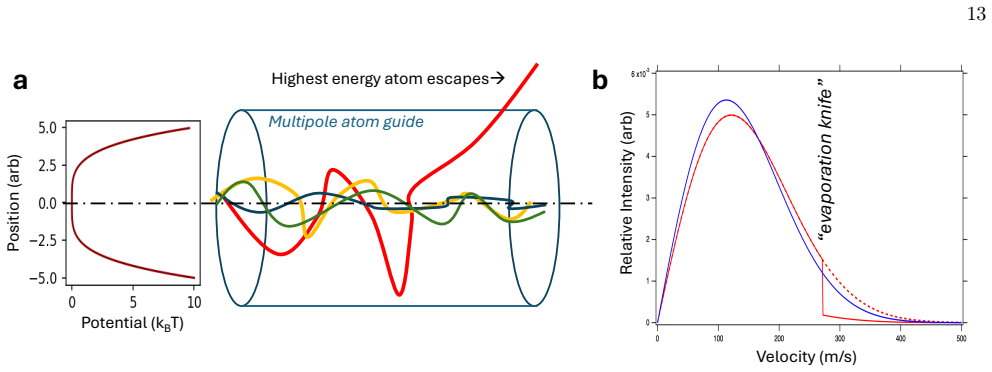
The central object is the magnetic multipole guide, whose transverse field $|B|\propto r^{\nu}$ creates a radial potential well for low-field-seeking atoms (those drawn toward weaker magnetic fields) with barrier height $\eta = \mu_a B_{\max}/k_B T$. The evaporation knife is the energy threshold $\eta$: atoms whose transverse kinetic energy after a collision exceeds the local wall escape, and the cooling exponent $\gamma$ relates the temperature drop to the fraction of atoms lost, $N \propto T^{1/\gamma}$. The analysis combines a density-of-states generalization of the analytic evaporative-cooling model with numerically computed loss rates from the Boltzmann collision integral, using a scaling form in density, cross section, and temperature. A dimensionless opacity $\zeta$ (collisions per beam crossing) maintains the thermalization requirement $\zeta \sim 1$. Slowing is treated as a scattering problem: localized kinks in the guide, with shape parameters chosen so that fewer than about 2% of trajectories reflect, convert longitudinal kinetic energy into transverse heat that the next cooling segment removes.
What would settle it
Measure the T-T triplet s-wave scattering length at sub-kelvin collision energies, or derive it from a QED-corrected potential; if it comes out orders of magnitude below 42 Å, the 12-meter tritium beamline loses its thermalization and the central projection fails. A second, model-level check is to run the lithium pathfinder and compare the measured $(T, j, v)$ evolution along the beamline with Eqs. 54 and 55; a large deviation would invalidate the cooling dynamics independent of the tritium cross section.
Extended reading notes
Core claim
The central claim is that evaporative cooling, normally applied to atoms held in a stationary trap, can be carried out continuously along a moving beam in a magnetic multipole guide. A thermalized cloud of low-field-seeking atoms travels along the guide while the most energetic atoms are allowed to escape over the magnetic wall; the remaining atoms rethermalize to a lower temperature, and the temperature and current evolve along the beamline according to a power law $N \propto T^{1/\gamma}$. The paper derives $\gamma$ including the trap density of states, validates the analytic model against a numerical solution of the Boltzmann collision integral, and adds a slowing mechanism: small transverse perturbations of the guide convert bulk longitudinal motion into heat, which subsequent evaporative segments carry away. Applied to tritium with the adopted T-T triplet scattering cross section, the model predicts that a 12-meter MECB can deliver $10^{15}$ atoms/s at 1 mK starting from $5\times10^{17}$ atoms/s at 0.2 K, an efficiency of $10^{-3}$; applied to lithium, it predicts a pathfinder beam at 1 mK and 1.2 m/s with about 5% efficiency in the cooler-slower section.
Load-bearing premise
The projected tritium performance rests on the adopted T-T triplet s-wave scattering cross section of $4.4\times10^{-16}$ m$^2$ (a scattering length of about 42 Å); if the true value is much smaller, thermalization would be too slow and the predicted 12-meter cooling trajectory would not be achieved.
Editorial extensions
If this is right
- A 12-meter MECB section is projected to deliver $10^{15}$ tritium atoms per second at 1 mK into the Project 8 magneto-gravitational trap, starting from $5\times10^{17}$ atoms/s at 0.2 K.
- The lithium pathfinder should reach 1 mK and 1.2 m/s at about 5% efficiency in the cooler-slower, providing a direct test of the model before tritium is used.
- No Lyman-alpha laser cooling is needed for atomic tritium; the entire cooling and slowing chain is laserless.
- Atomic tritium, rather than molecular T$_2$, removes the molecular final-state distribution that smears the beta-decay endpoint, enabling a 40 meV-scale neutrino mass measurement.
- The same analytic and numerical tools (cooling trajectory equations, slowing perturbation scans, opacity criterion) can be applied to design MECB systems for other low-field-seeking atomic species.
Reading between the lines
- If the central claim holds, the main experimental uncertainty shifts from cooling dynamics to the T-T scattering length; a direct measurement of that length, or of the H-H analogue with QED corrections, would sharpen or overturn the 12-meter design.
- The discrete slowing scheme is effectively a sequence of speed bumps; the paper's parameter scan suggests near-optimal kink shapes, and a feedback-controlled kink profile might reduce reflection losses below the 2% level assumed.
- The same beamline architecture may extend to other hydrogen isotopes and alkalis, where smaller triplet cross sections would require denser beams or longer guides---a scaling prediction that could be tested with the lithium apparatus.
- The opacity criterion $\zeta \sim 1$ could serve as a quick design rule for judging any future laserless atom-beam cooler before full simulation.
Editorial analysis
A structured set of objections, weighed in public.
Referee Report
Summary. This paper develops an analytic and numerical framework for magnetic evaporative beamline cooling (MECB), in which low-field-seeking atoms are radially confined in a multipole guide and evaporatively cooled as they travel along the beamline. The model combines a density-of-states evaporative cooling exponent, a numerical Boltzmann collision integral for position-dependent evaporation rates, and a transverse-perturbation scheme for slowing the beam. The framework is applied to two systems: a 6Li pathfinder beamline that is currently being constructed, and a speculative tritium beamline for Project 8. The central projection is that a 12-meter MECB line, fed by 5e17 tritium atoms per second at 0.2 K, could deliver 1e15 atoms per second at 1 mK, with an end-to-end efficiency of 1e-3.
Significance. If the central projection holds, the paper describes a laser-less route to a cold atomic tritium source capable of feeding a magneto-gravitational trap for a next-generation neutrino mass experiment, which would be a major enabling step for Project 8. The paper's contribution is more than the projection: the numerical treatment of the Boltzmann collision integral with a position-dependent evaporation cut, the explicit validation of scaling laws in Fig. 21, and the agreement between the numerical model and the Davis analytic model in Figs. 6 and 7 are valuable and appear carefully constructed. The authors are also commendably explicit about several speculative inputs, including the upstream tritium current and the absence of QED/nonadiabatic corrections to the T-T triplet scattering length. However, the tritium projection as presented rests on an internal inconsistency in the beam-opacity parameter that must be resolved before the quantitative claim can be considered supported.
major comments (3)
- [Sec. IID, Eq. (53); Sec. IIIB, Fig. 20]
- [Sec. IIC, Fig. 8; Sec. IIIB]
- [Sec. IIIB and Conclusions]
minor comments (5)
- [Eq. (53)]
- [Fig. 16]
- [Sec. IIA, Eq. (3)]
- [Sec. IIIA]
- [Fig. 8]
Circularity Check
No circularity: the cooling dynamics come from an independent Boltzmann model, and the design targets are used as benchmarks rather than fitted outputs.
full rationale
The derivation is self-contained. The cooling exponent gamma is obtained from the Davis density-of-states model (Eq. 25) and independently from the numerical Boltzmann collision integral (Eqs. 45-49 and Appendix A); neither is fitted to the 1 mK / 1e15 s^-1 targets. Evaporation and energy-loss rates are computed from stated physical inputs (sigma, density, temperature, evaporation cut, multipolarity) and are scaled as in Eq. 81 with scaling behavior validated in Fig. 21. The Li and T beamline designs are generated by choosing geometry parameters and then integrating the equations of motion (Eqs. 54-55), so the predicted efficiency and delivered current emerge from the model rather than being imposed by construction. The Project 8 self-citations motivate the neutrino-mass application, but they do not carry the MECB dynamics derivation. The T-T scattering cross section is an external literature input, not an output of the paper. The high beam-opacity operating point (zeta=60-150) reported in Sec. IIIB conflicts with the paper's own zeta~1 efficiency criterion stated in Sec. IID, but that is an internal consistency and correctness concern, not a circular reduction of the claimed result to its inputs.
Assumptions & free parameters
free parameters (6)
- Upstream tritium current to MECB =
5e17 atoms/s at 0.2 K
- T-T triplet s-wave scattering cross section =
4.4e-16 m^2 (scattering length about 42 Angstroms)
- Slowing factor per kink =
0.75 (about 3x reheating)
- Evaporative cut eta per segment =
varies per segment (not tabulated)
- Li Zeeman slower output =
1e12 atoms/s at 1 K
- Permanent magnet surface field Bmax =
0.5 T
assumptions (6)
- domain assumption The beam maintains a local Maxwell-Boltzmann distribution at each position in the guide (Eq. 5).
- domain assumption Elastic collisions are s-wave with a constant, energy-independent cross section.
- domain assumption Losses beyond evaporation, including dipole losses, Majorana spin flips, and background collisions, are sub-leading.
- domain assumption The beam rethermalizes between slowing kinks, so each kink sees an equilibrium co-moving distribution.
- domain assumption Only the stretched low-field-seeking hyperfine state survives in the guide; spin-exchange losses remove the others.
- standard math The multipole magnetic field and adiabatic spin following justify the effective potential in Eq. 4.
Cite this review
Pith. "Pith review of Dynamics of Magnetic Evaporative Beamline Cooling for Preparation of Cold Atomic Beams." pith.science (2026). https://pith.science/paper/TQPUERA4
@misc{pith2026250200188,
  author       = {Pith},
  title        = {Pith review of: Dynamics of Magnetic Evaporative Beamline Cooling for Preparation of Cold Atomic Beams},
  year         = {2026},
  howpublished = {\url{https://pith.science/paper/TQPUERA4}},
  note         = {Machine review of arXiv:2502.00188}
}
abstract
The most sensitive direct neutrino mass searches today are based on measurement of the endpoint of the beta spectrum of tritium to infer limits on the mass of the unobserved neutrino. To avoid the smearing associated with the distribution of molecular final states in the T-He molecule, the next generation of these experiments will need to employ atomic (T) rather than molecular (T$_{2}$) tritium sources, at currents of at least 10$^{15}$ atoms per second. Following production, atomic T can be trapped in gravitational and/or magnetic bottles for beta spectrum experiments, if and only if it can first be cooled to millikelvin temperatures. Accomplishing this cooling presents substantial technological challenges. The Project 8 collaboration is developing a technique based on magnetic evaporative cooling along a beamline (MECB) for the purpose of cooling T to feed a magneto-gravitational trap that also serves as a cyclotron radiation emission spectroscope. Initial tests of the approach are planned in a pathfinder apparatus using atomic Li. This paper presents a method for analyzing the dynamics of the MECB technique, and applies these calculations to the design of systems for cooling and slowing of atomic Li and T. A scheme is outlined that could provide a current of T at the millikelvin temperatures required for the Project 8 neutrino mass search.
Figures


Figures from the paper (18 more)




Reference graph
Works this paper leans on
-
[1]
Catcher ThegoalofthecatchersegmentistotrapaslargeafractionofthecurrentemergingfromtheZeemanslowersystem as possible, by selecting the relevant low energy part of the Maxwell-Boltzmann distribution with the strongest possible trapping magnets. The density in this segment is deliberately kept low, in order to avoid rethermalization while the fastest transve...
-
[2]
This can be accomplished via an octupole guide of steadily reducing diameter
Pre-cooler To begin true evaporative cooling, the aforementioned current must be compressed into a thermalization radius of around 1 cm forζ ∼ 1 to achieve a beam with sufficient density for evaporative cooling. This can be accomplished via an octupole guide of steadily reducing diameter. We have considered here an segment with radius steadily decreasing ...
-
[3]
Cooler-slower At the end of the pre-cooler we expectv = 6.8 m s−1, j ∼ 1011 s−1 and T = 20 mK, implying M ∼2.3. With such an incoming current, a ‘slower’ segment can be implemented that preserves the total current, reduces central momentum by a factor of3 4 and increases temperature by a factor of approximately3. The temperature can then be reduced using ...
-
[4]
Slowing section with momentum changepi+1 → 3 4 pi accompanied by reheating ofTi+1 → 3Ti,
-
[5]
Precision Physics, Fundamental Interactions, and Structure of Matter
Cooling section to return toM = 2.3 with temperature changeTi+2 → 9 3×16 Ti and bulk momentum preserved as pi+2 → pi+1 The combined effect of these two elements isTi+2 → 9 16 Ti and pi+2 → 3 4 pi, and the sequence always maintains at least 4 times the central momentum relative to RMS fluctuations of velocity inz to keep the beam moving forward along the b...
-
[6]
− f (⃗ r, pi 3)f (⃗ r, p4) . (79) The collision integral will also be cylindrically symmetric, so I(⃗ r, p4) ≡ I(⃗ r, p4) = σ 2π 4π(2ηa)3 N NX i qi m f (⃗ r, pi 1)f (⃗ r, pi
-
[7]
(80) In principle we can re-evaluateI for any phase space distribution
− f (⃗ r, pi 3)f (⃗ r, p4) . (80) In principle we can re-evaluateI for any phase space distribution. However, simple scaling arguments can be made that show that for a distribution which is close in form to the Maxwell Boltzmann, the collision terms have expected scaling withρ, σ, Tof ΓE = σ σ0 ρ ρ0 r T T0 Γ0 E(ηcut), ΓN = σ σ0 ρ ρ0 r T T0 Γ0 N (ηcut). (8...
-
[8]
Evidence for oscillation of atmospheric neutrinos,
Y. Fukudaet al., “Evidence for oscillation of atmospheric neutrinos,”Phys. Rev. Lett., vol. 81, pp. 1562–1567, 1998
1998
Show all 78 references
-
[9]
Direct evidence for neutrino flavor transformation from neutral current interactions in the Sudbury Neutrino Observatory,
Q. R. Ahmadet al., “Direct evidence for neutrino flavor transformation from neutral current interactions in the Sudbury Neutrino Observatory,”Phys. Rev. Lett., vol. 89, p. 011301, 2002
2002
-
[10]
Nufit: three-flavour global analyses of neutrino oscillation experiments,
M. C. Gonzalez-Garcia, M. Maltoni, and T. Schwetz, “Nufit: three-flavour global analyses of neutrino oscillation experiments,” Universe, vol. 7, no. 12, p. 459, 2021
2021
-
[11]
Review of Particle Physics,
R. L. Workmanet al., “Review of Particle Physics,”PTEP, vol. 2022, p. 083C01, 2022
2022
-
[12]
The design, construction, and commissioning of the KATRIN experiment,
M. Akeret al., “The design, construction, and commissioning of the KATRIN experiment,”Journal of Instrumentation, vol. 16, no. 08, p. T08015, 2021
2021
-
[13]
Direct neutrino-mass measurement based on 259 days of KATRIN data,
M. Akeret al., “Direct neutrino-mass measurement based on 259 days of KATRIN data,”Science, vol. 388, no. 6743, pp. 180–185, 2025
2025
-
[14]
Neutrinoless double-beta decay: status and prospects,
M. J. Dolinski, A. W. Poon, and W. Rodejohann, “Neutrinoless double-beta decay: status and prospects,”Annual Review of Nuclear and Particle Science, vol. 69, pp. 219–251, 2019
2019
-
[15]
Planck 2018 results. VI. Cosmological parameters,
N. Aghanimet al., “Planck 2018 results. VI. Cosmological parameters,”Astron. Astrophys., vol. 641, p. A6, 2020
2018
-
[16]
Constraints on Neutrino Physics from DESI DR2 BAO and DR1 Full Shape,
W. Elberset al., “Constraints on Neutrino Physics from DESI DR2 BAO and DR1 Full Shape,” 3 2025
2025
-
[17]
Relativistic Cyclotron Radiation Detection of Tritium Decay Electrons as a New Technique for Measuring the Neutrino Mass,
B. Monreal and J. Formaggio, “Relativistic Cyclotron Radiation Detection of Tritium Decay Electrons as a New Technique for Measuring the Neutrino Mass,”Phys. Rev., vol. D80, p. 051301, 2009
2009
-
[18]
Determining the neutrino mass with cyclotron radiation emission spectroscopy—Project 8,
A. Ashtari Esfahaniet al., “Determining the neutrino mass with cyclotron radiation emission spectroscopy—Project 8,” J. Phys. G, vol. 44, no. 5, p. 054004, 2017
2017
-
[19]
Tritium Beta Spectrum Measurement and Neutrino Mass Limit from Cyclotron Radiation Emission Spectroscopy,
A. Ashtari Esfahaniet al., “Tritium Beta Spectrum Measurement and Neutrino Mass Limit from Cyclotron Radiation Emission Spectroscopy,” Phys. Rev. Lett., vol. 131, no. 10, p. 102502, 2023
2023
-
[20]
Cyclotron radiation emission spectroscopy of electrons from tritiumβ decay and 83mKr internal conversion,
A. Ashtari Esfahaniet al., “Cyclotron radiation emission spectroscopy of electrons from tritiumβ decay and 83mKr internal conversion,”Phys. Rev. C, vol. 109, p. 035503, Mar 2024
2024
-
[21]
Assessment of molecular effects on neutrino mass measurements from tritium β decay,
L. I. Bodine, D. S. Parno, and R. G. H. Robertson, “Assessment of molecular effects on neutrino mass measurements from tritium β decay,” Phys. Rev. C, vol. 91, p. 035505, Mar 2015
2015
-
[22]
Improved treatment of the T2 molecular final-states uncertainties for the KATRIN neutrino-mass measurement,
S. Schneidewind, J. Schürmann, A. Lokhov, C. Weinheimer, and A. Saenz, “Improved treatment of the T2 molecular final-states uncertainties for the KATRIN neutrino-mass measurement,”Eur. Phys. J. C, vol. 84, no. 5, p. 494, 2024
2024
-
[23]
A magneto-gravitational trap for absolute measurement of the ultra-cold neutron lifetime,
P. Walstrom, J. Bowman, S. Penttila, C. Morris, and A. Saunders, “A magneto-gravitational trap for absolute measurement of the ultra-cold neutron lifetime,” Nuclear Instruments and Methods in Physics Research Section A: Accelerators, Spectrometers, Detectors and Associated Equ...
2009
-
[24]
Measurement of the neutron lifetime using a magneto-gravitational trap and in situ detection,
R. Pattie Jr, N. Callahan, C. Cude-Woods, E. Adamek, L. J. Broussard, S. Clayton, S. Currie, E. Dees, X. Ding, E. Engel,et al., “Measurement of the neutron lifetime using a magneto-gravitational trap and in situ detection,”Science, vol. 360, no. 6389, pp. 627–632, 2018
2018
-
[25]
Formation of an atomic hydrogen beam by a hot capillary,
K. Tschersich and V. von Bonin, “Formation of an atomic hydrogen beam by a hot capillary,”Journal of applied physics, vol. 84, no. 8, pp. 4065–4070, 1998
1998
-
[26]
Design studies for an advanced ECR ion source,
G. D. Alton and D. N. Smithe, “Design studies for an advanced ECR ion source,”Review of Scientific Instruments, vol. 65, pp. 775–787, 04 1994
1994
-
[27]
The stabilization of atomic hydrogen,
I. F. Silvera and J. Walraven, “The stabilization of atomic hydrogen,”Scientific American, vol. 246, no. 1, pp. 66–76, 1982
1982
-
[28]
Interaction of Atomic Hydrogen with the Surface of He-4,
R. Guyer and M. Miller, “Interaction of Atomic Hydrogen with the Surface of He-4,”Physical Review Letters, vol. 42, no. 26, pp. 1754–1757, 1979
1979
-
[29]
Evaporative cooling of magnetically trapped and compressed spin-polarized hydrogen,
H. F. Hess, “Evaporative cooling of magnetically trapped and compressed spin-polarized hydrogen,”Physical Review B, vol. 34, no. 5, p. 3476, 1986
1986
-
[30]
Evaporative cooling of spin-polarized atomic hydrogen,
N. Masuhara, J. M. Doyle, J. C. Sandberg, D. Kleppner, T. J. Greytak, H. F. Hess, and G. P. Kochanski, “Evaporative cooling of spin-polarized atomic hydrogen,”Physical Review Letters, vol. 61, no. 8, p. 935, 1988
1988
-
[31]
Bose-Einstein condensation of atomic hydrogen,
D. G. Fried, T. C. Killian, L. Willmann, D. Landhuis, S. C. Moss, D. Kleppner, and T. J. Greytak, “Bose-Einstein condensation of atomic hydrogen,”Physical Review Letters, vol. 81, no. 18, p. 3811, 1998
1998
-
[32]
Evaporative cooling of trapped atoms,
W. Ketterle and N. Van Druten, “Evaporative cooling of trapped atoms,” inAdvances in atomic, molecular, and optical physics, vol. 37, pp. 181–236, Elsevier, 1996
1996
-
[33]
Evaporative cooling of a guided rubidium atomic beam,
T. Lahaye, Z. Wang, G. Reinaudi, S. Rath, J. Dalibard, and D. Guéry-Odelin, “Evaporative cooling of a guided rubidium atomic beam,” Physical Review A, vol. 72, no. 3, p. 033411, 2005
2005
-
[34]
Evaporative cooling of an atomic beam,
E. Mandonnet, A. Minguzzi, R. Dum, I. Carusotto, Y. Castin, and J. Dalibard, “Evaporative cooling of an atomic beam,” The European Physical Journal D-Atomic, Molecular, Optical and Plasma Physics, vol. 10, pp. 9–18, 2000
2000
-
[35]
An adaptable dual species effusive source and Zeeman slower design demonstrated with Rb and Li,
W. Bowden, W. Gunton, M. Semczuk, K. Dare, and K. W. Madison, “An adaptable dual species effusive source and Zeeman slower design demonstrated with Rb and Li,”Review of Scientific Instruments, vol. 87, no. 4, p. 043111, 2016
2016
-
[36]
A hybrid Zeeman slower for lithium,
D. Garwood, L. Liu, J. Mongkolkiattichai, J. Yang, and P. Schauss, “A hybrid Zeeman slower for lithium,”Review of Scientific Instruments, vol. 93, no. 3, p. 033202, 2022
2022
-
[37]
Two-element Zeeman slower for rubidium and lithium,
G. E. Marti, R. Olf, E. Vogt, A. Öttl, and D. M. Stamper-Kurn, “Two-element Zeeman slower for rubidium and lithium,” Physical Review A, vol. 81, no. 4, p. 043424, 2010
2010
-
[38]
Continuous Centrifuge Decelerator for Polar Molecules ,
S. Chervenkov, X. Wu, J. Bayerl, A. Rohlfes, T. Gantner, M. Zeppenfeld, and G. Rempe, “Continuous Centrifuge Decelerator for Polar Molecules ,”Phys. Rev. Lett., vol. 112, p. 013001, 2014
2014
-
[39]
Zeeman deceleration of H and D,
S. D. Hogan, D. Sprecher, M. Andrist, N. Vanhaecke, and F. Merkt, “Zeeman deceleration of H and D,”Physical Review A- Atomic, Molecular, and Optical Physics, vol. 76, no. 2, p. 023412, 2007. 32
2007
-
[40]
The atomic coilgun and single-photon cooling: A method for trapping and cooling of hydrogen isotopes,
A. Libson, S. T. Bannerman, R. J. Clark, T. R. Mazur, and M. G. Raizen, “The atomic coilgun and single-photon cooling: A method for trapping and cooling of hydrogen isotopes,”Hyperfine Interactions, vol. 212, pp. 203–212, 2012
2012
-
[41]
Magneto-optic trapping of lithium using semiconductor lasers,
U. Schünemann, H. Engler, M. Zielonkowski, M. Weidemüller, and R. Grimm, “Magneto-optic trapping of lithium using semiconductor lasers,” Optics Communications, vol. 158, no. 1-6, pp. 263–272, 1998
1998
-
[42]
Resonator-enhanced optical dipole trap for fermionic lithium atoms,
A. Mosk, S. Jochim, H. Moritz, T. Elsässer, M. Weidemüller, and R. Grimm, “Resonator-enhanced optical dipole trap for fermionic lithium atoms,”Optics Letters, vol. 26, no. 23, pp. 1837–1839, 2001
2001
-
[43]
Mixture of ultracold lithium and cesium atoms in an optical dipole trap,
A. Mosk, S. Kraft, M. Mudrich, K. Singer, W. Wohlleben, R. Grimm, and M. Weidemüller, “Mixture of ultracold lithium and cesium atoms in an optical dipole trap,”Applied Physics B, vol. 73, pp. 791–799, 2001
2001
-
[44]
High-flux two-dimensional magneto-optical-trap source for cold lithium atoms,
T. Tiecke, S. Gensemer, A. Ludewig, and J. Walraven, “High-flux two-dimensional magneto-optical-trap source for cold lithium atoms,” Physical Review A – Atomic, Molecular, and Optical Physics, vol. 80, no. 1, p. 013409, 2009
2009
-
[45]
Trapping of lithium atoms in a large hollow optical dipole trap,
V. A. Vinogradov, K. A. Karpov, S. S. Lukashov, and A. V. Turlapov, “Trapping of lithium atoms in a large hollow optical dipole trap,”Quantum Electronics, vol. 50, no. 6, p. 520, 2020
2020
-
[46]
Spin-polarized atomic hydrogen: A magnetic gas,
I. F. Silvera and J. M. Walraven, “Spin-polarized atomic hydrogen: A magnetic gas,”Journal of Applied Physics, vol. 52, no. 3, pp. 2304–2308, 1981
1981
-
[47]
Spin exchange and dipolar relaxation rates in atomic hydrogen: Lifetimes in magnetic traps,
A. Lagendijk, I. F. Silvera, and B. J. Verhaar, “Spin exchange and dipolar relaxation rates in atomic hydrogen: Lifetimes in magnetic traps,”Physical Review B, vol. 33, no. 1, p. 626, 1986
1986
-
[48]
On the adiabatic theorem of quantum mechanics,
T. Kato, “On the adiabatic theorem of quantum mechanics,”Journal of the Physical Society of Japan, vol. 5, no. 6, pp. 435–439, 1950
1950
-
[49]
Practical concepts for design, construction and application of Halbach magnets in magnetic resonance,
P. Blümler and H. Soltner, “Practical concepts for design, construction and application of Halbach magnets in magnetic resonance,” Applied Magnetic Resonance, vol. 54, no. 11, pp. 1701–1739, 2023
2023
-
[50]
Mirror traps,
M. Ioffe, “Mirror traps,” inLectures presented at the Trieste Seminar on Plasma Physics, p. 421, 1965
1965
-
[51]
Maxwell’s equations for magnets,
A. Wolski, “Maxwell’s equations for magnets,”arXiv preprint arXiv:1103.0713, 2011
2011 arXiv
-
[52]
Spin-exchange and dipole relaxation rates in atomic hydrogen: Rigorous and simplified calculations,
H. T. C. Stoof, J. Koelman, and B. Verhaar, “Spin-exchange and dipole relaxation rates in atomic hydrogen: Rigorous and simplified calculations,”Physical Review B, vol. 38, no. 7, p. 4688, 1988
1988
-
[53]
Electronic spin-flipping collisions of hydrogen atoms,
B. Zygelman, “Electronic spin-flipping collisions of hydrogen atoms,”Physical Review A-Atomic, Molecular, and Optical Physics, vol. 81, no. 3, p. 032506, 2010
2010
-
[54]
An analytical model for evaporative cooling of atoms,
K. B. Davis, M. O. Mewes, and W. Ketterle, “An analytical model for evaporative cooling of atoms,”Applied Physics B, vol. 60, pp. 155–159, 1995
1995
-
[55]
The thermophysical properties of spin-polarized atomic tritium (T) in the temperature range 0.01 K–10 K,
A. Sandouqa and B. Joudeh, “The thermophysical properties of spin-polarized atomic tritium (T) in the temperature range 0.01 K–10 K,”Physica Scripta, vol. 93, no. 9, p. 095401, 2018
2018
-
[56]
The solid molecular hydrogens in the condensed phase: Fundamentals and static properties,
I. F. Silvera, “The solid molecular hydrogens in the condensed phase: Fundamentals and static properties,”Reviews of Modern Physics, vol. 52, no. 2, p. 393, 1980
1980
-
[57]
Improved potential energy curve and vibrational energies for the electronic ground state of the hydrogen molecule,
W. Kołos and L. Wolniewicz, “Improved potential energy curve and vibrational energies for the electronic ground state of the hydrogen molecule,”Journal of Molecular Spectroscopy, vol. 54, no. 2, pp. 303–311, 1975
1975
-
[58]
Ground state properties of spin-aligned atomic hydrogen,
J. Dugan Jr and R. Etters, “Ground state properties of spin-aligned atomic hydrogen,”The Journal of Chemical Physics, vol. 59, no. 11, pp. 6171–6172, 1973
1973
-
[59]
Collisions of ground-state hydrogen atoms,
M. Jamieson, A. Dalgarno, B. Zygelman, P. Krstić, and D. R. Schultz, “Collisions of ground-state hydrogen atoms,” Physical Review A, vol. 61, no. 1, p. 014701, 1999
1999
-
[60]
Formation of atomic tritium clusters and Bose-Einstein condensates,
D. Blume, B. Esry, C. H. Greene, N. Klausen, and G. Hanna, “Formation of atomic tritium clusters and Bose-Einstein condensates,” Physical Review Letters, vol. 89, no. 16, p. 163402, 2002
2002
-
[61]
Elementary scattering processes in a low temperature atomic hydrogen gas,
A. Berlinsky, “Elementary scattering processes in a low temperature atomic hydrogen gas,”Le Journal de Physique Colloques, vol. 41, no. C7, pp. C7–43, 1980
1980
-
[62]
A dilute hard-sphere bose-gas model calculation of low-density atomic hydrogen gas properties,
D. Friend and R. Etters, “A dilute hard-sphere bose-gas model calculation of low-density atomic hydrogen gas properties,” Journal of Low Temperature Physics, vol. 39, pp. 409–415, 1980
1980
-
[63]
Collisions and reactions of ultracold molecules,
W. C. Stwalley, “Collisions and reactions of ultracold molecules,”Canadian journal of chemistry, vol. 82, no. 6, pp. 709– 712, 2004
2004
-
[64]
Scattering properties of ground-state spin-polarized atomic hydrogen,
B. Joudeh, “Scattering properties of ground-state spin-polarized atomic hydrogen,” Physica B: Condensed Matter, vol. 421, pp. 41–45, 2013
2013
-
[65]
Scattering properties of spin-polarized atomic tritium,
A. Al-Maaitah, “Scattering properties of spin-polarized atomic tritium,”European Scientific Journal, vol. 8, no. 24, 2012
2012
-
[66]
Precision measurement of quasi-bound resonances in h2 and the h+ h scattering length,
K.-F. Lai, E. Salumbides, M. Beyer, and W. Ubachs, “Precision measurement of quasi-bound resonances in h2 and the h+ h scattering length,”Molecular Physics, vol. 120, no. 19-20, p. e2018063, 2022
2022
-
[67]
Precision measurement of the last bound states in h 2 and determination of the h+ h scattering length,
K.-F. Lai, W. Ubachs, and M. Beyer, “Precision measurement of the last bound states in h 2 and determination of the h+ h scattering length,”Physical Review A, vol. 111, no. 2, p. 022803, 2025
2025
-
[68]
Triplet s-wave resonance in Li 6 collisions and scattering lengths of Li 6 and Li 7,
E. Abraham, W. McAlexander, J. Gerton, R. Hulet, R. Côté, and A. Dalgarno, “Triplet s-wave resonance in Li 6 collisions and scattering lengths of Li 6 and Li 7,”Physical Review A, vol. 55, no. 5, p. R3299, 1997
1997
-
[69]
K. M. O’Hara,Optical trapping and evaporative cooling of fermionic atoms. PhD thesis, Duke University, 2000
2000
-
[70]
The electronic structure and spectra of the X 1Σ+ g and A 1Σ+ u states of Li2,
D. D. Konowalow and M. L. Olson, “The electronic structure and spectra of the X 1Σ+ g and A 1Σ+ u states of Li2,” The Journal of Chemical Physics, vol. 71, no. 1, pp. 450–457, 1979
1979
-
[71]
The “most likely
D. D. Konowalow, R. M. Regan, and M. E. Rosenkrantz, “The “most likely” potential energy curve for the lowest 3Σ+ u state of Li2,”The Journal of chemical physics, vol. 81, no. 10, pp. 4534–4536, 1984
1984
-
[72]
Ground and excited-state properties of Li2 and Li2+ from ab initio calculations with effective core polarization potentials,
I. Schmidt-Mink, W. Müller, and W. Meyer, “Ground and excited-state properties of Li2 and Li2+ from ab initio calculations with effective core polarization potentials,”Chemical physics, vol. 92, no. 2-3, pp. 263–285, 1985
1985
-
[73]
Variational calculations of dispersion coefficients for interactions among H, He, and Li atoms,
Z.-C. Yan, J. F. Babb, A. Dalgarno, and G. Drake, “Variational calculations of dispersion coefficients for interactions among H, He, and Li atoms,”Physical Review A, vol. 54, no. 4, p. 2824, 1996. 33
1996
-
[74]
Analysis of long-range dispersion and exchange interactions of two lithium atoms,
W. T. Zemke and W. C. Stwalley, “Analysis of long-range dispersion and exchange interactions of two lithium atoms,” The Journal of Physical Chemistry, vol. 97, no. 10, pp. 2053–2058, 1993
1993
-
[75]
Multistage Zeeman deceleration of hydrogen atoms,
N. Vanhaecke, U. Meier, M. Andrist, B. H. Meier, and F. Merkt, “Multistage Zeeman deceleration of hydrogen atoms,” Physical Review A, vol. 75, no. 3, p. 031402, 2007
2007
-
[76]
J. O. Stack,An ultra-cold lithium source for investigating cold dipolar gases. PhD thesis, Imperial College London, 2011
2011
-
[77]
Atomi orientati in campo magnetico variabile,
E. Majorana, “Atomi orientati in campo magnetico variabile,”Il Nuovo Cimento (1924-1942), vol. 9, no. 2, pp. 43–50, 1932
1924
-
[78]
Majorana spin-flip transitions in a magnetic trap,
D. Brink and C. Sukumar, “Majorana spin-flip transitions in a magnetic trap,”Physical Review A-Atomic, Molecular, and Optical Physics, vol. 74, no. 3, p. 035401, 2006
2006
Reviewed August 9, 2026 · model on record in the stance chip above.
Discussion (0). Continue with ORCID to comment.