REVIEW 3 major objections 3 minor 4 references
A Search for Eclipse Cycles Similar to the Hypersaros: Columbus and the Lunar Eclipse of March 14, 2025
T0 review · 3 major / 3 minor · reviewed 2026-08-09 · deepseek-v4-flash
Pith's one-line read Almost every lunar eclipse in the record is followed 521 years later—and 633 years later—by a nearly identical eclipse.
desk verdict A clear, modest empirical note that nails the 521- and 633-year recurrence peaks; the main fix needed is an explicit definition of the gamma-difference metric. read the letter →
The pith
A machine-rendered reading of the paper's core claim, the machinery that carries it, and where it could break.
The reading
What carries the argument
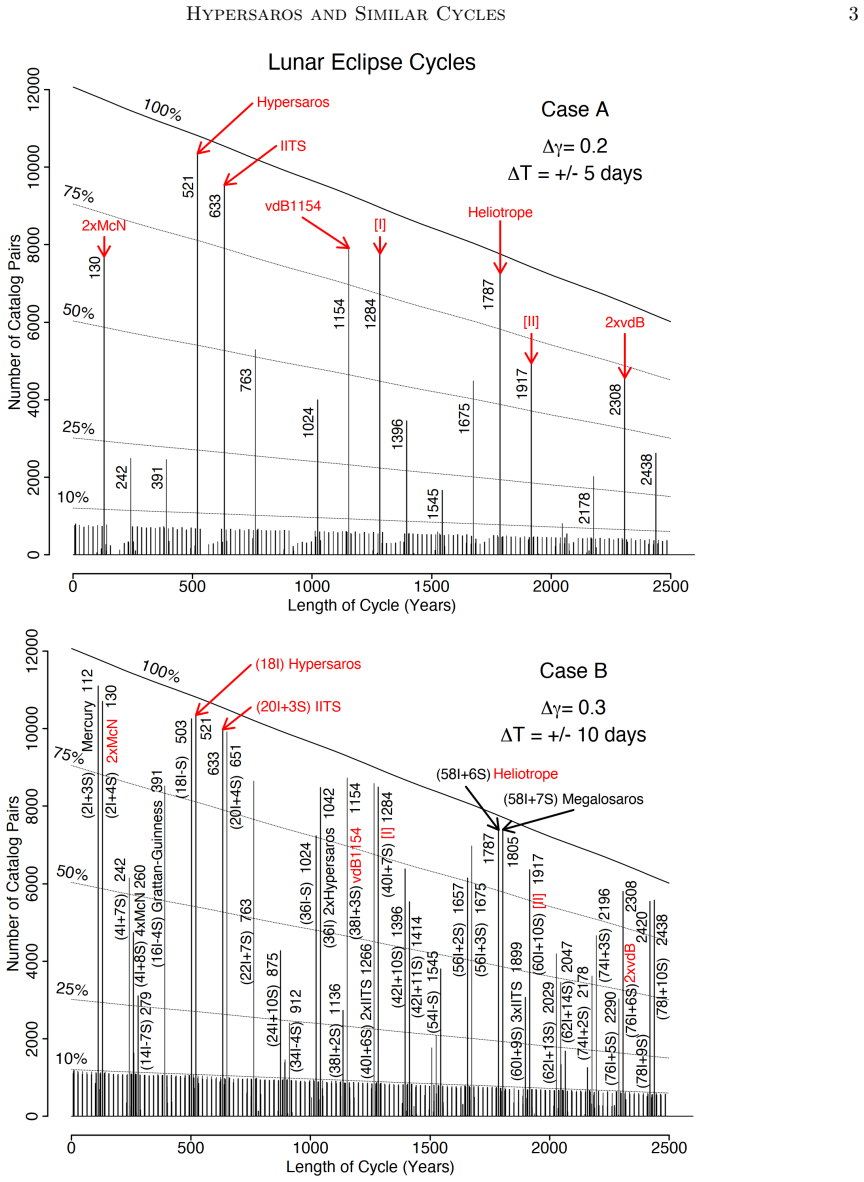
The machinery is a pair-counting histogram built from the Five Millennium Catalogs. For every pair of lunar eclipses, the paper computes the time separation, the difference ΔT between the eclipses' offsets from their respective vernal equinoxes, and the difference Δγ between their gamma values; pairs passing the thresholds contribute to a peak at their period in years. The named cycles—Hypersaros (521.0107 yr; 18 Inex), IITS (632.9908 yr; 20 Inex + 3 Saros), Mercury (111.98 yr), double McNaughton (130.01 yr), and an unnamed 279.02-yr cycle—serve as generative periods whose integer combinations produce the longer peaks. The method deliberately ignores lunar distance, which matters little for lunar eclipses but would change the total/annular distinction for solar ones.
What would settle it
Compute the match rate for every lunar eclipse in the Five Millennium Catalog at exactly 521.0107 and 632.9908 years with ΔT ≤ ±10 days and Δγ ≤ 0.3; if any eclipse lacks a counterpart within those thresholds, the "almost every" claim is falsified.
Extended reading notes
Core claim
The central claim is that when "similar" is defined by two observable quantities—the date relative to the vernal equinox (within ±5 to ±10 days) and the Moon's path through the shadow as measured by the gamma parameter (within 0.2 to 0.3)—the 521-year Hypersaros and the 633-year IITS emerge as near-universal cycles. Histograms of all eclipse pairs in the catalog show these two periods at nearly 100% match rates, meaning almost every lunar eclipse has a counterpart of the same depth and season one cycle later. Other strong periods (1154, 1284, 1787, 1917, and 2308 years) are combinations of three generative periods near 112, 130, and 279 years. The same pattern appears in the solar eclipse catalog.
Load-bearing premise
The Five Millennium Catalogs are complete and accurate for every eclipse from -1999 to +3000, because the paper counts pairs from these lists and any missing or duplicated entry would shift the histogram peaks.
Editorial extensions
If this is right
- The 2025 total lunar eclipse and the 1504 Columbus eclipse are Hypersaros twins, so observers in 2025 can directly reprise that historical episode.
- For any lunar eclipse, the 521- and 633-year cycles provide immediate predictions of similar eclipses in the past and future, as long as the catalog remains complete.
- The solar eclipse catalog shows essentially the same cycle structure, so the date-plus-gamma definition generalizes to solar eclipses.
- Longer cycles such as 1154, 1284, 1787, 1917, and 2308 years are all combinations of three basic periods near 112, 130, and 279 years, giving a compact generative scheme for eclipse recurrence.
Reading between the lines
- An untested extension would apply the same ΔT/Δγ pair-counting to other eclipse catalogs—for example, records of ancient eclipses from Babylon or China—to see whether the 521- and 633-year cycles remain the dominant peaks when observations are sparser.
- The paper's near-universal match rate is bounded by the Moon's slow secular drift away from the ecliptic; beyond the catalog's 5000-year span the same cycles should gradually fail, so the claim is about the current era, not eternal recurrence.
- For historians, the 521-year cycle gives a numerical cross-check: a reliably dated eclipse in medieval records implies a second eclipse of similar date and depth exactly one Hypersaros earlier or later, which could confirm or challenge existing dates.
Editorial analysis
A structured set of objections, weighed in public.
Referee Report
Summary. The paper searches the Five Millennium Catalogs of Lunar and Solar Eclipses for pairs of eclipses that occur within a threshold of the same date relative to the vernal equinox and with similar lunar eclipse gamma values. From histograms of time separations under two threshold choices, it identifies the 521-year Hypersaros and a 633-year period (IITS) as near-universal recurrence intervals, and lists longer-period cycles. It applies the 521-year cycle to connect the 2025 March 14 total lunar eclipse with the 1504 eclipse associated with Columbus.
Significance. If the near-100% recurrence at 521 and 633 years is confirmed, the paper provides a simple and observationally motivated eclipse-cycle taxonomy that is more directly tied to date and shadow-path similarity than the Saros/Inex families. The search is transparent and reproducible from a public catalog, with clearly specified thresholds, and it makes falsifiable predictions for future eclipses. However, the current manuscript does not fully pin down the definition of gamma similarity, which is central to the claimed match rates.
major comments (3)
- [Section 2, gamma criterion] The 'similar path' criterion is defined using Δγ, but the text does not state whether an eclipse pair must have the same sign of γ. Since positive and negative γ place the Moon on opposite sides of the shadow axis (above vs. below the ecliptic plane), pairs such as γ=+0.15 and γ=-0.05 would satisfy |Δγ|<0.2 under an absolute-difference implementation even though the shadow paths are mirror images. Please state explicitly whether the analysis requires γ1·γ2>0, and if it does not, rerun the search with that constraint and report the peak heights at 521 and 633 years.
- [Section 2, Figure 1] The claim that the 521-yr and 633-yr cycles are 'nearly 100%' is not quantified. Please report the actual match fractions at these peaks (e.g., '521-year peak: 96% of catalog eclipses have a partner at ±...'), together with the sample sizes and the edge-effect expected match rates, so the strength of the claim can be evaluated.
- [Section 2, final paragraph] The statement that 'corresponding graphs derived from the solar eclipse catalog are essentially identical to Fig. 1' is a substantial empirical claim that is not accompanied by a figure, table, or numerical summary. Either include the solar-eclipse results or qualify the statement as a preliminary check.
minor comments (3)
- [References and text] The name 'Espanek' appears in the text and references; the canonical spelling is 'Espenak' (e.g., Espenak & Meeus 2009).
- [Section 2, histogram description] The abstract and text state that the search finds the most common intervals 'between lunar eclipses separated by less than 1000 years,' but the histogram construction is not fully explicit; the paper should state that each satisfying pair contributes once to the histogram, and clarify whether only unique eclipses or all pairs are counted.
- [Section 2, thresholds] The thresholds for Cases A and B are presented without justification; a sentence noting that the labeled peaks are robust to modest variations of the thresholds would strengthen the paper.
Circularity Check
No significant circularity: the eclipse-cycle search is an empirical scan of an external catalog, with cycle periods identified after the histogram peaks appear.
full rationale
The paper's central result is an empirical search over the Five Millennium Catalogs of Lunar and Solar Eclipses (Espanek & Meeus 2009). The two selection criteria, ΔT and Δγ, are defined from independent observable quantities (equinox-relative date and shadow-axis distance) and do not encode the target periods 521 or 633 years. The histogram of time separations is constructed by counting all catalog pairs satisfying those thresholds, and the named cycles are assigned only after prominent peaks appear. Thus the Hypersaros and IITS peaks are not fitted inputs renamed as predictions; they are outputs of the scan. There are no author self-citations used as load-bearing evidence: the cited works are external catalogs, the prior cycle compilation of van Gent, and standard references. The claim that almost every eclipse has a 521- and 633-year counterpart is a falsifiable statement about the catalog counts. A possible concern about whether the Δγ criterion should require the same sign of gamma is a correctness or implementation question, not circularity, because it does not make the conclusion equivalent to the search definition. The paper is self-contained against the external eclipse catalogs, so no circular step is present.
Assumptions & free parameters
free parameters (2)
- Case A thresholds (delta-T, delta-gamma) =
±5 days, 0.2
- Case B thresholds (delta-T, delta-gamma) =
±10 days, 0.3
assumptions (2)
- domain assumption The Five Millennium Catalogs of Lunar and Solar Eclipses are complete and accurate.
- domain assumption Gamma alone, the shadow-axis distance, is sufficient to characterize whether two lunar eclipses have similar shadow paths.
invented entities (1)
-
Icosa-Inex-Triple-Saros (IITS) cycle
independent evidence
Cite this review
Pith. "Pith review of A Search for Eclipse Cycles Similar to the Hypersaros: Columbus and the Lunar Eclipse of March 14, 2025." pith.science (2026). https://pith.science/paper/WDYKHDOM
@misc{pith2026250201019,
  author       = {Pith},
  title        = {Pith review of: A Search for Eclipse Cycles Similar to the Hypersaros: Columbus and the Lunar Eclipse of March 14, 2025},
  year         = {2026},
  howpublished = {\url{https://pith.science/paper/WDYKHDOM}},
  note         = {Machine review of arXiv:2502.01019}
}
read the original abstract
The total lunar eclipse on March 14, 2025 UT occurs nearly exactly 521 years (one Hypersaros) after a similar eclipse on March 1, 1504 UT that is renowned for its importance to the voyage of Columbus to Jamaica. Eclipses separated by a Hypersaros have similar depths, appear very close to the same location in the sky, and occur at nearly the same time of year. This paper summarizes the results from a search for analogous cycles within the Five Millennium Catalogs of Lunar and Solar Eclipses. Under the two simple constraints of similar eclipse dates relative to the vernal equinox and similar paths of the Moon through the Earth's shadow, the most common time intervals between lunar eclipses separated by less than 1000 years are the 521-year Hypersaros and a 633-yr period of the Icosa-Inex-Triple-Saros (IITS). Notable cycles at longer periods occur at 1154, 1284, 1787, 1917, and 2308 years.
Figures
Reference graph
Works this paper leans on
-
[1]
Five Millennium Catalog of Lunar Eclipses: -1999 to +3000
Espanek, F., & Meeus, J. 2009, NASA Technical Publication TP-2009-214173 "Five Millennium Catalog of Lunar Eclipses: -1999 to +3000"
work page 2009
- [2]
-
[3]
Mathematical Astronomy Morsels V
Meeus, J. 2009, in "Mathematical Astronomy Morsels V" (Richmond VA:Willmann-Bell Inc.), Ch 2
work page 2009
- [4]
Reviewed August 9, 2026 · model on record in the stance chip above.
Discussion (0). Continue with ORCID to comment.