REVIEW 2 major objections 4 minor 37 references
Sum of Squared Extended $\eta$-$\mu$ and $\kappa$-$\mu$ RVs: A New Framework Applied to FR3 and Sub-THz Systems
T0 review · 2 major / 4 minor · reviewed 2026-08-09 · deepseek-v4-flash
Pith's one-line read The paper claims that sums of squared i.i.d. Extended $\eta$-$\mu$ and $\kappa$-$\mu$ fading variables have exact Gamma-function PDFs and CDFs that make multi-antenna FR3 and sub-THz analysis computationally fast.
desk verdict This paper gives a useful Gamma-series tool for sums of squared generalized fading RVs, but the load-bearing residue step is asserted rather than proven, so it deserves refereeing with a request to fill that gap. read the letter →
The pith
A machine-rendered reading of the paper's core claim, the machinery that carries it, and where it could break.
The reading
What carries the argument
The load-bearing mechanism is the MGF-based contour method: rewrite the exponential and hypergeometric (or Bessel) factors in the Laplace transform as Mellin-Barnes-type contour integrals, interchange the order of integration, evaluate the resulting double contour integral by the residue theorem at the two pole families that give a double power series, then use the Cauchy product identity of [33, Eq. (0.314)] to fold the double series into a single series with recursively defined coefficients $h_m$ (12) and $k_m$ (22). Here Extended $\eta$-$\mu$ is the NLoS-oriented fading model with power-ratio $\eta$, cluster count $\mu$, and in-phase/quadrature cluster ratio $p$ (envelope PDF (4)), and $\kappa$-$\mu$ is the LoS-oriented model with LoS-to-scatter power ratio $\kappa$ and cluster count $\mu$ (envelope PDF (20)). The inverse Laplace transform of each term is a Gamma function, which is why the final PDF/CDF are Gamma-function series; the same machinery yields a second, unconditionally convergent set of expressions and the ${}_1F_1$/${}_2F_2$ truncation bounds.
What would settle it
Evaluate the single-variable MGF in (6) by direct quadrature at a non-trivial parameter point, say $\eta=0.6$, $\mu=0.5$, $p=0.5$, $\hat{w}=1$, $s=1$, and compare with the residue-based series (9) truncated at increasing $m$; if the two disagree beyond quadrature accuracy, the contour step behind (13)-(14) is not valid. A second check is to compare the CDF (14) with Monte Carlo for $N=256$ under parameters where the convergence bounds are tightest.
Extended reading notes
Core claim
The central discovery is that the moment-generating function of each squared fading variable can be written as a double contour integral (8), that this integral can be evaluated by residues at the poles $t = m-l+\mu$ and $v = -l$ to give a double series (9), and that the double series collapses, through the Cauchy product, into a single power series in $1/(s\hat{w})$ whose coefficients obey the simple recurrences (12) and (22). Multiplying $N$ copies of the MGF gives another power series of the same form, and termwise inverse Laplace transform yields the PDF and CDF in (13)-(14) and (23)-(24), expressed entirely through Gamma functions. For the Extended $\eta$-$\mu$ case the paper works from the envelope PDF of [31], and for the $\kappa$-$\mu$ case from the PDF of [34]; in both cases the alternative MGF forms (16) and (25) give unconditionally convergent versions of the performance metrics. The paper shows absolute convergence of the series by bounding the coefficients and reducing the bound to finite Kummer hypergeometric values, and it supplies truncation-error bounds as ${}_2F_2$ expressions.
Load-bearing premise
Everything rests on the claim that the double contour integral in the MGF derivation collapses exactly into residues at two chosen pole families, a step the paper asserts by reference rather than demonstrating; if that step is wrong, the PDF and CDF series are not proven exact.
Editorial extensions
If this is right
- The PDF and CDF series (13)-(14) and (23)-(24) are exact for every valid set of fading parameters and for any number $N$ of antennas, with no integer-parameter restriction.
- The derived outage, coverage, BEP, and M-PSK/M-QAM SEP expressions inherit the Gamma-function form, and the second representations (16) and (25) converge for any parameter choices.
- Absolute-convergence proofs and truncation-error bounds justify stopping the series at a few hundred terms, keeping numerical error below a prescribed threshold.
- In the FR3 downlink example, 256 antennas give near-perfect coverage out to roughly 300-450 m at 15 GHz, and in the sub-THz example 1024 antennas give coverage out to roughly 700-1200 m at 140 GHz.
- The high-SNR asymptotics identify the diversity order as $N\mu$ (antennas times multipath clusters), and an eightfold increase in antennas approximately doubles the usable carrier frequency.
Reading between the lines
- Beyond the two models treated here, the same power-series-plus-recurrence template should apply to other generalized fading densities with a contour representation, such as $\alpha$-$\eta$-$\kappa$-$\mu$ or fluctuating two-ray models; this extension is not claimed in the paper.
- The truncation bounds involve Kummer and ${}_2F_2$ functions that stay finite, so the series is likely practical well past the 1024-antenna examples; a timing and memory benchmark at $N=2048$ or $4096$ would test that scaling claim directly.
- Because the $m=0$ terms dominate at high SNR, a designer could use the asymptotic diversity order $N\mu$ to budget antennas against multipath clusters before running the full series, a shortcut the paper leaves implicit.
Editorial analysis
A structured set of objections, weighed in public.
Referee Report
Summary. The manuscript derives infinite-series representations for the PDF and CDF of the sum of N i.i.d. squared Extended η-µ and κ-µ random variables, with coefficients defined recursively. It uses these series to obtain outage, BEP, and SEP expressions for M-PSK/M-QAM in closed form, together with asymptotic high-SNR formulas. The framework is applied to an FR3 downlink modeled by Extended η-µ and a sub-THz downlink modeled by κ-µ, and validated by Monte Carlo simulations and by comparison with existing special-function representations [21], [29].
Significance. If the claimed exactness holds, the paper provides a substantial practical advance: it replaces Fox-H/Horn-function representations with sums of Gamma functions that can be evaluated for massive antenna counts, with stated convergence and truncation bounds and with runtime gains of orders of magnitude. The paper also offers useful system-level insights (e.g., antenna count vs. carrier-frequency scaling). The main limitation is that the central residue-theorem step is asserted, not proved; because this step feeds the exactness of all subsequent expressions, the paper's central claim is currently unproven though supported numerically.
major comments (2)
- [Section II-A, Eq. (8) to Eq. (9)] The transition from the double contour integral in (8) to the residue series in (9) is the load-bearing step for both the Extended η-µ and κ-µ results, but it is not demonstrated. The text states that the contours are 'defined to guarantee convergence and circumvent duplicate poles' and that both integrals are solved by the residue theorem at the poles t → m−l+µ and v → −l, citing [27]; however, the integrand in (8) includes the factor Γ(µp/(1+p)−v)/Γ(µ−v), which is absent in [27]. The pole families of this integrand (t = −n, v = −n, t+v = µ+n, v = µp/(1+p)+n, and the zeros at v = µ+n) are not enumerated, the decay of the integrand at infinity is not shown, and it is not established that the residues at all other enclosed poles vanish or cancel. Since (9) is the sole source of exactness for (13)–(14) and, by the same argument, for (21)–(24), I request a complete contour-deformation proof, including the choice of contours L∗t and L∗v, a list of enclosed poles and their residues, and estimates for the remaining contour integrals, or an alternative derivation of (9) via analytic continuation of the Mellin-Barnes integral.
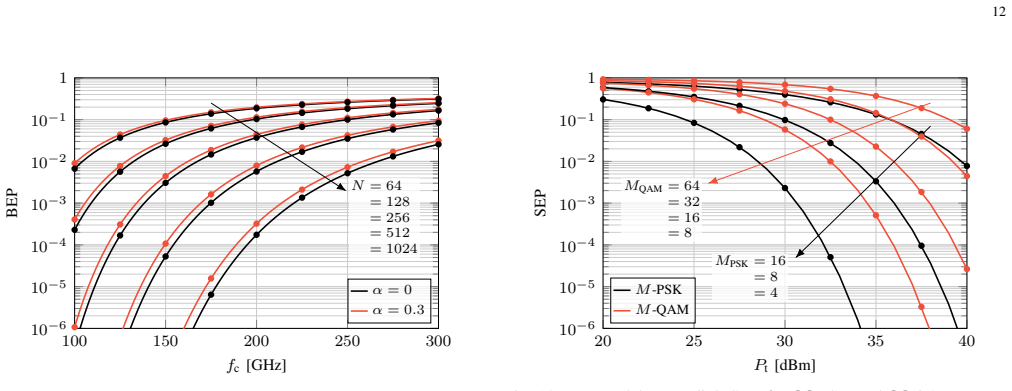
- [Section III-C, Eqs. (60) and (62)] The incomplete Beta function terms in (60) and (62) are written with negative first arguments, e.g., B(−ξ/(gq ˆw); Nµ+m, 1/2−Nµ−m) and B(−˜K/(gq ˆw); Nµ+m, 1/2−Nµ−m). In the standard definition, the incomplete Beta function B(x; a, b) is defined for 0 ≤ x ≤ 1 (with a,b>0), so these expressions are not defined without specifying an analytic continuation. If the authors intend a generalized incomplete Beta function or an analytic continuation, this must be stated explicitly and justified. Additionally, the SEP formulas (53), (60), (55), and (62) are presented without derivation; I ask for a sketch of the integration steps from (51) and (58) and for a direct numerical check against the integrals in (51) and (58) over a grid of parameters, because the simulation markers in Figs. 7 and 13 alone do not isolate all intermediate algebraic steps.
minor comments (4)
- [Section II-D] The computational complexity statement appears internally inconsistent: the recursion-tree count is given as 2ϵ−1 while the memoized count is ϵ(ϵ+1)−1, which exceeds the recursion-tree count for ϵ>1. Please clarify what quantity is being counted (e.g., number of h_m evaluations, number of terms in the inner sums, or number of floating-point operations) and correct the formulas.
- [Section II-C] The derivation of the bounds (33) and (35) relies on several steps summarized as 'after some mathematical manipulations'; please expand these steps or provide a supplementary derivation, since the bound on |hm| in (30)–(32) is essential to the convergence argument.
- [Section III-A] The asymptotic outage expressions (38) and (39) are stated as just the m=0 term of (14) and (24); please add the condition w/ˆw→0 under which this is the dominant term, or a short justification that the higher-order terms are negligible.
- [Table I] The phrase 'no restrictions on the convergence' for the second column should be reconciled with the analytic-continuation caveats for the Gauss hypergeometric function in (47)–(48) and (53)/(55); please state the exact convergence conditions for each expression.
Circularity Check
No circularity: the series coefficients are obtained by contour integration of the defining MGFs, with no fitted quantities and no load-bearing self-citations.
full rationale
The derivation chain is self-contained with respect to the claimed sum-statistics results. The PDF/CDF series in (13)-(14) and (23)-(24) are obtained by: (i) taking the defining envelope PDFs from [31, Eq. (14)] and [34, Eq. (1)]; (ii) applying a Laplace transform to obtain the single-RV MGF; (iii) evaluating the resulting double contour integral by residues following the method of [27]; (iv) raising the MGF to the N-th power for i.i.d. sums and applying [33, Eq. (0.314)] to organize the Cauchy product; and (v) inverting the Laplace transform termwise. No parameter in the final series is fitted to the target PDF/CDF or to any performance metric; the coefficients h_m and k_m are recursively defined solely in terms of the model parameters (eta, mu, p, kappa, N). The asymptotic formulas, e.g., (38), (39), (43), and (44), are leading-order truncations of the same exact series, not independent predictions. The self-citations [26] and [31] are to the authors' prior definition and study of the Extended eta-mu model; they supply the input model, not a surrogate for the sum-statistics derivation. The reference to [27] is to an external published residue method; even if that residue step were incomplete, it would be a mathematical gap (the evaluation from (8) to (9) is asserted rather than proven), not a circular reduction, because the assertion does not assume the conclusion it is used to prove. Figures 1-2 compare the series against simulation and against the existing solutions in [21] and [29], providing external numerical checks rather than circular support. No step reduces by construction to its own output, so the circularity score is 0.
Assumptions & free parameters
free parameters (2)
- FR3 Extended eta-mu scenario parameters =
eta = 1.5, mu = 0.5, p = 0.75 (also variants in Fig. 6)
- Sub-THz kappa-mu scenario parameters =
kappa = 0.5, mu = 0.5 (also variants in Fig. 12)
assumptions (4)
- domain assumption The Extended eta-mu envelope PDF in (4), taken from [31], is the correct statistical description of FR3 fading.
- domain assumption The kappa-mu envelope PDF in (20), taken from [34], is the correct statistical description of sub-THz fading.
- domain assumption The fading coefficients g_n are independent and identically distributed, with common scale w_hat.
- ad hoc to paper The double contour integral in (8) can be evaluated by residues at the stated poles, with all other singularities contributing zero.
Cite this review
Pith. "Pith review of Sum of Squared Extended $\eta$-$\mu$ and $\kappa$-$\mu$ RVs: A New Framework Applied to FR3 and Sub-THz Systems." pith.science (2026). https://pith.science/paper/PR3OHEPC
@misc{pith2026250202092,
  author       = {Pith},
  title        = {Pith review of: Sum of Squared Extended $\eta$-$\mu$ and $\kappa$-$\mu$ RVs: A New Framework Applied to FR3 and Sub-THz Systems},
  year         = {2026},
  howpublished = {\url{https://pith.science/paper/PR3OHEPC}},
  note         = {Machine review of arXiv:2502.02092}
}
abstract
The analysis of systems operating in future frequency ranges calls for a proper statistical channel characterization through generalized fading models. In this paper, we adopt the Extended $\eta$-$\mu$ and $\kappa$-$\mu$ models to characterize the propagation in FR3 and the sub-THz band, respectively. For these models, we develop a new exact representation of the sum of squared independent and identically distributed random variables, which can be used to express the power of the received signal in multi-antenna systems. Unlike existing ones, the proposed analytical framework is remarkably tractable and computationally efficient, and thus can be conveniently employed to analyze systems with massive antenna arrays. For both the Extended $\eta$-$\mu$ and $\kappa$-$\mu$ distributions, we derive novel expressions for the probability density function and cumulative distribution function, we analyze their convergence and truncation error, and we discuss the computational complexity and implementation aspects. Moreover, we derive expressions for the outage and coverage probability, bit error probability for coherent binary modulations, and symbol error probability for M-ary phase-shift keying and quadrature amplitude modulation. Lastly, we provide an extensive performance evaluation of FR3 and sub-THz systems focusing on a downlink scenario where a single-antenna user is served by a base station employing maximum ratio transmission.
Figures


Figures from the paper (4 more)



Reference graph
Works this paper leans on
-
[21]
On the sum of extended η-µ variates with MRC applications,
O. S. Badarneh and F. S. Almehmadi, “On the sum of extended η-µ variates with MRC applications,” IEEE Commun. Lett. , vol. 25, no. 11, pp. 3518–3522, 2021
work page 2021
-
[27]
F. D. Almeida García, F. R. A. Parente, M. D. Yacoub, and J. C. S. S. Filho, “Exact κ-µ sum statistics,” IEEE Wireless Commun. Lett. , vol. 12, no. 7, pp. 1284–1288, 2023
work page 2023
-
[29]
Outage performance of l- branch maximal-ratio combiner for generalized κ-µ fading,
M. Milisic, M. Hamza, and M. Hadzialic, “Outage performance of l- branch maximal-ratio combiner for generalized κ-µ fading,” in Proc. IEEE V eh. Technol. Conf. (VTC) , 2008
work page 2008
-
[31]
G. R. d. L. Tejerina, C. R. N. da Silva, and M. D. Yacoub, “Extended η-µ fading models,” IEEE Trans. Wireless Commun. , vol. 19, no. 12, pp. 8153–8164, 2020
work page 2020
-
[1]
NR; user equipment (UE) radio transmission and reception; part 1: Range 1 standalone,
3GPP, “NR; user equipment (UE) radio transmission and reception; part 1: Range 1 standalone,” 2024, 38.101-1 (v18.7.0)
work page 2024
-
[2]
NR; user equipment (UE) radio transmission and reception; part 2: Range 2 standalone,
——, “NR; user equipment (UE) radio transmission and reception; part 2: Range 2 standalone,” 2024, 38.101-2 (v18.7.0)
work page 2024
-
[3]
Study on the 7 to 24 GHz frequency range for NR,
——, “Study on the 7 to 24 GHz frequency range for NR,” 2021, 38.820 (v16.1.0)
work page 2021
-
[4]
Cellular wireless networks in the upper mid-band,
S. Kang, M. Mezzavilla, S. Rangan, A. Madanayake, S. B. Venkatakrish- nan, G. Hellbourg, M. Ghosh, H. Rahmani, and A. Dhananjay, “Cellular wireless networks in the upper mid-band,” IEEE Open J. Commun. Soc. , vol. 5, pp. 2058–2075, 2024
work page 2024
Show all 37 references
-
[5]
White paper on broadband connectivity in 6G,
N. Rajatheva, I. Atzeni, E. Björnson et al. , “White paper on broadband connectivity in 6G,” Jun. 2020. [Online]. Available: https://oulurepo.oulu.fi/handle/10024/36799
2020
-
[6]
Terahertz wireless channels: A holistic survey on measurement, modeling, and analysis,
C. Han, Y . Wang, Y . Li, Y . Chen, N. A. Abbasi, T. Kürner, and A. F. Molisch, “Terahertz wireless channels: A holistic survey on measurement, modeling, and analysis,” IEEE Commun. Surveys and Tuts., vol. 24, no. 3, pp. 1670–1707, 2022
2022
-
[7]
Terahertz channel propagation phenomena, measurement techniques and modeling for 6G wireless communication applications: A survey, open challenges and future research directions,
D. Serghiou, M. Khalily, T. W. C. Brown, and R. Tafazolli, “Terahertz channel propagation phenomena, measurement techniques and modeling for 6G wireless communication applications: A survey, open challenges and future research directions,” IEEE Commun. Surveys and Tuts. , vol....
1957
-
[8]
On outage performance of terahertz wireless communication systems,
J. Ye, S. Dang, G. Ma, O. Amin, B. Shihada, and M.-S. Alouini, “On outage performance of terahertz wireless communication systems,” IEEE Trans. Commun., vol. 70, no. 1, pp. 649–663, 2022
2022
-
[9]
Multipath cluster fading statistics and modeling in millimeter-wave radio channels,
N. Iqbal, J. Luo, R. Müller, G. Steinböck, C. Schneider, D. A. Dupleich, S. Häfner, and R. S. Thomä, “Multipath cluster fading statistics and modeling in millimeter-wave radio channels,” IEEE Trans. Antennas and Propag., vol. 67, no. 4, pp. 2622–2632, 2019
2019
-
[10]
Statistical modeling of propagation channels for terahertz band,
A. R. Ekti, A. Boyaci, A. Alparslan, ˙I. Ünal, S. Yarkan, A. Görçin, H. Arslan, and M. Uysal, “Statistical modeling of propagation channels for terahertz band,” in Proc. IEEE Conf. Stand. Commun. Netw. (CSCN) , 2017
2017
-
[11]
Measurements and analysis of millimeter-wave propagation from in-station to out-station in high-speed railway between train and trackside,
X. Liu, L. Yang, T. Liao, Z. Luo, D. Yu, and G. Yue, “Measurements and analysis of millimeter-wave propagation from in-station to out-station in high-speed railway between train and trackside,” IEEE Trans. Wireless Commun., vol. 23, no. 6, pp. 5922–5937, 2024
2024
-
[12]
Fading evaluation in standardized 5G millimeter-wave band,
T. R. R. Marins, A. A. D. Anjos, C. R. N. D. Silva, V . M. R. Peñarrocha, L. Rubio, J. Reig, R. A. A. De Souza, and M. D. Yacoub, “Fading evaluation in standardized 5G millimeter-wave band,” IEEE Access , vol. 9, pp. 67 268–67 280, 2021
2021
-
[13]
An experimentally validated fading model for THz wireless systems,
E. N. Papasotiriou, A.-A. A. Boulogeorgos, K. Haneda, M. F. de Guzman, and A. Alexiou, “An experimentally validated fading model for THz wireless systems,” Sci. Rep. , vol. 11, no. 1, p. 18717, 2021
2021
-
[14]
Performance and optimization of reconfigurable intelligent surface aided THz communications,
H. Du, J. Zhang, K. Guan, D. Niyato, H. Jiao, Z. Wang, and T. Kürner, “Performance and optimization of reconfigurable intelligent surface aided THz communications,” IEEE Trans. Commun. , vol. 70, no. 5, pp. 3575– 3593, 2022
2022
-
[15]
The multi-cluster fluctuating two-ray fading model,
J. D. V . Sánchez, F. J. Lopez-Martinez, J. F. Paris, and J. M. Romero- Jerez, “The multi-cluster fluctuating two-ray fading model,” IEEE Trans. Wireless Commun., vol. 23, no. 5, pp. 4199–4213, 2024
2024
-
[16]
Terahertz wireless transmissions with maximal ratio combining over fluctuating two-ray fading,
A. A. Joshi, P. Bhardwaj, and S. M. Zafaruddin, “Terahertz wireless transmissions with maximal ratio combining over fluctuating two-ray fading,” in Proc. IEEE Wireless Commun. and Netw. Conf. (WCNC) , 2022
2022
-
[17]
Performance analysis of RIS-aided THz wireless systems over α-µ fading: An approximate closed-form approach,
N. P. Le and M.-S. Alouini, “Performance analysis of RIS-aided THz wireless systems over α-µ fading: An approximate closed-form approach,” IEEE Internet of Things J. , vol. 11, no. 1, pp. 1328–1343, 2024
2024
-
[18]
Intelligent reflecting surfaces-assisted hybrid THz/RF system over generalized fading,
R. Premanand, N. Vishwakarma, R. Singh, and A. S. Madhukumar, “Intelligent reflecting surfaces-assisted hybrid THz/RF system over generalized fading,” in Proc. IEEE Int. Conf. Commun. (ICC) , 2024
2024
-
[19]
Performance analysis of dual-hop THz transmission systems over α-µ fading channels with pointing errors,
S. Li and L. Yang, “Performance analysis of dual-hop THz transmission systems over α-µ fading channels with pointing errors,” IEEE Internet of Things J. , vol. 9, no. 14, pp. 11 772–11 783, 2022
2022
-
[20]
A generalized statistical model for THz wireless channel with random atmospheric absorption,
P. Bhardwaj, R. Khanna, and S. M. Zafaruddin, “A generalized statistical model for THz wireless channel with random atmospheric absorption,” in Proc. IEEE Wireless Commun. and Netw. Conf. (WCNC) , 2024
2024
-
[22]
New exact ABER for MRC receiver in κ-µ faded channels,
D. Dixit, P. Pandey, P. K. Verma, D. Sigroha, and D. K. Tripathi, “New exact ABER for MRC receiver in κ-µ faded channels,” in Proc. Int. Conf. IoT Commun. Autom. Technol. (ICICAT) , 2023
2023
-
[23]
Selection combining over the extended η-µ fading channels,
O. S. Badarneh, M. K. Alshawaqfeh, F. S. Almehmadi, and H. S. Silva, “Selection combining over the extended η-µ fading channels,” IEEE Wireless Commun. Lett. , vol. 11, no. 4, pp. 722–726, 2022
2022
-
[24]
The κ-µ shadowed fading model with integer fading parameters,
F. J. Lopez-Martinez, J. F. Paris, and J. M. Romero-Jerez, “The κ-µ shadowed fading model with integer fading parameters,” IEEE Trans. V eh. Technol., vol. 66, no. 9, pp. 7653–7662, 2017
2017
-
[25]
Outage analysis of RF energy harvesting cooperative communication systems over Nakagami- m fading channels with integer and non-integer m,
T. M. Hoang, B. C. Nguyen, P. T. Tran, and L. T. Dung, “Outage analysis of RF energy harvesting cooperative communication systems over Nakagami- m fading channels with integer and non-integer m,” IEEE Trans. V eh. Technol., vol. 69, no. 3, pp. 2785–2801, 2020
2020
-
[26]
On the extended η-µ model: New results and applications to IRS-aided systems,
G. R. d. L. Tejerina, C. R. N. da Silva, R. A. A. de Souza, and M. D. Yacoub, “On the extended η-µ model: New results and applications to IRS-aided systems,” IEEE Trans. V eh. Technol., vol. 72, no. 4, pp. 4133–4142, 2023
2023
-
[28]
On the exact sum PDF and CDF of α-µ variates,
——, “On the exact sum PDF and CDF of α-µ variates,” IEEE Trans. Wireless Commun., vol. 22, no. 8, pp. 5084–5095, 2023
2023
-
[30]
Wolfram Research, Inc
(2001) The Mathematical Functions Site. Wolfram Research, Inc. Accessed: Oct. 19, 2023. [Online]. Available: http://functions.wolfram. com/
2001
-
[32]
Kreyszig, Advanced Engineering Mathematics , 10th ed
E. Kreyszig, Advanced Engineering Mathematics , 10th ed. Wiley Global Education, 2010
2010
-
[33]
I. S. Gradshteyn and I. M. Ryzhik, Table of integrals, series, and products, 7th ed. Elsevier/Academic Press, 2007
2007
-
[34]
The κ-µ distribution and the η-µ distribution,
M. D. Yacoub, “The κ-µ distribution and the η-µ distribution,” IEEE Trans. Antennas and Propag. , vol. 49, no. 1, pp. 68–81, 2007
2007
-
[35]
M. K. Simon and M.-S. Alouini, Digital communication over fading channels. John Wiley & Sons, 2005
2005
-
[36]
NIST Digital Library of Mathematical Functions,
“NIST Digital Library of Mathematical Functions,” Version 1.2.3; Release date 2024-12-15. [Online]. Available: https://dlmf.nist.gov/
2024
-
[37]
Sub-terahertz wireless coverage analysis at 142 GHz in urban microcell,
Y . Xing, O. Kanhere, S. Ju, and T. S. Rappaport, “Sub-terahertz wireless coverage analysis at 142 GHz in urban microcell,” in Proc. IEEE Int. Conf. Commun. (ICC) , 2022
2022
Reviewed August 9, 2026 · model on record in the stance chip above.
Discussion (0). Continue with ORCID to comment.