REVIEW 3 major objections 6 minor 10 references
Switch-based Independent Antagonist Actuation with a Single Motor for a Soft Exosuit
T0 review · 3 major / 6 minor · reviewed 2026-08-08 · deepseek-v4-flash
Pith's one-line read A switch-based gear mechanism lets one motor independently actuate both cables of an antagonist pair, regardless of cable path geometry, with a measured cable-switching time of 298.24 ms.
desk verdict A simple, genuinely new floating-gear switch that lets one motor drive an antagonist cable pair, with a solid qualitative proof-of-concept but a switching-time number that measures less than it claims. read the letter →
The pith
A machine-rendered reading of the paper's core claim, the machinery that carries it, and where it could break.
The reading
What carries the argument
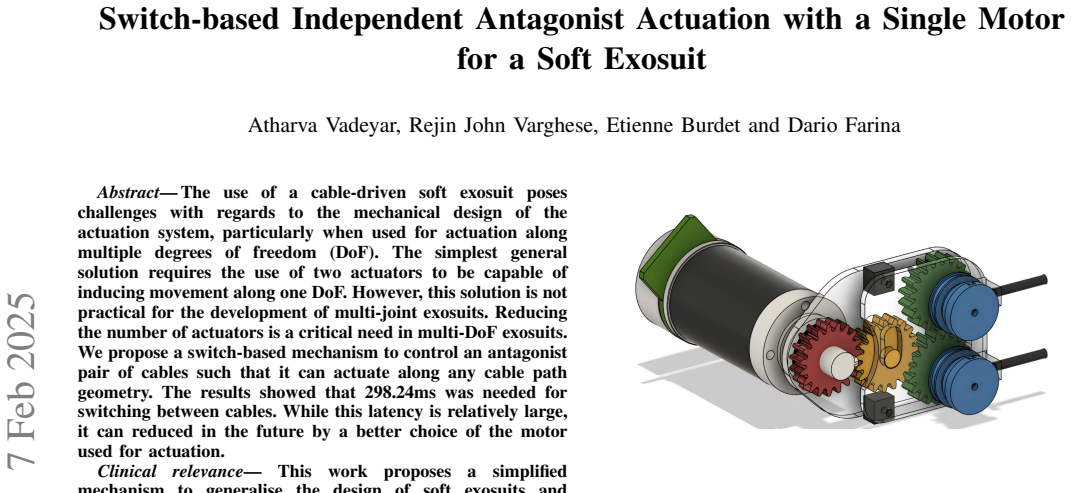
The switch gear is a planet gear that always remains meshed with the motor's driving gear but is free to roll along a circular track instead of being fixed in place. It travels between two driven gears, each connected to a cable spool; the driven gears are spring-loaded with clock springs so the disengaged cable remains taut. Tooth friction between the driving gear and the switch gear powers the traversal, and the angular separation θ between the driven gears, together with the gear radii, determines the switching delay, which the paper expresses as proportional to θ divided by motor speed. This gear-in-a-track mechanism is what converts one motor direction into either of two cable pulls without requiring any cable-path-specific geometry.
What would settle it
Time a full cable-to-cable switch on the same test rig by commanding a direction reversal while recording both string potentiometer signals, measuring from the last sample where the inactive cable's displacement stays constant to the first sample where the formerly inactive cable begins to move; if this interval is substantially longer than the ~300 ms traversal time, the paper's switching-time measurement would understate the true latency.
Extended reading notes
Core claim
The central discovery is that a truncated planetary gear arrangement can act as a switch between two antagonistic cables driven by one motor. When the motor reverses direction, the switch gear is carried around the driving gear by tooth friction until it meshes with the opposite driven gear, which is attached to the other cable's spool; because the driven gears are spring-loaded and mechanically independent, the cable that is not being pulled can unwind freely without affecting the driven cable. The authors verify this independence by driving the joint over its full −90° to 90° range while perturbing the unwinding spool and observing no effect on the driven cable. They measure a switch traversal time of 298–302 ms over ten trials for each direction at approximately 120 rpm motor output, and note that the motor shaft rotates 122.6° while the switch gear revolves only 19.8°, so the switching delay is set by gear geometry and motor speed rather than by the cable path shapes.
Load-bearing premise
The reported 298 ms switching time was measured by driving the switch gear along the track without engaging either driven gear or spool, so it counts only the gear's free traversal; if gear meshing and the beginning of spool rotation add meaningful time, the actual cable-switch latency would be larger than the headline number.
Editorial extensions
If this is right
- One actuation unit can replace two motors for each one-degree-of-freedom joint, halving the actuator count needed per joint in multi-joint soft exosuits.
- Because the spools are independently spring-loaded, the mechanism works without a known fixed relationship between agonist and antagonist cable paths, allowing the same hardware to accommodate different routing geometries.
- The roughly 300 ms switching latency is compatible with the 1–3 Hz movement rates typical of rehabilitation and activities of daily living, although it is too slow for highly dynamic assistance tasks.
- Moving the switch gear to the center of the track disengages the motor from both spools, providing a built-in safety feature that lets the joint move transparently with no actuation.
- Switching latency can be reduced in future versions by choosing a faster motor or adjusting the gear ratio between the driving and switch gears, since the delay scales with θ over motor speed.
- The paper states that the mechanism's switching time is independent of gravity and that the friction between the driving and switch gear is sufficient to engage either spool reliably, with very low variability across trials.
Reading between the lines
- The 298 ms figure measures only the switch gear's free traversal along the track, because the protocol explicitly ran the gear between two positions without engaging either driven gear or spool; the full cable-to-cable switching time would also include gear meshing and the start of spool rotation, which could add a nontrivial amount of time.
- The same single-motor time-sharing principle could be extended beyond two driven gears, allowing one motor to sequentially actuate several cables or even multiple joints when the switching latency is acceptable for the task.
- The claim of generality across 'any cable path geometry' is supported experimentally by one pair of curved paths; extending this to arbitrary, user-specific routings still relies on the spring-loaded spools providing enough tension to prevent slack, which is plausible but not exhaustively demonstrated.
- Since the switch gear's motion is driven by the balance between tooth friction and track friction, the mechanism's reliability may depend on maintaining that friction balance over time—wear, lubrication, or manufacturing variations could affect the switching behavior.
Editorial analysis
A structured set of objections, weighed in public.
Referee Report
Summary. This paper proposes a single-motor, switch-based actuation mechanism for antagonist cable pairs in soft exosuits. A motor-driven 'switch gear' travels along a track and alternately engages one of two spring-loaded driven gears, allowing one motor to independently wind and unwind two cables that follow different curved paths. The authors validate the concept with two experiments: a spool-independence test measuring joint motion under random perturbations, and a switching-time test reporting a mean traversal time of about 298 ms at 120 rpm. The paper concludes that the mechanism is lightweight, generalizable to arbitrary cable path geometries, and adequate for ADL and rehabilitation applications despite its switching latency.
Significance. If the mechanism performs as claimed, it offers a low-complexity, lightweight alternative to dual-motor actuation, custom pulley profiles, and one-to-many actuators for multi-DoF soft exosuits. The decoupled-spool design is an elegant idea, and the qualitative demonstration of agonist/antagonist independence is valuable. The paper also honestly acknowledges limitations such as the inability to provide on-demand stiffness. However, the quantitative contribution rests on a measured quantity that does not match the claimed quantity, and the ADL frequency statement is internally inconsistent. With proper end-to-end timing and tempered claims, the work would be a useful contribution.
major comments (3)
- [III-B2 and III-C] The reported switching time of 298.24 ms is not a cable-to-cable switching latency. The protocol in Section III-B2 times only the switch gear's free traversal between track extremes 'without engaging either driven gear/spool.' This omits disengagement from the active driven gear, meshing with the target driven gear, and the transient during which the newly engaged spool accelerates against the clock-spring and cable tension. Because the abstract presents this number as the time 'needed for switching between cables,' the central quantitative claim is unsupported. The authors should measure the full event end-to-end, e.g., from motor command reversal to the first detectable displacement of the newly driven spool, and report that latency separately from the free-traversal time.
- [IV and Abstract] The claim that a ~300 ms switching delay is acceptable for 1–3 Hz ADL is internally inconsistent. At 3 Hz the half-cycle duration is 167 ms, which is already shorter than the reported 298 ms free-traversal time, so alternating between agonist and antagonist at that rate is impossible. Even at 1 Hz, a 300 ms switch leaves only 200 ms of active actuation per half-cycle, which is likely insufficient for smooth assistance. The paper should either state the maximum switching frequency compatible with the measured delay, substantially reduce the latency, or qualify the ADL statement to very slow movements.
- [Abstract and III-A] The claim of actuating 'along any cable path geometry' is supported only by a single pair of curved cable paths in the test rig and a qualitative independence observation. While the decoupled-spool design is conceptually geometry-agnostic, the validation does not demonstrate that the clock-spring preload maintains cable tension and avoids slack across other geometries, such as paths with large length differences or non-monotonic routing. The claim should be either tempered to 'the tested paths' or accompanied by a formal argument for why any geometry is accommodated, ideally with additional experiments varying path geometry.
minor comments (6)
- [Abstract] The sentence 'it can reduced in the future' contains a grammatical error; it should read 'it can be reduced in the future.'
- [II] The term 'truncated planetary gear system' is not standard; please clarify what is truncated and why the planetary analogy is useful for readers unfamiliar with the arrangement.
- [III-B2] The 'empirically determined points' for the switching-time test are not reported as motor positions or angles; reporting the commanded displacement would aid reproducibility.
- [III-C] The spool-independence results are described only qualitatively with reference to Fig. 4; quantitative metrics such as maximum perturbation, correlation between spool displacements, or root-mean-square deviation would strengthen the claim.
- [III-C and Fig. 5] Figure 5 is mentioned in the text but the reader cannot verify the reported means and standard deviations from the figure; consider adding error bars or individual trial points.
- [II and IV] The safety feature of disengaging the motor by moving the switch gear to the center is claimed but not experimentally validated; a brief test or at least a specification of the commanded center position would support this feature.
Circularity Check
No circularity: the central claims rest on direct hardware experiments, not on fitting, self-referential derivation, or load-bearing self-citation.
full rationale
The paper's central claims are (i) that a switch-based mechanism can independently actuate an antagonist pair of cables from a single motor, and (ii) that the measured switching time is about 298 ms. Both claims are supported by direct physical experiments described in Section III: the spool-independence test directly demonstrates decoupled agonist/antagonist motion, and the switching-time test directly reports traversal durations of 302 ms and 298 ms over ten trials. No parameter is fitted to a subset of data and then renamed as a prediction; the switching time is a measured value, not a derived quantity. The paper does not invoke any uniqueness theorem, and it does not justify its design by an ansatz smuggled in through citation. The only author self-citation is reference [2], a general review of wearable robotics used for background motivation; no load-bearing argument depends on it. The skeptic concern that the switching-time protocol measures only free switch-gear traversal without engaging the driven gears or spools is a measurement-validity/correctness risk, not a circularity: the reported number is not equivalent by construction to its inputs, and the paper does not hide the protocol. Therefore the circularity score is 0.
Assumptions & free parameters
assumptions (3)
- domain assumption The friction between the driving gear and the switch gear is sufficient and reliable enough to make the switch gear revolve around the motor and engage the correct driven gear at the end of the track.
- domain assumption The clock-springs on both spools keep the disengaged cable taut, preventing slack and uncontrolled unspooling.
- ad hoc to paper The two curved cable paths in the test rig are representative of 'any cable path geometry' encountered in soft exosuits.
Cite this review
Pith. "Pith review of Switch-based Independent Antagonist Actuation with a Single Motor for a Soft Exosuit." pith.science (2026). https://pith.science/paper/IJQBPGDP
@misc{pith2026250205290,
  author       = {Pith},
  title        = {Pith review of: Switch-based Independent Antagonist Actuation with a Single Motor for a Soft Exosuit},
  year         = {2026},
  howpublished = {\url{https://pith.science/paper/IJQBPGDP}},
  note         = {Machine review of arXiv:2502.05290}
}
read the original abstract
The use of a cable-driven soft exosuit poses challenges with regards to the mechanical design of the actuation system, particularly when used for actuation along multiple degrees of freedom (DoF). The simplest general solution requires the use of two actuators to be capable of inducing movement along one DoF. However, this solution is not practical for the development of multi-joint exosuits. Reducing the number of actuators is a critical need in multi-DoF exosuits. We propose a switch-based mechanism to control an antagonist pair of cables such that it can actuate along any cable path geometry. The results showed that 298.24ms was needed for switching between cables. While this latency is relatively large, it can reduced in the future by a better choice of the motor used for actuation.
Figures


Figures from the paper (1 more)

Reference graph
Works this paper leans on
-
[1]
11em plus .33em minus .07em @technote 4000 4000 100 4000 4000 500 `\.=1000 = #1 #1 #1 0pt [0pt][0pt] #1 * \| ** #1 \@IEEEauthorblockNstyle \@IEEEauthorblockAstyle \@IEEEauthordefaulttextstyle \@IEEEauthorblockconfadjspace -0.25em \@IEEEauthorblockNtopspace 0.0ex \@IEEEauthorblockAtopspace 0.0ex \@IEEEauthorblockNinterlinespace 2.6ex \@IEEEauthorblockAinte...
-
[2]
M. Xiloyannis, R. Alicea, A.-M. Georgarakis, F. L. Haufe, P. Wolf, L. Masia, and R. Riener, ``Soft robotic suits: State of the art, core technologies, and open challenges,'' IEEE Transactions on Robotics, vol. 38, no. 3, pp. 1343--1362, 2021
work page 2021
-
[3]
R. J. Varghese, D. Freer, F. Deligianni, J. Liu, G.-Z. Yang, and R. Tong, ``Wearable robotics for upper-limb rehabilitation and assistance: A review of the state-of-the-art challenges and future research,'' Wearable technology in medicine and health care, pp. 23--69, 2018
work page 2018
-
[4]
H. In, H. Lee, U. Jeong, B. B. Kang, and K.-J. Cho, ``Feasibility study of a slack enabling actuator for actuating tendon-driven soft wearable robot without pretension,'' in 2015 IEEE International Conference on Robotics and Automation (ICRA). 1em plus 0.5em minus 0.4em IEEE, 2015, pp. 1229--1234
work page 2015
-
[5]
H. In, U. Jeong, H. Lee, and K.-J. Cho, ``A novel slack-enabling tendon drive that improves efficiency, size, and safety in soft wearable robots,'' IEEE/ASME Transactions on Mechatronics, vol. 22, no. 1, pp. 59--70, 2016
work page 2016
-
[6]
M. Xiloyannis, L. Cappello, D. B. Khanh, S.-C. Yen, and L. Masia, ``Modelling and design of a synergy-based actuator for a tendon-driven soft robotic glove,'' in 2016 6th IEEE International Conference on Biomedical Robotics and Biomechatronics (BioRob). 1em plus 0.5em minus 0.4em IEEE, 2016, pp. 1213--1219
work page 2016
- [7]
-
[8]
M. Xiloyannis, E. Annese, M. Canesi, A. Kodiyan, A. Bicchi, S. Micera, A. Ajoudani, and L. Masia, ``Design and validation of a modular one-to-many actuator for a soft wearable exosuit,'' Frontiers in neurorobotics, vol. 13, p. 39, 2019
work page 2019
Show all 10 references
-
[9]
Bajaj, V
A. Bajaj, V. Jain, P. Kumar, A. Unal, and A. Saxena, ``Soft hand exoskeleton for adaptive grasping using a compact differential mechanism,'' in Mechanism and Machine Science: Select Proceedings of Asian MMS 2018. 1em plus 0.5em minus 0.4em Springer, 2020, pp. 733--746
2018
-
[10]
Zhang, B
W. Zhang, B. G. Cangan, T. Buchner, A. M. Kübler, R. Asmus, and R. K. Katzschmann, ``Task-defined pulley design for nonlinearly coupled tendon-driven actuation,'' in 2024 IEEE 7th International Conference on Soft Robotics (RoboSoft), 2024, pp. 220--227
2024
Reviewed August 8, 2026 · model on record in the stance chip above.
Discussion (0). Continue with ORCID to comment.