REVIEW 3 major objections 6 minor 3 cited by
VersaPRM: Multi-Domain Process Reward Model via Synthetic Reasoning Data
T0 review · 3 major / 6 minor · reviewed 2026-08-08 · deepseek-v4-flash
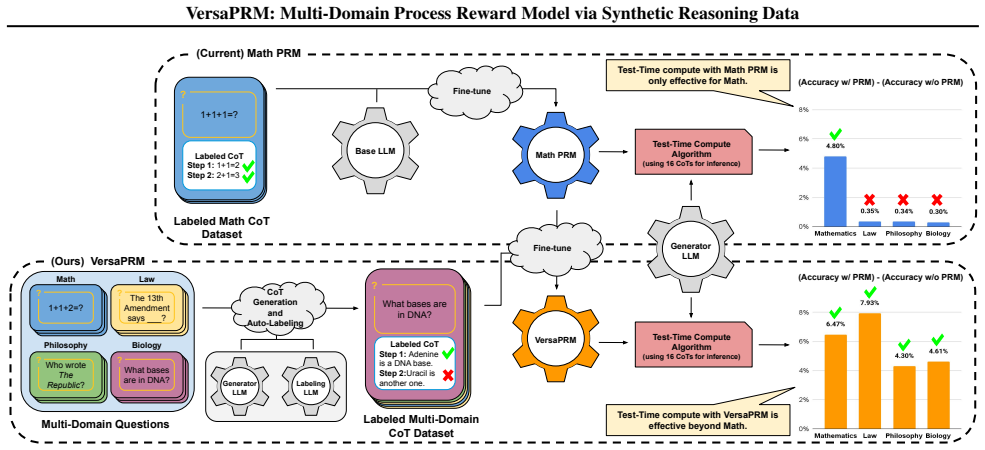
Pith's one-line read A step-scoring model trained on synthetic multi-domain data transfers beyond math, with weighted majority voting gaining 7.9 accuracy points in law and 4.6 in biology.
desk verdict A solid empirical demonstration that multi-domain synthetic CoT tuning makes PRMs useful beyond math, but the process-vs-outcome question is under-tested by one missing ORM baseline. read the letter →
The pith
A machine-rendered reading of the paper's core claim, the machinery that carries it, and where it could break.
The reading
What carries the argument
The load-bearing mechanism is the auto-labeling pipeline that turns unlabeled chains of thought into step-level reward targets. A 70B Llama judge is given the question, the ground-truth answer, and a three-level rubric (GOOD/OK/BAD) and asked to find the first incorrect step; the labels are converted to a 1/−1 sequence, and training uses a classification token appended to each step with cross-entropy loss on top of an 8B base model. This pipeline matters because it is what lets the PRM learn 'which step is wrong' in law and biology, not just 'which answer is right'; the paper's own ablation shows that removing the ground-truth answer or the rubric definitions collapses label quality and most of the downstream gain.
What would settle it
Take a fixed set of MMLU-Pro questions and generate 16 chains per question, then in each chain rewrite exactly one middle step to be factually wrong while keeping the final answer and all other steps unchanged; if VersaPRM's score for that step does not drop clearly below the scores of the unmodified steps in the majority of cases, the model is encoding answer consistency rather than process correctness.
Extended reading notes
Core claim
The central claim is that a process reward model can be made domain-general by continuing the training of a math PRM (LlamaPRM800K) on synthetic step-level supervision drawn from 5,750 MMLU-Pro questions across fourteen domains. Chains of thought are generated by Llama-3.1-8B-Instruct and labeled by Llama-3.1-70B-Instruct, which receives the ground-truth answer and a GOOD/OK/BAD rubric and returns the index of the first BAD step; all steps before it become 1, the bad step becomes −1, and later steps are discarded. The resulting VersaPRM beats open-source math PRMs and the majority-voting baseline under weighted majority voting, best-of-N, beam search, and MCTS, and hold-out-domain experiments show the gain does not depend on having seen that domain's questions during training. The paper also reports modest gains when reranking DeepSeek-R1's own chains in law and philosophy.
Load-bearing premise
The paper assumes that Llama-3.1-70B, when given the correct answer, marks the first genuinely wrong reasoning step accurately enough that roughly three-quarters of the training labels are correct; if those labels mostly reward whether the chain ends at the right answer, VersaPRM would be little more than an answer-consistency reranker.
Editorial extensions
If this is right
- Weighted majority voting and best-of-N with VersaPRM improve accuracy in non-math domains where math-trained PRMs are flat, so test-time compute can be spent productively beyond math.
- Domain diversity, not merely question-format familiarity, drives the gain: a random-subset model beats a math-subset model of the same size, and held-out domains still benefit.
- The gains persist across inference methods (WMV, BoN, beam search, and MCTS) and across generators of different sizes, and even DeepSeek-R1's chains are reranked better than majority voting.
- The 84,098 labeled chains were produced at a total cost under $100, so the generation-and-labeling pipeline is cheap enough to reproduce at scale.
- Prior exposure to math data helps the base model leverage multi-domain fine-tuning, while full fine-tuning can overfit; this points to initialization and regularization as important design choices.
Reading between the lines
- The same generation-and-label recipe should transfer to open-ended generation beyond MMLU-Pro; the paper's preliminary law experiment is consistent with this, and a cleaner test would push free-form biology or history answers through VersaPRM reranking.
- Because the ground-truth answer is essential to label quality, the learned signal may be partially answer-conditional; a variant trained with the answer removed from the labeler prompt would show how much of the gain is genuine step-level detection.
- The roughly 75% label-agreement rate implies substantial noise in the training set; modeling that noise explicitly, rather than self-filtering on the model's own scores, might sharpen the process signal further.
- The random-subset result hints at positive transfer from diverse domains into math; testing VersaPRM on harder held-out math benchmarks would reveal whether multi-domain training improves math verification or only MMLU-Pro-style questions.
Signed reviews
Editorial analysis
A structured set of objections, weighed in public.
Referee Report
Summary. The paper investigates whether process reward models (PRMs) trained on mathematical reasoning generalize to non-mathematical domains. It first shows that open-source math PRMs provide only marginal gains over majority voting in domains such as Law, Philosophy, and Biology. It then introduces VersaPRM, a PRM initialized from a Llama-based math PRM (LlamaPRM800K) and fine-tuned with LoRA on MMLU-Pro-CoT-Train (Labeled), a new synthetic dataset of roughly 84k chain-of-thought solutions auto-labeled by Llama-3.1-70B with step-level GOOD/OK/BAD judgments. VersaPRM is evaluated using weighted majority voting, best-of-N, beam search, and MCTS on a 14-domain MMLU-Pro subset, with consistent gains over majority voting and over math PRMs, particularly in non-math domains. The paper also ablates training-data diversity, holdout domains, base-model choice, aggregation rules, generator size, and augmentations, and releases the data, code, and model checkpoints.
Significance. If the results hold, the paper would provide evidence that step-level reward models can be trained cheaply for diverse domains and that domain diversity is an important driver of PRM generalization. The open-sourced dataset, code, and model are a strong community contribution, and several ablations are well designed: the holdout-domain experiment (Section 6.2, Figure 5) and the random-versus-math-subset experiment (Figure 4) directly address alternative explanations based on in-distribution format learning. However, the central 'process' interpretation is not yet isolated from outcome-based reranking because the auto-labeler is given the ground-truth answer, and the small per-domain evaluation samples limit the strength of the headline claims.
major comments (3)
- [Section 5.2 and Section 6.2] The paper does not compare VersaPRM against an outcome reward model (ORM) trained on the same synthetic data. Because the auto-labeler is given the ground-truth answer and labels every step before the first detected error as 1, the training signal is consistent with a CoT-level outcome filter: a CoT whose final answer matches the ground truth receives all-1 labels, and a CoT with a wrong final answer almost always receives a −1 at some earlier step. Without a same-data ORM baseline, or a PRM trained on labels produced without the ground-truth answer while holding the step-definition prompt fixed, the observed WMV/BoN gains do not demonstrate that the step-level process signal, rather than final-answer matching, drives the improvement. The ablated-prompt experiment in Appendix B.4 changes two variables simultaneously (the ground-truth answer and the step-definition instruction), so it does not isolate this factor.
- [Table 4 and Section 4.2] Per-domain accuracy is measured on approximately 145–150 questions, but the paper reports no confidence intervals or significance tests for the headline differences. For example, the Law gain of +7.93 points corresponds to roughly 11.5 questions out of about 145, and with a baseline accuracy of 35.93%, the standard error is approximately 4 points; this gain is borderline by conventional significance levels. The authors should report bootstrap confidence intervals or paired McNemar tests for the WMV-versus-MV and VersaPRM-versus-math-PRM comparisons.
- [Section 5.2] The manual validation of the auto-labels is based on only 64 questions, with 80% agreement for CoTs labeled correct and 71% agreement for CoTs labeled incorrect, and the paper estimates that 'approximately 75% of the CoTs in the entire dataset are correctly labeled' by averaging these two rates without accounting for class proportions or uncertainty in the point estimates. More importantly, the validation protocol checks agreement with human judgments but does not test whether the labeler identifies process-level errors independently of final-answer consistency; a labeler that simply rewards final-answer matching could plausibly achieve similar agreement numbers. The authors should provide a validation that separates process errors from outcome errors, for example by reporting the proportion of cases where the first BAD step occurs in a CoT whose final answer is correct.
minor comments (6)
- [Abstract and Table 4] The abstract states a '7.9% performance gain' and Section 1 repeats '7.9%', but Table 4 reports +7.93 absolute percentage points over the majority-voting baseline; please use 'percentage points' to avoid implying a relative improvement.
- [Section 6.1] The sentence 'Based on those findings, our final, our final multi-domain PRM' contains a duplicated phrase and should be edited.
- [Figure 6 caption and Section 6.3] The text refers to 'MVW' in the comparison of VersaPRM configurations; this should be 'WMV' (weighted majority voting).
- [Section 4.2] Please clarify whether the 150 questions per domain were sampled with or without replacement and how duplicate questions were handled across domains when 41 questions were discarded.
- [Section 5.2 and Appendix D.2] Step labels are described as 1 and −1 in Section 5.2, while Appendix D.2 describes training with '+' and '−' classification tokens; the notation should be unified.
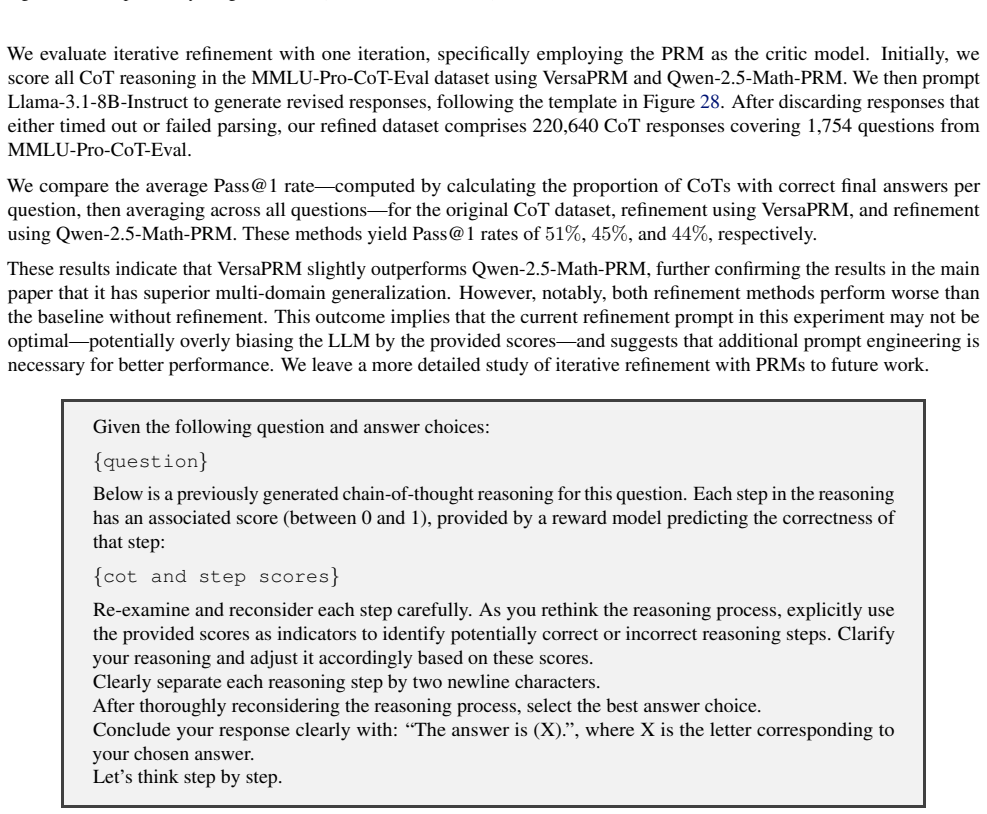
- [Appendix G.2] The Pass@1 comparison of iterative refinement discards responses that timed out or failed parsing in the refined set, but it is unclear whether the same filtering is applied to the original CoT baseline; please state the filtering procedure consistently for both conditions.
Circularity Check
No circularity found: VersaPRM is an empirical model-building study whose core claims are evaluated on disjoint held-out data, and the auto-labeling procedure is transparently reported rather than smuggled in.
full rationale
This paper does not present a derivation chain in which a predicted quantity is equivalent by construction to an input. VersaPRM is trained on step labels produced by Llama-3.1-70B-Instruct with access to the ground-truth answer (Section 5.2), but at inference the PRM scores CoTs without any ground truth, and the reported gains are final-answer accuracies on disjoint MMLU-Pro questions (Section 4.2), so the evaluation is not the training objective by construction. The auto-labeler's access to the ground-truth answer is explicitly documented, including the ablation showing degraded labels without it (Section 5.3, Appendix B.4), which is a transparency plus rather than a hidden circular step; whether those labels encode genuine step-level correctness or only final-answer consistency is a construct-validity question that would require a same-data ORM baseline, not a circularity. The self-filtering experiment in Appendix B.3 uses VersaPRM to filter its own training data, but the paper reports it provides no significant benefit and does not use it in the final model, so it is not load-bearing. No load-bearing self-citations, imported uniqueness theorems, or ansatz-via-citation reductions were found; comparisons are against external open-source PRMs, and the hold-out-domain ablations (Section 6.2, Appendix E.7) provide independent evidence that the gains are not merely in-distribution format learning.
Assumptions & free parameters
assumptions (3)
- domain assumption Llama-3.1-70B step-level judgments with the ground-truth answer and GOOD/OK/BAD rubric are accurate enough to serve as process supervision.
- domain assumption MMLU-Pro-CoT-Eval, with about 150 questions per domain and CoTs from Llama-3.1-8B-Instruct, is a representative measure of cross-domain PRM generalization.
- domain assumption Disjoint question subsets of MMLU-Pro for training and evaluation prevent answer memorization.
Cite this review
Pith. "Pith review of VersaPRM: Multi-Domain Process Reward Model via Synthetic Reasoning Data." pith.science (2026). https://pith.science/paper/FJLMHW46
@misc{pith2026250206737,
  author       = {Pith},
  title        = {Pith review of: VersaPRM: Multi-Domain Process Reward Model via Synthetic Reasoning Data},
  year         = {2026},
  howpublished = {\url{https://pith.science/paper/FJLMHW46}},
  note         = {Machine review of arXiv:2502.06737}
}
read the original abstract
Process Reward Models (PRMs) have proven effective at enhancing mathematical reasoning for Large Language Models (LLMs) by leveraging increased inference-time computation. However, they are predominantly trained on mathematical data and their generalizability to non-mathematical domains has not been rigorously studied. In response, this work first shows that current PRMs have poor performance in other domains. To address this limitation, we introduce VersaPRM, a multi-domain PRM trained on synthetic reasoning data generated using our novel data generation and annotation method. VersaPRM achieves consistent performance gains across diverse domains. For instance, in the MMLU-Pro category of Law, VersaPRM via weighted majority voting, achieves a 7.9% performance gain over the majority voting baseline -- surpassing Qwen2.5-Math-PRM's gain of 1.3%. We further contribute to the community by open-sourcing all data, code and models for VersaPRM.
Figures


Figures from the paper (24 more)



Forward citations
Cited by 3 Pith papers
-
MASPRM: Multi-Agent System Process Reward Model
MASPRM trains a per-agent, per-message value head from outcome-only MCTS rollouts and uses it to guide step-level beam search and MCTS, improving exact match on GSM8K by up to +30.7 points over a greedy multi-agent pass.
-
GM-PRM: A Generative Multimodal Process Reward Model for Multimodal Mathematical Reasoning
A generative multimodal process reward model that produces step-level critiques and corrections improves average math accuracy for six multimodal LLMs by 2.9 to 5.9 points under a refinement-based Best-of-N strategy.
-
Test-Time Scaling for Small VLMs on Multilingual Visual MCQ
On EXAMS-V, token budget and parseability dominate chain count, PRM-guided search, and selectors for small VLMs; the policy model itself yields the largest gain.
Reference graph
Works this paper leans on
-
[4]
A Ground Truth Answer
-
[5]
A Reference explanation of the answer
-
[6]
A Student’s Step-by-Step Solution, where each step is enclosed with tags and indexed from 0 You may use the ground truth answer and reference explanation in classifying the type of each step. A student’s final answer is considered correct if it matches the ground truth answer or only differs due to differences in how the answer is rounded. Once you identi...
-
[7]
A complete chain of reasoning steps, where each step is numbered (e.g., Step X). Your task is to: 1. Identify the major factual information, reasoning, and conclusions within the reasoning steps
-
[8]
This should include: - Identifying a step where the reasoning could naturally deviate
Explain how to generate an incorrect step to replace one of the existing steps. This should include: - Identifying a step where the reasoning could naturally deviate. - Speculating what type of error would be most appropriate to introduce at the chosen step
-
[9]
Introduce an incorrect next step that aligns stylistically with the previous steps. This incorrect step should: - Reflect a deviation in reasoning that significantly harms the correctness. - Appear natural and believable in the context of the reasoning process
-
[10]
Clearly explain how the incorrect step is an error, highlighting the specific logical or conceptual flaw. Output Format: STEP SUMMARY: [Summarize the reasoning within the steps in 1-2 sentences, identifying major information, logical steps, and conclusions.] INCORRECT STEP GEN: [Explain how the reasoning at a specific step could deviate naturally into bei...
work page 2025
-
[11]
GOOD Step A step is classified as GOOD if it meets all of these criteria: - Correct: Everything stated is accurate and aligns with known principles or the given problem. - Verifiable: The step can be verified using common knowledge, simple calculations, or a quick refer- ence (e.g., recalling a basic theorem). If verifying requires extensive effort (e.g.,...
Show all 74 references
-
[12]
Good job!
OK Step A step is classified as OK if it is: - Correct and Verifiable: Contains no errors and can be verified. - Unnecessary or Redundant: Adds little value, such as restating prior information or providing basic encouragement (e.g., “Good job!”). - Partially Progressing: Make...
-
[13]
- Is Hard to Verify: Requires significant effort to confirm due to poor explanation
BAD Step A step is classified as BAD if it: - Is Incorrect: Contains factual errors, misapplies concepts, derives an incorrect result, or contradicts the ground truth answer. - Is Hard to Verify: Requires significant effort to confirm due to poor explanation. - Is Off-Topic: I...
-
[14]
Otherwise, return the index of -1 (which denotes all steps are GOOD or OK)
A Ground Truth Answer Once you identify a BAD step, return the index of the earliest BAD step. Otherwise, return the index of -1 (which denotes all steps are GOOD or OK). Please put your final answer (i.e., the index) in \\boxed. Figure 15. Ablated system prompt used for auto-...
-
[15]
Selection: Starting from the root node, the algorithm traverses the tree by selecting child nodes according to a selection policy
-
[16]
This process continues until a terminal node is reached
Expansion and Simulation: Upon reaching a non-terminal leaf node, the tree is expanded iteratively by generating a fixed number of child nodes and then greedily selecting the child node with the highest value (which for us is determined by the PRM). This process continues unti...
-
[17]
These steps are repeated for a fixed number of iterations or until a computational or time limit is reached
Backpropagation: The results from the simulation are propagated back through the tree, updating value estimates and visit counts for each node along the path. These steps are repeated for a fixed number of iterations or until a computational or time limit is reached. To determ...
2024
-
[18]
The pedestrian’s statement is a spontaneous statement made while the person is under the stress of excitement caused by the event, and before they have time to reflect on the matter
-
[19]
The statement is an out-of-court statement that is being offered for the truth of the matter asserted, which is that the man switched lanes without signaling
-
[20]
Therefore, the statement is hearsay, but it is admissible under the excited utterance exception to the hearsay rule
-
[21]
The answer is (J). Math PRM rewards: 0.75, 0.82, 0.84, 0.86 VersaPRM rewards: 0.98, 0.95, 0.93, 0.17 Explanation: The Math PRM does not check that the selected answer lines up with the prior reasoning steps. CoT 2:
-
[22]
The statement is an outburst from the bystander immediately following the accident, and it describes what he just saw
-
[23]
33 VersaPRM: Multi-Domain Process Reward Model via Synthetic Reasoning Data
This meets the requirements of the present sense impression exception, which allows for the admission of statements describing or explaining an event or condition made while the declarant is perceiving the event or condition. 33 VersaPRM: Multi-Domain Process Reward Model via ...
-
[24]
The statement is describing the man’s actions in switching lanes without signaling, and it is being made immediately after the accident
-
[25]
Math PRM rewards: 0.94, 0.92, 0.96, 0.87 VersaPRM rewards: 1.00, 0.43, 1.00, 0.09 Explanation: The Math PRM fails to detect that the wrong hearsay exception was applied
The answer is (F). Math PRM rewards: 0.94, 0.92, 0.96, 0.87 VersaPRM rewards: 1.00, 0.43, 1.00, 0.09 Explanation: The Math PRM fails to detect that the wrong hearsay exception was applied. CoT 3:
-
[26]
The pedestrian’s statement is an out-of-court statement that is being offered for the truth of the matter asserted;I.e., that the man was a careless driver who failed to use a turn signal
-
[27]
The statement is an admission by a bystander, but it is still hearsay
-
[28]
There is no exception to the hearsay rule that allows a statement to be admitted if it was made by a bystander
-
[29]
The answer is (E). Math PRM rewards: 0.70, 0.90, 0.77, 0.65 VersaPRM rewards: 0.97, 0.80, 0.42, 0.08 Explanation: The Math PRM fails to recognize that there are exceptions to the hearsay rule such as the excited utterance exception. Thus, the PRM might have mistakenly judged t...
-
[30]
Validity refers to how accurately a test measures what it is supposed to measure
-
[31]
Reliability refers to how consistently a test measures what it is supposed to measure
-
[32]
However, there is another term that is often confused with validity, which is reliability
-
[33]
race to the bottom
The answer is (D). Math PRM rewards: 0.98, 0.99, 0.86, 0.80 VersaPRM rewards: 1.00, 1.00, 0.96, 0.02 Explanation: The Math PRM again does not check that the selected answer lines up with the prior reasoning steps. 35 VersaPRM: Multi-Domain Process Reward Model via Synthetic Re...
-
[34]
Devolution refers to the transfer of power or authority from a central government to a lower level of government, such as a state or local government
-
[35]
This is an example of devolution because the federal government is limiting the power of the state to act on its own, effectively ”devolving” power back to the federal level
Option C states that a state is prevented from implementing a fuel efficiency standard that is more stringent than that set by the federal government. This is an example of devolution because the federal government is limiting the power of the state to act on its own, effectiv...
-
[36]
The answer is (C). Math PRM rewards: 0.98, 0.63, 0.89 VersaPRM rewards: 1.00, 0.10, 0.47 Explanation: The Math PRM likely lacks the domain-specific understanding of political science and government structure. It does not recognize that devolution inherently involves granting m...
-
[37]
Let’s calculate the solubility of magnesium hydroxide in water and in 0.05M NaOH
-
[38]
The solubility product constant ( Ksp) is given by:
-
[39]
Ksp = [M g2+][OH −]2
-
[40]
For magnesium hydroxide, the dissolution reaction is:
-
[41]
M g(OH )2(s) ⇌ M g2+(aq) + 2OH −(aq)
-
[42]
Let x be the solubility of magnesium hydroxide in moles per liter (M)
-
[43]
Then, [M g2+] =x and [OH −] = 2x
-
[45]
8.9 × 10−12 = x(2x)2 8.9 × 10−12 = 4x3 x3 = 2.225 × 10⁻¹² x = 1.17 × 10⁻⁴ ≈ 1.2 × 10⁻⁴M
-
[46]
Therefore, the solubility of magnesium hydroxide in water is approximately 1.2 × 10⁻⁴M
-
[47]
The new concentration of OH − ions is 0.05 + 2x
When 0.05M NaOH is added, the concentration of OH − ions increases, and the equilibrium shifts to the left. The new concentration of OH − ions is 0.05 + 2x
-
[48]
However, the concentration of M g2+ ions is still x, because the NaOH does not react with Mg2+
-
[49]
Substituting these values into the Ksp expression, we get:
-
[50]
8.9 × 10−12 = x(0.05 + 2x)2
-
[51]
The concentration of OH − ions is much larger than the concentration of M g2+ ions, so we can assume that 0.05 + 2x ≈ 0.05
This equation is difficult to solve algebraically, but we can make an approximation. The concentration of OH − ions is much larger than the concentration of M g2+ ions, so we can assume that 0.05 + 2x ≈ 0.05
-
[52]
Substituting this value into the Ksp expression, we get:
-
[53]
8.9 × 10⁻¹² ≈ x(0.05)2 x ≈ 3.56 × 10⁻⁹M
-
[54]
Therefore, the solubility of magnesium hydroxide in 0.05M NaOH is approximately 3.6 × 10⁻⁹M
-
[55]
The answer is (J). 37 VersaPRM: Multi-Domain Process Reward Model via Synthetic Reasoning Data Math PRM rewards: 0.99, 0.98, 0.98, 0.97, 0.99, 0.99, 0.97, 0.96, 0.87, 0.98, 0.82, 0.84, 0.92, 0.95, 0.83, 0.91, 0.68, 0.87, 0.91 VersaPRM rewards: 1.00, 1.00, 1.00, 1.00, 1.00, 1.0...
-
[56]
The solubility product constant is given by Ksp = [M g2+][OH −]
-
[57]
The solubility of magnesium hydroxide is s
-
[58]
We know that Ksp = s2Kw, since s moles of magnesium hydroxide will produce s moles of M g2+ and 2s moles of OH −, and we know that Kw = 10−14
-
[60]
s = q Ksp Kw = q 8.9×10⁻¹² 10−14 = √ 8.9 × 102 = 9.43 × 10⁻²M
-
[61]
In the presence of .05M NaOH, we have an excess of hydroxide ions, so we can assume that the concentration of OH − is approximately equal to .05M
-
[62]
We can now calculate the solubility of magnesium hydroxide:
-
[63]
Ksp = [M g2+][OH −] = [M g2+](.05)
-
[64]
⇒ [M g2+] = Ksp .05 = 8.9×10⁻¹² .05 = 1.78 × 10⁻¹⁰M
-
[65]
The answer is (J). Math PRM rewards: 0.97, 0.99, 0.41, 0.94, 0.40, 0.87, 0.95, 0.98, 0.89, 0.63 VersaPRM rewards: 1.00, 1.00, 0.53, 1.00, 0.69, 0.96, 1.00, 0.95, 0.83, 0.12 Explanation: While the math PRM is able to detect the errors in steps 3 and 5, neither PRM recognizes th...
2014
-
[66]
The retailer purchased 20,000 pounds of soybeans in 2014 and 2015
2014
-
[67]
The cost of 20,000 pounds of soybeans in 2014 was 0.24 ∗ 20, 000 = 4800
2014
-
[68]
The cost of 20,000 pounds of soybeans in 2015 was 0.16 ∗ 20, 000 = 3200
2015
-
[69]
The percent change in the retailer’s expenses from 2014 to 2015 is 4800−3200 4800 = 1600 4800 = 1 3 = 33%
2014
-
[70]
The answer is (B). Math PRM rewards: 0.99, 0.98, 0.99, 0.18, 0.20 VersaPRM rewards: 1.00, 1.00, 1.00, 0.68, 0.78 Explanation: VersaPRM does not recognize the error in the order of subtraction in step 4, which causes the result to have an incorrect sign. 39 VersaPRM: Multi-Doma...
-
[71]
”To find the rate of inventory turnover, we need to use the following formula:
-
[72]
Inventory Turnover = Cost of Goods Sold / Average Inventory
-
[73]
The cost of goods sold is the difference between purchases and ending inventory:
-
[74]
Cost of Goods Sold = Purchases - Ending Inventory = $58,000 - $14,000 = $44,000
-
[75]
The average inventory is the average of beginning and ending inventory:
-
[76]
Average Inventory = (Beginning Inventory + Ending Inventory) / 2 = ($16,000 + $14,000) / 2 = $15,000
-
[77]
Now, we can calculate the inventory turnover:
-
[78]
Inventory Turnover = Cost of Goods Sold / Average Inventory = $44,000 / $15,000 = 2.93 (or approximately 3 times)
-
[79]
which of the following [X] is correct
The answer is (D). Math PRM rewards: 0.97, 0.98, 0.56, 0.55, 0.97, 0.93, 0.99, 0.21, 0.23 VersaPRM rewards: 1.00, 0.99, 0.96, 0.93, 1.00, 1.00, 1.00, 0.99, 0.95 Explanation: VersaPRM does not recognize the improper method of calculating the cost of goods sold in step 4, which ...
2023
Reviewed August 8, 2026 · model on record in the stance chip above.
Discussion (0). Continue with ORCID to comment.