REVIEW 3 major objections 3 minor 62 references
Feshbach spectroscopy of ultracold mixtures of $^{6}{\rm Li}$ and $^{164}{\rm Dy}$ atoms
T0 review · 3 major / 3 minor · reviewed 2026-08-08 · deepseek-v4-flash
Pith's one-line read Ultracold mixtures of lithium-6 and dysprosium-164 exhibit 21 interspecies Feshbach resonances, including a well-isolated one at 700.1 G where a strongly interacting lithium Fermi superfluid can host heavy dipolar dysprosium impurities.
desk verdict New Feshbach map for 6Li-164Dy, solid loss spectroscopy, but the Sec. III scattering-length values carry unquantified systematic bias. read the letter →
The pith
A machine-rendered reading of the paper's core claim, the machinery that carries it, and where it could break.
The reading
What carries the argument
The argument is carried by three standard tools. Magnetic Feshbach resonances -- scattering resonances tuned by shifting a bound channel across the open-channel threshold with an external field -- are detected through atom-loss spectroscopy, where the remaining $^{164}\mathrm{Dy}$ atom number is fit to a Breit-Wigner-Fano line shape to extract resonance position $B_0$ and width $\Delta B$. Around the 700.1 G resonance, the paper extracts the elastic scattering length by measuring interspecies thermalization: a heated Li cloud cools toward the Dy temperature with time constant $\tau$, related to the elastic cross section by $\tau^{-1} = \sigma_{\rm el}\,\xi\,v\,n/3$, with $\sigma_{\rm el} = 4\pi a^2$. The magnetic-field dependence is then fit to $a(B) = a_{\rm bg}(1 - \Delta/(B - B_r))$ to obtain $a_{\rm bg}$, $B_r$, and $\Delta$.
What would settle it
An independent determination of the Li$|3\rangle$-Dy$|1\rangle$ scattering length at 700.1 G -- for example, by photoassociation spectroscopy or by a full coupled-channel calculation constrained to reproduce all 21 resonance positions -- would settle the matter; if the extracted scattering length differs from the fitted background value of $-223(8)\,a_0$ by more than the combined uncertainties, the thermalization-based model is wrong.
Extended reading notes
Core claim
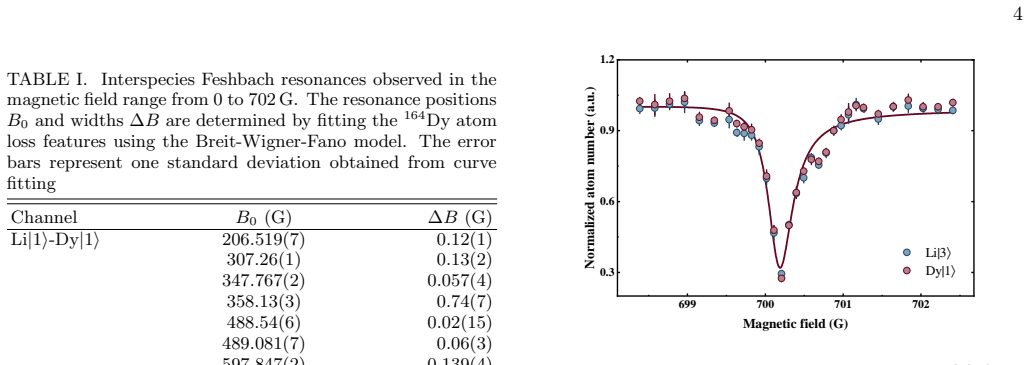
On the paper's own terms, the central result is a map: $^{6}\mathrm{Li}$ prepared in each of its three lowest hyperfine states, paired with $^{164}\mathrm{Dy}$ in its absolute ground state $|J=8, m_J=-8\rangle$, shows a total of 21 magnetic Feshbach resonances in the 0-702 G range. Three of these are relatively broad, with widths of 0.74(7) G, 1.27(9) G, and 1.17(13) G, offering continuous tunability of the Li-Dy interaction. The paper further claims that the resonance between Li$|3\rangle$ and Dy$|1\rangle$ at 700.18(2) G is an isolated narrow s-wave resonance whose elastic scattering length follows the single-resonance formula, with best-fit values $a_{\rm bg} = -223(8)\,a_0$, $B_r = 700.10(1)$ G, and $\Delta = -0.22(3)$ G. It argues this resonance is especially valuable because the same magnetic field puts a balanced Li$|1\rangle$-Li$|3\rangle$ mixture in the strongly interacting Fermi-superfluid regime, so the setup can place heavy dipolar impurities inside an interacting Fermi superfluid.
Load-bearing premise
The reported scattering lengths and resonance parameters at 700 G rest on assuming that the temperature decay in the thermalization measurement is driven only by elastic s-wave collisions with cross section $4\pi a^2$, and that evaporation and inelastic losses during the ramp and hold are negligible.
Editorial extensions
If this is right
- The 21-resonance map lets experimenters tune the lithium-dysprosium interaction strength across a wide field range, enabling systematic studies of strongly interacting Bose-Fermi mixtures.
- The three relatively broad resonances (0.74-1.27 G wide) provide a handle for creating lithium-dysprosium paramagnetic molecules through magnetoassociation.
- The 700.1 G resonance coincides with the field where a balanced Li$|1\rangle$-Li$|3\rangle$ mixture forms a strongly interacting Fermi superfluid, allowing heavy dipolar impurities to be immersed in the superfluid.
- The measured $a_{\rm bg}$, $B_r$, and $\Delta$ supply anchor data for building a coupled-channel model of the lithium-dysprosium interaction, which could predict scattering properties at other fields and spin states.
- The overlapping broad resonances in the Li$|1\rangle$-Dy$|1\rangle$ and Li$|2\rangle$-Dy$|1\rangle$ channels may enable studies of a Fermi sea coupled to a localized magnetic impurity.
Reading between the lines
- The small kink in the loss spectrum near 700.6 G, flagged by the authors as a possible three-body resonance, could, if confirmed, yield the first three-body parameter for this extreme mass-ratio system; a recombination-rate measurement versus field would test it.
- The thermalization method assumes only contact s-wave scattering, but with a highly magnetic atom like dysprosium, anisotropic dipolar collisions could contribute at low temperature; a temperature-dependence check of the extracted scattering length would reveal any such correction.
- The close overlap of broad resonances in two different lithium spin channels raises the possibility of mixed-spin molecule formation or interchannel interference in three-body loss, which the present single-channel analysis does not resolve.
- If a coupled-channel model validates the -223 $a_0$ background, the broad resonances should support a clear unitarity-limited interaction regime, which could be probed by measuring the closed-channel fraction through radio-frequency association.
Signed reviews
Editorial analysis
A structured set of objections, weighed in public.
Referee Report
Summary. This paper reports Feshbach spectroscopy of ultracold 6Li-164Dy mixtures. The authors prepare 6Li in its three lowest spin states and 164Dy in its lowest Zeeman state, identify 21 interspecies loss features between 0 and 702 G using atom-loss spectroscopy, and single out three relatively broad resonances as promising for interaction tuning. They then focus on a well-isolated resonance near 700.1 G in the Li|3>-Dy|1> channel. Using interspecies thermalization measurements at four magnetic fields and fitting with Eq. (2), they extract abg = -223(8) a0, Br = 700.10(1) G, and Delta = -0.22(3) G. The paper frames this resonance as a platform for studying heavy dipolar impurities in a strongly interacting 6Li Fermi superfluid.
Significance. If the results hold, the paper provides a valuable new heteronuclear Feshbach-resonance map for a mass-imbalanced, dipolar Bose-Fermi mixture. The loss-spectroscopy inventory itself — 21 features with positions and widths in Table I — is a useful benchmark for future coupled-channel calculations and for experiments seeking broad resonances or isolated narrow resonances. The 700.1 G resonance is particularly interesting because it lies in a field region where a two-component 6Li Fermi gas is strongly interacting; a reliable value of the interspecies scattering length near this resonance would be important for planned impurity-physics experiments. A clear strength is that the resonance positions are obtained directly from loss spectra, and the scattering length is inferred from independent thermalization data rather than from the same fit that locates the resonances. However, the quoted numerical values in the abstract depend on a thermalization model whose systematic uncertainties are not yet established.
major comments (3)
- [Sec. III, Eq. (3)] The quantitative claims in the abstract — abg = -223(8) a0, Br = 700.10(1) G, Delta = -0.22(3) G — rest entirely on the thermalization analysis using Eq. (3), which assumes a constant, zero-energy s-wave cross section sigma_el = 4*pi*a^2 and neglects inelastic loss and evaporation during the hold time. Near 700 G the atom-loss resonance is at its strongest, so loss can reduce the Li temperature on the same timescale as elastic equilibration, biasing the inferred thermalization time tau and hence the scattering length. The authors should estimate this bias, for example by including loss terms in the rate model or by comparing with a truncated-time analysis, before these parameters are quoted as definitive.
- [Sec. III and Fig. 3 vs. Fig. 5] The loss-spectroscopy position B0 = 700.18(2) G from Fig. 3 differs from the thermalization-derived Br = 700.10(1) G from Fig. 5 by about 0.08 G, which is roughly 4 times the combined statistical error. The text explains the difference between the loss width and the resonance width by thermal broadening, but it does not account for the position shift. If Br is the true resonance position, the loss feature is shifted by a statistically significant amount; the authors should explain this discrepancy or include an additional systematic uncertainty in Br.
- [Sec. III and Fig. 5] The fit of Eq. (2) in Fig. 5 uses only four magnetic-field points: 699.0103, 700.0162, 700.6868, and 701.1658 G, with two points very close to the resonance. With this limited leverage, the separation between a background scattering length, the resonance position, and the resonance width is not strongly constrained. A systematic-uncertainty analysis, additional field points, or a combined fit to the loss spectrum and thermalization data would materially strengthen the quoted values of abg, Br, and Delta.
minor comments (3)
- [Table I] Several fitted widths in Table I have relative uncertainties large enough to be consistent with zero, such as 488.54(6) G with width 0.02(15) G, 664.51(3) G with width 0.03(9) G, and 636.498(5) G with width 0.03(5) G. It would be helpful to state explicitly which of these features have widths that are statistically significant and how the fit constrained them.
- [Eq. (1)] The Breit-Wigner-Fano model is introduced as an empirical fit function, but the physical meaning of the asymmetry parameter q for a cold-atom loss feature is not discussed. A brief justification, or at least a statement that q is a purely phenomenological parameter, would improve clarity.
- [References] Reference [61] contains a typo ('2022)..') and reference [28] writes 'Phy. Rev. Lett.' instead of 'Phys. Rev. Lett.'; these should be corrected.
Circularity Check
No significant circularity: resonance positions are directly measured and the scattering-length parameters come from an independent thermalization analysis.
full rationale
The paper's central results are: (i) 21 loss features identified by atom-loss spectroscopy, with positions and widths determined from a Breit-Wigner-Fano fit (Eq. 1, Table I), and (ii) scattering-length parameters abg = -223(8) a0, Br = 700.10(1) G, and Delta = -0.22(3) G, obtained by fitting Eq. (2) to scattering lengths extracted from thermalization-rate measurements (Eq. 3, Fig. 4). No step in this chain reduces a derived quantity to a fitted input. The loss-spectroscopy resonance position B0 = 700.18(2) G is not used as input to the thermalization fit; it is a separate, direct observable, and the paper explicitly notes that the loss width (0.45(5) G) is larger than the narrower width Delta, attributing the discrepancy to thermal broadening. The thermalization model tau^-1 = sigma_el * xi * v * n / 3 with sigma_el = 4*pi*a^2 is a standard, externally established relation (refs. [33,55-57]), not an ansatz introduced by this paper and not justified by a self-citation. The only self-citations ([46,47]) are used to motivate the BCS-regime context of the Li Fermi gas, not to justify the measured resonance parameters; they are prior independent experimental results and are not load-bearing for the derivation. Concerns about systematic bias (momentum dependence near a narrow resonance, or loss and evaporation during thermalization) are model-validity issues, not circularity. The 21-feature inventory is direct experimental data, and the fitted a(B) values are determined from independent thermalization curves. The quantitative claims are therefore not equivalent to their inputs by construction.
Assumptions & free parameters
free parameters (5)
- Background scattering length a_bg =
-223(8) a0
- Resonance position B_r for the 700 G resonance =
700.10(1) G
- Resonance width Delta for the 700 G resonance =
-0.22(3) G
- B0 and Delta B for each of the 21 loss features =
Listed in Table I
- Thermalization time constants tau =
Four values at B = 699.0103, 700.0162, 700.6868, 701.1658 G
assumptions (5)
- standard math Isolated-resonance scattering length formula a(B) = a_bg (1 - Delta/(B - B_r)).
- domain assumption Thermalization rate relation tau^-1 = sigma_el xi 3 v n.
- domain assumption Energy-independent s-wave cross section sigma_el = 4 pi a^2.
- domain assumption Each observed loss feature is attributed to an interspecies magnetic Feshbach resonance.
- ad hoc to paper Breit-Wigner-Fano lineshape (Eq. 1) is an appropriate empirical model for the loss features.
Cite this review
Pith. "Pith review of Feshbach spectroscopy of ultracold mixtures of $^{6}{\rm Li}$ and $^{164}{\rm Dy}$ atoms." pith.science (2026). https://pith.science/paper/BEIM6FXP
@misc{pith2026250208099,
  author       = {Pith},
  title        = {Pith review of: Feshbach spectroscopy of ultracold mixtures of $^6\rm Li$ and $^164\rm Dy$ atoms},
  year         = {2026},
  howpublished = {\url{https://pith.science/paper/BEIM6FXP}},
  note         = {Machine review of arXiv:2502.08099}
}
abstract
We report on the observation of Feshbach resonances in ultracold $^6\mathrm{Li}$-$^{164}\mathrm{Dy}$ mixtures, where $^6\mathrm{Li}$ atoms are respectively prepared in their three lowest spin states, and $^{164}\mathrm{Dy}$ atoms are prepared in their lowest energy state. We observe 21 interspecies scattering resonances over a magnetic field range from 0 to \SI{702}{\gauss} using atom loss spectroscopy, three of which exhibit relatively broad widths. These broad resonances provide precise control over the interspecies interaction strength, enabling the study of strongly interacting effects in $^6\mathrm{Li}$-$^{164}\mathrm{Dy}$ mixtures. Additionally, we observe a well-isolated interspecies resonance at 700.1 G, offering a unique platform to explore novel impurity physics, where heavy dipolar $^{164}\mathrm{Dy}$ atoms are immersed in a strongly interacting Fermi superfluid of $^6\mathrm{Li}$ atoms.
Figures


Figures from the paper (2 more)


Reference graph
Works this paper leans on
-
[1]
Efimov, Phys
V. Efimov, Phys. Lett. B 33, 563 (1970)
1970
-
[2]
T. Kraemer, M. Mark, P. Waldburger, J. G. Danzl, C. Chin, B. Engeser, A. D. Lange, K. Pilch, A. Jaakkola, H.-C. N¨ agerl, and R. Grimm, Nature(London)440, 315 (2006)
work page 2006
-
[3]
G. Barontini, C. Weber, F. Rabatti, J. Catani, G. Thal- hammer, M. Inguscio, and F. Minardi, Phys. Rev. Lett. 103, 043201 (2009)
work page 2009
-
[4]
R. S. Bloom, M.-G. Hu, T. D. Cumby, and D. S. Jin, Phys. Rev. Lett. 111, 105301 (2013)
work page 2013
- [5]
-
[6]
S.-K. Tung, K. Jimenez-Garcia, J. Johansen, C. V. Parker, and C. Chin, Phys. Rev. Lett. 113, 240402 (2014)
work page 2014
-
[7]
K. K. Ni, S. Ospelkaus, M. H. G. de Miranda, A. Pe’er, B. Neyenhuis, J. J. Zirbel, S. Kotochigova, P. S. Julienne, D. S. Jin, and J. Ye, Science 322, 231 (2008)
work page 2008
-
[8]
K. K. Ni, S. Ospelkaus, D. Wang, G. Qu´ em´ ener, B. Neyenhuis, M. H. G. de Miranda, J. L. Bohn, J. Ye, and D. S. Jin, Nature(London) 464, 1324 (2010)
work page 2010
Show all 62 references
-
[9]
Takekoshi, L
T. Takekoshi, L. Reichs¨ ollner, A. Schindewolf, J. M. Hut- son, C. R. Le Sueur, O. Dulieu, F. Ferlaino, R. Grimm, and H.-C. N¨ agerl, Phys. Rev. Lett.113, 205301 (2014)
2014
-
[10]
P. K. Molony, P. D. Gregory, Z. Ji, B. Lu, M. P. K¨ oppinger, C. R. Le Sueur, C. L. Blackley, J. M. Hutson, and S. L. Cornish, Phys. Rev. Lett. 113, 255301 (2014)
2014
-
[11]
M. Guo, B. Zhu, B. Lu, X. Ye, F. Wang, R. Vex- iau, N. Bouloufa-Maafa, G. Qu´ em´ ener, O. Dulieu, and D. Wang, Phys. Rev. Lett. 116, 205303 (2016)
2016
-
[12]
J. W. Park, Z. Z. Yan, H. Loh, S. A. Will, and M. W. Zwierlein, Science 357, 372 (2017)
2017
-
[13]
Schindewolf, R
A. Schindewolf, R. Bause, X.-Y. Chen, M. Duda, T. Kar- man, I. Bloch, and X.-Y. Luo, Nature(London) 607, 677 (2022)
2022
-
[14]
H. Yang, J. Cao, Z. Su, J. Rui, B. Zhao, and J.-W. Pan, Science 378, 1009 (2022)
2022
-
[15]
Bigagli, W
N. Bigagli, W. Yuan, S. Zhang, B. Bulatovic, T. Kar- man, I. Stevenson, and S. Will, Nature(London) 631, 289 (2024)
2024
-
[16]
Kondo, Prog
J. Kondo, Prog. Theor. Phys. 32, 37 (1964)
1964
-
[17]
Massignan, M
P. Massignan, M. Zaccanti, and G. M. Bruun, Rep. Prog. Phys. 77, 034401 (2014)
2014
-
[18]
M.-G. Hu, M. J. Van de Graaff, D. Kedar, J. P. Corson, E. A. Cornell, and D. S. Jin, Phys. Rev. Lett. 117, 055301 (2016)
2016
-
[19]
Schmidt, M
R. Schmidt, M. Knap, D. A. Ivanov, J.-S. You, M. Cetina, and E. Demler, Rep. Prog. Phys. 81, 024401 (2018)
2018
-
[20]
C. R. Cabrera, L. Tanzi, J. Sanz, B. Naylor, P. Thomas, P. Cheiney, and L. Tarruell, Science 359, 301 (2018)
2018
-
[21]
B. J. DeSalvo, K. Patel, G. Cai, and C. Chin, Na- ture(London) 568, 61 (2019)
2019
-
[22]
R. Liu, W. Wang, and X. Cui, Phys. Rev. Lett. 131, 193401 (2023)
2023
-
[23]
Modugno, G
G. Modugno, G. Ferrari, G. Roati, R. J. Brecha, A. Si- moni, and M. Inguscio, Science 294, 1320 (2001)
2001
-
[24]
Hadzibabic, C
Z. Hadzibabic, C. A. Stan, K. Dieckmann, S. Gupta, M. W. Zwierlein, A. G¨ orlitz, and W. Ketterle, Phys. Rev. Lett. 88, 160401 (2002)
2002
-
[25]
Silber, S
C. Silber, S. G¨ unther, C. Marzok, B. Deh, P. W. Courteille, and C. Zimmermann, Phys. Rev. Lett. 95, 170408 (2005)
2005
-
[26]
Taglieber, A.-C
M. Taglieber, A.-C. Voigt, T. Aoki, T. W. H¨ ansch, and K. Dieckmann, Phys. Rev. Lett. 100, 010401 (2008)
2008
-
[27]
Wille, F
E. Wille, F. M. Spiegelhalder, G. Kerner, D. Naik, A. Trenkwalder, G. Hendl, F. Schreck, R. Grimm, T. G. Tiecke, J. T. M. Walraven, S. J. J. M. F. Kokkelmans, E. Tiesinga, and P. S. Julienne, Phys. Rev. Lett. 100, 053201 (2008)
2008
-
[28]
Yao, H.-Z
X.-C. Yao, H.-Z. Chen, Y.-P. Wu, X.-P. Liu, X.-Q. Wang, X. Jiang, Y. Deng, Y.-A. Chen, and J.-W. Pan, Phy. Rev. Lett. 117, 145301 (2016)
2016
-
[29]
Ferrier-Barbut, M
I. Ferrier-Barbut, M. Delehaye, S. Laurent, A. T. Grier, M. Pierce, B. S. Rem, F. Chevy, and C. Salomon, Science 345, 1035 (2014)
2014
-
[30]
H. Hara, Y. Takasu, Y. Yamaoka, J. M. Doyle, and Y. Takahashi, Phys. Rev. Lett. 106, 205304 (2011)
2011
-
[31]
Pasquiou, A
B. Pasquiou, A. Bayerle, S. M. Tzanova, S. Stellmer, J. Szczepkowski, M. Parigger, R. Grimm, and F. Schreck, Phys. Rev. A 88, 023601 (2013)
2013
-
[32]
R. Roy, A. Green, R. Bowler, and S. Gupta, Phys. Rev. Lett. 118, 055301 (2017)
2017
-
[33]
Ravensbergen, V
C. Ravensbergen, V. Corre, E. Soave, M. Kreyer, E. Kir- ilov, and R. Grimm, Phys. Rev. A 98, 063624 (2018)
2018
-
[34]
Trautmann, P
A. Trautmann, P. Ilzh¨ ofer, G. Durastante, C. Politi, M. Sohmen, M. J. Mark, and F. Ferlaino, Phys. Rev. Lett. 121, 213601 (2018)
2018
-
[35]
Ciamei, S
A. Ciamei, S. Finelli, A. Cosco, M. Inguscio, A. Trenkwalder, and M. Zaccanti, Phys. Rev. A 106, 053318 (2022)
2022
-
[36]
Sch¨ afer, Y
F. Sch¨ afer, Y. Haruna, and Y. Takahashi, Phys. Rev. A 107, L031306 (2023)
2023
-
[37]
Kirkby, T
W. Kirkby, T. Bland, F. Ferlaino, and R. N. Bisset, SciPost Phys. Core 6, 084 (2023)
2023
-
[38]
Kain and H
B. Kain and H. Y. Ling, Phys. Rev. A 89, 023612 (2014)
2014
-
[39]
Gurarie, L
V. Gurarie, L. Radzihovsky, and A. V. Andreev, Phys. Rev. Lett. 94, 230403 (2005)
2005
-
[40]
Finelli, A
S. Finelli, A. Ciamei, B. Restivo, M. Schemmer, A. Cosco, M. Inguscio, A. Trenkwalder, K. Zaremba- Kopczyk, M. Gronowski, M. Tomza, and M. Zaccanti, PRX Quantum 5, 020358 (2024)
2024
-
[41]
Karra, K
M. Karra, K. Sharma, B. Friedrich, S. Kais, and D. Her- schbach, J. Chem. Phys. 144, 094301 (2016)
2016
-
[42]
Baumann, N
K. Baumann, N. Q. Burdick, M. Lu, and B. L. Lev, Phys. Rev. A 89, 020701(R) (2014). 7
2014
-
[43]
Naidon and S
P. Naidon and S. Endo, Rep. Prog. Phys. 80, 056001 (2017)
2017
-
[44]
Cui and W
X. Cui and W. Yi, Phys. Rev. X 4, 031026 (2014)
2014
-
[45]
Zhao, H.-L
C.-Y. Zhao, H.-L. Han, and T.-Y. Shi, J. Phys. B: At. Mol. Opt. Phys. 57, 135301 (2024)
2024
-
[46]
X. Li, X. Luo, S. Wang, K. Xie, X.-P. Liu, H. Hu, Y.- A. Chen, X.-C. Yao, and J.-W. Pan, Science 375, 528 (2022)
2022
-
[47]
X. Li, S. Wang, X. Luo, Y.-Y. Zhou, K. Xie, H.-C. Shen, Y.-Z. Nie, Q. Chen, H. Hu, Y.-A. Chen, X.-C. Yao, and J.-W. Pan, Nature(London) 626, 288 (2024)
2024
-
[48]
Scalapino, J
D. Scalapino, J. Low Temp. Phys. 117, 179 (1999)
1999
-
[49]
Ravensbergen, V
C. Ravensbergen, V. Corre, E. Soave, M. Kreyer, S. Tzanova, E. Kirilov, and R. Grimm, Phys. Rev. Lett. 120, 223001 (2018)
2018
-
[50]
S. D. M. Brown, A. Jorio, P. Corio, M. S. Dresselhaus, G. Dresselhaus, R. Saito, and K. Kneipp, Phys. Rev. B 63, 155414 (2001)
2001
-
[51]
Bauer, C
J. Bauer, C. Salomon, and E. Demler, Phys. Rev. Lett. 111, 215304 (2013)
2013
-
[52]
J. P. D’Incao and B. D. Esry, Phys. Rev. Lett. 103, 083202 (2009)
2009
-
[53]
Wang, X.-J
J. Wang, X.-J. Liu, and H. Hu, Phys. Rev. Lett. 128, 175301 (2022)
2022
-
[54]
H. Hu, L. Jiang, H. Pu, Y. Chen, and X.-J. Liu, Phys. Rev. Lett. 110, 020401 (2013)
2013
-
[55]
C. Chin, R. Grimm, P. Julienne, and E. Tiesinga, Rev. Mod. Phys. 82, 1225 (2010)
2010
-
[56]
A. Mosk, S. Kraft, M. Mudrich, K. Singer, W. Wohlleben, R. Grimm, and M. Weidem¨ uller, Appl. Phys. B: Lasers Opt. 73, 791 (2001)
2001
-
[57]
Z.-X. Ye, A. Canali, E. Soave, M. Kreyer, Y. Yudkin, C. Ravensbergen, E. Kirilov, and R. Grimm, Phys. Rev. A 106, 043314 (2022)
2022
-
[58]
T. G. Tiecke, M. R. Goosen, J. T. M. Walraven, and S. J. J. M. F. Kokkelmans, Phys. Rev. A 82, 042712 (2010)
2010
-
[59]
Gao, Phys
B. Gao, Phys. Rev. A 58, 4222 (1998)
1998
-
[60]
B. Gao, E. Tiesinga, C. J. Williams, and P. S. Julienne, Phys. Rev. A 72, 042719 (2005)
2005
-
[61]
Ciamei, S
A. Ciamei, S. Finelli, A. Trenkwalder, M. Inguscio, A. Si- moni, and M. Zaccanti, Phys. Rev. Lett. 129, 093402 (2022)
2022
-
[62]
Maier, H
T. Maier, H. Kadau, M. Schmitt, M. Wenzel, I. Ferrier- Barbut, T. Pfau, A. Frisch, S. Baier, K. Aikawa, L. Chomaz, et al., Phys. Rev. X 5, 041029 (2015)
2015
Reviewed August 8, 2026 · model on record in the stance chip above.
Discussion (0). Continue with ORCID to comment.