REVIEW 3 major objections 4 minor 83 references
Keep your distance: learning dispersed embeddings on $\mathbb{S}_m$
T0 review · 3 major / 4 minor · reviewed 2026-08-08 · deepseek-v4-flash
Pith's one-line read The paper claims that a sliced great-circle regularizer and an online Lloyd quantization regularizer can substitute for costly pairwise dispersion on the hypersphere, and that Riemannian optimization of these objectives improves…
desk verdict Useful dispersion-regularizer paper with a genuinely new Sliced objective; the main caveat is an unquantified clipping heuristic that could drive the high-dimensional gains. read the letter →
The pith
A machine-rendered reading of the paper's core claim, the machinery that carries it, and where it could break.
The reading
What carries the argument
The central object is the great-circle slicing construction. A great circle is the intersection of the hypersphere with a plane through its center; each point $x\in\mathbb{S}_m$ projects onto it as an angle $\theta=\arctan_2(\langle x,q\rangle,\langle x,p\rangle)$. Lemma 3 gives the projection onto the set of optimally dispersed circular configurations: sort the projected angles, match them in order to the equal-spaced ideal angles, and shift all angles by their mean. Proposition 2 turns this projection into the gradient in Eq. (13), so that stochastic Riemannian gradient descent can optimize $L_{\mathrm{Sliced}}$. The Lloyd regularizer is the other load-bearing object: with the sphere as the target measure, each embedding is pulled toward the barycenter of uniform samples assigned to it, and its gradient is bounded, which permits a stochastic Riemannian convergence argument. Riemannian projection of gradients, $(I-xx^\top)\nabla$, is the mechanism that keeps both objectives and the baseline pairwise objectives well-behaved on the sphere.
What would settle it
In the clumped synthetic setting of Section 4.2, run the Sliced regularizer with clipping thresholds varying over several orders of magnitude, and also with the denominator $\langle x_i,Q\rangle^2+\langle x_i,P\rangle^2$ replaced by a smoothed $+\varepsilon$ version; if the final spherical variance and minimum distance change substantially with the threshold, the reported Sliced success comes from the clipping heuristic rather than from the dispersion objective itself.
Extended reading notes
Core claim
The paper's central claim is that dispersion on the hypersphere — the even covering of the sphere by a set of embedding vectors — can be optimized without forming the full pairwise-distance matrix. Kernel energy objectives are shown in Lemma 2 to be unbiased estimators of squared MMD against the uniform distribution, with the uniform terms reducing to a constant. The paper then introduces two alternatives: an online stochastic Lloyd regularizer that pulls each embedding toward the barycenter of uniformly sampled points in its Voronoi cell, and a sliced regularizer $L_{\mathrm{Sliced}}$ that projects the configuration onto random great circles and penalizes the squared distance of the projected angles from the set of optimally spaced circular configurations. In the synthetic and real-world evaluations, the paper argues that these regularizers approximate Tammes-optimal dispersion and improve prototype classification, discrete NMT, and continuous-output NMT, with Sliced making the fastest progress in clumped high-dimensional regimes. Across experiments it argues that Riemannian gradient updates, rather than Euclidean updates followed by projection, are systematically better.
Load-bearing premise
The claim depends on the assumption that the heuristic clipping of the Sliced regularizer's gradient does not materially change what the objective does, since that gradient becomes unbounded when an embedding nears the equator of a sampled great circle and the standard stochastic-convergence argument no longer applies.
Editorial extensions
If this is right
- Dispersion regularization becomes feasible at vocabulary scale: Lloyd costs $O(nm)$ and Sliced costs $O(nm+\mathrm{sort}(n))$ per Monte Carlo sample, versus $O(n^2m)$ for pairwise objectives.
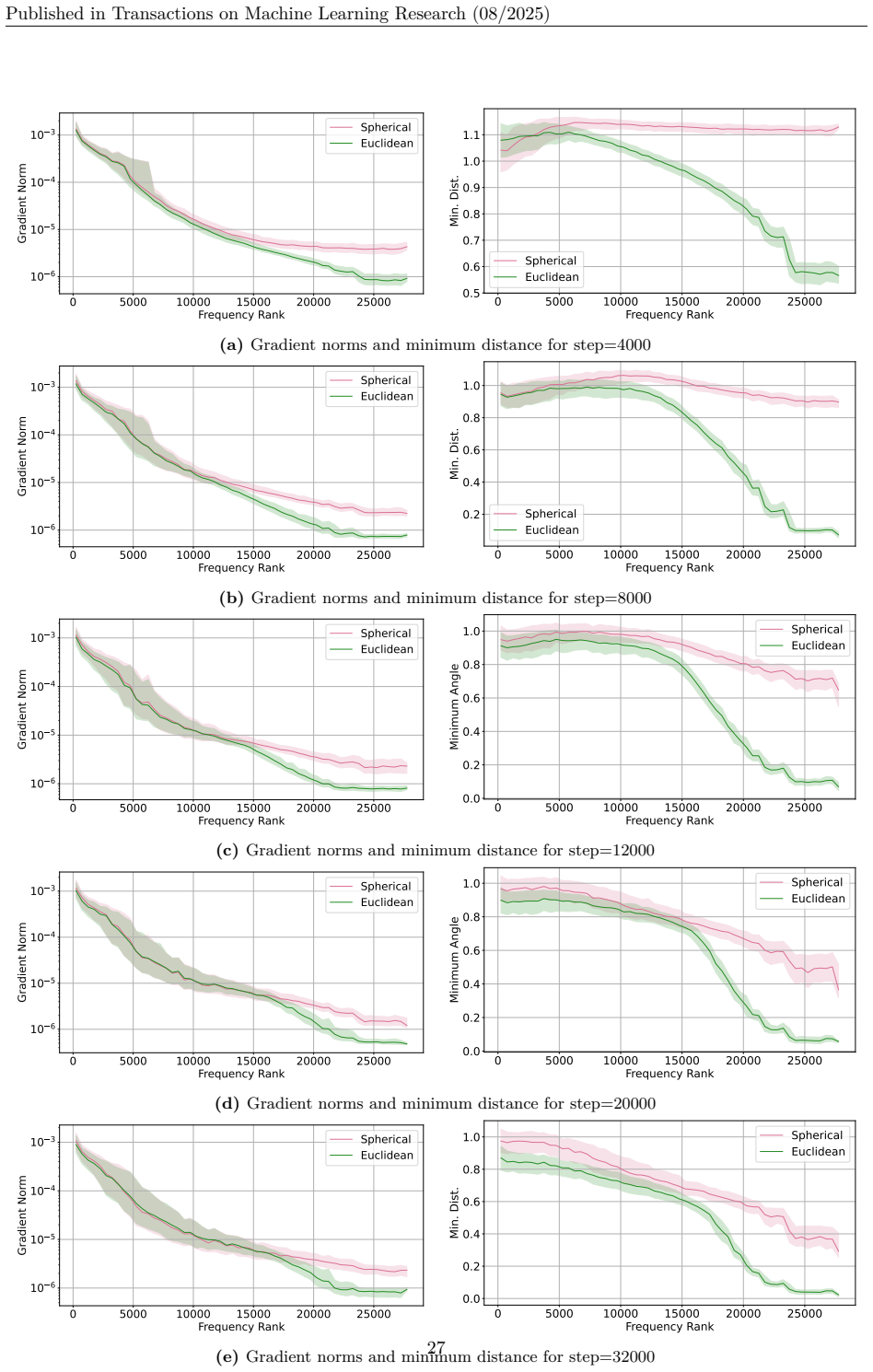
- Riemannian optimization of decoder embeddings, even without an extra regularizer, is claimed to reduce rare-token collapse; the paper reports an order-of-magnitude larger gradient norm for rare tokens and better BLEU than the Euclidean baseline.
- In clumped, high-dimensional regimes the Sliced regularizer makes the fastest initial progress on spherical variance, while max-min objectives keep improving minimum distance once points are already spread, so the right regularizer depends on the initialization regime.
- Because kernel energy objectives are squared MMD against the uniform spherical measure, their minibatch variance and concentration can be analyzed with the MMD toolkit.
- The prototype experiments show that minimum distance alone does not predict downstream accuracy; at output dimension equal to the number of classes, MHE approaches near-orthogonal solutions that underperform despite good separation.
Reading between the lines
- Editorial inference: a smoothed variant of the Sliced gradient that replaces the unbounded denominator in Eq. (13) with a small regularizer would likely recover a stochastic-convergence guarantee while preserving the objective, giving a principled alternative to clipping.
- Editorial inference: the slicing recipe should transfer to other homogeneous spaces with known one-dimensional optimal configurations, such as tori or projective spaces, by replacing the great-circle projection with the corresponding geodesic projection.
- Editorial inference: the MMD equivalence suggests a statistical use of dispersion measures, namely a post-training uniformity test on the learned embeddings to detect clumping, complementing the paper's spherical-variance and minimum-distance metrics.
- Editorial inference: the single-great-circle estimator is unbiased but may be high-variance in high dimensions; stratifying the sampled great circles (for example over axis-aligned directions) could lower variance at the same sample count.
Signed reviews
Editorial analysis
A structured set of objections, weighed in public.
Referee Report
Summary. The paper studies dispersion regularizers for embeddings constrained to the unit sphere S^m. It contributes (i) an interpretation of kernel-based dispersion objectives as squared MMD against the uniform distribution (Lemma 2, Prop. 1), (ii) a stochastic Lloyd-type regularizer for dispersion, and (iii) a "sliced dispersion" objective (Eq. 12) that measures the distance of projected angles to the optimally dispersed configuration on a great circle, with a gradient formula (Eq. 13). The authors evaluate these methods on the Tammes problem (n=24, m=3), synthetic high-dimensional settings with uniform and clumped initializations, ImageNet-200 prototype classification, and discrete and continuous-output neural machine translation. The central empirical claims are that Riemannian optimization improves dispersion and downstream performance, that Sliced makes fast progress in clumped high-dimensional regimes, and that Lloyd is a competitive efficient alternative.
Significance. If the empirical claims hold, the paper provides a practically useful toolbox for spherical dispersion regularization with favorable O(nm) or O(nm + n log n) complexity compared to pairwise O(n^2 m) methods. The theoretical contributions are modest but mostly sound: Lemma 2 follows from rotational invariance, Lemma 3 from the rearrangement inequality, and Prop. 2 computes the gradient correctly and notes the tangent property. The paper includes an open-source library and reports experiments on real tasks, which are strengths. However, the central Sliced regularizer relies on a heuristic clipping step whose details are not reported, and the MMD interpretation is stated more broadly than the assumptions justify. These issues weaken the evidential support for the paper's main claims but are addressable within the manuscript's scope.
major comments (3)
- [§3.3 (Eq. 13) and §4] The Sliced gradient is singular whenever the denominator ⟨xi,Q⟩²+⟨xi,P⟩² approaches zero, and the paper states that the standard stochastic Riemannian convergence argument does not hold and that numerical issues are handled heuristically "e.g., via clipping." However, the paper does not report the clipping threshold, the fraction of clipped gradient entries, or any sensitivity analysis. Because the favorable Sliced behavior is reported precisely in the clumped high-dimensional regime (§4.2), where the projection denominator is typically small, the current experiments cannot distinguish properties of the LSliced objective from properties of the clipping heuristic. Please report the clipping threshold used in each experiment, the fraction of clipped gradient entries over training, and an ablation (e.g., varying the threshold or using a smoothed bounded surrogate) to establish that the Sliced results are not artifacts of the clip level.
- [§3.1 / Prop. 1] Lemma 2 assumes a positive definite kernel, but Table 6 lists the Riesz kernel as only conditionally positive definite. Since squared MMD and the RKHS interpretation require a positive-definite kernel, the claim that "LMHE,k − c is an unbiased estimator of MMD²" is not justified for the Riesz kernel as stated. Please either explicitly restrict the proposition to positive-definite kernels or provide a separate treatment for conditionally positive definite kernels, and adjust the surrounding text accordingly.
- [§3.3 / Lemma 3] The displayed optimal configuration is Φ = (φ_1,...,φ_n) with φ_k = −π/n + 1/n + 2πk/n. This set does not have zero mean, contradicting the proof of Lemma 3, which uses "the last equality by choice of the zero-centered reference configuration Φ" to conclude τ* = (1/n)Σ_i θ_i. If the intended configuration is zero-centered (e.g., φ_k = −π + (2k−1)π/n), the formula should be corrected; otherwise the projection formula in Lemma 3, which enters the gradient in Eq. (13), is incorrect. Please clarify the definition and the range of k.
minor comments (4)
- [Lemma 2 / Prop. 1] In Lemma 2 and Proposition 1, "reproducible kernel Hilbert space" should be "reproducing kernel Hilbert space."
- [§4.1] The experimental setup gives the number of Lloyd samples (300), SSW projections (50), and Sliced great circles (1) in the text, but these parameters are not visible in Figure 4; adding them to the caption or a table would help reproducibility.
- [Figure 4] The label "uniform init." appears as a separate bar; please clarify whether this is the initial minimum angle before any optimization, and make the comparison with the optimal line explicit.
- [§3.3] The formula for Φ uses k without specifying its range; please state that k runs over 1..n (or 0..n−1) and ensure the formula matches the zero-mean property used in the proof.
Circularity Check
No circularity: the derivation chain is self-contained and validated against external benchmarks.
full rationale
The paper's load-bearing derivations are mathematical identities or new algorithms with independent empirical validation, not self-referential predictions. Lemma 2 and Proposition 1 derive the MMD interpretation of kernel energies from rotational symmetry of the kernel and the standard MMD definition; the kernel objective is not defined in terms of MMD to force the equivalence. Lemma 3 and Proposition 2 compute the Sliced gradient by direct calculus from the proposed objective Eq. (12), using the known optimal S1 configuration as a target rather than as a fitted parameter. Lloyd's regularizer is a standard quantization objective with bounded Riemannian gradients, and its convergence is cited from Bonnabel (2013), an external result. The empirical evaluation uses external yardsticks: the Robinson (1961) Tammes solution for n=24, BLEU/COMET on WMT test sets, and ImageNet-200 accuracy, none of which are functions of the proposed regularizers. The only appearance of author self-citation (Tokarchuk & Niculae 2024) supplies the CoNMT experimental setup, not the mathematical content, so it is not load-bearing. The unquantified clipping in §3.3 is flagged in the paper itself as a heuristic and as a reason the standard convergence argument fails; that is a correctness and robustness limitation, not circularity, because clipping is not fitted to the external metrics and the favorable results are not shown to be forced by the clip level. No equation reduces to its own input by construction.
Assumptions & free parameters
free parameters (7)
- kernel bandwidth gamma for RBF and Laplace MHE =
gamma = 1
- Riesz kernel exponent s =
s = 1
- dispersion regularization weight lambda =
not reported
- number of uniform samples for Lloyd =
300, 512, 200, or 100 per section
- number of great circles for Sliced and SSW =
1 or 13
- Riemannian Adam learning rate for NMT =
5e-3
- clipping threshold for Sliced gradient =
not specified
assumptions (6)
- standard math Uniform measure on S^m is rotationally invariant, so E_{Y~u}[k(z,Y)] is constant in z for rotationally invariant kernels.
- standard math Rearrangement inequality (Hardy et al. 1952) characterizes the optimal permutation in the 1D projection.
- standard math The known optimal configuration of n points on S1 is, up to rotation and permutation, the set Phi in Section 3.3.
- standard math Positive definiteness or conditional positive definiteness of the kernels in Table 6 (RBF, Laplace, Riesz) as cited from Feragen et al. 2015 and Bilyk and Grabner 2024.
- domain assumption Sampling great circles by orthogonalizing a 2 by m Gaussian matrix yields a uniform distribution over great circles, and dispersion along random great circles is a sufficient proxy for dispersion on S^m.
- ad hoc to paper Clipping or otherwise bounding the unbounded gradient in Eq. 13 preserves the useful behavior of the Sliced objective.
Cite this review
Pith. "Pith review of Keep your distance: learning dispersed embeddings on $\mathbb{S}_m$." pith.science (2026). https://pith.science/paper/P4XQTLMR
@misc{pith2026250208231,
  author       = {Pith},
  title        = {Pith review of: Keep your distance: learning dispersed embeddings on $\mathbbS_m$},
  year         = {2026},
  howpublished = {\url{https://pith.science/paper/P4XQTLMR}},
  note         = {Machine review of arXiv:2502.08231}
}
read the original abstract
Learning well-separated features in high-dimensional spaces, such as text or image embeddings, is crucial for many machine learning applications. Achieving such separation can be effectively accomplished through the dispersion of embeddings, where unrelated vectors are pushed apart as much as possible. By constraining features to be on a hypersphere, we can connect dispersion to well-studied problems in mathematics and physics, where optimal solutions are known for limited low-dimensional cases. However, in representation learning we typically deal with a large number of features in high-dimensional space, and moreover, dispersion is usually traded off with some other task-oriented training objective, making existing theoretical and numerical solutions inapplicable. Therefore, it is common to rely on gradient-based methods to encourage dispersion, usually by minimizing some function of the pairwise distances. In this work, we first give an overview of existing methods from disconnected literature, making new connections and highlighting similarities. Next, we introduce some new angles. We propose to reinterpret pairwise dispersion using a maximum mean discrepancy (MMD) motivation. We then propose an online variant of the celebrated Lloyd's algorithm, of K-Means fame, as an effective alternative regularizer for dispersion on generic domains. Finally, we derive a novel dispersion method that directly exploits properties of the hypersphere. Our experiments show the importance of dispersion in image classification and natural language processing tasks, and how algorithms exhibit different trade-offs in different regimes.
Figures


Figures from the paper (10 more)




Reference graph
Works this paper leans on
-
[1]
Kavosh Asadi and Michael L. Littman. An alternative softmax operator for reinforcement learning. In Doina Precup and Yee Whye Teh (eds.), Proceedings of the 34th International Conference on Machine Learning, volume 70 of Proceedings of Machine Learning Research, pp.\ 243--252. PMLR, 06--11 Aug 2017. URL https://proceedings.mlr.press/v70/asadi17a.html
2017
-
[2]
On the Equivalence between Herding and Conditional Gradient Algorithms
Francis Bach, Simon Lacoste-Julien, and Guillaume Obozinski. On the Equivalence between Herding and Conditional Gradient Algorithms . In ICML 2012 International Conference on Machine Learning , pp.\ --, Edimburgh, United Kingdom, June 2012. URL https://hal.science/hal-00681128
2012
-
[3]
Neural machine translation by jointly learning to align and translate
Dzmitry Bahdanau, Kyung Hyun Cho, and Yoshua Bengio. Neural machine translation by jointly learning to align and translate. In Proceedings of the International Conference on Learning Representations, January 2015
2015
-
[4]
Riemannian adaptive optimization methods
Gary Becigneul and Octavian-Eugen Ganea. Riemannian adaptive optimization methods. In International Conference on Learning Representations, 2019. URL https://openreview.net/forum?id=r1eiqi09K7
work page 2019
-
[5]
Positive definite singular kernels on two-point homogeneous spaces
Dmitriy Bilyk and Peter Grabner. Positive definite singular kernels on two-point homogeneous spaces, 2024. URL https://arxiv.org/abs/2410.22104
work page Pith review arXiv 2024
-
[6]
Spherical S liced- W asserstein
Cl \' e ment Bonet, Paul Berg, Nicolas Courty, Fran c ois Septier, Lucas Drumetz, and Minh Tan Pham. Spherical S liced- W asserstein. In The Eleventh International Conference on Learning Representations, 2023. URL https://openreview.net/forum?id=jXQ0ipgMdU
work page 2023
-
[7]
Stochastic gradient descent on R iemannian manifolds
Silvere Bonnabel. Stochastic gradient descent on R iemannian manifolds. IEEE Transactions on Automatic Control, 58 0 (9): 0 2217--2229, 2013
work page 2013
-
[8]
Convergence properties of the KMeans algorithm
L \' e on Bottou and Yoshua Bengio. Convergence properties of the KMeans algorithm. In Proc. of NeurIPS, 1995. URL http://leon.bottou.org/papers/bottou-bengio-95
work page 1995
Show all 83 references
-
[9]
Blaschko, Ioannis Antonoglou, and Arthur Gretton
Wacha Bounliphone, Eugene Belilovsky, Matthew B. Blaschko, Ioannis Antonoglou, and Arthur Gretton. A test of relative similarity for model selection in generative models. CoRR, abs/1511.04581, 2015. URL https://api.semanticscholar.org/CorpusID:3173270
2015 arXiv
-
[10]
A simple framework for contrastive learning of visual representations
Ting Chen, Simon Kornblith, Mohammad Norouzi, and Geoffrey Hinton. A simple framework for contrastive learning of visual representations. In International conference on machine learning, pp.\ 1597--1607. PMLR, 2020 a
2020
-
[11]
Big self-supervised models are strong semi-supervised learners
Ting Chen, Simon Kornblith, Kevin Swersky, Mohammad Norouzi, and Geoffrey E Hinton. Big self-supervised models are strong semi-supervised learners. Advances in neural information processing systems, 33: 0 22243--22255, 2020 b
2020
-
[12]
Table of spherical codes
Henry Cohn. Table of spherical codes. https://dspace.mit.edu/handle/1721.1/153543, 2024. Accessed: 2024-05-28
2024
-
[13]
Sphere-packings, lattices, and groups
John Horton Conway, Neil James Alexander Sloane, and Eiichi Bannai. Sphere-packings, lattices, and groups. Grundlehren der mathematischen Wissenschaften 290. Springer, New York, 3rd ed edition, 1999. ISBN 0387985859
1999
-
[14]
Finite point-sets on S^2 with minimum distance as large as possible
Ludwig Danzer. Finite point-sets on S^2 with minimum distance as large as possible. Discrete Mathematics, 60: 0 3--66, 1986. ISSN 0012-365X. doi:https://doi.org/10.1016/0012-365X(86)90002-6. URL https://www.sciencedirect.com/science/article/pii/0012365X86900026
1986
-
[15]
The power spherical distrbution
Nicola De Cao and Wilker Aziz. The power spherical distrbution. Proceedings of the 37th International Conference on Machine Learning, INNF+, 2020
2020
-
[16]
Uber eine Absch\
László Fejes Tóth. \"Uber eine Absch\"atzung des k\"urzesten Abstandes zweier Punkte eines auf einer Kugelfl\"ache liegenden Punktsystems. Jahresbericht der Deutschen Mathematiker-Vereinigung, 53: 0 66--68, 1943. URL http://dml.mathdoc.fr/item/GDZPPN002133873
1943
-
[17]
Geodesic exponential kernels: When curvature and linearity conflict
Aasa Feragen, Francois Lauze, and Soren Hauberg. Geodesic exponential kernels: When curvature and linearity conflict. In Proceedings of the IEEE conference on computer vision and pattern recognition, pp.\ 3032--3042, 2015
2015
-
[18]
Principal geodesic analysis for the study of nonlinear statistics of shape
P Thomas Fletcher, Conglin Lu, Stephen M Pizer, and Sarang Joshi. Principal geodesic analysis for the study of nonlinear statistics of shape. IEEE transactions on medical imaging, 23 0 (8): 0 995--1005, 2004
2004
-
[19]
Minimizing a differentiable function over a differential manifold
Daniel Gabay. Minimizing a differentiable function over a differential manifold. Journal of Optimization Theory and Applications, 37: 0 177--219, 1982
1982
-
[20]
Representation degeneration problem in training natural language generation models
Jun Gao, Di He, Xu Tan, Tao Qin, Liwei Wang, and Tieyan Liu. Representation degeneration problem in training natural language generation models. In International Conference on Learning Representations, 2019. URL https://openreview.net/forum?id=SkEYojRqtm
2019
-
[21]
A novel approach to the spherical codes problem
Simanta Gautam and Dmitry Vaintrob. A novel approach to the spherical codes problem. In MIT, Cambridge, MA, USA, Tech. Rep, 2013. URL https://api.semanticscholar.org/CorpusID:12647839
2013
-
[22]
Frage: Frequency-agnostic word representation
Chengyue Gong, Di He, Xu Tan, Tao Qin, Liwei Wang, and Tie-Yan Liu. Frage: Frequency-agnostic word representation. Advances in neural information processing systems, 31, 2018
2018
-
[23]
Borgwardt, Malte J
Arthur Gretton, Karsten M. Borgwardt, Malte J. Rasch, Bernhard Sch \"o lkopf, and Alexander Smola. A kernel two-sample test. Journal of Machine Learning Research, 13 0 (25): 0 723--773, 2012. URL http://jmlr.org/papers/v13/gretton12a.html
2012
-
[24]
Inequalities
Godfrey Harold Hardy, John Edensor Littlewood, and Gy \"o rgy P \'o lya. Inequalities. Cambridge University Press, 1952
1952
-
[25]
Momentum contrast for unsupervised visual representation learning
Kaiming He, Haoqi Fan, Yuxin Wu, Saining Xie, and Ross Girshick. Momentum contrast for unsupervised visual representation learning. In Proceedings of the IEEE/CVF conference on computer vision and pattern recognition, pp.\ 9729--9738, 2020
2020
-
[26]
Learning deep representations by mutual information estimation and maximization
R Devon Hjelm, Alex Fedorov, Samuel Lavoie-Marchildon, Karan Grewal, Phil Bachman, Adam Trischler, and Yoshua Bengio. Learning deep representations by mutual information estimation and maximization. In International Conference on Learning Representations, 2019. URL https://ope...
2019
-
[27]
Probability inequalities for sums of bounded random variables
Wassily Hoeffding. Probability inequalities for sums of bounded random variables. Journal of the American Statistical Association, 58 0 (301): 0 13--30, 1963. ISSN 01621459, 1537274X. URL http://www.jstor.org/stable/2282952
1963
-
[28]
Topics in circular statistics
S Rao Jammalamadaka and Ambar Sengupta. Topics in circular statistics. Series on multivariate analysis; vol. 5. World Scientific, Singapore, 2001. ISBN 9810237782
2001
-
[29]
S entence P iece: A simple and language independent subword tokenizer and detokenizer for neural text processing
Taku Kudo and John Richardson. S entence P iece: A simple and language independent subword tokenizer and detokenizer for neural text processing. In Eduardo Blanco and Wei Lu (eds.), Proceedings of the 2018 Conference on Empirical Methods in Natural Language Processing: System ...
2018 doi
-
[30]
Determinantal point processes for machine learning
Alex Kulesza and Ben Taskar. Determinantal point processes for machine learning. Foundations and Trends® in Machine Learning, 5 0 (2–3): 0 123--286, December 2012. ISSN 1935-8237, 1935-8245. doi:10.1561/2200000044. URL https://www.nowpublishers.com/article/Details/MAL-044. Pub...
2012 doi
-
[31]
von Mises-Fisher loss for training sequence to sequence models with continuous outputs
Sachin Kumar and Yulia Tsvetkov. von Mises-Fisher loss for training sequence to sequence models with continuous outputs. In International Conference on Learning Representations, 2019. URL https://openreview.net/forum?id=rJlDnoA5Y7
2019
-
[32]
Determinantal point process models and statistical inference
Frédéric Lavancier, Jesper Møller, and Ege Rubak. Determinantal point process models and statistical inference. Journal of the Royal Statistical Society Series B: Statistical Methodology, 77 0 (4): 0 853--877, 12 2014. ISSN 1369-7412. doi:10.1111/rssb.12096. URL https://doi.or...
2014 doi
-
[33]
Ya Le and Xuan S. Yang. Tiny ImageNet visual recognition challenge. Technical report., 2015. URL https://api.semanticscholar.org/CorpusID:16664790
2015
-
[34]
Quantization and clustering on riemannian manifolds with an application to air traffic analysis
Alice Le Brigant and Stéphane Puechmorel. Quantization and clustering on riemannian manifolds with an application to air traffic analysis. Journal of Multivariate Analysis, 173: 0 685--703, 2019. ISSN 0047-259X. doi:https://doi.org/10.1016/j.jmva.2019.05.008. URL https://www.s...
2019 doi
-
[35]
Sample estimate of the entropy of a random vector
Nikolai N Leonenko. Sample estimate of the entropy of a random vector. Problemy Peredachi Informatsii, 23 0 (2): 0 9--16, 1987
1987
-
[36]
Minimisation des fonctionnelles d \'e finies sur une vari \'e t \'e par la methode du gradi \"e nt conjugu \'e
Alain Lichnewsky. Minimisation des fonctionnelles d \'e finies sur une vari \'e t \'e par la methode du gradi \"e nt conjugu \'e . PhD thesis, These de Doctorat d'Etat. Paris: Universit \'e de Paris-Sud, 1979
1979
-
[37]
Riemannian stein variational gradient descent for bayesian inference
Chang Liu and Jun Zhu. Riemannian stein variational gradient descent for bayesian inference. In Proceedings of the AAAI Conference on Artificial Intelligence, volume 32, 2018
2018
-
[38]
Stein variational gradient descent: A general purpose bayesian inference algorithm
Qiang Liu and Dilin Wang. Stein variational gradient descent: A general purpose bayesian inference algorithm. Advances in neural information processing systems, 29, 2016
2016
-
[39]
Sphereface: Deep hypersphere embedding for face recognition
Weiyang Liu, Yandong Wen, Zhiding Yu, Ming Li, Bhiksha Raj, and Le Song. Sphereface: Deep hypersphere embedding for face recognition. In The IEEE Conference on Computer Vision and Pattern Recognition (CVPR), 2017
2017
-
[40]
Liu, Lixin Liu, Zhiding Yu, Bo Dai, and Le Song
Weiyang Liu, Rongmei Lin, Z. Liu, Lixin Liu, Zhiding Yu, Bo Dai, and Le Song. Learning towards minimum hyperspherical energy. In Neural Information Processing Systems, 2018. URL https://api.semanticscholar.org/CorpusID:43921092
2018
-
[41]
Learning with hyperspherical uniformity
Weiyang Liu, Rongmei Lin, Zhen Liu, Li Xiong, Bernhard Sch \"o lkopf, and Adrian Weller. Learning with hyperspherical uniformity. In Arindam Banerjee and Kenji Fukumizu (eds.), Proceedings of The 24th International Conference on Artificial Intelligence and Statistics, volume 1...
2021
-
[42]
Multilingual denoising pre-training for neural machine translation
Yinhan Liu, Jiatao Gu, Naman Goyal, Xian Li, Sergey Edunov, Marjan Ghazvininejad, Mike Lewis, and Luke Zettlemoyer. Multilingual denoising pre-training for neural machine translation. Transactions of the Association for Computational Linguistics, 8: 0 726--742, 2020. doi:10.11...
2020 doi
-
[43]
Least squares quantization in PCM
Stuart P Lloyd. Least squares quantization in PCM . IEEE Transactions on Information Theory, 28 0 (2): 0 129--137, 1982. doi:10.1109/TIT.1982.1056489
1982
-
[44]
Luenberger
David G. Luenberger. The gradient projection method along geodesics. Management Science, 18 0 (11): 0 620--631, 1972. ISSN 00251909, 15265501. URL http://www.jstor.org/stable/2629156
1972
-
[45]
Reliable measures of spread in high dimensional latent spaces
Anna Marbut, Katy McKinney-Bock, and Travis Wheeler. Reliable measures of spread in high dimensional latent spaces. In International Conference on Machine Learning, pp.\ 23871--23885. PMLR, 2023
2023
-
[46]
Mardia and P
Kanti V. Mardia and P. E. Jupp. Directional statistics . John Wiley & Sons, Inc., 1 1999. doi:10.1002/9780470316979. URL https://doi.org/10.1002/9780470316979
1999 doi
-
[47]
Statistics of directional data
Kantilal Varichand Mardia. Statistics of directional data. Journal of the Royal Statistical Society Series B: Statistical Methodology, 37 0 (3): 0 349--371, 1975
1975
-
[48]
Spherical text embedding
Yu Meng, Jiaxin Huang, Guangyuan Wang, Chao Zhang, Honglei Zhuang, Lance Kaplan, and Jiawei Han. Spherical text embedding. In Advances in neural information processing systems, 2019
2019
-
[49]
Hyperspherical prototype networks
Pascal Mettes, Elise van der Pol, and Cees G M Snoek. Hyperspherical prototype networks. In Advances in Neural Information Processing Systems, 2019
2019
-
[50]
Determinantal point process models on the sphere
Jesper M ller, Morten Nielsen, Emilio Porcu, and Ege Rubak. Determinantal point process models on the sphere. Bernoulli, 24 0 (2): 0 1171--1201, 2018. ISSN 13507265. URL http://www.jstor.org/stable/26491978
2018
-
[51]
Musin and Alexey S
Oleg R. Musin and Alexey S. Tarasov. The strong thirteen spheres problem . Discrete and Computational Geometry, 48 0 (1): 0 128--141, 2 2012. doi:10.1007/s00454-011-9392-2. URL https://doi.org/10.1007/s00454-011-9392-2
2012 doi
-
[52]
Musin and Alexey S
Oleg R. Musin and Alexey S. Tarasov. The Tammes problem for N = 14. Experimental Mathematics, 24 0 (4): 0 460--468, 2015. doi:10.1080/10586458.2015.1022842. URL https://doi.org/10.1080/10586458.2015.1022842
2015
-
[53]
Bastiaan Kleijn
Mattias Nilsson and W. Bastiaan Kleijn. On the estimation of differential entropy from data located on embedded manifolds. IEEE Transactions on Information Theory, 53 0 (7): 0 2330--2341, 2007. doi:10.1109/TIT.2007.899533
2007
-
[54]
fairseq: A fast, extensible toolkit for sequence modeling
Myle Ott, Sergey Edunov, Alexei Baevski, Angela Fan, Sam Gross, Nathan Ng, David Grangier, and Michael Auli. fairseq: A fast, extensible toolkit for sequence modeling. In Proceedings of NAACL-HLT 2019: Demonstrations, 2019
2019
-
[55]
B leu: a method for automatic evaluation of machine translation
Kishore Papineni, Salim Roukos, Todd Ward, and Wei-Jing Zhu. B leu: a method for automatic evaluation of machine translation. In Pierre Isabelle, Eugene Charniak, and Dekang Lin (eds.), Proceedings of the 40th Annual Meeting of the Association for Computational Linguistics, pp...
2002
-
[56]
Intrinsic statistics on R iemannian manifolds: Basic tools for geometric measurements
Xavier Pennec. Intrinsic statistics on R iemannian manifolds: Basic tools for geometric measurements. J Math Imaging Vis, 25: 0 127--154, 2006. URL https://link.springer.com/article/10.1007/s10851-006-6228-4
2006 doi
-
[57]
Computational optimal transport: With applications to data science
Gabriel Peyr \'e , Marco Cuturi, et al. Computational optimal transport: With applications to data science. Foundations and Trends in Machine Learning , 11 0 (5-6): 0 355--607, 2019
2019
-
[58]
A call for clarity in reporting BLEU scores
Matt Post. A call for clarity in reporting BLEU scores. In Ond r ej Bojar, Rajen Chatterjee, Christian Federmann, Mark Fishel, Yvette Graham, Barry Haddow, Matthias Huck, Antonio Jimeno Yepes, Philipp Koehn, Christof Monz, Matteo Negri, Aur \'e lie N \'e v \'e ol, Mariana Neve...
2018
-
[59]
Wasserstein barycenter and its application to texture mixing
Julien Rabin, Gabriel Peyr \' e , Julie Delon, and Marc Bernot. Wasserstein barycenter and its application to texture mixing. In Alfred M. Bruckstein, Bart M. ter Haar Romeny, Alexander M. Bronstein, and Michael M. Bronstein (eds.), Scale Space and Variational Methods in Compu...
2012
-
[60]
COMET : A neural framework for MT evaluation
Ricardo Rei, Craig Stewart, Ana C Farinha, and Alon Lavie. COMET : A neural framework for MT evaluation. In Bonnie Webber, Trevor Cohn, Yulan He, and Yang Liu (eds.), Proceedings of the 2020 Conference on Empirical Methods in Natural Language Processing (EMNLP), pp.\ 2685--270...
2020 doi
-
[61]
Arrangement of 24 points on a sphere
Raphael M Robinson. Arrangement of 24 points on a sphere. Mathematische Annalen, 144: 0 17--48, 1961. URL http://eudml.org/doc/160873
1961
-
[62]
Orthogonal estimation of wasserstein distances
Mark Rowland, Jiri Hron, Yunhao Tang, Krzysztof Choromanski, Tamas Sarlos, and Adrian Weller. Orthogonal estimation of wasserstein distances. In Kamalika Chaudhuri and Masashi Sugiyama (eds.), Proceedings of the Twenty-Second International Conference on Artificial Intelligence...
2019
-
[63]
Spreading vectors for similarity search
Alexandre Sablayrolles, Matthijs Douze, Cordelia Schmid, and Hervé Jégou. Spreading vectors for similarity search. In International Conference on Learning Representations, 2019. URL https://openreview.net/forum?id=SkGuG2R5tm
2019
-
[64]
Soft-max and Soft-argmax , 2024
Joseph Salmon and François-David Collin. Soft-max and Soft-argmax , 2024. URL https://josephsalmon.eu/blog/softmax/
2024
-
[65]
Web-scale K -means clustering
D Sculley. Web-scale K -means clustering. In Proc. of WWW, 2010
2010
-
[66]
Approximation theorems of mathematical statistics
Robert J Serfling. Approximation theorems of mathematical statistics. John Wiley & Sons, 2009
2009
-
[67]
A user's guide to sampling strategies for sliced optimal transport
Keanu Sisouk, Julie Delon, and Julien Tierny. A user's guide to sampling strategies for sliced optimal transport. Transactions on Machine Learning Research, 2025. ISSN 2835-8856. URL https://openreview.net/forum?id=ECBepTWAFG. Survey Certification
2025
-
[68]
Distribution of points in a cube and approximate evaluation of integrals
Ilya M Sobol. Distribution of points in a cube and approximate evaluation of integrals. USSR Computational mathematics and mathematical physics, 7: 0 86--112, 1967
1967
-
[69]
Sutherland
Danica J. Sutherland. Unbiased estimators for the variance of mmd estimators. ArXiv, abs/1906.02104, 2019. URL https://api.semanticscholar.org/CorpusID:174799385
1906 arXiv
-
[70]
On the origin of number and arrangement of the places of exit on the surface of pollen-grains
Pieter Merkus Lambertus Tammes. On the origin of number and arrangement of the places of exit on the surface of pollen-grains. PhD thesis, University of Groningen, 1930. Relation: http://www.rug.nl/ Rights: De Bussy
1930
-
[71]
JJ Thomson. On the structure of the atom: an investigation of the stability and periods of oscillation of a number of corpuscles arranged at equal intervals around the circumference of a circle; with application of the results to the theory of atomic structure. The London, Edi...
1904 doi
-
[72]
The unreasonable effectiveness of random target embeddings for continuous-output neural machine translation
Evgeniia Tokarchuk and Vlad Niculae. The unreasonable effectiveness of random target embeddings for continuous-output neural machine translation. In Kevin Duh, Helena Gomez, and Steven Bethard (eds.), Proceedings of the 2024 Conference of the North American Chapter of the Asso...
2024 doi
-
[73]
Hubs and hyperspheres: Reducing hubness and improving transductive few-shot learning with hyperspherical embeddings
Daniel Trosten, Rwiddhi Chakraborty, Sigurd Løkse, Kristoffer Wickstrøm, Robert Jenssen, and Michael Kampffmeyer. Hubs and hyperspheres: Reducing hubness and improving transductive few-shot learning with hyperspherical embeddings. In Proceedings of the IEEE/CVF conference on c...
2023
-
[74]
Auf welcher kugel haben 5, 6, 7, 8 oder 9 punkte mit mindestabstand eins platz ? Mathematische Annalen, 123: 0 96--124, 1951
Bartel Leendert van der Waerden and Kurt Schütte. Auf welcher kugel haben 5, 6, 7, 8 oder 9 punkte mit mindestabstand eins platz ? Mathematische Annalen, 123: 0 96--124, 1951. URL http://eudml.org/doc/160237
1951
-
[75]
Gomez, ukasz Kaiser, and Illia Polosukhin
Ashish Vaswani, Noam Shazeer, Niki Parmar, Jakob Uszkoreit, Llion Jones, Aidan N. Gomez, ukasz Kaiser, and Illia Polosukhin. Attention is all you need. In Advances in Neural Information Processing Systems, Red Hook, NY, USA, 2017. Curran Associates Inc. ISBN 9781510860964
2017
-
[76]
Optimal transport: old and new, volume 338
C \'e dric Villani et al. Optimal transport: old and new, volume 338. Springer Berlin, Heidelberg, 2008
2008
-
[77]
On convergence of projected gradient descent for minimizing a large-scale quadratic over the unit sphere
Trung Vu, Raviv Raich, and Xiao Fu. On convergence of projected gradient descent for minimizing a large-scale quadratic over the unit sphere. In 2019 IEEE 29th International Workshop on Machine Learning for Signal Processing (MLSP), pp.\ 1--6. IEEE, 2019
2019
-
[78]
Improving neural language generation with spectrum control
Lingxiao Wang, Jing Huang, Kevin Huang, Ziniu Hu, Guangtao Wang, and Quanquan Gu. Improving neural language generation with spectrum control. In International Conference on Learning Representations, 2020. URL https://openreview.net/forum?id=ByxY8CNtvr
2020
-
[79]
Understanding contrastive representation learning through alignment and uniformity on the hypersphere
Tongzhou Wang and Phillip Isola. Understanding contrastive representation learning through alignment and uniformity on the hypersphere. In Hal Daumé III and Aarti Singh (eds.), Proceedings of the 37th International Conference on Machine Learning, volume 119 of Proceedings of M...
2020
-
[80]
Mma regularization: Decorrelating weights of neural networks by maximizing the minimal angles, 2021
Zhennan Wang, Canqun Xiang, Wenbin Zou, and Chen Xu. Mma regularization: Decorrelating weights of neural networks by maximizing the minimal angles, 2021
2021
-
[81]
Atan2 --- Wikipedia , the free encyclopedia
Wikipedia contributors . Atan2 --- Wikipedia , the free encyclopedia. https://en.wikipedia.org/w/index.php?title=Atan2&oldid=1247664857, 2024. [Online; accessed 25-September-2024]
2024
-
[82]
Frequency-aware contrastive learning for neural machine translation
Tong Zhang, Wei Ye, Baosong Yang, Long Zhang, Xingzhang Ren, Dayiheng Liu, Jinan Sun, Shikun Zhang, Haibo Zhang, and Wen Zhao. Frequency-aware contrastive learning for neural machine translation. Proceedings of the AAAI Conference on Artificial Intelligence, 36 0 (10): 0 11712...
2022 doi
-
[83]
write newline
" write newline "" before.all 'output.state := FUNCTION n.dashify 't := "" t empty not t #1 #1 substring "-" = t #1 #2 substring "--" = not "--" * t #2 global.max substring 't := t #1 #1 substring "-" = "-" * t #2 global.max substring 't := while if t #1 #1 substring * t #2 gl...
Reviewed August 8, 2026 · model on record in the stance chip above.
Discussion (0). Continue with ORCID to comment.