A Systematic Survey of Semantic Role Labeling in the Era of Pretrained Language Models
Pith reviewed 2026-05-23 03:32 UTC · model grok-4.3
The pith
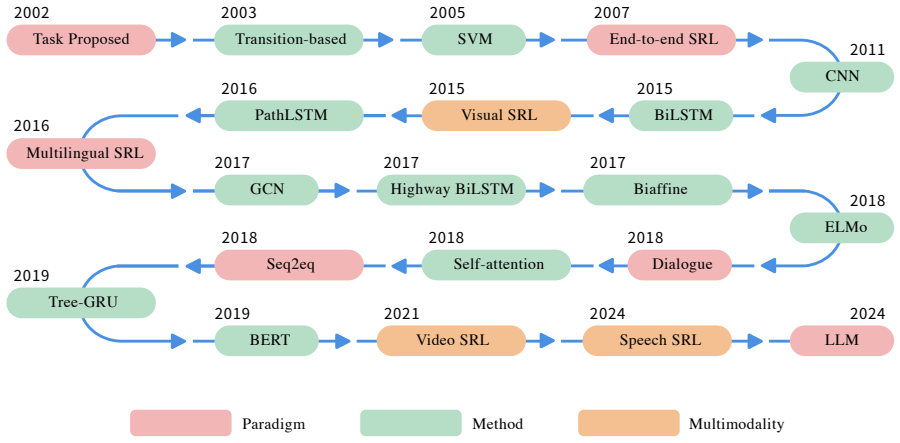
Semantic role labeling research is organized by a four-dimensional taxonomy that identifies when syntax features help and how large language models integrate.
A machine-rendered reading of the paper's core claim, the machinery that carries it, and where it could break.
Core claim
The survey proposes a unified four-dimensional taxonomy to categorize SRL research and delivers a critical analysis of syntactic features, pinpointing when they yield consistent gains over syntax-free approaches. It offers the first systematic treatment of SRL with large language models, highlighting complementary roles and hybrid directions, while extending to multimodal settings and discussing evaluation differences.
What carries the argument
The unified four-dimensional taxonomy categorizing SRL research along model architectures, syntax feature modeling, application scenarios, and multimodal extensions.
If this is right
- Syntax-aided SRL approaches provide consistent gains over syntax-free counterparts under specific conditions identified in the analysis.
- LLMs and specialized SRL systems play complementary roles, suggesting hybrid approaches for better performance.
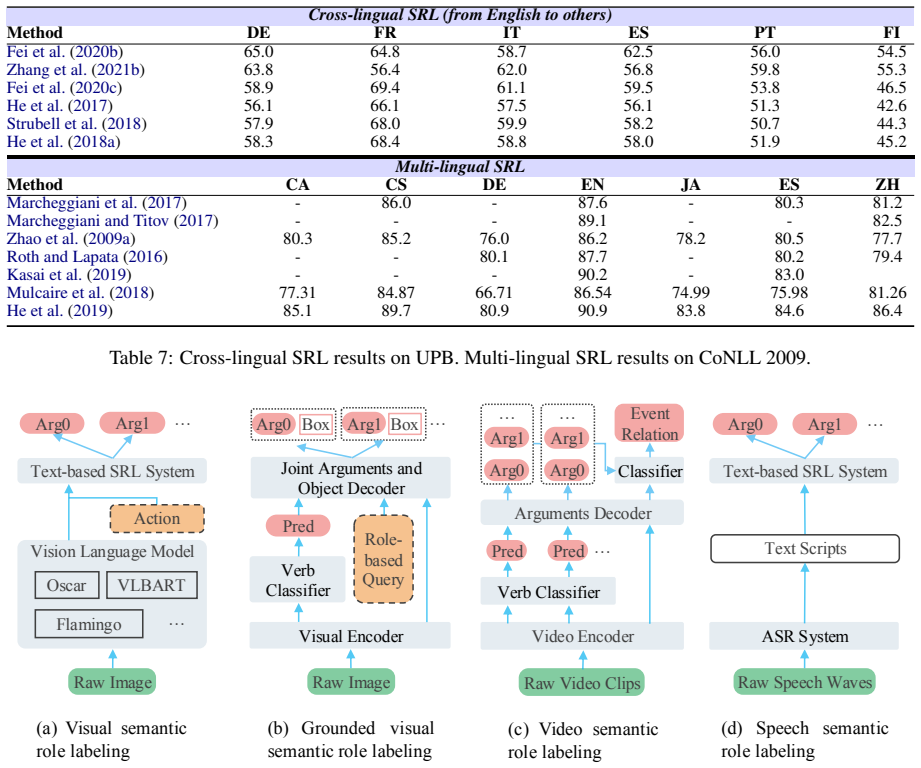
- Multimodal SRL in visual, video, and speech modalities requires distinct evaluation structures compared to text-only settings.
- Future directions include evolving SRL with LLMs and broader NLP applications across domains.
Where Pith is reading between the lines
- The taxonomy could serve as a template for surveying other NLP tasks in the LLM era to identify similar patterns in syntax usage.
- Researchers might test the identified conditions for syntax benefits by applying them to new model architectures not covered in the survey.
- Hybrid LLM-SRL systems could be evaluated on the multimodal benchmarks discussed to validate the complementary roles.
Load-bearing premise
The systematic literature search across major databases from 2000 to 2025 captured a representative sample of SRL research.
What would settle it
Discovery of a substantial number of SRL papers from 2000-2025 that were missed by the search criteria in ACL Anthology, IEEE Xplore, ACM Digital Library, and Google Scholar.
Figures


read the original abstract
Semantic role labeling (SRL) is a central natural language processing task for understanding predicate-argument structures within texts and enabling downstream applications. Despite extensive research, comprehensive surveys that critically synthesize the field from a unified perspective remain lacking. This survey makes several contributions beyond organizing existing work. We propose a unified four-dimensional taxonomy that categorizes SRL research along model architectures, syntax feature modeling, application scenarios, and multimodal extensions. We provide a critical analysis of when and why syntactic features help, identifying conditions under which syntax-aided approaches provide consistent gains over syntax-free counterparts. We offer the first systematic treatment of SRL in the era of large language models, examining the complementary roles of LLMs and specialized SRL systems and identifying directions for hybrid approaches. We extend the scope of SRL surveys to cover multimodal settings including visual, video, and speech modalities, and analyze structural differences in evaluation across these modalities. Literature was collected through systematic searches of the ACL Anthology, IEEE Xplore, the ACM Digital Library, and Google Scholar, covering publications from 2000 to 2025 and applying explicit inclusion and exclusion criteria to yield approximately 200 primary references. SRL benchmarks, evaluation metrics, and paradigm modeling approaches are discussed alongside practical applications across domains. Future research directions are analyzed, addressing the evolving role of SRL with large language models and broader NLP impact.
Editorial analysis
A structured set of objections, weighed in public.
Referee Report
Summary. This survey on Semantic Role Labeling (SRL) proposes a unified four-dimensional taxonomy categorizing research by model architectures, syntax feature modeling, application scenarios, and multimodal extensions. It claims to deliver a critical analysis of conditions under which syntax-aided SRL approaches yield consistent gains over syntax-free ones, the first systematic treatment of SRL in the LLM era including complementary roles and hybrid directions, coverage of multimodal (visual, video, speech) settings with evaluation differences, and discussion of benchmarks, metrics, applications, and future directions. The synthesis rests on a systematic literature search across ACL Anthology, IEEE Xplore, ACM Digital Library, and Google Scholar (2000–2025) that applies explicit inclusion/exclusion criteria to produce ~200 primary references.
Significance. If the taxonomy, conditions for syntax utility, and LLM-era analysis are grounded in a representative sample, the work would fill a noted gap by providing a unified organizing framework and actionable insights on hybrid SRL-LLM systems and multimodal extensions, potentially guiding research at the intersection of structured prediction and large models.
major comments (2)
- [Literature collection paragraph] Literature collection paragraph: the claim of a representative sample of ~200 references from systematic searches of ACL Anthology, IEEE Xplore, ACM Digital Library, and Google Scholar (2000–2025) with explicit inclusion/exclusion criteria is load-bearing for the taxonomy, the identified syntax-gain conditions, and the 'first systematic LLM-era treatment.' However, the manuscript provides no search strings, synonym handling for 'semantic role labeling' or 'predicate-argument,' duplicate-resolution protocol, or explicit coverage verification for post-2022 LLM-only SRL papers; without these, the representativeness and therefore the validity of all synthesized claims cannot be assessed.
- [Abstract and taxonomy description] Abstract and taxonomy description: the four-dimensional taxonomy and the specific conditions under which 'syntax-aided approaches provide consistent gains' are presented as central contributions, yet the manuscript does not indicate how the ~200 references were mapped onto the taxonomy dimensions or how counter-examples or null results were handled in deriving the 'conditions'; this mapping is required to substantiate the critical analysis.
Simulated Author's Rebuttal
We thank the referee for the constructive feedback. The comments highlight important areas for improving transparency in our survey methodology and analysis. We address each major comment below and will incorporate revisions to strengthen the manuscript.
read point-by-point responses
-
Referee: [Literature collection paragraph] Literature collection paragraph: the claim of a representative sample of ~200 references from systematic searches of ACL Anthology, IEEE Xplore, ACM Digital Library, and Google Scholar (2000–2025) with explicit inclusion/exclusion criteria is load-bearing for the taxonomy, the identified syntax-gain conditions, and the 'first systematic LLM-era treatment.' However, the manuscript provides no search strings, synonym handling for 'semantic role labeling' or 'predicate-argument,' duplicate-resolution protocol, or explicit coverage verification for post-2022 LLM-only SRL papers; without these, the representativeness and therefore the validity of all synthesized claims cannot be assessed.
Authors: We agree that explicit documentation of the search protocol is necessary to substantiate the representativeness of the ~200 references. In the revised version, we will expand the literature collection section with a new subsection that includes: (1) the complete search strings and Boolean queries used in each database, incorporating synonyms such as 'semantic role labeling', 'SRL', 'predicate-argument structure', and 'argument role labeling'; (2) the duplicate-resolution protocol (title + DOI matching followed by manual verification); and (3) our post-2022 coverage verification steps, including targeted searches for LLM-only SRL papers and the resulting inclusion counts. This addition will allow readers to assess the sample directly. revision: yes
-
Referee: [Abstract and taxonomy description] Abstract and taxonomy description: the four-dimensional taxonomy and the specific conditions under which 'syntax-aided approaches provide consistent gains' are presented as central contributions, yet the manuscript does not indicate how the ~200 references were mapped onto the taxonomy dimensions or how counter-examples or null results were handled in deriving the 'conditions'; this mapping is required to substantiate the critical analysis.
Authors: We acknowledge that the current manuscript lacks an explicit account of the categorization process. We will revise the taxonomy description section to add: (1) a step-by-step description of how papers were assigned to the four dimensions (model architectures, syntax feature modeling, application scenarios, multimodal extensions), including decision rules and inter-annotator agreement if applicable; (2) concrete examples of mapping for 4–5 representative papers; and (3) a dedicated paragraph explaining how counter-examples and null results on syntax utility were identified and incorporated when formulating the 'conditions' for consistent gains. These changes will make the derivation of our critical analysis fully traceable. revision: yes
Circularity Check
No circularity: survey synthesizes external literature without internal derivations
full rationale
This is a literature survey paper with no equations, fitted parameters, predictions, or first-principles derivations. The four-dimensional taxonomy, analysis of syntactic features, and treatment of LLM-era SRL are presented as syntheses of the collected ~200 external references. No step reduces by construction to the paper's own inputs, self-citations, or ansatzes. The literature search description is methodological and does not create self-referential loops. This is the expected outcome for a non-derivational survey.
Axiom & Free-Parameter Ledger
Forward citations
Cited by 2 Pith papers
-
Beyond Chunking: Discourse-Aware Hierarchical Retrieval for Long Document Question Answering
A hierarchical QA framework converts RST discourse trees into enhanced sentence representations for structure-guided retrieval and reports consistent gains over baselines on four datasets across genres and languages.
-
Revisiting Semantic Role Labeling: Efficient Structured Inference with Dependency-Informed Analysis
A new encoder-based SRL system with dependency-informed analysis delivers 10x faster inference and comparable or better F1 scores using BERT, RoBERTa, and DeBERTa while supporting multilingual projection.
Reference graph
Works this paper leans on
-
[1]
The berkeley framenet project. In Proceedings of the 36th Annual Meeting of the Association for Computational Linguistics and 17th International Conference on Computational Linguistics, pages 86– 90. Laura Banarescu, Claire Bonial, Shu Cai, Madalina Georgescu, Kira Griffitt, Ulf Hermjakob, Kevin Knight, Philipp Koehn, Martha Palmer, and Nathan Schneider. ...
work page 2013
-
[2]
In Pro- ceedings of the Sixth International Workshop on Com- putational Semantics, page 12
Building text meaning representations from contextually related frames - a case study. In Pro- ceedings of the Sixth International Workshop on Com- putational Semantics, page 12. Jiaxun Cai, Shexia He, Zuchao Li, and Hai Zhao. 2018. A full end-to-end semantic role labeler, syntactic- agnostic over syntactic-aware? In Proceedings of the 27th International ...
work page 2018
-
[3]
Human-like controllable image captioning with verb-specific semantic roles. In Proceedings of the IEEE/CVF Conference on Computer Vision and Pattern Recognition, pages 16846–16856. Xinchi Chen, Chunchuan Lyu, and Ivan Titov. 2019. Capturing argument interaction in semantic role la- beling with capsule networks. In Proceedings of the 2019 Conference on Emp...
work page 2019
-
[4]
Collaborative transformers for grounded situ- ation recognition. In Proceedings of the IEEE/CVF Conference on Computer Vision and Pattern Recog- nition, pages 19627–19636. Junhyeong Cho, Youngseok Yoon, Hyeonjun Lee, and Suha Kwak. 2021. Grounded situation recognition with transformers. In Proceedings of the 32nd British Machine Vision Conference 2021, pa...
work page 2021
-
[5]
Natural language processing (almost) from scratch. Journal of machine learning research , 12:2493–2537. Thilini Cooray, Ngai-Man Cheung, and Wei Lu. 2020. Attention-based context aware reasoning for situation recognition. In Proceedings of the IEEE/CVF Con- ference on Computer Vision and Pattern Recognition, pages 4735–4744. Angel Daza and Anette Frank. 2...
work page internal anchor Pith review Pith/arXiv arXiv 2020
-
[6]
Intelligenza Artificiale, 17(2):173–191
Grounding end-to-end pre-trained architec- tures for semantic role labeling in multiple languages. Intelligenza Artificiale, 17(2):173–191. Fariz Ikhwantri, Samuel Louvan, Kemal Kurniawan, Bagas Abisena, Valdi Rachman, Alfan Farizki Wicak- sono, and Rahmad Mahendra. 2018. Multi-task ac- tive learning for neural semantic role labeling on low resource conve...
work page 2018
-
[7]
In Ad- vances in Neural Information Processing Systems , pages 8199–8210
Grounded video situation recognition. In Ad- vances in Neural Information Processing Systems , pages 8199–8210. Peter Koomen, Vasin Punyakanok, Dan Roth, and Wen- tau Yih. 2005. Generalized inference with multiple semantic role labeling systems. In Proceedings of the Ninth Conference on Computational Natural Lan- guage Learning, pages 181–184. Mikhail Koz...
work page 2005
-
[8]
In Find- ings of the Association for Computational Linguistics: EMNLP 2020, pages 1134–1151
High-order semantic role labeling. In Find- ings of the Association for Computational Linguistics: EMNLP 2020, pages 1134–1151. Zuchao Li, Hai Zhao, Junru Zhou, Kevin Parnow, and Shexia He. 2022b. Dependency and span, cross-style semantic role labeling on propbank and nombank. ACM Transactions on Asian and Low-Resource Lan- guage Information Processing, 2...
work page 2020
-
[9]
Exploiting semantics in neural machine trans- lation with graph convolutional networks. In Pro- ceedings of the 2018 Conference of the North Amer- ican Chapter of the Association for Computational Linguistics: Human Language Technologies, Volume 2 (Short Papers), pages 486–492. Diego Marcheggiani, Anton Frolov, and Ivan Titov
work page 2018
-
[10]
In Proceedings of the 21st Conference on Computa- tional Natural Language Learning, pages 411–420
A simple and accurate syntax-agnostic neural model for dependency-based semantic role labeling. In Proceedings of the 21st Conference on Computa- tional Natural Language Learning, pages 411–420. Diego Marcheggiani and Ivan Titov. 2017. Encoding sentences with graph convolutional networks for se- mantic role labeling. In Proceedings of the 2017 Conference ...
work page 2017
-
[11]
MRP 2020: The second shared task on cross- framework and cross-lingual meaning representation parsing. In Proceedings of the CoNLL 2020 Shared Task: Cross-Framework Meaning Representation Parsing, pages 1–22. Stephan Oepen, Omri Abend, Jan Hajic, Daniel Her- shcovich, Marco Kuhlmann, Tim O’Gorman, Nian- wen Xue, Jayeol Chun, Milan Straka, and Zdenka Ureso...
work page 2020
-
[12]
A span selection model for semantic role la- beling. In Proceedings of the 2018 Conference on Empirical Methods in Natural Language Processing, pages 1630–1642. Sebastian Padó and Mirella Lapata. 2006. Optimal constituent alignment with edge covers for semantic projection. In Proceedings of the 21st International Conference on Computational Linguistics an...
work page 2018
-
[13]
Computational Linguistics, 31(1):71– 106
The proposition bank: An annotated corpus of semantic roles. Computational Linguistics, 31(1):71– 106. Sameer Pradhan, Kadri Hacioglu, Wayne H. Ward, James H. Martin, and Daniel Jurafsky. 2005a. Seman- tic role chunking combining complementary syntac- tic views. In Proceedings of the Ninth Conference on Computational Natural Language Learning, pages 217–2...
-
[14]
Transactions of the Associa- tion for Computational Linguistics, 3:29–41
Efficient inference and structured learning for semantic role labeling. Transactions of the Associa- tion for Computational Linguistics, 3:29–41. Zhixing Tan, Mingxuan Wang, Jun Xie, Yidong Chen, and Xiaodong Shi. 2018. Deep semantic role labeling with self-attention. In Proceedings of the Thirty- Second AAAI Conference on Artificial Intelligence, pages 4...
work page 2018
discussion (0)
Sign in with ORCID, Apple, or X to comment. Anyone can read and Pith papers without signing in.