REVIEW 4 major objections 5 minor 6 references
Privacy-Preserving Hybrid Ensemble Model for Network Anomaly Detection: Balancing Security and Data Protection
T0 review · 4 major / 5 minor · reviewed 2026-08-07 · deepseek-v4-flash
Pith's one-line read A hybrid ensemble of KNN, SVM, XGBoost, and ANN reports 94.3% accuracy on network anomaly detection while claiming privacy preservation.
desk verdict A clear, readable survey of standard techniques, but the headline accuracy and privacy claims rest on an unverifiable table and a self-contradictory DP description. read the letter →
The pith
A machine-rendered reading of the paper's core claim, the machinery that carries it, and where it could break.
The reading
What carries the argument
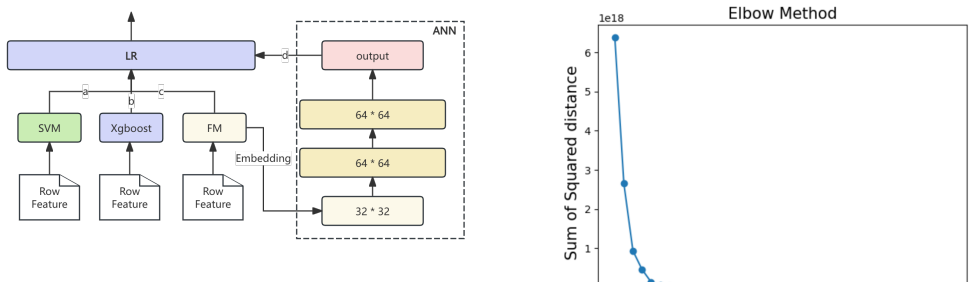
The key object is the ensemble itself: KNN with k=5 is used for clustering and feature importance, its outputs feed factorization machines whose embedding vectors are passed to an ANN, while SVM and XGBoost are trained in parallel, and all four outputs are combined by a logistic regression (or softmax) layer. The other load-bearing components are the preprocessing steps: similarity-based interpolation for minority classes (a SMOTE-like formula), z-score and KNN outlier handling, and the differential-privacy noise addition described in Section III-D. The ensemble formula is the stacking step, and the paper attributes the performance gain to the diversity of the four learners.
What would settle it
Run the same pipeline on a named public intrusion dataset such as NSL-KDD or CICIDS2017 with a stated differential-privacy budget, for example $\epsilon = 1$, and compare accuracy with and without noise; if the ensemble's accuracy drops materially below 94.3% or if no epsilon can be specified, the central claim is falsified.
Extended reading notes
Core claim
The paper sets out to show that a logistic-regression ensemble of KNN, SVM, XGBoost, and ANN detects network anomalies better than any of its components, and that the same model can be made privacy-preserving by anonymizing sensitive fields, adding differential-privacy noise, and applying adversarial training. In the reported experiments the ensemble reaches 94.3% accuracy and a 93.5% F1-score, ahead of the strongest single model, ANN, at 92.1% accuracy and 91.5% F1. The privacy-preserving aspects are asserted as part of the design; the paper does not report an epsilon value, noise scale, or a with/without privacy comparison, so the accuracy figure is not tied to a stated privacy guarantee.
Load-bearing premise
The load-bearing premise is that adding unspecified controlled noise for differential privacy preserves the ensemble's 94.3% accuracy, yet no epsilon or noise scale is reported.
Editorial extensions
If this is right
- If the ensemble result holds, practitioners can expect a 2–3 point accuracy gain from stacking these four classifiers over the best single model on imbalanced intrusion data.
- The preprocessing combination of similarity-based oversampling and z-score/KNN outlier filtering can be reused as a general recipe for small, imbalanced network datasets.
- If the privacy techniques are made quantitative with an epsilon and noise scale, the architecture could be adapted for cross-silo federated deployment where raw traffic cannot be shared.
- The performance ranking with XGBoost and ANN above SVM and FM on this dataset gives a baseline expectation for which individual models dominate in similar anomaly-detection tasks.
Reading between the lines
- The paper does not name its dataset or report a privacy budget, so the privacy discussion may be illustrative; a testable extension would be to re-run the ensemble on NSL-KDD or CICIDS2017 with a concrete epsilon and measure the accuracy drop.
- Because the ensemble uses logistic regression stacking on only four models, the same framework could be extended to include newer classifiers, such as differently configured gradient-boosted trees or transformer-based tabular models, and the marginal gain from each could be measured.
- The privacy-preserving claim would be strengthened by an ablation that toggles each privacy mechanism (anonymization, noise, adversarial training) and reports accuracy, F1, and a privacy metric such as epsilon or membership-inference risk; the current paper leaves that as future work.
Signed reviews
Editorial analysis
A structured set of objections, weighed in public.
Referee Report
Summary. The paper proposes a hybrid ensemble model for network anomaly detection that combines KNN, SVM, XGBoost, and ANN, with logistic regression as the meta-learner. The preprocessing pipeline includes similarity-based oversampling, Z-score and KNN-based outlier detection, and several claimed privacy mechanisms such as anonymization, federated learning, secure multi-party computation, and differential privacy. The empirical contribution is a single table (Table I) reporting accuracy, precision, recall, and F1-score for FM, SVM, XGBoost, ANN, and the ensemble, with the ensemble achieving 94.3% accuracy and 93.5% F1-score. The paper concludes that this ensemble outperforms the individual models while ensuring privacy and security.
Significance. The would-be contribution is incremental: an ensemble of standard classifiers with standard preprocessing, framed with privacy-preserving terminology. The paper gives no dataset identifier, no experimental protocol, no code, and no privacy accounting, so the central claims are not verifiable. If the reported numbers came with reproducible experiments and a concrete differential-privacy guarantee, the paper would be a modest but useful data point; as written, it provides no falsifiable evidence and no implementation that another group could check.
major comments (4)
- [Section V, Table I] Table I is the entire empirical support for the paper's central claim, but it reports only point estimates with no dataset name, no sample size, no train/test split, no cross-validation scheme, and no error bars. Without this information, the 1.8-percentage-point accuracy gap between ANN (92.1%) and the ensemble (94.3%) cannot be distinguished from noise, and the claim that the ensemble is superior is unsupported.
- [Section III-D and Section IV-A] The privacy-preserving claim is load-bearing but unsubstantiated. Section III-D states that differential privacy was applied by adding controlled noise to the dataset to prevent re-identification, while Section IV-A states that noise was added to gradients or weights during training. These are incompatible descriptions with different sensitivity and privacy-accounting requirements. No privacy budget (epsilon, delta), noise scale, sensitivity, or with/without-privacy ablation is reported, so the abstract and conclusion's claim of balancing privacy and accuracy is not supported.
- [Section IV-G and Table I] The ensemble is a logistic regression meta-learner fit to the outputs of the base models, but the manuscript does not state whether Table I was computed on the same data used to fit the logistic regression weights. If the evaluation is in-sample, the ensemble's improvement is expected by construction and is not evidence of generalization. A nested cross-validation or held-out test set is required to validate the reported ensemble advantage.
- [Section IV-B, IV-C, IV-G, and Table I] The model description is internally inconsistent. The ensemble combiner in Eq. (12) is said to combine KNN, ANN, SVM, and XGBoost outputs, but Table I reports 'FM' rather than KNN and gives no results for KNN. Conversely, the factorization machine described in Section IV-C and Eq. (6) is never included in the ensemble combiner. This makes the reported comparison impossible to reconstruct from the text.
minor comments (5)
- [Abstract and keywords] The keyword heading is misspelled as 'Kerwords'; this should be 'Keywords'.
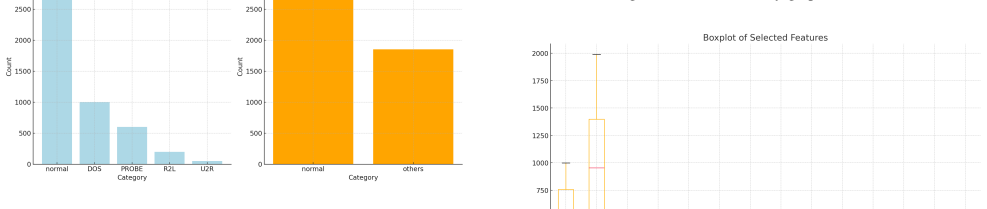
- [Section III-A and Figures 1-3] The class distribution, cluster similarity graph, and box plots are referenced as Figures 1-3, but no actual data values or axis labels are provided, so these figures are illustrative rather than reproducible.
- [Section II] Reference [5] on financial sentiment analysis with FinBERT and GPT-4o is unrelated to the network anomaly detection topic and should be removed or integrated with a direct connection to the paper's argument.
- [Equation (14)] The focal loss formula is written for a single predicted probability y-hat, but the text says it is used for multi-class scenarios; the standard multi-class form with per-class alpha_t and p_t should be given to avoid ambiguity.
- [Section IV-H] The 'Security of the Model' subsection lists adversarial training, model hardening, and secure deployment, but none of these techniques are evaluated or connected to the experimental results, so they should be presented as design considerations rather than validated contributions.
Circularity Check
No significant circularity: the only self-citation is background material, and the ensemble and privacy claims rest on empirical tables and missing experimental details rather than on a derivation that reduces to its inputs.
full rationale
This paper has no claimed derivation chain that could be circular; the central claims are empirical performance numbers (Table I) and qualitative privacy statements. Ref. [1] (Yang et al., co-authored by S. Liu) is cited in Related Work as background on federated XGBoost and is not used to justify the ensemble's accuracy or the privacy guarantee, so the self-citation is not load-bearing. The logistic-regression stacking rule in Eq. (12) is a standard combination of base-model outputs; whether the ensemble's reported superiority over the base models is an artifact of in-sample fitting cannot be established from the text because no train/test split is described, but the paper never says the comparison is in-sample, so this is an experimental-reporting concern rather than a circular reduction. Likewise, the privacy-preserving claim is unsubstantiated by any epsilon, noise scale, or with/without-privacy ablation, but missing evidence is a correctness risk, not circularity. No equation or fitted parameter is defined in terms of the quantity it purportedly predicts, so no circular step is present.
Assumptions & free parameters
free parameters (9)
- KNN neighbor count k =
5
- Z-score outlier threshold =
3
- SMOTE interpolation coefficient lambda =
random in [0,1]
- SVM regularization C =
not reported
- XGBoost hyperparameters =
not reported
- ANN architecture and training hyperparameters =
not reported
- Logistic regression ensemble weights =
learned from data, not reported
- Differential privacy noise scale =
not reported
- Focal loss alpha and gamma =
not reported
assumptions (6)
- standard math Standard ML algorithms (KNN, SVM, XGBoost, ANN) are correctly implemented and behave as textbook descriptions.
- domain assumption The dataset used for evaluation is representative of network traffic and the train/test split is unbiased.
- domain assumption Adding controlled noise for differential privacy preserves enough utility for the reported accuracy to hold.
- domain assumption Synthetic oversampling from Eq. 2 improves generalization without harmful distortion.
- domain assumption Outlier removal does not discard true attack samples.
- domain assumption Anonymization and differential privacy prevent re-identification.
Cite this review
Pith. "Pith review of Privacy-Preserving Hybrid Ensemble Model for Network Anomaly Detection: Balancing Security and Data Protection." pith.science (2026). https://pith.science/paper/YKVIVL25
@misc{pith2026250209001,
  author       = {Pith},
  title        = {Pith review of: Privacy-Preserving Hybrid Ensemble Model for Network Anomaly Detection: Balancing Security and Data Protection},
  year         = {2026},
  howpublished = {\url{https://pith.science/paper/YKVIVL25}},
  note         = {Machine review of arXiv:2502.09001}
}
read the original abstract
Privacy-preserving network anomaly detection has become an essential area of research due to growing concerns over the protection of sensitive data. Traditional anomaly detection models often prioritize accuracy while neglecting the critical aspect of privacy. In this work, we propose a hybrid ensemble model that incorporates privacy-preserving techniques to address both detection accuracy and data protection. Our model combines the strengths of several machine learning algorithms, including K-Nearest Neighbors (KNN), Support Vector Machines (SVM), XGBoost, and Artificial Neural Networks (ANN), to create a robust system capable of identifying network anomalies while ensuring privacy. The proposed approach integrates advanced preprocessing techniques that enhance data quality and address the challenges of small sample sizes and imbalanced datasets. By embedding privacy measures into the model design, our solution offers a significant advancement over existing methods, ensuring both enhanced detection performance and strong privacy safeguards.
Figures

Figures from the paper (1 more)

Reference graph
Works this paper leans on
-
[1]
M. Yang, S. Liu, J. Xu, G. Tan, C. Li, and L. Song, ``Achieving privacy-preserving cross-silo anomaly detection using federated xgboost,'' Journal of the Franklin Institute, vol. 360, no. 9, pp. 6194--6210, 2023
work page 2023
-
[2]
P. Maniriho, E. Niyigaba, Z. Bizimana, V. Twiringiyimana, L. J. Mahoro, and T. Ahmad, ``Anomaly-based intrusion detection approach for iot networks using machine learning,'' in 2020 international conference on computer engineering, network, and intelligent multimedia (CENIM). 1em plus 0.5em minus 0.4em IEEE, 2020, pp. 303--308
work page 2020
-
[3]
Z. Liu, N. Thapa, A. Shaver, K. Roy, X. Yuan, and S. Khorsandroo, ``Anomaly detection on iot network intrusion using machine learning,'' in 2020 International conference on artificial intelligence, big data, computing and data communication systems (icABCD). 1em plus 0.5em minus 0.4em IEEE, 2020, pp. 1--5
work page 2020
-
[4]
T. D. Nguyen, P. Rieger, M. Miettinen, and A.-R. Sadeghi, ``Poisoning attacks on federated learning-based iot intrusion detection system,'' in Proc. Workshop Decentralized IoT Syst. Secur.(DISS), vol. 79, 2020
work page 2020
-
[5]
Y. Shen and P. K. Zhang, ``Financial sentiment analysis on news and reports using large language models and finbert,'' arXiv preprint arXiv:2410.01987, 2024
arXiv 2024
-
[6]
eEWE \ kł ņ A u],Py o 7/'ݹg\:/f*ْ<Yd ;>!M h L/ȕrC Ma P+@1N 1> T ۉI , V 9m9eH_5 4>_ @3|A CV
11em plus .33em minus .07em 4000 4000 100 4000 4000 500 `\.=1000 = #1 \@IEEEnotcompsoconly \@IEEEcompsoconly #1 * [1] 0pt [0pt][0pt] #1 * [1] 0pt [0pt][0pt] #1 * \| ** #1 \@IEEEauthorblockNstyle \@IEEEcompsocnotconfonly \@IEEEauthorblockAstyle \@IEEEcompsocnotconfonly \@IEEEcompsocconfonly \@IEEEauthordefaulttextstyle \@IEEEcompsocnotconfonly \@IEEEauthor...
Reviewed August 7, 2026 · model on record in the stance chip above.
Discussion (0). Continue with ORCID to comment.