When to Boost: How Dose Timing Determines the Epidemic Threshold
Pith reviewed 2026-05-23 02:12 UTC · model grok-4.3
The pith
Prioritizing first vaccine doses over boosters can shift the epidemic threshold at low vaccination rates.
A machine-rendered reading of the paper's core claim, the machinery that carries it, and where it could break.
Core claim
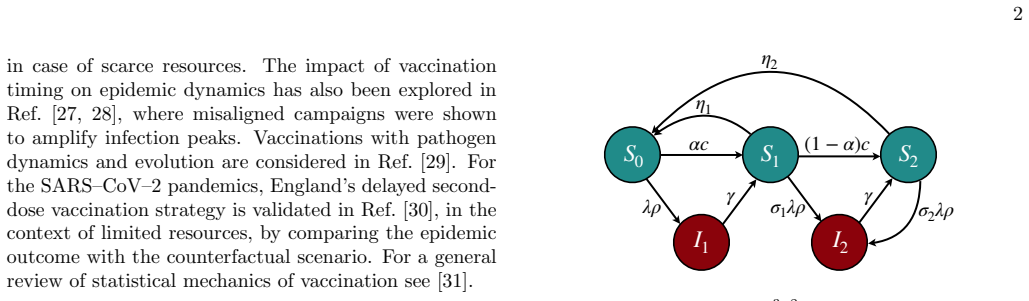
Properly prioritizing the administration of first and second doses can shift the epidemic threshold, separating the disease-free from the endemic state and potentially preventing widespread outbreaks. Assuming homogeneous mixing, at a low vaccination rate the best strategy is to give absolute priority to first doses. In contrast, for high vaccination rates a scheduling is proposed that outperforms a first-come first-served approach. The threshold separating these two scenarios is identified along with the optimal prioritization scheme and inter-dose interval.
What carries the argument
Vaccination-rate-dependent dose prioritization that modulates the epidemic threshold in a two-dose model.
If this is right
- Absolute priority to first doses is optimal below the identified vaccination-rate threshold and can keep the disease below the endemic equilibrium.
- Above the threshold a derived scheduling and inter-dose interval outperform first-come-first-served delivery.
- The choice of timing between primer and booster directly determines whether the disease persists or disappears.
- The same threshold and optimal scheme hold in simulations on both real and synthetic contact networks.
Where Pith is reading between the lines
- The same rate-dependent logic may guide allocation of other multi-dose interventions whose protection builds in stages.
- Structured or age-stratified contact patterns could move the low-to-high regime threshold and alter the optimal ordering.
- Public-health data from campaigns that varied dose order could directly test the predicted change in effective reproduction number.
Load-bearing premise
The population mixes homogeneously, which allows the analytical separation into low-rate and high-rate regimes.
What would settle it
An agent-based simulation or field observation in which, at low vaccination rates, giving absolute priority to first doses fails to raise the threshold above the level achieved by other orderings.
Figures


read the original abstract
Most vaccines require multiple doses, the first to induce recognition and antibody production and subsequent doses to boost the primary response and achieve optimal protection. We show that properly prioritizing the administration of first and second doses can shift the epidemic threshold, separating the disease-free from the endemic state and potentially preventing widespread outbreaks. Assuming homogeneous mixing, we prove that at a low vaccination rate, the best strategy is to give absolute priority to first doses. In contrast, for high vaccination rates, we propose a scheduling that outperforms a first-come first-served approach. We identify the threshold that separates these two scenarios and derive the optimal prioritization scheme and inter-dose interval. Agent-based simulations on real and synthetic contact networks validate our findings. We provide specific guidelines for effective resource allocation, showing that adjusting the timing between primer and booster significantly impacts epidemic outcomes and can determine whether the disease persists or disappears.
Editorial analysis
A structured set of objections, weighed in public.
Referee Report
Summary. The paper claims that strategic prioritization and timing of first and second doses in multi-dose vaccines can shift the epidemic threshold, separating disease-free from endemic states. Under homogeneous mixing, it proves that at low vaccination rates absolute priority to first doses is optimal, identifies the threshold separating low- and high-rate regimes, derives an optimal scheduling scheme outperforming first-come-first-served at high rates, and validates the findings via agent-based simulations on real and synthetic contact networks, providing guidelines for resource allocation.
Significance. If the central claim holds, the work has clear public-health significance by showing that inter-dose interval and prioritization can determine whether an epidemic is contained. The combination of an analytical derivation under homogeneous mixing with network-based simulations is a strength, as is the explicit identification of a regime-separating threshold and the provision of concrete scheduling guidelines.
major comments (2)
- [Analytical derivation (homogeneous mixing)] Abstract and analytical derivation section: The proof that absolute priority to first doses is optimal at low vaccination rates, and the identification of the threshold separating the two regimes, are derived explicitly under the homogeneous-mixing assumption. The manuscript does not demonstrate that the same regime boundary or performance ordering of strategies is preserved on the heterogeneous contact networks used for validation; this is load-bearing for the claim that dose prioritization can shift the epidemic threshold in realistic settings.
- [Simulation validation] Simulation validation section: While agent-based simulations on real and synthetic networks are presented as validation, the manuscript does not report a direct comparison of the analytically derived threshold value against the observed threshold on the networks, nor does it test whether the low-rate optimum remains absolute priority to first doses when network structure is introduced. This leaves open whether the claimed threshold shift survives the move from mean-field to heterogeneous mixing.
minor comments (1)
- Notation for the inter-dose interval and vaccination rate parameters should be introduced with explicit definitions in the main text before their first use in the threshold derivation.
Simulated Author's Rebuttal
We thank the referee for their positive assessment of the work's significance and for the constructive feedback. We address each major comment below and will revise the manuscript to incorporate additional validation on heterogeneous networks.
read point-by-point responses
-
Referee: [Analytical derivation (homogeneous mixing)] Abstract and analytical derivation section: The proof that absolute priority to first doses is optimal at low vaccination rates, and the identification of the threshold separating the two regimes, are derived explicitly under the homogeneous-mixing assumption. The manuscript does not demonstrate that the same regime boundary or performance ordering of strategies is preserved on the heterogeneous contact networks used for validation; this is load-bearing for the claim that dose prioritization can shift the epidemic threshold in realistic settings.
Authors: We agree that the explicit analytical results, including the regime threshold and optimality of absolute priority to first doses at low rates, are derived under the homogeneous mixing assumption. The simulations on real and synthetic contact networks demonstrate that the proposed strategies can shift epidemic outcomes in heterogeneous settings, but we did not perform an explicit extraction of the regime boundary from the simulation data or a direct comparison to the analytical threshold. In the revised manuscript, we will add this analysis by estimating the effective threshold from the network simulations and comparing the performance ordering of strategies across low and high vaccination rate regimes to confirm consistency with the analytical predictions. revision: yes
-
Referee: [Simulation validation] Simulation validation section: While agent-based simulations on real and synthetic networks are presented as validation, the manuscript does not report a direct comparison of the analytically derived threshold value against the observed threshold on the networks, nor does it test whether the low-rate optimum remains absolute priority to first doses when network structure is introduced. This leaves open whether the claimed threshold shift survives the move from mean-field to heterogeneous mixing.
Authors: We acknowledge that the manuscript does not include a direct numerical comparison between the analytically derived threshold and the thresholds observed in the agent-based simulations, nor a specific test of the low-rate strategy optimality on networks. The simulations were designed to validate the overall impact of dose timing and prioritization on epidemic spread. To address this, we will revise the simulation validation section to include a direct comparison of thresholds and an explicit check of whether absolute priority to first doses remains optimal at low vaccination rates on the heterogeneous networks. revision: yes
Circularity Check
No circularity: analytical proof under explicit homogeneous-mixing assumption plus independent network simulations
full rationale
The derivation begins with an explicit modeling assumption (homogeneous mixing) to prove regime separation and optimal dose prioritization at low vs. high vaccination rates, then identifies a threshold and derives the scheduling rule. Validation is performed separately via agent-based simulations on real and synthetic contact networks. No quoted step reduces the epidemic-threshold claim, the low-rate priority rule, or the inter-dose interval to a fitted parameter renamed as prediction, a self-definition, or a load-bearing self-citation chain. The central result is therefore not equivalent to its inputs by construction.
Axiom & Free-Parameter Ledger
axioms (1)
- domain assumption homogeneous mixing
Reference graph
Works this paper leans on
-
[1]
WHO, Interim recommendations for use of the Moderna mRNA-1273 vaccine against COVID-19 (2021)
work page 2021
-
[2]
WHO, Interim recommendations for use of the Pfizer- BioNTech COVID-19 vaccine, BNT162b2, under Emer- gency Use Listing (2021)
work page 2021
-
[3]
JCVI statement, Optimising the COVID-19 vaccination programme for maximum short-term impact (2021)
work page 2021
-
[4]
Voysey et al., The Lancet 397, 881 (2021)
M. Voysey et al., The Lancet 397, 881 (2021)
work page 2021
-
[5]
S. R. Kadire, R. M. Wachter, and N. Lurie, New England Journal of Medicine 384, e28 (2021)
work page 2021
-
[6]
M. Halloran, M. Haber, I. M. Longini, and C. J. Struchiner, American Journal of Epidemiology 133, 323 (1991)
work page 1991
-
[8]
J. Wallinga, M. Van Boven, and M. Lipsitch, Proceedings of the National Academy of Sciences 107, 923 (2010)
work page 2010
- [9]
-
[10]
R. Balderrama, J. Peressutti, J. P. Pinasco, F. Vazquez, and C. S. D. L. Vega, Scientific Reports12, 12583 (2022)
work page 2022
-
[11]
R. Pastor-Satorras and C. Castellano, Scientific Reports 12, 15950 (2022)
work page 2022
-
[12]
J. A. Moreno L´ opez, D. Mateo, A. Hernando, S. Meloni, and J. J. Ramasco, Scientific Report 15 (2025)
work page 2025
-
[13]
P. Castioni, S. G´ omez, C. Granell, and A. Arenas, npj Complexity 1, 20 (2024)
work page 2024
- [14]
-
[15]
G. Pontrelli, G. Cimini, M. Roversi, A. Gabrielli, G. Salina, S. Bernardi, F. Rocchi, A. Simonetti, C. Gi- aquinto, P. Rossi, and F. S. Labini, Frontiers in Public Health 9 (2021)
work page 2021
- [16]
-
[17]
Wei et al., Nature Communications 13, 3748 (2022)
J. Wei et al., Nature Communications 13, 3748 (2022)
work page 2022
- [18]
- [19]
-
[20]
Cerqueira-Silva et al., The Lancet Infectious Diseases 22, 791 (2022)
T. Cerqueira-Silva et al., The Lancet Infectious Diseases 22, 791 (2022)
work page 2022
-
[21]
R. Pastor-Satorras and A. Vespignani, Physical Review E 65, 036104 (2002)
work page 2002
- [22]
- [23]
-
[24]
S. M. Moghadas, T. N. Vilches, K. Zhang, S. Nour- bakhsh, P. Sah, M. C. Fitzpatrick, and A. P. Galvani, PLOS Biology 19, e3001211 (2021)
work page 2021
-
[25]
L. Souto Ferreira, O. Canton, R. L. P. Da Silva, S. Poloni, V. Sudbrack, M. E. Borges, C. Franco, F. M. D. Mar- quitti, J. C. De Moraes, M. A. D. S. M. Veras, R. A. Kraenkel, and R. M. Coutinho, PLOS Computational Bi- ology 18, e1009978 (2022)
work page 2022
-
[26]
Z. Wang, G. R¨ ost, and S. M. Moghadas, Royal Society Open Science 11, 231971 (2024)
work page 2024
-
[27]
P. Castioni, S. G´ omez, C. Granell, and A. Arenas, npj Complexity 1, 1 (2024)
work page 2024
- [28]
-
[29]
C. M. Saad-Roy, S. E. Morris, C. J. E. Metcalf, M. J. Mina, R. E. Baker, J. Farrar, E. C. Holmes, O. G. Pybus, A. L. Graham, S. A. Levin, B. T. Grenfell, and C. E. Wagner, Science 372, 363 (2021)
work page 2021
-
[30]
Imai et al., The Lancet Public Health 8, e174 (2023)
N. Imai et al., The Lancet Public Health 8, e174 (2023)
work page 2023
-
[31]
Z. Wang, C. T. Bauch, S. Bhattacharyya, A. d’Onofrio, P. Manfredi, M. Perc, N. Perra, M. Salath´ e, and D. Zhao, Physics Reports 664, 1 (2016)
work page 2016
-
[32]
E. N. Gilbert, The Annals of Mathematical Statistics 30, 1141 (1959), 2237458
work page 1959
-
[33]
I. Z. Kiss, J. C. Miller, P. L. Simon, et al. , Cham: Springer 598, 31 (2017)
work page 2017
-
[34]
J. C. Miller and T. Ting, Journal of Open Source Soft- ware 4, 1731 (2019)
work page 2019
-
[35]
J. Leskovec and A. Krevl, SNAP Datasets: Stanford large network dataset collection, http://snap.stanford.edu/ data (2014)
work page 2014
- [36]
-
[37]
M. ´A. Serrano, D. Krioukov, and M. Bogun´ a, Physical Review Letters 100, 078701 (2008)
work page 2008
-
[38]
R. S. Sander, G. S. Costa, and S. C. Ferreira, Physical Review E 94, 042308 (2016)
work page 2016
-
[39]
G. S. Costa and S. C. Ferreira, Computer Physics Com- munications 267, 108046 (2021)
work page 2021
-
[40]
P. Shu, W. Wang, M. Tang, and Y. Do, Chaos: An In- terdisciplinary Journal of Nonlinear Science 25 (2015)
work page 2015
-
[41]
C. M. Buckner et al., Cell 185, 4333 (2022)
work page 2022
discussion (0)
Sign in with ORCID, Apple, or X to comment. Anyone can read and Pith papers without signing in.