Higher-order contagion processes in 3.99 dimensions
Pith reviewed 2026-05-23 02:58 UTC · model grok-4.3
The pith
Higher-order contagion processes are formally equivalent to pairwise mechanisms like facilitation and controlled by network spectral dimension.
A machine-rendered reading of the paper's core claim, the machinery that carries it, and where it could break.
Core claim
Based on a mesoscopic field-theoretic Langevin description, pairwise mechanisms such as facilitation or thresholding are formally equivalent to higher-order ones, pairwise interactions at coarse-grained scales govern the higher-order contact process, and the interplay between noise and topology is determined by the network spectral dimension. Classical field theories rooted on model symmetries and/or network dimensionality still capture the nature of the phase transition and predict finite-size effects in real and synthetic networks.
What carries the argument
The mesoscopic field-theoretic Langevin description, which establishes formal equivalence between higher-order and pairwise interaction terms via model symmetries.
If this is right
- The phase transition belongs to the same universality class as the corresponding pairwise model.
- Finite-size effects in both real and synthetic networks follow from the spectral dimension alone.
- Classical field theories suffice to describe higher-order contagion without modification for interaction order.
- The equivalence holds across different dimensions including non-integer spectral dimensions near four.
Where Pith is reading between the lines
- The result implies that many apparent higher-order effects in empirical contagion data may reduce to effective pairwise processes when viewed at larger scales.
- Existing critical-phenomena toolkits developed for standard contact processes can be applied directly to higher-order variants.
- One could test the claim by comparing critical behavior on networks engineered to have identical spectral dimensions but different local interaction orders.
- The equivalence may extend to other dynamical processes governed by similar symmetries, such as opinion dynamics or epidemic spreading with thresholds.
Load-bearing premise
The mesoscopic field-theoretic Langevin description remains valid and complete once higher-order interactions are introduced, without requiring additional non-local or non-Markovian terms that would invalidate the equivalence to pairwise mechanisms.
What would settle it
A higher-order contagion model on a network whose critical exponents or finite-size scaling deviate from those predicted by the equivalent pairwise model using the same spectral dimension would falsify the central equivalence.
Figures


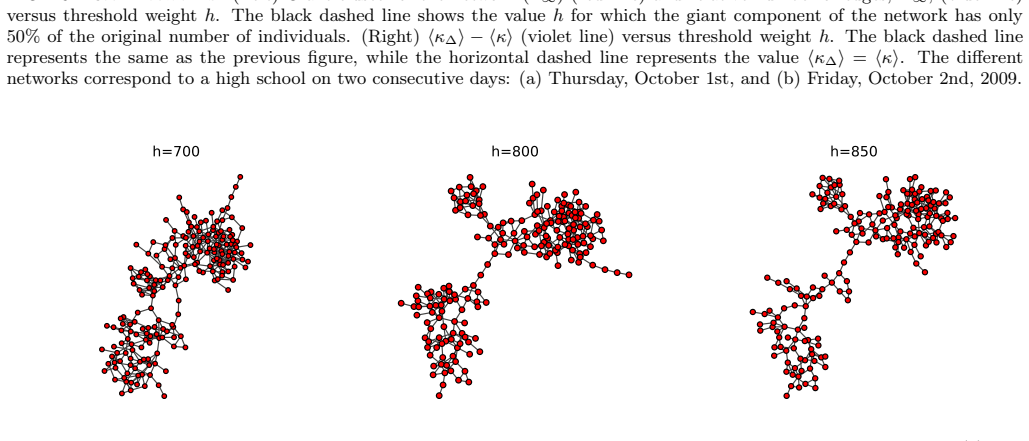



read the original abstract
Higher-order interactions have recently emerged as a promising framework for describing new dynamical phenomena in heterogeneous contagion processes. However, a fundamental open question is how to understand their contribution from the perspective of the physics of critical phenomena. Based on a mesoscopic field-theoretic Langevin description, we show that: (i) pairwise mechanisms such as facilitation or thresholding are formally equivalent to higher-order ones, (ii) pairwise interactions at coarse-grained scales govern the higher-order contact process and, (iii) the interplay between noise and topology is determined by the network spectral dimension. In short, we demonstrate that classical field theories, rooted on model symmetries and/or network dimensionality, still capture the nature of the phase transition, also predicting finite-size effects in real and synthetic networks.
Editorial analysis
A structured set of objections, weighed in public.
Referee Report
Summary. The manuscript develops a mesoscopic field-theoretic Langevin description for higher-order contagion processes on networks. It claims that pairwise mechanisms such as facilitation or thresholding are formally equivalent to higher-order interactions, that pairwise interactions at coarse-grained scales govern the higher-order contact process, and that the interplay between noise and topology is set by the network spectral dimension. Classical field theories are argued to capture the phase transition and to predict finite-size effects in real and synthetic networks.
Significance. If the asserted equivalence and the closure of the effective Langevin description hold, the result would be significant for the statistical mechanics of contagion: it would indicate that higher-order interactions do not generate new universality classes beyond those fixed by symmetries and spectral dimension, thereby allowing standard field-theoretic tools to describe these processes without additional non-local or non-Markovian terms.
major comments (2)
- [Abstract] Abstract (first paragraph after 'Based on a mesoscopic...'): the claim that the mesoscopic Langevin description 'remains valid and complete' once higher-order interactions are introduced is asserted without any derivation steps, explicit equations, or error estimates. This is load-bearing for all three numbered claims and prevents assessment of whether the equivalence to pairwise mechanisms is formal or merely phenomenological.
- [Abstract] Abstract, claim (i): the formal equivalence between pairwise facilitation/thresholding and higher-order terms is stated but not derived; without the explicit mapping or symmetry argument that produces an unchanged Langevin equation, it is impossible to verify that no additional non-local terms arise.
minor comments (1)
- The title's reference to '3.99 dimensions' is not explained in the abstract; a brief parenthetical linking it to the spectral dimension would improve accessibility.
Simulated Author's Rebuttal
We thank the referee for the careful reading and for identifying points where the abstract requires greater precision to allow independent assessment of the claims. The derivations supporting the three numbered results are contained in the main text (Secs. II–IV), but we agree that the abstract as written is too terse. We have therefore revised the abstract to include brief pointers to the relevant sections and a one-sentence outline of the mapping procedure. No other changes to the body of the manuscript are required.
read point-by-point responses
-
Referee: [Abstract] Abstract (first paragraph after 'Based on a mesoscopic...'): the claim that the mesoscopic Langevin description 'remains valid and complete' once higher-order interactions are introduced is asserted without any derivation steps, explicit equations, or error estimates. This is load-bearing for all three numbered claims and prevents assessment of whether the equivalence to pairwise mechanisms is formal or merely phenomenological.
Authors: The phrase 'remains valid and complete' is shorthand for the result, derived in Sec. II, that a standard Doi-Peliti or van-Kampen expansion of the microscopic master equation on a network yields a closed Langevin equation whose deterministic part contains only local cubic nonlinearities and whose noise is multiplicative and local. The closure is obtained by truncating the moment hierarchy at second order after coarse-graining over neighborhoods whose size is set by the correlation length; higher-order interaction terms are absorbed into renormalized rate coefficients without generating non-local kernels. We have added to the abstract the clause 'as obtained by coarse-graining the microscopic master equation (Sec. II)' and a parenthetical reference to the explicit mapping in Sec. III. This revision makes the claim traceable while preserving the abstract's length. revision: yes
-
Referee: [Abstract] Abstract, claim (i): the formal equivalence between pairwise facilitation/thresholding and higher-order terms is stated but not derived; without the explicit mapping or symmetry argument that produces an unchanged Langevin equation, it is impossible to verify that no additional non-local terms arise.
Authors: The explicit mapping is given in Sec. III. A higher-order contagion term of the form k·(product of n neighboring states) is rewritten, after averaging over the local degree distribution, as an effective pairwise facilitation rate whose functional form is identical to the classical threshold or facilitation model. Because the rewriting is algebraic and preserves the polynomial degree and the locality of the interaction, the resulting Langevin equation retains the same structure (cubic drift, multiplicative noise) and therefore belongs to the same universality class. No additional non-local operators appear because the coarse-graining step already integrates out microscopic non-locality. We have inserted a single sentence in the revised abstract that summarizes this symmetry argument and points to Sec. III. revision: yes
Circularity Check
No significant circularity identified
full rationale
The paper asserts equivalence between pairwise and higher-order contagion via a mesoscopic Langevin equation whose form is taken to remain unchanged under coarse-graining, together with symmetry and spectral-dimension arguments. No equations, fitted parameters, or self-citations are exhibited that would reduce any claimed prediction or equivalence to a quantity defined by the authors' own prior work or by construction. The derivation chain therefore remains self-contained against external benchmarks and does not trigger any of the enumerated circularity patterns.
Axiom & Free-Parameter Ledger
Lean theorems connected to this paper
-
IndisputableMonolith/Cost/FunctionalEquation.leanwashburn_uniqueness_aczel unclear?
unclearRelation between the paper passage and the cited Recognition theorem.
pairwise mechanisms such as facilitation or thresholding are formally equivalent to higher-order ones... classical field theories, rooted on model symmetries and/or network dimensionality
-
IndisputableMonolith/Foundation/AlexanderDuality.leanalexander_duality_circle_linking unclear?
unclearRelation between the paper passage and the cited Recognition theorem.
interplay between noise and topology is determined by the network spectral dimension... upper critical dimension d_crit=4
What do these tags mean?
- matches
- The paper's claim is directly supported by a theorem in the formal canon.
- supports
- The theorem supports part of the paper's argument, but the paper may add assumptions or extra steps.
- extends
- The paper goes beyond the formal theorem; the theorem is a base layer rather than the whole result.
- uses
- The paper appears to rely on the theorem as machinery.
- contradicts
- The paper's claim conflicts with a theorem or certificate in the canon.
- unclear
- Pith found a possible connection, but the passage is too broad, indirect, or ambiguous to say the theorem truly supports the claim.
Forward citations
Cited by 2 Pith papers
-
The Synergistic Route to Stretched Criticality
Synergistic interactions provide a distinct route to stretched criticality and Griffiths-like dynamics in higher-order and nonlinear pairwise systems.
-
The Synergistic Route to Stretched Criticality
Synergistic interactions in spreading processes create broad distributions of relaxation rates, enabling Griffiths-like extended criticality that is robust across networks and appears in both higher-order and nonlinea...
Reference graph
Works this paper leans on
-
[1]
Higher-order contagion processes in 3.99 dimensions
by explicitly mapping higher-order contagion ∗ sandro@ifisc.uib-csic.es † pablo.villegas@cref.it models onto a field-theoretical pairwise framework. In particular, we demonstrate how the two classical ingredients account for the effects of such interactions on phase transitions in heterogeneous networks. Our mapping translates the recently proposed simpli...
work page internal anchor Pith review Pith/arXiv arXiv 2026
-
[2]
for an extended discussion on the issue). Higher-order interactions Pairwise interactions Interaction network Active Inactive Pairwise activation Inactivation Inactivation μ μ β Higher-order activation β, βΔ β βΔ β FIG. 1.Spreading dynamics.Different microscopic rules are shown to account for pairwise interactions and higher- order (2-simplex) interaction...
-
[3]
R. Pastor-Satorras, C. Castellano, P. Van Mieghem, and A. Vespignani, Rev. Mod. Phys.87, 925 (2015)
work page 2015
-
[4]
D. Centola, J. C. Gonzalez-Avella, V. M. Eguiluz, and M. San Miguel, J. Confl. Resolut.51, 905 (2007)
work page 2007
-
[5]
S. Funk, E. Gilad, C. Watkins, and V. A. Jansen, Proc. Natl. Acad. Sci. U.S.A.106, 6872 (2009)
work page 2009
- [6]
-
[7]
J. N. Raissa M. D’Souza, Jesus Gómez-Gardeñes and A. Arenas, Adv. Phys.68, 123 (2019)
work page 2019
-
[8]
W. Cai, L. Chen, F. Ghanbarnejad, and P. Grassberger, Nat. Phys.11, 936 (2015)
work page 2015
-
[9]
I. Iacopini, G. Petri, A. Barrat, and V. Latora, Nat. Commun.10, 2485 (2019)
work page 2019
-
[10]
G. F. de Arruda, G. Petri, and Y. Moreno, Phys. Rev. Res.2, 023032 (2020)
work page 2020
- [11]
- [12]
-
[13]
L. P. Kadanoff, inProceedings of the Enrico Fermi Summer School of Physics, Varenna 1970, edited by M. S. Green (Academic Press, London and New York, 1971)
work page 1970
-
[14]
Ma,Modern Theory of Critical Phenomena (Routledge, New York, 2018)
S.-K. Ma,Modern Theory of Critical Phenomena (Routledge, New York, 2018)
work page 2018
-
[15]
J. J. Binney,The Theory of Critical Phenomena: An Introduction to the Renormalization Group(Oxford University Press, Oxford, 1992)
work page 1992
-
[16]
D. J. Amit and V. Martin-Mayor,Field Theory, the Renormalization Group, and Critical Phenomena, 3rd ed. (World Scientific, Singapore, 2005)
work page 2005
-
[17]
Zinn-Justin,Phase Transitions and Renormalization Group(Oxford University Press, 2007)
J. Zinn-Justin,Phase Transitions and Renormalization Group(Oxford University Press, 2007)
work page 2007
-
[18]
A. Poggialini, P. Villegas, M. A. Muñoz, and A. Gabrielli, Phys. Rev. Lett.134, 057401 (2025)
work page 2025
- [19]
- [20]
-
[21]
J. Marro and R. Dickman,Nonequilibrium Phase Transitions in Lattice Models, Collection Alea-Saclay: Monographs and Texts in Statistical Physics (Cambridge University Press, Cambridge, 1999)
work page 1999
- [22]
- [23]
- [24]
-
[25]
F. E. Rosas, P. A. M. Mediano, A. I. Luppi,et al., Nat. Phys.18, 476 (2022)
work page 2022
- [26]
-
[27]
F. Radicchi, C. Castellano, A. Flammini, M. A. Muñoz, and D. Notarmuzi, Phys. Rev. Res.2, 033171 (2020)
work page 2020
-
[28]
L. Böttcher, J. Nagler, and H. J. Herrmann, Phys. Rev. Lett.118, 088301 (2017)
work page 2017
-
[29]
M. A. Muñoz, R. Dickman, A. Vespignani, and S. Zapperi, Phys. Rev. E59, 6175 (1999)
work page 1999
-
[30]
M. A. Muñoz, G. Grinstein, and Y. Tu, Phys. Rev. E56, 5101 (1997)
work page 1997
-
[31]
S. di Santo, P. Villegas, R. Burioni, and M. A. Muñoz, Phys. Rev. E95, 032115 (2017). 6
work page 2017
-
[32]
Grassberger, inNonlinear Phenomena in Chemical Dynamics, edited by C
P. Grassberger, inNonlinear Phenomena in Chemical Dynamics, edited by C. Vidal and A. Pacault (Springer Berlin Heidelberg, Berlin, Heidelberg, 1981) pp. 262–262
work page 1981
-
[33]
S. di Santo, P. Villegas, R. Burioni, and M. A. Muñoz, Phys. Rev. E95, 032115 (2017)
work page 2017
-
[34]
T. E. Harris, Ann. Probab.2, 969 (1974)
work page 1974
-
[35]
J. D. Murray,Mathematical Biology I. An Introduction (Springer, New York, 2002)
work page 2002
-
[36]
P.VillaMartín, J.A.Bonachela,andM.A.Muñoz,Phys. Rev. E89, 012145 (2014)
work page 2014
- [37]
-
[38]
G. Bizhani, M. Paczuski, and P. Grassberger, Phys. Rev. E86, 011128 (2012)
work page 2012
-
[39]
P. Grassberger, L. Chen, F. Ghanbarnejad, and W. Cai, Phys. Rev. E93, 042316 (2016)
work page 2016
-
[40]
P. V. Martín, J. A. Bonachela, S. A. Levin, and M. A. Muñoz, Proc. Natl. Acad. Sci. U.S.A.112, E1828 (2015)
work page 2015
-
[41]
S. Di Santo, P. Villegas, R. Burioni, and M. A. Muñoz, Proc. Natl. Acad. Sci. U.S.A.115, E1356 (2018)
work page 2018
-
[42]
C. M. Taylor and A. Hastings, Ecol. Lett.8, 895 (2005)
work page 2005
-
[43]
M. Pal, A. K. Pal, S. Ghosh, and I. Bose, Phys. Biol.10, 036010 (2013)
work page 2013
-
[44]
Scheffer,Critical transitions in nature and society (Princeton University Press, Princeton, 2020)
M. Scheffer,Critical transitions in nature and society (Princeton University Press, Princeton, 2020)
work page 2020
-
[45]
R. Solé and J. Bascompte,Self-Organization in Complex Ecosystems.(Princeton University Press, Princeton, 2006)
work page 2006
-
[46]
See Supplemental Material at [] for further details
- [47]
- [48]
-
[49]
SocioPatterns Collaboration. http://www.sociopatterns.org/. Accessed Dec 2024
work page 2024
- [50]
- [51]
- [52]
- [53]
-
[54]
R. Mastrandrea, J. Fournet, and A. Barrat, PloS ONE 10, e0136497 (2015)
work page 2015
- [55]
- [56]
-
[57]
P. Villegas, T. Gili, G. Caldarelli, and A. Gabrielli, Nat. Phys.19, 445 (2023)
work page 2023
-
[58]
P.MorettiandM.A.Muñoz,Nat.Comm.4,2521(2013)
work page 2013
- [59]
- [60]
-
[61]
A. P. Millán, G. Gori, F. Battiston, T. Enss, and N. Defenu, Phys. Rev. Res.3, 023015 (2021)
work page 2021
- [62]
-
[63]
F. Malizia, A. Guzmán, I. Iacopini, and I. Z. Kiss, arXiv preprint (2025), arXiv:2501.17800 [physics.soc-ph]. Supplementary Information: Higher-order contagion processes in 3.99 dimensions Sandro Meloni,1, 2, 3,∗Andrea Gabrielli,3, 4, 5 and Pablo Villegas3, 6,† 1Institute for Cross-Disciplinary Physics and Complex Systems (IFISC), CSIC-UIB, 07122 - Palma ...
-
[64]
I. Iacopini, G. Petri, A. Barrat, and V. Latora, Simplicial models of social contagion, Nat. Commun.10, 2485 (2019)
work page 2019
-
[65]
Hinrichsen, Non-equilibrium critical phenomena and phase transitions into absorbing states, Adv
H. Hinrichsen, Non-equilibrium critical phenomena and phase transitions into absorbing states, Adv. Phys.49, 815 (2000)
work page 2000
-
[66]
S. Di Santo, P. Villegas, R. Burioni, and M. A. Muñoz, Landau–ginzburg theory of cortex dynamics: Scale-free avalanches emerge at the edge of synchronization, Proc. Natl. Acad. Sci. U.S.A.115, E1356 (2018)
work page 2018
-
[67]
P. Moretti and M. A. Muñoz, Griffiths phases and the stretching of criticality in brain networks, Nat. Comm.4, 2521 (2013)
work page 2013
-
[68]
M. Génois and A. Barrat, Can co-location be used as a proxy for face-to-face contacts?, EPJ Data Sci.7, 1 (2018)
work page 2018
- [69]
- [70]
-
[71]
J. Stehléet al., High-resolution measurements of face-to-face contact patterns in a primary school, PloS ONE6, e23176 (2011)
work page 2011
-
[72]
J. Fournet and A. Barrat, Contact patterns among high school students, PloS ONE9, e107878 (2014)
work page 2014
-
[73]
R. Mastrandrea, J. Fournet, and A. Barrat, Contact patterns in a high school: a comparison between data collected using wearable sensors, contact diaries and friendship surveys, PloS ONE10, e0136497 (2015)
work page 2015
-
[74]
G. Kotliar, P. W. Anderson, and D. L. Stein, One-dimensional spin-glass model with long-range random interactions, Phys. Rev. B27, 602 (1983)
work page 1983
-
[75]
R. Burioni and D. Cassi, Geometrical universality in vibrational dynamics, Mod. Phys. Lett. B11, 1095 (1997)
work page 1997
-
[76]
A. P. Millán, G. Gori, F. Battiston, T. Enss, and N. Defenu, Complex networks with tuneable spectral dimension as a universality playground, Phys. Rev. Res.3, 023015 (2021)
work page 2021
-
[77]
F. Malizia, S. Lamata-Otín, M. Frasca,et al., Hyperedge overlap drives explosive transitions in systems with higher-order interactions, Nat. Commun.16, 555 (2025)
work page 2025
discussion (0)
Sign in with ORCID, Apple, or X to comment. Anyone can read and Pith papers without signing in.