Applications of the Quantum Phase Difference Estimation Algorithm to the Excitation Energies in Spin Systems on a NISQ Device
Pith reviewed 2026-05-23 02:58 UTC · model grok-4.3
The pith
The quantum phase difference estimation algorithm computes excitation energies in small spin systems on NISQ hardware by exploiting constant-depth circuits from the Heisenberg time-evolution operator.
A machine-rendered reading of the paper's core claim, the machinery that carries it, and where it could break.
Core claim
The QPDE algorithm computes the difference between two eigenvalues of a unitary operator by preparing a superposition of the corresponding eigenstates and measuring an interference term, applied here to the time-evolution operator generated by Heisenberg Hamiltonians; the resulting energy gaps for symmetric, asymmetric, spin-frustrated, and non-frustrated two- and three-spin systems are extracted on NISQ devices with 85-93 percent agreement to classical values after noise suppression.
What carries the argument
The match-gate-like structure of the time-evolution operator for the Heisenberg Hamiltonian, which permits constant-depth quantum circuits without controlled-unitary operations.
If this is right
- Energy gaps in additional spin configurations can be obtained on the same hardware without increasing circuit depth.
- The absence of controlled-unitary gates reduces resource overhead compared with standard quantum phase estimation.
- Noise-suppression techniques already integrated allow the method to remain accurate under current device error rates.
- The adaptive framework demonstrated can be reused for other small many-body Hamiltonians that admit similar unitary structure.
Where Pith is reading between the lines
- If the match-gate structure generalizes, the same constant-depth approach could apply to other bilinear spin interactions beyond the pure Heisenberg case.
- Verification on larger lattices would require checking whether the structure survives when additional interaction terms are included.
- The reported accuracy range supplies a concrete benchmark for comparing QPDE against variational or other NISQ algorithms on identical spin problems.
Load-bearing premise
The time-evolution operator of the Heisenberg Hamiltonian possesses a match-gate-like structure that permits constant-depth circuits on NISQ hardware.
What would settle it
Running the QPDE circuit for a three-spin frustrated Heisenberg system on an IBM processor and obtaining energy-gap accuracy below 80 percent even after Pauli Twirling and Dynamical Decoupling would falsify the claim of practical viability.
Figures



read the original abstract
The Quantum Phase Difference Estimation (QPDE) algorithm, as an extension of the Quantum Phase Estimation (QPE), is a quantum algorithm designed to compute the differences of two eigenvalues of a unitary operator by exploiting the quantum superposition of two eigenstates. Unlike QPE, QPDE is free of controlled-unitary operations, and is suitable for calculations on noisy intermediate-scale quantum (NISQ) devices. We present the implementation and verification of a novel early fault-tolerant QPDE algorithm for determining energy gaps across diverse spin system configurations using NISQ devices. The algorithm is applied to the systems described by two and three-spin Heisenberg Hamiltonians with different geometric arrangements and coupling strengths, including symmetric, asymmetric, spin-frustrated, and non-frustrated configurations. By leveraging the match gate-like structure of the time evolution operator of Heisenberg Hamiltonian, we achieve constant-depth quantum circuits suitable for NISQ hardware implementation. Our results on IBM quantum processors show remarkable accuracy ranging from 85\% to 93\%, demonstrating excellent agreement with classical calculations even in the presence of hardware noise. The methodology incorporates sophisticated quantum noise suppression techniques, including Pauli Twirling and Dynamical Decoupling, and employs an adaptive framework. Our findings demonstrate the practical viability of the QPDE algorithm for quantum many-body simulations on current NISQ hardware, establishing a robust framework for future applications.
Editorial analysis
A structured set of objections, weighed in public.
Referee Report
Summary. The paper presents an implementation of the Quantum Phase Difference Estimation (QPDE) algorithm, an extension of QPE without controlled-unitaries, to compute energy gaps in two- and three-spin Heisenberg Hamiltonians on NISQ devices. It applies the method to symmetric, asymmetric, frustrated, and non-frustrated configurations, claims that the time-evolution operator admits a match-gate-like structure enabling constant-depth circuits, incorporates Pauli Twirling and Dynamical Decoupling for noise suppression, and reports 85-93% agreement with classical results on IBM hardware.
Significance. If the constant-depth claim and numerical results hold with full documentation, the work would demonstrate a concrete NISQ application of QPDE to small spin systems and the utility of noise-suppression techniques, providing a practical framework for many-body simulations. The testing across multiple geometries is a strength, but the absence of circuit constructions, depths, and error bars reduces immediate reproducibility and impact.
major comments (2)
- [Abstract] Abstract (methodology paragraph): the assertion that the time-evolution operator of the Heisenberg Hamiltonian possesses a match-gate-like structure permitting constant-depth circuits for all listed configurations (including asymmetric and spin-frustrated) is load-bearing for the NISQ suitability claim yet supplies no explicit circuit construction, gate decomposition, or depth count; for asymmetric couplings this structure is not automatic and any Trotterization would introduce depth scaling.
- [Results] Results section (accuracy reporting): the headline claim of 85-93% accuracy with classical calculations is presented without error bars, raw measurement data, or exact circuit depths, rendering the agreement unverifiable and weakening the assessment of noise-suppression efficacy.
minor comments (1)
- The abstract refers to an 'adaptive framework' without defining the adaptation criterion or how it interacts with the QPDE circuit.
Simulated Author's Rebuttal
We thank the referee for the constructive comments, which help strengthen the clarity and reproducibility of our work on QPDE for spin systems. We address each major point below and will revise the manuscript to incorporate additional details where needed.
read point-by-point responses
-
Referee: [Abstract] Abstract (methodology paragraph): the assertion that the time-evolution operator of the Heisenberg Hamiltonian possesses a match-gate-like structure permitting constant-depth circuits for all listed configurations (including asymmetric and spin-frustrated) is load-bearing for the NISQ suitability claim yet supplies no explicit circuit construction, gate decomposition, or depth count; for asymmetric couplings this structure is not automatic and any Trotterization would introduce depth scaling.
Authors: The match-gate-like structure follows from the bilinear form of the Heisenberg interaction, which maps to a set of two-qubit gates that can be applied in parallel across the fixed small number of spins (2 or 3), yielding constant depth independent of Trotter steps for these system sizes. For asymmetric couplings the same local decomposition applies, with the Trotter step still constant-depth because the number of distinct Pauli terms remains fixed. We acknowledge that the abstract does not contain the explicit decompositions; the main text describes the structure but does not tabulate gate counts or diagrams for every geometry. In the revision we will add explicit circuit constructions, gate decompositions, and depth counts (including for asymmetric and frustrated cases) to substantiate the constant-depth claim. revision: yes
-
Referee: [Results] Results section (accuracy reporting): the headline claim of 85-93% accuracy with classical calculations is presented without error bars, raw measurement data, or exact circuit depths, rendering the agreement unverifiable and weakening the assessment of noise-suppression efficacy.
Authors: The 85–93 % figures are obtained from the mitigated expectation values on the IBM hardware. We agree that error bars, circuit depths, and access to raw counts are necessary for full verification. In the revised manuscript we will report standard deviations from repeated executions as error bars, state the exact circuit depths employed for each geometry, and deposit the raw measurement counts and circuit QASM files in the supplementary material. revision: yes
Circularity Check
No circularity: experimental implementation with hardware results independent of self-referential fits or citations
full rationale
The paper reports hardware executions of QPDE on IBM devices for 2- and 3-spin Heisenberg models across geometries, with accuracies (85-93%) obtained by direct measurement and comparison to classical diagonalization. No equations or results are shown to reduce to fitted parameters renamed as predictions, nor does any central claim rest on a self-citation chain whose validity is presupposed by the present work. The match-gate-like structure is invoked as an enabling property of the time-evolution operator to justify constant-depth circuits, but this is presented as a known structural feature rather than a result derived from the paper's own data or prior self-citations. The work is therefore self-contained against external benchmarks (classical energies and hardware runs) with no load-bearing circular steps.
Axiom & Free-Parameter Ledger
axioms (1)
- domain assumption The Heisenberg Hamiltonian time-evolution operator admits a match-gate-like decomposition enabling constant-depth circuits.
Lean theorems connected to this paper
-
IndisputableMonolith/Foundation/RealityFromDistinction.leanreality_from_one_distinction unclear?
unclearRelation between the paper passage and the cited Recognition theorem.
Our results on IBM quantum processors show remarkable accuracy ranging from 85% to 93%
What do these tags mean?
- matches
- The paper's claim is directly supported by a theorem in the formal canon.
- supports
- The theorem supports part of the paper's argument, but the paper may add assumptions or extra steps.
- extends
- The paper goes beyond the formal theorem; the theorem is a base layer rather than the whole result.
- uses
- The paper appears to rely on the theorem as machinery.
- contradicts
- The paper's claim conflicts with a theorem or certificate in the canon.
- unclear
- Pith found a possible connection, but the passage is too broad, indirect, or ambiguous to say the theorem truly supports the claim.
Forward citations
Cited by 1 Pith paper
-
Quantum Error-Corrected Computation of Molecular Energies
First end-to-end demonstration of quantum error correction integrated with quantum phase estimation to compute molecular hydrogen ground-state energy to 0.001(13) hartree accuracy on Quantinuum H2-2 hardware.
Reference graph
Works this paper leans on
-
[1]
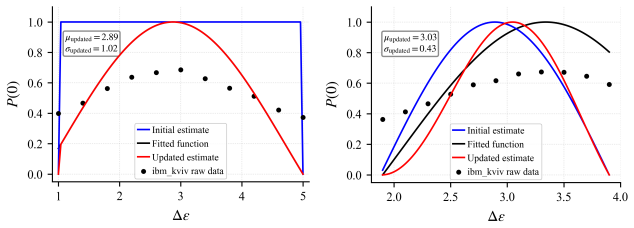
The process begins with setting an initial estimate of the range where the actual energy difference ∆E locates, using a Gaussian function with the mean µini and standard deviation σini that satisfy the re- lationship µini−σini≤∆E≤µini +σini, or a uni- form distribution in the range between µini−σini and µini +σini
-
[2]
2 with the setting µini−σini≤∆ϵ≤µini +σini and generate a ∆εvs
Run the quantum circuit shown in Fig. 2 with the setting µini−σini≤∆ϵ≤µini +σini and generate a ∆εvs. P (0) plot. The plot is fitted with a Gaus- sian function, and the range estimate is updated by multiplying two (initial and fitted) Gaussians
-
[3]
If the mean of the fitted Gaussian function µfit falls outside the range (µini−λσini,µini +λσini), where λis a predetermined threshold, an adaptive strat- egy is employed: return to the second step withµfit as µini, while maintaining the prior standard devi- ation. In this study we used λ= 0.6. This ensures reliable convergence to values consistent with t...
-
[4]
Convergence check. If the standard deviation of the updated distribution σupdated falls below the predetermined tolerance threshold Ethre, then the algorithm returns the mean of the updated Gaus- sian functionµupdated as the calculated energy gap. Otherwise, return to the second step and replace µini and σini with µupdated and σupdated, respec- tively. In...
-
[5]
F. Grasselli, Quantum Cryptography: From Key Distri- bution to Conference Key Agreement (Springer, Switzer- land, 2021)
work page 2021
- [6]
-
[7]
M. Schuld and F. Petruccione, Supervised Learning with Quantum Computers (Springer, Switzerland, 2018)
work page 2018
-
[8]
Y. R. Sanders, D. W. Berry, P. C. S. Costa, L. W. Tessler, N. Wiebe, C. Gidney, H. Neven, and R. Babbush, PRX Quantum 1, 020312 (2020)
work page 2020
-
[9]
Y. Cao, J. Romero, and A. Aspuru-Guzik, IBM J. Res. Dev. 62, 1 (2018)
work page 2018
-
[10]
R. P. Feynman, Int. J. Theor. Phys. 21, 467 (1982)
work page 1982
-
[11]
A. Peruzzo, J. McClean, P. Shadbolt, and et al., Nat. Commun. 5, 4213 (2014)
work page 2014
-
[12]
M. H. Yung, J. Casanova, A. Mezzacapo, and et al., Sci. Rep. 4, 3589 (2014)
work page 2014
-
[13]
D. S. Abrams and S. Lloyd, Phys. Rev. Lett. 83, 5162 (1999). 9
work page 1999
-
[14]
A. Y. Kitaev, Quantum measurements and the abelian stabilizer problem (1995), arXiv:quant-ph/9511026 [quant-ph]
work page internal anchor Pith review Pith/arXiv arXiv 1995
-
[15]
M. A. Nielsen and I. L. Chuang, Quantum Computa- tion and Quantum Information: 10th Anniversary Edi- tion (Cambridge University Press, Cambridge, 2010)
work page 2010
- [16]
- [17]
-
[18]
K. Sugisaki, C. Sakai, K. Toyota, K. Sato, D. Shiomi, and T. Takui, Phys. Chem. Chem. Phys. 23, 20152 (2021)
work page 2021
- [19]
-
[20]
L. Clinton, T. S. Cubitt, R. Garcia-Patron, A. Mon- tanaro, S. Stanisic, and M. Strokeks, Quantum phase estimation without controlled unitaries (2024), arXiv:2410.21517 [quant-ph]
-
[21]
K. Sugisaki, C. Sakai, K. Toyota, K. Sato, D. Shiomi, and T. Takui, J. Phys. Chem. Lett. 12, 11085 (2021)
work page 2021
-
[22]
K. Sugisaki, H. Wakimoto, K. Toyota, K. Sato, D. Sh- iomi, and T. Takui, J. Phys. Chem. Lett. 13, 11105 (2022)
work page 2022
-
[23]
K. Sugisaki, V. S. Prasannaa, S. Ohshima, T. Katagiri, Y. Mochizuki, B. K. Sahoo, and B. P. Das, Electron. Struct. 5, 035006 (2023)
work page 2023
- [24]
-
[25]
P. S. Mundada, A. Barbosa, S. Maity, Y. Wang, T. Merkh, T. M. Stace, F. Nielson, A. R. R. Carvalho, M. Hush, M. J. Biercuk, and Y. Baum, Phys. Rev. Appl. 20, 024034 (2023)
work page 2023
-
[26]
C. G. D., Nature 136, 411 (1935)
work page 1935
- [27]
-
[28]
J. H. V. Vleck, Nature 130, 490 (1932)
work page 1932
-
[29]
R. Pauncz, The Construction of Spin Eigenfunctions, An Exercise Book (Kluwer Academic/Plenum Publish- ers, New York, 2000)
work page 2000
-
[30]
J. J. Sakurai and J. Napolitano, Modern Quantum Me- chanics, 3rd ed. (Cambridge University Press, Cam- bridge, 2020)
work page 2020
-
[31]
K. Sugisaki, S. Yamamoto, S. Nakazawa, K. Toyota, K. Sato, D. Shiomi, and T. Takui, J. Phys. Chem. A 120, 6459 (2016)
work page 2016
-
[32]
H. F. Trotter, Proc. Am. Math. Soc. 10, 545 (1959)
work page 1959
- [33]
-
[34]
N. Hatano and M. Suzuki, in Quantum Annealing and Other Optimization Methods, edited by A. Das and B. K. Chakrabarti (Springer, Berlin, 2005) pp. 37–68
work page 2005
-
[35]
L. G. Valiant, SIAM J. Comput. 31, 1229 (2002)
work page 2002
-
[36]
L. B. Oftelie, R. V. Beeumen, E. Younis, E. Smith, C. Iancu, and W. A. de Jong, Mater. Theory6, 13 (2022)
work page 2022
-
[37]
Y. Kharkov, A. Ivanova, E. Mikhantiev, and A. Kotel- nikov, Arline benchmarks: Automated bench- marking platform for quantum compilers (2022), arXiv:2202.14025 [quant-ph]
-
[38]
A. Javadi-Abhari, M. Treinish, K. Krsulich, C. J. Wood, J. Lishman, J. Gacon, S. Martiel, P. D. Na- tion, L. S. Bishop, A. W. Cross, B. R. Johnson, and J. M. Gambetta, Quantum computing with qiskit (2024), arXiv:2405.08810
work page internal anchor Pith review Pith/arXiv arXiv 2024
-
[39]
S. Sivarajah, S. Dilkes, A. Cowtan, W. Simmons, A. Edg- ington, and R. Duncan, Quantum Sci. Technol.6, 014003 (2020)
work page 2020
-
[40]
J. J. Wallman and J. Emerson, Phys. Rev. A 94, 052325 (2016)
work page 2016
- [41]
- [42]
- [43]
-
[44]
Wolfram Research, Inc., Mathematica, Version 14.2 , Champaign, IL (2024). Supplementary Materials Contents 1 Spin Eigenfunctions 2 2 Matrix Representation of the Heisenberg Hamiltonian 4 3 Results Of Different Spin Configurations 6 4 Constant Depth Data Table 11 1 arXiv:2502.19809v1 [quant-ph] 27 Feb 2025 1 Spin Eigenfunctions Eigenfunctions of the spin S...
work page internal anchor Pith review Pith/arXiv arXiv 2024
discussion (0)
Sign in with ORCID, Apple, or X to comment. Anyone can read and Pith papers without signing in.