Cell-Free Integrated Sensing and Communication: Principles, Advances, and Future Directions
Pith reviewed 2026-05-23 01:49 UTC · model grok-4.3
The pith
Cell-free integrated sensing and communication merges distributed access points with unified radar and data functions to raise spectral and energy efficiency.
A machine-rendered reading of the paper's core claim, the machinery that carries it, and where it could break.
Core claim
The paper claims that CF-ISAC, by pairing cell-free architecture that eliminates cell boundaries with ISAC that unifies radar sensing and communication on shared resources, improves spectral and energy efficiency, coverage, and sensing performance while enabling robust multi-user communication and distributed multi-static sensing. It fills the prior gap in comprehensive reviews by revisiting fundamentals, categorizing state-of-the-art results in performance, allocation, security, and design approaches, and outlining challenges including synchronization, multi-target detection, interference management, and fronthaul capacity along with emerging directions such as next-generation antennas,near
What carries the argument
The CF-ISAC architecture, which uses distributed access points without cell boundaries to enable simultaneous data transmission and environmental sensing on shared spectral and hardware resources.
If this is right
- Multi-user communication gains robustness through cooperative transmission across distributed points.
- Sensing improves via distributed multi-static observations from multiple access points.
- Resource allocation becomes seamless by jointly optimizing shared spectrum and hardware for both functions.
- Spectral and energy efficiency rise by removing cell boundaries and unifying operations.
- Security designs address joint threats to communication and sensing data.
Where Pith is reading between the lines
- Machine learning integration could dynamically adjust resources as network conditions change.
- Near-field models would be needed when targets or users lie close to access points.
- Real deployments would reveal whether fronthaul latency limits can be met at scale.
- Security approaches might need to protect sensing waveforms from interception separately from data.
Load-bearing premise
No prior comprehensive survey on CF-ISAC existed and the paper's categorization of literature, challenges, and trends accurately captures the field without major omissions.
What would settle it
A major body of CF-ISAC papers or results on synchronization or multi-target detection that the survey omits or fails to address.
Figures


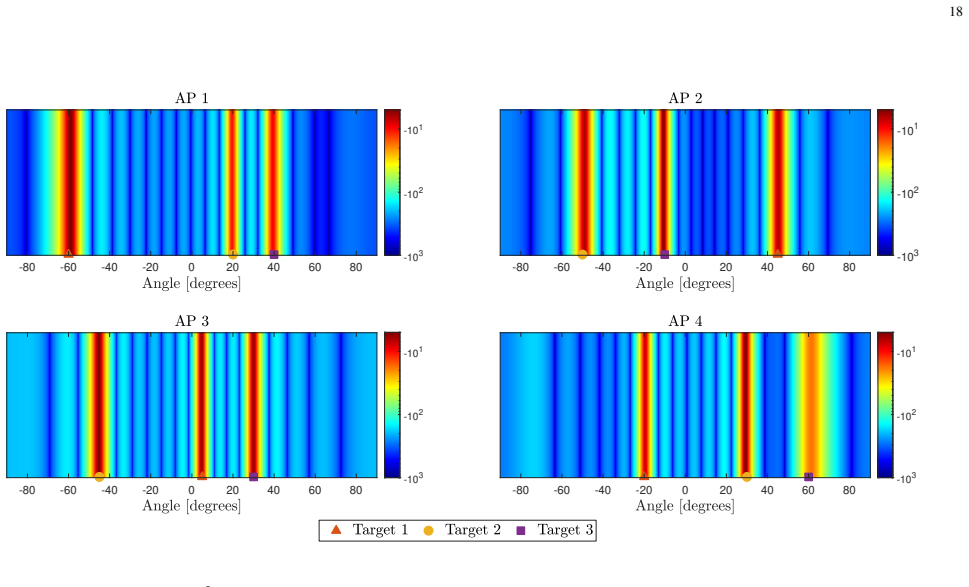


read the original abstract
Cell-free (CF) integrated sensing and communication (ISAC) combines CF architecture with ISAC. CF employs distributed access points, eliminates cell boundaries, and enhances coverage, spectral efficiency, and reliability. ISAC unifies radar sensing and communication, enabling simultaneous data transmission and environmental sensing within shared spectral and hardware resources. CF-ISAC leverages these strengths to improve spectral and energy efficiency while enhancing sensing in wireless networks. As a promising candidate for next-generation wireless systems, CF-ISAC supports robust multi-user communication, distributed multi-static sensing, and seamless resource optimization. However, a comprehensive survey on CF-ISAC has been lacking. This paper fills that gap by first revisiting CF and ISAC principles, covering cooperative transmission, radar cross-section, target parameter estimation, ISAC integration levels, sensing metrics, and applications. It then explores CF-ISAC systems, emphasizing their unique features and the benefits of multi-static sensing. State-of-the-art developments are categorized into performance analysis, resource allocation, security, and user/target-centric designs, offering a thorough literature review and case studies. Finally, the paper identifies key challenges such as synchronization, multi-target detection, interference management, and fronthaul capacity and latency. Emerging trends, including next-generation antenna technologies, network-assisted systems, near-field CF-ISAC, integration with other technologies, and machine learning approaches, are highlighted to outline the future trajectory of CF-ISAC research.
Editorial analysis
A structured set of objections, weighed in public.
Referee Report
Summary. The manuscript is a survey on Cell-Free Integrated Sensing and Communication (CF-ISAC). It first revisits principles of cell-free architectures (cooperative transmission, coverage) and ISAC (radar cross-section, target estimation, integration levels, metrics), then describes CF-ISAC features and multi-static sensing benefits. State-of-the-art work is categorized into performance analysis, resource allocation, security, and user/target-centric designs with case studies. The paper concludes by listing challenges (synchronization, multi-target detection, interference, fronthaul) and trends (advanced antennas, near-field operation, ML integration).
Significance. If the four-way categorization accurately reflects the literature without major omissions, the survey would provide a useful entry point and reference for researchers in integrated sensing and communication, particularly those exploring cell-free deployments for 6G-era systems. The explicit listing of open challenges and trends supplies a clear research roadmap.
minor comments (3)
- [Abstract] Abstract: the statement that 'a comprehensive survey on CF-ISAC has been lacking' is central to the paper's positioning; it would be strengthened by briefly citing the closest prior reviews on ISAC or cell-free systems to make the novelty claim verifiable.
- [Abstract] The abstract refers to 'case studies' under the four categories but does not indicate their scope (e.g., whether they are numerical examples drawn from the reviewed papers or new simulations); clarifying this in the introduction would help readers gauge the depth of the review.
- The listed challenges (synchronization, fronthaul latency) and trends (near-field CF-ISAC, network-assisted systems) are presented at a high level; adding one or two concrete open questions or example references per item would make the future-directions section more actionable.
Simulated Author's Rebuttal
We thank the referee for the positive summary and recommendation of minor revision. The assessment that the survey provides a useful entry point and research roadmap is appreciated. No specific major comments were listed in the report.
Circularity Check
No significant circularity
full rationale
This is a survey paper whose structure consists of literature review, categorization of external works into performance analysis/resource allocation/security/user-centric designs, and identification of open challenges/trends. No original derivations, equations, predictions, or fitted parameters appear; all technical content is attributed to cited prior literature. The claim that no prior comprehensive survey existed is a framing statement, not a load-bearing technical result that reduces to self-reference. The paper is self-contained against external benchmarks with no self-citation chains or ansatzes that close on themselves.
Axiom & Free-Parameter Ledger
Lean theorems connected to this paper
-
IndisputableMonolith/Foundation/AbsoluteFloorClosure.leanreality_from_one_distinction unclear?
unclearRelation between the paper passage and the cited Recognition theorem.
State-of-the-art developments are categorized into performance analysis, resource allocation, security, and user/target-centric designs... Key challenges such as synchronization, multi-target detection, interference management, and fronthaul capacity and latency.
-
IndisputableMonolith/Cost/FunctionalEquation.leanwashburn_uniqueness_aczel unclear?
unclearRelation between the paper passage and the cited Recognition theorem.
Sensing metrics in ISAC... CRB... beampattern gain... sensing SE = max ... log det(...)
What do these tags mean?
- matches
- The paper's claim is directly supported by a theorem in the formal canon.
- supports
- The theorem supports part of the paper's argument, but the paper may add assumptions or extra steps.
- extends
- The paper goes beyond the formal theorem; the theorem is a base layer rather than the whole result.
- uses
- The paper appears to rely on the theorem as machinery.
- contradicts
- The paper's claim conflicts with a theorem or certificate in the canon.
- unclear
- Pith found a possible connection, but the passage is too broad, indirect, or ambiguous to say the theorem truly supports the claim.
Forward citations
Cited by 2 Pith papers
-
Space-Time-Frequency Synthetic Integrated Sensing and Communication Networks
Space-time-frequency synthetic ISAC fuses multistatic and monostatic observations to tighten CRLBs on position and velocity estimates, with centralized MLE outperforming per-BS estimation plus fusion especially at low SNR.
-
Holographic Surface Enabled Integrated Sensing and Communications
A tutorial on HISAC showing how reconfigurable holographic surfaces enable cost-efficient ultra-massive MIMO for joint communication and sensing in 6G under hardware constraints.
Reference graph
Works this paper leans on
-
[1]
A survey on fundamental limits of integrated sensing and communication,
A. Liu et al. , “A survey on fundamental limits of integrated sensing and communication,” IEEE Commun. Surveys Tuts. , vol. 24, no. 2, pp. 994–1034, 2nd Quart. 2022
work page 2022
-
[2]
J. Wang et al. , “Integrated sensing and communication: Enabling techniques, applications, tools and data sets, standardiz ation, and future directions,” IEEE Internet Things J. , vol. 9, no. 23, pp. 23 416–23 440, Dec. 2022
work page 2022
-
[3]
Enabling joint communication and radar sensing in mobile networks — A survey,
J. A. Zhang et al., “Enabling joint communication and radar sensing in mobile networks — A survey,” IEEE Commun. Surveys Tuts. , vol. 24, no. 1, pp. 306–345, 1st Quart. 2022
work page 2022
-
[4]
A road map for NF- ISAC in 6G: A comprehensive overview and tutorial,
A. Hakimi, D. Galappaththige, and C. Tellambura, “A road map for NF- ISAC in 6G: A comprehensive overview and tutorial,” Entropy, vol. 26, no. 9, Sept. 2024
work page 2024
-
[5]
F. Liu, C. Masouros, and Y . Eldar, Eds., Integrated Sensing and Communications. Springer Singapore, Jul. 2023
work page 2023
-
[6]
Beamforming design in cell-free massive MIMO integrated sensing and communication systems,
W. Mao et al. , “Beamforming design in cell-free massive MIMO integrated sensing and communication systems,” in Proc. IEEE Global Commun. Conf. , Dec. 2023, pp. 546–551
work page 2023
-
[7]
Cell-free joint sensing a nd communi- cation MIMO: A max-min fair beamforming approach,
U. Demirhan and A. Alkhateeb, “Cell-free joint sensing a nd communi- cation MIMO: A max-min fair beamforming approach,” in Proc. IEEE Asilomar Conf. Signals, Syst., Comput. , Oct. 2023, pp. 381–386
work page 2023
-
[8]
Coordinated power con trol for network integrated sensing and communication,
Y . Huang, Y . Fang, X. Li, and J. Xu, “Coordinated power con trol for network integrated sensing and communication,” IEEE Trans. V eh. Technol., vol. 71, no. 12, pp. 13 361–13 365, Dec. 2022
work page 2022
-
[9]
Y . Cao and Q.-Y . Y u, “Design and performance analyses of V -OFDM integrated signal for cell-free massive MIMO joint communi cation and radar system,” IEEE Syst. J. , vol. 17, no. 4, pp. 5943–5954, Dec. 2023
work page 2023
-
[10]
B. Wang, L. Xu, Z. Cheng, and Z. He, “Semi-distributed hy brid beamforming design for cooperative cell-free dual-functi on radar- communication networks,” in Proc. IEEE Int. Conf. Acoust., Speech, Signal Process. W orkshops, Jun. 2023, pp. 1–5. 25 SINRCom k = L(L + 1) ∑M m=1 ζ2 hmk + L2 ∑M m=1 ∑M m′̸=m ζhmk ζhm′k L ∑K i̸=k ∑M m=1 ζhmk ζhmi + L ∑T t=1 ∑M m...
work page 2023
-
[11]
Uplink payload power control in cell-free communication a nd radar networks,
A. Sakhnini, A. Bourdoux, M. Guenach, H. Sahli, and S. Po llin, “Uplink payload power control in cell-free communication a nd radar networks,” in Proc. IEEE Global Commun. Conf., Dec. 2022, pp. 5111– 5116
work page 2022
-
[12]
Multi-s tatic ISAC in cell-free massive MIMO: Precoder design and privacy asse ssment,
I. W. G. Da Silva, D. P . M. Osorio, and M. Juntti, “Multi-s tatic ISAC in cell-free massive MIMO: Precoder design and privacy asse ssment,” in Proc. IEEE Globecom W orkshops , Dec. 2023, pp. 461–466
work page 2023
-
[13]
Power allocation for joint communication and sensing in ce ll-free massive MIMO,
Z. Behdad, ¨O. T. Demir, K. W. Sung, E. Bj¨ ornson, and C. Cavdar, “Power allocation for joint communication and sensing in ce ll-free massive MIMO,” in Proc. IEEE Global Commun. Conf. , Dec. 2022, pp. 4081–4086
work page 2022
-
[14]
Interplay between sensing and communication in cell-free massive MIMO with UR LLC users,
Z. Behdad, ¨O. T. Demir, K. W. Sung, and C. Cavdar, “Interplay between sensing and communication in cell-free massive MIMO with UR LLC users,” in Proc. IEEE Wireless Commun. Netw. Conf. , Apr. 2024, pp. 1–6
work page 2024
-
[15]
Multi-cell MIMO cooperative networks: A new look at interference,
D. Gesbert et al. , “Multi-cell MIMO cooperative networks: A new look at interference,” IEEE J. Sel. Areas Commun. , vol. 28, no. 9, pp. 1380–1408, Dec. 2010
work page 2010
-
[16]
Coordinated beamforming for the m ulticell multi-antenna wireless system,
H. Dahrouj and W. Y u, “Coordinated beamforming for the m ulticell multi-antenna wireless system,” IEEE Trans. Wireless Commun., vol. 9, no. 5, pp. 1748–1759, May 2010
work page 2010
-
[17]
Cloud radio access n etwork (C-RAN): A primer,
J. Wu, Z. Zhang, Y . Hong, and Y . Wen, “Cloud radio access n etwork (C-RAN): A primer,” IEEE Netw., vol. 29, no. 1, pp. 35–41, Jan. 2015
work page 2015
-
[18]
Cell-free massive MIMO versus small cells,
H. Q. Ngo, A. Ashikhmin, H. Y ang, E. G. Larsson, and T. L. M arzetta, “Cell-free massive MIMO versus small cells,” IEEE Trans. Wireless Commun., vol. 16, no. 3, pp. 1834–1850, Mar. 2017
work page 2017
-
[19]
MIMO radar: An idea whose time has come,
E. Fishler et al. , “MIMO radar: An idea whose time has come,” in Proc. IEEE Radar Conf. , Aug. 2004, pp. 71–78
work page 2004
-
[20]
MIMO radar with widely separated antennas,
A. M. Haimovich, R. S. Blum, and L. J. Cimini, “MIMO radar with widely separated antennas,” IEEE Signal Process. Mag. , vol. 25, no. 1, pp. 116–129, Jan. 2008
work page 2008
-
[21]
M. A. Richards, Fundamentals Of Radar Signal Processing . McGraw- Hill Education (India) Pvt Limited, 2005
work page 2005
- [22]
-
[23]
User-centric cell-free massive MIMO networks: A survey of opportunities, challenges and solutions,
H. A. Ammar, R. Adve, S. Shahbazpanahi, G. Boudreau, and K. V . Srinivas, “User-centric cell-free massive MIMO networks: A survey of opportunities, challenges and solutions,” IEEE Commun. Surveys Tuts. , vol. 24, no. 1, pp. 611–652, 1st Quart. 2022
work page 2022
-
[24]
Ubiquitous cell-free massive MIMO communications,
G. Interdonato, E. Bj¨ ornson, H. Q. Ngo, P . K. Frenger, a nd E. G. Lars- son, “Ubiquitous cell-free massive MIMO communications,” EURASIP J. Wireless Commun. Netw. , vol. 2019, pp. 1687–1499, Aug. 2019
work page 2019
-
[25]
Prospective multiple antenna technologies for beyond 5G,
J. Zhang et al. , “Prospective multiple antenna technologies for beyond 5G,” IEEE J. Sel. Areas Commun. , vol. 38, no. 8, pp. 1637–1660, Aug. 2020
work page 2020
-
[26]
Cell-free mas sive MIMO: A survey,
S. Elhoushy, M. Ibrahim, and W. Hamouda, “Cell-free mas sive MIMO: A survey,” IEEE Commun. Surveys Tuts. , vol. 24, no. 1, pp. 492–523, 1st Quart. 2022
work page 2022
-
[27]
Cell-free massive MIMO: A new next-generation paradigm,
J. Zhang et al. , “Cell-free massive MIMO: A new next-generation paradigm,” IEEE Access , vol. 7, pp. 99 878–99 888, Aug. 2019
work page 2019
-
[28]
A su rvey on user-centric cell-free massive MIMO systems,
S. Chen, J. Zhang, J. Zhang, E. Bj¨ ornson, and B. Ai, “A su rvey on user-centric cell-free massive MIMO systems,” Digital Commun. Netw., vol. 8, no. 5, pp. 695–719, Dec. 2022
work page 2022
-
[29]
A review on cell-free massive MIMO systems,
J. Kassam, D. Castanheira, A. a. Silva, R. Dinis, and A. G ameiro, “A review on cell-free massive MIMO systems,” Electronics, vol. 12, no. 4, p. 1001, Feb. 2023
work page 2023
-
[30]
Next- generation multiple access with cell-free massive MIMO,
M. Mohammadi, Z. Mobini, H. Quoc Ngo, and M. Matthaiou, “ Next- generation multiple access with cell-free massive MIMO,” Proc. IEEE, vol. 112, no. 9, pp. 1372–1420, Sept. 2024
work page 2024
-
[31]
Cell-free mass ive MIMO with underlay spectrum-sharing,
D. Galappaththige and G. Amarasuriya, “Cell-free mass ive MIMO with underlay spectrum-sharing,” in Proc. IEEE Int. Conf. Commun. , May 2019, pp. 1–7
work page 2019
-
[32]
D. Galappaththige, R. Shrestha, and G. A. Aruma Baduge, “Exploiting cell-free massive MIMO for enabling simultaneous wireless informa- tion and power transfer,” IEEE Trans. Green Commun. Netw. , vol. 5, no. 3, pp. 1541–1557, Sept. 2021
work page 2021
-
[33]
NOMA-aided cel l-free mas- sive MIMO with underlay spectrum-sharing,
D. Galappaththige and G. Amarasuriya, “NOMA-aided cel l-free mas- sive MIMO with underlay spectrum-sharing,” in Proc. IEEE Int. Conf. Commun., Jun. 2020, pp. 1–6
work page 2020
-
[34]
Sum rate maximiz ation for RSMA-assisted CF mMIMO networks with SWIPT users,
D. Galappaththige and C. Tellambura, “Sum rate maximiz ation for RSMA-assisted CF mMIMO networks with SWIPT users,” IEEE Wireless Commun. Lett. , vol. 13, no. 5, pp. 1300–1304, May 2024
work page 2024
-
[35]
Per- formance analysis of IRS-assisted cell-free communicatio n,
D. Galappaththige, D. Kudathanthirige, and G. Amarasu riya, “Per- formance analysis of IRS-assisted cell-free communicatio n,” in Proc. IEEE Global Commun. Conf. , Dec. 2021, pp. 1–6
work page 2021
-
[36]
Exploiting unde rlay spectrum sharing in cell-free massive MIMO systems,
D. Galappaththige and G. A. A. Baduge, “Exploiting unde rlay spectrum sharing in cell-free massive MIMO systems,” IEEE Trans. Commun. , vol. 69, no. 11, pp. 7470–7488, Nov. 2021
work page 2021
-
[37]
E. Bj¨ ornson, J. Hoydis, and L. Sanguinetti, Massive MIMO Networks: Spectral, Energy, and Hardware Efficiency , 2017, vol. 11
work page 2017
-
[38]
T. L. Marzetta, E. G. Larsson, H. Y ang, and H. Q. Ngo, Fundamentals of Massive MIMO . Cambridge University Press, 2016
work page 2016
-
[39]
On the total energy efficiency of cell-free massive MIMO,
H. Q. Ngo, L.-N. Tran, T. Q. Duong, M. Matthaiou, and E. G. Larsson, “On the total energy efficiency of cell-free massive MIMO,” IEEE Trans. Green Commu. and Networking , vol. 2, no. 1, pp. 25–39, Mar., 2018
work page 2018
-
[40]
D. Galappaththige, F. Rezaei, C. Tellambura, and A. Maa ref, “Cell-free bistatic backscatter communication: Channel estimation, optimization, and performance analysis,” IEEE Trans. Commun. , vol. 72, no. 10, pp. 6617–6632, Oct. 2024
work page 2024
-
[41]
Scalable cell-free m assive MIMO systems,
E. Bj¨ ornson and L. Sanguinetti, “Scalable cell-free m assive MIMO systems,” IEEE Trans. Commun. , vol. 68, no. 7, pp. 4247–4261, Jul. 2020
work page 2020
-
[42]
Cell-free massive MIMO wit h finite fronthaul capacity: A stochastic geometry perspective,
P . Parida and H. S. Dhillon, “Cell-free massive MIMO wit h finite fronthaul capacity: A stochastic geometry perspective,” IEEE Trans. Wireless Commun., vol. 22, no. 3, pp. 1555–1572, Mar. 2023
work page 2023
-
[43]
A dimensioning framework for indoor DAS LTE networks,
S. Elhoshy et al. , “A dimensioning framework for indoor DAS LTE networks,” in Proc. Int. Conf. Sel. Topics Mobile Wireless Netw. , Apr. 2016, pp. 1–8
work page 2016
-
[44]
Coordinated multipoint: Concepts, performance, and field trial results,
R. Irmer et al. , “Coordinated multipoint: Concepts, performance, and field trial results,” IEEE Commun. Mag. , vol. 49, no. 2, pp. 102–111, Feb. 2011
work page 2011
-
[45]
Network M IMO: Overcoming intercell interference in indoor wireless syst ems,
S. V enkatesan, A. Lozano, and R. V alenzuela, “Network M IMO: Overcoming intercell interference in indoor wireless syst ems,” in Proc. IEEE Asilomar Conf. Signals, Syst., Comput. , Nov. 2007, pp. 83–87
work page 2007
-
[46]
D istributed MIMO in multi-cell wireless systems via finite-capacity lin ks,
O. Simeone, O. Somekh, H. Vincent Poor, and S. Shamai, “D istributed MIMO in multi-cell wireless systems via finite-capacity lin ks,” in Proc. 3rd Int. Symp. Commun., Control Signal Process. , Mar. 2008, pp. 203– 206
work page 2008
-
[47]
Exploring 5G fronthaul network architecture: Intelligence splits and connectivity,
Intel Corporation, “Exploring 5G fronthaul network architecture: Intelligence splits and connectivity,” Int el Corporation, Tech. Rep., 2021. [Online]. Available: https://www.intel.com/content/dam/www/public/us/en/documents/white-papers/exploring-
work page 2021
-
[48]
System architectur e and key technologies for 5G heterogeneous cloud radio access netwo rks,
M. Peng, Y . Li, Z. Zhao, and C. Wang, “System architectur e and key technologies for 5G heterogeneous cloud radio access netwo rks,” IEEE Netw., vol. 29, no. 2, pp. 6–14, Apr. 2015
work page 2015
-
[49]
A su rvey on mobile edge computing: The communication perspective,
Y . Mao, C. Y ou, J. Zhang, K. Huang, and K. B. Letaief, “A su rvey on mobile edge computing: The communication perspective,” IEEE Commun. Surveys Tuts., vol. 19, no. 4, pp. 2322–2358, 4th Quart. 2017
work page 2017
-
[50]
Channel hardening and favora ble propaga- tion in cell-free massive MIMO with stochastic geometry,
Z. Chen and E. Bj¨ ornson, “Channel hardening and favora ble propaga- tion in cell-free massive MIMO with stochastic geometry,” IEEE Trans. Commun., vol. 66, no. 11, pp. 5205–5219, Nov. 2018. 26
work page 2018
-
[51]
A. A. Polegre, F. Riera-Palou, G. Femenias, and A. G. Arm ada, “Chan- nel hardening in cell-free and user-centric massive MIMO ne tworks with spatially correlated Ricean fading,” IEEE Access , vol. 8, pp. 139 827–139 845, Aug. 2020
work page 2020
-
[52]
A. Papoulis and S. Pillai, Probability, Random V ariables, and Stochas- tic Processes , ser. McGraw-Hill series in electrical and computer engineering. McGraw-Hill, 2002
work page 2002
-
[53]
Communication-sensing region for cell-free massive MIMO ISAC systems,
W. Mao et al. , “Communication-sensing region for cell-free massive MIMO ISAC systems,” IEEE Trans. Wireless Commun. , pp. 1–1, Sept. 2024
work page 2024
-
[54]
Energy efficiency optimization for cell-free massive MIMO ,
H. Q. Ngo, L.-N. Tran, T. Q. Duong, M. Matthaiou, and E. G. Larsson, “Energy efficiency optimization for cell-free massive MIMO ,” in Proc. IEEE Int. W orkshop Signal Process. Adv. Wireless Commun., Jul. 2017, pp. 1–5
work page 2017
-
[55]
Performance analysis of cell-free massiv e MIMO systems: A stochastic geometry approach,
A. Papazafeiropoulos, P . Kourtessis, M. D. Renzo, S. Ch atzinotas, and J. M. Senior, “Performance analysis of cell-free massiv e MIMO systems: A stochastic geometry approach,” IEEE Trans. V eh. Technol., vol. 69, no. 4, pp. 3523–3537, Apr. 2020
work page 2020
-
[56]
Energy efficiency of massive MIMO: Cell-free vs. cellular,
H. Y ang and T. L. Marzetta, “Energy efficiency of massive MIMO: Cell-free vs. cellular,” in Proc. IEEE 87th V eh. Technol. Conf. , Jun. 2018, pp. 1–5
work page 2018
-
[57]
M. A. Richards, J. A. Scheer, and W. A. Holm, Eds., Principles of Modern Radar: Basic principles , ser. Radar, Sonar and Navigation. Institution of Engineering and Technology, 2010
work page 2010
- [58]
-
[59]
M. C. Rezende, I. M. Martin, M. A. S. Miacci, and E. L. Noha ra, “Radar cross section measurements (8-12 GHz) of magnetic an d dielectric microwave absorbing thin sheets,” in Proc. SBMO/IEEE MTT-S Int. Microw. Optoelectronics Conf. , Dec. 2002, pp. 439–443
work page 2002
-
[60]
Skolnik, Introduction to Radar Systems , ser
M. Skolnik, Introduction to Radar Systems , ser. Electrical engineering series. McGraw-Hill, 2001
work page 2001
-
[61]
Weibull, log-Weibull and K-distributed ground clutter modeling analyzed by AIC,
S. Sayama and H. Sekine, “Weibull, log-Weibull and K-distributed ground clutter modeling analyzed by AIC,” IEEE Trans. Aerosp. Electron. Syst. , vol. 37, no. 3, pp. 1108–1113, Apr. 2001
work page 2001
-
[62]
N. Levanon and E. Mozeson, Radar Signals , ser. IEEE Press. Wiley, 2004
work page 2004
-
[63]
Overview of radar waveform diversity,
S. D. Blunt and E. L. Mokole, “Overview of radar waveform diversity,” IEEE Aerosp. Electron. Syst. Mag. , vol. 31, no. 11, pp. 2–42, Jul. 2016
work page 2016
-
[64]
J. Li, J. Li, and P . Stoica, MIMO Radar Signal Processing , ser. IEEE Press. Wiley, 2009
work page 2009
-
[65]
M. Mohammadi, Z. Mobini, D. Galappaththige, and C. Tell ambura, “A comprehensive survey on full-duplex communication: Cur rent so- lutions, future trends, and open issues,” IEEE Commun. Surveys Tuts. , pp. 1–1, 2nd Quart. 2023
work page 2023
-
[66]
Cell-free full-duplex communication – An o verview,
D. Galappaththige, M. Mohammadi, H. Q. Ngo, M. Matthaio u, and C. Tellambura, “Cell-free full-duplex communication – An o verview,” arXiv, 2024
work page 2024
-
[67]
Flowing t he information from Shannon to Fisher: Towards the fundamenta l tradeoff in ISAC,
Y . Xiong, F. Liu, Y . Cui, W. Y uan, and T. X. Han, “Flowing t he information from Shannon to Fisher: Towards the fundamenta l tradeoff in ISAC,” in Proc. IEEE Global Commun. Conf. , Dec. 2022, pp. 5601– 5606
work page 2022
-
[68]
D. Ma, N. Shlezinger, T. Huang, Y . Liu, and Y . C. Eldar, “J oint radar- communication strategies for autonomous vehicles: Combin ing two key automotive technologies,” IEEE Signal Process. Mag. , vol. 37, no. 4, pp. 85–97, Jun. 2020
work page 2020
-
[69]
FRaC: FMCW-based joint radar-communications sys tem via index modulation,
——, “FRaC: FMCW-based joint radar-communications sys tem via index modulation,” IEEE J. Sel. Topics Signal Process. , vol. 15, no. 6, pp. 1348–1364, Nov. 2021
work page 2021
-
[70]
Generalize d transceiver beamforming for DFRC with MIMO radar and MU-MIM O communication,
L. Chen, Z. Wang, Y . Du, Y . Chen, and F. R. Y u, “Generalize d transceiver beamforming for DFRC with MIMO radar and MU-MIM O communication,” IEEE J. Sel. Areas Commun., vol. 40, no. 6, pp. 1795– 1808, Jun. 2022
work page 2022
-
[71]
Joint transmit beamforming for multiuser MIMO com- munications and MIMO radar,
X. Liu et al. , “Joint transmit beamforming for multiuser MIMO com- munications and MIMO radar,” IEEE Trans. Signal Process. , vol. 68, pp. 3929–3944, Jul. 2020
work page 2020
-
[72]
Information theory and radar waveform design ,
M. Bell, “Information theory and radar waveform design ,” IEEE Trans. Inf. Theory , vol. 39, no. 5, pp. 1578–1597, Sept. 1993
work page 1993
-
[73]
MIMO radar waveform desig n in colored noise based on information theory,
B. Tang, J. Tang, and Y . Peng, “MIMO radar waveform desig n in colored noise based on information theory,” IEEE Trans. Signal Process., vol. 58, no. 9, pp. 4684–4697, Sept. 2010
work page 2010
-
[74]
An overview of signal processing techniques for joint communication and radar sensing,
J. A. Zhang et al. , “An overview of signal processing techniques for joint communication and radar sensing,” IEEE J. Sel. Topics Signal Process., vol. 15, no. 6, pp. 1295–1315, Nov. 2021
work page 2021
-
[75]
S. M. Kay, Fundamentals of Statistical Signal Processing, V ol. I: Estimation Theory . Englewood Cliffs, NJ, USA: Prentice Hall, 1998
work page 1998
-
[76]
Energy effici ent beamforming optimization for integrated sensing and commu nication,
Z. He, W. Xu, H. Shen, Y . Huang, and H. Xiao, “Energy effici ent beamforming optimization for integrated sensing and commu nication,” IEEE Wireless Commun. Lett., vol. 11, no. 7, pp. 1374–1378, Jul. 2022
work page 2022
-
[77]
On probing signal design fo r MIMO radar,
P . Stoica, J. Li, and Y . Xie, “On probing signal design fo r MIMO radar,” IEEE Trans. Signal Process. , vol. 55, no. 8, pp. 4151–4161, Jul. 2007
work page 2007
-
[78]
MIMO radar waveform de sign with constant modulus and similarity constraints,
G. Cui, H. Li, and M. Rangaswamy, “MIMO radar waveform de sign with constant modulus and similarity constraints,” IEEE Trans. Signal Process., vol. 62, no. 2, pp. 343–353, Jan. 2014
work page 2014
-
[79]
Optimal transmit beamformi ng for integrated sensing and communication,
H. Hua, J. Xu, and T. X. Han, “Optimal transmit beamformi ng for integrated sensing and communication,” IEEE Trans. V eh. Technol. , vol. 72, no. 8, pp. 10 588–10 603, Mar. 2023
work page 2023
-
[80]
Spectrally constrained MIMO radar wa veform design based on mutual information,
B. Tang and J. Li, “Spectrally constrained MIMO radar wa veform design based on mutual information,” IEEE Trans. Signal Process. , vol. 67, no. 3, pp. 821–834, Feb. 2019
work page 2019
discussion (0)
Sign in with ORCID, Apple, or X to comment. Anyone can read and Pith papers without signing in.